A Fortress of Paper and Pine: The Cold War of Whispering Pines and the Architect of Retribution
CHAPTER 1: The Iron and the Pink
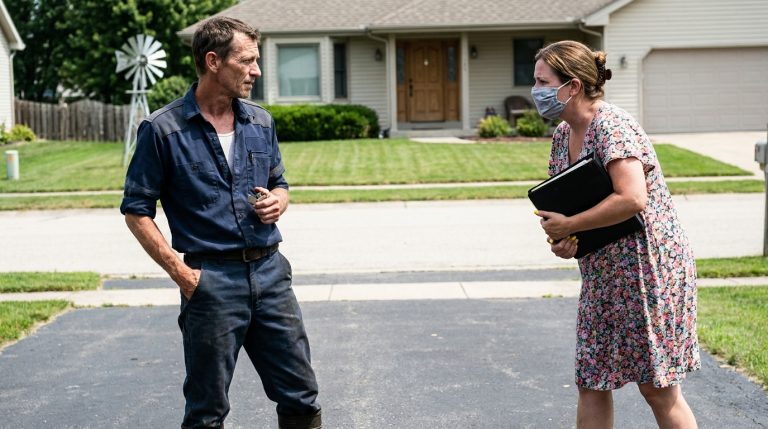
The engine’s idle was a rhythmic, guttural tremor that vibrated through the soles of Jack’s boots, traveling up his spine like a warning. He stood on the edge of his property, his feet planted with the practiced stance of a man who had stood his ground in much worse places than a suburban lawn in upstate New York.
Karen Miller stood across from him, a beacon of garish, aggressive polyester. Her pink tracksuit strained against her frame, a lurid contrast to the soft, earthy greens of the creek bank. She was holding a clipboard—her scepter of authority—and her gaze was fixed not on Jack, but on the bridge. She looked at it with the same visceral, unadulterated contempt one might reserve for a blight.
“Ten seconds, Jack,” she spat, her voice raspy, as if she were chewing on gravel. “Either you pull the keys, or my operator pulls the structure. I’m not playing the committee game today.”
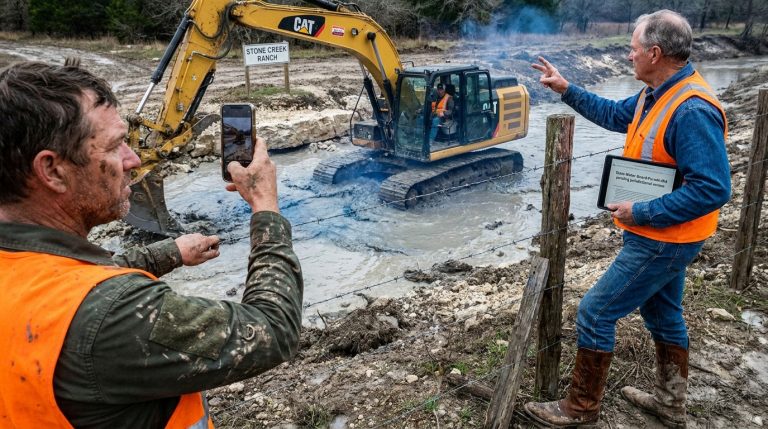
Jack didn’t blink. He kept his hands at his sides, fingers slightly curled, ready to move but refusing to show the tension that coiled like a spring in his gut. The silence between the bulldozer’s mechanical growl and the distant, taunting song of a meadowlark was thick enough to choke on. He watched the operator—a man who looked less like a contractor and more like a terrified hostage—glance repeatedly at the house where Sarah watched from behind the veil of the living room curtains.
“Karen,” Jack said, his voice a low, modulated flatline. It was a sound that had once silenced a platoon. “You’re standing on private land. You’re threatening private property. And you’re doing it with a machine that has no business being past that oak tree.”
She let out a sharp, mocking bark of a laugh. “Property? You’re a squatter, Jack. A glorified renter with a chip on your shoulder. You’re a shadow that hasn’t realized the sun set on your permit a long time ago.”
She gestured at the bridge, the hemlock and cedar structure Jack had painstakingly built for Sarah—the only path that allowed her to navigate the terrain without pain. To Karen, it was a violation of section 7, subsection B. To Jack, it was a lifeline.
He reached into his pocket, his movements slow, deliberate, and entirely devoid of panic. He didn’t pull a weapon; he pulled a laminated copy of his survey map. The edges of the paper were crisp, the ink dark and immutable.
“Look at the line, Karen,” he said, holding the paper up like a shield. “You cross this, you’re not just trespassing. You’re committing a felony.”
The operator behind the bulldozer wiped sweat from his forehead with a stained sleeve, his eyes darting toward the street, clearly hoping for an exit. Karen, however, took a step forward, the pink fabric of her suit shimmering with a static, dangerous energy. She reached for the operator’s radio, her finger hovering over the transmission button.
“Tear it down,” she hissed, not to Jack, but to the machine itself. “I’ll pay the fine. Just move.”
Jack felt the cold, familiar rage tighten his grip. He didn’t shout. He didn’t react. He simply turned his gaze toward the bridge, noting the way the early morning sun caught the grain of the wood, and then back to Karen, whose eyes held a desperate, hollow flicker of someone who had already lost the war, even if she hadn’t realized it yet. The real threat wasn’t the bulldozer; it was the fact that she was willing to destroy everything to keep the gate—and the contract behind it—moving forward.
The operator’s hand hesitated, hovering over the controls. Then, a sharp, metallic clink sounded as a piece of debris shifted beneath the bulldozer’s massive treads—an object that didn’t belong in the creek bed, something bright and metallic, half-buried in the mud near the footer. A clue to a different game entirely.
Jack stepped forward, blocking her path to the operator. “Final warning, Karen. Move or I call the Sheriff. And believe me, he’s going to be very interested in why you’re so desperate to clear this specific path.”
CHAPTER 2: The Weight of the Binder
The bulldozer’s engine didn’t just die; it gave a final, shuddering cough that seemed to vibrate through the very bedrock of the creek. Silence rushed back in to fill the vacuum, heavy and oppressive. The operator, a man with a sunburned neck and eyes that darted like a trapped bird, killed the ignition.
“Ma’am, I’m done,” he muttered, his voice barely audible over the sudden, jarring quiet. “I don’t do trespassing, and I don’t do property destruction. Not for any fee.”
Karen didn’t look at him. Her gaze was locked on Jack’s chest, her eyes wide, glassy, and vibrating with an intensity that went beyond simple anger. She looked unmoored, the veneer of her calculated, suburban malice slipping to reveal something far more fragile underneath. For a second, Jack saw the twitch in her left eyelid, the frantic, jagged way her hand tightened around the clipboard. She wasn’t just fighting for her rules; she was fighting for her footing in a world that was clearly slipping out of her grasp.
Jack didn’t give her an inch. He kept his posture relaxed—the “predator-prey” calculation running at full capacity in the back of his mind. He scanned her movements, noting the way she shifted her weight, the way she refused to acknowledge the operator’s resignation. She was looking for a move, a counter-play, but the board had already changed.
“You’re going to pay for this, Sterling,” she hissed, though the threat lacked the surgical precision of her earlier tone. “You have no idea what you’ve started. This isn’t just about a bridge. This is about the integrity of Whispering Pines.”
“It’s about a deed, Karen,” Jack said, stepping toward her just enough to force her to retreat. “It’s about five acres of land that don’t belong to you. And now, it’s about a piece of evidence.”
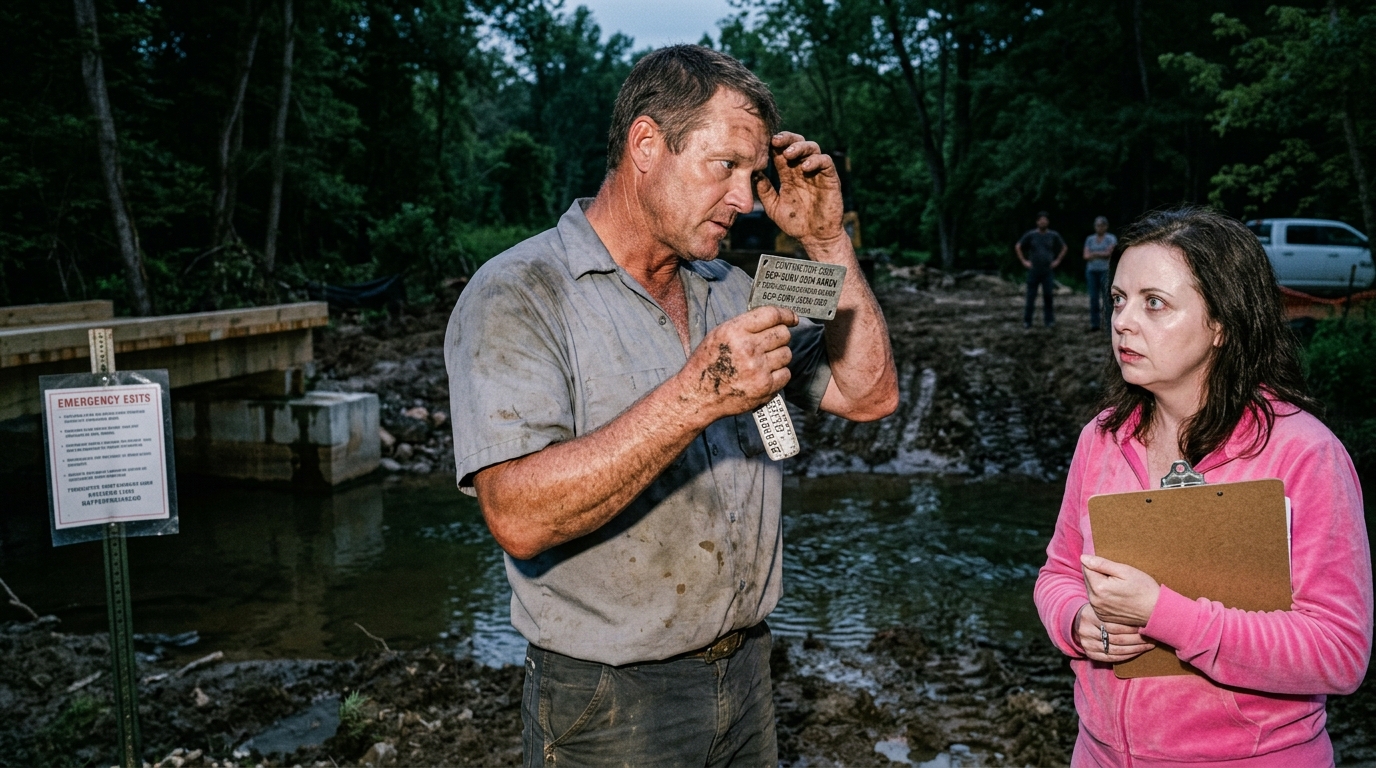
He crouched by the creek bank, his movements fluid. He reached into the viscous, dark mud where the bulldozer had churned the earth and pulled out the object that had clinked against the blade. It was a corroded aluminum casing—a surveyor’s marker, but one that looked freshly unseated, discarded in the silt. It wasn’t just a marker; it was stamped with a contractor’s code that he’d seen on the emergency gate project. A piece of the puzzle that shouldn’t have been anywhere near his property line.
Karen’s face went a shade paler, a sickly gray that made her heavy makeup look like a mask in the morning light. She surged forward, her hand outstretched as if to snatch the object, but Jack rose, holding the casing up in the morning sun.
“What is this doing here, Karen?” he asked, his voice devoid of heat, filled only with the cold, hard logic of an interrogator. “Why is a piece of the emergency gate’s structural equipment buried in my creek?”
She didn’t answer. She spun on her heel, her pink tracksuit rustling like dry leaves, and scrambled back toward her white SUV. Her gait was uneven, frantic, a sharp contrast to the composed, “Supreme Dictator” persona she had wielded just minutes before. She jammed the key into the ignition, the engine roaring to life with a screech of tires on the gravel, and peeled away, kicking up a cloud of dust that hung in the air like a taunting shroud.
Jack stood by the bridge, the cold aluminum in his hand, feeling the weight of the realization. This wasn’t just about the HOA’s rigid, irrational enforcement of rules. This was about a paper trail. The emergency gate, the kickbacks, the contractor brother-in-law—it was all connected. Karen wasn’t just a tyrant; she was a desperate actor in a scheme that had clearly hit a snag.
He walked back to the house. Sarah was waiting at the door, her hand gripping the doorframe to steady herself. Her face was a pale mask of concern, her eyes tracking the retreating dust cloud of Karen’s vehicle.
“She’s gone,” Jack said, his voice softening as he saw her.
“She’ll be back,” Sarah replied, her voice trembling slightly. “Jack, look at the house. Look at the porch.”
He followed her gaze. On the porch, taped to the door, was a new envelope—the standard, cream-colored, gold-embossed cardstock of Whispering Pines. He pulled it down, the paper thick and expensive. He opened it in the kitchen, the sunlight filtering through the window, hitting the black ink of the legal threats.
The letter was a masterpiece of intimidation. It didn’t just mention the bridge; it detailed a “Retroactive Fine Assessment” that reached back five years, claiming non-compliance on land clearing that happened before they had even bought the property. The total was staggering.
Jack set the letter down on the kitchen table and pulled out the heavy, three-ring black binder he had purchased the day before. He opened it to the first blank section. He didn’t feel rage anymore. He felt a deep, chilling clarity. He grabbed a pen and began to log the incident, the time, the bulldozer operator’s name, and the surveyor’s marker he’d pulled from the mud.
He was an engineer. He knew that for every action, there was an equal and opposite reaction. He had the facts, he had the evidence, and now, he had the motive. Karen had chosen the ground for this battle, but he was going to determine the outcome. He reached for his phone, his thumb hovering over the contact for the legal firm he’d researched, the one that promised they didn’t do “slip and fall” cases.
He wasn’t going to just defend his bridge. He was going to dismantle the entire foundation of Karen Miller’s power, one page, one receipt, one certified letter at a time. The war had just begun, and for the first time, Jack wasn’t just waiting for the next attack. He was already planning the counter-offensive.
CHAPTER 3: The Insurgency
The kitchen smelled of stale coffee and the sharp, metallic tang of the surveyor’s marker Jack had left on the granite island. Outside, the twilight was deepening, the woods behind the Whispering Pines estate turning from a friendly green into a wall of impenetrable shadow. Jack stood at the window, watching the perimeter of his property. He didn’t see gnomes or manicured hedges; he saw vectors.
“She’s scared, Jack,” Sarah said from the kitchen table. She was tracing the edge of the cream-colored letter, her expression unreadable. “You saw her eyes. That wasn’t just authority slipping. That was desperation.”
“She’s burning capital,” Jack replied, his voice devoid of emotion. He was thinking about the surveyor’s marker. The stamp on the side—a specific numerical string—didn’t belong to the town’s planning office. It was a serial number for a specific class of high-tensile material used in government-contracted emergency exits. “She’s not just enforcing an aesthetic code. She’s trying to hide a structural failure in that gate, and my bridge—specifically the footing—is the only thing keeping that track from collapsing into the creek bed.”
The connection clicked into place with the cold, mechanical precision of a rifle bolt. The emergency gate wasn’t an exit; it was a vanity project that had likely gone millions over budget, and the structural integrity of the logging road depended on the very terrain she was trying to “clean up.”
Jack reached for the binder. It was already growing in weight, the sleeves filled with copies of property tax records and the official survey. He grabbed his coat and keys. “I’m going to see Margaret.”
“The gnome lady?” Sarah asked, a faint, weary smile touching her lips.
“She’s been the one receiving the most frequent notices. If Karen is panicked, she’s going to be casting a wider net, hitting the people she thinks are the easiest targets. That’s where the patterns will emerge.”
The drive to Margaret’s house was short, the roads of Whispering Pines winding through the manicured darkness. Every streetlight seemed to cast long, interrogatory shadows. When Jack pulled into her driveway, the silence of the neighborhood felt artificial—a staged, quiet comfort masking the decay of the administration.
Margaret opened the door before he could knock, her hand trembling as she held it ajar. Her home was a sanctuary of cluttered warmth, a stark contrast to the sterile, aggressive lines of the HOA’s design standards.
“Mr. Sterling,” she whispered, ushering him into the living room. “I’ve had three more today. They were slipped under the door. Not even mail. Just… shoved.”
Jack took the envelopes. They were copies of the same gold-embossed violations, but they were typed on a different machine, the font sharper, more erratic. He laid them out on her coffee table, side by side with the one he had received.
“She’s not using the official board letterhead anymore,” Jack noted, pointing to the absence of the seal. “She’s doing this on her own time. This is a personal project, Margaret.”
He scanned the text. The citations were gibberish, citing sections of the covenant that didn’t exist. It was a disorganized, frantic attempt to generate paper to bury them in. He looked at the gnomes lined up on her mantle—a defiant, colorful array of ceramic joy in a sea of beige.
“How many people do you talk to on this street?” Jack asked, keeping his voice low.
“Most of them,” Margaret said, her bird-like eyes lighting up. “We have a group chat. The Garcías, the colonel, the young couple in the blue house. We’re all… we’re all getting them, Jack. But they’re scared. They think if they don’t pay, they’ll lose their homes.”
“Nobody is losing their home,” Jack said. He pulled a fresh sleeve from his pocket and filed the latest violation, adding it to the growing archive. “But we need to stop reacting. If we keep responding to every letter, we’re just doing the work she wants us to do. We need to go over her head.”
He looked at the gnome with the fishing rod. “Mr. Henderson. The forensic accountant. You said he lives two houses down?”
“He does,” Margaret confirmed. “But he hasn’t been out of the house in weeks. He’s been… agitated.”
“Get him on the phone,” Jack said. “Tell him I have a piece of hardware that links the emergency gate construction directly to the structural failure of the logging road. Tell him if he wants to see the numbers match, he needs to look at the gate’s procurement records.”
As Margaret reached for the phone, Jack walked to the window. Across the street, he saw a black SUV idling under the glow of a streetlight. It didn’t move. It just sat there, a dark, heavy presence in the neighborhood’s carefully curated silence. He recognized the silhouette—the wide, blunt nose, the tinted glass.
Karen.
She wasn’t just sending letters anymore. She was watching. Jack didn’t draw the blinds. He stepped back from the window and turned toward Margaret, his posture calm, his intent hardened. The tactical reality was shifting; they were no longer dealing with a frustrated president, but with a cornered adversary who was losing the ability to distinguish between her private vendetta and the law.
He leaned down and picked up the gnome with the fishing rod. “Tell Henderson we’re going to need a full audit,” Jack said, his voice a steady, rhythmic pulse in the quiet room. “And tell him to bring every discrepancy he’s found. Tonight is about building the map. Tomorrow, we start the demolition.”
The atmosphere in the room shifted. It wasn’t the weight of fear anymore; it was the heavy, kinetic anticipation of a counter-move. Jack felt the old, familiar focus settling into his bones, the same clarity that had guided him through the desert, turning the noise of chaos into a single, solvable, tactical problem.
CHAPTER 4: The Legal Flanking
The static on the radio in the black SUV across the street was the only sound Jack could hear in his mind, even as the real world around him held its breath. The gnome in his hand felt unnaturally heavy, a ceramic piece of evidence in a war that was no longer about property lines, but about the integrity of the ground beneath their feet. He didn’t drop the blinds. Instead, he pulled his phone from his pocket, the screen casting a pale, antiseptic blue light onto the wood floor.
“Amelia,” Jack said, his voice clipped and quiet, cutting through the sudden, heavy humidity in Margaret’s living room. “I need an office visit. First thing tomorrow. And bring the litigation templates for tortious interference. The situation has shifted from defensive to predatory.”
On the other end, Amelia Davis’s voice was the steady, grounding sound of a professional who thrived on exactly this kind of escalation. “I thought you might call, Jack. I’ve been tracking the HOA’s filings. They aren’t just filing violations—they’re preparing a motion for an injunction to halt all ‘unauthorized construction’ on the creek. They’re trying to use the courts to do what that bulldozer couldn’t.”
“Let them,” Jack replied, his eyes never leaving the black SUV. “If they file, they have to open the discovery process. That’s exactly where we catch them.”
Before Amelia could answer, the sky—already a bruised purple in the distance—collapsed. A sudden, violent burst of rain slammed against the windows of Margaret’s home, a rhythmic drumming that masked the sound of the world outside. The streetlights flickered and died, plunging the neighborhood into an ink-black, rain-lashed abyss. The SUV across the street roared to life, its headlights slicing through the downpour, and it lurched forward, skidding on the slick asphalt as it accelerated away.
“Jack?” Amelia asked, her voice tight.
“She’s retreating,” Jack said, his focus sharpening. “But she’s leaving a trail. If she’s panicked enough to watch us from a parked car in a thunderstorm, she’s made a mistake somewhere.”
He hung up and turned to find Henderson standing in the doorway. The retired accountant looked pale, his hands clutching a thick folder of spreadsheets that seemed to tremble in the dim, erratic light of the storm.
“I’ve run the numbers twice,” Henderson said, his voice shaking with a mix of fear and righteous fury. “The gate project… Jack, it’s not just a budget overrun. They’ve been siphoning the reserve fund for five years. The bridge was a distraction. They needed the emergency route to justify the gate, and they needed to seize the land to hide the fact that the road itself is built on a sinkhole. It’s failing, Jack. The whole back corner of the development is shifting.”
Jack took the folder, his fingers brushing the cool, damp paper. He felt the weight of the conspiracy—not grand, not elegant, but ugly and desperate. It was the frantic, amateurish theft of a woman who was trying to keep her world from physically collapsing.
“We go to the city inspector,” Jack said, his voice hard as iron. “Not the town hall. The city. They don’t have ties to the local HOA influence. They’ll see the geological report, and they’ll shut that gate down permanently.”
The storm rattled the window frames, a chaotic, physical manifestation of the stress fracturing the neighborhood. Margaret moved to the window, peering into the rain. “I can’t believe she would risk all our homes for a few kickbacks,” she whispered, her voice lost in the thunder.
“She doesn’t care about the homes,” Jack said, his gaze fixed on the folder in his hands. “She cares about the appearance of success. The gate is her totem. If it fails, the illusion fails. And when the illusion fails, she’s just a woman in a pink suit with no control over anything.”
He began to organize the papers. He wasn’t just building a case; he was creating a roadmap for a total, systemic collapse. He needed the bank records, the structural report on the logging road, and a statement from the bulldozer operator. Every piece of the puzzle had to be accounted for, documented, and presented with such lethal clarity that there would be no room for a defense.
“Get some rest, Arthur,” Jack said, handing the folder back. “Tomorrow, we stop playing the HOA’s game. Tomorrow, we hand the bill to the people who can actually collect.”
As he stepped out into the rain, the cold water soaking through his jacket, he felt a strange, grim satisfaction. The threat across the street was gone, but the ground had shifted. He wasn’t just a combat engineer anymore; he was the one holding the demolition charge, waiting for the right moment to trigger the implosion. He walked to his truck, the rain washing away the dust of the afternoon, his mind already calculating the next move, the next piece of leverage, the next blow to the heart of the machine. The “Great Bridge War” was no longer a skirmish; it was a siege, and he had finally found the wall where the mortar was weakest.
CHAPTER 5: The Inspection Trap
The City Inspector’s office was a room of beige walls, flickering fluorescent lights, and the heavy, stagnant odor of old coffee and wet paper. Jack walked in, the heavy black binder under his arm, his boots tracking mud across the pristine linoleum. The inspector, a man named Halloway with a face that looked like it had been carved from a block of weathered pine, looked up from his desk.
“You’re the one from Whispering Pines,” Halloway said, his voice as dry as the files he was stacking. “The one with the bridge.”
“I’m the one who doesn’t want the emergency gate to collapse into my property,” Jack replied, laying the binder on the counter. He opened it to the page where he’d placed the aluminum surveyor’s marker—the evidence he’d pulled from the mud.
Halloway’s gaze traveled from the marker to the spreadsheets Arthur Henderson had compiled. He spent a long, agonizing silence reading the technical specs of the gate construction. Outside, the rain continued to thrash against the building, the sound muffled by the thick glass.
“This,” Halloway said, tapping a document in the binder, “is a variance application. It was signed by the HOA President. It basically certifies that the logging road was reinforced to handle heavy emergency vehicle weight.” He looked up, his eyes narrowing. “That’s a lie, Jack. This road is basically packed silt and old logging debris. It wouldn’t hold a standard pickup truck, let alone a fire engine.”
“Karen Miller signed that,” Jack said, his voice a low, hard edge. “She didn’t just bypass the board. She fabricated the safety certification to push the contractor’s contract through.”
Halloway didn’t speak. He reached for a stamp, his movements slow and deliberate. He pulled a bright, official-looking document from a file—a Stop Work Order—and slammed it onto the counter with the finality of a gavel. “I’m not just going to inspect it. I’m shutting it down. If they’ve been falsifying safety certifications for the fire department, that’s not just a zoning issue. That’s a criminal investigation.”
Jack felt the tension that had been coiled in his chest for weeks begin to snap, not into relief, but into a cold, focused clarity. He walked out of the office and back into the driving rain. He pulled his phone and dialed Amelia Davis.
“It’s done,” Jack said, watching the rain blur the headlights of passing cars. “The city is pulling the permit. We have the leverage to force a full board dissolution by the end of the day.”
Amelia’s voice was sharp. “Jack, listen. Karen knows. She just filed an emergency injunction in the local county court. She’s claiming you and the board members are ‘sabotaging infrastructure.’ It’s a desperate play, but she’s trying to hold the ground until the board meeting.”
“She can try,” Jack said, looking toward the dark, turbulent skyline where the Whispering Pines estate lay. “But she’s out of ground. The city inspection is going to happen regardless of what a local judge says about her ego.”
He started the truck, the engine turning over with a steady, powerful growl. He drove back toward the estate, his mind operating in a series of logical, tactical steps. The goal was no longer the bridge; the goal was the total, irreversible dismantling of the power structure Karen had built.
When he turned onto the main road of the Whispering Pines estate, he saw the flickering lights of the clubhouse. Cars were already gathering—a disorganized, anxious crowd of residents who had seen the news of the inspector’s visit. He saw the black SUV parked near the entrance, its lights extinguished, a silent predator waiting for the final act.
He pulled into the parking lot, his headlights catching Karen for a brief second as she emerged from the shadows of the building. She was standing alone, her pink tracksuit sodden with rain, her face a pale, shattered ruin. She looked at his truck, her eyes wide and unfocused, the reality of the situation finally beginning to penetrate the fortress of her denial.
Jack killed the engine. The silence that followed was heavy with the weight of the coming confrontation. He didn’t rush. He stepped out of the truck, the rain cooling his face, and walked toward the clubhouse entrance where the board members and the residents were gathering. He didn’t look at Karen. She was no longer an antagonist to be debated or negotiated with; she was a variable that had been effectively removed from the equation. He held the binder against his chest, the weight of the evidence providing a sense of gravity that even the storm couldn’t disturb. The final act of the “Great Bridge War” was about to be written, and for the first time, the outcome was no longer a question of probability—it was a mathematical certainty.
CHAPTER 6: The Final Audit
The interior of the clubhouse was suffocatingly warm, the air thick with the scent of damp wool and the nervous, vibrating energy of sixty people who had finally reached their limit. Jack walked into the center of the room, the heavy black binder tucked under his arm like a combat manual. He didn’t need to speak; the room fell silent the moment he crossed the threshold.
At the front of the room, Karen Miller stood behind the podium, her hands gripping the wood so tightly her knuckles were translucent. Her face was a mask of jagged, broken pride, the remnants of her authority crumbling in the face of the crowd. She looked not at Jack, but at the empty space beside the podium, as if waiting for a ghost to come to her defense.
“The meeting is adjourned,” she whispered, her voice a hollow, thin sound that barely traveled three feet.
“The meeting hasn’t started yet, Karen,” a voice boomed from the back. It was Arthur Henderson. He walked down the center aisle, his folder held high, his gait steady and devoid of the agitation that had marked him days before. He stepped to the podium, not as a subordinate, but as an auditor. “We have the city inspection report. We have the bank records showing the diversion of reserve funds. And we have the signature of the board president on a falsified safety certificate.”
Karen tried to snatch the folder, her movements erratic and uncoordinated, but Bob, the former crony who had finally found his backbone, stepped between them. He didn’t shove her; he simply stood as a physical barrier, his presence a clear statement that the protection she had bought with favors was over.
Jack stepped forward, placing his binder on the table. He didn’t present the evidence to her; he presented it to the room. He opened it to the very last page—the surveyor’s report he’d obtained from the city, showing the exact point where the logging road had been compromised by the unauthorized gate construction.
“She wasn’t building an emergency exit,” Jack said, his voice quiet but resonant, hitting every corner of the room. “She was building a barricade for her own ego. The gate was a sinkhole, and the land was being seized to cover the debt of a failing construction contract that she personally authorized.”
Karen’s defense finally shattered. She didn’t scream, and she didn’t fight back. She slumped, her shoulders dropping, the stiff, aggressive posture that had defined her for years collapsing into something small, pathetic, and fundamentally hollow. She looked at the faces in the room—not with defiance, but with a terrifying, blank confusion, as if she had suddenly awakened to find that the world she had built had never existed at all.
“I just wanted… to keep it perfect,” she murmured, the words barely audible. It was the absolute, final truth of her tragedy. She had sacrificed her humanity, her community, and her own peace to maintain an image of order that was fundamentally fraudulent.
The vote of no confidence was quick, a clinical act of democracy that felt like a surgical extraction. By the time the motion passed, Karen was already walking toward the door, her pace slow and aimless. No one tried to stop her. She reached the exit and paused, looking back once at the room she had terrorized, then turned and stepped out into the dark, rainy night. She was gone.
The denouement was quiet. Over the following hours, the room didn’t erupt into cheers; it began the tedious, necessary work of reconstruction. Arthur Henderson took the podium, his voice crisp and practical, outlining the first steps toward a transparent financial audit.
Jack stepped out of the clubhouse and walked to his truck. The rain had slowed to a steady, rhythmic drizzle. He looked toward his property, toward the dark silhouette of the bridge. It stood solid, a permanent, immovable anchor in a landscape that had finally stopped shifting.
He returned home and walked across the bridge. It was still, silent, and perfect. He stood in the center, resting his hand on the railing he had mortised and tenoned with his own hands. Sarah was waiting on the porch, her silhouette framed by the warm glow of the living room light. She didn’t call out; she just stood there, watching him walk back into the sanctuary they had defended.
Jack took a deep breath, the air clean and cold in his lungs. He reached down and tightened a loose bolt on the railing—a small, physical act of maintenance, a repair of the world he was responsible for. He wasn’t thinking about the HOA, the binder, or the empty space Karen had left behind. He was thinking about the stillness.
He walked up the steps and took Sarah’s hand. They stood there for a long time, looking out over the meadow and the woods. The war was over. The structure had held. The truth hadn’t set them free—it had simply restored the order that had been there all along. It was a quiet, unshakable victory, the kind that didn’t need to be announced, just lived. He turned off the porch light, leaving the house in the soft, natural embrace of the night.