The Surveyor’s Gambit: A Cold War for the Ancestral Boundary of a Retired Sergeant Major
CHAPTER 1: THE COVENANT OF STONE
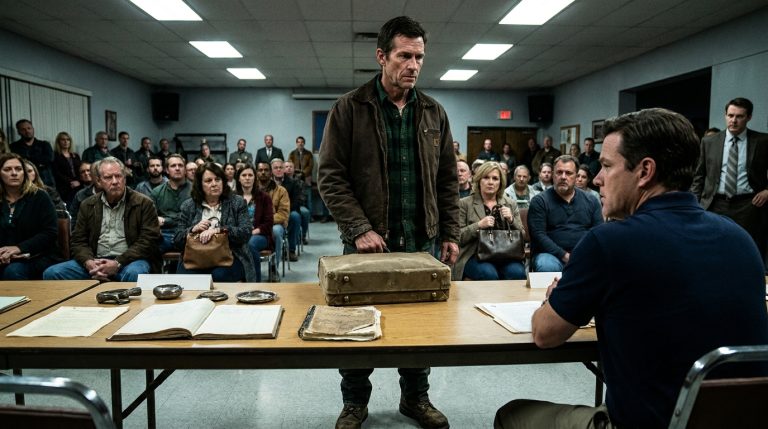
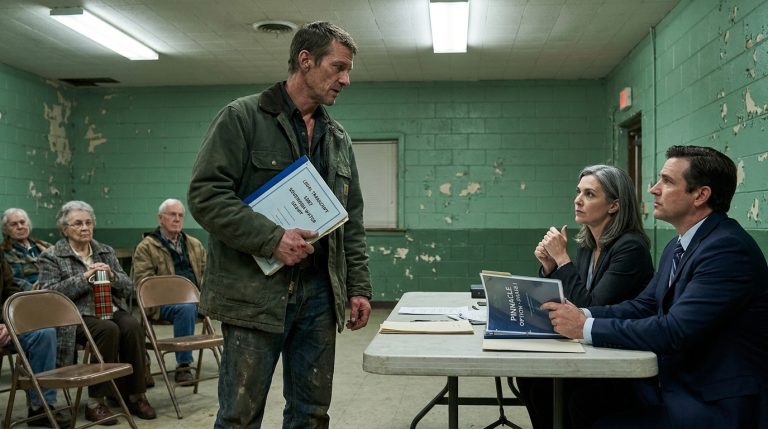
The air inside the community clubhouse was recycled and thin, smelling faintly of synthetic lemon floor wax and the stale perfume of artificial authority. Karen Miller sat at the center of the folding table, her frame expansive enough to command the plastic throne she occupied. She held the gavel with the clumsy, over-earnest grip of someone who had practiced the motion in front of a mirror until her wrist ached.
“The board has voted, Mr. Caldwell,” she said, her voice a practiced, velvet-edged purr that did little to hide the jagged malice underneath. “Your heritage fence is a violation of covenant 7.4 subsection B. Unapproved materials. You have thirty days, or we remove it and bill you for the demolition.”
I stood in the center of the room, my posture straight, my muscles locked into the familiar, rigid geometry of twenty-five years in the Corps of Engineers. Around me, twenty residents shifted in their chairs. They were ghosts, fading into the beige walls, their eyes darting away whenever I looked their way. They were afraid of the fine, afraid of the clipboard, afraid of the silence.
I didn’t blink. I watched the way the fluorescent light caught the gold-plated nameplate on Karen’s desk, the way her cronies to her left and right bobbed their heads in perfect, rhythmic synchronization. It was an engineering problem, nothing more. A structural instability. A failure of load-bearing integrity in a petty system.
“The fence is pre-1922,” I said, my voice cutting through the stale air with the dry, flat precision of a range order. “It predates your incorporation by seventy-six years. Your covenants are not retroactive.”
Karen smiled, a tight, thin-lipped expression that didn’t reach her eyes. She leaned forward, the plastic table groaning under the shift in weight. “The lawyer has advised us, Frank. New construction on your parcel triggers re-engagement. Your house is new. Therefore, the ground it stands on is new. Your history is irrelevant to our aesthetic standards.”
She tapped a button on her microphone, the feedback whine a sharp, high-pitched scream that made the room flinch. The “legal advice” was a hollow shell—a tactical bluff designed to see if I would fold. I looked at the wall behind her, noting the slight unevenness of the trim, the poor quality of the materials. It was a cheap, superficial structure, built to mask the rot underneath.
I didn’t argue. I didn’t raise my voice. I took the thirty-day ultimatum and tucked the paper into my breast pocket, folding it with clinical, deliberate speed. I had been in hostile territory before, and I knew the rules of engagement: you don’t fight the bullet; you dismantle the weapon.
As I turned to leave, my gaze locked onto the corner of the room where the clubhouse foundation met the carpet. I noticed a microscopic crack in the baseboard, a slight structural displacement. I felt a cold, jagged spark of intuition. Karen Miller had been so obsessed with the rocks of my wall that she hadn’t bothered to look at the geometry of her own kingdom.
I walked out of the clubhouse and into the North Carolina heat, the silence of the street feeling heavy, expectant. The fence was just the beginning. I had the plat maps, I had the deeds, and I had the iron-rod memory of my great-grandfather’s hand in the dirt. I didn’t look back at the beige boxes of the subdivision. I was already calculating the slope, the depth, and the angle of the collapse.
CHAPTER 2: THE BLUEPRINT
The heavy glass door of the clubhouse hissed shut behind me, severing the recycled, air-conditioned chill from the oppressive weight of the North Carolina afternoon. The heat hit me like a physical wall. I stood on the edge of the manicured concrete walkway, the thirty-day ultimatum folded sharply in my breast pocket. The asphalt of the parking lot radiated a wavy, distorted mirage, blurring the hard lines of the beige houses lining the street.
I walked to my F-250. Every step was deliberate, the heavy soles of my boots grinding against the loose gravel. I wasn’t just walking away; I was measuring the distance. The angle of the clubhouse roof, the slope of the common area lawn, the precise geometry of their territory. I reached the truck, the door handle burning against my callused palm. I pulled it open, the heavy steel hinges groaning, and climbed inside. I didn’t start the engine immediately. I sat in the stifling cabin, hands gripping the textured leather of the steering wheel, and let the engineer’s mindset take total control.
Karen Miller wanted a war of attrition over aesthetics. She had mistaken my silence in that room for submission. She didn’t understand that a man who spent twenty-five years assessing load-bearing structures under hostile conditions didn’t fight back by raising his voice. He fought back by finding the structural flaw and applying focused, overwhelming pressure to the weakest point.
I keyed the ignition. The diesel engine rumbled to life, a deep, steady vibration that traveled up the steering column. I dropped the truck into gear and drove out of the Oakwood Preserve, watching the uniform properties slide past the glass. By the time I turned onto the dirt access road leading to my ten acres, the anger was gone, replaced by a cold, sharp-edged clarity.
The trees swallowed the sunlight as I pulled into my driveway. My house sat at the end of the gravel path, anchored by a deep porch and the century-old stone wall running along the northern perimeter. The dry-stack stones were weathered gray and sharp, perfectly balanced by gravity and friction. It was a monument to endurance.
I parked the truck and walked inside. The interior was cool, shadowed, and silent.
Sarah was standing by the kitchen island, a ceramic coffee mug resting in her hands. The afternoon light filtering through the blinds caught the sharp angle of her jaw. She watched me drop my keys onto the counter with a heavy metallic clack. She didn’t ask how the meeting went. She didn’t offer empty sympathies. She took one look at the rigid set of my shoulders and the flat, unblinking focus in my eyes.
“What’s the plan, Frank?” she asked, her voice quiet, steady.
“We need the table,” I said.
She nodded once, moving immediately to clear the centerpiece and the woven placemats. I walked to my home office and opened the steel filing cabinet. I pulled out the heavy architectural scales, the drafting compass, the straight edges, and the thick manila folders containing my own property deeds. When I returned to the dining room, Sarah had a fresh pot of black coffee waiting.
I dropped the tools onto the solid mahogany surface. For the next hour, the dining room ceased to be a domestic space. I unrolled the thick parchment of my grandfather’s 1920 survey map, pinning down the corners with brass paperweights. I laid out the tax records, the easements, the original chain of title. I traced the black ink lines with my index finger, confirming the undisputed boundaries of my inheritance.
But looking at my own defenses wasn’t enough. I needed the enemy’s schematics.
“I don’t have their foundation,” I muttered, staring at the blank space on the map where the subdivision bordered my land.
“Where is it?” Sarah asked, leaning against the doorframe.
“County archives,” I said, checking my watch. It was two in the afternoon. “I need their plat maps. I need their founding charter. I need the exact language Karen’s lawyer thinks he’s hiding behind.”
I grabbed my keys and headed back out the door. The drive into town took thirty minutes, the transition from rural timber to the concrete grid of the city mirroring the shift in my focus. I parked in the subterranean garage beneath the Forsyth County Records Office, the air smelling of exhaust and damp concrete.
The archives room on the second floor was a mausoleum of bureaucracy. The air was dry and smelled of old dust, binding glue, and fading ink. A grid of massive metal cabinets dominated the space, flanked by rows of archaic microfilm readers. I didn’t waste time at the front desk. I walked straight to the index catalogs, pulling the heavy wooden drawers with a sharp scrape.
I needed everything on Oakwood Preserve. Incorporation date: 1998. Developer: Oakwood Land Holdings LLC.
I retrieved three spools of microfilm and carried them to an empty station in the corner. The metal chair groaned as I sat down. I threaded the first strip of film through the glass plates of the reader and flicked the power switch. The bulb hummed to life, projecting a harsh, blinding rectangle of white light onto the screen, instantly filled with the ghostly black text of legal descriptions.
I turned the crank. The pages blurred past. Fifty pages. A hundred. My eyes burned, tracking the dense, microscopic font. I was looking for the structural flaw. Karen’s lawyer had claimed “re-engagement” nullified the historical protection of my wall. I needed the charter’s exact jurisdictional limits.
It took three hours of relentless, mind-numbing scanning. The shadows outside the archive windows lengthened, plunging the room into twilight, but I didn’t move. Finally, the crank stopped.
There it was. Article 4, Section 2 of the HOA’s founding charter. The text was sharp and absolute: Authority is strictly limited to properties and structures for which building permits were issued after the date of this charter’s filing.
My fence never had a permit. It was built seventy-six years before the charter existed. It was a pre-existing non-conforming structure. Karen had no legal jurisdiction. The lawyer’s argument was a paper-thin bluff. I had my defense.
I printed the page, the machine grinding out a warm, chemical-smelling sheet. I should have been satisfied. I had the ammunition to stop the demolition. But as I wound the microfilm forward to eject the spool, the master plat map for the subdivision flashed across the screen.
I stopped. I reversed the crank slowly.
The 1998 developer’s map glowed against the glass. It showed the lots, the roads, the common areas, and the boundary line it shared with my property. I pulled my folded copy of the 1920 survey from my pocket and laid it flat against the screen, aligning the southern markers.
My breath caught in my throat. The lines didn’t match.
Along the northern edge—the exact spot where the clubhouse sat—the developer’s survey seemed to claim a slightly different angle. A twenty-foot shift. It was a minute discrepancy, an anomaly I might have chalked up to old magnetic north versus modern GPS. But staring at the harsh white light of the screen, the memory of that microscopic crack in the clubhouse baseboard hit me with the force of a physical blow.
The blueprint was flawed. Not just legally. Physically.
I tapped the cold glass over the surveyor’s notes, the realization settling into my chest like a block of ice. A piece of paper wasn’t going to be enough to break Karen Miller. I needed to prove exactly where the earth ended and her fantasy began. And to do that, I needed to dig up a ghost.
CHAPTER 3: THE IRON ROD
I didn’t sleep that night. I sat at the dining room table, the documents from the archive splayed out under the harsh, overhead light. I studied the overlap again and again. The discrepancy in the plat maps wasn’t an error. It was a calculated adjustment, a soft, invisible shift of the border that placed the clubhouse squarely on the most valuable, and yet, legally precarious, edge of the Oakwood Preserve development.
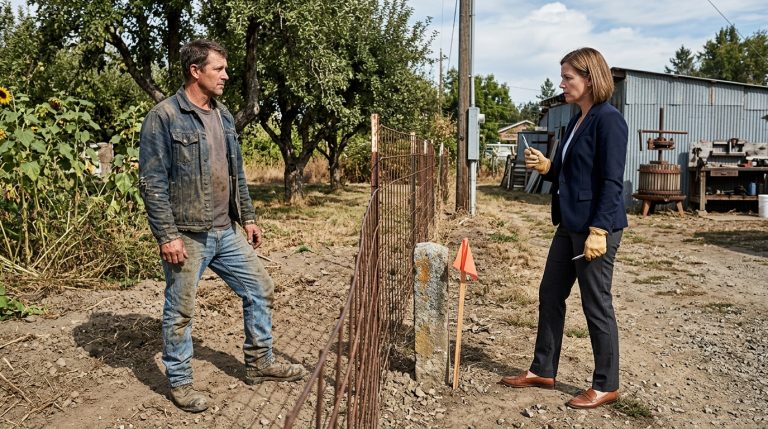
At 7:00 AM, the gravel of my driveway crunched under the arrival of the survey crew. I was already on the porch, a fresh mug of black coffee in my hand, watching the three men climb out of a white pickup marked with the logo of a Charlotte-based firm.
Two of them were young, their movements quick and synchronized, wearing high-visibility vests that seemed far too bright for the cool, damp morning. The third was older, a man with leathery skin and gray hair tucked under a brimmed hat. He carried a heavy-duty field bag with the practiced ease of someone who had walked the earth’s boundaries for decades.
I walked down to meet them.
“Mr. Caldwell?” the older man asked. He extended a hand. His grip was firm, calloused. “I’m Gus. These are my leads, Miller and Chen.”
“I appreciate you coming out on such short notice, Gus,” I said, my voice steady. I didn’t bother with pleasantries. I stepped to the truck and pulled out the folded microfilm printout and my grandfather’s 1920 survey. “This is what I need you to reconcile. I have the historical markers. I need them verified by current GPS data.”
Gus took the documents, his eyes narrowing as he scanned the old hand-drawn lines. He looked up at the northern edge of the property, where the dense woodland transitioned into the manicured, manicured lawn of the Oakwood Preserve clubhouse.
“Forensic surveying,” he muttered, a small, knowing smile touching his lips. “I love the old ones. The land never lies, Frank. Only the people who walk on it do.”
We moved into the woods. The work was slow, methodical. Miller and Chen set up the total station on the southern boundary, the laser-guided instrument humming with a soft, mechanical precision. Gus and I walked the line, the metal detector in his hand emitting a rhythmic, low-frequency beep.
The morning passed in a blur of exertion. We found three of the original iron pins by noon, buried under inches of accumulated topsoil and decades of tangled roots. Each one was a rusted, heavy rod, driven deep into the ground—a permanent, immovable testament to a property line drawn by a man who had been dead for fifty years.
“Everything’s matching, Frank,” Gus said, wiping sweat from his forehead with a handkerchief. “The southern and western pins are spot on. Your great-grandfather didn’t miss by an inch.”
“Let’s move to the north,” I said.
The dynamic shifted the moment we reached the boundary. The air felt different here—it was cleaner, more manicured, devoid of the natural decay of the woods. The subdivision’s putting green was right in front of us, the grass unnaturally, almost obscenely, green. It bordered the rear patio of the Oakwood clubhouse, a structure of beige siding and oversized, glass-paned windows.
Gus didn’t look at the clubhouse. He kept his eyes on the ground, his metal detector sweeping the grass. He moved toward the very center of the putting green, his pace slowing to a crawl. The machine emitted a sharp, high-pitched whine.
“Here,” he whispered.
He pulled a small trowel from his kit and cut a neat, circular plug in the grass. He dug down six inches, the sound of metal striking metal ringing out in the quiet of the morning. He reached into the hole and brushed away the dark, rich soil, revealing the jagged, rusted top of a one-inch-thick iron rod.
He didn’t say a word. He beckoned for me.
I knelt beside him, my boots pressing into the turf. I looked down into the small, dark cavity in the earth. The iron rod was there, just as the 1920 map had promised. It was an anchor in the center of their pristine golf course.
Gus stood up, his face pale, his eyes wide. He pulled a handheld GPS unit from his belt and tapped the screen. He looked from the iron pin to the clubhouse building, then back to the pin.
“Frank,” he said, his voice dropping to a whisper. “I’ve checked this three times. I’ve run the coordinates against the county monuments. There’s no ambiguity. The clubhouse is sitting on top of your boundary.”
I stood up, my pulse a rhythmic, heavy thud in my ears. I looked at the clubhouse—the manager’s office, the pool deck, the pump house. It was all on my land. The fence wasn’t the target. The fence had just been the pebble that started the avalanche.
“What does this mean for them?” I asked.
Gus sighed, a sound of weary professional recognition. “It means they’ve been trespassing for twenty years. It means every single improvement they’ve made on this land—the pool, the tennis courts, the clubhouse—is legally vulnerable. They don’t just have a border dispute. They have a multi-million dollar liability.”
I looked across the lawn. The clubhouse was silent, the shades drawn. Inside, Karen Miller was probably preparing her next notice, blissfully unaware that the ground she stood on had just been reclaimed.
“I need you to mark this, Gus,” I said, my voice cold, calm. “I need an official survey report, stamped and certified. I want the coordinates of every corner.”
“I’ll have it on your desk by morning,” he promised.
I walked back to my property alone. The weight of the world felt different now—not a burden, but a tool. The arrogance of the HOA had been their undoing. They had been so focused on the superficial—the flag, the paint, the stone wall—that they had ignored the foundations of reality itself.
I sat on my porch and watched the clubhouse. I didn’t feel rage anymore. I felt the precise, calculated focus of a sergeant major preparing for an objective. I had the ground. Now, I just needed the leverage.
CHAPTER 4: THE LEGAL SIEGE
The sun dipped below the tree line, casting long, bruised purple shadows across the woodland floor. I remained on the porch, my coffee long cold, watching the lights flicker on inside the clubhouse. Each window was a beacon of the opposition, a bright, artificial square that contained everything I needed to burn their authority to the ground.
My phone vibrated against the wood of the armrest. Dave Jensen.
I didn’t answer immediately. I took a moment to pull my thoughts into the same rigid alignment I’d used for bridge inspections and supply depot logistics. I pressed the call button and held the phone to my ear.
“Frank,” Dave said. His voice was immediate, layered with the crisp authority of a man who spent his life in courtrooms. “I got your email. The GPS data, the surveyor’s photos—it’s comprehensive.”
“Is it enough?” I asked.
“It’s a tactical nuclear strike,” he replied, and for a moment, the professional lawyer dropped away, replaced by the Colonel I’d served with in the desert. “You don’t just have a boundary encroachment. You have a case for continuing trespass and unjust enrichment. They’ve been maintaining private infrastructure on your land for two decades. They’ve used it to justify neighborhood levies, to fine residents, to build a culture of compliance based on a lie.”
“How do we move?”
“We don’t,” Dave said. “We don’t alert them yet. We move to fortify. I’m preparing a filing to be lodged with the county registrar of deeds that codifies your boundary line as the definitive legal reality. Once that’s stamped and recorded, it becomes the foundation of every subsequent action. We treat this like a blockade, Frank. We cut off their ability to claim ignorance, and then we wait for them to make the mistake of testing the line.”
“They have a demolition crew coming in three weeks,” I said. “They’re targeting the wall.”
“Let them,” Dave’s voice was sharp. “Let them show up. Let them prepare to tear down a historical structure on property they no longer have a legal leg to stand on. When they put a blade to your dirt, that’s when we trigger the injunction. We don’t just stop the bulldozer; we seize the narrative.”
I ended the call and set the phone down. The weight of the plan felt cold and solid, like the iron pins Gus had found in the grass.
It reminded me of a project in a forward operating base years ago, where we had been tasked with reinforcing a perimeter wall that was failing under the pressure of a shifting water table. I had stood in the mud, watching the silt liquefy under the concrete, realizing that no matter how much steel we added, the base was compromised. The entire structure was leaning into its own inevitable collapse.
That was Karen Miller. She was reinforcing a failure.
I stood up and walked back inside. The dining room was still a mess of blueprints and documents. I spent the next four hours refining the file. I organized the affidavits I’d collected from the neighbors—the Garcías, Mr. Henderson, the young families who had been harassed for the color of their shutters or the placement of a swing set.
Each document was a separate, jagged piece of evidence in a much larger mosaic. It wasn’t just about the fence; it was about the misuse of power. I wasn’t just building a legal case; I was documenting an insurgency.
As the clock ticked toward midnight, a knock sounded at the front door. I froze, my hand instinctively checking the edge of the table.
I walked to the door and opened it. It was Mr. Henderson. He looked older than I remembered, his shoulders slumped under the weight of his own grievances. He held a small, crumpled envelope in his hand.
“Frank,” he said, his voice hesitant. “I saw your truck earlier. I saw the survey crew. Everyone is talking. They say you found something.”
I didn’t invite him in. I stood in the doorway, the shadow of the porch covering my face. “I found the truth of where my land ends and this HOA’s domain begins, Henderson. Why are you here?”
He looked down at the envelope. “They fined me again. Two hundred dollars. My garden gnome, Frank. They said it wasn’t ‘consistent with the aesthetic.’ It’s the third time this month. I’m tired.”
He looked up, his eyes searching mine. “I heard you’re fighting them. Not just about the wall, but about the way they do things. I just wanted to say… if you need someone to sign something, if you need an account of what she’s done to us, I’m in.”
I looked at the man. He was the enemy’s neighbor, their subject. But he was also a cracked foundation.
“Keep your records, Henderson,” I said, my voice low and steady. “Keep every receipt, every notice, every threat. You’ll have your chance to use them soon.”
I watched him walk back down the driveway, his silhouette fading into the darkness. I went back to the table and added his name to the top of my list. The strategy was set. Dave was handling the legal architecture; I was handling the physical and human terrain.
Karen Miller thought she was the architect of the subdivision. She didn’t realize she was the one living in the structure destined for demolition.
CHAPTER 5: THE TACTICAL TRAP
The morning air was sharp, smelling of wet earth and impending rain. I was sitting at the dining room table, the list of neighbors who had pledged their support spread out before me, when the sharp, repetitive slap of a newspaper hitting the porch signaled the day’s start. I walked to the door, my movements fluid and measured.
Resting against the jamb was not a newspaper, but a thick, formal envelope bearing the seal of a local law firm. I opened it without hesitation. Inside, a cease-and-desist demand regarding “unauthorized and disruptive agitation” of subdivision residents, citing the community charter’s anti-harassment clause. It was signed by the HOA’s lawyer, Davies.
The move was aggressive, clumsy, and entirely expected. They were feeling the pressure. By trying to shut down my communication with the neighbors, Karen Miller had unwittingly confirmed that she was aware of the brewing insurgency. She was lashing out because she was frightened, trying to enforce compliance through legal intimidation.
My phone rang before I could even set the letter down. It was Dave.
“They’ve filed a formal complaint with the county, Frank,” Dave said, his voice stripped of all pleasantry. “They’re trying to portray your inquiries with the residents as a campaign of harassment. It’s a classic deflection tactic. They want to force you into a defensive position, to make you spend your time and resources responding to their claims rather than preparing the boundary suit.”
“They’re worried,” I said.
“They’re terrified,” Dave corrected. “But they’ve made a strategic error. By filing this, they’ve opened a channel of formal discovery. They’ve engaged the legal process on a platform that we can now leverage. We don’t defend against this, Frank. We counter-file.”
“How?”
“We file for a full audit of their covenant enforcement records under the North Carolina Planned Community Act,” Dave said. “If they want to play the ‘harassment’ card, we force them to produce every single fine, every single warning, and every single meeting minute for the last five years. We turn the spotlight back on their own internal inconsistencies. It will drown them in paperwork, and it will force them to reveal the extent of their procedural abuse.”
“Do it,” I said.
“I’m already drafting the motion. But be prepared. When we hit them with this, they won’t just sit on their hands. Karen will escalate. She’s going to try to paint you as the neighborhood pariah, someone who is actively threatening the peace and value of the community.”
“Let her,” I said. “Every step she takes is another move toward the trap.”
I hung up the phone and walked to the window. The sky was darkening, the clouds gathering over the subdivision in the distance. The atmosphere felt heavy, charged with static electricity. I went to the garage and started the truck. I needed to see the ground again. I needed to see the clubhouse.
I drove slowly through the subdivision, the beige houses and perfectly manicured lawns seeming more artificial than ever under the gray, flat light. I pulled into the visitor’s lot of the clubhouse and sat there, the engine idling.
The pool was quiet, the water a stagnant, brilliant blue. The tennis courts were empty, the nets sagging slightly in the damp breeze. I watched the windows of the manager’s office. I saw a shadow move across the blinds—a quick, nervous gesture. Karen was in there. I knew it.
A golf cart rounded the corner of the building, moving at an erratic, high speed. It was Karen. She stopped abruptly ten feet from my truck, her face a mask of furious, blotchy pink. She didn’t get out. She just stared at me, her hands gripping the steering wheel so hard her knuckles were white.
“You’re trespassing, Caldwell,” she shouted, her voice thin and high, cracking with a mixture of rage and desperation. “This is private community property. I have the authority to have you removed.”
I didn’t roll down the window. I simply looked at her, my expression as unreadable and cold as the stone wall on my property. I watched the way her breath hitched, the way her eyes darted to the clubhouse building and back to me. She was projecting her own insecurity. She knew the ground beneath her cart was a lie.
She turned the cart in a tight, violent circle and accelerated away, her movements frantic and uncontrolled.
I watched her go, then shifted the truck into gear and pulled away. She had played her hand early. The “harassment” filing was a sign of a failing defensive perimeter. She had abandoned the high ground of procedure for the low ground of personal attack.
I returned home and went straight to the dining room. I didn’t return to the files. Instead, I went to the small, locked cabinet where I kept my old drafting tools from my time in the Corps. I laid out the survey again, the GPS coordinates Gus had provided. I took a red pencil and marked the exact, irrefutable perimeter of my land.
I wouldn’t wait for her to come to me. I would start preparing the site for the next phase. If she wanted to talk about covenants and property rights, we would speak in the language of permanent, unavoidable physical barriers.
The trap was closing. Every move they made, every letter they wrote, and every fine they levied was just tightening the noose. My job now was to maintain the pressure, to keep them isolated in their own flawed logic until they had nowhere left to maneuver.
I sat back and watched the light fail. The house was quiet, but in the distance, I could hear the faint, low rumble of thunder—the sound of an approaching storm that no amount of rules, covenants, or beige paint could hold back.
CHAPTER 6: THE DEMOLITION STANDOFF
The silence of the final days was not an absence of sound, but a compression of energy. My property became a fortress of waiting. I spent the time preparing the physical line, clearing the brush along the northern perimeter, and marking the GPS coordinates Gus had verified with heavy, high-visibility stakes. I didn’t want any ambiguity when they arrived.
The deadline for the fence removal was marked on my calendar with a bold, black ‘X’. I felt the shift in the air when the date finally dawned—a crisp, unforgiving morning that tasted of iron and damp earth. I was on the porch, a mug of coffee in my hand, when the rumble of diesel engines announced the arrival of the demolition crew.
They came in a convoy of heavy machinery: a flatbed truck carrying a Cat D6, its steel treads caked in mud, followed by an excavator. They parked directly on the road, blocking the access to the subdivision. Karen Miller was in the lead, her golf cart zipping up the driveway with a frantic, agitated speed. She looked haggard, her face tight with a desperate, sharp-edged resolve.
I didn’t move. I waited until she braked in front of the stone wall, the tires kicking up a spray of gravel.
“Time’s up, Frank!” she shouted, not even bothering to get out of the cart. She looked at the foreman, who was already hopping down from the cab of the flatbed. “Proceed. Remove the structure. Tear it down to the foundation.”
The foreman, a man who looked like he had seen a thousand disputes but wanted no part of this one, hesitated. He looked at the wall—the ancient, weathered stones that had stood for a century—and then at me.
I stood up and walked down the steps. My boots hit the gravel with a rhythmic, steady thud. I stopped five feet from the foreman and pulled a heavy, sealed 9×12 envelope from my jacket. I didn’t acknowledge Karen.
“This is a formal cease-and-desist,” I said, my voice cutting through the idling drone of the diesel engines. “Enclosed is a certified copy of a court-filed injunction, an official record of the boundary survey filed with the county registrar, and a notice of criminal trespass. You touch one stone of this wall, and you are not just violating a covenant. You are committing a felony on private, non-subdivision land.”
The foreman took the envelope. He opened it, his eyes scanning the documents. He looked at the court seal, then at the map. His expression shifted from professional indifference to a deep, visceral caution.
“Lady,” he said, turning to Karen, “I’m not touching this. This is a court order. My company’s insurance won’t cover this.”
“It’s a bluff!” Karen shrieked, her voice cracking. “He forged those documents! The board has authorized the demolition, and I am the president of the board!”
“I don’t care who you are,” the foreman said, closing his cab door. “My job is to tear down fences, not get arrested for trespassing on private land.”
He signaled his driver, and the heavy equipment began to shudder, the engines revving as they prepared to reload.
I looked at Karen. She was shaking, her hands clutching the steering wheel so tightly that her knuckles were white. For a moment, the mask of the suburban tyrant slipped, and I saw something else—an utter, paralyzing fear. She looked at the clubhouse in the distance, then back at me, her eyes darting across the survey map she had grabbed from the foreman’s hand.
I experienced a flash of phantom sensory input—the smell of diesel and dry heat from a past life, an engineering project in the desert where we had miscalculated the stability of a bridge. I felt a sudden, sharp spike of doubt: What if they found a way around the filing? What if I’d missed a single, obscure clause that validated their claim?
I pushed it down. The precision of the engineering was sound. The math of the property lines didn’t lie.
“The survey is recorded, Karen,” I said, my voice low. “Your jurisdiction ended at the road. You’ve been trespassing on my land for twenty years. You weren’t protecting the neighborhood. You were just protecting your own delusion.”
She looked at me, and for the first time, she didn’t have a response. The silence of the street was absolute. The neighborhood had gathered—the Garcías, Mr. Henderson, a dozen others—standing on their lawns, watching the scene unfold.
The foreman’s truck pulled away, the weight of the heavy machinery vibrating through the ground. Karen was left standing alone in the center of the road, the paper map fluttering in the damp breeze like a broken wing.
She turned the golf cart around, her movements erratic, and drove back toward the clubhouse. I watched her go, a small, pathetic figure against the backdrop of the beige sprawl. I had stopped the immediate threat, but the wall was still there, and the larger truth was still locked away in the records.
I walked back to the stone wall and placed my hand on one of the larger, central stones. It was cold, steady, and immovable. The standoff wasn’t the resolution. It was the crack that would shatter their entire world.
CHAPTER 7: THE EMERGENCY SESSION
The walk from the stone wall to the clubhouse felt like crossing a minefield. The neighborhood was alive—not with the usual quiet of a suburban Tuesday, but with the frantic, high-frequency energy of a colony under threat. People were spilling out of their homes, clustering on sidewalks, their faces illuminated by the harsh, unnatural glow of porch lights. They weren’t looking at their gardens anymore; they were looking toward the clubhouse, the beige building that had suddenly become the epicenter of their collective ruin.
I stepped into the lobby. The sound hit me first—a cacophony of raised voices, overlapping shouts, and the sharp, rhythmic gaveling of a board member struggling to assert control. The room was packed. Men and women I recognized as neighbors—people who had spent months worrying about mailbox colors and lawn height—were now standing shoulder-to-shoulder, their composure shredded by the realization that their property values were being anchored to an illegal foundation.
I didn’t move toward the front immediately. I stopped in the doorway, letting my eyes survey the geometry of the room. Karen sat at the head of the folding table, her face a pale, ghostly mask of defiance. Beside her, the other two board members were physically leaning away, their chairs pushed back as if trying to shrink away from the fallout.
The air was thick, humid with the breath of two hundred panicked people.
“How could you not know?” a woman in the third row shouted, her voice trembling. “You had the records! You had the surveys!”
“This is all a mistake!” Karen screamed back, her voice losing its practiced, smug authority, dropping into a desperate, shrill cadence. “The developer filed these maps! We relied on professional assessments! Mr. Caldwell is the one causing this—he’s the one dredging up ancient history to extort the community!”
It was a pathetic, transparent defense. A few people booed, the sound rippling through the crowd like a wave.
I took a step forward. The crowd saw me. The movement shifted, the mass of bodies parting to create a path. It wasn’t the wary, avoidant movement of before; it was the calculated opening of a lane for a projectile. I walked toward the front row. I didn’t speak. I simply kept my gaze fixed on the back of the room, my posture neutral, my breathing controlled.
The silence that followed me was heavier than the noise.
When I reached the front row, I took a seat. Beside me, Mr. Henderson turned, his face lined with anxiety. He didn’t say a word, but he gave a single, firm nod. The weight of the room shifted. Everyone was watching the table, waiting for the inevitable.
The HOA’s lawyer, Davies, was projected onto a screen at the front of the room via a shaky video call. He looked miserable. His tie was loosened, his hair disheveled, and his eyes kept darting off-screen, likely tracking the frantic messages hitting his inbox.
“Mr. Davies,” Henderson called out, his voice cutting through the remaining murmurs. “On a scale of one to ten, just how screwed are we?”
Davies stalled, his mouth opening and closing. “Our preliminary review—”
“Forget the review!” someone shouted from the back. “Do we own the land or not?”
Davies sighed, a sound of profound professional resignation. “Our current findings suggest that Mr. Caldwell’s position is substantially credible.”
The word “substantially” was the catalyst. It was the moment the tension turned into absolute, unmitigated panic. The room erupted. People began to demand answers about their dues, about their equity, about who would be held accountable for the millions of dollars that had been funneled into a clubhouse that was, for all intents and purposes, a massive, illegal structure on someone else’s property.
Karen tried to stand, her hands gripping the edge of the table. “We have the insurance! We can fight this! We can negotiate an easement!”
“Fight it with what money?” a man shouted. “You just spent forty thousand on a legal team to tear down a fence that was never the problem!”
I watched her. She was spiraling. Her movements were jerky, uncoordinated. She was looking at the crowd not as constituents, but as a mob. She had lost the thread of her own narrative, and in the chaos, the truth was finally starting to breathe.
I leaned forward, my elbows on my knees, and caught her eye. I didn’t smile. I didn’t gloat. I simply held her gaze, showing her the absolute, unyielding certainty of the boundary I had spent weeks validating.
She looked away, her eyes darting to the side door. She was calculating an exit.
The meeting wasn’t about the law anymore. It was about the social collapse of an empire built on beige paint and petty spite. I had the records, I had the survey, and I had the neighborhood’s attention. All that remained was the final, formal dismantling. The room was ready to burn, and I had already poured the fuel.
“Mr. Henderson,” I said, my voice quiet, though the room fell still enough to hear it clearly. “I think the board has had enough to say.”
Henderson stood up, his face set in a look of grim, necessary duty. He turned to the crowd, and the gavel in his hand finally fell, a single, sharp sound that signaled the end of the old regime. The room began to move, the collective energy shifting toward the stage, ready to demand the total surrender of the board.
I remained in my seat, a stationary point in a room of kinetic energy, waiting for the final collapse.
CHAPTER 8: THE TREATY OF ASHES
The gavel’s strike still vibrated in the air when the room’s frantic energy curdled into a heavy, suffocating stillness. The mob—the neighbors who had been screaming for answers seconds ago—now turned their gaze toward the folding table at the front. It was a cold, collective focus that left no room for deflection.
Karen Miller was still standing, her hands trembling as she clutched the table’s edge. Her face was bloodless, a stark contrast to the aggressive, flushed pink of her earlier outbursts. She looked around the room, searching for an ally, a loophole, a distraction—anything to break the stare of the two hundred people who now viewed her not as a president, but as an architect of their impending financial ruin.
“Mr. Henderson,” she whispered, her voice failing. “You can’t just… you can’t just take over. This is a coup.”
Henderson didn’t even look at her. He stepped forward, his posture rigid. “This isn’t a coup, Karen. It’s an audit. The community is taking control of its own future.”
I stood up and walked toward the table. The crowd parted, silent and watchful. I placed the leather-bound folder Dave had prepared onto the table, directly in front of the empty seat where the vice president had sat—the man who had already slunk out the side door.
“The survey is filed,” I said, my voice projecting with the practiced, flat resonance of a command. “The encroachment is a matter of public record. The clubhouse, the pool, the tennis courts—they are all situated on land with a clear, unbroken title dating back to 1922. You’ve been managing property you had no right to occupy, and you’ve been doing it with money collected under fraudulent pretenses.”
Karen looked at the folder, then at me. Her defiance was leaking out, replaced by a dull, hollow shock. “We didn’t know,” she murmured, but the lie felt small, pathetic, and utterly useless in the face of the mounting evidence.
“You didn’t look,” I corrected. “You were too busy looking for reasons to destroy a wall that stood long before this subdivision was even a thought in a developer’s mind.”
I opened the folder. It contained the five conditions of surrender. The purchase of the encroached land at market value, the restoration of the stone wall, the total overhaul of the bylaws, the refund of every arbitrary fine levied under her tenure, and her immediate, permanent resignation.
“Sign it,” I said, pointing to the final page. “Or we proceed with the litigation. The lawyers are already waiting for my call.”
She looked at the paper, then at the crowd, her eyes lingering on the Garcías, on Henderson, on the people she had bullied for years. There was no support left. The infrastructure of her authority had been stripped away, leaving her exposed.
She picked up a pen. Her hand shook so violently that the ink blotted against the paper as she scrawled her name. It was a frantic, ugly signature, the final act of a woman who had mistaken a temporary position of influence for genuine power.
She dropped the pen, turned, and walked out of the room. She didn’t look back. She disappeared into the night, a shadow retreating from the very community she had tried to shape into her own image.
The silence she left behind was profound. Then, slowly, the room began to breathe again.
The denouement was quiet, rhythmic, and methodical. Over the following months, the clubhouse was transitioned. The management company moved in, the records were audited, and the refunds began to trickle out to the homeowners. The restoration of the stone wall began—not as an act of defiance, but as an act of preservation.
I stood on my porch one evening, watching the master stonemasons at work. They were meticulous, resetting the stones my great-grandfather had placed, cleaning the lichen, ensuring the structure was balanced for the next century. It was a quiet, tactile process—the steady clink of hammers against rock, the smell of damp earth and dust.
Sarah stepped out behind me, the warmth of the evening light hitting her face. She placed a hand on my shoulder, her touch light, grounding. “It’s quiet,” she said.
“It’s as it should be,” I replied.
I looked out at the stone wall. It was straight, true, and permanent. It was no longer a symbol of a war, but a boundary—a clear, respected line that held the land together.
Later, I walked out to the northern perimeter, the ground beneath my feet firm and solid. I knelt and touched the iron rod Gus had found under the putting green. It was still there, embedded in the earth, a silent, rusted witness to the fact that truth, no matter how deeply buried, eventually surfaces.
The conflict had cost me time, energy, and a heavy toll on my peace of mind. But looking at the restored wall, and seeing the new playground the community trust had built for the kids, I felt the sharp edges of the last few months smooth out. The anger, the tactical calculation, the suspicion—they were fading, replaced by a deep, quiet satisfaction.
I walked back toward my home, the path clear, the air settling into a calm, atmospheric peace. My arc wasn’t just about the land; it was about the restoration of a legacy. I had defended the ground, and in doing so, I had rebuilt the integrity of the world around me. I sat on my porch, took a breath, and for the first time in a very long time, I didn’t feel the need to look for a flaw in the foundation. I just sat, watched the sunset, and let the quiet take hold.