The Weight of Mountain Water and the Hardened Hearts That Try to Hold It Back
CHAPTER 1: THE SCENT OF CORDITE AT DAWN
The smell hit me half a mile down the access road.
It wasn’t pine or damp loam. It was cordite—sharp, sulfurous, and chemical. It burned the back of my throat before my truck tires even crunched onto the gravel driveway.
I cut the engine. Morning mist hung low over the pond, but the sound was all wrong. The steady, century-old rush of water tumbling over hand-cut limestone had turned into a violent, hollow roar.
I stepped out of the cab. My thumb automatically found the worn brass bezel of my great-grandfather’s 1924 hydrometer in my pocket, rolling the cold metal against my palm.
Where the limestone wall had stood since Warren G. Harding took office, there was only a jagged breach. Grey dust coated the hemlocks. Chunks of five-hundred-pound masonry lay scattered in the mud like broken teeth.
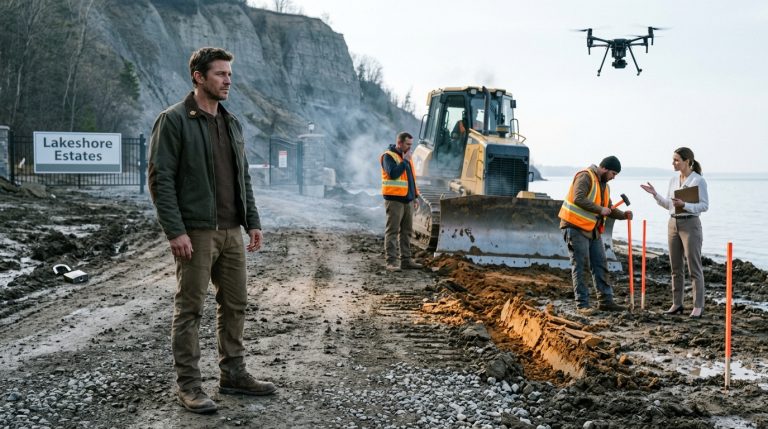
Dexter Hawthorne stood on the upper bank. He wore a crisp navy polo shirt, pressed khakis, and loafers that had never seen a day’s real work. He was holding his phone at arm’s length, adjusting his posture for a selfie with the smoking ruins behind him.
“You’re trespassing, Dexter,” I said. My voice didn’t rise. It didn’t need to.
Dexter turned, lowering the phone with a tight, practiced smile. He dusted a speck of white mortar off his sleeve.
“Ezra. You’re late for coffee,” he said. He didn’t step back. He didn’t even look nervous. “County code enforcement cleared the hazard. Free demolition, neighbor. That swamp was killing property values at Milbrook.”
I walked to the edge of the breach. The water level in the three-acre pond was already dropping fast, exposing black silt and dying weed beds. The raw flow was dumping straight down the ravine toward the manicured cul-de-sacs of Milbrook Estates.
“That wasn’t a swamp,” I said. I tapped the brass hydrometer against my knuckles. The metallic clink was quiet, but Dexter’s eyes flicked down to my hand. “That was a three-hundred-thousand-gallon surge buffer.”
Dexter chuckled. The sound was like dry gravel spinning in a garbage disposal. “It was an eyesore. Unlicensed, unpermitted stone.”
“Built in 1924,” I said. “Six weeks before the mountain snowpack melts.”
“We’ve got engineers, Ezra,” he said, taking a step closer and lowering his voice to a conspiratorial murmur. “Real ones. Not guys raising trout in a dirt hole. You owe twelve grand in back HOA assessments anyway. Consider the clearance a courtesy.”
I looked past his shoulder. Down in the valley, his eight-hundred-thousand-dollar McMansion sat right in the throat of the historical overflow channel. He had no idea what he had just uncorked.
“Your foundation sits three feet below the nineteen-twenty-three high-water line, Dexter,” I said softly.
He grinned, tapping his phone against his chest. “Paperwork’s filed, Ezra. Try suing an HOA.”
He turned and walked toward his BMW X7, his leather soles crunching arrogance into the gravel. I stayed by the water, watching the current carve deeper into the mud, holding the brass gauge until the cold metal bit into my palm.
CHAPTER 2: PAPER TRAILS AND PAPER MEN
The taillights of the BMW vanished over the crest of the ridge, leaving behind nothing but a blue haze of exhaust and the hollow, accelerating rush of my pond emptying into the gorge.
I didn’t move. My fingers were stiff around the 1924 brass hydrometer, the cold nickel-plated edges biting straight into the calluses of my palm. I turned the bezel once. Click. The needle inside hung dead at zero, suspended above a tarnished dial that my great-grandfather had set by hand when the road up here was still just a logging trail for mule teams.
The water level was dropping three inches every ten minutes now. Down in the shadows of the ravine, the creek wasn’t just trickling; it was gathering mass, eating away at the soft red dirt where the limestone wall used to key into the bedrock.
I turned on my heel and walked up the gravel slope toward my cabin. The mud pulled at the heels of my work boots with a wet, sucking sound.
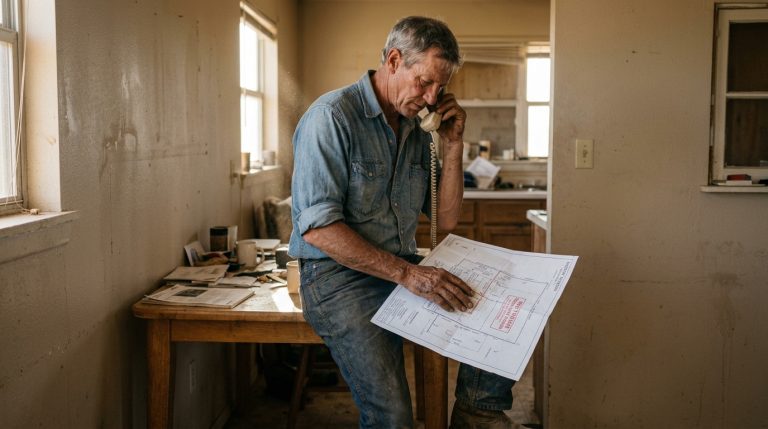
Inside, the kitchen smelled of stale roast chicory and damp pine wood. I didn’t turn on the overhead light. I went straight to the heavy oak desk in the corner, where three months of unopened mail lay stacked beneath a cast-iron paperweight shaped like an anvil.
I slid the top envelope out. Certified mail. Thick paper, heavy bond, with a pre-printed return address from Hawthorne Landscaping LLC.
I tore the end off with my thumb. The invoice inside was short, printed in crisp, corporate sans-serif: Assessment for Regional Hydraulic Stabilization & Watershed Conservation Fee—$12,450.00. Attached to the back was a carbon copy of a county inspection summary bearing the faded stamp of the Milbrook Building Department.
I held the sheet up to the morning light filtering through the window.
The stamp was real enough, but the signature above the title Chief Inspector was a jagged, illegible scribble in blue ballpoint. Beside it, tucked into the stapled margin of the county form, was a tiny slip of yellow paper—a certified mailing receipt with a tracking number that didn’t match the county system. The print was misaligned, offset by three millimeters, the way cheap thermal paper looks when it’s run through an uncalibrated desktop machine in a home office.
My thumb rubbed the rough edge of the paper. Hawthorne Landscaping LLC. A company that didn’t own an excavator, didn’t employ a crew, and didn’t hold a commercial contractor’s bond in the state of Colorado.
The floorboards creaked behind me. I didn’t jump. I knew the cadence of those boots.
“He did it, didn’t he?” Janet Morrison stood in the doorway, wearing a heavy canvas coat covered in dried yellow clay. Her hands were buried deep in her pockets, her knuckles bulging against the fabric. She lived two parcels down, where the creek flattened out before hitting the development. Her late husband had been on the original board before Dexter took over the HOA eight years ago.
“He used four charges,” I said, laying the paper flat on the desk. “Shaped. Set low on the keyway.”
Janet walked over, her boots leaving dry crusts of dirt on the pine floor. She looked down at the invoice, then at the brass hydrometer resting on my desk. Her eyes were tired, framed by deep lines that hadn’t been there when her husband was still running the maintenance crew.
“He told the board last night that your wall was spalling,” she said, her voice dropping an octave. “Said the county was going to condemn the whole draw if we didn’t clear the risk. He passed around a sheet showing structural cracks.”
“He never walked the wall, Janet.” I pointed a finger at the misaligned stamp on the carbon copy. “Look at the inspector’s registration number at the bottom. C-4082.”
She leaned in, squinting. “What about it?”
“That’s a residential plumbing credential,” I said. “Rick Morrison’s license. No relation to you, but Dexter’s golf partner. He didn’t evaluate a hundred-year-old gravity dam. He copied a boilerplate report for a cracked septic tank and slapped my parcel number on the header.”
Janet let out a slow, shaking breath that smelled faintly of peppermint and cold air. She reached out, her fingers trembling slightly as they touched the edge of the document, before she pulled her hand back as if the paper were hot.
“He’s charging the HOA twelve thousand dollars for the removal,” she whispered. “He’s billing us for his own demolition crew.”
“Not the HOA,” I corrected softly, watching her eyes track the numbers. “He’s billing me first. When I refuse to pay, he uses the default to file an emergency lien against my twelve acres. Once the lien attaches, the HOA gets the right of first refusal to buy the parcel at tax-sale value.”
Janet stared at me, her lower lip tightening against her teeth. She reached into her coat pocket, pulled out a small, frayed leather notebook bound with an elastic band, and flipped it open to a page filled with handwritten columns of figures.
“He took eighteen thousand out of the reserve fund three weeks ago,” she said, her voice barely louder than the hum of the refrigerator. “He logged it as ‘Emergency Drainage Remediation.’ I asked him for the receipt at the Tuesday meeting. He told me to stop worrying my head about routine maintenance.”
“He’s emptying the accounts, Janet,” I said. “He needs the land cleared because his resort plans require an open channel for the artificial lagoons. But he can’t buy the land until the dam is gone, and he can’t get the dam gone without making it look like a public safety hazard.”
“The snowmelt,” she said, looking toward the window. The sound of the rushing water outside seemed to grow louder, filling the quiet room with a steady, rhythmic thrum. “The upper basin has four feet of pack. If the warm front hits next week…”
“The creek takes its old path,” I said. I picked up the brass gauge and dropped it into my coat pocket, the weight settling solid against my hip. “Right through his lower fairway. Right through your back porch.”
Janet’s hand went to her throat. She didn’t cry; people who live in these mountains don’t waste water on tears when there’s work to be done. Instead, her jaw set into a hard, stubborn line that matched the granite ledges outside.
“What do we do?” she asked.
“We don’t go to the county,” I said, grabbing my keys off the hook by the door. “Not yet. Morrison’s sitting on the planning commission, and Walsh has the city council locked up. We go to the people who are paying for the diesel.”
“The HOA meeting’s tonight,” she said, her eyes lighting up with a cold, fierce clarity. “Seven o’clock at the clubhouse.”
“Gather your bank statements, Janet,” I said, opening the door to the crisp, mountain air. “The ones from before her husband died. We’re going to show them what an eighteen-thousand-dollar hole looks like.”
CHAPTER 3: THE BOARDROOM COUP
The double doors of the Milbrook Estates clubhouse swung open, releasing a stale gust of floor wax and over-processed air-conditioning.
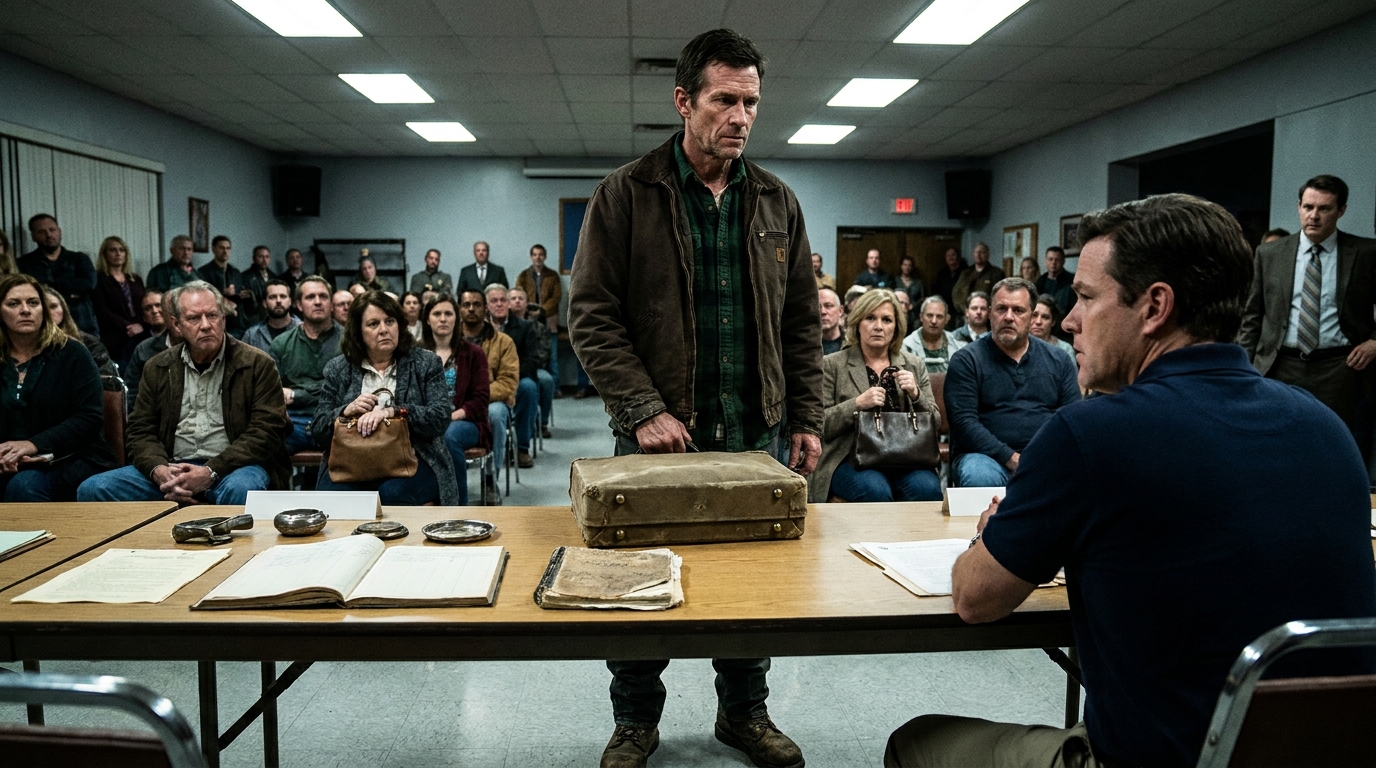
Janet walked half a step behind me, her boots leaving faint grey ovals of dry clay on the polished linoleum. In her right hand, she gripped her husband’s leather-bound ledger so tightly her knuckles were white as porcelain. I carried my battered canvas briefcase under my arm, the heavy copper clasp cold against my ribs.
Forty homeowners sat on beige folding chairs, their voices a muffled drone beneath the hum of overhead fluorescent tubes. At the front of the room, seated behind a long folding table, Dexter Hawthorne was adjusting the microphone.
He didn’t look up when the door latch clicked, but his shoulder muscles tightened beneath his tailored navy polo. Beside him sat Bradley Walsh, a city councilman with a politician’s soft jawline and a silk tie that looked entirely out of place in a suburban community center.
“We have a full quorum,” Dexter said into the microphone. His voice bounced off the acoustic ceiling tiles, smooth and practiced. “Item three on tonight’s agenda is the emergency infrastructure assessment for the upper drainage basin.”
I didn’t wait for a seat. I walked straight down the center aisle, the rubber soles of my boots squeaking against the slick floor.
“Let’s skip to item three, Dexter,” I said.
The room went dead silent. Forty heads turned in unison. A woman in the third row pulled her handbag closer to her lap; a man in a windbreaker leaned forward, elbows on his knees.
Dexter’s fingers twitched around his pen, but his smile remained perfectly locked. “Ezra. This is a closed board meeting for HOA members in good standing. According to county records, your parcel is in arrears.”
“My parcel isn’t in your HOA,” I said. I stopped three feet from the head table, placing my briefcase flat on the laminate surface. The heavy brass feet clattered against the wood grain. “And the twelve-thousand-dollar assessment you mailed me yesterday didn’t come from the county. It came from a laser printer in your basement.”
Bradley Walsh shifted in his chair, clearing his throat with a dry, rattled cough. “Now, hold on. Mr. Blackwood, the planning commission has reviewed the structural risk—”
“The planning commission hasn’t seen a real report,” I interrupted, staring directly at Walsh. “Rick Morrison filed a residential plumbing form for a century-old gravity structure. He didn’t even get the material right. He listed poured concrete. My great-grandfather built that wall out of hand-cut limestone blocks in nineteen-twenty-four.”
Dexter leaned back, crossing his arms. “Terminology doesn’t change the safety hazard, Ezra. The wall is breached. The threat is real.”
“The breach is real because you set four shaped charges on the keyway at six this morning,” I said, my voice dropping into a flat, steady register that cut through the room.
A sharp murmur rippled across the folding chairs. Janet stepped forward, opening the frayed leather notebook flat on Dexter’s desk, right over his printed agenda.
“Page forty-two,” Janet said, her fingers trembling but her voice unyielding. “Eighteen thousand dollars paid out of the emergency reserve fund three weeks ago. Payee: Hawthorne Landscaping LLC. Account number ending in four-zero-two.”
Dexter didn’t look at the book. “Routine grounds maintenance. Approved by the executive committee.”
“You don’t have an executive committee, Dexter,” Janet said, leaning over the table until she was staring him straight in the eye. “My husband was the treasurer for six years before he died. The bylaws require three signatures for any disbursement over five thousand dollars. Where are the other two signatures?”
Dexter’s eyes flicked to Walsh, then back to Janet. For a fraction of a second, the polished composure slipped, revealing the raw, cornered beast beneath. His jaw muscle jumped.
“This isn’t the forum for an audit, Janet,” Dexter said softly.
I reached into my pocket, pulled out the 1924 brass hydrometer, and set it on top of the financial ledger. The tarnished metal caught the harsh fluorescent light.
“It’s the forum for an embezzlement investigation,” I said. “I ran the corporate registry this afternoon. Hawthorne Landscaping LLC shares a registered address with Mountain West Advisory—the shell company that billed this board twenty-five thousand dollars for ‘legal consultation’ on water rights.”
The man in the windbreaker stood up in the fourth row. “Is that true, Dexter?”
“Sit down, Frank,” Dexter snapped, his voice dropping the artificial warmth entirely. “Mr. Blackwood is throwing around baseless accusations to distract from the fact that his illegal dam has compromised this entire development’s flood insurance standing.”
“Check your bank statements,” I told the room, not turning around. “Every owner here paid a three-hundred-dollar special assessment in March for spillway maintenance. Look at the cancelled checks on your online portal. See who endorsed them.”
A dozen phones were out before I even finished the sentence. The room filled with the rapid tapping of fingers on glass screens.
Dexter stood up so fast his metal chair screeched against the linoleum. “This meeting is adjourned.”
“You can’t adjourn a meeting you didn’t legally convene, Dexter,” I said, leaning over the table. “You don’t have three board members present. You haven’t had a legal quorum since November.”
“You think you’re smart, don’t you?” Dexter whispered, his face inches from mine, his breath smelling of stale coffee and mints. “You think some old paper and a stone wall give you leverage down here? That water is coming down the draw whether you like it or not. The demolition order stands.”
“The county order is fraudulent,” I said softly. “And when the water hits the lower fairway next week, every homeowner in this room is going to know exactly who tore down their only surge protection.”
Walsh was already packing his leather folio, his face pale, avoiding eye contact with every person in the aisle as he edged toward the side exit.
Dexter grabbed his phone, his thumb swiping wildly across the screen as he turned his back on the crowd. “Get off my stage, Ezra.”
I didn’t argue. I picked up the brass hydrometer, dropped it into my pocket, and locked my briefcase. As Janet and I walked back down the aisle, the quiet hum of the clubhouse had exploded into a wall of shouting voices, homeowners crowding the front table with bank apps open on their screens.
Outside, the mountain air was frigid. The sky above the ridge was dark, heavy with low-hanging clouds that smelled of impending rain.
“We bought some time,” Janet said, her coat pulled tight around her throat as we reached my truck.
“We broke his cover,” I said, unlocking the driver’s door. “Which means he’s out of options. He won’t wait for the city council now.”
I looked up toward the dark silhouette of the ridge where my broken dam lay. Down in the valley, the first heavy drops of cold spring rain began to hit the windshield with a flat, metallic ping.
CHAPTER 4: THE CRACK IN THE FOUNDATION
The rain had turned from a steady drizzle into a hard, driving sheet by the time my truck climbed back up the access road. The tires spun twice on the slick clay before the rear axle locked and bit into the gravel.
I killed the headlights fifty yards short of the crest.
The roar of the creek was louder now, a heavy, resonant thudding that vibrated through the floorboards of the cab. I grabbed my heavy rubberized flashlight from the passenger seat, my coat collar turned up against the cold wind that whistled through the gap in the driver’s door.
Down at the breach, three figures moved in the dark.
Their yellow halogen lanterns cast long, distorted shadows across the churning water. The clatter of iron sledgehammers against wet limestone echoed up the draw—clack-thud, clack-thud—a sharp, unnatural rhythm that didn’t belong in the woods at midnight.
I didn’t run. I walked down the slope with deliberate, heavy steps, letting my boots slide through the pine needles to keep my balance. My left hand stayed tucked in my pocket, wrapped around the cold brass cylinder of the 1924 hydrometer.
“That stone’s nineteen inches thick,” I called out over the rush of the water. “You’re going to break a wrist before you clear two inches of keyway.”
The hammers stopped instantly.
The tallest figure turned, swinging a halogen spotlight straight into my face. The white beam burned against my eyes, blindingly bright.
“Private property, Blackwood,” a voice barked. It was Rick Morrison, the county inspector. He was wearing a heavy yellow oilskin slicker, his face slick with rain and sweat. Beside him stood Dexter’s brother-in-law, holding a six-pound wedge, and a hired hand I recognized from the local equipment rental yard. “Emergency abatement. The board authorized immediate stabilization.”
“The board didn’t authorize a damn thing,” I said, stepping sideways out of the direct glare of the spotlight. The mud pulled at my boots, icy water soaking through the leather seam at the welt. “The board just spent forty minutes looking at Dexter’s bank statements.”
Morrison lowered the lantern an inch, his jaw working silently beneath his slicker hood. “This structure is unsafe. The county signed the warrant.”
“You signed a residential plumbing permit,” I said. I pointed my flashlight down at his feet, where a steel wedge was driven deep into the mortar joint of the lower spillway gauge block. “And you’re driving steel into a weight-bearing keyway on a rising creek. That’s not abatement. That’s criminal vandalism of watershed infrastructure.”
“It’s a pile of loose rocks,” the hired hand muttered, wiping his wet brow with a muddy sleeve.
“Look at the mortar,” I said, stepping closer until the toe of my boot touched the wedge. I shone my beam down into the seam.
Wedged behind the stone was a yellowed oilskin envelope, frayed at the edges and caked in black river mud. It had been sealed inside the masonry pocket behind the original 1924 spillway gauge—a pocket that only existed because someone had hammered the outer face apart forty minutes ago.
I reached down. Morrison took a quick step forward, his boot sliding on the wet stone, but I grabbed the envelope before he could reach it.
“Give me that,” Morrison growled, his voice cracking slightly. “That’s county property under the assessment order.”
“This is my great-grandfather’s vault pocket,” I said.
I wiped the mud off the oilskin with my sleeve. The fabric was stiff, brittle with age, but the lead seal at the corner was intact. Stamped into the wax was a three-digit registry number: 1953-FC-09.
Morrison’s breath hitched. He stepped back, the spotlight beam wavering in his hand as he looked down at the dark water surging through the break.
“You don’t know what you’re touching, Ezra,” Morrison said, his arrogance suddenly replaced by a dry, raspy terror that had nothing to do with the HOA bank accounts.
“I know it’s not a plumbing permit,” I said, sliding the heavy envelope into the deep inside pocket of my coat, right beside my chest. The cold weight of the brass hydrometer pressed against it through the wool. “And I know why Dexter wanted this wall down before the snowmelt hit.”
“The water’s coming either way!” Morrison yelled over a sudden surge in the current, the creek rising two inches in a heartbeat as the upper drainage began to unload its runoff. “You can’t hold back forty square miles of mountain pack with a pile of dead limestone!”
“I don’t have to hold it back,” I said, stepping back onto the firm gravel of the bank. “I just have to make sure the legal liability lands on the man who pulled the plug.”
A crack like a rifle shot echoed through the gorge.
The wedge Morrison had set in the keyway gave way under the rising pressure of the pond. A three-hundred-pound slab of hand-cut limestone sheared cleanly along its nineteen-inch grain, tumbling into the main channel with a heavy, deafening splash that sent a plume of ice-cold spray twenty feet into the air.
The current widened by three feet in an instant. The water didn’t trickle down the ravine anymore—it roared, a black, violent wall carrying silt, broken branches, and century-old gravel straight toward the access road below.
Morrison dropped his hammer, his boots scrambling frantically up the muddy embankment as the creek overflowed its banks. “You’re crazy! The whole slope is going!”
“Get off my land, Rick,” I said softly, standing my ground as the cold water washed over the toes of my boots. “And tell Dexter he’d better start packing his basement.”
CHAPTER 5: THE UNSTOPPABLE CURRENT
The cold water washed over the toes of my boots, carrying the sharp, flinty scent of crushed limestone. The creek didn’t just rise; it expanded. The black surface swelled outward, swallowing the gravel bank in a single, violent heave.
Rick Morrison scrambled up the muddy embankment on his hands and knees, his yellow slicker glowing under the erratic sweep of his dropped halogen lantern. “The whole slope is going!” he screamed, his voice barely cutting through the concussive roar of the main channel.
“Get off my land, Rick,” I said softly, my voice perfectly level despite the vibration shaking the ground beneath my feet. I didn’t step back. I let the freezing current rush over my ankles. “And tell Dexter he’d better start packing his basement.”
The hired hand was already gone, his heavy boots crashing through the dark timberline toward the access road. Morrison didn’t look back. He grabbed the handle of his lantern and hauled himself over the crest, disappearing into the driving rain.
I stood alone in the dark. The water pressure was terrifying. Without the three-hundred-thousand-gallon buffer of the pond, the spring runoff from forty square miles of mountain pack was funneling directly into a thirty-foot gorge.
I turned and waded back to solid ground. My right hand was buried deep in my coat, my fingers locked around the stiff, mud-caked oilskin envelope. 1953-FC-09. My great-grandfather hadn’t just built a dam; he had signed a Federal Flood Control Compact. He had legally anchored this limestone wall into the municipal watershed infrastructure, turning it from a private pond into a federally protected safety mandate.
And Dexter Hawthorne had just paid his own brother-in-law to destroy it.
I pulled out my phone. The screen was slick with rain, the backlight harsh against the total darkness of the woods. I opened the group text I’d set up with Janet and the four other legacy owners in the lower basin.
The keyway is breached, I typed, my thumb slipping slightly on the wet glass. Full surge protocol. Activate the sensors. Get everyone above the second contour line.
I hit send, shoved the phone into my pocket, and broke into a heavy, measured jog toward the truck.
Shadows stretched across the dashboard, and twenty minutes of tense silence broke when my tires finally crunched onto the paved cul-de-sac of Milbrook Estates.
The rain was falling in solid sheets now, turning the streetlights into blurred halos of sodium-orange. The neighborhood was eerily quiet, the kind of stillness that only exists right before a disaster.
I parked the truck sideways across the intersection of Maple and Oak, blocking the main thoroughfare that dipped down toward the natural floodplain. The heavy copper clasp of my briefcase clattered as I threw it onto the passenger seat.
Down the street, the front door of Janet’s house burst open. She stepped onto her porch wearing the same clay-stained canvas coat, a high-powered LED beam in her hand. Behind her, the sharp, electronic wail of a water sensor cut through the sound of the rain.
“It’s over the back step!” she yelled, jogging toward my truck. Her boots splashed heavily in the gutters, which were already overflowing. “The gauge in the crawlspace triggered three minutes ago. It’s rising an inch a minute.”
“Where’s Dexter?” I asked, rolling the window down just enough to be heard.
“He called an emergency meeting at his house,” Janet said, her chest heaving, her knuckles white around the flashlight grip. “He’s telling everyone the county ordered a controlled release and it’s perfectly safe. He’s trying to keep them from evacuating so they don’t see the property damage until morning.”
I looked down the slope. Dexter’s eight-hundred-thousand-dollar McMansion sat at the very bottom of the cul-de-sac. It was built directly over the creek’s historical overflow channel—a piece of land my great-grandfather had deliberately left vacant for ninety years.
“Get in,” I said.
Janet didn’t hesitate. She pulled the passenger door open and climbed in, the wet canvas of her coat smelling of rain and fear.
I dropped the truck into low gear and eased down the incline. The water in the street was already hubcap-deep, a swirling, muddy brown current carrying lawn chairs, plastic garbage cans, and thick branches stripped from the upper gorge.
Dexter’s driveway was packed with luxury SUVs and sedans. All the lights on the ground floor were blazing. Through the massive picture windows, I could see two dozen neighbors clustered in the living room. Dexter was standing on the bottom step of his sweeping staircase, holding a glass of scotch, waving his free hand dismissively as he spoke.
He had no idea. He couldn’t hear the roar of the creek over his triple-paned glass.
I didn’t bother parking. I drove the truck straight up onto his pristine, manicured front lawn, the heavy tires tearing deep, muddy trenches through the sod. I threw it in park, grabbed the oilskin envelope from my coat pocket, and kicked my door open.
The water was halfway up the driveway now, moving with a silent, terrifying velocity.
I walked up to the heavy mahogany front doors and didn’t bother knocking. I kicked the brass kickplate with the heel of my work boot. The impact sounded like a gunshot.
The door swung inward. Dexter stood in the foyer, his scotch glass halfway to his mouth. His tailored polo was perfectly dry. The twenty homeowners behind him fell dead silent, staring at the mud dripping from my jeans onto the white marble tile.
“You’re trespassing again, Ezra,” Dexter said, his voice tight, his eyes darting toward the open door. “I’m calling the sheriff.”
“Sheriff Santos is already on her way,” I said, stepping inside. The heavy, muddy water from the driveway began to lap over the marble threshold behind me. “But she isn’t coming for me.”
Dexter lowered his glass. His left eye twitched, a tiny, involuntary spasm that completely betrayed the forced calm of his posture. “I told you, the county signed off on the abatement.”
“You forged a residential plumbing permit to justify an eighteen-thousand-dollar payout to Hawthorne Landscaping LLC,” I said, my voice echoing off the vaulted ceiling. I walked forward, closing the distance until I was standing two feet from him. “And you used that forged permit to send a crew with sledgehammers to destroy the Spillway Gauge.”
A woman in the back of the room gasped, pointing toward the foyer. The muddy water was creeping across the marble, soaking into the edges of a Persian rug.
“It’s just a little runoff,” Dexter snapped, not taking his eyes off me. “The storm drains will handle it.”
“There are no storm drains big enough for this,” I said softly. I reached into my coat, pulled out the oilskin envelope, and broke the lead seal. The wax crumbled onto the pristine floor.
I pulled out the heavy, yellowed parchment.
“This is the Federal Flood Control Compact of nineteen-fifty-three,” I said, holding it up so the harsh recessed lighting caught the official seal of the Army Corps of Engineers. “My great-grandfather didn’t just build a wall. He signed a federal mandate. That dam was classified as critical watershed infrastructure. You didn’t just vandalize private property tonight, Dexter. You committed a federal crime.”
Dexter’s face went entirely slack. The color drained from his cheeks, leaving his skin a sickly, mottled grey. The scotch glass slipped from his fingers, shattering against the marble, the amber liquid instantly swallowed by the rising tide of muddy water.
CHAPTER 6: WHAT THE RIVER KEEPS
The glass shards lay submerged beneath two inches of brown, silty water, catching the glare of the chandelier overhead.
Dexter didn’t move. His mouth remained half-open, his eyes locked on the damp parchment in my hand. The yellowed ink of the 1953 Federal Flood Control Compact stood out sharp and dark against the rain-streaked parchment—the bold, sweeping signature of the district engineer from the Army Corps of Engineers sealing his fate.
“You’re lying,” Dexter rasped, his voice dropping an octave as he made one last, desperate attempt to reclaim the room. He reached out a trembling hand, his fingers twitching as if he could simply snatch the paper and tear it to shreds. “That’s an obsolete county record! I’m the president of this board! I have the authority to abate a public safety hazard!”
“You don’t have authority over federal water infrastructure, Dexter,” I said. My voice didn’t rise; it carried the cold, unyielding weight of the river outside. “And you didn’t abate a hazard. You breached a designated surge basin to clear land for a resort project, and you funded the demolition through Hawthorne Landscaping LLC using stolen HOA reserves.”
The man in the windbreaker from the clubhouse meeting pushed his way through the crowd of neighbors standing in the flooded living room. He looked down at the muddy water swirling over the plush Oriental rug, then straight at Dexter.
“My basement is under four feet of water, Dexter,” he said, his knuckles white as he clenched his fists at his sides. “And you told us twenty minutes ago it was a routine county drain clearance.”
Behind me, the flashing red and blue lights of three squad cars cut through the heavy rain outside, casting long, pulsing shadows across the grand foyer. Heavy boots splashed through the water on the front porch.
Sheriff Maria Santos stepped through the doorway, her badge gleaming wetly beneath her slicker. Two deputies followed close behind, their eyes immediately taking in the submerged marble floor, the cracked mahogany threshold, and the yellowed document held firm in my grip.
“Dexter Hawthorne,” Sheriff Santos said, her voice crisp and broadcast-clear over the low hum of her radio. “Step down off those stairs.”
Dexter backed up one step, his heel catching on the riser. “Maria, listen to me—this is a civil boundary dispute! Ezra Blackwood is trespassing on private—”
“The State Attorney General’s office opened a file an hour ago, Dexter,” Santos interrupted, pulling a pair of steel cuffs from her belt. “Along with a federal warrant for interference with authorized flood control infrastructure. Hands behind your back.”
Janet stepped up beside me, holding her husband’s leather-bound ledger flat against her chest. “The bank records for Hawthorne Landscaping LLC were subpoenaed twenty minutes ago, Dexter. The credit union confirmed the transfer numbers.”
Dexter’s jaw worked silently. The arrogance that had carried him through eight years of HOA meetings, forged permits, and backroom deals vanished in a single, hollow breath. His shoulders sagged forward, his knees giving way slightly as the deputy took his right wrist and clicked the cold steel bracket shut.
The neighbors parted in total silence as the deputies escorted Dexter down the flooded hall and out into the storm. Through the open front door, I watched the tail lights of the patrol car reflect off the rising water in the cul-de-sac.
Six months later, the mountain air tasted clean again—free of cordite, free of stale floor wax, carrying only the crisp, pine-scented chill of early autumn.
I stood on the newly reinforced abutment at the edge of the pond. Below me, the three-acre basin was full, its surface a mirror-smooth sheet of dark blue reflecting the yellow aspens along the ridge.
The dam was whole again.
It wasn’t a crude pile of rubble or a concrete slab. The Army Corps of Engineers had overseen the restoration under the 1953 Compact, using federal disaster mitigation funds recovered directly from Dexter’s liquidated assets and the civil penalties levied against his shell companies. Hand-cut limestone blocks—quarried from the same mountain seam my great-grandfather had tapped a century ago—were keyed nineteen inches deep into the bedrock.
Beside the keyway, mounted securely into the stone face where the old wall had been breached, sat the original Spillway Gauge.
I pulled the 1924 brass hydrometer from my coat pocket. The nickel plating was worn smooth along the edges, but the internal needle held steady, resting precisely on the median line. I reached down, aligned the bezel with the fresh brass housing on the stone gauge, and tightened the mounting screw until it clicked flush.
A quiet step crunched on the dry gravel behind me.
Janet Morrison walked up the bank, holding a steaming mug of black coffee. She didn’t wear her canvas coat today; she wore a simple woolen sweater, her eyes clear and unburdened for the first time since I’d returned to the valley.
“Flow rate’s sitting right at twelve cubic feet a second,” she said, looking out over the water. “Smooth as silk.”
“It’ll hold ten times that when the spring thaw comes,” I replied, dropping my hands into my pockets.
“The new board voted last night,” Janet said softly, taking a slow sip from her mug. “We’re setting aside ten percent of the annual dues for a permanent watershed monitoring fund. Named it after your great-grandfather.”
I looked down at the limestone wall, listening to the gentle, rhythmic tumble of clean water spilling over the smooth edge and settling into the creek below. The sound was steady, continuous, and solid—a hundred years of engineering restored to the soil where it belonged.
“He built it to last,” I said, my thumb brushing the cold brass bezel one last time before I let my hands rest quiet in the mountain breeze. “Water always remembers where it’s supposed to go.”