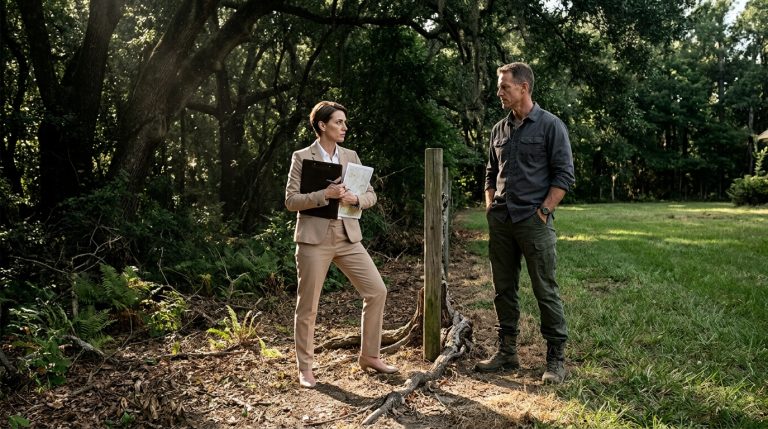
The Weight of Concrete and Paper: Unraveling a Suburban Tyranny Through Cold Calculation and Rusted Truth
CHAPTER 1: THE TWO OCLOCK KITCHEN
The coffee had already settled into the bottom of the ceramic mug by the time Garrett stepped through the screen door, letting the latch click home with a familiar, deadened thud that had not changed since the Clinton administration. Dolores sat at the laminate table with her glasses perched high on the bridge of her nose, her fingers resting flat against a three-page stack of legal bond paper that smelled faintly of a Raleigh printing shop.
“You drove too fast,” she said. Her voice didn’t shake. It had the dry, seasoned cadence of someone who had watched three decades of southern pines weather into grey timber.
“Four hours,” Garrett said, dropping his keys onto the counter. The metal clinked against the formica. “The speed limit was compliant most of the way.”
“The girl at the management office didn’t even look up when she handed it to the boy,” Dolores continued, sliding the document across the grain with two fingers. “Just dropped it like a dead bird on the welcome mat. Seven days, Garrett. Apparently, the roses are threatening the structural integrity of the county.”
Garrett picked up the first page. The language was dense, bloated with statutory citations meant to frighten people who paid their taxes and kept their mouths shut. His thumb rubbed the edge of the paper, feeling the crisp, sharp bite of the cut. Twelve years of watching terrain shift under pressure had taught him one absolute rule: when an adversary moves with excessive noise, they are trying to cover the ground where they are weakest.
“They’re measuring from the wrong baseline,” he said quietly, his eyes tracking the clause referencing repeat offenders and habitation restrictions. “They took the height from the top of the fence rail instead of the grade level. Anyone with a tape measure and a straight eye can see it.”
“Beverly doesn’t use a straight eye,” Dolores murmured, taking a sip from her cup. “She uses a magnifying glass. Ever since the old man across the street moved down to Florida with his bad hips, she’s needed a project. A neighborhood doesn’t run itself, she tells people. Someone has to keep the standards from sliding into the ditch.”
Garrett didn’t answer right away. He walked to the kitchen window, parting the cotton curtain just enough to look out at the yard. The stone path he and his father had laid back in ninety-four cut a pale, uneven spine through the grass, grey limestone flecked with quartz they’d pulled out of a roadside ditch up near Boone. The mailbox sign—hand-painted, the blue paint flaking slightly at the corners—stood sentinel beside the curb.
The paperwork on the table claimed three violations. Two were old ghosts, settled and paid two summers ago when a garden hose had been left out past dark. You don’t drag a closed file back into the light unless you’re digging for ballast.
“Who signed the certification on page three?” Garrett asked, his breath fogging the corner of the cold windowpane.
“A lawyer named Vance in Raleigh. But the filing ID at the top belongs to the board’s administrative register.”
“Which requires a quorum,” Garrett said, turning back from the glass. The shadow of the overhead bulb caught the hard line of his jaw. “Section six of the original 1991 covenants. You can’t restrict occupancy without a recorded vote of at least four sitting members, documented in open minutes.”
Dolores looked up at him then, her eyes sharp behind the bifocals, holding a flicker of something that wasn’t fear, but a cold, waiting curiosity. “And you think Beverly forgot to hold a meeting?”
“People who build small kingdoms don’t like sharing the throne long enough to take a vote,” Garrett said, reaching for his jacket. “They just assume the stationery does the work for them.”
He reached out and picked up the second page, his thumb resting over the signature block where Beverly Trout’s name was stamped in crisp, unyielding black ink. But as his eyes drifted down to the margins of the appendix—a routine financial disclosure statement stapled to the back of the eviction notice as padding—a small numerical discrepancy caught the edge of his vision, sitting quietly beneath the noise of the rose dispute.
CHAPTER 2: THE STONE AND THE SEAL
The brass handle of the county records office was cold enough to bite into the skin of Garrett’s palm. The courthouse had not changed in a decade; it wore the same expression of tired permanence, smelling faintly of floor wax, old wool, and damp masonry that had survived every flood and political shift since the reconstruction.
Outside, the mid-morning sun was burning off the low-hanging valley fog, cutting long, pale shafts of light across the asphalt where a line of work trucks idled with a low, rhythmic vibration. Garrett didn’t rush his stride. A man who moves too fast in a government building only attracts the kind of bureaucratic attention that ends in a three-week waiting period for a carbon copy.
He walked past the records counter, where a clerk with half-moon spectacles was methodically stamping a stack of property liens with a heavy, rhythmic thunk.
“Public access terminals are down in the east alcove,” the clerk muttered without looking up. “Use the manual drawers by the pillar if you’re looking back past ninety-five.”
“I’m looking for the structural register,” Garrett said, his voice level, pitched just low enough to carry across the linoleum without drawing the room’s collective gaze. “Subdivision filings for Penrook Lane, specifically the original 1993 incorporation and any subsequent amendments regarding board authority over residential modifications.”
The clerk paused, the stamp hovering a fraction of an inch above a blue form. He looked up, his eyes narrowing slightly as they swept over Garrett’s weather-worn canvas jacket and the flat, unblinking stillness of his posture. People who came in asking for specific covenants usually wanted to start a fight. People who asked for foundational incorporation documents usually brought an axe.
“Drawer four, second row down,” the clerk said, turning back to his paperwork. “Don’t take the originals out of the metal sleeves.”
Garrett pulled the heavy steel drawer out. It groaned against its tracks, shedding a fine film of gray dust that settled across the knuckle of his thumb—the unmistakable signature of neglected paper. Inside, organized by yellowing tabs and rusting paperclips, sat the legal architecture of a hundred suburban dreams built on swampland and red clay.
He didn’t look for his mother’s name immediately. That was a rookie’s error—running straight for the grievance instead of the foundation. Instead, he pulled the master roster of the original board, tracing the signatures from thirty years ago down through the successive elections until he hit the three-year window corresponding to Beverly Trout’s ascent.
The paperwork told a very quiet, very precise story.
A homeowners association is a small machine. Left alone, it rusts into harmless irrelevance. But when someone with a taste for control takes the crank, the gears tighten. The rules stop being about property values and start being about leverage.
Garrett’s finger traced a line down the 2021 financial amendment—the one that granted the board president unilateral authority to contract emergency maintenance without a three-member quorum if the community’s safety was deemed at risk. It was a neat little paragraph, tucked away between standard provisions for fence paint and roof shingles. It had been added during a rainy Tuesday night meeting where only two board members had signed off, neither of whom had lived on Penrook Lane for more than twelve months.
A sharp clatter echoed from the main hallway—the metallic snap of a security gate and the heavy, deliberate click of heels against the tile.
Garrett didn’t turn his head. He adjusted his weight onto his back foot, his peripheral vision locking onto the reflective glass of the directory board across the hall. A woman in a sharp cream blazer, carrying a leather folio tucked tightly against her ribs, was speaking in a clipped, low register to one of the county zoning officers.
Beverly Trout.
She wasn’t supposed to be at the courthouse today. According to the board schedule, Tuesdays were her days for managing the regional property management consortium in Greensboro. But panic has its own geography, and it always leads back to the paper trail.
She stopped at the water fountain, her reflection caught briefly in the dark glass of the exit doors. Her fingers were working the clasp of her leather folio with a nervous, repetitive snap—open, close, open, close. She looked smaller out here, away from the manicured perimeter of her white Cadillac and the protective buffer of her lawn ornaments. Without the driveway to frame her, she looked like someone who had spent so long guarding a small perimeter that she had forgotten what lay beyond the property line.
Garrett let the metal drawer slide shut with a heavy, muffled thud. The sound was deliberate—just loud enough to carry over the hum of the vending machines.
Beverly stiffened. Her head jerked toward the east alcove, her eyes narrowing as she scanned the rows of steel shelving. For three seconds, neither of them moved. The courthouse air hung heavy between them, thick with the smell of old dust and the silent friction of two different worlds colliding over a paragraph of local ordnance.
Then, Beverly turned sharply on her heel, her posture tightening into an impenetrable shell of institutional authority, and walked toward the Records Supervisor’s desk.
Garrett watched her go, his hand sliding into his pocket to brush against the corner of the photocopied covenant. The machine was oiled, the gears were turning, and the first layer of the wall was beginning to show its hairline fractures.
He turned toward the side exit, stepping out into the blinding mid-day glare of the parking lot where his truck idled softly in the heat.
CHAPTER 3: THE WHITE CADILLAC THRESHOLD
The tires crunched over the loose gravel of Penrook Lane just past noon, the heat shimmering off the manicured lawns in pale, distorted waves. Garrett didn’t pull into his mother’s driveway immediately. Twenty yards short of the Wolfson place, a white Cadillac SUV sat parked directly across the asphalt, its engine idling with a low, expensive hum that rattled the air in the wheel wells.
Beverly Trout stood beside the driver’s side door, her cream blazer pristine despite the midday glare, holding a clipboard pressed tightly against her waist like a shield. She wasn’t looking at the sky or the weeping cherries down the lane; she was staring straight up at the hand-painted wooden sign by Dolores’s mailbox—the one that had marked the property line since the first Bush administration.
Garrett brought the Ford to a slow, deliberate halt thirty feet back. He didn’t kill the ignition. He let the engine rumble softly, keeping the vehicle in gear, watching the way Beverly’s shoulders tightened under the heavy fabric of her jacket every time a cicada buzzed through the dry air.
He stepped out of the cab into the thick, sun-baked humidity, his boots hitting the pavement with a flat, heavy thud.
Beverly turned around slowly, her chin lifting just a fraction of an inch—the practiced posture of someone accustomed to ruling a micro-fiefdom of trash cans and lawn heights. Her expression didn’t show surprise; it showed a tight, brittle annoyance, the kind worn by people who found reality inconveniently stubborn.
“Mr. Wolfson,” she said, her voice dry and clipped, carrying across the asphalt without a trace of warmth. “I trust your trip to Raleigh was educational. Though I would advise against tracking county dust onto public rights-of-way.”
“The asphalt is public, Beverly,” Garrett said, closing the truck door with a solid, weighted click. He didn’t walk toward her; he maintained his distance, letting the empty space between them work as a buffer. “The driveways, however, require a forty-eight-hour written notice for inspection. At least, that’s what the 1993 covenants say down in drawer four.”
A tiny micro-twitch registered at the corner of her left eye. It was gone in less than a second, swallowed back into the rigid mask of her corporate-styled composure, but it was there—the sudden, sharp realization that her paperwork hadn’t stayed locked in the filing cabinets where she left them.
“The covenants are administered by the board executive,” she said, stepping around the open door of her Cadillac and resting one manicured hand against the cool metal of the fender. “And the board has standard procedures for handling uncooperative residents who choose to ignore municipal aesthetic standards. Your mother’s mailbox sign violates section twelve, paragraph four. Unapproved exterior modification. It’s been logged.”
“Logged by who?” Garrett asked, taking two slow steps forward. The gravel crunched under his boots with a dry, rhythmic friction. “There hasn’t been a quorum vote on Penrook Lane since the autumn budget review. I checked the register this morning. Unless you’ve learned how to clone signatures, your paperwork is missing about three names.”
Beverly’s hand tightened on the fender until the knuckles lost color, the white skin stark against the dark paint of the vehicle. “You are interfering with routine neighborhood management. This community relies on order, Mr. Wolfson. People who don’t understand that tend to bring unnecessary complications upon themselves—and upon their aging relatives.”
“My mother has lived here thirty-one years, Beverly,” Garrett said, his voice dropping an octave, losing all conversational polish until it sounded like a heavy iron gate settling into frozen earth. “She laid that stone path by hand. She knows every root system under this dirt. When you start throwing around seven-day notices for four inches of natural growth, you aren’t managing a neighborhood. You’re trying to push people out before someone looks too closely at what’s underneath.”
For a single heartbeat, the air between them went completely dead. The cicadas seemed to stop their shrill humming, and the only sound was the low, mechanical thrum of the Cadillac’s air conditioning unit. Beverly’s gaze flicked away from his face, dropping down toward the manila folder sticking out of his canvas jacket pocket—the photocopied municipal records, the registry stamps, and the faint, unsettling hint of a financial trail leading straight back to a shell company in Raleigh.
She swallowed, her throat moving sharply beneath the collar of her blouse, but her voice held its thin, brittle lacquer.
“You’re out of your depth, Navy boy,” she whispered, the polite suburban veneer finally cracking just enough to let the raw panic bleed through. “This is a private association. We handle our own affairs.”
“Not anymore,” Garrett said.
He didn’t say another word. He turned his back on her, walking past the white Cadillac toward his mother’s porch without looking back to see if she got into the vehicle or stood there in the dust. Behind him, the gravel crunched as Beverly yanked her door open, the heavy metal slamming shut with a sharp, echoing crack that cut through the afternoon heat.
The white SUV didn’t back out; it lurched forward, its tires spitting small stones against the curb as it sped down the lane, leaving behind a thin, settling cloud of gray dust that slowly drifted over the unyielding green of the rose bushes.
Garrett walked up the wooden steps, the old pine boards groaning softly beneath his weight, and pushed open the screen door. Dolores was sitting at the kitchen table with a fresh cup of coffee, her eyes fixed on the doorway as he stepped inside and let the latch fall home.
CHAPTER 4: THE KITCHEN TABLE COUNCIL
The coffee pot had grown cold on the burner, leaving a dark, bitter ring around the base of the glass carafe. Garrett pulled out a wooden chair, the legs scraping across the linoleum with a harsh, dry screech, and sat down opposite his mother. Between them, the papers from the county clerk’s office lay scattered like dry leaves caught in a draft.
Thatcher arrived twenty minutes later, his sedan crunching over the gravel before killing its engine with a tired mechanical wheeze. He didn’t knock; he just pushed the screen door open, carrying a thick manila folder tucked under his arm and smelling of wet asphalt and printer toner. He dropped the folder onto the formica with a dull, heavy slap that made Dolores’s ceramic mug rattle in its saucer.
“It’s wider than a single procedural oversight,” Thatcher said, pulling out a chair without waiting for an invitation. He didn’t take off his coat; he unzipped it halfway, revealing a rumpled dress shirt with the sleeves rolled up to reveal thick, weather-beaten forearms. “I spent the last three hours pulling the financial disclosures for the last four fiscal cycles. The numbers don’t just lean; they collapse under their own weight.”
Garrett didn’t touch the coffee. His fingers rested flat against the edge of the table, tracing the worn grain of the wood where thirty years of family history had rubbed the varnish smooth. “How bad is the reserve fund?”
“For a development of this size, with eighty-two units and a community pool? It should be sitting north of three hundred thousand,” Thatcher said, tapping a finger against the corner of a computer printout. “As of last quarter, they had forty-two thousand dollars in the common account. Forty-two thousand. That’s not a reserve; that’s a drying puddle.”
Dolores sat quietly at the head of the table, her hands folded over a linen napkin. Her expression hadn’t changed since morning—steady, unyielding, but carrying the heavy, silent weight of someone watching strangers measure the perimeter of her life. “Beverly always complained about the maintenance costs,” she said softly. “Every summer she’d hold a meeting about the pool pumps, talking about how expensive parts had become since the supply chains broke down.”
“Parts didn’t break down,” Thatcher said, opening the manila folder to reveal a multi-page spreadsheet filled with neat columns of numbers. “The vendor did. Look at the disbursement records for the major capital improvement project two years ago—the pool resurfacing job.”
Garrett leaned in, his eyes scanning the rows of figures until they hit the line item for Pristine Aquatic Solutions LLC. The billed amount to the homeowners association was three hundred eighty thousand dollars. Below it, attached via a stapled county permit receipt, was the actual projected cost of materials and labor filed with the municipal assessor’s office: thirty-one thousand five hundred.
A gap of nearly three hundred and fifty thousand dollars doesn’t disappear into administrative overhead or routine contractor inflation. It leaves tracks, sharp and deep, like heavy machinery dragging across soft soil.
“Who owns Pristine Aquatic Solutions?” Garrett asked, his voice flat and even.
Thatcher flipped the page, revealing a state business entity registration form bearing a Raleigh stamp and a signature block at the bottom.
Beverly Renee Trout.
The silence in the kitchen grew heavy, pressing against the windows like the humid air outside. There was no theatrical gasp, no sudden outburst of rage. Out here on Penrook Lane, corruption didn’t wear a villain’s mask; it wore a cream blazer, drove a white Cadillac, and hid behind paragraphs about lawn heights and rose bush clearances.
“The eviction notice wasn’t about the roses,” Garrett said, the pieces locking into place with the cold, mechanical precision of a breech-bolt sliding home. “The roses were just a convenient lever. If she could force my mother out quietly within seven days, she’d clear the immediate property line of anyone who remembered what the neighborhood looked like before the board files were consolidated.”
“And if we pushed back through official channels without the financial data, she would have buried us in legal fees until the house had to be sold to cover the court costs,” Thatcher added, tossing a pen onto the table. “She’s been using the HOA’s operating account as a private line of credit, covering the deficits by leaning hard on older residents who don’t want the trouble of fighting back.”
Garrett stood up abruptly, walking over to the sink to look out toward the front yard. The sun was dipping lower now, casting long, bruised shadows across the stone path he and his father had laid three decades ago. The mailbox sign stood crooked by an inch where the frost had heaved the post over the winter.
“Twelve years in the service teaches you how to map an adversary’s perimeter,” Garrett said, his back to the table. “You don’t attack the strongest point of the wall. You look for the seam where the mortar has rotted out.”
He turned back around, his eyes locking onto Thatcher. “How many other families on this lane have received sudden compliance warnings in the last six months?”
“At least four,” Thatcher said, sliding a second list across the formica. “All elderly residents, all living within two blocks of the common pool area. All of them paid minor fines or fixed things that weren’t broken just to keep the peace.”
“Then we stop playing defense,” Garrett said, his hand resting on the back of the wooden chair. “We don’t wait for the board meeting. We start walking the lane tonight.”
CHAPTER 5: THE SHOEBOX ARCHIVE
The dusk air carried the metallic tang of cooling asphalt and dry pine needles as Garrett walked down the gravel shoulder toward the lower loop of Penrook Lane. The houses here wore identical brick facades and manicured turf, but beneath the uniform exterior, every property held the quiet, heavy tension of a perimeter under watch.
He didn’t knock on the front doors with the casual rhythm of a neighbor dropping by for sugar. He knocked with two measured raps of his knuckles against hollow wood—the flat, deliberate sound of someone who expected an answer.
At number 412, the porch light flickered on after a long interval. The lock turned with a dry click, and the heavy oak door opened an inch, held securely by a rusted brass chain. A pair of faded, anxious eyes peered through the narrow gap, framed by gray hair pulled back in a loose bun.
“Mrs. Gable?” Garrett asked, keeping his voice low, pitched to carry across the screen without startling her.
“I paid the fine,” the old woman whispered immediately, her fingers clutching the edge of the door frame until her knuckles went gray. “The certified letter said if I didn’t clear the branches by Tuesday, the board would add another two hundred dollars to the assessment. I wrote the check yesterday morning. It’s already in the drop box.”
Garrett didn’t move away from the threshold. He kept his shoulders squared, offering a steady, unthreatening posture against the darkening evening. “You didn’t violate the landscape code, Mrs. Gable. The branch clearance rule applies to thirty-foot setbacks, not your side fence.”
She blinked, her gaze dropping to the canvas jacket he wore, then up to the sharp, flat line of his jaw. “The paper had the stamp on it. The red seal from the management office. Beverly said if a resident doesn’t keep their boundaries clean, the whole street depreciates.”
“Beverly used that stamp to clear the field,” Garrett said, his hand sliding into his pocket to touch the folded statement from the county records office. “She’s been running money through a private account for two years, using compliance fines to plug the holes in her own ledgers. You aren’t the only one who received a bill that didn’t belong in your mailbox.”
The old woman stared at him for a long, quiet moment. The tension in her shoulders didn’t vanish, but it shifted—moving from blind panic into something heavier, something like exhausted recognition. Slowly, with a metallic rattle that set Garrett’s teeth on edge, she unhooked the brass chain.
She stepped back into the dim hallway, leaving the door wide. “Come inside, Mr. Wolfson. My husband passed two years ago, and I haven’t opened a box from that association since the day they installed the new pool.”
She led him back down a narrow hallway smelling of lemon polish and old paper into a small back bedroom where a metal-framed twin bed sat against the wall. Bending down with a sharp groan of protesting joints, she pulled a battered shoebox out from the shadows underneath the dust ruffle. The cardboard was faded at the corners, bowed inward by the weight of three years’ worth of certified envelopes, photocopied citations, and handwritten receipts.
She set it on the edge of the mattress and took off her glasses, wiping them slowly on the hem of her apron.
“Every time a new envelope came, I thought I was losing my mind,” she murmured, her voice cracking slightly as she lifted the lid. “I thought I forgot how to maintain a garden after forty years on this street. I just paid it because fighting them felt harder than losing the house.”
Garrett knelt beside the box, his fingers sifting through the dense strata of paper. Each violation notice was identical—the same corporate font, the same threatening statutory citations, the same unverified signature blocks stamped in black ink. But as he sorted through the bottom layer, beneath a stack of parking warnings from two summers ago, a folded yellow carbon slip caught his eye.
It was a bank counter receipt dated eighteen months prior, showing a cash transfer deposited directly into an account bearing the name Pristine Aquatic Solutions LLC, signed with the same initialed scrawl that appeared on the bottom of his mother’s eviction notice.
Twelve other families on this lane had shoe boxes just like this one. Twelve separate households taxed, frightened, and ground down by a petty tyrant playing accountant with a rubber stamp.
“Keep the box,” Garrett said quietly, looking up from the floor. “We’re going to need every page of it tomorrow night at the community center.”
Mrs. Gable looked down at the cardboard archive, her hand reaching out to touch the worn corner of the lid. “Will she be sitting at the head of the table?”
“No,” Garrett said, standing up and brushing the dust from his knees. “She won’t.”
CHAPTER 6: THE COMMUNITY CENTER RECKONING
The fluorescent lights of the Penrook Lane Community Center hummed with a low, aggressive vibration that cut through the silence of the lobby. Inside, the folding chairs were packed tight against the wood-paneled walls. Homeowners stood three-deep along the perimeter, their faces drawn and tight in the harsh overhead glare. Renwick stood near the back emergency exit, clutching a clipboard like a drowning man holding a splintered oar.
Up front at the laminate table, Dorance sat flanked by two other board members, his expression carved from old pine. Empty space dominated the center chair at the head of the table—the seat reserved for the president.
The heavy double doors swung open with a sharp click.
Beverly Trout walked down the center aisle. She wore her signature cream blazer, her stride deliberate and unyielding, though her eyes flicked rapidly across the crowded room, taking in the standing homeowners, the stack of shoebox files under Mrs. Gable’s arm, and the quiet, solid presence of Garrett standing near the back row. She didn’t look at Dolores, who sat quietly in the third row wearing her Sunday blue dress, hands folded calmly in her lap.
“This is an unauthorized gathering,” Beverly announced, her voice cutting through the room with a practiced, razor-sharp edge as she dropped her leather folio onto the table. “Unless the executive committee has vetted the agenda twenty-four hours in prior, any motions brought tonight are procedurally null. Dorance, call the meeting to order and clear the aisles.”
Dorance didn’t touch his gavel. He leaned forward, resting his forearms on the formica, and looked straight across the table at her. “Where are the official minutes for the vote authorizing the eviction notice against Dolores Wolfson, Beverly?”
The silence that rushed into the room was heavy, dense with the collective weight of twelve households holding their breath.
Beverly’s chin lifted. “The president possesses emergency administrative powers under section twelve for structural preservation. The board was informed.”
“We weren’t informed of a damn thing,” Dorance said, his voice dropping an octave into a low, rumbling authority that brooked no argument.
Thatcher stepped forward from the side aisle, carrying a thick binder of municipal documents and bank statements. He didn’t raise his voice; he simply laid the papers flat on the table directly in front of Beverly’s leather folio.
“Section twelve requires a verified quorum and a recorded vote filed with the county clerk,” Thatcher said, his finger tapping against the stamped municipal registry. “More importantly, emergency powers do not extend to self-dealing, unauthorized disbursements, or operating an unbonded shell company under the guise of association maintenance.”
He flipped the binder open to the financial disclosures. The projector mounted above the table clicked on, throwing a bright, glaring white rectangle onto the pull-down screen behind the board.
Pristine Aquatic Solutions LLC.
The corporate registration form filled the wall. Name: Beverly Renee Trout. Registered address: A post office box in downtown Raleigh. Below it, the capital improvement contract for the community pool: three hundred eighty thousand dollars billed to the association. Directly beneath that, the county assessor’s permitted work order: thirty-one thousand five hundred.
A collective murmur rolled through the standing crowd like wind through dry brush. Old Mrs. Gable clutched her shoebox tighter against her chest. Renwick shifted uncomfortably by the back door, his pencil snapping clean in half between his fingers.
Beverly’s face drained of color, the bright, artificial flush of her cheeks giving way to a gray, paper-thin pallor. Her hands dropped to the edge of the table, her fingernails digging into the formica. “The pool required specialized engineering. Prices fluctuate. The board approved the budget framework.”
“The board approved nothing of the sort,” one of the junior members muttered, staring down at his notepad as though seeing it for the first time.
Garrett stepped out from the shadows of the back row, walking slowly down the center aisle until he stood three feet from the table. He didn’t look at Beverly; he laid a single, certified land survey down beside the financial ledger.
“And the roses?” Garrett asked quietly, his voice carrying effortlessly across the silent room. “The formal notice claimed a violation of four inches over natural growth limits, measured from the highest structural point. My landscape architect certified the actual grade. Two bushes were fully compliant. The third exceeded the line by exactly one and one-quarter inches. That was the emergency. That was the justification used to force a ninety-three-year-old woman out of her home in seven days.”
Beverly looked around the room, her gaze sweeping from the projector screen to the hard, unblinking eyes of the neighbors she had spent three years managing through fear and petty paperwork. She opened her mouth to speak, but no sound came out—only the dry, shallow intake of breath of someone whose small, walled kingdom had finally run out of walls.
Dorance raised his hand, his palm flat and decisive. “The eviction notice against Dolores Wolfson is hereby rescinded and declared null and void ab initio. Furthermore, Beverly Trout is placed on immediate, indefinite suspension from all board duties, pending a full forensic audit by the state attorney general’s office.”
Four hands went up around the table before the echo of his words had even faded.
Beverly stared at them for three long seconds. Then, without a word, she snatched her leather folio off the table, turned sharply on the heel of her designer pumps, and walked out the side exit without looking back. The heavy metal door swung shut behind her with a dull, final thud.
The audit took six weeks. The state investigators found more than three hundred thousand dollars in unsupported disbursements, shell invoices, and falsified maintenance logs. The community association was restructured, the fines refunded, and the shoe boxes put back on closet shelves where they belonged.
Two months later, the morning sun was cutting a clean, warm path across Penrook Lane. Garrett stood on the front porch with a wrench in his hand, tightening the loose bolt on the mailbox sign that said The Wolfson Place. The blue paint was still slightly chipped at the corner, but the post stood straight and unyielding against the red clay.
Down the stone path—the one laid by hand three decades ago—Dolores walked slowly toward the garden, her secateurs in hand, clipping back a stray branch of roses that had grown a fraction of an inch past the border. She didn’t measure them. She didn’t need to. The ground belonged to her, and the road was quiet at last.