The Iron Gate of Whispering Pines: Standing Firm Against the Uniform Tide of Suburban Control
CHAPTER 1: The Smoke Over the Fence
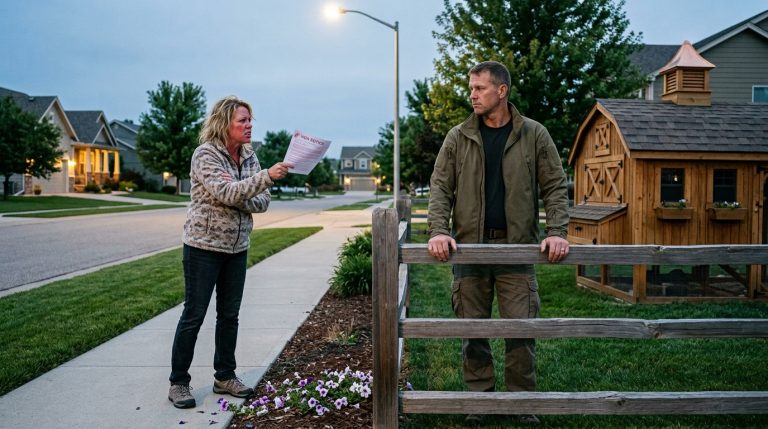
The fat from the ribeye hit the coals with a sharp, greasy hiss, sending a pale blue plume curling into the stagnant evening air of Whispering Pines. Across the property line, the manicured emerald lawn of number 44 stretched out like a billiard table, untouched by a single stray dandelion or fallen leaf.
Julian stood on the warped cedar boards of his porch, turning the meat with a pair of long-handled tongs. He didn’t look back, but he could feel the weight of it—the cold, unblinking focus coming from the other side of the rusted iron wire fence.
Brenda didn’t blink. She stood ankle-deep in her chemically fertilized Kentucky bluegrass, her heels sinking precisely zero fractions of an inch into the spongy earth. In her left hand, she held a black leather-bound clipboard; in her right, an iPhone aimed squarely at Julian’s back porch. Her lips were pressed into a hard, bloodless line, the expression of a woman who viewed a stray weed as an act of personal treason.
“You’re drifting over the line again, Julian,” she called out. Her voice carried across the dead air, thin and sharp like a dry pine twig snapping underfoot. “Decibel levels on that portable speaker are registering past fifty-five. Municipal ordinance dictates a maximum of forty-five after six o’clock.”
Julian set the tongs down on the splintered wood of the prep table. He wiped his hands on a rag that smelled faintly of motor oil and tomato vines. He turned slowly, letting the afternoon sun catch the gray dust settled in the cracks of his boots.
“There’s no ordinance out here, Brenda,” Julian said, his voice flat, stripped of any rising inflection that might invite debate. “You know that. The county recorder maps this parcel three hundred feet outside your corporation limits.”
Brenda tapped the screen of her phone, her thumb moving with the practiced rhythm of an auditor calculating a ledger deficit. “The corporate boundary was amended during the second phase development filing of nineteen ninety-eight. Your grandfather’s signature is a legal ghost, Julian. A technicality of an old man refusing to look at the future.”
“My grandfather signed nothing,” Julian said, stepping off the porch and walking toward the rusted wire boundary. The earth beneath his boots felt loose, full of stones and old roots, resisting the unnatural flatness of the subdivision beyond. “He let them pave around him like water hitting a stone. You want to call code enforcement, go ahead. The inspector was here Tuesday. He looked at the sunflowers, he looked at the porch, and he drank a glass of well water.”
Brenda lowered the phone, her eyes narrowing as she adjusted her tortoiseshell glasses. “The inspector is an inefficient bureaucrat who hasn’t read the updated neighborhood covenants regarding secondary property blight. When that lien hits your title tomorrow morning, let’s see how much water you’re drinking.”
She turned on her heel, her movements sharp and rehearsed, and marched toward her immaculate back door without waiting for an answer.
Julian stood by the wire, watching the screen door latch behind her with a clean, expensive click. He looked down at the base of the corner post, where a weathered stone marker sat half-buried in wild chicory. Something glinted beneath the dry dirt—a yellow plastic surveyor’s flag, freshly driven into his side of the boundary line, its printed coordinates turned away from his view.
CHAPTER 2: The Clipboard Shadow
The plastic flag mocked him from the tall grass, a neon stub of authority planted two feet inside the invisible line that had held firm since the Truman administration. Julian did not touch it. To pull it up would be to play a game with rigged rules; to leave it was to invite an anchor. He bent down instead, his knuckles brushing against the dry, sun-baked dirt, and scooped up a handful of loose soil mixed with flint and shale. It was heavy, unyielding earth that had never known a bag of chemical fertilizer or a landscaper’s spade.
The morning light cut through the overgrown apple trees, casting long, fractured shadows across the unpaved path leading down to his grandfather’s old workshop. A sudden flash of memory pulled at the back of Julian’s mind—his grandfather kneeling in this exact spot thirty years ago, hammering a stubborn iron hinge back into place with rhythmic, unhurried blows, muttering that a man who lets another fellow draw his boundaries has already lost the room to sit in.
A sharp rap of a high heel on concrete shattered the quiet.
Julian turned slowly. Brenda stood at the corner of her manicured property line, her clipboard tucked firmly beneath her arm like an officer’s baton. She wasn’t holding her phone today; instead, she wore a pair of thin leather gardening gloves, clean and unstained, tapping a silver pen against her thumb with a metronomic cadence.
“Survey crew was out at dawn, Julian,” Brenda said, her voice carrying across the wild grass with practiced crispness. “Phase Two property adjustments were registered with the county clerk three days ago. That corner post? It sits forty-two inches inside the municipal utility easement now. Which means your tool shed violates setback regulations.”
Julian wiped the dry dirt from his palm onto the thigh of his jeans. He didn’t step forward. He kept his weight balanced on the balls of his boots, feeling the familiar friction of the uneven ground beneath him.
“My grandfather’s workshop was built in nineteen forty-four,” Julian said evenly. “Easements didn’t exist out here then. The county records from the old township office show an explicit waiver grandfathered into the original municipal incorporation act.”
“Old papers rot, Julian. Just like wood left out in the rain,” Brenda replied, taking a measured step closer, though she stopped short of crossing the rusted wire boundary. Her eyes flicked toward the weathered cedar siding of the shed, measuring its dimensions with cold, calculating precision. “The board is meeting on Thursday to review structural non-compliance files. When they issue the abatement order, you won’t just be looking at fines. The county will have to clear the hazard.”
“Hazard,” Julian repeated, tasting the word. It was a clean, bureaucratic word designed to mask the simple act of taking something that didn’t belong to them. “It’s an apple press and a workbench.”
“It’s an unpermitted structure on an improperly maintained parcel,” Brenda countered, her pen tapping faster now against her glove. ” Whispering Pines maintains a property valuation standard. Every single house within a half-mile radius depends on uniformity. Your little island of… neglect pulls every equity line down. People have invested their life savings here, Julian. They aren’t going to let one stubborn property ruin their return.”
She turned abruptly, her immaculate loafers crunching on the pristine gravel of her own driveway, and walked away without waiting for a rebuttal. She didn’t look back once.
Julian watched her go, listening to the precise rhythm of her footsteps until they vanished behind the heavy oak door of her garage. He looked back down at the surveyor’s flag. The coordinates printed on the plastic label were fresh, stamped with an ink that hadn’t yet faded in the sun. A municipal utility easement. It was a clever angle—not a direct assault on the historical deed, but a backdoor attack using zoning technicalities that municipal boards loved to rubber-stamp in closed sessions.
He walked past the garden, the tall stalks of sunflowers rustling in the mid-morning breeze, and headed straight for the old screened-in back porch. Inside, the air smelled of old paper, cedar dust, and dried sage. He pulled open the bottom drawer of his grandfather’s oak roll-top desk, shoving aside a clutter of rusted hex nuts, vintage spark plugs, and brass door keys, until his fingers brushed against a heavy, canvas-bound ledger with water-stained edges.
The title papers from nineteen forty-eight were right where his grandfather had left them, pinned beneath a lead paperweight shaped like an anvil. But as Julian flipped open the brittle parchment pages, something else slipped out from between the folds—a pink carbon-copy notice from the municipal tax assessor’s office, dated just six weeks prior.
It wasn’t addressed to his grandfather. It was addressed to Brenda’s household at number 44.
Julian brought the paper closer to the window, squinting at the fine print. It was a final notice of tax lien arrears, stamped in bold red ink across the top margin: SECOND WARNING — IMMINENT FORECLOSURE PROCEEDINGS.
The numbers at the bottom weren’t small. They represented an amount that a suburban homeowner living a life of immaculate, expensive pretense could never hope to absorb on a single income.
Julian stared at the red stamp, the pieces clicking into place with the cold, heavy snap of a mechanism falling into gear. The pristine lawn, the relentless clipboard policing, the sudden obsession with his property lines—it wasn’t just about neighborhood aesthetics. Brenda wasn’t protecting Whispering Pines’ property values out of civic pride. She was trying to force a municipal variance or an emergency land acquisition to bail out her own sinking ship, using the county’s zoning board as a blunt instrument to carve up the only unattached parcel left on the block.
He set the paper down on the scarred wood of the desk, his reflection staring back at him from the dark, dusty glass of the windowpane. The game had changed from a simple neighborhood nuisance into something far sharper, and for the first time, Julian could see the panic hidden just beneath Brenda’s iron-pressed exterior.
He reached for the telephone on the corner of the desk, his thumb tracing the worn plastic receiver before he picked it up and dialed the direct number for the county land records office.
CHAPTER 3: The County Archives and the Iron Deed
The receiver clicked down onto the cradle with a hollow, plastic thud. Julian did not wait for the office clerk to return on the line. He had heard enough of the automated directory loop to know that public records for nineteenth-century land grants required an in-person signature and a thumb through the basement leather-bound folios.
He didn’t change his shirt. He left the grease-stained work jacket hanging on the porch peg, grabbed his truck keys off the iron tray by the door, and walked straight out to the gravel drive. The old Ford’s engine sputtered twice before catching with a deep, rattling cough that shook the rusted fender.
The drive into town was a study in artificial horizons. Every mile he put between his property and Whispering Pines felt like passing through layers of fresh paint applied over rotten wood. Cookie-cutter strip malls, identical franchise facades, and pristine subdivisions blurred past the cracked windshield. When he reached the county administration annex, the building stood like a monument to gray administration—a square block of utilitarian brick constructed during the Eisenhower era, surrounded by rows of heat-shimmering asphalt.
Inside, the air smelled of floor wax, ozone from old copying machines, and decades of damp paper stored below grade.
“Deed records for Township Four, unincorporated section twelve,” Julian said, leaning his forearms across the scarred walnut counter of the public record desk.
The clerk, a woman with a mountain of stacked manila folders and glasses dangling from a beaded chain, didn’t look up immediately. She finished typing a sequence into a yellowed terminal before sliding her gaze over the rims of her lenses. “Property identifiers? Parcel numbers?”
“Original farm grant, nineteen forty-four. Name is Miller. Refused inclusion during the Whispering Pines master platting in ninety-eight.”
The clerk’s fingers paused over the keyboard. A faint flicker of recognition crossed her face, followed by the protective, weary caution of a civil servant who had seen too many neighbors fight over fence posts and drainage ditches. She tapped a short string into the system, listened to the heavy, sluggish whir of the mainframe, and then pushed herself up from her rolling stool.
“Wait by table three,” she muttered, turning toward the iron-grilled door of the restricted archive stacks.
Twenty minutes later, she returned carrying a flat cardboard box stamped with archival inventory codes. Inside sat a heavy leather folder bound with faded red ribbon.
Julian untied the ribbon with calloused fingers. The parchment inside was thick, stiff, and yellowed at the edges like old bone. It was the original survey map and covenant exclusion rider signed by his grandfather and countersunk by a county judge fifty years prior. But pinned to the back of the folio was something newer—a municipal annexation addendum dated from the late nineties, bearing a series of initialed stamps.
As Julian traced the margin notes with his thumb, the pattern became stark. The developer’s initial filing had indeed attempted to fold his grandfather’s plot into the Whispering Pines footprint, but his grandfather’s explicit handwritten rejection had carved out an absolute exemption. However, tucked beneath that rider was a secondary administrative note filed just two months ago—initialed not by the county supervisor, but bearing an electronic authorization stamp from the Whispering Pines HOA presidential office.
An administrative override request. Filed under a zoning reclamation clause normally reserved for abandoned or tax-defaulted parcels.
The clerk walked back past the table, pausing to adjust a stack of papers. She glanced down at the open ledger and the loose filing slip in Julian’s hand.
“Looking for the tax default flags, are you?” she asked quietly, her voice dropping beneath the hum of the overhead fluorescent tubes.
Julian looked up. “What do you mean?”
“That parcel next to yours—number forty-four,” the clerk said, leaning slightly against the edge of the adjacent desk, her eyes drifting toward the window facing the parking lot. “People see the green lawns and the German cars out in Whispering Pines, they think everything’s paved with gold. But the president of that association… she’s been fighting the county treasurer’s office for six months over deferred municipal assessments and emergency stormwater liens. Her property’s sitting right on the edge of a forced tax sale.”
Julian stared at the filing slip. The pieces locked together with absolute, merciless clarity. Brenda wasn’t just trying to preserve the neighborhood’s aesthetic symmetry; she was manufacturing code violations against the only exempt property on her border to trigger an emergency municipal boundary adjustment—a legal mechanism that would allow the HOA to absorb his land, liquidate the parcel, and use the equity windfall to clear her own mounting municipal debt.
The air in the archive basement felt thin, smelling sharply of dry ink and old cotton. Julian closed the leather folder slowly, the sound muffled by the thick binding.
“Thanks,” Julian said, his voice entirely steady.
He didn’t rush out of the building. He walked back to his truck with deliberate, measured steps, feeling the heavy heat of the afternoon sun beat down on his shoulders. The game had shifted from defense to a counter-strike, and he knew exactly what letter had to be written next.
CHAPTER 4: The Notice of CounterAction
The engine ticking cooling metal echoed in the quiet evening air as Julian stepped down from the Ford. The gravel crunched under his boots with a dry, sharp rhythm. In his hand, he carried a heavy manila envelope containing certified copies of the nineteen-forty-eight land patent and the county recorder’s plat map.
As he mounted the low wooden steps of the porch, a flash of white caught his eye lodged against the bottom wire of the screen door. A folded square of heavy cardstock paper, slipped in through the mesh without a knock.
Julian pulled it free. It was an official notice from the Whispering Pines Architectural Review and Compliance Board, printed on textured ivory stationery with embossed metallic lettering. NOTICE OF FORMAL ABATEMENT HEARING. The date set for the review was less than forty-eight hours away. The penalty listed at the bottom was staggering: a mandatory municipal seizure and demolition order for all secondary structures deemed non-compliant with district aesthetic codes.
The ink was barely dry.
From across the shared boundary line, the sharp click of pruning shears cut through the stillness. Brenda stood near her back hedge, dressed in a pristine pastel windbreaker, working the blades around a perfectly spherical boxwood shrub. She didn’t look up immediately, but her shoulders were rigid, locked in the posture of a sentinel waiting for an impact.
Julian didn’t head inside. He turned toward the rusted iron fence, the manila envelope heavy in his grip. The dry earth beneath his shoes felt solid, unyielding.
“You missed a spot on the filing, Brenda,” Julian said, his voice cutting across the manicured grass.
The shears stopped. Brenda lowered the handles slowly, turning to face him. Her expression was a hard, defensive mask, stripped of the polite veneer she wore for the rest of the subdivision. Her eyes darted to the manila envelope in his hand, lingering on the embossed seal of the county clerk’s office visible through the corner opening.
“The board operates under state municipal authority, Julian,” she said, her voice thin and brittle, carrying a sudden, nervous edge that she couldn’t entirely smooth out. “An independent parcel review was entered into the municipal registry last month. The zoning compliance officer has already signed off on the initial assessment.”
“The zoning officer signed an administrative override form,” Julian replied, taking a step closer to the wire. “A form that requires a verified property lien status before a municipal absorption clause can even be activated.”
Brenda’s jaw tightened. She took a step toward the fence, her leather-gloved hand gripping the plastic handle of the shears as if it were a weapon. “You don’t know what you’re talking about. The board has absolute jurisdiction over the district footprint. If you don’t clear those structures by Thursday, the county heavy machinery will settle the matter for us.”
“The county treasurer’s office has a different file on your desk, Brenda,” Julian said quietly, letting the words drop like lead weights into the space between them. “Parcel number forty-four. Six months of deferred municipal assessments. Emergency stormwater liens piling up while you spend your afternoons measuring grass heights with a clipboard.”
The color drained entirely from Brenda’s face. The sharp, rehearsed authority vanished, replaced for a single, fleeting second by the raw, panicked realization of a cornered animal. Her grip on the shears slackened, the blades dipping toward the turf.
“That’s a private municipal matter,” she snapped, her voice rising sharply, losing its carefully measured cadence. “You have no right—”
“I have every right when your private financial default becomes the justification for trying to swallow my grandfather’s land,” Julian interrupted, his tone cold, flat, and absolute. “The board meeting on Thursday isn’t going to review my shed, Brenda. Because the moment I hand these certified county records to the rest of the board members tomorrow morning, they’re going to see exactly whose name is actually on the default registry.”
Brenda stood frozen beside her boxwood shrub, the immaculate neighborhood around her suddenly feeling painfully fragile, like a thin veneer of paint over rusted iron. She opened her mouth to speak, but no words came out.
Julian turned his back on her, walking back up the weathered steps of his porch without another word. He pushed open the screen door, the old spring hinge creaking softly behind him, and stepped into the dim, familiar quiet of the house. The trap had been sprung, but the real test would come when the board opened their mail the following morning.
CHAPTER 5: The Unraveling of the Board
The morning air smelled of dust and dry cheatgrass. Julian stood on his front porch, holding a sealed, heavy brown envelope addressed to the executive members of the Whispering Pines Architectural Review Board. The sun had barely cleared the eastern ridge of identical rooftops, casting long, sharp shadows across the manicured lawns that stretched out like emerald carpets on either side of his property line.
The screen door gave a light, metallic groan as he let it swing shut behind him. He didn’t take his truck. He walked down the gravel path, his boots striking the ground with a rhythmic, measured cadence, carrying the packet straight toward the community clubhouse three blocks away where the emergency executive session was scheduled to convene at eight sharp.
The clubhouse was a brick-and-stucco building designed to mimic a colonial estate, complete with white pillars and an impeccably swept flagstone plaza. Inside the executive boardroom, the atmosphere was dense with the smell of fresh carpet and percolated coffee. Three members of the board—men and women in pressed business casual attire—sat around a polished mahogany table. Brenda sat at the far end, her posture rigid, her clipboard lying flat before her like a shield. She looked as though she had spent the entire night staring at the ceiling, her eyes shadowed behind her tortoiseshell frames.
As Julian pushed open the heavy oak door, the low murmur of conversation cut off instantly. All heads turned toward the threshold.
“Mr. Miller,” the board treasurer, a graying man named Harris, said, his voice tightening with bureaucratic caution. “This is a closed executive session. Non-residents are not permitted unless formally summoned for a compliance review.”
“I wasn’t summoned,” Julian said, his voice flat and unyielding as he stepped into the cool, air-conditioned room. He walked straight to the mahogany table and laid the heavy brown envelope squarely in the center, right over Brenda’s pristine leather clipboard. “I’m here to submit an addendum to the board registry.”
Brenda’s hand twitched toward the envelope, her fingers curling into a fist against the wood. “The board has already reviewed the primary compliance filings regarding unpermitted structures and boundary violations. We don’t need—”
“Open it, Harris,” Julian interrupted, his eyes fixed on the treasurer.
Harris hesitated, glancing sideways at Brenda’s pale, tightened expression, before sliding a finger beneath the flap of the envelope. He pulled out the thick stack of papers—the nineteen-forty-eight land patent, the certified county recorder’s plat map showing the absolute exemption, and, beneath it, the printed financial default notices bearing Brenda’s household identifier and the looming red tax lien warnings from the county treasurer’s office.
The room grew so quiet that the faint hum of the overhead ventilation unit sounded like a distant engine.
Harris turned the pages slowly, his eyebrows drawing together as his eyes tracked the itemized municipal assessment arrears and the unauthorized zoning override forms bearing Brenda’s initialed executive stamp. The other board members leaned in, their expressions shifting from polite corporate detachment to absolute, stunned disbelief.
“Brenda,” Harris said, his voice dropping an octave as he looked up from the papers. “What is this? The stormwater liens… the boundary override filed against an exempt parcel? The board never voted on an emergency annexation request for parcel forty-four.”
“It was a procedural necessity to protect the neighborhood equity baseline,” Brenda said, her voice sharp, though it cracked slightly at the edge. She stood up abruptly, her chair scraping harshly against the flagstone floor. “The property is a blight. If we don’t absorb it and clear the non-compliant structures, the entire subdivision’s valuation index drops during the upcoming fiscal quarter assessment. I was exercising executive discretion to safeguard the community’s financial interests.”
“You were using executive authority to cover up six months of personal tax defaults by manufacturing a municipal land grab,” Harris retorted, standing up to face her across the table. The legal and financial reality of what she had attempted hung heavily in the air, stripping away every layer of suburban pretense.
Brenda looked around the room, meeting only cold, averted gazes from the people she had governed with an iron clipboard for years. The veneer had cracked entirely, exposing the frantic, hollow core beneath. Without another word, she snatched her clipboard off the table, turned on her heel, and marched out of the executive room, the heavy oak door swinging shut behind her with a dull, echoing thud.
Julian stood silently by the table, watching the light catch the polished wood. The board members sat in stunned silence, the machinery of their controlled little world temporarily grinding to a halt. Julian reached down, picked up his certified copies, and slid them back into his folder.
“The parcel remains exempt,” Julian said quietly to the room at large. “And the board will ensure the boundary markers are restored to their proper place by sundown.”
He turned and walked out of the clubhouse, leaving the pristine, uniform world behind him as he headed back down the road toward home.
CHAPTER 6: The Unbroken Ground
The walk back from the Whispering Pines clubhouse was quiet, measured by the crunch of fine gravel under heavy boot leather and the dry rattle of wind moving through the tall stalks of sunflowers along the fence line. Julian pushed open the screen door of his porch, the old spring hinge groaning with its familiar, well-worn cadence. Inside, the air smelled of old paper, engine oil, and the sharp, green scent of earth drifting in through the open windows.
Within forty-eight hours of the executive session, the board’s resolution swept through the subdivision like a cold draft through a poorly sealed hallway. The emergency municipal annexation request was formally rescinded, logged into the county registry as an administrative error. The yellow surveyor’s plastic flags planted near the corner post were pulled up by a maintenance crew working under strict board supervision, tossed casually into the back of a municipal pickup truck without a word of explanation to the onlookers peering through their pristine, double-paned windows.
Brenda remained inside number 44. Her pristine emerald lawn stayed as manicured as ever, but the heavy curtains on the front picture window stayed drawn shut day after day. The clipboard was gone from her porch; the neighborhood police officer of aesthetic conformity had been stripped of her badge by the very board she had manipulated.
Months passed, and the changing seasons brought a heavy autumn frost that turned the suburban maples into jagged smears of red and gold.
On a bright Saturday afternoon in late October, Julian hauled a pair of heavy wooden speakers out onto the wide, wrap-around porch. The air was crisp, carrying the dry, earthy scent of fallen leaves and woodsmoke. He fired up the old barbecue grill, letting the fat from the sausages hit the coals with a steady, greasy hiss that sent a blue plume curling into the open air.
He didn’t keep the volume low. A live band recording from an old blues record filled the yard, the guitars ringing clear and loud across the property line.
Down the gravel drive, thirty friends and neighbors—people from outside the sterile corporate footprint of the subdivision—arrived in trucks and sedans, parking along the shoulder without a care for municipal curb clearances. Folding tables were set up beneath the apple trees, laden with food and heavy ceramic pitchers. There were no clipboards, no measuring tapes, and no hidden lien notices. Just a gathering of people celebrating the simple, unyielding fact that a home built on history could not be legislated away by a spreadsheet.
As the afternoon sun dipped low behind the western ridge, casting long shadows across the wild garden, Julian walked down to the edge of the property line where the rusted iron wire fence met the corner post.
The old wire was still scarred with age, its metal pitted and brown from decades of weather, but it held its ground. Right beside it, the hand-forged iron latch on the garden gate swung slightly in the breeze, catching on a stubborn hinge that emitted a familiar, metallic squeak.
Julian pulled a small can of machine oil from his back pocket, unscrewed the cap, and let a few slow drops of amber oil sink deep into the dry joints of the hinge. He worked the gate back and forth with his hand, listening as the friction smoothed away into a quiet, effortless glide.
Across the lawn, number 44 sat dark and silent behind its manicured hedges, a monument to a system of control that had finally broken under its own weight. Julian wiped his hands on a clean rag, smelling the rich, dry earth beneath his boots, and walked back up the wooden steps to join the music, knowing the ground beneath his feet was entirely his own.