The Echo of the Unspoken: A Quiet Marine’s Legacy Found in a Tennessee Garage
CHAPTER 1: The Threshold of Silence
The morning air in Maryville held the crisp, biting promise of October, smelling of damp leaves and wood smoke. Henry Caldwell walked with a familiar, rhythmic limp, his boots crunching against the gravel driveway of the Mercer farmhouse. He wasn’t a man who sought out crowds, but estate sales had become his quiet ritual—a way to witness the end of things that people usually hurried to forget.
He took his cap off as he approached the porch, a reflex born of decades of ingrained respect. The handwritten sign, Grandpa Tom passed in August. Everything must go, felt like a small, ragged flag fluttering in the wind. Henry paused, his gaze drifting over the scattered remnants of a life: a chipped butter churn, piles of weathered paperbacks, and a group of young men drinking coffee with the detached boredom of people who hadn’t yet learned how to mourn.
He wasn’t looking for anything in particular. He liked the quiet dignity of the abandoned boxes, the way they held the artifacts of a finished existence. But as he wandered into the garage, his breath caught. It wasn’t the clutter that stopped him; it was the light. A single, dusty shaft of sun cut through the garage door, illuminating a wooden case resting between a chrome toaster and a stack of magazines.
He stopped, his heart stuttering with a rhythm he hadn’t felt since the Queson Valley. He moved closer, the air in the garage feeling suddenly thin. The case was dark walnut, hand-fitted with brass corners that had long ago surrendered to a greenish oxidation. He didn’t touch it, but he knew the shape of the scuff near the latch—narrow, curved, the exact impression of a boot heel kicked in a frantic hurry on a wet morning that had never truly ended for him.
“Excuse me, son,” Henry said, his voice soft against the casual hum of the morning.
The young man standing nearby, preoccupied with his phone, didn’t look up immediately. “Oh, yeah, that one? That’s just Grandpa’s old war souvenir. Forty bucks, take it.”
Henry’s hand tightened on his cap. The indifference was a physical blow, yet he kept his face steady, his eyes locked on the brass latches. He was looking at the end of a bridge he hadn’t known how to cross for fifty-six years.
“All right if I open it?” Henry asked, his voice barely audible over the distant drone of a leaf blower. “Just to look.”
The young man shrugged, dismissive. “Yeah, sure. Go for it.”
Henry knelt. His knees protested, a sharp reminder of the years, but he didn’t care. He reached out, his liver-spotted fingers hovering over the brass. The metal was cold, but as he thumbed the latch, he felt a spark of electric recognition. The click that followed wasn’t just a mechanical sound; it was the sharp, definitive snap of a door opening into a world he had thought buried forever. He lifted the lid, and the garage around him began to fade into the gray, misty shadows of a hillside in November of 1968.
CHAPTER 2: The Weight of Memory
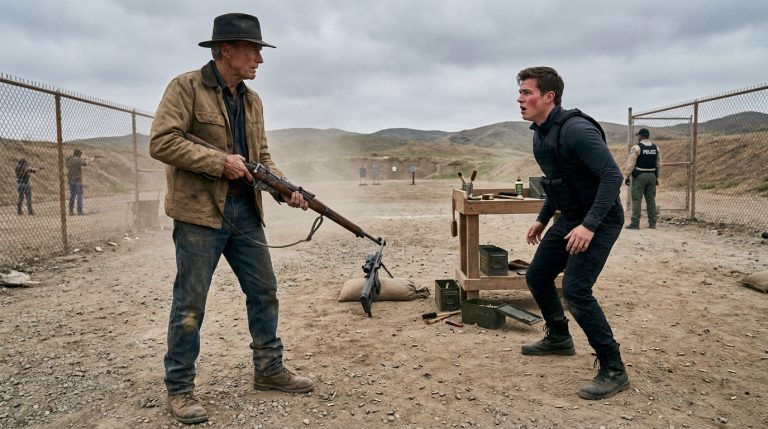
The snap of the rifle’s action against its own receiver was a sound that didn’t belong in a sun-drenched Tennessee garage. It was a dry, mechanical cough, the sound of a predator waking from a long, troubled sleep. As the dust motes danced in the light, Henry found his hand trembling. He didn’t pull the rifle from its felt-lined bed. Instead, he gripped the walnut stock, feeling the texture—worn smooth by palms that had held it in rain, in heat, and in the shadow of death.
The young man standing over him, the one with the beard, shifted his weight. “You alright, sir? You look like you’ve seen a ghost.”
Henry’s breath came in a ragged, measured pull. He felt the cold iron of the barrel through his fingertips. Suddenly, the garage walls seemed to recede. He wasn’t in Maryville anymore. He was back on that hillside, the air thick with the smell of wet earth and the metallic tang of cordite. He could hear the low, steady voice of Tom Mercer, whispering instructions, his hands moving with the practiced, terrifying grace of a man who treated war as a grim kind of geometry. The phantom weight of the green notebook in his own breast pocket seemed to press against his chest, a heavy reminder of all the names that had been erased by the passage of the years.
“I’m fine,” Henry managed, though his voice sounded thin, like parchment paper being folded. He looked up, his pale blue eyes meeting the young man’s confused, impatient gaze. The contrast was a jagged thing—the man standing before him belonged to a world of smart devices and easy convenience, while the rifle in his hands belonged to a world of absolute stakes, where a fraction of an inch determined the difference between a pulse and a memory.
“This,” Henry said, gesturing to the serial number stamped into the metal, “isn’t just a souvenir. It’s a record.”
The younger brother, who had been leaning against a stack of crates, straightened up, a flicker of genuine curiosity breaking through his boredom. “What kind of record? It’s just an old hunting piece, right? Grandpa took it to Wyoming once or twice.”
Henry didn’t correct him. He felt the weight of the moment, the delicate responsibility of being the only one left who could translate the language of this steel. He closed the lid of the case with a slow, deliberate movement, the brass latch engaging with a satisfying, permanent thud. The sound grounded him, pulling him back from the hillside and into the garage. He stood up, his knee groaning in protest, and looked at the two young men. They were not bad people; they were merely ignorant, living in the comfortable, air-conditioned afterglow of a sacrifice they had never been told to value.
“Your grandfather,” Henry began, his voice gaining a slow, iron strength, “was a man who knew how to wait. He knew that the world is a place where you have to decide what matters, and you have to be willing to hold onto it when everyone else tells you to throw it away.”
He looked at the rifle case, then back at them. The tension in the garage had shifted. It was no longer the casual, transactional air of a yard sale; it had become an arena of inheritance. He realized then that he couldn’t just tell them; he had to show them the weight of what they held.
“If you’re going to sell this,” Henry said, his tone devoid of judgment but heavy with consequence, “you’re selling more than forty dollars worth of steel. You’re selling the silence he kept for fifty-six years. Are you certain that’s the price you want to put on it?”
The older brother looked at his phone, then back at the case, his thumb hovering over the screen. He looked at the dust on the box, the way the light caught the grain of the dark walnut. The silence stretched, uncomfortable and thick, a physical barrier between the two young men and the object they had so easily dismissed. For the first time, they seemed to see the case not as a box of old metal, but as a locked door.
“Mom said it was just taking up space,” the younger brother murmured, his voice lacking its earlier bluster. “She said he didn’t even talk about the war. Ever. We thought… we thought it was because he wanted to forget.”
Henry allowed himself a small, sad smile. “He didn’t want to forget, son. He wanted to be sure he remembered for the right reasons.”
He turned and walked toward the porch, the gravel crunching under his boots, a sound that seemed abnormally loud in the sudden quiet of the yard. He had planted the seed of a question in their minds, a crack in the armor of their indifference. Now, he had to see if they were willing to let the truth break through.
CHAPTER 3: The Weavers Burden
The older grandson, whose name was Caleb, didn’t move. He stood there on the concrete slab of the garage, the phone still clutched in his hand, his thumb hovering over the screen as if he were waiting for an algorithm to tell him how to process what he’d just heard. The air in the garage felt heavy, saturated with the dust of decades and the sudden, sharp clarity of a truth long suppressed.
Henry remained still, his back straight, his hands tucked into the pockets of his worn denim jacket. He was no longer just an old man at an estate sale; he was a conduit. He watched the way the younger brother, the one who had snorted earlier, looked at the Winchester—not as a piece of property, but as a living piece of iron. The boy’s eyes were wide, darting from the dark walnut stock to Henry’s face, searching for a sign that this was a dream, or a trick, or something else entirely.
“You really… you really knew him?” the younger one asked, his voice cracking.
Henry stepped forward, his boots moving slowly over the concrete. He reached out, his hand trembling slightly, and placed his palm flat against the lid of the wooden case. He didn’t open it. He didn’t need to. He could feel the coldness of the brass through his skin, a temperature that brought him straight back to the mud of the Queson Valley.
“I didn’t just know him,” Henry said, the words heavy and deliberate. “I lived because of him. And every day since 1968, I’ve carried the debt of those minutes on that hillside. I walked through estate sales, looking for the faces of strangers, hoping to find someone who remembered him—or someone who needed to know that his life wasn’t just a quiet drift into nothing.”
The granddaughter, Rachel, had stopped moving. She stood near the garage door, her clipboard held against her chest like a shield. She looked at the group—the two boys, the old soldier, and the rifle—and her expression shifted from the professional detachment of an estate liquidator to something profoundly human. She set the clipboard down on a nearby stack of boxes.
“We thought he was just… tired,” Rachel said, her voice soft. “He wouldn’t go to the reunions. He didn’t wear the pins. When we asked about the war, he’d just stare out at the cornfields and tell us to go play outside. We thought he was hiding something he was ashamed of.”
“He wasn’t ashamed,” Henry corrected, his gaze fixing on hers. “He was holding onto the memory of a boy he couldn’t save. That’s what quiet men do, Rachel. They don’t hide their bravery; they bury it deep so they can keep living for the ones who didn’t get that chance.”
The tension in the garage spiked. It wasn’t the kind of tension that leads to shouting; it was the suffocating weight of history suddenly finding its voice. Caleb looked down at the rifle case, then at the National Geographics. He looked at the toaster, which suddenly seemed like a ridiculous, hollow object. He let his phone slide into his pocket, the screen going dark.
“What do we do?” Caleb asked, his voice small. “We’ve already tagged everything. People are going to be here to pick through this stuff in an hour.”
Henry looked at the grandchildren, really looked at them. He saw the shift, the way they were finally beginning to comprehend the mosaic of their grandfather’s life. He knew the risk of this moment—if he pushed too hard, he might scare them back into the comfort of their denial. But he had come too far to retreat. He had to be the bridge.
“You stop the sale,” Henry said. “You take the things that belong to his life—not the things that were just in his house, but the things that tell his story—and you put them back where they belong. You start by remembering.”
Caleb hesitated for a heartbeat, his eyes darting toward the house. “Mom won’t understand. She wants the house cleared out by Sunday.”
“Then you make her understand,” Henry said, his tone sharpening. “You don’t do it with a price tag. You do it with the truth. You tell her that Tom Mercer wasn’t just a man who worked for the railroad. You tell her he was a Marine who stood his ground when the world was coming apart at the seams. You tell her that the price of this rifle isn’t forty dollars—it’s the weight of a man’s legacy, and that’s not for sale.”
The younger brother moved toward the folding table, reaching out to peel the yellow sticker off the lid of the rifle case. His fingers fumbled with the adhesive, his movements hurried and erratic. The sticker came away in a messy, jagged strip, leaving behind a gummy residue that wouldn’t easily scrub off. It was a small act of violence against the status quo, a sign that the indifference had been permanently scarred.
“It’s not for sale,” the boy repeated, his voice stronger now, as if he were trying it on for size. “It’s not for sale.”
Henry watched them, a deep, tired warmth spreading through his chest. He felt the phantom pain in his right thigh, a dull, familiar ache, but it was overshadowed by the feeling of the heavy, cold metal of the rifle case beneath his palm. The bridge was holding. He had laid the first stone, and now, for the first time in over fifty years, the truth was out in the open, breathing in the thin, dusty air of the garage, waiting for the rest of the story to be told.
CHAPTER 4: The Final Salute
The garage remained in a state of suspended animation. The younger brother, Caleb, stood with his fingers still touching the marred surface of the rifle case, the adhesive residue leaving a tacky, stubborn patch where the yellow price sticker had been. The air had shifted, losing its stagnant, estate-sale feeling, replaced by something clearer, colder, and far more significant.
Henry didn’t rush them. He stood with his hands loosely clasped in front of him, watching the way Rachel looked at the shoebox of photographs she had pulled from her mother’s car. The images were curled and yellowed, windows into a world that felt like it had existed a century ago rather than five decades. She pulled out the black-and-white print of two young men, their smiles tight and guarded, standing against the backdrop of sandbags.
“Is this you, Henry?” she asked, her voice hushed, as if speaking too loudly might shatter the fragile connection they had built.
Henry leaned in, peering through his cataracts at the faces of men who were essentially strangers to him now, ghosts he had outlived. “That’s us,” he whispered. “November 1968. We were boys playing a man’s game, thinking we were invincible because we had a rifle and a spotter’s scope.”
Caleb finally stepped away from the table. He didn’t look at the other items—the cast iron skillets, the fishing rods, the boxes of paperbacks. He looked only at the case. “We didn’t know,” he said again, the repetition sounding more like a prayer than an excuse. “We spent the last few months trying to clean this place out, trying to get rid of things, and all we were doing was clearing out the only parts of him that actually mattered.”
“Grief does that,” Henry said softly. “It makes you want to wipe the slate clean so you don’t have to look at the gaps left behind. But a gap is just a space waiting for a story.”
The afternoon began to wane, the light outside the garage door shifting from the sharp, golden yellow of early autumn to the soft, violet hues of dusk. A car pulled into the gravel drive—the older sister, Susan, having heard the news from Rachel. She emerged from her sedan, her eyes red-rimmed, carrying the weight of a lifetime of missing the truth.
When she saw Henry, she didn’t look at him like an intruder; she looked at him like a long-lost witness to her own life. She crossed the garage in three long strides, stopping in front of him. For a moment, there was no sound but the distant hum of the wind through the maple tree.
“He never told me,” she said, her voice trembling. “He never mentioned the Silver Star, or the ambush, or the fact that he… he kept his partner’s initials on that receiver every single day for fifty years.”
“He kept them there because he wanted to remember why he was still standing,” Henry replied, his voice steady. He reached out and gently laid his hand on the lid of the case, his palm resting on the spot where the initials HC were punched into the steel. “He didn’t need the world to know. He just needed to know that the promise he made in that armory—the promise to remember—was still honored.”
The culmination of the day wasn’t a grand gesture, but a quiet, solemn transition. Caleb, the boy who had been so eager to flip the items for a profit, walked to the workbench and found a clean, soft cloth. He began to wipe the dust from the brass latches, his movements careful, almost reverent. He was no longer just clearing a garage; he was curating a monument.
Henry stood by as the family gathered around the table. There was no more talk of price tags or estate liquidators. The toaster, the magazines, the mundane refuse of a life were forgotten. They huddled together, the grandchildren and the daughter, leaning in to hear the fragments of the man they had once thought they knew.
As the sun dipped below the tree line, casting long, lean shadows across the farmhouse, the retired Gunnery Sergeant from the VFW arrived. He stood at the edge of the garage, seeing the group and understanding immediately the gravity of the scene. He stepped forward, his posture rigid and precise, and rendered a salute.
It wasn’t a salute to the rifle, or to the case, or to the items on the table. It was a salute to the endurance of a memory, to the act of one man finding another across the gulf of time, and to the children who had finally learned to honor the silence.
Henry watched them, a profound, aching peace settling over his frame. His work was done. The stories had been transferred. The rifle was no longer a souvenir; it was a testament. He felt the weight of his years, the tiredness in his bones, but for the first time in nearly six decades, the phantom pain in his leg felt like a dull, distant echo of a battle he had finally, truly, put to rest.
He walked out toward his Ford pickup as the evening deepened into a cool, star-pricked twilight. He didn’t look back. He didn’t need to. He knew that when he returned in November, the rifle would still be there, hanging on the wall, and the story of the man who had stood his ground would be a part of the house, a part of the family, and a part of the air they breathed.
He reached his truck, the engine turning over with a familiar, stubborn growl that felt like a comfort. As he pulled away from the gravel, he caught a final glimpse of the garage door—a square of warm, yellow light against the deepening blue of the Tennessee night. Inside, the grandchildren were laughing, a quiet, fragile sound that carried the promise of the future.
Henry drove, his hands steady on the wheel, the road winding through the rolling hills that reminded him, in a way, of the quiet dignity of a life lived, and a life remembered. He was a man who had finally arrived home, not to his house on Old Pine Road, but to the quiet, settled truth of a story well-told, and a debt paid in full. The stars were out, clear and sharp, and for the first time in a very long time, he didn’t feel the need to look behind him.