A Retired Engineer Declares Strategic War on a Suburban Homeowners Association to Protect His Son’s Sanctuary
CHAPTER 1: THE DISCREPANCY
The fluorescent lights of the Harmony Creek clubhouse hummed with a low-frequency buzz that vibrated in my teeth. It was a sterile, unforgiving sound, perfect for an interrogation. I didn’t rush. I smoothed the blueprints out on the folding table, the heavy bond paper snapping sharply against the plastic.
“Mr. Riley,” Karen said, her voice dripping with an artificial, practiced patience. “The Architectural Review Committee has already made its determination. The structure is non-compliant. We don’t need a lecture on load-bearing dynamics.”
I ignored the bait. My focus narrowed to the man sitting to her left—the one I knew from the neighborhood directory as David Thorne, the board’s treasurer. He wasn’t looking at me. He was looking at the bottom right corner of my document, where I had attached the county’s official exemption codes.
“This isn’t a lecture, Karen,” I said, my voice steady, stripped of the heat I felt rising in my chest. I tapped the center of the drawing with a finger that hadn’t shaken in twenty years of service. “This is a structural assessment. Article Seven, Section Four mandates that all structures must meet safety standards. I have provided the certification that this treehouse exceeds the standards for a primary residential dwelling.”
I watched them. I was calculating the angle of their resistance. Karen was the shield, all deflection and volume, but Thorne was the soft point. His knuckles were white where he gripped his fountain pen.
“It doesn’t matter,” Karen snapped, reaching for the papers to dismiss them.
I pulled them back an inch—just enough to deny her control. “It matters if the board is acting outside the scope of its own bylaws,” I replied. “If you deem this a ‘permanent structure’ to justify an immediate removal, then you must provide the specific clause under which this was categorized. And if you cannot, then this entire enforcement action is not only arbitrary—it’s a liability.”
I paused, letting the silence expand. I wasn’t just talking about a treehouse. I was speaking the language of a man who knew exactly how to dismantle a foundation.
“I have the minutes from the last three years of board meetings,” I lied—or rather, I half-lied. I had the minutes, but I hadn’t found the smoking gun yet. But the look that passed between Karen and Thorne was worth more than a dozen documents.
Thorne suddenly looked up, his eyes meeting mine. There was a frantic, trapped quality in his gaze that hadn’t been there when the meeting began. It was the look of a man watching his walls start to crack.
“Mr. Riley,” Thorne interrupted, his voice thin. “Perhaps… perhaps we should take this under advisement. A formal review.”
Karen whipped her head toward him, her floral blouse rustling like dead leaves. “David, don’t be ridiculous—”
“I think a review is exactly what’s needed,” I said, leaning in. As I looked down at the board’s ledger sitting open on the table, I noticed something that didn’t belong. A set of initials scribbled in the margin of the budget report, next to a line item for ‘Property Maintenance’ that totaled nearly forty thousand dollars—a massive, unexplained sum for a neighborhood that hadn’t seen a new lightbulb installed in months.
The initials weren’t Karen’s. They were initials I recognized from the county permit office records I’d pulled that morning: a local developer who had no business being in the HOA’s ledger.
The treehouse wasn’t the target. It was just the pebble that had started the landslide.
CHAPTER 2: THE ANATOMY OF A DENIAL
The air in the community clubhouse felt like it had been vacuum-sealed. The sound of the cheap ceiling fan struggling against the heat was suddenly the only thing keeping the room from complete, suffocating silence.
I kept my hand pressed firmly against the ledger. The ink—small, hurried, and entirely out of place—seemed to glow under the harsh glare of the fluorescent lights. Karen’s eyes darted from my hand to Thorne’s face, and for a fleeting, jagged second, I saw it: the flicker of terror. She wasn’t just annoyed by a treehouse; she was terrified of what I was currently touching.
“Mr. Riley,” Karen said, her voice dropping an octave, losing its performative, suburban cheer. It became thin, sharp, and metallic. “I think you’ve overstayed the ‘homeowner concerns’ portion of this meeting. You’ve presented your appeal. The board will review it and notify you by mail.”
She reached out, her fingers hooked like claws, aiming for the ledger.
I didn’t let her have it. I pulled it back, my movement deliberate, controlled, and entirely defensive. As I shifted my weight, my pocket pressed against the rusted, bent surveyor’s stake I’d carried since my days in the Corps. The sharp edge of the metal dug into my thigh, a biting reminder of how a single miscalculation in a foundation leads to the collapse of the entire structure.
The phantom scent of river mud and ozone from an old bridge survey in the Mekong Delta hit me with the force of a physical blow—that same smell of impending instability. I had spent years analyzing the structural integrity of bridges under enemy fire, learning to spot the micro-fractures before they became fatal. Looking at this ledger, I realized this board was no different. They weren’t fighting for standards; they were fighting for a cover-up.
“A review implies an objective look at the facts,” I said, my tone remaining dangerously even. I locked eyes with the nervous woman taking minutes. “I’m sure the residents of Harmony Creek would be fascinated to know why the ‘Property Maintenance’ fund is being routed through an outside development firm. Especially when the playground equipment has been rusting for three years.”
A murmur rippled through the fifteen chairs behind me. The retirees, who had been half-asleep moments ago, were suddenly sitting upright. One of the younger couples whispered to each other, their faces hardening.
Karen’s face flushed a deep, blotchy red. She stood up, her chair screeching against the linoleum. “That is an absurd allegation! This meeting is adjourned. Security, please escort Mr. Riley out.”
There was no security. There was only an elderly, bewildered man by the door who looked like he’d rather be anywhere else. He didn’t move.
“You don’t want to do that, Karen,” I said, my voice low. I didn’t raise it; I didn’t need to. “If you try to have me removed for asking about the budget, you’re admitting that the board has something to hide. And that,” I looked directly at Thorne, “is a legal nightmare you aren’t prepared to handle.”
Thorne stood up, his face ashen. He looked like a man standing on the edge of a precipice, staring down at the jagged rocks below. He looked at Karen, then at me, and finally at the ledger in my hand. He knew I had seen the initials. He knew the connection was made.
“Karen,” Thorne whispered, the sound cutting through the room. “Maybe… maybe he’s right. About the review.”
Karen turned on him with a look of pure, venomous shock. “Sit down, David.”
“No,” Thorne said, his voice gaining a sudden, desperate strength. He walked around the table, his movements jerky, the motions of someone trying to untangle themselves from a net. “He’s an engineer, Karen. He knows what he’s looking at. If he’s questioning the maintenance line, he’s going to look at the audits. You know we can’t let him look at the audits.”
The room went completely silent. It was a tactical error of the highest order. He had just confirmed everything.
I stood still, my pulse steady, feeling the weight of the room shifting. I had the board in a state of internal collapse, but I knew the danger was just beginning. Karen wasn’t going to surrender; she was going to double down. I could see her jaw tightening, her fingers digging into the table. She was calculating her next move, the same way I was.
“I’m not leaving,” I said, my eyes tracing the lines of the ledger one last time before I closed it. I needed to get this out of here. I needed to copy it, verify the trail, and find out who this developer was. “And I think the rest of the neighborhood would like a little transparency.”
I looked at the residents—the people who paid their dues, who followed the rules, who trusted the beige-painted lie of this community. I saw the questions forming in their eyes.
“Meeting’s not over, Karen,” I added, stepping back, positioning myself so I could see the exit and the table simultaneously. “I think it’s just beginning.”
CHAPTER 3: THE DENIED APPEAL
The silence in the room was no longer just quiet; it was a physical weight, pressing against my eardrums like deep water. Thorne remained standing, his face pale, his hands trembling slightly as he clutched the edge of the folding table. Karen, for the first time since I’d moved into Harmony Creek, looked small. The power she held wasn’t absolute—it was conditional, and I had just exposed the condition.
“I think,” I said, keeping my voice low and measured, “that we should call for a motion to freeze all current enforcement actions until the budget in question is audited by an independent third party.”
Karen’s gaze snapped back to me. The shock was fading, replaced by a cold, hardened resolve. She wasn’t going to fold. Not here. Not in front of the neighbors. She straightened her floral blouse, her movements sharp, robotic.
“The board does not take motions from the floor, Mr. Riley,” she said, her voice regaining that jagged edge of authority. “This meeting is adjourned. Any further disruptions will be handled by the authorities.”
She didn’t wait for a response. She turned and began packing her bag, her motions brisk and efficient. The other board members—the two men who had sat like bookends at her side—scrambled to follow her lead, shoving papers into folders with nervous haste.
I didn’t move to stop her. I didn’t need to. I had the ledger in my hand, and more importantly, I had the room. I looked back at the residents. The whisper of dissatisfaction had turned into a low, steady murmur. They weren’t looking at Karen anymore; they were looking at me.
“Mr. Riley,” one of the younger men in the back said, standing up. “What did you mean about the maintenance fund?”
“I mean,” I replied, shifting my posture to ensure I could keep an eye on the exit, “that there are four thousand dollars of neighborhood money missing from the last quarter alone. And the company it was paid to is a shell corporation owned by the same group that tried to buy the greenbelt last year.”
A collective gasp rippled through the small group. That was the leverage I needed. I didn’t need to win the meeting; I just needed to plant the doubt.
Karen stopped at the door, her back to me. She didn’t turn around, but I saw her shoulders tense. She was already calculating the fallout. She was the president of a tiny, beige kingdom, and she was realizing that the walls were beginning to lose their structural integrity.
“We’re leaving,” she said to the room at large, her voice tight. She walked out, and the two men followed, Thorne lingering for a second—a half-beat of hesitation where he looked at me, then at the ledger, and then back at the door—before he finally scurried after them.
The clubhouse emptied quickly after that. People were nervous, the kind of nervous that comes when you realize the people you trusted to manage your property taxes are playing a game you didn’t know existed. A few of them stopped by my chair to offer a tentative nod of support, but they didn’t linger. Nobody wanted to be caught on the wrong side of the HOA president.
I stayed until the last of them was gone, the quiet of the room finally settling in. My heart was still hammering against my ribs, a dull, rhythmic thud. I pulled the ledger closer, opening it to the margin where the developer’s initials were scrawled. The ink was fresh, a stark, unforgiving black.
I needed to get this out. I needed to document the entries. I pulled my phone from my pocket and began taking photos, one page at a time. The mechanical click of the shutter sounded like a gunshot in the hollow, empty room. Each image was a piece of the foundation I was going to tear out from under them.
I knew Karen wouldn’t let this slide. By tomorrow morning, she’d be working the phones. She’d be trying to spin the narrative, to isolate me, to find some other violation—any violation—to force the treehouse down before I could bring the rest of the board’s secrets into the light.
I stood up, the chair scraping loudly against the floor. I felt the weight of the rusted surveyor’s stake in my pocket, a grounding, sharp reminder of the cost of this kind of work. I had the evidence, but I didn’t have the victory. Not yet.
I walked out of the clubhouse and into the humid Florida night. The air was thick, heavy with the scent of pine and damp earth. My house was only three blocks away, a quiet, dark silhouette against the streetlights. As I walked, I listened to the silence. It wasn’t the peaceful quiet of a suburban evening; it was the tense, coiled silence of a battlefield after the first shots had been fired.
I reached my driveway, my eyes scanning the yard. The oak tree stood tall, its branches reaching into the dark sky, the treehouse a silent, sturdy sentinel in the dark. It was more than a castle, more than a project. It was the reason I was here.
I stepped onto my porch and stopped. My front door was slightly ajar.
A sliver of light spilled out onto the welcome mat—a thin, golden line that shouldn’t have been there. My pulse spiked, a sharp, cold spike of adrenaline. I hadn’t left the lights on. And I certainly hadn’t left the door unlocked.
I didn’t move. I stood in the darkness of the porch, my hand hovering near the door handle, listening for any sound from inside. The house was dead silent, but the air felt charged, heavy with the sense of an intruder. Karen wasn’t waiting for a formal review. She was already making her move.
CHAPTER 4: THE INTRUDERS FOOTPRINT
I didn’t move. I stood in the heavy, humid darkness of my porch, my eyes tracing the outline of the front door. The golden sliver of light from the hallway was steady, unmoving. If someone were inside, they would have heard the click of my shoes on the concrete or the rattle of my keys. The fact that the house remained silent was more disturbing than if I had heard a crash. It meant they were waiting.
My fingers curled around the rusted surveyor’s stake in my pocket. It was a jagged, ugly piece of metal, but in this moment, it felt like the only anchor I had. I reached out with my left hand, my movements fluid and practiced, and slowly pushed the door inward. It creaked—a low, protestful sound that seemed to echo down the length of the hall.
The entryway was empty.
I stepped inside, my body angled, keeping my center of gravity low. The scent of my own home—floor wax, lemon, and the faint, lingering smell of cedar from the treehouse project—felt alien, violated. I moved toward the kitchen, my boots silent on the hardwood. I didn’t reach for the light. I didn’t need it. I knew the geometry of this space better than I knew my own reflection.
I checked the living room, then the dining area where I’d spent those nights hunched over the covenants. Everything looked undisturbed, but then I saw it: the dining table. The stack of papers I had been meticulously organizing was fanned out, as if someone had rifled through them in a hurry. The ledger was missing.
I didn’t let the anger take me. I felt the heat rising—that cold, crystalline fire—but I pushed it down. Rage was a luxury for people who didn’t have to win. I was an engineer. I needed to see what they had left behind.
I scanned the floor, my eyes moving with the precision of a surveyor. Beside the chair where I’d been sitting, there was a faint, muddy print on the rug. It wasn’t a shoe; it was the tread of a high-end rubber boot, the kind a landscaper or a contractor might wear. It was heavy, textured, and fresh.
I followed the trail of mud to the back door, which was locked from the inside. They had entered through the front and exited through the back, bypassing the alarm system I’d installed a week after we moved in. That meant they hadn’t just broken in; they’d disabled the hardware. They knew the layout. They knew the security protocols.
My stomach turned. This wasn’t just a petty act by an HOA president with a grudge. This was the work of someone with resources.
I walked to the kitchen island and pulled out my laptop, my fingers flying over the keys. I didn’t need to report this to the police—not yet. If I involved them, Karen would play the victim, claiming I was harassing her, and the police would see it as a petty neighborhood dispute. I needed proof that the break-in was connected to the ledger, and I needed to find the person who knew my security codes.
As I worked, I heard a soft, rhythmic thud from the backyard.
I froze. I moved to the window and pulled back the curtain, keeping myself in the shadows. The backyard was bathed in the pale, blue light of the moon. The ancient oak tree stood as a dark silhouette, its leaves rustling in the light breeze.
Someone was standing at the base of the tree.
I couldn’t see a face, only the lean, athletic build of a man in dark, tactical-style clothing. He wasn’t doing anything. He was just looking up, staring at the treehouse. My breath hitched. If they were planning to tear it down, they wouldn’t be standing there admiring the view. They were looking for something. Or they were waiting for someone.
I remembered the missing ledger. If they had taken it, they would have realized that my research went deeper than just the treehouse. They would know I had the audit records, and they would know I was onto the land grab.
The figure turned, his movements sharp and calculated, and looked directly toward the house. I ducked, the edge of the window frame cutting into my shoulder. I waited, counting the seconds—one, two, three. When I risked another look, he was gone, disappearing into the dense line of trees that separated our property from the common area.
I left the house, my boots crunching on the dry grass, and walked toward the oak. I didn’t care about stealth anymore. I needed to know what they had been looking for. I reached the trunk and ran my hand over the rough, weathered bark. I checked the treehouse attachment bolts. They were untouched. I checked the base of the tree.
There, half-buried in the dirt, was a small, plastic tag—the kind used by property surveyors to mark lots for development. It hadn’t been there yesterday. I picked it up, the plastic cool and smooth against my skin. It was labeled with a date: three days from now.
They weren’t just here to intimidate me. They were already mapping out the demolition.
I stood there in the dark, the tag in my hand, feeling the weight of the war ahead. The HOA wasn’t just a group of angry neighbors. They were the ground crew for a systematic, professional erasure of this entire neighborhood. And I was the only thing standing between them and the destruction of the place I had fought so hard to call home. I wasn’t going to just defend the treehouse anymore. I was going to systematically dismantle their entire operation, piece by piece, until there was nothing left for them to build on.
CHAPTER 5: THE SURVEYORS MARK
The plastic tag felt wrong in my hand. It was too clean, a stark, synthetic sliver of orange amidst the dark, damp earth of my own backyard. I held it up to the moonlight, the embossed letters—D.M.G. DEVELOPMENT—staring back at me like a declaration of intent. Three days. They weren’t just playing games; they were on a schedule.
I knelt there, my knees sinking into the soft, cooling soil, and felt the familiar, heavy tension of a site assessment. My mind drifted, unbidden, to a project years ago in the lowlands where we’d tried to build a forward operating base on a marshy shelf. I’d warned the command staff that the silt wouldn’t hold, that the foundation would shift under the weight of the heavy machinery. They hadn’t listened. Three weeks later, the entire structure had settled, leaning at a sickening, structural-failure angle. Looking at the marker, I felt that same cold, creeping anxiety.
The HOA wasn’t just a bureaucracy; they were a site crew. They were preparing the soil, clearing the obstacles—me—so that their developers could begin the heavy lifting.
I stood up, my joints aching, and tucked the marker into my pocket beside the rusted surveyor’s stake. The house behind me loomed, dark and violated. I couldn’t go back in there just yet. I didn’t know if they were still watching, or if they had left behind something else—a hidden microphone, a sensor, a bug. I had to assume the house was compromised.
I walked to the edge of the tree line. The common area beyond my fence was a tangle of overgrown shrubs and wild grasses that the HOA had been “neglecting” for months—an intentional choice, I realized now. If the area looked derelict, nobody would notice a crew coming in to survey the land.
I pulled my phone out. I didn’t call the police. Instead, I opened a private browser and accessed the county’s property records portal. I bypassed the standard search and went straight into the GIS map database, cross-referencing the lot numbers with the zoning applications submitted in the last six months.
It took fifteen minutes of scrolling through tedious permit applications and legal filings, but I found it. A hidden amendment to the original development plan, filed just two weeks ago. It was a request to rezone the Harmony Creek “common areas” from recreational use to “high-density residential.”
The developer—D.M.G.—wasn’t just buying the land. They were essentially vaporizing the entire neighborhood’s value to maximize the footprint of their project. And Karen Miller was listed as the signatory for the HOA.
My breath caught. It wasn’t just greed. It was a complete liquidation of our lives.
I heard a twig snap behind me.
I didn’t turn. I didn’t gasp. I shifted my weight, dropping my center of gravity, and kept my eyes fixed on the illuminated screen of my phone. The sound hadn’t come from the woods; it had come from the porch. Someone was back.
I slid the phone into my pocket and turned, keeping my movements deliberate. A shadow was framed in the doorway of my kitchen. It was too small to be the man I’d seen earlier.
“Mr. Riley?”
It was Thorne.
The treasurer stood on my porch, his hands held up, palms out. He was sweating, his face a mask of panic. He looked like a man who had finally reached the absolute limit of his cowardice and had no choice left but to jump.
“I saw your car,” he said, his voice cracking. “I saw your lights go out. I knew you’d be home.”
I took a step toward the porch, my eyes narrowed, scanning the yard for his shadow—for the man in the tactical gear who might be standing right behind him. “You’re a long way from the clubhouse, David.”
“They’re going to do it, Jack,” he whispered, stepping out of the shadow of the door. “They’re going to force the removal on Thursday. They have the sheriff’s office pre-approved for the escort. They’re coming for the treehouse, but it’s just the beginning. Once they get the demolition order for one ‘non-compliant’ structure, they’re going to use it as a precedent to condemn the entire lane.”
I looked at him—really looked at him. There was no deception there, just a profound, wretched fear. He wasn’t a co-conspirator; he was a hostage.
“Why tell me?” I asked.
Thorne swallowed hard, his Adam’s apple bobbing. “Because I have a daughter. And she loves that treehouse, too. She plays in it when you’re at work. Karen… Karen told me it was just business. But it’s not. It’s an execution.”
He reached into his jacket and pulled out a small, thick envelope. He held it out with trembling fingers.
“This is the real budget. The internal one. Not the one they showed the neighborhood. It lists the payments. All of them. And the offshore accounts where the kickbacks are going.”
I looked at the envelope. It was the answer to everything, but it was also a target. If I took it, I was officially at war, and there would be no turning back. I reached out, my hand steady as a rock, and took it from him. The paper felt heavy, substantial, and incredibly dangerous.
“They’re going to know you took this, David,” I said.
Thorne nodded, a single, sharp motion. “I know. That’s why I’m not going back.”
CHAPTER 6: THE WEIGHT OF THE LEDGER
The envelope felt impossibly dense, the paper stock thick and high-quality, as if the very documents inside were stained with the gravity of their purpose. I didn’t look inside. I didn’t need to. The way Thorne stood—shoulders hunched, eyes darting toward the street—spoke louder than any forensic audit could. He was a man who had already burned his bridges, and now he was standing on the charred remains, waiting to see if I would offer a hand or let him fall.
“You’re not going back,” I said, my voice barely audible over the hum of the distant highway. It wasn’t a question. “If you hand this to me, you’re a liability to them. And Karen doesn’t tolerate liabilities.”
Thorne let out a jagged, hollow laugh. “She stopped tolerating me months ago, Jack. When I started asking about the wire transfers to D.M.G., she didn’t just ignore me. She started mentioning my mortgage. She started mentioning my daughter’s private school tuition. She’s not an HOA president. She’s a collection agent for people who don’t care about community standards. They care about dirt.”
I looked at him, searching for the crack in the facade. This could be a play—a way to feed me false intel, to lure me into a trap where I’d be found with stolen property. But there was a tremor in his hands, a genuine, biological fear that you couldn’t fake. He was genuinely terrified.
“Go to my truck,” I said, pointing toward the detached garage. “There’s a lockbox under the passenger seat. Take the keys, get in, and wait. Do not leave until I come to get you.”
Thorne blinked, surprised by the instruction, but he didn’t argue. He nodded, once, and disappeared into the shadows toward the garage. I watched him go, then turned back to the house. The door was still ajar.
I didn’t enter immediately. I went to the side of the house, to the external utility panel, and checked the main breaker. It was off. Someone had cut the power to the house to bypass the sensors. This wasn’t a smash-and-grab; this was surgical. Whoever had been here knew that if they tripped the alarm, they’d have less than sixty seconds to get out. They had given themselves the luxury of time.
I moved to the back door, stepping carefully over the threshold. The house was cold, the central air having stopped when the power cut. I walked through the kitchen, my movements echoing in the stillness. I didn’t turn on a flashlight. I moved by the ambient glow of the moon hitting the floorboards, a technique I’d practiced in environments far more hostile than a Florida cul-de-sac.
I made it to my office. The room was a wreck. My filing cabinet had been pulled out, the drawers hanging open like broken jaws. My hard drives were gone. They weren’t looking for the ledger; they were looking for the digital footprint of my research. They wanted the data, the raw math of the land-use fraud.
I stepped over a stray folder and reached for the floor vent beneath my desk. I’d installed it myself—a custom modification for a safe, reinforced with cross-bracing that could withstand a pry bar. I pulled the cover loose and felt the smooth surface of my encrypted backup drive, still there. They had missed it. In their haste to clear the visible clutter, they hadn’t looked for the architecture of the room itself.
I felt a flash of vindication—cold and sharp—but it vanished as quickly as it came. My mind was already moving to the next failure point. If they had been here, they knew what I was looking for. They knew I had Thorne on the hook.
I went back to the yard and made my way to the garage. Thorne was huddled in the passenger seat of the truck, his face buried in his hands. I got in and started the engine. The roar of the truck broke the silence, a jarring, mechanical interruption.
“Where are we going?” Thorne asked, his voice barely audible.
“We’re going to get you a copy of those documents,” I said, putting the truck in gear. “And then we’re going to find out exactly who is pulling Karen’s strings.”
As I backed out of the driveway, I glanced one last time at the treehouse. In the pale moonlight, it looked vulnerable, a wooden shell waiting for the hammer to fall. I hadn’t just promised my son a castle; I had promised him a place of safety. And right now, the foundation of that safety was rotting beneath us. I had the ledger, I had the witness, and I had the drive. But I also had a deadline. Three days.
The road ahead was dark, winding through the manicured streets of Harmony Creek, each house a mirror image of the next. It was a community designed for conformity, for people who wanted to live in neat, predictable lines. But as I drove, I saw the truth of it: it was a stage set, and the play was about to turn violent. I gripped the wheel, the leather biting into my palms. I wasn’t an engineer anymore; I was a soldier in a war of attrition, and for the first time in years, the target was clear.
CHAPTER 7: THE TACTICAL PIVOT
The highway was a ribbon of black glass reflecting the rhythmic strobing of the passing streetlights. Inside the cab of the truck, the silence was heavy, vibrating with the unspoken weight of the documents in my passenger footwell. Thorne sat rigid, his hands clasped so tightly in his lap that his knuckles looked like polished bone. Every time a pair of headlights appeared in the rearview, his breath hitched.
“You’re shaking,” I said, my voice cutting through the hum of the tires on the asphalt.
“I’m waiting for the lights,” Thorne whispered, staring straight ahead. “She told me once, during a private meeting with the developers… she said anyone who tried to stop the Harmony Creek project wouldn’t just lose their house. They’d lose their life. I thought it was a figure of speech.”
I didn’t answer. I reached down and adjusted the radio, scanning the frequencies until I found the low-frequency chatter of the local dispatch. It was standard police band, mostly mundane reports of noise complaints and traffic stops, but I was listening for something else: the signature of a coordinated surveillance team. I’d seen the man in the tactical gear at my house; he hadn’t been an amateur. He had the gear, the posture, and the tactical discipline of a private security contractor. If they were following us, they wouldn’t use marked cars.
The truck hit a patch of uneven asphalt, and suddenly, the steering wheel jerked in my hands. A loud, rhythmic thwack-thwack-thwack erupted from the rear driver’s side. The vehicle shuddered, its momentum pulling hard to the left.
“Blowout,” I muttered, my heart rate spiking. I didn’t slam on the brakes—a rookie mistake. I steered into the skid, slowing the truck down through gear reduction, and guided us onto the narrow, darkened shoulder. The truck came to a stop under the flickering yellow glow of a distant freeway lamp.
“Stay inside,” I commanded, grabbing my flashlight and the rusted surveyor’s stake from the side pocket. I didn’t need to say it twice. Thorne pulled his seat back as far as it would go, trying to disappear into the upholstery.
I climbed out. The night air was biting, smelling of burnt rubber and cold oil. I walked to the back tire. It wasn’t a puncture; the sidewall was shredded, a jagged, clean cut that looked like it had been sliced with a razor. Someone had sabotaged the vehicle while I was in the house. They hadn’t just followed me; they had known where I was going to stop.
I dropped to one knee, keeping my head low. I scanned the darkness beyond the shoulder. The highway was empty for the moment, but the woods—the deep, overgrown thickets that lined this stretch of road—were a perfect staging ground.
Click.
The sound was subtle, almost lost in the rustle of the wind, but I knew it. A safety coming off.
I didn’t think; I acted. I rolled to the side, pressing my back against the steel chassis of the truck, and hit the flashlight button. A narrow beam of light cut through the brush, dancing across the trees. For a fraction of a second, I caught the reflection of light in a pair of lenses—a scope, mounted on a rifle.
“Thorne, get down!” I yelled, just as a sharp, high-pitched ping rang out, the sound of metal striking the truck’s fender just inches from my head.
I scrambled underneath the truck, dragging myself toward the front axle. They were trying to pin us down, to keep us here until someone could reach us. I looked at the surveyor’s stake in my hand, then at the tire. I wasn’t going to fix this, and I wasn’t going to let us be a sitting target.
I crawled to the front of the truck, moving with a speed born of years of habit, and pulled the tire iron from the chassis mount. I didn’t head for the brush; I headed for the cab. I yanked the door open and grabbed the envelope.
“Out,” I said, grabbing Thorne by the collar and hauling him out of the truck and into the ditch on the far side of the shoulder.
“They’re shooting at us!” he screamed, his voice bordering on hysteria.
“They’re trying to keep us from moving,” I corrected, pulling him low into the tall grass. “If we stay here, we’re done. We need to reach the construction site at the old bypass. It’s a mile through the woods, but it’s the only way to lose them.”
I didn’t wait for his consent. I grabbed his arm and began to move, staying low, keeping the slope of the ditch between us and the tree line. We were no longer fighting a bureaucratic war. We were in a sprint for survival, and the terrain—the dark, unforgiving woods of Florida—was now our only ally. As I ran, my mind worked the problem: if they were willing to use live rounds to stop us, then the document I held wasn’t just a budget report. It was the absolute key to the entire operation. They weren’t just protecting their project; they were protecting a crime that was worth killing for.
CHAPTER 8: THE BYPASS GATE
The forest was a suffocating wall of tangled vines and low-hanging branches that clawed at my jacket. Behind us, the highway remained a distant hum, a fading lifeline. I kept a firm grip on Thorne’s arm, pulling him through the dark with the rhythm of a man who knew how to navigate by terrain rather than by sight. Every few yards, I paused, pressing my back against the rough trunk of a slash pine to listen. The woods were loud—crickets, the scuttle of small animals, the wind sighing through the canopy—but beneath that, there was the rhythmic crunch of boots on dry leaves. They were still coming.
“They’re tracking us,” Thorne wheezed, his breath coming in ragged, painful gulps. “I can hear them.”
“Keep moving,” I hissed. “They’re faster than we are, but they’re staying on the trail. That means they don’t know this terrain.”
I steered us toward the old construction bypass, a remnant of a road-widening project that had stalled years ago. It was a strip of crushed limestone and gravel, overgrown with weeds, but it provided a faster route toward the main site. When we finally broke through the tree line, the gravel crunching under our feet felt like a death sentence—every step was a gunshot in the silence of the night.
I pulled Thorne into the shelter of a rusted, half-collapsed shed that had once housed heavy equipment. The air inside smelled of wet iron and rot. I shone my flashlight, keeping the beam tight against the ground. The shed was littered with discarded cable spools and piles of scrap metal. But in the center of the room, there was something else: a portable command terminal, neatly set up on a makeshift workbench.
I froze. This was supposed to be an abandoned bypass.
I stepped closer, the beam of my light sweeping over the terminal’s screen. It wasn’t just a survey tool. It was a real-time monitor for the Harmony Creek drainage grid. I looked at the maps on the display and felt the blood drain from my face. They weren’t just clearing the land for houses; they were planning to alter the entire water table of the valley. My treehouse wasn’t just an “unsightly structure”—it was sitting directly over a critical junction in their new drainage plan. If they tore down the oak, they wouldn’t just be reclaiming space. They would be flooding the downstream properties to force them into bankruptcy and acquisition.
“Jack?” Thorne whispered. “What is this?”
“They’re planning to drown the neighborhood,” I said, my voice cold. “It’s not just land acquisition. It’s an engineered catastrophe.”
Before Thorne could respond, a beam of light cut through the shed’s doorway, blinding us. I dropped to the floor, pulling Thorne with me, just as a hail of gravel kicked up against the rusted corrugated steel. A voice echoed from outside, calm, clinical, and completely devoid of empathy.
“Mr. Riley, we aren’t here for the witness. Just the data.”
It was the man from the tactical gear. He didn’t rush. He moved with the terrifying, slow confidence of someone who knew the perimeter was already secured.
I looked at the terminal, then at the envelope in my hand. If I gave it to them, we might walk out of here. But if I did, the neighborhood—and my family—would be gone within the month. I looked at the rusted surveyor’s stake in my pocket. It was a tool, but it wasn’t a weapon. I needed a distraction.
I signaled Thorne to stay low. I moved toward the back of the shed, where a massive, corroded cable spool leaned against the wall. I hooked my foot behind the base and gave it a violent, calculated shove. It fell with the roar of an avalanche, the heavy steel rim smashing through the rotting wooden wall of the shed and into the fuel tank of an old generator parked outside.
The explosion wasn’t a fireball, but a sudden, violent spray of pressurized diesel that hissed into the open air, followed by the immediate woosh of the man’s flashlight beam catching the mist.
In the sudden, chaotic burst of light and confusion, I didn’t run for the trees. I lunged for the terminal’s hard drive, ripping it from the console.
“Go!” I shouted to Thorne. We burst through the gap the spool had created, sprinting into the tall, waist-high grass of the bypass. We didn’t look back. We didn’t need to. Behind us, the shed was a scene of chaos, the man swearing as the leaking fuel pooled around his boots.
We ran until our lungs burned, until the dark silhouettes of the construction site’s fence line finally appeared ahead. We were out of the woods, but we were far from safe. We were now in the open, and I knew—I felt it in my bones—that we were being driven, not escaped. They were herding us toward the site. And I had a sinking feeling that the site was exactly where they wanted us to be.
CHAPTER 9: THE EVIDENCE LOCKER
The construction site was a tomb of silence. Massive mounds of dirt, illuminated by the harsh, sweeping beams of security floodlights, resembled the barrows of some ancient, long-forgotten war. We skidded to a halt in the shadow of a row of parked excavators, our breathing ragged and loud in the stillness. I checked the perimeter—no movement, no spotlights hitting our position. Just the low, mechanical drone of the site’s temporary power grid.
“They’re not here,” Thorne whispered, clutching the chain-link fence. “Jack, we have to get this to the press, to the building inspector… to anyone.”
“We’re not leaving without the rest of it,” I said, my voice tight. I pulled the hard drive from my jacket. I needed to connect it to the site’s master terminal. It was the only way to decrypt the full scope of the drainage modifications and link them directly to the HOA’s digital signature.
I looked at the site office—a double-wide trailer sitting on cinder blocks in the center of the lot. It was the nerve center for the entire D.M.G. operation. I didn’t see any guards, but that didn’t mean they weren’t there. My pulse hammered in my throat, a rhythmic, pulsing reminder of the risk. I felt the familiar weight of the surveyor’s stake in my pocket; it was the only thing I had to defend myself with if the security team circled back.
We moved in a low, disciplined crouch, navigating the maze of trenches and pipes. Every step felt like a calculation—the ground here was soft, churned by heavy treads, and I knew how easily a man could trip in the dark. My mind flickered to a bridge site in the valley, a foundation that had failed because we hadn’t accounted for the moisture density of the lower layers. If this site was built on the same principle, the ground under our feet was literally ready to liquefy.
“Stay close,” I instructed.
We reached the trailer’s service door. It was locked, but the handle was a standard, flimsy piece of residential hardware. I jammed the tip of the surveyor’s stake into the frame and applied pressure. With a sharp, metallic crack, the latch gave way.
Inside, the air was cold—chilled by industrial air conditioning. The office was a sterile, organized space, filled with blueprints, coffee cups, and the low, constant hum of a server rack in the corner. I moved to the master terminal, my fingers steady as I plugged in the drive.
Accessing.
The screen blinked. I wasn’t looking for a document; I was looking for the metadata. I needed to see the logs of every email sent between Karen and the D.M.G. project lead.
“Come on,” I muttered, watching the progress bar crawl toward completion.
Thorne hovered by the window, his face pale as he watched the yard. “They’re coming back, Jack. I see headlights.”
“Hold your position,” I said, not turning away from the screen. The log opened—a massive, encrypted database of board meeting notes, private correspondence, and financial transfers. I saw Karen’s name, again and again, but I also saw something else: a name I hadn’t expected. The D.M.G. lead wasn’t just a developer; he was a former board member of the city’s urban planning commission. The entire rezoning wasn’t a local HOA issue. It was a regional infrastructure pivot.
The screen went black.
“They’ve locked us out,” I realized, pulling the drive. My hands trembled, but it wasn’t fear—it was clarity. I had enough. I had the signatures, the dates, and the scope of the fraud.
“Jack!” Thorne yelled.
I turned just as the trailer door swung wide. A flashlight beam blinded me, hitting me directly in the eyes. I didn’t wait to see who it was. I lunged for the window, smashing through the tempered glass with the surveyor’s stake.
I rolled onto the dirt outside, the impact bruising my ribs, and reached back to pull Thorne through. But he didn’t move. He stood in the doorway, caught in the grip of the man in the tactical gear.
“Leave the drive, Mr. Riley,” the man said, his voice calm, projected from behind the blinding glare of the light. “Or you’ll have to watch what happens to your friend.”
I stood up, the hard drive gripped tightly in my hand. The wind whipped at my jacket, carrying the scent of iron and ozone. I looked at Thorne, then at the man. The logic of the situation was absolute: I had the evidence to save the neighborhood, but I had to sacrifice the only person who had tried to help me. I gripped the stake, my muscles coiled, my mind racing through the physics of the gap between us. I wasn’t just an engineer anymore; I was a man who had finally understood the cost of a foundation.
CHAPTER 10: THE MEETING OF RECKONING
The security operative’s flashlight didn’t waver. Behind the blinding white glare, his face was a mask of professional disinterest, the calm, practiced look of a man who dealt in the subtraction of problems. Thorne, held in a tight grip, let out a soft, whimpering sound, his eyes wide and fixed on mine. He wasn’t a hero; he was a terrified man who had gambled on the truth and lost.
“Mr. Riley,” the operative said again, his voice dropping to a conversational hum. “Drop the drive. We can settle this without any more structural damage to your friend.”
My mind didn’t race; it processed. I looked at the surveyor’s stake in my hand, its rusted, jagged edge glinting under the security floodlight. It was a tool, but a tool has a fulcrum. I looked at the nearby gravel pile, then at the heavy, industrial-grade generator that had been the cause of the earlier explosion. The physics were simple: force, leverage, and time.
“You don’t want the drive,” I said, my voice steady. I took a deliberate step toward him. “You want the silence that comes with it. But you already triggered the alarm protocols in the clubhouse. The data I pulled? It’s not just on the drive. It’s synced to a cloud-based server with a dead-man’s trigger. If I don’t check in by morning, the entire regional planning board—and the D.A.—gets a copy of that ledger.”
The operative’s posture shifted. It was subtle—a fraction of an inch—but it was there. The lie had hit its mark.
“I don’t think so,” he said, but he hesitated.
“Test it,” I challenged, holding up the drive. “Take the shot. Or let him go and we walk. You’re being paid to protect a project, not to commit a homicide that will bring down the entire state oversight board. Do the math.”
The silence stretched, thick with the smell of scorched diesel and damp earth. I saw his gaze flick toward the trailer door, then back to me. He was calculating the value of the job against the heat of the exposure. It was the same moment of doubt I’d seen in Thorne, the same crack in the foundation.
He shifted his grip on Thorne’s collar, the muzzle of his weapon nudging Thorne’s temple. “You’re an amateur, Riley. You think you’re fighting for a treehouse. You have no idea what’s actually buried under this lot.”
He wasn’t talking about drainage pipes. He was talking about something else—a deeper, more systemic rot that even I hadn’t mapped yet.
“I know enough,” I said.
I didn’t wait for his next word. I threw the hard drive—not at him, but into the darkness toward the pile of heavy construction debris to my left. It clattered against the metal, a sharp, distinct sound that compelled him to look away.
In that split-second—that single, fraction-of-a-second delay—I moved.
I didn’t lunge for him. I swung the surveyor’s stake, not at the man, but at the support leg of the lighting tower directly above us. The rusted iron bit into the weakened, oxidized steel of the post. With a gut-wrenching groan of structural failure, the tower shuddered, then tipped.
The floodlight crashed down, a thunderous, metallic impact that sent a plume of blinding sparks and dust into the air. The world went black, filled with the roar of falling steel and the scream of twisting wire.
In the chaos, I didn’t reach for the drive. I reached for Thorne. I tackled him, dragging him away from the path of the falling tower, our bodies hitting the soft, churned mud of the site. We rolled into the trench, the edge of the pit protecting us from the spray of debris.
“Run!” I shouted.
Thorne scrambled up, his face covered in grit and blood, and didn’t look back. We sprinted toward the perimeter fence, the sound of shouting behind us, the flashlights of reinforcements now sweeping the site like searchlights in a prison break. I didn’t care about the drive anymore. I didn’t care about the ledger. I had the knowledge. And as we cleared the fence, the cold, sharp realization hit me: the fight wasn’t about the HOA anymore. Karen Miller was just the skin of a much larger, uglier machine. And tomorrow, I was going to tear the machine apart.
CHAPTER 11: THE FOUNDATION CRACKS
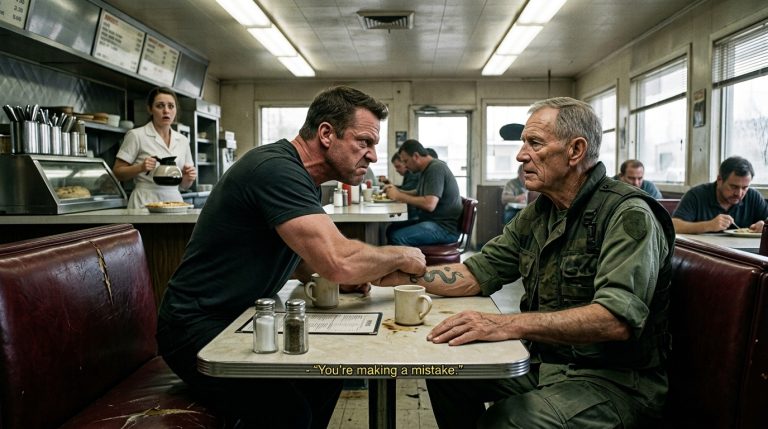
We didn’t stop running until the streetlights of Harmony Creek had faded into a dull, yellowish blur behind us. We found ourselves in the sterile, dimly lit lobby of a twenty-four-hour diner three towns over, the scent of stale coffee and grease hitting us like a physical wall. Thorne collapsed into a vinyl booth, his breathing still shallow, his shirt torn and stained with mud. I remained standing, my eyes fixed on the door. I had the drive, I had the witness, and for the first time in this nightmare, I had the leverage.
“We have to go to the police,” Thorne whispered, his voice trembling. “We have to show them everything.”
I pulled the drive from my pocket. It felt lighter than it should have, a tiny sliver of plastic holding the weight of an entire community’s survival. “The police won’t touch this, David. Not yet. The D.M.G. influence reaches deeper than the local precinct.”
I pulled out my phone and dialed a number I hadn’t used since my days in the Corps—a private contact, a journalist who specialized in infrastructure fraud. I didn’t need the police; I needed the truth to be impossible to ignore.
As I waited for the call to connect, I saw a familiar beige sedan pull into the diner’s parking lot. It pulled up slowly, the headlights cutting through the darkness, stopping directly in front of the window. My heart skipped a beat. Karen.
She stepped out, alone. She wasn’t wearing her floral blouse this time; she was dressed in a sharp, dark suit, her face stripped of its usual performative suburban pleasantries. She looked like exactly what she was: a frightened, desperate woman who had run out of road. She walked toward the entrance, her gait stiff, her eyes locked on mine through the glass.
I didn’t wait for her to come inside. I walked out to meet her. The air outside was cold, the night wind whipping at my jacket.
“You don’t want to do this, Jack,” she said, her voice devoid of its usual, smug authority. It was thin, brittle. “You think you’re a hero, but you have no idea what you’re pulling on. If you release that data, you don’t just destroy me. You destroy this entire town.”
“You already destroyed it, Karen,” I said, stepping into her personal space. I could smell the expensive perfume—a stark contrast to the grit and oil on my own hands. “You traded it for a piece of a predatory land grab. You sold out your own neighbors for a debt you couldn’t pay.”
Her eyes widened, a momentary fracture in her mask. “They promised me I’d be safe. They said if I just signed the applications, if I just kept the opposition quiet, the debt would be forgiven.”
“There is no safety in a lie,” I replied.
I held up the hard drive. “This is going to the state board in an hour. And when they see the drainage modifications, when they see the signatures, it won’t just be your HOA presidency that ends. It’ll be the end of the D.M.G. project. And you? You’ll be the one left holding the bill for the collapse.”
She looked at the drive, then at the diner, where Thorne was watching us through the window. She realized then that she had lost the board, lost the community, and most importantly, lost the ability to control the narrative. The woman who had treated my property like a project to be managed was now just a shell, a victim of her own misguided fear.
“They’ll come for you, Jack,” she whispered, her voice barely a breath. “When they realize the project is dead, they won’t stop at the HOA. They’ll erase anyone who was involved.”
“Let them come,” I said.
I didn’t feel triumph. I felt an exhaustion so profound it settled into my bones. But behind the exhaustion was a solid, unwavering sense of peace. I had protected the foundation. I had stood my ground. And as I turned my back on her—leaving her standing in the parking lot, a small, insignificant figure beneath the vast, uncaring night sky—I knew the war wasn’t over, but for the first time, I was the one holding the map.
CHAPTER 12: THE SHADE OF THE OAK
Karen’s figure, a solitary, sharp-edged shadow against the neon buzz of the diner, finally turned and retreated to her sedan. I watched the taillights flare—a dull, bruised red—as she pulled away, leaving nothing behind but the scent of exhaust and the heavy, lingering chill of the night. My chest felt hollow, a drum beaten thin by days of constant, grinding tension. I reached into my pocket and touched the rusted surveyor’s stake. It was just a piece of metal, a discarded fragment of a life I’d left behind years ago, but it felt, in this moment, like the only solid thing in a world that had suddenly turned fluid and treacherous.
I walked back into the diner. Thorne was slumped in the booth, his eyes fixed on a cup of coffee that had long since gone cold. He looked up as I slid into the seat opposite him. “Is she gone?”
“She’s done,” I said, my voice sounding distant to my own ears. I pulled the hard drive from my pocket and placed it on the table. It was over. The regional oversight board had already been pinged by my contact; the data was being analyzed, the logs were being verified, and the D.M.G. project was already being flagged as a massive, systematic fraud.
We sat in silence for a long time, the only sound the low, rhythmic ticking of a clock on the wall and the distant, lonely drone of a refrigerator. The adrenaline had bled out of me, leaving behind a cold, crystalline clarity. Karen was a small player in a very big, very ugly game, but she was the one who had made the mistake of thinking I would break. She had forgotten that an engineer doesn’t just build things; they know how to calculate the exact amount of force required to bring something down.
The drive back to Harmony Creek was quiet. Thorne slept, his head pressed against the cool glass of the window, his breathing deep and ragged. When I finally pulled into my driveway, the sun was beginning to bleed over the horizon—a pale, bruised violet that tinted the sky with the promise of a long, difficult day.
I didn’t go inside. I walked to the backyard.
The ancient live oak stood tall, its massive, gnarled limbs reaching into the morning light like the fingers of a giant. The treehouse sat nestled in the heart of the canopy, silent and serene. I climbed the ladder, the rungs solid beneath my feet, and pulled myself onto the second-story lookout deck. From up here, the neighborhood looked small, insignificant—a collection of beige boxes painted in the colors of compliance.
I sat down, my back against the rough, familiar bark of the trunk. I reached into my bag and pulled out a small wrench and a box of galvanized screws. The platform had shifted slightly during the chaos of the last few days—a minor misalignment in the decking, a stress point that needed reinforcing. I spent the next hour working in the quiet, the mechanical click of the wrench and the steady, rhythmic turn of the screws providing a physical grounding.
It was a small repair, but it was essential. A foundation—whether it was a bridge in the Mekong or a castle for an eight-year-old—required constant maintenance. You couldn’t just build it and walk away. You had to stay, you had to watch, and you had to be willing to fix the fractures before they became failures.
Leo came out into the backyard just as I was finishing. He looked up, his eyes widening when he saw me on the deck. He didn’t ask where I’d been, or why I looked like I’d been through a war. He just smiled, a bright, unadulterated flash of joy that hit me harder than any bullet.
“Dad! Can we go up?”
I looked down at him, then at the tree, then at the neighborhood beyond. I had won, but the cost was etched into the quiet of the morning. I would have to testify, I would have to deal with the fallout, and I would have to watch as this entire beige kingdom was dismantled by the law. But the tree remained. The oak was rooted deep, a massive, living anchor that had survived droughts, storms, and the petty, arrogant machinations of a homeowners association.
“Yeah, kiddo,” I said, my voice thick. “Come on up. We’ve got a castle to defend.”
I leaned back, closing my eyes and listening to the wind move through the leaves. The air smelled of damp earth and the coming heat of the Florida sun. For the first time in twenty years, I wasn’t waiting for a deployment. I wasn’t waiting for the next order. I was exactly where I was meant to be, holding the only thing that truly mattered, in a place that—finally—felt like home.