The Iron Calibration: A Soldier’s Search for Truth Behind a Faulty Barrel and Silenced History
CHAPTER 1: The Friction of Silence
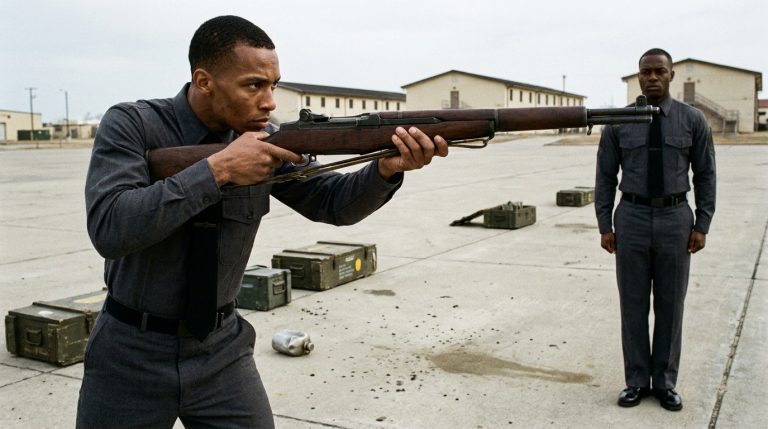
The concrete floor of the indoor range was slick with fine dust, the kind that got into the lungs and stayed there. Rasque pulled the bolt back, the action grinding with a coarse, uneven sound that sent a jolt of irritation up his forearm. He hated this weapon. It was an extension of his own body that refused to cooperate, a piece of machinery that had developed a stubborn, private agenda.
Six inches to the left. Every single time.
He looked toward the observation bench. His squad leader, Miller, was checking his watch, the harsh fluorescent lights washing out the lines of frustration on his face. Miller didn’t care about the physics of the grouping; he cared about the bottom line of the qualification report.
“It’s not the rifle, Rasque,” Miller repeated, his voice echoing off the cinderblock walls. “Stop looking for excuses. It’s the shooter. Adjust your hold or accept the failure. We don’t have time for a troubleshooting seminar.”
Rasque felt the heat rise behind his eyes. He didn’t answer. He couldn’t trust his voice not to shake with the exertion of holding back his frustration. He looked down at the weapon—a standard-issue platform, worn thin in the places where his hands gripped it most, the finish rubbed away to reveal the dull, gray steel beneath.
Then, there was the sound.
A steady, rhythmic shhh-shhh-shhh behind him.
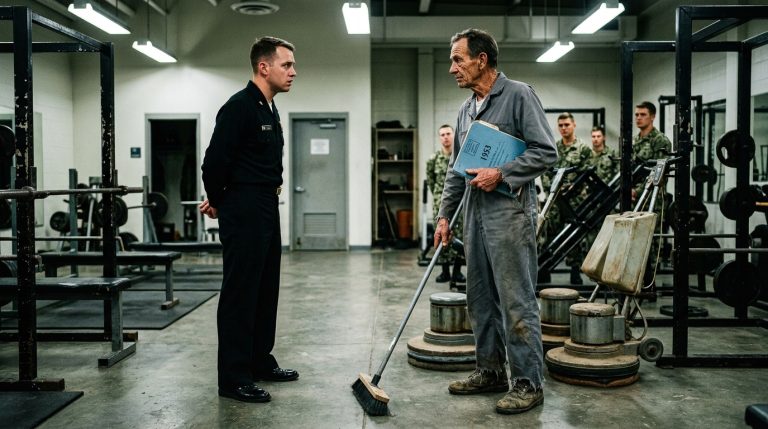
In the shadows near the back wall, the old janitor continued his work. He moved with a precision that seemed entirely out of place in a room meant for raw, kinetic violence. He wasn’t just sweeping; he was mapping the floor, his broom bristles finding every crack and indentation. Rasque watched the man’s reflection in the safety glass of his goggles. The janitor had stopped, his back slightly bent, staring not at the targets, but at the breach of Rasque’s rifle.
The old man’s eyes weren’t clouded with age, as Rasque had initially assumed. They were sharp, focused, and uncomfortably observant.
“You’re fighting the friction,” the janitor murmured. The voice was barely audible above the hum of the ventilation system, a low rasp that sounded like dry leaves on pavement.
Rasque stiffened. He glanced toward Miller, but the squad leader was busy writing in his clipboard, oblivious to the side conversation. Rasque turned his attention back to the janitor, but the man had already turned away, his broom resuming its methodical path.
Rasque looked down at the rifle again. He ran his thumb along the feed ramp. Under the film of oil and carbon, his fingertip caught on something—a tiny, jagged imperfection in the steel that hadn’t been there the day before.
It wasn’t a defect of manufacturing. It felt, to the touch, like a deliberate, surgical strike.
CHAPTER 2: The Geometry of a Lie
The silence in the indoor range had gained a physical weight. Rasque’s thumb stayed pressed against the feed ramp, the sharp, microscopic bite of the metal burr digging into his skin. He didn’t pull away. If he moved his hand, the reality of what he had found—or what he had been allowed to find—would dissipate into the mundane frustration of a bad training day.
Six inches to the left.
He looked up, his eyes darting to the janitor. The old man was thirty feet away now, his silhouette framed by the harsh, flickering overhead lights. He was still sweeping, but the rhythm had changed. It was slower, more deliberate, as if he were waiting for Rasque to process the physical evidence beneath his fingernails.
Miller’s voice cut through the air, sharp and impatient. “Rasque! Did you hear me? Clear the chamber and get off the line. You’re holding up the rest of the squad.”
Rasque didn’t immediately move. His internal compass, calibrated by years of strict adherence to protocol, was spinning wildly. He had been taught that the equipment was the only constant; if a round went wide, the failure was his own. That was the fundamental law of their world. But the jagged, intentional shape of the metal on the feed ramp wasn’t an accident. It was a structural manipulation. A deliberate handicap.
He cleared the weapon, the metal-on-metal sound ringing out like a gavel in the sterile room.
“I’m done, Chief,” Rasque said, his voice flat. He kept his hand shielded, burying the metallic burr against his palm as he locked the bolt to the rear.
“Good. Don’t let it happen again. Check your optics before the next rotation,” Miller replied, already turning his attention back to the younger recruits waiting at the ready line. He didn’t even look at the rifle.
Rasque walked toward the equipment lockers, his movements stiff. The air felt colder as he moved away from the firing line. Every step felt like a miscalculation. The memory of his father’s old shop surged, unbidden—the smell of hot oil and the sound of his father’s voice explaining that a machine always tells the truth, even if the person using it is lying. He had spent his entire career trying to become that truth. Now, he felt like a cog in a machine that was being deliberately misaligned.
He reached the armory locker, his breath coming in shallow, rhythmic bursts. He needed to verify. He needed to see if the other rifles in the crate had the same imperfection.
He glanced back over his shoulder. The janitor was closer now, pushing his wide, straw broom across the concrete with a sound like sandpaper on glass. As the man passed, he didn’t look at Rasque. He didn’t speak. But as the janitor’s boot passed near Rasque’s, a small, folded scrap of heavy-gauge paper slipped from his apron pocket and settled onto the floor.
It was a piece of technical schematics, the kind used for internal armory audits.
Rasque’s heart hammered against his ribs. He crouched, pretending to tie his boot, and snatched the paper. His fingers brushed the rough concrete—grit, dust, and the lingering residue of lead. When he stood, the janitor was already ten yards away, his back to him, his posture hunched with the feigned fragility of a man who spent his life cleaning up after others.
Rasque retreated to the privacy of the locker row. He unfolded the paper with trembling fingers. It wasn’t a schematic. It was a list of serial numbers—the entire batch of rifles assigned to his squad. Beside every number, a single word was handwritten in a jagged, hurried script: Compromised.
The air in the room suddenly felt thin. He looked down at the rifle in his arms, the weapon that had been his best friend and his greatest enemy for the last six months. It wasn’t just a piece of gear. It was a cage. And he had been running headlong into its walls every time he pulled the trigger, blaming himself for a failure that had been scripted into the steel before he even picked it up.
He shoved the rifle into the locker and slammed the door. The sound echoed, a sharp, metallic finality. He wasn’t just looking for an optic adjustment anymore. He was looking for the architect of his own obsolescence.
He leaned his forehead against the cool, painted metal of the locker. He had to be calm. He had to be cold. If Miller or anyone else realized he knew, the rifle wouldn’t be the only thing compromised in this facility. He had to treat this like a combat scenario: assess the perimeter, identify the threat, and move without triggering the alarm.
The janitor was still sweeping, the rhythm steady and hypnotic. Shhh-shhh-shhh. It sounded like a ticking clock, counting down the seconds he had left to act before he was rotated out or, worse, silenced.
Rasque straightened his uniform, wiping the sweat from his palms onto his trousers. He turned away from the locker, his face a mask of practiced indifference. He needed to get to the main armory logbook. If he could prove the rifles were sabotaged, he could prove the order came from the top.
He started walking toward the door, his eyes scanning the room. He didn’t look at Miller. He didn’t look at the targets. He looked at the shadows, at the vents, and at the way the light played off the floor—the geography of a trap he was just beginning to understand.
CHAPTER 3: The Weight of the Ledger
The transition from the range to the central armory was a corridor of fluorescent hums and lingering drafts. Rasque walked with a measured, predatory gait, his eyes tracing the seams of the walls and the movement of shadows. Every muscle in his body felt coiled. He was no longer a soldier moving through a facility he recognized; he was an intruder in his own house.
His hand stayed pressed against the pocket where the janitor’s list was hidden. The texture of the paper felt coarse, a stark reminder of the jagged burr on his rifle.
As he reached the heavy, reinforced door of the armory, he slowed. The usual electronic chime of his access card failed to trigger the lock immediately. Instead, a muffled sound of voices echoed from inside—sharp, rhythmic, and hurried.
Rasque froze. The logbook wasn’t supposed to be accessed at this hour. The night shift wasn’t scheduled for another two hours.
He leaned his forehead against the cold, industrial frame of the door, listening.
“The calibration cycle is inconsistent,” a voice said—a voice Rasque recognized as the lead armorer, Sergeant Halloway. “If we push these through the inspection, the audit will flag the deviation.”
“The audit is already being managed,” a second, unfamiliar voice replied. It was colder, more detached. “Focus on the primary feed ramp. The burr needs to be consistent across the entire shipment. If a single unit doesn’t have it, the failure is obvious. If they all have it, it’s just ‘manufacturing variance’.”
Rasque’s stomach did a slow, nauseating turn. Manufacturing variance. They were codifying the sabotage.
He didn’t move. He couldn’t. The logic of his world—the structure, the hierarchy, the belief that he was being prepared for something meaningful—was collapsing. He was not being prepared for battle; he was being systematically dismantled.
Suddenly, the door swung inward.
Rasque pivoted, dropping into a natural, casual stance as if he were just arriving for an equipment requisition. Sergeant Halloway stepped out, his face pale, clutching a tablet. Behind him, the second man—tall, wearing the sterile white coat of a civilian technician—looked up from a clipboard.
Halloway’s eyes widened slightly when he saw Rasque. “Rasque? What are you doing here? Range is closed for the night.”
“Optic failure, Sergeant,” Rasque said, his voice steady, stripped of all emotion. He played the part of the frustrated soldier perfectly. “Told Miller I wouldn’t leave until I swapped it out. I’m not carrying a rifle that can’t hold a zero.”
Halloway hesitated, his gaze flickering to the technician behind him. The technician didn’t react; he just stood there, the cool, detached air of a man who held the keys to the kingdom.
“The armory is restricted, Rasque. It’s an audit night,” Halloway said, his voice regaining its practiced authority. “Everything is being serialized and packed. You’ll have to wait until tomorrow.”
“I’ve got a live-fire drill at dawn,” Rasque pushed, though he knew he was walking a razor’s edge. “If I don’t swap this out, I’m dead weight in the field. You want to explain to the Colonel why my fire team is missing a spot in the morning?”
The technician stepped forward, his shoes clicking sharply on the concrete. He stared at Rasque—not with suspicion, but with a clinical, diagnostic interest. He looked at Rasque’s hands, his posture, the slight fraying of his uniform sleeve.
“The drill is canceled,” the technician said softly. It was the first time Rasque had heard him speak directly.
“Canceled?” Rasque kept his face neutral, though his heart was hammering against his ribs.
“Re-routing,” the technician corrected. “The equipment is being transferred to a different facility for additional… testing. You won’t be needing those rifles tomorrow. Or for the foreseeable future.”
The technician gestured toward the room behind him. Through the opening, Rasque caught a glimpse of the long rows of lockers. They were already being emptied. The rifles—the ones on the list—were being tagged and crated, their barrels pointing into the dark, padded interiors of transport cases like so many dead things.
Rasque felt a cold wave of adrenaline hit him. He had been looking for a way to prove the sabotage, but the sabotage was leaving the building.
“Testing?” Rasque repeated, leaning slightly into the conversation, his body language mimicking the frustration of a soldier denied his gear. “What kind of testing? These units were just cleared for deployment last week.”
“Standards change,” the technician said, turning his back to Rasque and waving a dismissive hand at Halloway. “Secure the area, Sergeant. We have the transport team arriving in ten minutes.”
As Halloway began to slide the door shut, Rasque saw his chance. He jammed the heel of his boot into the threshold, stopping the heavy door just before it latched.
“Wait,” Rasque said, his voice dropping into that dangerous, quiet register that made even seasoned NCOs pause. “If you’re moving the gear, I need a signed receipt for my armory file. I’m not leaving this station without a record of where my kit went.”
Halloway looked at the technician, then at the heavy steel door. For a second, the power dynamic in the room shifted. Rasque stood his ground, a monument of resolve in a room that was suddenly feeling very small. He didn’t care about the receipt. He needed ten more seconds to look at the shipping manifest on the desk inside.
He didn’t need to defeat them. He just needed to see the final destination.
CHAPTER 4: The Signature of Sabotage
The heavy steel door pressed against the heel of Rasque’s boot with a constant, unforgiving pressure. Inside, the technician didn’t move. He simply watched, his expression devoid of alarm. It was an unnerving calmness, the kind that came from someone who knew exactly how the rules were written and how easily they could be used as a weapon against someone like Rasque.
“Ten seconds, Rasque,” the technician said, his voice quiet, almost conversational. “Every second you hold that door is a second you move from being an inquisitive soldier to a logistical liability. Which one do you want to be?”
Rasque’s heart hammered against his ribs, a frantic, rhythmic drumming that felt too loud in the confined space of the corridor. He pulled his boot back half an inch, the door biting further into the frame, then pushed his weight against it again. He needed to see the manifest. He needed to know if his name—and the names of his squad—were attached to the crates being prepared for the “testing” facility.
“I’m just doing my job,” Rasque said, his voice rough. “Armory protocols are clear. I don’t leave gear unaccounted for. You’re shipping out a fleet of weapons, and I don’t see a transfer authorization signed by the Commanding Officer.”
Halloway, standing just behind the technician, looked like he was vibrating with anxiety. He reached for the door handle, his knuckles white. “Rasque, move the boot. This is way above your pay grade. If you don’t step back, I’m calling Security.”
“Call them,” Rasque said, not breaking eye contact with the technician. “I’ll be happy to explain to the MPs why the unit’s equipment is being wiped of its maintenance logs. I’m sure they’ll be very interested in the ‘manufacturing variance’ you’re so fond of.”
The technician’s gaze flickered for the first time. It was a subtle shift—a sharpening of the focus. The clinical interest was replaced by something colder, more calculated. He reached out and placed a hand on Halloway’s arm, pulling the sergeant back.
“He wants the manifest,” the technician said, as if discussing the price of office supplies. “Give it to him. Let him see the logistics of his own removal.”
Halloway hesitated, then fumbled with the tablet in his hands, tapping the screen with shaky fingers. He turned the display toward Rasque.
Rasque’s eyes swept across the screen. It wasn’t a standard shipment manifest. It was a deployment schedule disguised as a maintenance rotation. The location for the “testing” wasn’t a domestic lab; it was a remote, high-risk sector in a territory that had been officially closed to their unit for months. The serial numbers of the rifles were grouped into batches, each marked with a specific operational code.
His breath hitched. He saw the serial number of his own rifle, and beneath it, a note: Terminal degradation predicted at 400 rounds.
It wasn’t a training aid. It wasn’t a maintenance test. They were sending the unit into a kill zone with rifles that were rigged to fail after a specific duration of use.
“See?” the technician asked, a ghost of a smile touching his lips. “It’s all in order. You’re scheduled for a long trip, Sergeant. I suggest you go pack your personal effects. You’re going to need all the time you can get.”
Rasque felt the ground shift beneath him. The anger that had been fueling him since the range was suddenly replaced by a sharp, icy clarity. He realized then that he hadn’t just discovered a mechanical flaw; he had uncovered the reason for his squad’s existence. They weren’t a team; they were a data point. A variable in a strategic equation that required them to stop functioning at a very specific moment in time.
He slowly pulled his boot from the threshold. The door slammed shut with a final, echoing boom, locking into place with the heavy thud of an electronic bolt.
He stood alone in the hallway, the sound of his own pulse roaring in his ears. He looked down at the floor, where the dust motes danced in the pale light of the emergency exit signs. He couldn’t go back to the barracks. He couldn’t go to Miller. He was entirely on his own, the weight of the secret pressing against his chest like a physical burden.
He turned and began to walk away, his steps silent against the concrete. Every corner of the hallway now looked like an ambush point. Every shadow felt like an extension of the technician’s cold, calculated reach. He had the truth, but it was a truth that had just turned him into a target.
He reached the end of the corridor and stepped out into the night air. The range complex was surrounded by a chain-link fence, the sky above a bruised purple. He looked toward the armory windows, seeing the faint, flickering glow of the light inside. They were still in there, preparing the crates, preparing his future.
He took a deep breath of the cold, metallic air, his mind already working through the tactical implications. He had the list. He had the serial numbers. But he needed a leverage point. Something that wouldn’t just expose the sabotage, but that would make it impossible for them to move forward with the rotation.
He remembered the janitor. The old man’s eyes—the way he had watched the rifles as if they were dying things. He had to find him. If anyone knew the full extent of this operation, it was the man who had been sweeping up the evidence of their lies for years.
Rasque checked his watch. He had three hours before the shift change, and in that time, he had to disappear from the grid. He moved toward the shadows of the secondary warehouse, his movements fluid, his purpose absolute. The soldier was gone. In his place was a man who knew exactly how the machine worked, and he was ready to jam the gears.
CHAPTER 5: Shadows of the Sovereign
The perimeter of the warehouse complex was a gauntlet of chain-link and shadow. Rasque moved with the calculated efficiency of a man who had stopped caring about the rules and started caring only about the next thirty seconds. He stayed low, hugging the corrugated metal siding of the storage units, his ears straining against the low-frequency hum of the facility’s security grid.
He didn’t trust his own eyes. The way the light caught the edge of the perimeter fence seemed to ripple, as if the entire facility were a mirage designed to keep him walking in circles. Every shadow felt like an extension of the technician’s clinical gaze. Was he being tracked by motion sensors, or was this the internal friction of a mind forced to process a reality that didn’t match its training? He focused on the physical sensation of the cold iron against his palms, using the discomfort to ground his racing pulse.
The maintenance shaft. He knew the layout of the facility from a decade of service, but he had never needed to look at it as a tactical network of escape routes. He reached the hatch, a heavy, rusted plate of steel set into the foundation. It groaned in protest as he tugged it open, the screech of metal on metal sounding like a siren in the dead of the night.
He dropped into the darkness, his boots landing on a slick, oily floor. The smell hit him immediately—a pungent mix of ozone, stagnant water, and the copper tang of ancient, neglected grease. This was the digestive system of the base, a labyrinth of pipes and conduit lines that ran beneath the orderly facade of the training grounds.
He pulled the hatch shut, plunging himself into absolute blackness. He waited, his breathing shallow, listening for the sound of pursuit. Nothing. Just the slow, rhythmic drip of condensation somewhere off to his left.
He began to move. His hands mapped the walls—rough, pitted concrete and the cold, vibrating surfaces of high-pressure lines. He was looking for the janitor’s supply closet, a small, sublevel staging area that he’d seen the old man frequent during the lunch rotation. It was the only place in the entire facility where the janitor had any semblance of privacy, and according to the internal facility maps, it shared a junction point with the secondary maintenance tunnels.
As he crawled, his thoughts spiraled. The technician’s words—Terminal degradation predicted at 400 rounds.—repeated in his mind, a mantra of his own death. They hadn’t just sabotaged the rifle; they had calculated his expiration. It was an insult as much as a threat. They thought he was a machine that could be tuned, broken, and discarded without anyone noticing.
He reached a junction and paused. A faint, amber light flickered through a ventilation grate ahead. He moved toward it, his boots making no sound on the damp flooring. He peered through the slats.
It was the supply closet. The janitor was there, sitting on a low wooden stool, his back to the wall. He was cleaning a set of old, heavy-duty work gloves, his hands moving with a meticulous, slow-motion grace.
Rasque pushed against the grate. It was loose. He carefully eased it out, the sound muffled by his own coat, and slipped into the room. He didn’t stand up. He kept low, his hand drifting toward the combat knife at his belt—not to use it, but to remind himself he still had agency.
The janitor didn’t look up. “The air is getting thin in the upper levels, Sergeant,” the old man said, his voice as dry as the dust he’d been sweeping earlier. “They’ve activated the atmospheric scrubbers for the transport bay. They want the atmosphere clean for the cargo.”
Rasque froze. The old man hadn’t even checked to see who was behind him. “You knew,” Rasque said, his voice barely a rasp. “You knew they were moving the rifles. You knew they were rigging them.”
The janitor finished with the glove and placed it on the floor. He finally turned his head, his clouded, elderly eyes locking onto Rasque’s. In the flickering light of the closet, the “cloudiness” seemed to vanish, replaced by a piercing, intellectual intensity that felt out of place with the janitor’s uniform.
“I have been watching this facility for twenty-four years,” the janitor said. “I have seen units come and go. I have seen the rifles change, and I have seen the men change even faster. You are the first one who stopped looking at the target and started looking at the barrel.”
“Why?” Rasque asked, moving closer. “Why let them do it? Why let all those other units go out there if you knew?”
The janitor’s expression didn’t change, but his shoulders slumped, as if he were carrying a weight of iron. “Because I am a janitor, Sergeant. I clean the floors. I do not determine the mission. I only provide the information to those who are capable of using it. My reach does not extend to the officers’ lounge. It only extends to the truth.”
“I need to stop the shipment,” Rasque said, his voice tight. “I need the logs. The real ones. Not the ones they showed me in the armory.”
The janitor reached into the lining of his utility apron and pulled out a small, metallic object—a physical key, encoded with the signature of the base’s secure data vault. It wasn’t something a janitor should have had. It was a high-level access tool, worn smooth by years of use.
“The vault is in the sub-basement, under the central generator,” the janitor said, holding it out. “It is the only place they don’t monitor with digital sensors, because the electrical interference from the generator masks the signal. If you want the truth, you have to go into the heart of the machine.”
Rasque reached for the key, but stopped. He looked at the old man, seeing the scars on his knuckles, the way his body held itself with a rigid, military discipline that contradicted his station. He wasn’t just a janitor. He was a ghost, left behind by a war that this facility had long since forgotten.
“Why are you helping me?” Rasque asked.
“Because,” the janitor said, his voice low and solemn, “when the machine breaks, it is the job of the person on the floor to make sure it doesn’t take the rest of the building down with it.”
Rasque took the key. It felt heavy, cold, and final. He knew that by accepting it, he had just signed his own exit order from the life he had known. There was no going back to the range. There was no going back to Miller. There was only the vault, the truth, and the long, dark road that lay ahead.
He turned toward the door, but stopped as he heard a sharp, rhythmic tapping on the heavy steel pipe running through the ceiling of the closet. A pattern. An alert.
The janitor stood, his face hardening. “They know you’re in the maintenance tunnels. They’ve engaged the lockdown protocol.”
Rasque looked at the key, then at the shaft he had crawled through. He was trapped, and for the first time, he realized the facility wasn’t just guarding its secrets—it was actively trying to digest anyone who came looking for them.
CHAPTER 6: Into the Heart of the Machine
The tapping on the ceiling pipes wasn’t just a signal; it was a countdown. Rasque looked at the janitor, who was already turning back to his work with a calm that defied the closing net of security protocols. There was no farewell, no dramatic final advice. The old man simply vanished into the shadows of the supply shelves, leaving Rasque alone with the heavy, cold key.
Rasque moved. He didn’t run—running made noise and invited suspicion—but he transitioned into a stride of intense, focused intent. He exited the closet and slipped back into the maintenance shaft, the air now thick with the acrid, metallic smell of overheating circuitry. The facility’s lockdown protocol had changed the environment; the usual dim, yellow emergency lighting had been replaced by a pulsing, crimson strobe that turned the pipes into bleeding arteries in the dark.
He navigated the shaft toward the central generator room. The vibration increased with every yard he covered, a low-frequency hum that rattled his teeth and made the air feel heavy. This was the powerhouse of the facility, a massive, subterranean cathedral of turbines and cooling lines. If the truth was buried anywhere, it was beneath the sheer, deafening weight of this machinery.
He reached the heavy blast door that separated the shaft from the generator core. He held the key to the reader. It was old-school—an analog friction-lock designed for legacy hardware. He slid the key in, feeling the tumblers shift with a satisfying, heavy resistance.
Click.
The door groaned open, revealing a cavernous, roaring space. Giant turbines spun in the gloom, their movement a blurred, relentless dance. The heat was immediate, a dry, scorching wave that tasted of ozone and burning grease. Rasque stepped inside, the blast door hissing shut behind him.
He was in the belly of the beast. The sound was so absolute it felt like silence—a physical pressure that drowned out his own thoughts. He scanned the room, his eyes adjusting to the shifting, chaotic light. There, in the center of the floor, tucked beneath a massive, vibrating cooling column, was the access panel for the secure data vault.
He moved toward it, keeping his body low. As he approached, a sudden, violent shudder shook the floor. The power flickered. The main turbine began to whine, the frequency shifting from a low roar to a high, piercing shriek. A surge of excess energy arced across the cooling columns, illuminating the room in blinding, strobe-like flashes of electric blue.
Rasque dove for cover behind a steel pillar just as a bank of overhead conduits exploded in a shower of sparks. The facility wasn’t just in lockdown; it was being purged. They were dumping the excess power into the generator grid to clear the cache, to wipe the very logs he was trying to retrieve.
He didn’t wait for the surge to settle. He sprinted the final twenty feet to the access panel, his boots skidding on the oily, vibrating floor. He slapped his hand against the console, his fingers frantic as he punched in the bypass sequence he’d memorized from the janitor’s directions.
The panel beeped, a sharp, digital protest against the intense electromagnetic field of the generators. He shoved the key into the port.
Data began to stream across the small, flickering screen—a waterfall of green text. It was a mass of logistics, shipping manifests, and casualty projections. His eyes scanned the lines, looking for the specific code he’d seen on the armory manifest.
Unit 7-Alpha: Equipment Failure/Tactical Disposal.
He kept scrolling, his heart hammering against his ribs as the generator whined, the pitch increasing to a level that threatened to shatter his eardrums. It wasn’t just his unit. There were dozens of them. Entire battalions labeled as “disposable,” their equipment rigged for failure in sectors where they were specifically ordered to engage insurmountable odds. It wasn’t a military operation. It was a cull. A calculated, bureaucratic culling of soldiers who were deemed either too costly or too risky to bring home.
A loud, jarring alarm cut through the roar of the turbines. The system was responding. The vault was not just a repository; it was a trap. By accessing the files, he had triggered a remote uplink that was now broadcasting his exact location to the security team.
He pulled the portable drive from his webbing, jamming it into the console to initiate the download. The progress bar crawled forward. 20%… 40%… 60%…
The room darkened as the main turbines began to spin down, the facility’s power being diverted. He was trapped in the sudden, oppressive silence of the dying machinery.
Then, the blast door at the far end of the room groaned open.
Flashlights cut through the darkness, their beams tight and professional. Footsteps, heavy and rhythmic, echoed on the metal floor.
“Sergeant Rasque,” a voice boomed, amplified by the cavernous space. It was the technician from the armory. He didn’t sound angry; he sounded disappointed, like a teacher dealing with a student who had finally stopped listening. “You are currently standing in the middle of a high-voltage testing zone. Step away from the terminal, or I will be forced to initiate a total system reset.”
Rasque didn’t look back. He kept his eyes on the progress bar. 80%… 90%…
“You’re killing your own people,” Rasque yelled, his voice barely audible over the remaining hum.
“I am managing the inventory of a nation,” the technician replied, stepping into the dim light. Behind him, two security guards moved into position, their rifles raised. “Inventory wears out, Sergeant. It is our job to ensure it happens with the maximum possible efficiency.”
95%…
Rasque looked at the key. He looked at the guards. He knew he couldn’t win a firefight in a room filled with high-voltage lines, but he also knew the technician wasn’t going to pull the trigger. He needed the data wiped, and he needed Rasque alive to authorize the system reset.
100%.
Rasque yanked the drive from the console and turned, his back to the wall. He wasn’t a soldier anymore. He was a witness. And he had exactly one card left to play.
CHAPTER 7: The Catalyst of Collapse
Rasque did not move. He stood with his back pressed against the cold, vibrating metal of the generator housing, the drive humming against his palm. The technician, still smiling that thin, clinical smile, took a slow, measured step forward. The two security guards fanned out, their boots striking the metal floor in perfect, rhythmic synchronization.
“The drive is useless, Sergeant,” the technician said, his voice cutting through the roar of the dying turbines like a razor. “You have the data, but you do not have the authorization. Without the master signature, those files are nothing more than encrypted noise. You have successfully committed grand larceny of a digital ghost.”
Rasque’s eyes darted to the console. He saw the light on the drive blink—a steady, rhythmic pulse. He had the data. Whether it was encrypted or not, he knew one thing: if he couldn’t get it out of the room, it didn’t exist. He had to reach the external uplink node located on the far side of the generator bay, a point that bypassed the internal security net.
He didn’t argue. Arguing was for men who thought they could convince the system to change its mind. He was past that. He had the truth in his hand, and he had the tactical advantage of knowing the facility’s geography better than the men paid to guard it.
“You’re right,” Rasque said, his voice dropping. “It’s encrypted noise.”
He surged forward, not toward the technician, but toward the massive cooling pipe running along the floor. He dropped to his knees, sliding on the oily concrete, and slammed the heavy combat knife from his belt into the junction point of the cooling line.
The pipe hissed, a violent, pressurized scream. A jet of supercooled vapor erupted into the room, creating an instant, blinding whiteout of fog. The security guards stumbled, their flashlights cutting useless, panicked arcs through the dense plume.
Rasque scrambled through the chaos. He didn’t need to see; he navigated by the vibration in his soles and the memory of the floor plan. He felt the cold touch of the vapor against his skin, the sudden drop in temperature making his teeth ache. He heard the technician shouting orders, the metallic clatter of rifles being raised, and the panicked footsteps of the guards.
He reached the far wall and felt for the recessed panel of the uplink node. His fingers found the port, the metal cool and unyielding. He jammed the drive into the slot. The connection clicked—a solid, tactile success.
The upload status bar on his internal HUD flickered: Transferring.
“Get him!” the technician’s voice roared, somewhere off to the left.
A gunshot rang out—a sharp, deafening crack that shattered the ambient roar of the room. A bullet sparked against the steel wall just inches from Rasque’s head, showering him in red-hot shrapnel. He pressed his back to the wall, his breath coming in ragged, painful gasps. He was pinned. The plume of cooling vapor was beginning to dissipate, revealing his position to the guards.
He looked at the progress bar. 40%… 50%…
The guards were closing in. He could hear them breathing, the sound of their tactical gear rattling as they moved through the thinning mist. He pulled his sidearm, but his hand was shaking—not from fear, but from the sheer exhaustion of the last few hours.
“You think this changes anything?” the technician called out, his voice now right behind the wall of mist. “Even if you upload this to the public network, who will believe you? A disgraced sergeant with a sabotaged rifle? You are a statistical error, Rasque. And errors are corrected.”
Rasque felt a grim, dark smile spread across his face. He didn’t need them to believe him. He just needed to ensure that the “inventory” he had uncovered became common knowledge. The truth was not a weapon he was going to use to win a fight; it was an infection he was going to release into their pristine system.
The mist cleared. The guards were ten feet away, their weapons trained directly on his chest.
“Step away from the node!” the lead guard commanded.
Rasque looked at the progress bar: 90%… 95%…
He didn’t step away. He looked at the technician, who had emerged from the mist, his expression finally revealing a crack of genuine concern.
“It’s not for them,” Rasque said, his voice steady. “It’s for the records.”
100%.
Transfer Complete.
Rasque hit the emergency shutoff for the entire generator bank—a legacy switch designed for catastrophic meltdowns. The room went silent. The turbines, the hum, the strobes—everything ceased. The facility fell into a deep, heavy darkness, save for the faint, steady blue light of the uplink node.
The guards fired.
CHAPTER 8: The Architecture of Truth
The impact of the floor against his ribs was sharp, but it was nothing compared to the clarity of the silence. Without the hum of the turbines, the room was a tomb of cold iron. Rasque pressed himself into the shadow of a cooling vane, his lungs burning with the intake of stagnant air. Around him, the shouts of the guards were frantic, punctuated by the metallic click of tactical lights snapping on, slicing through the darkness like scalpel blades.
He didn’t move. He held his breath, his hand still clutched around the portable drive. The data was live, pulsing with the weight of hundreds of names, dates, and locations—a digital indictment of everything this facility stood for. The technician was shouting now, his voice shrill and unpracticed in its panic.
“Find him! He’s in the bay! If that drive connects to the external node, we are finished!”
Rasque saw their boots scuffing the oily concrete just feet away. He watched their shadows dance against the massive, silent turbine blades. He knew they would find him, but it didn’t matter. The upload was complete. The truth had left the building.
He rose to his feet. He didn’t hide his weapon; he holstered it. He stood tall, stepping into the center of the bay, directly into the crosshairs of their lights. The sudden glare was blinding, a wall of white fire that forced him to shield his eyes.
“Drop it!” the lead guard yelled, his rifle leveled at Rasque’s chest.
Rasque stood his ground. He pulled the drive from the port and held it up, a small, silver sliver of reality in a room filled with lies. “It’s already gone,” he said, his voice quiet but echoing in the vast, still space. “The manifest, the rotation schedules, the ‘terminal degradation’ reports—they’re in the cloud. Every agency, every oversight committee, every family on that list… they all have it now.”
The technician stepped into the light, his face a mask of ruined composure. He looked at the drive, then at Rasque, and then at the dark, silent ceiling where the uplink node sat. He looked smaller, suddenly—a man who had spent his life managing a machine, only to realize he was just another component.
“You’ve signed your own warrant, Sergeant,” the technician whispered. “You think the truth sets people free? In this house, the truth is just a different kind of ammunition. They will find you.”
“They might,” Rasque said, stepping forward. He didn’t look at the guards; he looked at the technician, seeing the fear behind the clinical veneer. “But they won’t find the ghost. The machine is broken, and you’re the one holding the wrench.”
The guards hesitated. They were soldiers, trained to follow orders, but the sudden, total silence of the facility had stripped the authority from the air. Without the hum of the machine, without the logistics and the schedules, they were just men standing in a dark room.
Rasque walked toward the blast door. The technician didn’t stop him. The guards lowered their weapons, their eyes tracing his movement with a mixture of confusion and a flicker of something that looked dangerously like relief. He reached the door, keyed the emergency manual override, and stepped out into the pre-dawn light.
The world outside was cold, crisp, and shockingly quiet. The perimeter fences were still, the horizon bleeding a pale, bruised orange. Rasque walked to the center of the parade ground—the place where he had stood so many times in rigid, manufactured formation.
He looked down at his rifle, still slung across his back. He unbuckled the sling and let it fall. It hit the ground with a dull, heavy thud—a piece of dead, cold steel that no longer defined him.
He reached into his pocket and found the key the janitor had given him. He walked to the edge of the drainage run, a deep, concrete channel that led out to the open plains beyond the base, and tossed it in. He heard it splash, a small, final sound that felt like the closing of a door.
He didn’t look back at the facility. He didn’t wait to see if the authorities would arrive or if the guards would follow. He began to walk. The gate was open, the barrier that had kept him inside for so long now just an open span of rusted wire.
His muscles ached, his lungs felt tight, but as he crossed the threshold and stepped out onto the open, uneven earth of the plains, he felt a strange, quiet sensation. For the first time in his life, the ground beneath his feet didn’t feel like a position in a hierarchy. It felt like space.
He didn’t know where he was going, or how he would survive what was coming. But as the sun began to breach the horizon, illuminating the path ahead, he knew one thing with absolute, ringing clarity: he was finally moving at his own speed. He turned away from the facility, his footsteps steady on the dry, hard dirt, and walked until the buildings were nothing more than small, dark shapes against the growing light. He had repaired the damage to his own life, and in the quiet morning, he finally found the peace that no machine could ever provide.