The Echo of the Unspoken: A Quiet Veteran Rewrites the Rhythm of a Cold Institution
CHAPTER 1: The Friction of Efficiency
The training hall was a machine, and like all machines, it hated anything that didn’t fit the gears.
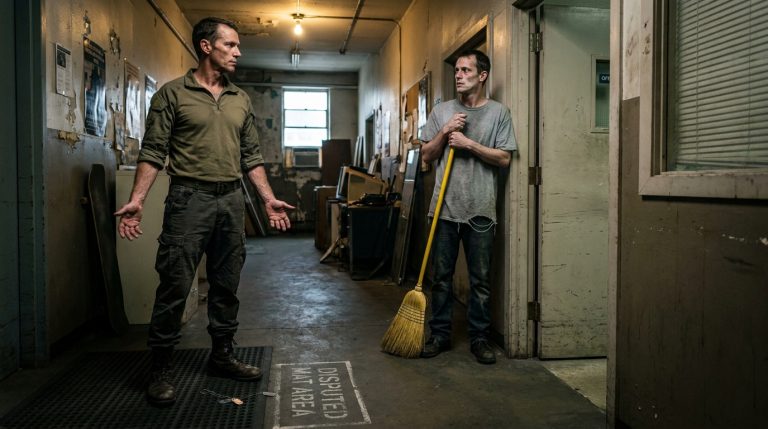
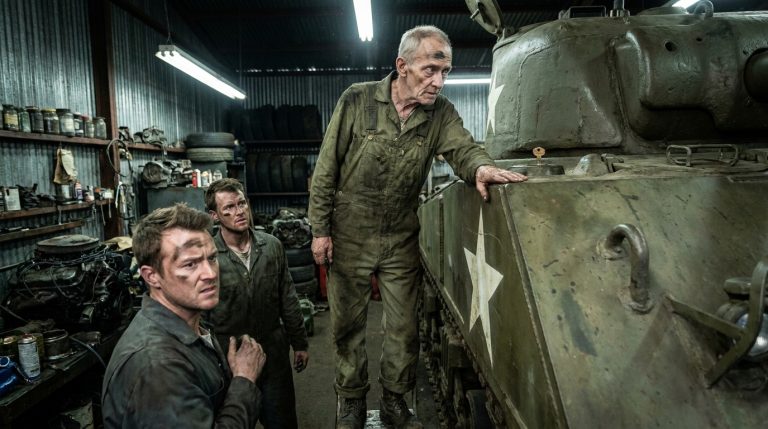
Thomas Hail stood near the ventilation duct, his faded work jacket a smudge of neutral color against the high-gloss white of the walls. He was sixty-eight, and his stillness was not the stillness of an old man waiting to be rescued. It was the stillness of a mountain in a windstorm. He wasn’t resisting the flow of the trainees—he was simply occupying space, a constant in an equation the supervisor, a man named Halloway, was currently trying to solve.
Halloway’s clipboard was an extension of his wrist. He marched down the line, a blur of crisp creases and rhythmic tapping. Every three steps, he corrected a boot angle or a slouch. Every correction was a victory for the system. Then, he saw Thomas.
Halloway’s stride faltered. It wasn’t a big stumble, just a micro-second of hesitation, as if he’d stepped on a pebble that shouldn’t have been there. He approached, the air around him charged with the static of forced order.
“Sir,” Halloway said, his voice clipped, manufactured to be heard over the hum of the fluorescent lights. “We’re mid-cycle. This is an active sector. You’re disrupting the geometry.”
Thomas didn’t move. He didn’t look at the floor. He kept his gaze on the far wall, where the light caught the dust motes dancing in the air. “I’m not in the line, son,” he said, his voice as steady as an old tide. “I’m just watching the morning start.”
“You’re in the perimeter,” Halloway countered, tapping his clipboard with the tip of a metallic pen. The sound was like a snapping twig. “The perimeter is for moving parts. If you aren’t moving, you’re an obstruction.”
Around them, the trainees went silent. It was a strange, sudden vacuum of noise, as if someone had pulled a plug. A young trainee, no older than twenty, glanced back, his eyes widening. He’d seen the patch on Thomas’s shoulder—the one where the thread was so thin it looked like a spiderweb—and he’d stopped walking.
Halloway noticed the trainee’s lag. His jaw tightened. “Keep moving, Recruit! Don’t look at the distractions. Focus is the only currency here.”
The trainee didn’t move. He looked at the floor, then at Thomas, his confusion mounting. “Sir, he’s not doing anything wrong,” the boy muttered, the words barely escaping his throat.
Halloway spun, his eyes narrowing, but before he could deliver a reprimand, he looked back at Thomas. He expected to see a challenge. He expected to see an old man clinging to the past. Instead, he saw Thomas reaching into his pocket, his hand moving with a slow, deliberate grace.
The supervisor went cold. The room held its breath, waiting for the threat, for the hidden weapon, for the defiance. Thomas pulled his hand out, but it was empty, save for a small, dulled coin he turned over in his fingers, the metal catching the artificial light in a way that seemed to drain the room of its urgency.
Then, the door at the back of the hall swung open, and the retired officer stepped in, his shadow stretching long and thin across the polished concrete. He didn’t say a word, but his gaze went straight to Thomas, and for the first time that morning, the machine stuttered. The coin in Thomas’s hand vanished back into his pocket, and the heavy silence that followed didn’t feel like an ending—it felt like the beginning of something that couldn’t be audited.
CHAPTER 2: The Ripple
The silence in the hall did not break; it simply deepened, becoming a physical presence that pressed against the back of every trainee’s neck. Thomas Hail stood in the center of the geometric precision he had supposedly disrupted, his posture unchanged, his breathing shallow and rhythmic. He didn’t look at Halloway. He didn’t look at the officer. He looked at the floor, where a small sliver of the supervisor’s broken pen had skittered into the light.
The recruit who had spoken out, a boy with damp, nervous eyes, shifted his weight. The movement was small, a mere tremor in the line, but in the current stillness, it sounded like a heavy footfall. He was terrified of the supervisor, yet more terrified of the void that had opened up between the man in the faded jacket and the rigid, polished order of the training hall.
Halloway’s face had gone from a professional, composed mask to something tighter, the skin pulled thin over his cheekbones. He stared at the broken plastic in his hand, his thumb pressing into the jagged edge until a white crescent appeared beneath his nail.
“The line,” Halloway whispered, his voice stripped of its practiced, authoritative snap. It was brittle, frayed at the edges. “We maintain the line.”
He didn’t know who he was talking to. The recruits, paralyzed by the sudden shift in the air, stood in their designated boxes, eyes front, staring at the back of the neck of the person ahead of them. They were like clockwork gears that had suddenly encountered sand.
Thomas took a half-step forward. The movement was so small it might have been an illusion caused by the flickering overhead lights. He didn’t approach Halloway with aggression; he approached with an agonizing, grandfatherly patience. He looked at the supervisor’s hand, then up at his eyes.
“The pen didn’t break because of me, son,” Thomas said. His voice was not soft, but it lacked the abrasive friction of a command. “It broke because you were holding it too tight. You’ve been holding it too tight for a long time.”
A tremor went through Halloway’s shoulders. He looked as if he wanted to shout, to cite a regulation, to restore the geometry of the room, but the retired officer—the man who had walked in with the gravity of a storm—was now only a few paces away. The officer’s eyes were locked onto the shoulder patch of Thomas’s jacket.
For a heartbeat, the memory slammed into Thomas—the smell of cedar wood and the heavy, humid heat of a barracks porch in a season that no longer existed on any calendar. The sound of a creaking swing, the silence of men who had seen the end of the world and decided to survive it anyway. The sensory ghost of that memory was so sharp it tasted like copper on his tongue.
The young trainee, the one who had spoken, took a bold, unauthorized step out of line. He walked toward the pair, his boots clacking with an amateurish, uneven rhythm. “Sir,” the trainee said to Halloway, gesturing toward Thomas, “he’s just… he’s just standing there. The room is wide enough.”
Halloway blinked, his focus fracturing. He looked at the trainee, then at the retired officer, then back to Thomas. He was searching for an escape, a way to fold the fabric of this moment back into the tidy, predictable fold of his morning briefing. But the hall refused to cooperate. The silence was absolute. Even the coffee urn in the corner had ceased its hissing, as if the very machinery of the room were holding its breath, waiting to see if the institution would reject this old man or finally, painfully, learn to accommodate him.
Thomas didn’t wait for permission. He moved toward the trainee, his hands resting naturally at his sides. He wasn’t a veteran returning to power; he was simply a man walking through a room.
“You’re shaking,” Thomas observed, his tone conversational, as if they were discussing the weather rather than a breach of base protocol.
The trainee looked down at his hands, surprised to see the fine tremors in his fingers. “I didn’t mean to—”
“Focus on the rhythm of your boots, not the sound of the room,” Thomas advised. He reached out, his hand hovering near the trainee’s shoulder but never making contact—a phantom touch that seemed to steady the boy anyway. “The hall is only as loud as you let it be.”
Halloway watched them, his hand still holding the shards of the broken pen. He looked smaller than he had five minutes ago. The retired officer finally moved, his polished leather shoes striking the floor with a rhythmic, measured cadence that reclaimed the room’s attention. He moved not to reprimand, but to bridge the gap. He stood beside Thomas, his stature reinforcing the older man’s quiet presence, a silent alignment that whispered through the hall like a sudden, cooling breeze.
The institutional clock on the wall clicked—a mechanical, heartless sound—but it didn’t restart the room. The trainees stood there, caught between the rules they were taught to worship and the undeniable weight of the history standing in their midst. Thomas kept his eyes on the trainee, intentionally ignoring the officer, intentionally ignoring the supervisor, creating a small, safe pocket of humanity in the center of the cold, fluorescent sprawl.
But as Thomas turned to follow the officer toward the back of the hall, he caught a flicker of movement in Halloway’s peripheral vision. The supervisor was reaching for his radio, his thumb hovering over the transmit button. The cold, logical part of the system was trying to call for reinforcements, to reassert the geometry, to flush out the anomaly. Thomas saw it, felt the shift in the air, and knew that this wasn’t going to be a simple morning of recognition. The machine was waking up, and it was starting to realize that Thomas Hail was not just an obstruction—he was a key.