The Echo of the Intake: How a Forgotten Veteran Restored the Honor of the Skies
CHAPTER 1: THE WEIGHT OF THE HANGAR
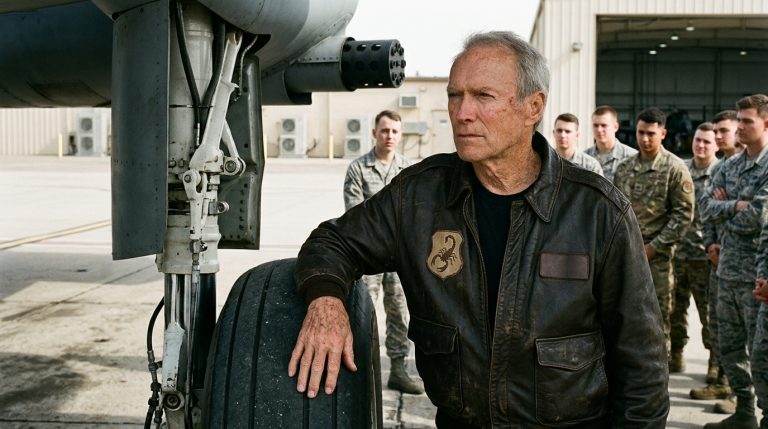
The Northbend Regional Airfield smelled of ozone and cold coastal pines at 4:00 in the morning. It was a scent Arthur Pendleton had memorized over decades of silence. He moved with the slow, calculated glide of a man who had long ago traded his fluid grace for the grinding, rhythmic ache of arthritis in his hip. To the mechanics and administrators, he was a fixture—an stooped, invisible janitor with watery blue eyes and a broom that seemed to be an extension of his own gnarled frame.
In the center of the vast, cavernous hangar, bathed in a reverent pool of morning light, sat the F-18 Hornet. It was a lethal, elegant machine, its gray skin absorbing the light as if holding its breath. Standing beside the cockpit were two lieutenants, Viper and Jester, fresh from Pensacola and wrapped in the crisp, bright olive green of their flight suits.
“Look, I’m telling you, section 7 sub-paragraph B is redundant,” Viper said, his voice cutting through the hangar’s echo with sharp, dismissive confidence. He gestured to the maintenance binder sprawled on a cart. “It’s a legacy check. The C variant’s avionics make it obsolete. I’m not wasting ten minutes on a diagnostic the computer already ran”.
Jester stood firm, his jaw tight, running a hand through his short-cropped hair. “The pre-flight is law, Viper. We do what’s in the book”.
Arthur felt the familiar, cold throb in his knee—a phantom limb of a sky that had once tried to claim him. He knew that bleed-air valve. He knew that section. He knew that the young pilot’s dismissal wasn’t just a technical error; it was a fundamental misunderstanding of the physics of survival.
He stood perfectly still, his back to them, his knuckles white against the wooden handle of his broom. He was the janitor, the man assembled from spare parts and quiet dignity, and he had promised himself he would remain a ghost. But as the debate grew louder, the arrogance in the hangar began to chafe against the memory of a younger man, a friend, whose voice he could still hear whispering over the comms during a final, tumbling descent.
The hangar suddenly felt too small, the air thick with the smell of hydraulic fluid and the suffocating scent of impending error. He looked down at his own hands, trembling slightly from the early morning chill—or perhaps from the weight of the history they carried—and felt the leather-bound notebook in his pocket press against his hip like a heavy, unspoken promise.
CHAPTER 2: THE FRICTION OF DISCIPLINE
The argument hadn’t ended; it had merely been suspended, waiting for oxygen to catch flame. Viper stood with his back to the Hornet, his shoulders squared in a rigid display of confidence that didn’t quite reach his eyes. Beside him, Jester’s knuckles were white where he gripped the edge of the maintenance cart. The laminated binder, containing the flight manual that Arthur knew by heart, lay open between them like a battlefield map.
Arthur took a half-step back, his boots finding a patch of oil-stained concrete that felt familiar, an anchor against the shifting tide of their egos. He lowered his gaze, focusing on the frayed hem of his trousers, letting the sound of the hangar’s ventilation system fill the space. It was a low, steady hum, a mechanical heartbeat that grounded him. He did not look up, but he felt the heat radiating from the two young men—a restless, frantic energy that sought external validation.
“It’s a bleed-air valve, Viper,” Jester said, his voice dropping into that low, tactical register that meant he was moving from debate into a defensive stance. “If we skip the cycle, and the system fails mid-climb, we’re not just losing an asset. We’re losing the rhythm of the flight.”
Viper let out a sharp, dismissive huff, the sound echoing off the high, dirty windows that let in the pale, indifferent morning light. “The rhythm, Jester? We’re not in a jazz club. We’re in a multi-million-dollar fighter jet. The automated system is flawless. I’ve read the updated bulletins. You’re ghost-chasing.”
The word hit Arthur like a physical weight. Ghost-chasing. He stayed motionless, his grip on the broom handle tightening until the skin across his knuckles turned translucent. He remembered the feeling of a ghost-chase—the nights spent in sterile briefing rooms under the hum of fluorescent lights, trying to map the behavior of machines that defied logic. He remembered the way the air tasted when an engine began to cough, a sharp, metallic tang of impending failure that no sensor could ever fully categorize.
He saw Viper reach out, his hand hovering over the checklist binder as if to slam it shut and end the conversation once and for all. Jester moved to intercept, a reflexive twitch of his shoulder, and for a second, the two men were locked in a stalemate that had nothing to do with aviation and everything to do with the desperate, fragile need to be right.
Arthur felt the impulse to move, to place his hand on the cart, to bridge the gap between their rigid world and the messy, dangerous reality of the sky. But he held himself in the stillness he had spent decades perfecting. To intervene now would be to step out of the shadows, and he wasn’t ready to shed the mask of the janitor. He wasn’t ready to let them see the map of altitudes and pressures etched into the fine, hidden lines of his face.
“We have a window, Jester,” Viper said, his voice now lower, more persuasive. He wasn’t yelling anymore; he was maneuvering. “The ground crew is watching. You want to look like the guy who doesn’t know how to run a modern bird?”
Jester glanced toward Sarah, who was hovering near the baggage tug. She was pretending to inspect a bolt, her movements precise and strained, but her eyes were darting toward the argument, caught in the gravity of their discord. Jester saw her, and his posture slumped almost imperceptibly. He cared about the perception of discipline as much as he cared about the act itself.
“I don’t care how it looks,” Jester muttered, though his voice lacked the conviction of a moment ago. He pulled his hand back, leaving the binder exposed, a vulnerable open page of rules that both men were now hesitant to claim.
Arthur felt the shift in the air—the momentary collapse of resolution. He dragged the broom across the concrete, the sound a soft, rhythmic shoo-shush that seemed to emphasize the silence of the massive, inactive engine of the F-18. It was a small movement, a calculated disruption of their narrative. He kept his head down, his posture slouched into the familiar, weary shape of an old man who had seen too many mornings arrive in this cold, metallic cathedral.
He didn’t need to speak. He just needed to sweep. He moved past the maintenance cart, his left foot dragging in that rhythmic, gliding motion, a dance of distribution he had perfected to mask the chronic, grinding agony in his hip. He felt their eyes on him for a fleeting, suspicious second—an intrusion of a civilian variable into their closed-loop environment—before they dismissed him, returning to the friction of their own making.
But as he moved away, he noticed a detail they had missed, a tiny, dark speck of debris—a metal shaving, perhaps, or a fleck of gasket—resting near the rear tire of the Hornet. It was an anomaly, a sign of mechanical fatigue that didn’t belong on a bird this well-maintained. It was a whisper of a problem that had nothing to do with the bleed-air valve, and everything to do with the hidden reality of the machine. Arthur stopped, his broom poised over the debris, his heart stuttering a slow, heavy beat against his ribs. The argument was still raging behind him, but he was no longer listening to their words; he was listening to the metal.
CHAPTER 3: THE ANOMALY IN THE DUST
Arthur remained stooped, his broom forgotten. His fingers, gnarled and trembling not from the cold but from the sudden, sharp clarity of his pulse, reached down to pick up the fragment. It was smaller than a fingernail, but as he turned it over in the dim hangar light, he saw the jagged edge—a stress fracture, clean and sharp. It wasn’t just debris; it was the signature of failing steel, a piece of a housing that should never have been shedding fragments.
The argument behind him had reached a new, caustic frequency. Viper was pointing at the cockpit ladder, his tone no longer conversational but demanding. Jester, though visibly wavering, had finally closed the binder, the snap echoing against the concrete walls. To any observer, the issue was settled. The pilots had prioritized their schedule over the procedure. They were moving, their boots clicking sharply on the tarmac, heading toward the aircraft as if marching toward a predetermined fate.
Arthur felt a physical sensation in his chest, a tightness that mirrored the structural stress he held in his palm. He stood, his knee protesting with a dull, grinding ache, and turned his head just enough to track them. He saw the way Viper moved—a careless, fluid confidence that assumed the world was built to support his ambition. He saw Jester’s hesitation, a subtle hitch in his stride that suggested the pilot knew something was wrong but was too intimidated by the hierarchy of the cockpit to speak up.
He needed to move, but he was trapped by the very invisibility he had cultivated. If he walked over to them now, he would be the crazy old janitor, the man Henderson had already threatened to fire. They wouldn’t see the metal shard in his hand; they would see an interruption, a nuisance, a senile distraction.
He shuffled forward, the shoo-shush of his broom becoming a frantic, irregular rhythm. He reached the maintenance cart they had abandoned. It was still open, the pages of the manual ruffled by the draft that moved through the vast, cathedral-like space. He looked around; Sarah Jenkins had turned her back, focusing on the baggage tug. The other mechanics were scattered, their attention occupied by their own duties.
He leaned over the cart, his heart thumping against his ribs. He didn’t have much time. He placed the shard on the laminated page of the checklist, right over the entry for the bleed-air valve cycle. It was a silent, desperate message—a physical discrepancy that anyone who looked at the book would have to confront. He hoped, with the intensity of a prayer, that Jester would be the one to reopen the binder.
As he retreated, his broom in hand, he watched the pilots reach the Hornet. The aircraft loomed above them, a massive, predatory machine of titanium and secrets. He saw Viper climb the ladder, his flight suit a sharp, vibrant green against the dull gray of the fuselage. He saw Jester hesitate at the bottom, his hand resting on the metal skin of the jet.
Arthur’s breath hitched. For a second, Jester looked down, his gaze scanning the tarmac as if searching
CHAPTER 3: THE ANOMALY IN THE STEEL
The debris was barely the size of a fingernail—a jagged, metallic sliver resting innocuously against the dark, absorbent gray of the Hornet’s skin. To anyone else, it was a negligible imperfection, a speck of hangar dust or a stray byproduct of routine maintenance. To Arthur, it was a scream.
He didn’t move. He kept his posture stooped, his hand gripping the broom handle, letting the familiar ache in his hip ground him. Behind him, the debate between Viper and Jester had shifted into a low, jagged thrum of mutual hostility. They were still arguing, their voices vibrating through the concrete floor, but they were drifting—or perhaps, in their arrogance, they were simply failing to look.
Arthur leaned closer, his movements slow and deliberate, mimicking the natural labor of an old man cleaning the flight line. He felt the coarse, dry texture of the hangar air, heavy with the phantom scent of fuel and the sharp, clean ozone of the jet. He tilted his head just enough to catch the light, watching how it glinted off the serrated edge of the metal sliver. It wasn’t just metal; it was the signature of a structural compromise, a microscopic fracture that only occurred under a very specific, high-stress pressure cycle.
He knew this signature. He had seen it forty years ago, on a prototype that never should have left the ground. It was the physical evidence of a component operating beyond its thermal threshold—a symptom of the very valve they were currently refusing to cycle.
They don’t see it, he thought, a cold, hollow ache settling in his chest. They see the paint, they see the silhouette, they see their own status, but they don’t see the skin.
He heard Viper’s footsteps—crisp, impatient, the sound of boots on polished concrete—as the pilot turned away from the maintenance cart. Viper was walking toward the ladder, his mind clearly focused on the clock, on the hard takeoff window, on the crushing necessity of his own performance. Jester remained by the cart, his frustration vibrating in his silence. Neither of them had glanced down. Neither of them had noticed the tiny, jagged truth resting on the flank of their machine.
Arthur knew he had two choices. He could continue to sweep, leaving the sliver to be swept into the darkness, allowing the inevitability of the machine’s failure to unfold in the silence of the clouds. Or he could reach out. He could speak. He could risk the mask of the janitor, the quiet anonymity he had spent four decades carefully cultivating, to pull them back from the edge of a catastrophe that only he understood.
He felt a tremor start in his fingers, the one that worsened with the drop in barometric pressure. It was a phantom signal, a warning of a coming storm. He forced his hand to remain steady, his knuckles white against the broom handle. He thought of the 1,200 children in Ridgecrest, and the way the sky had once turned black with the weight of his own failure.
He stepped forward, the drag of his left foot a rhythmic skritch on the concrete. He reached the rear tire of the Hornet, his shadow falling over the anomaly. The metal sliver was still there, dark and jagged. He moved his broom, pushing the pile of dust and debris he had gathered earlier across the floor, maneuvering the bristles until they gently nudged the sliver. He didn’t pick it up—that would be an intrusion—but he moved it into the pool of light, right where Viper would have to walk if he turned back to check the starboard intake.
“Captain,” a voice whispered.
Arthur didn’t jump, but his heart hit his ribs like a bird in a cage. Sarah Jenkins was standing only a few feet away, her eyes fixed on the metal sliver, then on Arthur. She was a mechanic, a person who understood the language of tools and parts. She had seen him looking at the fuselage with an intensity that didn’t match the job of a janitor.
“That’s not from a standard tug,” she said softly, her voice barely audible over the hum of the ventilation. Her gaze was sharp, intelligent, and unburdened by the ego that plagued the two pilots. She didn’t look at Arthur with the dismissive contempt of a superior; she looked at him with the curiosity of an apprentice who has just caught a master in the act of teaching.
Arthur straightened, his joints popping, his back a map of old pressures. He looked at her, his watery blue eyes suddenly clear, stripped of the haze of the “senile” act. He didn’t speak. He simply gestured with a slight nod toward the sliver, then toward the bleed-air valve on the intake.
Sarah’s breath hitched. She looked at the valve, then at the sliver, and the connection bridged in her mind. It was a silent conversation, a language of technical proficiency and shared understanding that didn’t require a single word. She was the first person in forty years who had looked at him and seen not the man with the broom, but the man who understood why the broom was there in the first place.
“I’ll handle the check,” she said, her voice firm. She turned, her movements purposeful, and began to walk toward the maintenance cart. She wasn’t just doing her job; she was stepping into the middle of the storm, taking the risk that the pilots were too arrogant to even see.
Arthur felt a sudden, profound relief, a softening of the cold, iron knot in his chest. He watched her go, a small, hopeful motion in the vast, indifferent hangar. He turned back to his sweeping, the rhythm of his work now tinged with a new, dangerous urgency. He had started a fire, a quiet, controlled flame that might just save them. Or, he realized with a sharp pang of dread, it might just expose him to the very people he had spent a lifetime trying to hide from. The silence of the hangar was no longer a comfort; it was a holding pattern, waiting for the sound of an engine that would either scream in triumph or fail in the terrible, inevitable dark.
CHAPTER 4: THE PLASTIC THRONE
The chair in Henderson’s office was made of hard, molded plastic that seemed designed to discourage lingering. Arthur sat on its edge, his hands resting on his knees. He could feel the familiar, dull throb of his hip, a grounding pain that reminded him of the reality outside this small, airless box. The office was windowless, illuminated by a flickering overhead light that cast long, rhythmic shadows across the desk—a desk covered in stacks of neatly organized forms, manifests, and disciplinary write-ups.
Henderson sat across from him, his brow furrowed in a permanent expression of professional irritation. The air in the room was stale, recycled, and carried a faint, acidic scent of floor cleaner that seemed to mock the purpose of Arthur’s life. Outside the door, the hangar remained a vast, distant world where the F-18 sat silent and waiting, but in here, the atmosphere was pressurized with the small-minded concerns of base logistics.
“Arthur,” Henderson began, his voice thin and strained, “I don’t know what you were thinking. You know the protocols. The military pilots are not here for show-and-tell. They have a schedule, a mission, and a responsibility. When you step out of line, you don’t just interrupt their work—you compromise the base’s reputation.”
Arthur didn’t answer. He looked at the floor, where a single dust mote danced in the light of the flickering bulb. He felt a sudden, intrusive memory—a phantom sensation of cold, thin air rushing past his face, the sound of a turbine screaming as it disintegrated, and the absolute, terrifying quiet of a cockpit that had become a coffin. He blinked, the image of the Mojave Desert shattering against the plastic wall of the office. He forced his breathing to stay slow, even, and shallow.
“I just wanted to be helpful, sir,” Arthur said, his voice raspy and carefully modulated. He kept his head bowed, playing the part of the tired, confused old man who had overstepped his bounds. He was the janitor. He was the invisible man who pushed the broom.
Henderson sighed, the sound like wind moving through dry leaves. “Helpful? You were quoting technical specifications that haven’t been in the standard manual for thirty years. You frightened them, Arthur. You acted like you knew their aircraft better than they did.”
I built it, Arthur thought, though the words remained trapped behind a wall of caution. I mapped the stresses. I wrote the lines that keep them alive.
“I apologize,” Arthur replied, his voice barely a whisper.
Henderson opened a folder and pulled out a sheet of paper—a formal reprimand. He reached for a pen, his hand moving with the rote, rhythmic efficiency of a man who dealt in minor infractions and daily inconveniences. Arthur watched the pen, seeing the ink pool on the paper. It was a mundane moment, a trivial act of bureaucracy, but it felt like a guillotine. If Henderson signed this, if this became part of the record, it would be harder to stay here. It would be harder to remain the ghost.
“This is a warning, Arthur. One more incident, and I won’t have a choice,” Henderson said, his eyes finally meeting Arthur’s. There was no malice in them, only a weary, utilitarian desire to keep his world running smoothly. “Why do you even care? You’re eighty-two years old. You should be home, resting.”
“The hanger… it’s all I know,” Arthur said, and for once, the lie felt like a heavy, suffocating weight.
He stared at the document, his mind flashing to Sarah. He knew she had followed his instruction. He knew she would be at the maintenance cart, looking for the shard, verifying the risk. He felt a surge of pride, sharp and dangerous, followed by an immediate, chilling fear. He had left a trail. He had acted. The ghost was beginning to leave footprints, and in the world of high-performance aviation, footprints were invitations to investigation.
The office door rattled, the sound sudden and sharp in the silence. It wasn’t a knock, but the turning of a handle. Henderson stiffened, looking toward the entrance with an expression of annoyance.
“I’m in a meeting,” Henderson called out, his voice sharper.
The door swung open, and the light from the hallway spilled in—a blinding, clean white that made Arthur squint. A figure stood there, framed by the brightness, their silhouette tall and rigid. It was not one of the pilots. It was someone who moved with the deliberate, heavy grace of an officer. Arthur’s breath caught in his throat. He recognized the shape, the posture, the way the light caught the silver of the hair.
He hadn’t seen this man in forty years, but he would have known him in the dark. He felt a phantom pain in his ribs, a reminder of the hospital bed where he had once held a pen, his hands shaking with the effort of drafting a safety protocol for a man who had already presumed him dead. The silence in the office grew dense, impossible, and Arthur knew, with a sinking, final certainty, that the janitor’s world was about to be burned away.
CHAPTER 5: THE GHOST IN THE ROOM
The office felt smaller than it had seconds ago. The air, already stale, now seemed charged with a high-tension static that made the fine hairs on Arthur’s arms stand up. General Marcus Thorne stood in the doorway, a living relic of a life Arthur had buried under layers of dust and routine. Thorne’s gaze didn’t scan the room; it locked onto Arthur with the predatory precision of a man who had spent forty years looking for a needle in a haystack.
Henderson, the base manager, had shifted from his posture of authority to a state of near-paralysis. He looked at Thorne, then at the two young pilots, and finally at Arthur, his mouth opening and closing as he tried to grasp a reality that had just shifted on its axis.
“Ghost,” Thorne repeated, his voice low, a sound that bypassed the intellect and struck directly at the nervous system.
Arthur felt the chair underneath him, the hard, unforgiving plastic. He didn’t rise. He couldn’t. His hands, resting on his knees, were beginning to shake again—a tremor that had nothing to do with age and everything to do with the resurgence of a suppressed identity. He could feel the weight of his legacy pressing down on him, a physical burden that made it difficult to breathe.
“I don’t know who you’re talking about, General,” Arthur said, his voice raspy, a performance that suddenly felt transparent and thin.
Viper, the young lieutenant who had been so dismissive only an hour ago, stepped forward, his arrogance replaced by a frantic, nervous energy. “Sir, there’s been a misunderstanding. This man—he’s a civilian contractor. A janitor. We were just addressing a disciplinary issue regarding flight line protocols.”
Thorne didn’t look at Viper. He didn’t acknowledge the young man’s existence. He kept his eyes on Arthur, his face a mask of granite, carved by decades of command and the hard, cold truths of military life.
“Protocols,” Thorne murmured, his voice laced with a subtle, dangerous irony. He took a single step into the room, the sound of his boot on the floor a heavy, definitive thud. “You’re worried about protocols, Lieutenant, while standing in the presence of the man who wrote the book you’re trying so hard to ignore.”
Henderson blinked, his face paling as the gravity of the situation sank in. He looked at Arthur, the man he had been about to terminate, with a fresh, horrified realization. The room was silent, save for the hum of the overhead light, which seemed to flicker in sync with the erratic, desperate beating of Arthur’s heart.
“You can’t be here, Marcus,” Arthur said, his voice finally dropping the janitor’s rasp, his tone settling into a quiet, weary gravity that belonged to someone who had commanded the same skies as the general.
The pilots recoiled. The transformation was subtle, but it was total. Arthur had shed the persona of the senile, stooped old man, and in the space of a heartbeat, the room was occupied by two giants of a bygone era.
“I’ve spent forty years wondering if you were dead or just hiding,” Thorne said, his voice softened by a tinge of grief. He looked around the cramped, sterile office, his eyes taking in the dust, the faded files, and the broom leaning against the corner. “You chose this? You chose to spend your days scrubbing the concrete while the world forgets what you did?”
“I chose peace,” Arthur replied, meeting Thorne’s gaze. It was a confrontation of values—Thorne’s unwavering commitment to the legacy of the Air Force versus Arthur’s desperate, quiet need for redemption through obscurity.
“Peace is a luxury,” Thorne said, his voice hardening. “Especially when the people you saved are still flying, and the lessons you taught them are being treated as relics.” He motioned toward the hangar, toward the F-18. “There’s a mechanical anomaly in that machine, Arthur. Sarah Jenkins found the shard you pointed out. She’s already alerted the tech team. They’re grounded, by my order.”
Arthur felt a surge of relief, followed by a deeper, more profound fear. He had been right. The shard was a symptom of a larger, systemic failure—a flaw in the bleed-air cycle that he had anticipated four decades ago. He had saved the flight, but he had also brought his ghost back to life.
“They won’t listen to you, Marcus,” Arthur said, his gaze drifting to Viper and Jester, who were now standing in the corner like frightened boys. “They don’t want to hear the old stories. They want the future. They want the automated perfection.”
“Then we’ll show them the truth,” Thorne said, his hand reaching into his jacket. He pulled out a small, worn leather book—not the one in Arthur’s pocket, but its twin, a volume that had been kept in a safe for forty years. “The accident reports, Arthur. The ones you wrote from your hospital bed. I’ve kept them. All of them.”
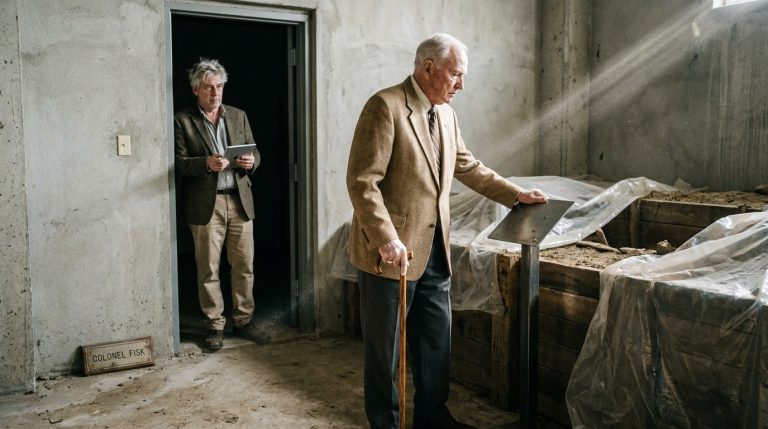
The implication was clear. Thorne wasn’t here to bring Arthur back into the fold; he was here to force the truth into the light. The office felt as though it were collapsing, the walls closing in on the secrets Arthur had guarded with his life. He looked at the floor, at the dust motes still dancing in the light, and realized that the quiet, simple life he had built was over. The ghost wasn’t hiding anymore. He was being summoned, and the price of his silence had finally, inevitably, come due.
CHAPTER 6: THE DEMOLITION OF SILENCE
The silence in the office was no longer the comfortable void Arthur had curated; it was a pressurized chamber, tight and ready to burst. Henderson sat frozen, his hand still poised over the pen, his eyes darting between the General’s granite-set features and the stooped, trembling frame of his janitor. The power dynamic of the room had inverted completely. Henderson, the man who held the power of termination, was now an irrelevant observer in a history he had no capacity to comprehend.
Thorne didn’t look at the manager. He stayed fixed on Arthur, his presence a dark, immovable gravity. “The accident reports,” Thorne said again, his voice dropping to a low, insistent rumble. “They’re not just paper, Arthur. They’re a timeline. They’re the reason those two—” he gestured briefly to the cowering lieutenants—”are alive today. You want to call it peace? I call it an insult to the ones who didn’t come home.”
Arthur stood up slowly. Every joint in his body protested, a chorus of clicks and pops that sounded like gunfire in the stillness. He didn’t look at Thorne. He looked at the windowless wall, at the stained, yellowed beige of the paint, trying to find the boundaries of the life he had built here. For forty years, he had been Arthur the janitor. He had been the man who cleaned the floors, the man who listened to the rhythm of the engines, the man who was nobody. Now, that identity was being stripped away like dry, brittle skin.
“You think you’re helping,” Arthur said, his voice stronger now, though it still carried the rasp of disuse. He turned to face Thorne. “You think by dragging this out, you’re restoring honor. But look at them, Marcus.” He gestured vaguely toward Viper and Jester. “They don’t see a hero. They see an inconvenience. They see a reason to be embarrassed.”
Viper flinched. The young lieutenant, who only an hour ago had been the picture of unearned confidence, was now staring at his boots. The arrogance had been burned out of him, replaced by a raw, naked discomfort that was, in its own way, more painful to watch. Jester was worse; he was trembling, his hand twitching at his side.
“They don’t matter,” Thorne said, his voice flat. “The individuals don’t matter. The truth does.”
“The truth is a weight,” Arthur snapped, a sudden, sharp clarity breaking through his exhaustion. He took a step toward Thorne, and for the first time in four decades, he didn’t drag his left foot. He moved with a residual, haunting grace, the muscle memory of a test pilot overriding the limp of a broken man. “You kept those reports in a safe. You kept the ghost under lock and key. Don’t lecture me on truth when you’re the one who waited until the very last possible moment to pull it out.”
Thorne didn’t blink. “I waited because I knew you’d fight it. I waited because I knew you were waiting to die.”
The bluntness of the statement landed like a physical blow. Arthur felt a sudden, sharp hollowness in his chest. Was he waiting to die? He looked down at his gnarled, liver-spotted hands. He had spent forty years in the hangar, not living, but observing—a phantom witnessing the evolution of the craft he had helped create. He had been so obsessed with the survival of the checklist that he had forgotten to survive his own life.
“Get out,” Arthur whispered.
Henderson looked up, bewildered. “Excuse me, Arthur?”
“All of you,” Arthur said, his voice echoing in the small room. He looked at Henderson, at the lieutenants, and finally at Thorne. “This isn’t your briefing room. This isn’t the Mojave. This is my airfield.”
Thorne studied him for a long moment, a flicker of something—regret, perhaps, or respect—crossing his features. He didn’t argue. He knew that Arthur had reached a threshold, a point of no return that no amount of rank or military authority could bridge. Thorne nodded, once, a sharp, military motion, and turned toward the door.
He stopped, his hand on the latch, and looked back over his shoulder. “The inquiry starts tomorrow, Arthur. The base commander is expecting a testimony. If you aren’t there… if you continue to hide… I’ll have to tell the story myself. And it won’t be the one you wrote.”
The door clicked shut, the sound final and hollow. Henderson was still staring, his mouth slightly agape, but he lacked the words to fill the void. Arthur didn’t wait for him to speak. He turned and walked out of the office, his gait steady, his head held high. He passed Viper and Jester in the hallway, but he didn’t look at them. He didn’t look at anything. He walked straight to the hangar, straight to the broom he had left leaning against the wall, and gripped the wood with hands that were, for the first time in years, completely, unnervingly still.
The hangar was dark now, the sun having dipped below the Cascade Mountains, leaving the vast space filled with shadows and the low, mournful sigh of the wind. He was alone, and for the first time in forty years, he didn’t know who he was supposed to be when the lights came up.
CHAPTER 7: THE TESTIMONY OF THE ASHES
The hangar had transformed from a cathedral of potential into an ossuary of ghosts. Arthur stood in the center of the vast space, the broom discarded against the cold, unyielding concrete. The darkness outside had deepened, the Cascade Mountains now nothing more than a jagged, ink-black tear against the twilight. Inside, the only light came from the dim, high-mounted security lamps that cast long, distorted shadows across the F-18—a metallic predator currently stripped of its arrogance.
He looked at the leather-bound notebook he had pulled from his pocket. It felt heavier than it had that morning, as if the paper inside had absorbed the tension of the last twelve hours. He didn’t need to open it; he knew every word etched onto the yellowed pages. It wasn’t just a manual; it was a confession. It was the record of every structural failure, every calculated risk, and every young pilot whose life had been traded for the advancement of the machines.
A movement in the shadows near the maintenance cart drew his attention. Sarah Jenkins emerged, her face pale but her expression resolute. She had been waiting. She had seen the General leave, and she had seen the way Arthur stood—not like a janitor, but like a sentinel guarding a graveyard.
“They’re scrubbing the diagnostic logs, Arthur,” she said, her voice quiet, cutting through the vast, hollow space of the hangar. “I saw them. The maintenance crew. They’re following orders from the base commander to ‘normalize’ the data before the inquiry tomorrow.”
Arthur didn’t react. He had expected it. The system was designed to protect its own, to smooth over the jagged edges of human error and mechanical decay with the antiseptic gloss of procedure. “They’re protecting the status quo,” Arthur said, his voice flat.
“It’s more than that,” Sarah persisted, walking closer. She looked up at the F-18, the giant, sleeping machine that had almost cost two lives that morning. “They’re erasing you. They’re erasing the fact that you caught the failure. If there’s no record of the shard, there’s no record of the warning. And if there’s no record of the warning, the bleed-air valve failure becomes just another ‘unexplained anomaly’.”
Arthur felt a spark of something he hadn’t felt in decades—not the cold, intellectual detachment of the test pilot, but the burning, righteous indignation of a protector. They weren’t just erasing a janitor; they were erasing the safety of every pilot who would follow. They were setting the stage for the next crash.
“Give me the manual,” Arthur said.
Sarah hesitated, then handed him the binder she had retrieved from the cart. Arthur opened it to the page he had marked with the metal shard. He pulled a pen from his work shirt pocket—a cheap, plastic thing that leaked slightly at the tip—and began to write. He didn’t just note the failure; he drafted a technical addendum, using the shorthand of engineers, the precise, mathematical language of a man who viewed physics as a moral imperative.
He worked with a speed that defied the arthritis in his knuckles, his hand flying across the paper. He was documenting the failure, the stress threshold, the atmospheric conditions, and the exact, catastrophic trajectory of the system’s collapse. He was creating a record that could not be normalized, could not be erased, and could not be ignored.
“If you bring this to the inquiry,” Sarah said, watching him with wide, fearful eyes, “they won’t just fire you, Arthur. They’ll ruin you. They’ll paint you as a lunatic, a disgruntled former employee with a vendetta against the service.”
“Let them,” Arthur replied, finishing the last equation with a firm, final stroke of the pen. He closed the binder and handed it to her. “The inquiry tomorrow won’t be about me. It’ll be about the machine. And the machine can’t lie.”
He looked at Sarah, truly seeing her for the first time—not as a curious apprentice, but as the successor to a lineage of men and women who stood between the sky and the cold, hard earth. She was the one who would carry the weight now. He felt a sudden, profound sense of lightness, a thinning of the heavy, protective veil he had drawn around his life.
“Take this to Thorne,” Arthur said. “Don’t give it to the commanders. Don’t give it to Henderson. Give it to the General. He’s the only one who still remembers the cost of the silence.”
Sarah took the binder, her hands steady. She looked at him with an expression of deep, mournful respect. “And what will you do, Arthur?”
“I’m going to do what I’ve done every morning for forty years,” Arthur said, reaching out to retrieve his broom from the shadows. “I’m going to clean this hangar. And then, I’m going to show them who the Ghost really is.”
He turned back to his work, the familiar rhythm of the broom on the concrete returning, but it was different now. The shoo-shush sounded like a countdown. He moved with a precision that was terrifying, his eyes fixed on the horizon of the morning, ready to face the inquiry not as a janitor, but as the man who had survived the fire so that others might have the chance to learn from the ashes.
CHAPTER 8: THE GHOST STEPS INTO THE LIGHT
The hangar doors were rolled back to their fullest extent, allowing the pale, sterile light of dawn to bleed into the vast, cavernous space. It was no longer a workplace; it had become an arena. Chairs had been arranged in precise, military rows facing a makeshift dais where the base commander, General Thorne, and a panel of senior officers sat in grim, anticipation-filled silence. The air felt heavy, vibrating with the collective weight of reputations on the line and the crushing, undeniable gravity of the truth Arthur held in his hands.
Arthur didn’t walk to the dais; he moved toward it with a deliberate, haunting ease that made every eye in the hangar track his path. He had shed the oversized gray work-pants and the stained shirt. He wore his old flight suit, faded and worn, but clean—a relic pulled from the back of a locker, preserved in the scent of mothballs and memory. The distinguished flying cross, pinned to the chest, caught the morning light, flashing with a sudden, sharp brilliance that seemed to blind those who tried to look directly at him.
He stepped onto the stage, the wood groaning slightly under his boots. He didn’t use a microphone. He didn’t need to. He stood at the edge of the platform and looked out over the assembly—the mechanics, the administrators, the base personnel, and finally, the two young lieutenants, Viper and Jester, who sat in the front row, their faces pale, their eyes fixed on the man they had once dismissed as a senile nuisance.
“I didn’t come here to apologize for my silence,” Arthur began, his voice ringing through the hangar, resonant and steady, stripped of the janitor’s rasp. “I came here because silence is a debt that eventually comes due, and I am finished paying it.”
He didn’t look at Thorne. He looked at the base commander, a man whose hands were currently resting on the very diagnostic logs Sarah Jenkins had been told to scrub. Arthur reached into his pocket and pulled out the small, leather-bound notebook—the true one, the one that contained not just the mechanical history of the bleed-air valve, but the names of the pilots who had died because that history was ignored.
“There is a difference between a machine that is flawless and a machine that is understood,” Arthur said, his voice quiet but commanding. “The Hornet is a masterpiece of engineering, but it is a creature of physics, not of magic. When I wrote the checklist you labeled a relic, I wasn’t writing for a prototype. I was writing for the one-in-a-million moment that inevitably finds every pilot who trusts their life to a machine.”
He stepped forward, placing the manual on the lectern with a heavy, final sound. He then pulled the Distinguished Flying Cross from his chest and laid it beside the book. It was an act of finality, a symbolic surrender of his secret.
“The diagnostic logs you were ordered to normalize?” Arthur said, his gaze shifting to the base commander. “They are incomplete. They don’t reflect the structural stress test that Sarah Jenkins performed last night. They don’t reflect the sliver of metal I found in the intake—the metal that would have sheared through the turbine blades within ten minutes of takeoff.”
The room went deathly still. The base commander looked at the General, then back at Arthur, his face a complex map of realization and dawning horror. Thorne sat perfectly still, his eyes locked on Arthur’s, a look of profound, agonizing relief passing between them.
The resolution wasn’t a shouting match or a dramatic revelation that toppled the base overnight. It was the slow, methodical dismantling of a lie. Arthur spoke for thirty minutes, his voice never rising, detailing the technical history of the valve, the physics of the fracture, and the systemic failure of a culture that prioritized speed over the brutal, uncompromising reality of mechanical law. He didn’t monologue; he gave them the data, the evidence, and the, indisputable, hard truth.
When he finished, there was a long, heavy silence—the sound of a hundred people realizing that they had been standing on the edge of a cliff without ever looking down. Viper was the first to stand. He didn’t say a word. He simply walked to the front of the stage and offered a salute—not a perfunctory military gesture, but a slow, deep, and genuine acknowledgment of the man who had just saved his life. Jester followed. Then the mechanics. Then, one by one, the entire room rose, a slow, inevitable tide of respect that filled the vast, cold space of the hangar.
Arthur didn’t salute back. He simply nodded, his eyes misty, his hands finally, completely still.
The denouement came in the quiet, golden light of the mid-morning. The base commander, his authority stripped away by the evidence Arthur had provided, issued the order to stand down the flight operations. The diagnostic logs were reinstated, the investigation was handed over to a federal board, and the “normalizing” of the truth was rendered impossible.
Thorne waited for Arthur by the hangar doors as the crowd slowly thinned. They walked together out onto the tarmac, the sun warm and golden against their faces. They didn’t speak of the past, or the crash, or the forty years in the dark. They walked in the silence of two men who had finished their watch.
Arthur walked to his old, rusted pickup truck. He opened the glove box and pulled out a small wrench, one he had kept for years, its handle worn smooth from his grip. He walked back to the hangar and, with a few precise, practiced movements, tightened a loose bolt on the sliding hangar door—a minor piece of maintenance he had been meaning to address for weeks.
CHAPTER 8: THE FINAL SALUTE
The morning light was different today. It didn’t just illuminate the dust motes dancing in the hangar’s rafters; it seemed to sharpen the edges of the world, stripping away the hazy, comfortable layers of the persona Arthur had worn for forty years. He stood in the center of the hangar, the broom lying at his feet, and watched the dawn paint the Cascade Mountains in hues of pale, bruised purple.
The hangar was already stirring. Mechanics were moving in the distance, their voices muted, their movements purposeful. The air was cold, smelling of pine and jet fuel—the same scent that had accompanied him through every morning of his second life. But the weight in his chest was gone. The report was in Thorne’s hands, the truth was anchored in ink, and for the first time, Arthur felt the ground beneath his feet not as a place to hide, but as a foundation to stand upon.
The door to the hangar opened. It was Sarah Jenkins, walking with a steady, determined stride. Behind her trailed Lieutenant Viper and Lieutenant Jester. They looked different—their posture was no longer the arrogant, squared-shouldered rigidity of the “new breed.” They carried a quiet, somber humility, their faces drawn as if they had spent the night dissecting the weight of their own ignorance.
Arthur didn’t reach for his broom. He stood still, his hands at his sides, his spine straight—a posture that hadn’t been seen in Northbend in decades.
Sarah stopped a few feet away, her eyes glistening. She didn’t speak. She simply nodded toward the hangar floor, toward the space where the Hornet had sat. The aircraft had been towed to the hangar’s far bay, grounded by the mechanical inspection Thorne had ordered. “The General is waiting at the operations center, Arthur,” she said, her voice soft. “He didn’t want to come here. He wanted to give you the choice to walk there yourself.”
Arthur looked at the two lieutenants. Viper stepped forward, his throat working as he swallowed the remnants of his pride. “Captain,” he said, the title landing with the heavy, overdue recognition it deserved. “We read the report. Sarah showed us the addendum you wrote.”
Jester didn’t speak; he couldn’t. He looked at Arthur with a mixture of shame and awe, his gaze fixed on the man who had been a myth—a story pilots whispered about in briefing rooms—before he became a janitor.
“The bleed-air valve,” Viper continued, his voice trembling slightly. “It was… the shard. It was a structural failure, just like you said. If we had skipped the cycle… if we had taken off…” He stopped, the reality of the hypothetical crash echoing in the silence of the hangar. “We owe you our lives, sir. And we insulted you.”
Arthur looked at them—not as children, not as arrogant intruders, but as pilots. They were the reason he had stayed. They were the fragile, reckless, beautiful reason that the checklists had to be held sacred.
“You owe me nothing,” Arthur said, his voice steady. “But you owe the truth everything. If you want to honor the ones who came before you, you don’t do it with swagger. You do it with the silence of the pre-flight check. You do it by treating the machine as a living thing, and the manual as a testament.”
He turned away from them, walking toward the hangar door that led to the tarmac. His limp was there—a permanent, physical reminder of the cost of his choice—but he moved with a fluid, rhythmic power that spoke of a man who had finally settled his accounts.
He reached the threshold and stopped, looking back at the hangar one last time. He saw the broom, the dustpan, the mundane, unremarkable tools of a life he had successfully hidden. He reached down, picked up the broom, and set it carefully against the wall. It was a small, symbolic act—the closing of a long, lonely chapter.
He walked out onto the tarmac. The sun was breaking over the horizon, casting a long, golden shadow across the concrete. General Thorne was standing by a black sedan, his silhouette stark against the morning sky. As Arthur approached, the General didn’t move. He waited. He watched the man who had been a ghost walk into the light.
When Arthur reached him, Thorne stood at attention. It was a quiet, deliberate gesture, acknowledging not the janitor, but the Captain who had saved a school in the desert. And then, in the absolute, ringing silence of the waking airfield, General Marcus Thorne raised his hand and offered a sharp, perfect salute.
Arthur stopped. He looked at Thorne, at the years of history written in the creases of the General’s face, and for a fleeting, perfect moment, he felt the heavy mantle of the “Ghost” fall away. He was just Arthur. He was the man who had done his duty.
Arthur returned the salute. His hand was steady. His back was straight. And in the cool, crisp air of the morning, he finally allowed himself the luxury of a smile—a quiet, peaceful curve of the lips that said everything that needed to be said. He wasn’t hiding anymore. He was a witness to his own life, a man who had found his way back from the desert, and he was ready to face whatever came next, standing tall, under the open, infinite reach of the sky.