A Quiet Stand: How One Man’s Silent Vigil Restored the Soul of a Disconnected Community
CHAPTER 1: The Weight of Compliance
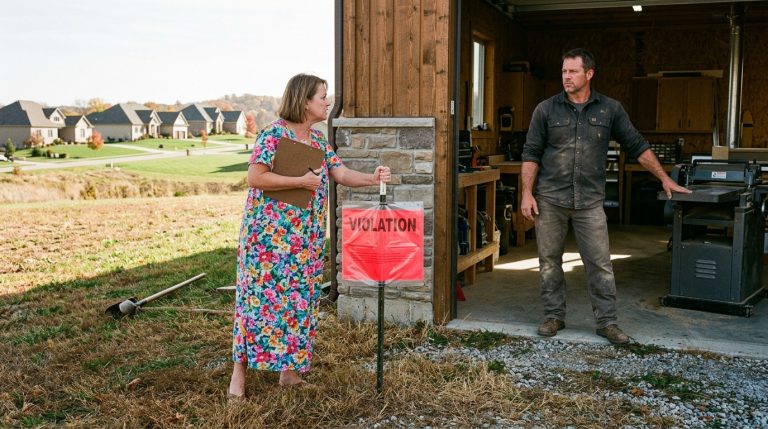
The clipboard was angled so the morning sun caught the plastic edge, casting a sharp, jagged shadow across Frank’s porch. Diane Halverson stood three steps below him, her silhouette framed by the manicured perfection of a subdivision that didn’t know how to handle an old Marine.
“Mr. Delaney,” she started, her voice not quite a question, more of a conclusion. “This is your final notice. That flag comes down in forty-eight hours, or we remove it ourselves. It’s too large, too loud, and frankly, it violates our aesthetic standards.”
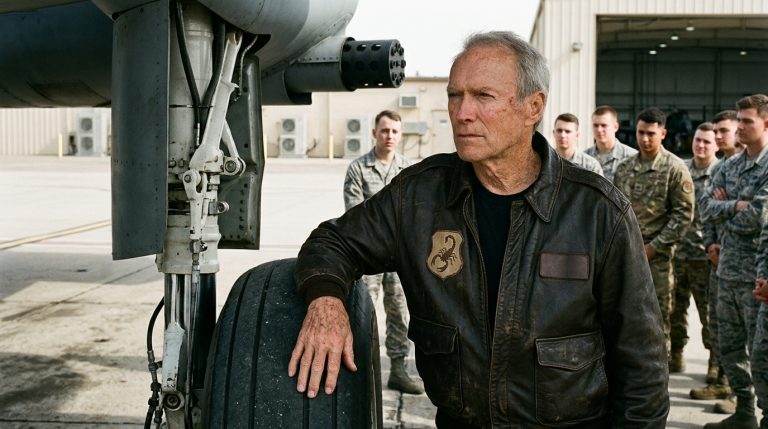
Frank didn’t blink. He felt the familiar, dull ache in his left thigh—a souvenir from a place that didn’t appear on any of the maps in Willow Ridge. He looked past her, toward the pole. At six in the morning, the fabric hung heavy and still, the wool-stitched stripes absorbing the early gray light. He had raised it himself just hours ago, his right hand fighting the tremor that had been his constant companion since ’68.
“Ma’am,” Frank said, his voice as dry as the dust on his boots. He didn’t offer her a seat. He didn’t offer a defense. “I’ll need to make a phone call.”
Diane smiled. It was a practiced, realtor’s smile—the kind used to smooth over cracked foundations or leaky pipes before an open house. She tucked the clipboard under her arm, the action crisp and efficient. She assumed the conversation was a closed file, a simple matter of compliance. She didn’t see the way Frank’s grip tightened on his mug, the ceramic groaning under the pressure. She didn’t notice that he wasn’t looking at the flag pole anymore; he was looking through her, at a horizon that had been burning for over half a century.
“I’m glad we could resolve this, Mr. Delaney,” she said, already turning toward her Lexus, parked precisely in the center of the street. “I’d hate to see a situation escalate over something as simple as lawn maintenance.”
As she walked away, the click of her heels sounded like small, rhythmic gunshots against the quiet of Juniper Court. Frank stood on the porch, a statue in a flannel shirt, watching her go. He felt the cold iron of the dog tags under his undershirt, pressing against his skin like a reminder of a debt that couldn’t be paid with HOA fees.
The silence that followed her departure wasn’t peaceful. It was heavy, a vacuum waiting to be filled. Frank looked down at his right hand. The tremor was back, rhythmic and persistent. He realized then that he couldn’t keep the world out of his garden anymore. The flag wasn’t just his property; it was the only thing standing between his peace and the encroaching tide of a neighborhood that had forgotten how to look up.
He stepped back into the house, closing the door on the crisp, clean air of Willow Ridge. The cedar box sat on the mantle, its lid slightly askew. He didn’t need to open it to know what was inside. He walked to the kitchen table, the wood worn smooth by years of solitary coffee, and reached for the black address book tucked beside the pepper shaker. His hand hovered over the letter W. He had spent decades keeping his silence, treating his history like a classified document, but the woman on his porch had touched something she shouldn’t have. She had touched the halyard, and now, the cable was beginning to fray.
CHAPTER 2: The Echo of the Cedar
The silence inside the house was different from the silence on the porch. It wasn’t a vacuum waiting to be filled; it was a pressurized chamber. Frank stood in the entryway, the front door firmly latched against the suburban hum of Willow Ridge. The cedar box rested in his hands, its weight familiar—a heavy, anchoring presence that had weathered as many years as the man holding it.
He moved to the kitchen, his gait stiff, favoring the left leg that carried the faint, rhythmic ache of old shrapnel. He didn’t turn on the television or the radio. The house was filled with the relics of a life he had built with Marjorie, yet tonight, the air felt thin, stripped of its usual comfort. He set the box on the dining room table, the wood scarred and darkened by time, and pulled out the chair where he had sat for thousands of meals.
He opened the lid. The scent drifted up immediately—not cedar, not really. To him, it smelled of dry grass, distant cordite, and the metallic tang of fear.
His fingers trembled, a fine, high-frequency vibration that he had learned to navigate by sheer force of will. He didn’t pick up the flag. He simply stared at the two dog tags taped to the underside of the lid. Delaney, Francis R. The metal was cool, etched with the identity of a man who had been twenty-two years old, standing in the mud of a fire base that felt like the edge of the world. Beside it, Talbot, James L.
The memory hit him, not with the grace of a recollection, but with the sudden, jarring velocity of an impact. It was the rice paddy near Khe San, the sky a bruised purple, the air thick with the smell of wet earth and impending violence. James had been laughing—or maybe he had been shouting, it was hard to tell through the roar—as he adjusted the strap of the flag he carried. Then the world had tilted. The roar became a physical weight, pressing the breath out of Frank’s lungs. He remembered the feeling of the flag’s fabric, coarse and damp, slipping through James’s fingers and catching on his own.
Frank blinked, and the rice paddy dissolved. He was back in the kitchen, the yellow light of the overhead fixture casting a pool of warmth across the table. His chest rose and fell, slow and controlled, a cadence he had practiced for decades to keep the ghosts at bay.
He didn’t touch the tags. He knew if he did, the tremor would climb from his hand, up his arm, and settle into his heart. Instead, he reached for the address book. The leather was worn thin, the spine reinforced with tape that had yellowed into a brittle cream color. He flipped the pages, the paper dry and whisper-soft.
His finger traced the column of names—men who had seen the same mud, who had breathed the same fire. He stopped at the letter W. Whitfield, Marcus.
He stared at the numbers scrawled in faded blue ink. For fifty-three years, he had treated these names like precious stones, rarely taken out of the vault. He had built his life on the principle of the “quiet stand”—that a man’s duty was to bear his own weight without complaint, to maintain the perimeter of his own soul, and to never, ever make himself a burden to those who had already given enough.
But Diane Halverson had changed the geometry of the room. She hadn’t just cited a violation; she had placed a hand on his flag. She had treated it like a stage prop, a piece of inventory to be moved or discarded to improve a spreadsheet.
He picked up the receiver of the landline, the plastic warm from the house’s interior temperature. The dial tone hummed in his ear—a steady, indifferent sound. He hesitated. The logic of his life had always been Therefore/But: He had survived, therefore he must be stoic. But the past was no longer in the past. It was sitting on his porch, in the form of a woman with a clipboard and a Lexus.
He began to dial, his fingers finding the familiar sequence with a muscle memory that bypassed his conscious thought. He didn’t need to look at the book. He had memorized the rhythm of the numbers long ago, even if he had never dared to press them.
The house seemed to hold its breath. A floorboard creaked in the hall, a settling of the foundation that sounded unnaturally loud. Frank waited for the first ring, his heart steadying, the tremor in his hand finally, mercifully, subsiding. He wasn’t doing this for the flag. He wasn’t doing this for the HOA, or the property values, or the aesthetic standards of Willow Ridge. He was doing this because for the first time in over half a century, the silence had become untenable.
He looked at the empty chair across from him, where Marjorie used to sit, her presence a soft, constant gravity. He imagined what she would say, and the thought brought a ghost of a smile to his lips—a brief, fleeting expression that vanished before it could reach his eyes.
“Marcus,” he whispered to the empty room, the name feeling heavy on his tongue, a key turning in a long-rusted lock. “I didn’t want to bother you.”
The phone clicked at the other end. The ringing started, a stark, hollow sound that cut through the silence of the house. Frank sat up straight, his shoulders square, his gaze fixed on the cedar box. He was prepared for the conversation to be short, for the connection to be severed, for the weight of the past to remain exactly where it was. But as the third ring echoed through the kitchen, he knew that the moment he had avoided for fifty-three years had finally arrived.
He didn’t look away. He kept his hand on the receiver, his thumb brushing the cool plastic, and waited for the voice that would bridge the distance between the mud of Khe San and the cul-de-sac of Juniper Court.
CHAPTER 3: The Geometry of a Promise
The phone settled back into its cradle with a soft, final click that seemed to echo through the kitchen. Frank remained standing at the table, his hand still resting on the cool plastic of the landline. For a moment, the only sound was the refrigerator’s low, rhythmic hum. Then, as if the connection had physically shifted the atmosphere, the air in the room felt sharper, more defined.
He had spoken. The words to Marcus—the explanation, the plea, the simple admission of a need that had been buried under decades of routine—were already drifting into the past. He didn’t feel relief. Relief was a luxury for those whose lives were unburdened by the weight of things left unsaid. Instead, he felt a grim, focused clarity. He checked the clock above the stove. Four minutes had passed since he began the call.
He didn’t return to the chair. He walked to the window, peering out into the early morning darkness of Juniper Court. The street was still. No headlights swept across his lawn; no neighbors were out checking their mail. It was as if the subdivision was waiting for the sun to give it permission to exist.
He needed to move. Staying still gave the mind too much room to maneuver, to question the necessity of the coming storm. He pulled on his work jacket—heavy canvas, stiff with years of wear—and stepped out into the garage.
The air inside smelled of stale oil and dry, stored memories. His 1994 F-150 sat under the fluorescent lights, a slab of metal that had refused to die, just like him. He’d promised Marjorie it wouldn’t be replaced until it quit, and it had proven to be as stubborn as its owner.
He didn’t drive it, but he went to the workbench and pulled out a pressure gauge. His movements were precise, economy of motion learned in a place where wasted effort could cost a life. He knelt by the front tire, the concrete biting into his bad knee. He unscrewed the valve cap, his fingers steady, and pressed the gauge to the stem. The hiss of escaping air was the only sound in the garage, a sharp, sibilant whisper.
Thirty-two PSI.
He moved to the next, then the next. He wasn’t just checking tires; he was calibrating his own focus. He had told Marcus he would be ready by 0600 on Saturday, and for Frank, “ready” wasn’t a state of being—it was a standard of maintenance. Every detail had to be airtight. He thought of Diane Halverson’s hand on the flag, the way she had looked at it not as a symbol, but as an object of commerce. He felt a slow, cold heat move through his chest. It wasn’t rage. Rage was messy, impulsive, and loud. This was something else—an alignment of purpose.
He stood up, wiping his hands on a rag, and noticed the shadow cast by the truck against the far wall. It looked, for a fleeting, distorted second, like the silhouette of the fire base at Khe San. He shook the thought away.
He walked to the back of the garage, where a small, locked cabinet held the tools he rarely used. He pulled out a box of heavy-duty hardware—the kind used for securing structures against high mountain winds. He hadn’t touched it since the pole was installed in ’97, but he knew exactly where it was. He picked up a wrench, feeling the cold, familiar bite of the steel. He wouldn’t need to reinforce the pole—the earth and the concrete were as solid as they had been twenty-nine years ago—but he needed to know that the connection was absolute.
He walked back out onto the driveway. The sky was beginning to bruise with the first light of dawn, a faint, metallic blue bleeding into the horizon. He walked to the flag pole and looked up. The flag was a dark, indistinct shape against the stars.
He didn’t reach for the halyard. He simply stood at the base, his hands hanging at his sides, breathing in the scent of the coming day—the pine needles, the dry asphalt, the faint, lingering smell of rain on the foothills. He was the anchor here. Willow Ridge was a place of shifting values and changing amendments, a subdivision built on the idea that everything could be improved, curated, and optimized. But the ground beneath his feet was constant.
He looked toward Diane Halverson’s corner house. The windows were dark. She was likely sleeping, dreaming of slide decks and community standards, unaware that the gears he had set in motion were already turning. The realization hit him with a strange, hollow weight: he wasn’t just protecting a flag. He was protecting the right to hold onto something that didn’t have a price tag.
He heard a car engine in the distance, a low, smooth purr—a neighbor heading to work, or perhaps a delivery driver. He turned and walked back toward the porch, his stride even, his mind tracing the logistical necessities of the next forty-eight hours. He had to be at the flag at 0600. He had to be dressed, shaved, and prepared for whatever form the “compliance” took.
He paused at the porch steps. The morning paper was waiting, a thin, rolled cylinder of news that felt increasingly irrelevant. He didn’t pick it up. Instead, he looked at his reflection in the glass of his screen door. The man staring back had silver hair cropped in a high-and-tight, eyes that had seen the horizon burn, and a face carved from the same hard, unyielding material as the life he had led since coming home.
He wasn’t waiting for the storm anymore. He was the one who had invited it in. And as the sun began to push its first, thin golden sliver above the plains, Frank Delaney turned his back on the house and prepared to meet the day.
CHAPTER 4: The Sound of the Tide
The first sound was not a roar, but a vibration—a low-frequency hum that seemed to emerge from the earth itself. Frank stood at the base of his flag pole, the halyard held firmly in his right hand. The morning sky was the color of a faded photograph, washed out and pale, but the light was beginning to sharpen the edges of the neighborhood.
At 0600, he did not hesitate. The motion was an old prayer, etched into his muscles by over half a century of repetition. He raised the flag. The fabric caught the breeze, a sharp snap that sounded like a dry branch breaking. He held the pose, hand over his chest, feeling the steady, rhythmic thump of his own heart.
Then, the hum became a thrum.
Frank turned, his movements slow, deliberate. At the mouth of Juniper Court, the first headlight cut through the morning haze like a cauterizing beam. It was a black Harley, heavy and polished, its chrome catching the nascent light. Then another. And another. They didn’t enter the neighborhood with a display of aggression; they moved with the eerie, synchronized grace of a funeral procession, two by two, a slow-moving tide of black leather and silver machinery.
He watched them, his expression unreadable, even as the first wave of heat moved through his chest. Doc was at the lead—Ernesto Ramirez, the corpsman who had stitched him back together when the world was coming apart at the seams. He looked older, his face a map of the years since, but the eyes behind the helmet were the same eyes that had looked at Frank in the mud of a rice paddy outside Khe San. They were the eyes of a man who remembered.
The motorcycles formed an arc that sealed the entrance of the cul-de-sac. It was a wall of intent, a barricade that turned Willow Ridge into something else—a sanctuary. The silence that fell over the street as the engines were cut was absolute, a heavy, suffocating pressure that forced the residents of Juniper Court to look out from behind their screen doors.
Diane Halverson’s house stood on the corner, cream-colored and pristine, its windows staring out at the arc like blank, uncomprehending eyes. Frank didn’t look toward it. He didn’t need to. He could feel the neighborhood’s confusion, the collective holding of breath as the veterans began to dismount. They were quiet, orderly, moving with a field-honed efficiency. Every man reached into his gear, every man pulled out a folded flag, and every man began to walk.
It was a systematic reclamation of the space. One by one, they moved into the yards, their boots clicking against the concrete with a sound that felt like the steady ticking of a clock. They planted their flags in the grass, the poles angled with military precision. The colors—faded red, brittle white, and blue that had turned the color of deep water—blossomed across the lawns of Willow Ridge, turning the manicured subdivision into a landscape of remembrance.
Helen Margolis, the widow from next door, stepped out onto her porch. She was small, wrapped in a housecoat, her eyes fixed on the man who had stopped in front of her home. The veteran didn’t speak. He simply planted the flag, pulled the light-weight vest from his shoulders, and draped it over her shivering frame. It was a gesture of profound, wordless empathy—a kintsugi act, mending the cracks in the neighborhood’s facade with the gold of shared history.
Frank felt the tremor in his hand settle into a hard, cold resolve. He looked toward the center of the arc, where Marcus Whitfield stood. The colonel had dismounted last, his movements stiff, his face set in a mask of grim determination. He didn’t look at the houses. He didn’t look at the cameras that were beginning to gather at the edge of the perimeter, drawn by the magnetism of the scene. He looked only at Frank.
Marcus began the walk up the driveway. Each step was measured, the sound of his boots rhythmic and predictable. The space between them closed, and for a moment, the subdivision, the HOA, and the clipboard-wielding threat of the last few weeks ceased to exist. There was only the fire base, the mud, the flag, and the fifty-three-year-old promise to stand guard.
When Marcus reached him, he didn’t offer a greeting. He simply raised his hand in a salute—the sharp, crisp gesture of a career Marine—and held it. Frank returned it, his hand steady, his chin tucked, his soul finally aligned with the present. They didn’t need to speak to know that the perimeter had been breached, and they were the only ones left to hold the line.
Behind them, the neighborhood was beginning to wake up, not to the routine of trash day or HOA compliance, but to the weight of a history that had been buried under their feet all along. Diane Halverson remained inside her house, her silhouette visible through the frosted glass of her front door, a ghost of her former authority. She was watching, her hands likely pressed to her sides, witnessing the transformation of her “asset” into something far more volatile.
The tension in the air was thick, vibrant with the friction of two worlds colliding—the curated, aesthetic reality of Willow Ridge and the raw, unvarnished truth of the men standing on its lawns. Frank turned his head, just for a second, to look at the flag on his pole. It was still there, snapping in the wind, a beacon that had guided them home. The battle for the cul-de-sac hadn’t been won, but the front lines had been drawn, and for the first time in over five decades, Frank Delaney wasn’t standing alone.
CHAPTER 5: The Reading of the Law
Diane Halverson opened the door not with a flourish, but with the cautious, brittle movement of someone stepping onto thin ice. The cream-colored foyer behind her was bright and impeccably staged, but she looked diminished, the vibrant confidence of the HOA president drained away, leaving only a woman in a gray sweatshirt with red-rimmed eyes.
Marcus stood on the porch, his posture relaxed yet immovable. The men behind him—the seven veterans he’d brought as silent witnesses—stood at the bottom of the steps, their presence a weight that seemed to compress the air. He held the single sheet of paper with a calm, surgical precision.
“Ma’am,” Marcus said. His voice wasn’t elevated; it was the steady, resonant tone of a command officer, one that didn’t need volume to command absolute attention. “Am I speaking to Diane Halverson, president of the Willow Ridge Homeowners Association?”
Diane gripped the edge of the doorframe. Her knuckles were white. “Yes,” she breathed. The word was small, lost in the expanse of the morning.
“My name is Marcus Whitfield. I’m a retired colonel, United States Marine Corps. I served with Frank Delaney in 1967 and 1968. I’d like, if you have a moment, to read you something.”
He didn’t wait for her to invite him inside. He began to read, his eyes fixed on the text of the Federal Flag Code. He recited the statutes as if he were reading a combat order—clear, precise, and entirely devoid of emotion. As he spoke about the universal custom, the sunset, the 24-hour illumination, and the sanctity of the flag, the atmosphere in the cul-de-sac shifted. The earlier tension, the visceral, adrenaline-fueled friction of the arriving bikes, began to crystallize into something sharper: the cold, unyielding weight of law and duty.
Diane’s eyes darted to the men standing at the base of her walkway. They weren’t moving. They weren’t shouting. They were simply standing, a wall of faded denim and leather, their faces etched with the same stoic, impenetrable resolve. She looked back at Marcus, her mouth parting as if to frame a defense, but the words failed her. There was no defense against the language he was reading—it was a document of history, a standard that transcended the local amendments she had so carefully, so pridefully, constructed in her Pinterest-board vision of Willow Ridge.
“Section 8,” Marcus continued, his voice dropping an octave, becoming a low, resonant rumble. “No disrespect should be shown to the flag of the United States of America.”
He stopped. The silence that rushed back into the space was absolute. He looked up, meeting her gaze, and for the first time, Diane saw exactly what she had done. She saw the distance between her aesthetic standards and the reality of the man she had cited. She saw the flag pole not as a height violation, but as a lighthouse, a tether for a man who had left the best part of himself in a place she would never visit.
“Ma’am,” Marcus said, the title now sounding less like a formality and more like a verdict. “Mr. Delaney’s pole meets every specification of the federal flag code. His flag size is correct. He is not in violation of a single statute of the state of Colorado or the United States government. What he is in violation of is an amendment passed by a five-person board in May of this year. That amendment is not the law. That amendment is an opinion.”
He took a step closer, the wood of the porch groaning under his weight. Diane retreated a fraction, her eyes filling with the sudden, stinging realization of her own fragility.
“And what I am here to tell you,” Marcus said, “is that you placed your hand on his flag two days ago and you told a Marine who earned the Silver Star carrying that flag out of Khe San that it violated your aesthetic standards.”
The sentence hung in the air, a physical blow. Diane’s mouth opened, then clamped shut. The sheer scale of her misunderstanding, the pedestrian nature of her power against the gravity of his sacrifice, seemed to shatter the composure she had fought to maintain. She looked toward the end of the cul-de-sac, where the news vans were pulling into position, their antennas rising like jagged thorns above the rooflines.
“I am not going to threaten you,” Marcus said, his tone shifting into something almost, but not quite, kind. “I am not going to raise my voice. I am going to ask you a single question. Are you going to withdraw that notice this morning of your own free will before the 9:00 meeting, or do I need to make the short walk down to the clubhouse and read this same document at that meeting in front of every homeowner in Willow Ridge and the three television crews that are, as we speak, turning onto Aspen Avenue?”
Diane’s gaze flickered to the cameras. The reality of the situation—the optics, the exposure, the absolute dismantling of her narrative—hit her with the force of a tidal wave. The clubhouse, the blue blazer, the slides on property values—it all seemed like a children’s game played in the shadow of a mountain.
“I will withdraw it,” she whispered.
“Thank you, ma’am,” Marcus said. He didn’t gloat. He didn’t offer a reprieve or a friendly handshake. He simply turned, his movements crisp and mechanical, and walked back down the porch steps.
As he rejoined his men, the pressure in the cul-de-sac seemed to dissipate, replaced by a sudden, cooling breeze. The veterans began to move, retreating toward their bikes with the same quiet efficiency with which they had arrived. Diane stood in her doorway, the door half-open, her hands trembling as she looked out at the street. The flags were still planted on the lawns, their red, white, and blue a stark, vivid contrast to the muted cream and gray of the suburban houses. She was no longer the president of the board, not in any way that mattered; she was just a woman standing in a doorway, realizing that she had been living in a house built on ground she hadn’t understood at all.
Marcus looked back at the house one last time, his face a mask of iron, before he swung a leg over his bike. The engine turned over with a deep, resonant bark, a sound that seemed to signal the closing of a chapter. Across the street, at the end of the cul-de-sac, Frank Delaney stood by his pole, his hand on the halyard. He watched, his eyes steady, as the last of the bikes began to move in a slow, steady stream toward the neighborhood exit. The battle was over. The lawn was reclaimed. But the man at the pole knew, as the morning light hit the finial, that the true resolution was not in the notice, but in the silence that would remain when the engines finally faded away.
CHAPTER 6: The Unfolding of the Truth
The cul-de-sac was returning to its natural state, but the quality of the silence was changed. It was no longer the heavy, suffocating pressure of a community divided; it was the hollow, resonant quiet of a room after a long-held breath has finally been released. The motorcycles had vanished, leaving only the smell of exhaust and the ghostly presence of the forty-seven flags standing in the lawns, a temporary perimeter of memory.
Frank stood at his pole, his hand resting on the halyard. He felt a strange lightness in his chest, a sensation that bordered on vertigo. The battle with the HOA was over—the notice rescinded, the board in shambles, the neighborhood forced to look at the ground they walked upon. But the real weight, the one he had carried since 1968, was the only thing that remained.
He turned toward his house. The sun was fully up now, a bright, unrelenting light that bleached the gray paint of his home into a stark, almost clinical white. He walked up the driveway, his limp more pronounced after the hours of standing, and stepped onto the porch. He didn’t go inside immediately. He looked at the neighbor’s house, where Helen Margolis stood on her porch, her hand resting on the flag that had been planted by a stranger—a flag that held the weight of her own loss. Their eyes met, and in that gaze, there was no need for words. They were both survivors of a time that hadn’t quite finished happening.
He went inside. The kitchen was just as he had left it, the coffee cup still sitting on the counter, the smell of burnt toast lingering in the air. He walked to the mantel and reached for the cedar box. This time, he didn’t hesitate. He took it down, his hands steady, and set it on the dining room table.
He opened the lid. The flag inside, the one from Khe San, seemed to pulse in the morning light. He took it out, not with the practiced, military efficiency he used for the daily flag, but with a slow, almost reverent tenderness. He unfolded it. The fabric was thin, worn almost to transparency, the red turned to a deep, dark brown, the blue to a slate gray. And there it was—the bullet hole, a small, jagged aperture that had once been the focus of his entire world.
He reached up to his undershirt and pulled the bead chain over his head. The two dog tags clattered against each other—his own and James Talbot’s. He laid them on the table next to the flag.
“James,” he said, the name sounding foreign and yet intimate in the empty house. “I finally brought it home.”
He looked at the bullet hole. He hadn’t been able to speak of it for fifty-three years because to speak of it was to acknowledge the cost, and he had spent his life trying to live as if that cost hadn’t been paid. He sat down, the chair groaning under him, and for the first time in his life, he didn’t push the memory away. He let the scene unfold: the heat of the fire base, the thunder of the mortar, the way James had looked at him before the world ended, a boy from Tennessee who had trusted Frank to carry the weight.
He reached out and smoothed the fabric, his fingers tracing the frayed edges of the hole. He thought of the medal in the back of the box, the citation for conspicuous gallantry that he had never bothered to show to a single soul. It wasn’t a prize; it was a receipt for a life he had been gifted and had spent the next five decades trying to justify.
He stood up, his joints stiff, and walked to the wall where he kept the framed photograph of his squad. He took it down, the glass cool against his palms, and placed it on the table alongside the flag. He wasn’t hiding these things anymore. He was letting the light in.
He heard a soft knock at the door. He turned, his heart slowing, and walked to the entryway. He opened it to find Diane Halverson standing on his porch. She wasn’t wearing her blazer, and she didn’t have her clipboard. She wore a simple gray sweatshirt, her hair pulled back in a ponytail, and she looked younger, more vulnerable than he had ever seen her.
She held a mug in both hands, a small, warm thing. She didn’t look at the flag pole; she looked at Frank, her eyes red-rimmed and clear.
“I was wrong,” she said, her voice catching on the words. “About all of it. I didn’t see you. I just saw the pole.”
Frank looked at her, really looked at her, for the first time. He saw the genuine, agonizing weight of her own realization. He thought of his grandfather, the man who had fought in Korea, the man she had finally remembered in the dark of her own home. He opened the door wider, a gesture that was both simple and profound.
“Would you like a cup of coffee?” he asked.
She nodded, a tear tracking a path through the dust on her cheek. She stepped inside, into the house that had been a fortress of silence for so long, and sat at the table. Frank made the coffee, the smell of the grounds filling the kitchen—a mundane, grounding act that felt like the start of something entirely new.
They sat together as the sun climbed higher, the flag spread between them on the table like a map of a territory they were both finally willing to explore. Frank told her about the flag, about the rice paddy, about James Talbot, and about the fifty-three years he had spent standing guard over a silence that had nearly consumed him. He spoke without the tremor, without the need for the stoicism that had been his armor. He was just a man, speaking to another human being about the things that made them whole.
The neighborhood outside was waking up. The flags were still there, the cul-de-sac was still Juniper Court, but the fear was gone. The HOA would move on, the board would be rescinded, and the people of Willow Ridge would go back to their lives. But something had been mended.
Frank reached out and touched the edge of the flag. He felt the history of it, the pain and the grace, the way it had held the shape of his life for so long. He wasn’t finished with his service, and he never would be, but he was finished with the hiding. He stood up, went to the mantel, and placed the photograph of his squad in the center, a beacon that would watch over his home. He had his friends, he had his memory, and for the first time since ’68, he had a future that wasn’t just a shadow of the past.