The Echo of the Clock: A Legacy of Calm Above the Clouds and Within the Soul
CHAPTER 1: THE DESCENT INTO SILENCE
Harold Lawson did not reach for the emergency oxygen mask. He did not look at the businessman franticly tapping on a dead phone screen. Instead, he looked at his wrist. The oversized chronograph, its steel casing pitted by decades of friction, seemed to pulse in the flickering orange glow of the emergency lights.
The silence from the cockpit was the most honest thing on the plane. It was an absolute, suffocating void. Ten minutes of silence meant the air was gone, the instruments were black, and the men behind that reinforced door were no longer pilots; they were ghosts tethered to a failing machine.
“Sit down, old man,” the air marshal, Fuller, snapped. His voice was a thin, brittle vibration in the pressurized cabin. He reached for his jacket, his fingers twitching toward the cold, hidden weight at his hip. “This is a federal situation. You are a civilian. You stay in your seat.”
Harold felt the vibration through the soles of his shoes—a low-frequency shudder that bypassed the ears and settled in the marrow of his bones. The starboard engine was starving. It wasn’t just a fire; it was a slow, inevitable mechanical divorce from the sky.
He didn’t look at Fuller. He looked through him, his eyes the color of a winter sky, seeing not the panicked faces of passengers, but the faint, ghostly green of a phosphor-lit cockpit from fifty years ago. The smell of ozone hit him—sharp, stinging, a bitter memory of the Asha Valley. He was suddenly standing in the wreckage of a machine that had never officially existed, holding the hand of a man who hadn’t made it home.
“The transponder is off,” Harold said. His voice was a rasp, a dry friction of sound that seemed to pull the oxygen out of the air.
Fuller blinked, his bravado momentarily cracked by the old man’s terrifying lack of tremors. “What?”
“The transponder. It’s not broadcasting. And we’ve banked,” Harold continued, his head cocked at an angle, listening to the scream of the starboard engine. “Southeast. We’re losing the hydraulics.”
Fuller’s face flushed a deep, panicked purple. He stepped forward, his body a barricade of fear disguised as authority. “I’m not going to ask you again. You are a threat to the safety of this flight. Sit down, or I will put you in cuffs.”
The plane dropped. A sudden, violent jolt sent a wave of nausea through the cabin. People screamed—a jagged, dissonant sound that tore through the thin veneer of order. Harold remained motionless. He didn’t care about the marshal’s handcuffs; he cared about the integrity of the avionics bay, two decks below, where the fire was currently chewing through their ability to survive the next ten minutes.
He looked down at his watch again. The crystal was scratched, a map of a thousand small impacts. It had once been a tether for a man who had flown an ugly, broken bird across a border, carrying the ghosts of his friends.
“Son,” Harold said, his voice soft, holding an ancient, terrible gravity. “You have no idea what a threat to this flight looks like. But you will, very soon, if you don’t let me help.”
As Fuller hesitated, his hand trembling, Harold saw the flight attendant’s service satchel spill across the aisle. Amid the clutter of plastic and paper lay a small, handheld radio. A lifeline. A straw. Harold shifted, his movement a fluid, unexpected economy of motion that belied his age.
He moved toward the radio, and the air around him seemed to freeze, the screaming in the cabin receding into a distant, muted backdrop. This was the moment of grace. He would either find the key to the cage, or they would all go down into the dark.
CHAPTER 2: THE WEIGHT OF THE WATCH
Harold held the handheld radio as if it were a fragile bird that might shatter under the slightest pressure. The plastic casing felt cold and unnervingly slick, a stark contrast to the rough, pitted steel of the chronograph strapped to his left wrist. The cabin around him didn’t just vibrate; it hummed with the high-pitched, metallic whine of a dying fuselage. The orange emergency strips cast long, flickering shadows that danced like ghosts against the bulkheads, making the faces of the passengers appear hollow, etched with a desperate, hungry anxiety.
Fuller took a step forward, his boot scuffing against the cabin floor—a sound that seemed disproportionately loud in the pressurized gloom. The air marshal’s face was a mask of strained muscle, his jaw so tight it looked ready to fracture. “I said, put it down,” Fuller hissed, his voice dropping into a low, predatory register. He was trying to assert authority, but the tremor in his hands betrayed him. He wasn’t reaching for his weapon anymore; he was reaching for the illusion of control that Harold had dismantled with a single sentence.
“Listen to me,” Harold said, his voice quiet, lacking any cadence of fear. He ignored the marshal’s posturing, focusing instead on the dial of the radio. The static was a living thing, a chaotic wall of sound that scraped against the eardrums. “The fire in the avionics bay is creating a feedback loop. Every time we bank, the heat shifts. We aren’t just fighting a fire; we’re fighting the center of gravity.”
As if to punctuate his words, the Boeing shuddered violently. A sickening lurch tilted the floor beneath them, sending a wave of displacement through the aisles. A tray of half-empty plastic cups slid across a seat back, clattering to the floor. The woman in the row behind Harold let out a soft, broken sound—not a scream, but a sigh of absolute defeat.
Harold braced himself against the seat, his knees bending with a fluid, practiced grace that defied his eighty-three years. He felt the shift in the air pressure, the subtle change in the engine’s pitch that indicated a temporary loss of lift. The butterfly effect of the maneuver wasn’t just physical; it forced him to adjust his grip on the radio, his thumb slipping slightly on the dial. The frequency shifted, the harsh static thinning for a micro-second to reveal a high-pitched, distorted hum—the dying cry of an avionics system being cooked from the inside out.
Fuller stumbled, thrown off balance by the lurch. He grasped the overhead bin handle to steady himself, his eyes darting around the cabin, seeking a target for his mounting frustration. He looked at the passengers, their eyes wide and reflecting the eerie, fading orange light, then back to Harold. He was a man drowning in a situation where his badge and his training were as useless as paper shields against a wildfire.
“You’re making this worse,” Fuller growled, though the conviction in his voice was fraying. “We have procedures for this. You’re causing mass panic!”
Harold didn’t look up. He was watching the way the smoke seeped through the ventilation grilles above the cockpit door—a thin, gray ribbon that curled into the cabin air. It was a textured, ghostly movement, slow and deliberate. It told him exactly how much time they had before the fumes overwhelmed the cabin crew and the fire breached the main structure.
“Procedure is for a world that still exists, son,” Harold murmured, more to himself than the marshal. He tuned the radio again, his movements meticulous. He wasn’t thinking about his own life; he was thinking about the Asha Valley. He was thinking about the way the light had looked through the canopy of a broken aircraft, the way the silence had felt right before the final impact. He was calculating the cost of every second.
The weight of the watch on his wrist felt heavier, as if it were anchoring him to the present moment even as his mind drifted through the archives of his memory. The crystal was scratched, the lume faded, but it kept time with a relentless, mechanical precision. It was the rhythm of survival.
“If you want to help,” Harold continued, finally meeting Fuller’s gaze, “then find me a fire extinguisher. Not the small one in the galley—the heavy-duty unit from the forward locker. The one they keep for the internal panels.”
Fuller hesitated, his mouth opening to retort, but the words died in his throat. The cabin lurched again, this time more severely. The plane felt less like a sophisticated piece of aerospace engineering and more like a tomb being shaken by a giant hand. The fear in the cabin was reaching a fever pitch; the air was thick with the metallic, sharp tang of adrenaline and burning insulation.
The army private, the young soldier who had been watching Harold with a quiet, watchful intensity, stood up. He didn’t look at Fuller; he looked at Harold. “I’ll get it, sir,” he said. The way he said sir was not a gesture of subservience, but an acknowledgement of hierarchy—not one defined by rank, but by a proven, silent capability.
Fuller looked at the soldier, then at Harold, his face a landscape of conflicting emotions. He was losing his grip on the narrative of the flight. He was no longer the protector; he was becoming an observer. He watched as the soldier began to move down the aisle, his steps careful and balanced, moving against the unsettling motion of the plane.
Harold turned his attention back to the radio, pressing the transmit button. The plastic was smooth and worn under his thumb. He was no longer looking at the emergency lights or the panicked passengers. He was staring into the gray, curling smoke by the cockpit door, his heart rate steady, his mind a crystalline, cold space where only one thing mattered: the frequency.
“This is Ugly Six,” he whispered into the static, his voice a calm anchor in a world tilting on its axis. “Do you read? I need to know if the door is truly sealed, or if the fire has already found the lock.”
He waited, the radio pressed to his ear, listening to the vast, indifferent silence of the sky.
CHAPTER 3: THE GHOST FREQUENCY
The radio crackled, a rhythmic, pulsing static that felt like a heartbeat against Harold’s palm. He held it with a steady hand, his thumb tracing the edges of the casing. In the faint, flickering orange emergency light, he noticed something the others hadn’t. The battery compartment cover, a small piece of sliding plastic, was slightly misaligned. A sliver of copper was exposed, the metal dulled by what looked like intentional scouring. It wasn’t the wear and tear of age; it was a deliberate, manual intervention—a sabotage that had almost rendered their only lifeline useless.
He didn’t mention it. To alert the passengers would be to invite the very panic that Fuller was so desperate to contain. Instead, he adjusted his grip, his fingers working the plastic with the practiced patience of a man who had spent years fixing things that were never meant to survive.
Fuller was watching him, his face a landscape of uncertainty. The air marshal’s initial anger had been eroded by the sheer, unyielding reality of their situation. He stood a few feet away, his arms crossed over his chest, his gaze flickering between Harold and the cockpit door. The young army private was returning down the aisle now, his movements precise, carrying the heavy-duty fire extinguisher like a soldier bearing an offering. He didn’t speak to Fuller. He walked straight to Harold, nodding once.
“It’s here, sir,” the private said, his voice low.
Harold acknowledged him with a curt nod, his eyes remaining fixed on the radio. “Keep it nearby, son. Don’t engage the panels until I tell you. The heat distribution is erratic.”
The plane dropped again, a stomach-churning plummet that lasted only a second, but felt like an eternity. The floorboards groaned in protest, a sound of stressed metal that echoed the fragility of their environment. Harold waited for the motion to stabilize, his internal clock counting down the seconds. He wasn’t just waiting for a response; he was calculating the distance to the nearest Air Route Traffic Control center, mentally mapping the flight path based on the engine’s rhythm.
Then, through the cacophony of the static, a voice emerged. It was fragmented, distorted by the atmospheric interference and the failing avionics, but it was there.
“Ugly… Six… do you… copy?”
The words hit Harold like a physical weight. The call sign felt strange on his ears, a relic of a time when the world was smaller, yet infinitely more dangerous. He pressed the transmit button, feeling the slight give of the sabotaged casing.
“This is Ugly Six,” Harold replied, his voice a steady, rhythmic pulse. “I hear you, Aurora. The situation is critical. Cockpit is unresponsive. We are losing hydraulic integrity. I am in the cabin. Requesting guidance for a manual override. Is the transponder signal being picked up, or are we truly a ghost?”
The pause that followed was agonizing. The cabin fell into a hush so profound that the only sound was the wind rushing over the fuselage and the labored breathing of the people around him. Fuller moved closer, his own bravado completely replaced by a stark, naked need for an answer. He wasn’t the law right now; he was just another passenger in the dark.
“Ugly Six, this is Aurora,” the voice came back, clearer this time, bolstered by a stronger signal. “We have no radar return. You are invisible to the primary array. We are scrambling assets. You have two F-35s vectoring to your position. ETA, four minutes. Maintain your current heading, Colonel. Do not—I repeat, do not—attempt to breach the cockpit door until you have eyes on the wing.”
The mention of the F-35s sent a ripple of tension through the cabin. A woman near the window seat gasped, pressing her forehead against the glass. Harold didn’t look. He focused on the radio, his mind synthesizing the information. Four minutes. It was an eternity in a failing machine, but it was all they had.
He looked at Fuller. “Did you hear that?” Harold asked, his voice devoid of accusation. “We’re being hunted by our own side because they think we’re a threat. When those jets arrive, there will be no room for hesitation. If we don’t have our act together, they’ll assume the worst.”
Fuller blinked, his face pale. “They… they’re going to shoot us down?”
“They’re going to secure the asset,” Harold said, his tone clinical. “It’s a protocol. A nasty one.”
He looked back at the radio, his thumb still resting on the sabotaged casing. He realized now that the sabotage wasn’t just meant to kill the radio—it was meant to isolate them, to ensure that no word could reach the ground until it was too late. Someone on this flight, or perhaps someone who had boarded it, didn’t want them talking to Aurora.
He scanned the cabin, his gaze lingering on the faces of the passengers. They were all terrified, their eyes wide and searching. It could be any of them. The businessman with the dead phone, the woman who had been sobbing, the teenager in the sweatshirt. Anyone. The suspicion was a cold, hard stone in his chest, but he pushed it down. He couldn’t afford to be distracted by paranoia. He had to be the anchor.
He took a slow, deliberate breath, the air smelling of ozone and fear. He was the only one who remembered the language of this broken machine, and he would be the one to guide it home, regardless of the ghosts that haunted the aisles. He turned to the soldier.
“Private,” Harold said, his voice cutting through the ambient hum. “When those jets show up, I need you to be ready. The door is going to be the next problem. We’ll need to work the manual release from the inside, but first, we have to ensure the avionics bay doesn’t catch the cabin on fire.”
The soldier stood tall, his posture a stark contrast to the slumped, defeated appearance of the others. “Understood, sir. What’s the plan?”
Harold looked at the radio, then back to the cockpit door. He was beginning to see the shape of the truth, a decoy secret that was being played out in the engine failure, masking something much deeper, something that required this silence. He felt the weight of the chronograph on his wrist—a ticking reminder that for every second he spent, he was paying for their survival with his own history.
“The plan,” Harold said, his eyes hard and clear, “is to stay in the air until we can’t. And then, we do whatever is necessary to keep the ground from meeting us too quickly.”
CHAPTER 4: THE CONVERGENCE
The air in the cabin had grown deathly thin, turning the simple act of breathing into a conscious, labored labor. Harold gripped the radio, his knuckles white against the dark plastic, as the scream of the static reached a crescendo. Outside the windows, the sky was no longer a vast, indifferent blue. It had been reclaimed by steel and fire. Two F-35s materialized from the cloud layer, their silhouettes jagged and predatory. They moved with a predatory, synchronized grace that made the lumbering 777 feel like a wounded animal being cornered by wolves.
The sight rippled through the passengers like a physical blow. The sobbing ceased, replaced by a suffocating, heavy silence. Even Fuller, who had been hovering nearby with a frantic, unspent energy, backed away, his face turning the color of ash. He stared at the fighter jets, his eyes wide, reflecting the distant, cold flicker of the escorting aircraft’s navigation lights.
“They’re here,” Harold whispered, his voice barely audible over the growing roar of the jet engines outside. He felt the vibration in his teeth—a deep, rhythmic thrumming that was the signature of a formation flight. The military had arrived, but they hadn’t come to rescue the passengers; they had come to manage a threat.
“This is Viper One,” a voice cut through the radio, clear, clipped, and terrifyingly efficient. “Civilian aircraft 739, we have visual confirmation. You are drifting five degrees off your assigned vector. Correct immediately, or we will be forced to engage our interception protocols.”
Harold pressed the transmit button. His thumb brushed the scoured, sabotaged casing of the battery compartment. The plastic felt hot, a sign that the electrical system was drawing far more power than it should. “Viper One, this is Ugly Six. My control surfaces are sluggish, and the avionics bay is compromised. I cannot correct to that vector without risking a total stall.”
“Ugly Six, confirm identity,” the voice of the fighter pilot replied, the cadence unchanging, robotic. “That call sign is restricted. Identify yourself by current civilian passenger manifest.”
Harold felt a familiar phantom chill creep up his spine. The air in the cabin seemed to shift, the smell of recycled plastic and burning wire replaced, for a fleeting, sickening second, by the acrid, metallic stench of smoke-choked air and wet earth. He was back in the Asha Valley. He was hanging upside down, the world a spinning, fractured mosaic of fire and darkness. He could hear Mike, his navigator, gasping for air, the sound of his struggle a wet, rhythmic rattling in the silence of the cockpit.
“Harold,” he whispered, the name slipping out before he could catch it. He shook his head, the sensation of the wreckage fading back into the reality of the shaking Boeing. “This is Colonel Harold Lawson. I am on board. I repeat: I am the only one holding this machine together.”
He looked at the cockpit door. The smoke was thicker now, a gray, curling ribbon that clung to the ceiling. The avionics fire was no longer a latent threat; it was active, consuming the very nerves of the aircraft.
“Colonel,” the pilot replied, his voice softening by a fraction. “We have received orders from Aurora. You are to be given absolute priority. But we have a problem. The sensors are detecting a high-intensity thermal spike in your avionics bay. If that fire reaches the hydraulic bundle, you lose the tail. You have less than three minutes before your control becomes entirely theoretical.”
Harold looked at the army private. “It’s time,” he said, his voice hard. “The extinguisher.”
The soldier moved with a sudden, sharp efficiency. He ripped the pin from the heavy-duty canister, his movements trained and precise. He didn’t hesitate. He stepped toward the cockpit door, his shoulder braced against the frame.
“Wait,” Fuller shouted, stepping forward, his hands raised as if he could stop the inevitable. “You can’t open that door! The protocol—”
“The protocol is a coffin, son,” Harold snapped, his voice a lash of authority that silenced the marshal instantly. “You want to live? Then get behind the curtain and stay there.”
Harold moved with the private, his own feet feeling strangely heavy, as if the floor were made of lead. He watched as the soldier prepared to strike, the metal of the extinguisher reflecting the flickering orange glow of the emergency strips. They were about to expose the heart of the machine to the cabin, and in doing so, they would either starve the fire or unleash a wall of toxic, superheated gas.
He looked at his wrist, at the scarred, pitted chronograph. Its hands were moving, tracking time with an implacable, steady rhythm. He had been here before. He had stood on the edge of the abyss and looked down into the dark, and he knew that the only way through was to move forward. He was not the hero of this story—he was merely the one who had survived long enough to ensure others could too.
The plane shuddered, a bone-jarring impact that sent them both sprawling against the bulkhead. The F-35s outside banked in perfect formation, their exhaust plumes painting the clouds in streaks of white. The time for hesitation had passed. Harold gripped the handle of the cockpit door, his eyes locked on the darkening metal.
“On my count,” Harold said, his voice a low, steady rumble. “Three, two, one. Break it.”
The soldier swung the canister, the metal biting into the door, and the world began to tilt.
CHAPTER 5: THE LANDING OF SCARS
The cockpit door didn’t just open; it disintegrated into a tangle of twisted metal and shattered composite, pushed inward by the sheer pressure differential of the cabin. A wave of superheated, smoke-laden air erupted into the aisle, smelling of charred insulation and something darker, something like hot oil and scorched earth. Harold felt the heat hit him like a physical blow, a searing wave that singed the fine hairs on his arms. He didn’t flinch. He leaned into the smoke, his eyes squinting against the stinging, acrid haze.
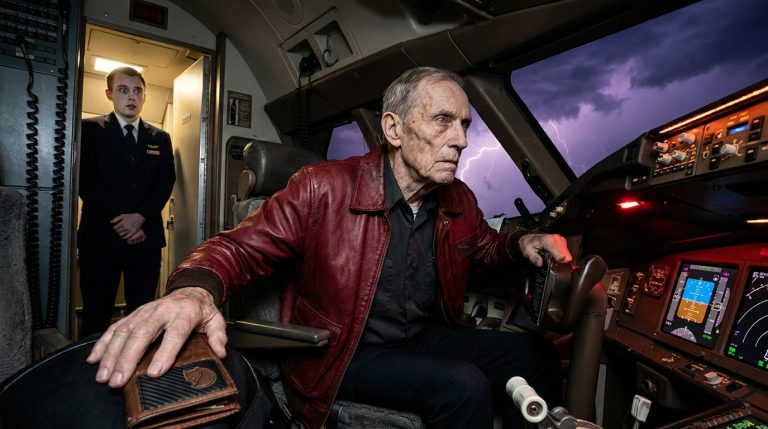
“Get behind me!” Harold commanded, his voice raspy but sharp, cutting through the sudden roar of the air rushing past the fractured bulkhead. He stepped over the threshold, his boots crunching on shards of polycarbonate. The cockpit was a ruin of flickering instruments and darkness. The primary screens were dead, their surfaces cracked into spiderwebs of light and shadow, but the emergency flight indicators—the old-fashioned analog gauges he had spent a lifetime learning to trust—were still glowing with a dim, phosphorescent green.
The first officer was slumped over the center console, his head lolling against the yoke. He was alive, his chest rising in shallow, ragged hitches, but he was unconscious, overwhelmed by the toxic cocktail of fumes that had filled the enclosure.
Harold reached for the controls, his hands finding the familiar, cold geometry of the flight management system. He could feel the vibration of the starboard engine through the yoke—a rhythmic, uneven stutter that warned of catastrophic failure. The airplane was fighting to stay level, its flight control computers struggling to compensate for the imbalance, but it was losing.
“Private!” Harold shouted, not looking back. “The first officer! Get him out of the seat! Lay him in the galley! He needs oxygen, now!”
The soldier didn’t hesitate. He dived into the cockpit, his movements efficient despite the blinding smoke. He grabbed the young pilot, dragging him clear with a strength born of necessity and training.
Harold took the seat. It felt cold, stiff, and strangely empty. He was alone now, sitting in a cockpit that was slowly becoming an oven. The smoke was so thick it coated his throat like soot, and for a terrifying moment, the vision of the Asha Valley returned—the smell of burning fuel, the sight of Jesse’s hand reaching out for a control he couldn’t grasp, the silence that followed the explosion. The line between then and now began to blur. He reached out to pull back the throttle, and for a second, he thought he was back in that broken, ugly bird, wrestling with the same controls.
“Colonel Lawson!” The voice on the radio was the pilot from the F-35, Viper One. It was tight, urgent. “You are descending too fast! Your vertical speed is exceeding safe limits. Pull up, Colonel! You’re going to strike the approach lights!”
Harold shook his head, forcing the memory away with a sharp, physical effort. He blinked hard, the stinging smoke watering his eyes. He wasn’t back then. He was here, in the year 2026, in a crippled 777. He focused entirely on the analog altimeter, ignoring the ghost-voices and the panic of the jet pilot. He moved the yoke with a light, measured touch, feeling the plane’s response through the friction of the controls.
“I have the aircraft,” Harold whispered, his voice steady. He wasn’t speaking to the F-35 pilot. He was speaking to the plane itself.
The runway appeared as a blur of white foam in the center of the windshield—a streak of unnatural light in the darkening landscape of the Midwest. He felt the weight of the chronograph on his wrist, the metal biting into his skin. It was his anchor. It was the only thing that kept him tethered to the reality of the present. He aligned the nose with the centerline, his hands working in a synchronized dance of recovery.
The landing gear groaned, the structure of the plane screaming as it took the final, crushing weight of the approach. Harold held the pitch steady, his lungs burning, his skin slick with sweat and soot. He could hear the F-35s roaring somewhere above him, a protective, lethal canopy, but he was alone in the cockpit, a relic of a different age, guiding a modern leviathan down to the earth.
He didn’t think about the landing. He thought about the rhythm of it—the way the wings would bite into the air, the way the descent would transition into the final flare. He thought about the promise he had made so long ago to a man who hadn’t made it home.
“Steady,” he murmured, his gaze locked on the foam. “Just keep it steady.”
The plane struck the runway with a violence that made the entire fuselage buckle. The main gear slammed into the foam, the tires shrieking as they fought for traction. Harold fought the yoke, forcing the nose to remain level as the plane skidded down the runway, shedding speed in a spray of white foam and metallic debris. He felt the engine cut out, the sudden, jarring cessation of power, but the momentum was still there, a massive, unstoppable force of gravity and steel.
He held the brake, his leg muscles locking as the plane slowed, finally shuddering to a halt amidst the swirling foam and the flashing lights of a hundred emergency vehicles.
Silence followed. Not the suffocating, empty silence of the cockpit, but a soft, breathing, living silence. He sat there, his hands still on the yoke, his breathing labored and ragged. He looked down at the chronograph. The second hand was ticking forward, steady and sure, marking the end of a lifetime of waiting.
CHAPTER 6: THE COFFEE SHOP
The bell above the door chimed—a thin, reedy sound that seemed to pull the tension out of the air. Harold didn’t look up immediately. He kept his gaze fixed on the steam rising from his mug, a swirling, dissipating ghost of warmth against the gray afternoon light filtering through the window. He knew who it was. The rhythm of the footsteps was hesitant, lacking the aggressive, measured cadence of the man who had once tried to arrest him at 37,000 feet.
Fuller walked toward the table. He was dressed in a plain polo shirt and jeans, his posture diminished, the sharp, rigid angles of the air marshal replaced by a slouch that spoke of deep, weary introspection. He looked like a man who had been stripped of his armor and found that the person beneath was smaller than he had imagined.
“Colonel Lawson,” Fuller said. His voice was quiet, stripped of the brittle authority that had once characterized his every interaction.
Harold set his newspaper aside. He looked up, his eyes the color of a winter sky—faded, yet possessing an unnerving clarity. He gestured to the empty chair across from him. “Sit down, son. The coffee is still warm.”
Fuller hesitated, then sat. He stared at his hands, which were clasped tightly on the tabletop, the knuckles white. He looked like a man trying to hold onto the wreckage of his own life. The shop was quiet, save for the low murmur of the barista behind the counter and the soft, rhythmic patter of the rain against the glass. It was a mundane scene, entirely divorced from the high-stakes terror of the flight, yet it felt like the final, critical maneuver of the entire ordeal.
“I wanted to apologize,” Fuller said, the words coming out in a rush, as if he were purging a poison. “What I did, how I treated you… there’s no excuse. I was scared, and you were right. I was in a cage. I’m sorry.”
Harold watched him, his expression neutral. He saw the genuine, raw ache in the man’s eyes—the realization that he had been fighting a war against a ghost of his own making. The “Ugly Six” legacy, the secrets of the cockpit, the fire, the jets—it all boiled down to this: two men sitting in a quiet, rain-drenched shop, acknowledging the fragility of the walls they built around themselves.
“Fear makes you deaf, son,” Harold said softly, his voice a low, raspy whisper that seemed to carry the weight of decades. “It’s a cage you build for yourself. You think that by asserting control, you’re protecting the world, but all you’re really doing is isolating yourself from it. Courage isn’t about not having the cage. It’s about finding the key.”
He reached into his pocket and pulled out his watch. He placed it on the table between them. The crystal was scratched, the steel case pitted and scarred from a lifetime of impacts. It was a relic, an antique that looked entirely out of place in the modern, sanitized setting of the coffee shop.
“You asked me about this, back on the plane,” Harold continued, his fingers brushing the cool, worn surface of the watch. “You thought it was just a piece of history. You thought it was a relic of a time when men were different.”
Fuller looked at the watch, then up at Harold. “Was it?”
“No,” Harold said. “It was a promise. Every mark on this casing, every scratch on the glass—they aren’t just accidents. They are the cost of bringing people home. When I was in that cockpit, decades ago, I didn’t save my crew because I was a hero. I saved them because I knew that if I didn’t, I would have to carry their ghosts for the rest of my life. That’s what command is. It’s not about rank. It’s about being the person who refuses to let the light go out, even when the machine is burning around you.”
He pushed the watch across the table toward Fuller. The metal clinked softly against the ceramic tabletop. It was a symbolic act, a transfer of weight.
“You don’t need a badge to be a protector, Fuller. You just need to be present for the people who are counting on you. That’s the only truth that matters.”
Fuller touched the edge of the watch, his fingertips trembling slightly. The silence between them stretched, not with the suffocating tension of the flight, but with the quiet, restorative peace of a lesson finally learned. The rain continued to fall, washing the world outside clean, blurring the sharp, jagged edges of the street into a soft, monochromatic haze.
Harold felt a strange, quiet lightness in his chest. The “Ugly Six” were no longer just names on a redacted file or voices in the static. They were a part of the air he breathed, a part of the quiet, settled resolution of a man who had finally finished his mission. He had guided the plane home, and in doing so, he had guided a lost man back to his own center.
He picked up his coffee and took a slow, deliberate sip. The warmth flooded his senses—a simple, grounding comfort. He wasn’t the colonel, or the legend, or the survivor. He was just Harold, a man sitting in a shop, watching the rain, and for the first time in a very long time, the past felt like a story he could finally close.
The shop bell chimed again, but neither of them looked up. The world continued its steady, relentless march forward, but here, in this quiet, rain-washed moment, everything had found its place. The watch sat on the table, a silent witness to a journey that had spanned generations, now finally at rest.