The Quiet Echo of Valor: A Veteran’s Silent Stand Against the Noise of Modern Arrogance
CHAPTER 1: The Weight of the Gavel
The air in Courtroom 4B was stagnant, smelling of floor wax and the stale breath of the public gallery. James Stewart, eighty-three years old and draped in a tweed jacket that had seen better decades, did not blink. His hands, gnarled and liver-spotted, rested on the scarred wooden table. They were perfectly still, a stark contrast to the young lawyer, Ben Carter, whose leg bounced with a frantic, rhythmic anxiety beside him.
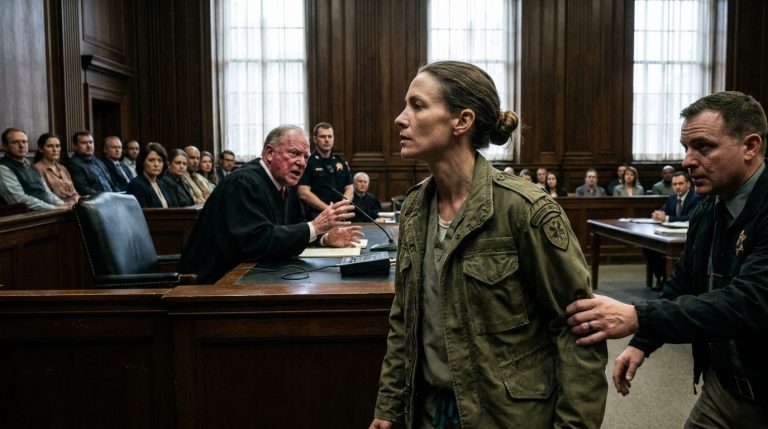
“Mr. Stewart, let me ask you again,” Judge Albright drawled, his voice saturated with a rehearsed, booming arrogance. “Do you find these proceedings amusing, or are you simply too old to understand the gravity of your situation?”
James did not move. He was not looking at the bench. His pale blue eyes were fixed on the state seal behind Albright, his gaze piercing through the plaster and paint to a different horizon entirely. To the judge, this was a battle of ego—a simple traffic citation, a failure to yield, and a stubborn old man refusing to plead guilty to a lie. To James, it was a fundamental breach of a contract written in shadows decades ago.
“Your Honor, my client understands—” Ben Carter began, his voice thin against the judge’s posturing.
“Does he?” Albright cut him off with a flick of his wrist, a dismissive gesture that signaled his audience was losing interest. “Because from where I’m sitting, I see a man who has shown nothing but contempt for this court. A simple failure to yield, Mr. Stewart, and you have dragged this out, wasting the taxpayers’ money.”
James felt the phantom itch on his left wrist, right where the cuff of his shirt pressed against his skin. It was a rhythmic, burning sensation, a memory of a needle in a dark room. He didn’t look down. He couldn’t. Not here.
Albright leaned forward, his face reddening. “People like you seem to believe that having been alive for a long time grants you some special privilege—that you can pick and choose which laws to obey.”
The judge continued his tirade, painting James as a relic of entitlement, a malcontent who had forgotten his place. The courtroom, initially bored, was beginning to shift, the spectators leaning in to watch the hunt. It was a practiced performance, the judge’s weaponized rhetoric designed to strip the dignity from an old man who had nothing left to say.
Then, Albright hit a nerve. “It suggests a certain lack of character, a lack of discipline. Frankly, it’s a kind of cowardice, if you ask me.”
The word hung in the air, heavy and poisonous. Ben Carter’s jaw clenched, a muscle jumping in his cheek as he looked at James, waiting for the spark of outrage. But James remained motionless, a deep, silent ocean into which the judge’s stones disappeared without a ripple.
And then, the silence broke. Not with a sound, but with a detail. As James moved his hand to adjust his cuff, the sleeve shifted just enough for Ben to glimpse it—a blurred, grayed shape, a ghost of an emblem etched into the flesh of his wrist. It wasn’t just a mark; it was a promise. And as the judge sneered, demanding to know where James had served, James felt the phantom thrum of rotor wash in the back of his mind. He wasn’t in a courtroom. He was in the jump seat of a little bird, high over the canopy, listening to the desperate, ragged breathing of men who believed he was their only way home.
The judge leaned in closer, his grin widening, fully convinced he had broken the old man’s spirit. “Nothing to say? I thought not. The stories are always bigger than the man.”
James looked at him then, truly looked at him, and the judge blinked, momentarily confused by the sudden, terrifying clarity in those eyes.
CHAPTER 2: The Sound of the Jungle
The laughter was not the sound of a man enjoying a joke; it was the dry, rasping friction of sandpaper against bone. Judge Albright leaned back, his robes rustling like dead leaves, and the sound shattered the vivid, humid memory of the jungle that had gripped James only moments before.
The smell of ozone and damp rot evaporated, replaced instantly by the thin, chemical scent of institutional floor polish and the underlying, metallic tang of the courtroom’s aging HVAC system. The thwamp-thwamp-thwamp of the MH6 Little Bird’s rotors didn’t fade—it was hammered into silence by the rhythmic, hollow ticking of the clock above the judge’s bench.
James’s hand, still resting on the scarred mahogany table, felt the wood’s cold, lifeless texture. He didn’t look at the judge. He looked at the grain of the table, focusing on a deep, jagged scratch near the corner. It was a small, ugly imperfection, a mark of someone else’s frustration, or perhaps someone else’s boredom. It was honest.
His thumb brushed against the side of his wrist, his skin feeling papery and brittle against the faded, ink-blurred phantom of the Spectre emblem. The itch was still there, a ghost of a needle’s entry point, a prickling reminder of the life that had been traded for silence.
“Nothing to say?” Albright’s voice was slick, triumphant. “I thought not. The stories are always bigger than the man.”
The judge’s gaze was a predator’s squint—expectant, hungry for a tremor, a breakdown, anything that would validate his own preordained reality of the world. He wanted the old man to be a pathetic, delusional veteran who clung to medals to mask a wasted life. That was the Layer 1 reality the judge was building—a simple, linear tale of entitlement meeting its match.
Ben Carter, sitting just inches away, shifted his weight. The leather of his briefcase creaked. Ben’s eyes were darting back and forth, from the judge’s smug face to James’s motionless profile. The young lawyer was desperate, his fingers tapping a nervous, uneven code against his legal pad. He was looking for a crack in the old man’s composure, too, but for a different reason. Ben didn’t want the judge to win; he wanted to find the leverage he needed to save his client from a disaster he didn’t fully comprehend.
James could feel Ben’s anxiety radiating off him like heat. It was a tangible pressure, a human element he had spent his life protecting.
“Counselor,” James said, his voice dropping into the quiet, resonant register that commanded attention without ever needing to be loud. He didn’t look at Ben; he kept his eyes on the scratch in the table. “Stop fidgeting. You’re making the air too thin.”
Ben froze. His hand stayed mid-air, hovering over his phone. The sudden, calm command seemed to catch the judge off guard; Albright blinked, his mouth slightly parted.
“Mr. Stewart,” Albright said, his voice regaining its sharper, venomous edge. “You will not address your counsel while I am speaking. You are here to answer for your actions, not to stage-manage a performance.”
“I am not performing, Your Honor,” James said, finally lifting his head. His eyes were not angry. They were simply tired—the fatigue of a man who had seen the sun set over places that no longer existed on any map. “I am simply waiting for you to finish your sentence so we can both go home.”
“Oh, you’ll go home,” Albright sneered, his eyes darting to the gallery as if checking if his audience was still captivated by his cruelty. “But I suspect it won’t be the home you’re expecting.”
James turned his gaze toward the back of the room, toward the double doors. The space was still, but his mind—the mind that had once calculated wind speeds and flight paths in the dead of night—was tracing the architecture of the room. The exit route, the distance to the doors, the time it took for a bailiff to cross the aisle. He wasn’t plotting an escape; he was assessing the terrain, a lifetime of reflex acting upon a sterile environment.
The ticking of the clock seemed to grow louder, each second a heavy beat in a sequence that felt dangerously close to concluding. James felt the weight of the promise he had made in that smoke-filled tent in Echo Valley. It was a heavy, invisible chain, one that made the threat of a traffic court seem almost comically fragile. Yet, he knew the danger. He knew that even the smallest, most petty fire could consume everything if left unchecked.
Ben, beside him, reached for his phone again, his eyes briefly meeting James’s. There was a desperate, pleading light in the young man’s gaze—a search for a signal, for permission, for a way to break the deadlock.
James gave no nod, no sign. He simply looked away, returning his focus to the judge’s throat—the pulse point that revealed the true, thin-skinned anxiety of the man behind the gavel. Albright was not the master of this room; he was merely the one who feared silence the most.
“I’m ready, Your Honor,” James whispered, though his voice carried to the corners of the ceiling. “Whenever you are.”
CHAPTER 3: The Unseen Signal
Ben Carter’s hand, gripped around the edges of his legal pad, began to sweat. He was a creature of habit, trained in the sterile, predictable world of the JAG Corps, where every document was filed in triplicate and every motion followed a pre-ordained path. But this—this was different. The silence James Stewart projected was not the silence of a man who had given up; it was the silence of a man who was observing the battlefield, waiting for the exact, singular moment to strike back.
“I’m ready, Your Honor,” James had said, his voice dropping into that measured, dangerous register.
Judge Albright looked as if he’d been slapped. He shifted in his seat, the leather of his high-backed chair groaning under his weight. He was a man who lived for the sound of his own voice, and James Stewart’s quietude was a vacuum he didn’t know how to fill.
“Very well,” Albright snapped, his fingers drum-rolling against the bench. “Since you have nothing to contribute to your own defense, we shall proceed with the sentencing. I believe a period of reflection is in order.”
Ben’s heart hammered against his ribs. He felt the phone beneath his legal pad, a small, cold weight. He had only seconds. He had to bridge the gap between this pathetic, make-shift courtroom and someone who knew what that tattoo on James’s wrist actually meant. He had to reach Master Sergeant Miller.
“Your Honor,” Ben blurted out, his voice cracking slightly before he regained his composure. He stood up, his chair scraping loudly against the linoleum, the sound echoing like a gunshot. “Before you proceed, I—I move for a brief recess. My client has been under significant duress. I believe a moment to confer could… could clarify his position regarding the citation.”
Albright scoffed, leaning forward. “A recess? You’ve had all morning, Mr. Carter. This is not a stall tactic. It’s a traffic hearing, not a capital murder trial.”
“It’s a matter of procedure, Your Honor,” Ben insisted, his eyes flicking toward the bailiff, then back to the judge. He was improvising, his pulse thrumming in his throat. He needed the judge to turn his head, to look at the clock, to look anywhere but at the table.
As if on cue, the clock on the wall above the bench gave a mechanical clunk as the minute hand jumped forward. Albright glanced up at it, his annoyance turning to a jagged, impatient scowl.
That was all Ben needed. Under the heavy, opaque cover of his legal pad, he slid his phone out. His fingers moved with a frantic, learned muscle memory. He didn’t look at the screen; he watched the judge’s eyes.
Courtroom 4B. Santa Maria Superior. Judge Albright. Veteran: James Stewart. Accused of cowardice. Wrist tattoo: Spectre emblem. Help needed now.
He hit send. The soft, electronic chirp of the message departing seemed to ring through the room like a siren. Ben’s lungs burned as he held his breath, his hand slipping the phone back beneath the pad. He sat down, his legs trembling beneath the table.
“Denied,” Albright barked, his eyes snapping back to Ben. “The court is moving forward. If you have nothing substantive to offer, sit down.”
Ben sank into his chair, his hands clasped so tightly together the knuckles turned white. He risked a sideways glance at James. The old man hadn’t moved. His posture was still ramrod straight, his eyes fixed on that same scratch on the table. But there was a subtle change—the tension in James’s shoulders had shifted, a minute realignment that Ben recognized as a tactical readiness. It was as if, without a word being spoken, James had realized the move had been made.
“Mr. Stewart,” the judge continued, his voice regaining its venomous, rhythmic flow. “You are an elderly man. I would hate to see you spend your twilight years in a state of confusion. Perhaps if you spoke, if you just apologized for your lack of cooperation, we could move past this. But you choose to sit there like a stone.”
James remained silent. The courtroom felt smaller now, the walls pressing in. The gallery was quiet, the spectators sensing that the tide in the room was beginning to turn, though they couldn’t possibly know why.
Ben could feel the ghost of his own service at Bagram stirring in his mind—the camaraderie of men who never spoke of their actions, the quiet ones who carried the weight of the world in their silences. He realized, with a sudden, sinking clarity, that he wasn’t just a lawyer anymore. He was a courier. And he was waiting for a reply that might never come.
“Is there anything, Mr. Stewart?” Albright asked, his voice dripping with condescension. “Any last words before I sign the order for your evaluation?”
James turned his head slowly. For the first time, he locked eyes with the judge. The pale blue of his irises was steady, unyielding, and terrifyingly clear.
“I have nothing to say to you, Your Honor,” James said softly. “But I would suggest you keep your ears open. You never know when the wind is going to change.”
Albright stared at him, his face flushing a deep, mottled purple. “The wind,” the judge muttered, his voice trembling with a mix of fury and confusion. “You think you’re a poet? You’re a defendant. Bailiff, prepare the papers.”
As the bailiff moved forward, the courtroom doors at the back of the room emitted a faint, metallic click. It was so quiet that only someone listening for it would have heard it. Ben’s breath hitched. He stared at the doors, his entire world narrowing down to that narrow line of shadow between the wood and the frame.
The silence that followed was heavy, thick with the smell of floor wax and the static charge of impending change.
CHAPTER 4: The Arrival of Authority
The sound was not loud—a simple metallic engagement of a latch—but to James, it echoed with the finality of a bolt-action rifle being chambered.
The courtroom had been a stale box of boredom, but the air within it now vibrated. James remained seated, his hands still placed flat against the worn mahogany of the defendant’s table. He did not turn around. He did not need to. His internal gyroscope, calibrated by years of survival in environments where the air itself could betray you, had already mapped the shift in the room’s pressure.
“Bailiff,” Judge Albright repeated, his voice irritated by the delay. “I said, prepare the papers. Are you deaf?”
The bailiff, a man whose weary posture had defined his day, did not move. He was staring at the back of the courtroom, his hand, which had been reaching for James’s shoulder, frozen in mid-air.
James felt the shift in the ambient temperature before he heard the footsteps. It was the synchronized, rhythmic cadence of disciplined movement. They were not the shuffling, uncoordinated footsteps of the public gallery; they were the precise, heavy-soled strikes of individuals who knew exactly how much force to apply to every square inch of the floor.
Click. Click. Click.
The sound bypassed the judge’s indignation and settled directly into the marrow of the room. Ben Carter, sitting beside James, had his hands clamped onto his legal pad so tightly his knuckles were white ridges beneath his skin. He was trembling, a fine, high-frequency vibration that James could feel through the table.
“I said,” Albright barked, his face turning a shade of purple, “is there a problem with the doors?”
The judge finally turned, his robes swirling in a flurry of self-importance. As he looked toward the back of the room, his eyes widened. The arrogance that had fueled his tirade for the last hour stalled, trapped in his throat.
Two airmen were walking down the center aisle. They were tall, their silhouettes sharp against the muted light of the courtroom, dressed in immaculate, dark blue uniforms that seemed to absorb the light rather than reflect it. Every detail—the creases in their trousers, the polish on their low-quarters, the steady, unwavering gaze they fixed on the front of the room—spoke of a different world. A world of order, of consequences, and of a power that made the judge’s gavel look like a child’s toy.
Following them was a man whose presence felt like a temperature drop. He was older, his hair a distinguished salt-and-pepper, his chest a tapestry of service that silenced the murmuring in the gallery. As he walked, the courtroom seemed to recede. The wood-paneled walls, the plastic chairs, the dusty American flag in the corner—it all became background noise to the gravity of his approach.
James kept his eyes on the scratch on the table. He didn’t look up, but he felt the sudden, intense focus of every eye in the room shifting toward him. The air grew dense, pressurized, as if the room were filling with water.
“General Kraton,” Ben Carter whispered, the name barely escaping his lips. It was a sound of pure, unadulterated shock.
The General stopped five paces from the defendant’s table. He didn’t acknowledge the judge. He didn’t look at the bailiff. He looked only at the man in the faded tweed jacket.
James finally moved. He pushed himself back from the table, the chair legs screeching softly against the floor. He stood slowly, his movements stiff from years of old injuries that no medal could ever heal. He faced the General, his posture straightening until it echoed the form of the man standing before him.
The General did not speak at first. He simply stared, his eyes tracking the age-worn face of the man who had been called Spectre. Then, with a motion so fluid it was almost invisible, he snapped his hand up. The salute was perfect—a sharp, cutting movement that ended in a razor-edge palm. It was not a gesture for a judge; it was a gesture of profound, historical reverence.
“Colonel Stewart,” the General said, his voice deep and echoing with a sudden, startling resonance. “It is an honor to see you again, sir.”
The courtroom was so quiet that the hum of the overhead lights became deafening. James looked at the General—the stars on his shoulders gleaming like cold, indifferent suns—and felt the weight of the promise from Echo Valley settle squarely on his shoulders once more. He returned the salute, his own movement a mirror image of the General’s, devoid of flourish, packed with the quiet, devastating dignity of a ghost returning from the fog.
Judge Albright found his tongue, though it was a shaky, pathetic instrument now. “What… what is the meaning of this? This is my courtroom! I have not authorized—”
The General turned his head. He didn’t raise his voice; he didn’t need to. He simply turned his gaze upon the judge, and the air in the room seemed to crystallize.
“You are currently in the presence of a hero of this nation, Judge,” the General said, his tone turning into a razor. “And I would suggest that you remain silent while we rectify the administrative error you are currently committing. If you speak again, you will be doing so to a military tribunal. Do you understand?”
Albright went pale, the color draining from his face so fast it looked like a magic trick. He sat back, his hands fumbling blindly for the gavel, but he couldn’t grasp it. He was looking at the General, then at the two airmen standing watch by the doors, and finally at James—the old man who, for the first time, looked like he was carved out of something much harder than bone.
James looked at the General, then at the room around them. He saw the shock, the awe, and the fear in the faces of the spectators. The decoy secret—the petty traffic citation—was dissolving, evaporating in the heat of the truth that was beginning to spill into the room. But beneath that, the deeper truth—the promise to the boys who never came home—remained locked, a silent, burning coal in his chest.
“Let’s go home, Jimmy,” the General said, his voice softening, the command of a soldier replaced by the quiet concern of a comrade.
James nodded. He didn’t look at Albright. He didn’t look at his lawyer. He simply turned, his movements measured and deliberate, and began the walk toward the back of the room. The courtroom, the judge, the petty lies—they were already fading, becoming nothing more than a memory of a storm that had passed, leaving behind only the quiet, unrelenting weight of a life lived in service to the silent.
CHAPTER 5: The Unpacking of the Ghost
The marble floors of the courthouse hallway were cold, a sharp contrast to the suffocating heat of the room they had just vacated. James walked with a steady, measured gait, his hands tucked into the pockets of his worn tweed jacket. Behind him, the General moved with the easy, predatory grace of a man who spent his life in motion. The two airmen maintained a perfect perimeter, their eyes scanning the corridor with a clinical detachment that turned the civilian space into a tactical zone.
“You didn’t have to do that, Kraton,” James said, his voice barely audible above the rhythmic click of their heels.
“I didn’t do anything but present the facts, Jimmy,” the General replied, his voice devoid of its earlier, razor-edged tone. It had softened, returning to the timbre of a man speaking to a brother-in-arms. “You left a mess in there. I just tidied up.”
James stopped walking. He turned slowly, his face illuminated by the harsh, flickering fluorescent lights of the hallway. He looked at the General—really looked at him—and saw the lines of age and the weight of the silver stars. “It wasn’t a mess. It was a test. And I would have handled it.”
“Handled it?” The General let out a short, hollow laugh. “You were three minutes away from a 72-hour hold in a psych ward, Jimmy. That wasn’t a test; that was a burial.”
James didn’t respond. He looked down at his wrist, where the faded Spectre emblem lived beneath the fabric of his shirt. The phantom itch was gone, replaced by a dull, aching thrum. The truth of the courtroom—the petty, banal injustice of a traffic ticket—had been crushed, but the burden he carried, the Layer 2 reality of the promise made in the humid dark of Echo Valley, felt heavier than ever.
They reached the doors leading to the courthouse lobby. The General stepped forward, placing a hand on the old man’s shoulder. “The record is wiped, Colonel. The judge is being processed. You can go back to your garden. You can go back to the quiet.”
“Is that what you think I want?” James asked. His eyes were clear, reflecting the harsh light. “I didn’t carry that sign for fifty years to hide in a garden. I carried it because someone had to remember what happened when the birds went down.”
The General’s expression shifted, a flicker of something raw and ancient passing across his features. He reached into his pocket and pulled out a small, tarnished silver coin—a challenge coin, worn smooth by decades of touch. He pressed it into James’s hand.
“They remember, Jimmy. More than you think. And they’re tired of the silence, too.”
James closed his hand around the coin, the cold metal biting into his palm. It was a tangible, physical connection to a reality that the world had tried to categorize as a ghost story.
“The judge,” James said, his voice quiet. “He’s just a man who didn’t know what he was looking at. Don’t ruin him for it. Just make sure he understands why.”
“He understands,” the General said, his gaze drifting back down the hall toward the courtroom, where the murmurs of the stunned gallery were beginning to leak out like escaping gas. “He’s going to spend the next year of his life in a classroom, listening to people who have seen more than he’ll ever dream of. I believe he’ll learn to be quiet.”
They continued walking, exiting the building into the sudden, blinding brightness of the California afternoon. The air was dry, smelling of asphalt and distant, sun-baked earth. A black sedan was idling at the curb, its tinted windows mirroring the world like cold, unblinking eyes.
Ben Carter caught up to them, his face flushed and his breath ragged. He stopped a few feet away, hesitant, as if afraid to break the circuit of command that surrounded the two men. “General,” he stammered, looking at James. “I… I did what I could.”
The General looked at Ben, then nodded toward James. “You did more than that, Counselor. You kept the door open.”
James turned to Ben, a small, weary smile touching his lips. “You did fine, son. But next time, don’t wait for the judge to start the fire. Just find the exit.”
Ben looked at James, really looked at him—the faded jacket, the gnarled hands, the history that lived in the set of his jaw. He seemed to see, for the first time, not the old man from the defendant’s table, but the Spectre—the ghost who had walked through hell to bring the lost home. He nodded, once, a gesture of profound respect that bridged the generational divide.
As James moved toward the sedan, the General remained behind for a moment, watching him. The world was still. The sun continued its slow, indifferent descent toward the horizon. The drama of the courthouse was receding, but the truth remained—a burning, quiet ember that had finally been acknowledged, if only by the few who understood the cost of its preservation. James slid into the back of the sedan, the door closing with a soft, expensive thud, effectively sealing off the noise of the world and leaving him in the quiet, shadowed interior of his own history.
CHAPTER 6: The Quiet After the Storm
The engine of the black sedan hummed, a smooth, muted vibration against the soles of James’s feet as the car pulled away from the curb. He watched through the rear window until the courthouse disappeared behind a stand of oaks. It was a brutalist structure of concrete and arrogance, and now, it was nothing more than a blurred shape in the rearview mirror.
He arrived at his house as the late afternoon sun was beginning to slant, casting long, golden shadows across the lawn. The house was modest, a single-story frame structure with peeling white paint and a porch that groaned under the weight of his boots. He stepped out of the car, the air cool and thick with the scent of damp earth and blooming jasmine.
He didn’t go inside immediately. Instead, he walked toward the back of the property, where a small vegetable garden occupied the space between a rusted fence and the edge of the woods. He had spent years here, pulling weeds, turning soil, and watching the seasons cycle through the same predictable, beautiful patterns. It was the only place where time didn’t feel like an enemy.
His hands, still feeling the phantom ache of the courtroom table, reached for a trowel lying on the edge of a raised bed. He began to work, his movements slow and deliberate. The soil was rich, dark, and cool beneath his fingernails.
The weight of the last few hours began to dissolve into the rhythmic motion of the garden. He thought of the young man, Ben, who had found the courage to reach out to the past. He thought of General Kraton, the man who had traded the battlefield for the bureaucratic hallways of the Pentagon, yet still remembered the call sign. Most of all, he thought of the promise.
He dug a small hole, placed a starter plant inside, and packed the earth firmly around it. He was not just planting a seedling; he was grounding himself in the present. The “Spectre” was a ghost, a title given to a man who had existed in a time of fire and desperate, screaming radios. But James Stewart was here, now, planting tomatoes that would eventually feed him.
A month later, the quiet was broken by the sound of a visitor. James was on the porch, nursing a cup of black coffee, when a familiar figure turned up the gravel path. It was the former judge, Albright.
The man looked different. The arrogance that had once defined his posture had been stripped away, leaving behind a frame that seemed to sag under the weight of a newly acquired perspective. He was wearing casual clothes—a faded polo shirt and slacks—and his eyes lacked the predatory sharpness that had once intimidated defendants. He stopped at the bottom of the porch steps, hesitating, as if he were waiting for an invitation that might never come.
James did not stand up. He watched the man with eyes that were as calm and indifferent as a still pond.
“Mr. Stewart,” Albright said, his voice hesitant. “I didn’t come here to make excuses. I just… I needed to see this place. To see where you went when the world didn’t understand who you were.”
James took a slow, deliberate sip of his coffee. The heat was comforting, grounding. “You’re a long way from your bench, Judge.”
“I’m not a judge anymore,” Albright replied, his gaze dropping to the porch boards. “Not in the way you mean. The commission… they were thorough. But the training, the things they made me read, the people they made me sit with… it changed how I look at the law.”
Albright looked up, and for the first time, there was a flash of genuine humility in his eyes. “I realized that the law is just a framework. It doesn’t mean anything if you don’t understand the people living inside it. I spent my career looking for rules to enforce, and I never stopped to think about what was being broken.”
James looked at the former judge—a man who had been the architect of his own downfall, now standing in the dirt of a garden, looking for a way to reconcile with a past he had been completely blind to. It was not a grand, dramatic redemption. It was a small, quiet, and messy human moment. And in that, there was a kind of justice.
“Courage isn’t just about what you do in the heat of the moment,” James said, his voice soft but carrying clearly across the porch. “It’s about what you do when the cameras are off and no one is watching. It’s about being able to live with the person you see in the mirror every morning.”
Albright nodded, a slow, solemn motion. He didn’t ask for forgiveness. He didn’t ask for a reprieve. He simply turned, acknowledging the weight of the moment, and began the long walk back to his car.
James watched him go. He felt the cold, tarnished challenge coin in his pocket. It was a reminder of a life that had demanded everything, but it was not the only thing that defined him. He stood up and walked to the edge of the porch, looking out over the garden. The plants were growing, the soil was healthy, and the silence—that beautiful, hard-won silence—was his to keep.
He leaned against the wooden post, watching the sunset bleed into the horizon. The promise was kept. The ghosts were resting. And for the first time in fifty years, James Stewart felt the weight of the air lift, leaving him with nothing but the rhythm of his own heartbeat and the quiet, enduring peace of the ground he stood upon.