The Architect’s Ledger: A Meticulous Deconstruction of a Suburban Tyrant’s Carefully Constructed House of Cards
CHAPTER 1: THE PERSISTENT LEAK
The sound was what hit me first—the wet, rhythmic thwack-gurgle of water forced through a narrow aperture. It was an unnatural sound in the stillness of Oak Creek Meadows, a rhythmic violation of the silence that usually defined my morning.
I stood at the edge of the quagmire that used to be my property’s southern boundary. Where there should have been a gentle, manicured slope of fescue, there was now a sprawling, murky pool, swallowing the vibrant yellow legs of the therapeutic slide I had installed for Sarah. The rubberized surface tiles, which I had painstakingly leveled to within a fraction of an inch, were now floating islands in a dark, silt-heavy soup.
My fingers brushed against the rough bark of a newly planted Arborvitae—a stunted, out-of-place thing that hadn’t been on the subdivision’s original landscape plan. I pushed the branches aside, ignoring the scratch of needles against my palms. There it was. A four-inch corrugated pipe, black and ugly, protruding from the earth like a malignant growth. It was spewing a steady, calculated stream directly onto my soil.
The air smelled of stagnant vegetation and the sharp, metallic tang of runoff. It wasn’t just rainwater. I caught a drift of chlorine—pool water, perhaps, or runoff from a heavily treated garden.
I felt the familiar, cold shift in my gut. It wasn’t anger; anger was wasteful, a chemical spike that clouded the field of vision. This was a tactical realization. I didn’t see a puddle. I saw a system under assault. I saw the hydrostatic pressure building against the perimeter of my daughter’s playground, a silent, creeping force that would, if left unchecked, liquefy the ground beneath the footers until the entire structure leaned, buckled, and failed.
I didn’t look back at the house, though I could feel the weight of Karen’s gaze from the deck above. I didn’t need to see her to know the expression she’d be wearing: that thin, pinched line of practiced righteousness.
Instead, I pulled a small digital laser level from my pocket, ignored the mud splashing my boots, and aimed it at the discharge point. The beam danced over the wet ground, mapping the trajectory of the water. It was aimed with intent, a surgical strike designed to saturate the foundation of my project.
I checked my watch. 07:14.
I turned away, my boots sinking into the saturated earth with a heavy, sucking sound. I had thirty years of engineering logic, a command-center garage filled with original schematics, and a tactical need for retribution that would, when calculated correctly, turn this suburban swamp into a legal graveyard for her tyranny.
As I walked toward the back porch, I glanced at the ground one last time. There was a faint ripple in the pool near the base of the playground—a tiny, erratic disturbance that didn’t match the flow of the pipe. A missing drainage access plate. I hadn’t realized the cover was gone. Someone had been digging here, and they hadn’t been looking for water. They had been looking for a way out.
The thought settled into my mind like a cold stone. Karen wasn’t just rerouting water. She was hiding something beneath the surface that required a fast, hidden discharge to keep the earth from shifting. I didn’t know what it was yet, but as I stepped onto my porch, I knew one thing for certain: she was desperate, and desperate people make mistakes in their measurements.
I was going to find every single one of them.
CHAPTER 2: COMMAND CENTER
The garage door groaned as it rolled shut, sealing out the miserable drizzle and the sight of the ruined playground. Inside, the environment was my sanctuary. It was a space designed by an engineer for an engineer: organized, climate-controlled, and smelling faintly of ozone from the laser printer and the dry, grounding scent of pencil graphite.
I didn’t move toward the workbench immediately. I stood in the center of the concrete floor, the soles of my muddy boots leaving dark, circular prints on the epoxy finish. I looked down at them, a small, involuntary twitch of frustration pulling at the corner of my mouth. I hated disorder, and right now, my life was being introduced to a significant amount of it.
I stripped off my heavy coat and hung it on the rack near the secondary entry. My hands were steady, but the lingering dampness of the lawn seemed to have seeped into my bones. I moved to the workbench, a massive slab of solid maple I had hauled from my previous house, and clicked on the task lamp.
The light hummed to life, washing the surface in a clinical, white glare. My blueprints were still spread out, weighted down by steel calipers and a heavy brass plumb bob. I looked at the master grading plan for lot 43 and lot 42. They were pristine—crisp, black lines on white vellum. They told the truth of the land.
I picked up a drafting pencil, the weight of it familiar and comforting, and began to outline the path of the water I had traced outside. The pipe was a jagged, incorrect addition, a deviation from the reality that existed on paper. But as I sketched the trajectory of the flow, something caught my eye. The area where the missing access plate had been—the spot near the playground’s footing—didn’t line up with the natural slope.
I leaned closer, the lens of my glasses catching the light. If that plate was missing, it wasn’t due to simple neglect. Someone had been accessing the subsurface. Why?
I tapped the tip of my pencil against the map. If the foundation of the neighborhood’s drainage system was being tampered with, it wasn’t just to spite me. It was to facilitate something else. My mind drifted back to Karen’s house. She was obsessed with appearances, but her panic in the yard had been visceral. She hadn’t been acting like a president protecting her bylaws; she had been acting like a woman whose floor was literally falling out from under her.
I walked over to the tall metal filing cabinet in the corner. I had boxes of records from my time as a private consultant in this region—before I joined the Corps. I flipped through the folders, my fingers stopping on a file marked Oak Creek Meadows: Subsurface Geological Surveys 2004.
I pulled it out and set it on the desk. The data inside was technical, full of soil composition reports and load-bearing capacities. I opened it and spread the reports alongside the grading plan. As I began to cross-reference the permeability of the soil under lot 42 with the current drainage volume, the numbers didn’t add up. The soil was saturated, yes, but the pattern of the saturation suggested a void.
A sinkhole? Or something more controlled?
If the foundation of her house were failing, the pressure on her own slab would be immense. Any minor structural shift would be magnified by the lack of proper runoff management. By forcing the water away from her property and onto mine, she wasn’t just being a bully—she was engaging in a desperate, last-ditch effort to keep her own house from settling into the clay.
The realization sat in the center of my chest, heavy and cold. It wasn’t malice; it was survival. But her survival was coming at the cost of my granddaughter’s safety.
I felt a surge of cold, focused energy. This changed the engagement parameters. I wasn’t just fighting a tyrant now; I was fighting an adversary who had everything to lose. And she was currently digging in the dark, destroying public infrastructure to hide her own systemic failure.
I needed evidence of that void. If the foundation were collapsing, she would be paying contractors or engineers for “repairs” that she wouldn’t be reporting to the HOA. I needed to see her permits. I needed to know what kind of “garden work” she’d been conducting under the guise of an English garden.
I opened my laptop. The screen glowed, the only light in the dim room besides the desk lamp. I pulled up the county’s public access portal for property records. It was a tedious, bureaucratic slog, but I knew the syntax. I searched for Lot 42, Karen’s address.
Records, permits, liens.
My cursor hovered over the ‘Liens’ tab. I clicked it. My breath hitched. There were three notices of default from the local bank in the last six months. She was underwater, not just figuratively, but literally and financially. The foreclosure proceedings were already in motion, but they were being contested.
She wasn’t trying to impress the neighborhood. She was trying to keep the bank from inspecting the interior and exterior of the property until the very last possible moment.
The garage felt suddenly smaller, the walls closing in as the complexity of the situation crystallized. I pushed away from the desk and stood, my knees popping. The air felt thin, recycled, and entirely devoid of the warmth I had been cultivating for my family.
I walked to the small refrigerator in the corner and pulled out a bottle of water, but I didn’t drink it. I stared at the closed garage door, listening to the muffled drumming of the rain on the roof.
She was a woman holding back a tidal wave with a piece of plastic pipe. She was terrified.
And I was the only one who understood exactly how fast the collapse was going to be.
I didn’t feel sorry for her. Empathy was a luxury I couldn’t afford if I wanted to protect Sarah. I had to be colder than the water she was pumping onto my land. I had to be precise.
I took a deep breath, the scent of graphite sharpening my resolve. I needed to reach out to the county inspectors, but not yet. Not before I had the full picture. I needed to see what she was hiding in that trench.
I walked back to the workbench and pulled a sturdy, rubber-handled spade from the wall hook. It was heavy, well-balanced. I wouldn’t use it to dig—that would be beneath me. But I would use it as a probe.
I looked at the blueprints again, tracing the line of the fiber-optic trunk that ran near our property line. She was playing with fire, and she was going to burn the whole subdivision down if I didn’t stop her.
My phone vibrated on the desk. An email notification from the HOA board: Routine inspection scheduled for Tuesday.
A sardonic smile touched my lips. She was planning to use the board to formalize her attack on me before the county could look too closely at her property.
I picked up my pen and began to write out a response, my script precise, unyielding, and absolutely devoid of emotion.
Gentlemen, I look forward to the inspection. I have prepared a full site analysis that I believe the board will find… enlightening.
The trap wasn’t just set; it was ready to be sprung.
CHAPTER 3: THE FIRST VOLLEY
The cursor on my screen continued to blink, a rhythmic, taunting pulse against the white expanse of the email draft. My finger hovered over the ‘Send’ key, but the silence of the garage suddenly felt heavy. Sending the email would formalize the conflict, locking me into a trajectory from which there would be no retreat. I looked at the blueprints again, specifically at the lot line where the arborvitae sat. If I sent this now, I was effectively alerting Karen to the fact that I had opened the records—that I knew about the defaults.
I leaned back, the leather of my chair creaking in the stillness. I needed to be sure. I didn’t want to engage in a war of attrition if I could end this with a singular, surgically precise maneuver.
I stood, the movement sharp and decisive. I didn’t send the email. Instead, I grabbed my coat and a pair of heavy work gloves from the pegboard. I needed to see that trench again, but this time, I wasn’t going to look at it as a homeowner. I was going to look at it as the engineer who had signed off on the original grading plan.
I stepped out into the drizzle. The air was colder now, the kind of damp that settled into the lungs. My boots crunched on the gravel as I moved toward the shared property line. The house stood quiet, a hollowed-out monument to a life that was clearly unraveling. I could see the light in her kitchen flickering—a buzzing, dying fluorescent tube—but there was no movement behind the blinds.
I reached the spot where the Arborvitae created a visual screen. I didn’t cross the line; I didn’t have to. I knelt, the mud soaking into the knees of my trousers, and focused my attention on the earth beneath the hedge.
My flashlight cut through the gloom, its beam narrow and intense. The earth here was soft, churned up in a way that suggested frantic, amateurish work. I poked the soil with the edge of my spade. It wasn’t just soft; it was hollow.
I frowned, pushing the spade deeper. There was a sound—a distinct, metallic clink—as the metal struck something buried just inches below the surface. Not a rock. It sounded like galvanized steel, or perhaps a section of old drainage hardware that had been improperly patched.
I carefully cleared the soil away. A flash of light caught my eye—a piece of yellow caution tape, snagged and half-buried, fluttering in the damp breeze. I pulled it free. It wasn’t a standard utility marking. It was industrial, the kind of tape used by temporary contractors to cordon off private sites. She had hired people to come in under the cover of darkness, to bypass the standard permitting and inspection process entirely.
I traced the line of the trench with my flashlight. It didn’t lead toward the street. It led toward the foundation of her own house, specifically the corner where the kitchen extension had been added.
The structural implication was clear. She wasn’t just trying to drain water; she was trying to shore up a settling corner of her slab by injecting fill or attempting to bypass a collapsed drain tile that was saturating the soil beneath her own home. She was drowning me to keep herself dry.
A shadow moved in the upstairs window. I went rigid, my hand tightening around the handle of the spade. I kept my posture still, staring into the mud as if I were merely inspecting the saturation levels.
She was watching.
I waited, a slow, deliberate count of twenty. Then, I stood, brushing the mud from my knees with an exaggerated, casual motion. I didn’t look up at the window. I turned and walked back toward my house, my steps measured, deliberate, and entirely indifferent. I needed her to believe that I was just an annoyed neighbor documenting the damage for a small claims filing.
I didn’t want her to know she was being watched by an engineer who understood exactly why her house was sinking.
As I stepped onto my porch, the back door of her house opened. I paused, my hand on my own door handle. I didn’t turn around.
“Mr. Evans?” Her voice was thin, brittle, stripped of the condescending authority she usually wore like a costume.
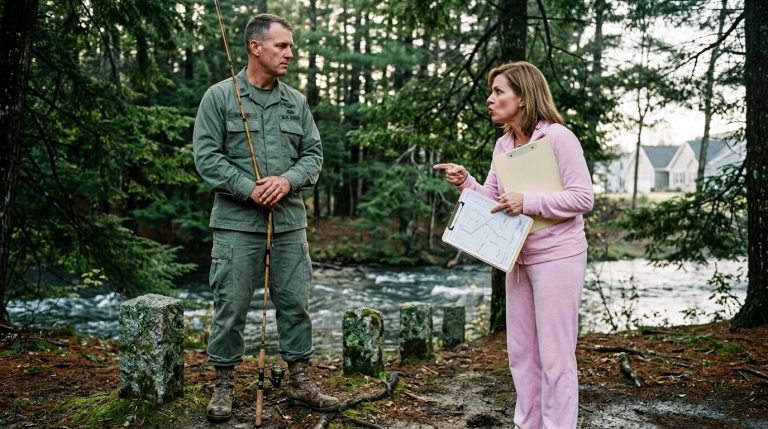
I kept my back to her. “Yes, Karen?”
“The drainage issue,” she said, her voice wavering. “It’s an act of God. You’re harassing me with your little camera and your trespassing.”
I turned, slowly. She was standing on her deck, clutching a cardigan around herself as if she were shivering. Her face looked drawn, the makeup unable to hide the dark, exhausted hollows beneath her eyes. She was a woman at the end of her rope, and it was fraying fast.
“It’s not an act of God, Karen,” I said, my voice steady, professional, and devoid of the anger she was expecting. “It’s a design failure caused by unauthorized modification. I’ve documented the source. I’ve documented the saturation levels. And I’ve documented the impact on my property.”
“I have a right to landscape my yard,” she snapped, a flash of the old vitriol returning, but it was hollow, lacking the sharp bite it once possessed.
“You have a right to landscape, yes,” I agreed. “You do not have a right to destroy your neighbors’ foundation or the community infrastructure. I’m sending a formal notice to the board and the county planning department in the morning.”
She gasped, a sharp intake of breath. “You wouldn’t.”
“I would,” I said, and this time, I let the weight of my intent show in my eyes. “The clock is ticking, Karen. I suggest you consult with an engineer before the county does. Their report will be much more expensive than mine.”
I didn’t wait for her reply. I stepped inside and pulled the door shut, the lock clicking into place with a final, mechanical snap. I walked back to my laptop and, without a second’s hesitation, hit ‘Send’ on the email.
The volley was fired. Now, I waited to see how the house of cards would lean.
CHAPTER 4: THE COUNTERSTRIKE
I left the door locked. The silence in the garage was absolute, save for the low, rhythmic hum of the dehumidifier pulling moisture from the air. I didn’t sit down. I paced, the concrete floor cool beneath my boots, my mind already running through the permutations of her next move. She would panic. That was a certainty. She would try to involve the HOA board, her only remaining leverage, but the email I had sent was structured to make her actions visible to the other members. If she tried to suppress the information, she would be forcing her allies to participate in a cover-up.
It was a brilliant maneuver in its simplicity, but it was just the opening act. I walked to the drafting table and looked at the violation notice she had taped to my door yesterday—a crude, poorly printed thing that reeked of desperation. It was a formal accusation of “unauthorized landscaping.” I picked it up, feeling the cheap, thin paper against my fingertips, and filed it into the cabinet alongside the dozens of others.
I didn’t have to wait long.
At 8:42 a.m., my phone chimed. An email from the HOA secretary, Brenda. It was brief, cold, and smelled of fear. Mr. Evans, the Board of Directors has received your recent correspondence. We will be discussing this in our executive session on Tuesday. Please be advised that any further communication should be directed through the official portal.
She was trying to isolate me. She wanted to funnel me into a closed-door session where she could control the narrative and keep the board in the dark.
I didn’t reply to Brenda. Instead, I pulled out my phone and dialed Arthur Henderson’s number. He answered on the second ring, his voice crisp and alert.
“I saw the email, Mark,” he said without preamble. “She’s panicking. She sent a frantic message to the board claiming you were threatening her and accusing her of sabotage. She’s trying to get them to authorize an immediate injunction against you.”
“Let her,” I said, my voice low and steady. “I have the geotechnical survey and the county’s public storm water plans. If she wants an injunction, she’ll have to present her case in front of the board. And when she does, I’ll be there with the documentation of the fiber-optic damage.”
“She doesn’t know about that yet,” Arthur chuckled, though the sound was devoid of humor. “She thinks she got away with it because the cable company fixed it without involving the police.”
“She’s wrong,” I replied. “The cable company doesn’t forgive, and they certainly don’t forget. I spoke with their regional manager this morning. They’re filing a formal report with the county zoning board tomorrow.”
There was a pause on the line. I could almost hear Arthur’s gears turning. He had been an accountant; he understood the weight of liabilities better than anyone. “You’re going to bury her, Mark.”
“I’m going to restore the original grading,” I corrected. “Whatever happens to her is the result of her own structural negligence. I’m just an interested party documenting the decline.”
I hung up the phone and looked out the garage window. A delivery truck pulled up to Karen’s house. Two men in unmarked vests climbed out and began unloading heavy bags of rapid-set concrete and rolls of plastic sheeting. She wasn’t slowing down. She was ramping up her efforts to seal the trench before any real inspection could occur.
The sight triggered a memory, unbidden and sharp: the Mississippi Delta, 1996. We had watched a levee segment fail in real-time, the water cutting through the soft earth like a blade. We had tried to reinforce it with sandbags, but the foundation was already liquid. It was a failure of physics, not effort. Seeing her try to plug a sinking foundation with bagged concrete was the same kind of futile, panicked struggle. It was an insult to the mechanics of the earth.
I didn’t feel pity. I felt the sharp, cold edge of resolve. I had to prevent her from compromising the integrity of the soil any further. If she poured concrete into that trench, she might permanently alter the subgrade, making it impossible to remediate correctly later.
I walked to my workbench and picked up the phone again, this time calling the county’s non-emergency line. I didn’t report a neighbor dispute; I reported an “active, unpermitted excavation potentially compromising public utility lines and sensitive storm water infrastructure.”
The operator put me through to a supervisor. I spoke clearly, citing the section of the county code that prohibited the disturbance of sub-surface grading in designated drainage zones without a professional, sealed engineering plan. I gave them my credentials. I didn’t need to be loud or angry; I just needed to be precise.
“We’ll have an inspector out there within the hour,” the supervisor said.
I set the phone down and watched through the window. The delivery men were already breaking the seal on the concrete bags.
Karen stepped out of her house, her phone pressed to her ear, pointing toward the yard. She looked frantic, her movements jerky and erratic. She was a woman watching her castle crumble, and she was doing everything she could to push the walls back up with her bare hands.
I didn’t look away. I watched as she directed the men to the trench. I watched as they dumped the first bag of concrete into the mud.
It was a disastrous decision. The concrete would react with the saturated earth, causing a massive heat release and potentially fracturing the already stressed soil, creating a rigid, brittle plug in a zone that needed to remain flexible and permeable.
It was a structural catastrophe.
I picked up my camera and walked out of the garage. I didn’t walk toward her. I walked to the edge of my lawn, right at the property line, and simply stood there, my camera slung over my shoulder, observing.
She saw me. She froze, the bag of concrete half-slung over her shoulder. Her face went pale, a mixture of rage and terror contorting her features. She started walking toward me, her pace fast and aggressive, her phone now held like a weapon.
“You!” she screamed, her voice shrill and thin in the damp air. “You’re trespassing! You’re stalking me!”
I didn’t blink. I didn’t raise my voice. I simply held up my camera and took a photo of the men dumping the concrete into the trench.
“I’m observing the destruction of public property,” I said, my voice calm. “And you should know, Karen, the county inspector is on their way.”
She stumbled to a halt, her eyes widening. The realization hit her like a physical blow. The concrete, the trench, the pipe—the evidence of her desperation was now being memorialized in real-time, under the watchful eye of the authority she couldn’t bribe or intimidate.
She looked at the men, then back at me, her chest heaving. The facade was finally, truly beginning to buckle.
CHAPTER 5: THE COALITION
The silence that followed the electrical pop was heavier than before, suffocating and sharp. Across the property line, the two hired hands stood frozen, their shovels suspended over the hardening concrete, staring at the wisps of gray smoke curling out of the open trench. Karen was still clutching her phone, but her face had gone slack. The power surge had been a harsh, physical exclamation point to my warning.
I didn’t move. I kept the camera leveled, documenting the smoke, the concrete, and the terrified confusion on the men’s faces. The proximity of the damage to the main fiber-optic trunk line was undeniable.
“Get out of the trench,” I said, my voice low and authoritative. It wasn’t a suggestion; it was an order honed by thirty years of managing construction safety.
The men didn’t argue. They dropped their tools and scrambled out of the muddy ditch, their boots slipping on the slick, wet grass. They were just day laborers, and they knew when a site had turned from a simple job into a liability nightmare.
Karen swung toward me, her eyes wild, her composure finally shattered. “Look what you did!” she shrieked, though the accusation lacked any conviction. She was looking at the smoke, not at me. “You sabotaged the lines!”
“I’ve been standing here for ten minutes, Karen,” I replied, not breaking eye contact. “My camera has the entire sequence of your crew digging without a utility survey. You’re the one who authorized this. You’re the one who ordered them to pour concrete into an active drainage zone.”
I didn’t wait for her to respond. I turned and walked back to my own property, leaving her standing alone in the drizzle, the smoke from the trench drifting toward her face. I had the footage. I had the witness. And I had the physical proof of her recklessness.
I headed straight for the garage, my mind racing. The power surge hadn’t just been a local nuisance; it would trigger an automated response from the utility company’s monitoring station. They would be here, and they would be looking for blood.
Inside the garage, I went straight to my drafting table and pulled out the file Arthur Henderson had been putting together. He had been quiet lately, but I knew he was working the phones. I dialed his number again, the phone ringing only once before he picked up.
“Mark? I’ve heard the commotion. The lights went out on the entire block. What happened?”
“She hit the main trunk again, Arthur. This time, there’s no patching it without a full investigation. The county inspector is going to arrive at a disaster site.”
“Good,” Arthur said, his voice hard. “I’ve finished the affidavits. I have twelve homeowners, including the Garcas and Mrs. Gable, all ready to sign. We’re not just talking about drainage anymore, Mark. We’re talking about a pattern of reckless endangerment.”
“Bring them,” I said. “Bring them to the community center tonight. Don’t wait for the board meeting. If we gather everyone now, we can present a unified front to the county inspector when they arrive.”
“I’m on it.”
I hung up and started organizing the documentation. I needed the blueprints, the photos, and the chronologically ordered violation notices. I wasn’t just building a case; I was building a barricade. I knew Karen would try to frame this as an “unfortunate accident” or an “act of God,” just as she had the flooding. I had to ensure that the narrative was anchored to the physical reality of the site.
As I worked, I felt the familiar weight of a project nearing its completion. It wasn’t the joy of creation, but the grim satisfaction of a structural analysis verifying a predicted collapse. I was watching the failure of a human system, and it was just as predictable as the failure of a poorly calculated levee.
I looked out the garage window. A county truck with flashing amber lights was pulling up to the curb. Two people in high-visibility vests climbed out, their faces set in grim lines of professional duty.
I picked up my binder and stepped out of the garage. I didn’t rush. I walked with the steady, measured pace of a man who held the master plan. As the inspectors moved toward Karen’s yard, I intercepted them at the property line.
“I’m Mark Evans,” I said, offering a firm hand. “I’m the original design engineer for this subdivision. I have the master drainage plan and a full documentation of the unauthorized work conducted on lot 42. I believe you’ll find it useful.”
The lead inspector took my binder, her eyes narrowing as she flipped through the pages. “This is highly irregular, Mr. Evans, but if you’re the design engineer, I’m listening.”
“The pipe is a red herring,” I said, pointing toward the trench. “The real issue is the structural instability beneath the kitchen addition. She’s trying to bridge a void, and she’s compromised the primary utility trunk in the process.”
The inspector looked at the trench, then back at Karen, who was now standing on her deck, clutching her phone and trembling. The inspector’s face was unreadable, but I saw the shift—the moment the professional suspicion crystallized into certainty.
The investigation had moved from “unauthorized excavation” to “structural negligence.”
I had given them the tools to dismantle her world, piece by piece. Now, I just had to watch the structure fall.
CHAPTER 6: THE TRAP
The inspector, a woman named Ms. Halloway, didn’t look at Karen. She kept her eyes fixed on the house, her gaze tracing the jagged, hairline fracture that had appeared, almost overnight, along the exterior brickwork of the kitchen addition. It was a spiderweb of stress, dark and insistent. Beside her, the second inspector, Peterson, was kneeling at the edge of the trench. He didn’t need to speak; the way he stood up, his face grim, told the whole story.
“Mr. Evans,” Halloway said, her voice dropping into a clinical, professional register. “The subsurface moisture content here is well above standard capacity. This isn’t just drainage. You were right about the void.”
Karen was still on the deck, but the aggression had drained out of her, replaced by a jittery, manic energy. She began to pace, her heels clicking a staccato rhythm on the wood. “It’s the pipe! You didn’t check the city’s main drain! It’s backing up! That’s what’s causing the shift!”
She was grasping at straws, her voice rising to a pitch that made the neighbors standing at the property line shift uncomfortably. She was pointing at me, her finger shaking. “He sabotaged the line! He’s the engineer! He knows how to manipulate the grades! It’s all his fault!”
I didn’t answer her. I didn’t need to. The inspectors were busy taking readings with their equipment. They weren’t looking at me; they were looking at the physics of the site, and physics does not care about Karen’s accusations.
“Ma’am,” Halloway said, not turning around. “The city’s main drainage line is functioning within normal parameters. The saturation we are recording is localized to the foundation of your kitchen addition. This appears to be a systemic failure of your property’s stabilization. You’ve been discharging water directly against a compromised slab.”
“I have a right!” Karen screamed, her voice cracking.
I looked over at Arthur Henderson. He was standing near the property line, his arms crossed, watching the scene with the detached, analytical focus of a man who had seen this exact kind of arrogance play out a dozen times before. Behind him, the Garcas and Mrs. Gable were recording the entire exchange on their phones. They weren’t just neighbors anymore; they were a jury.
“This is an emergency order,” Halloway continued, pulling a pad of forms from her clipboard. “I am placing a red tag on this property. The structure is declared unsafe for occupancy effective immediately.”
The word immediately seemed to hang in the air.
Karen stopped pacing. She looked at the red tag in Halloway’s hand, then at the house, as if seeing it for the first time. “I have… I have work inside. I have appointments. You can’t do this.”
“The foundation is shifting, ma’am,” Peterson said, his voice softer, but no less final. “Every hour you remain in this house, you risk a catastrophic collapse. We need you to vacate.”
The “Consequence Loop” I had been tracking for weeks was closing. She had tried to patch the foundation with concrete to avoid the cost of an inspection, and that very concrete had served as a seal, trapping the moisture against the weakened slab and accelerating the failure.
She turned and ran inside the house, slamming the door.
“She’s going to try and move her things,” I said, stepping closer to Halloway. “She’s desperate. She’s already in default on the mortgage.”
Halloway looked at me, her expression hardening. “Thank you for the heads-up, Mr. Evans. I’ll notify the county sheriff’s office to assist with the evacuation.”
As Halloway moved toward the door, I took a step back. I had done my part. The system was now taking over, moving with the cold, mechanical inevitability of a court order. I walked back toward my own property, the weight of the last few weeks finally beginning to lift.
But as I reached my porch, I saw a familiar sight—the playground, still standing, though a little muddy. I walked over to it and knelt, checking the footing one last time. It was solid. The grade I had designed, the one Karen had tried to destroy, was holding. The water was still flowing toward the street, channeled exactly as I had intended.
I was not a saboteur. I was an engineer. And the work I had done two decades ago was still the best thing in this neighborhood.
Karen’s life was about to collapse, not because of what I had done, but because of what she had refused to acknowledge. She had treated the ground beneath her feet as something she could bully into submission, and the ground, in its own silent, indifferent way, had decided to move.
I stood up and looked back at her house. The lights were flashing as she scrambled to pack, her silhouette moving frantically behind the curtains. I took a deep breath, the air finally clearing of the smell of smoke. The battle was nearly over. Now, it was just a matter of watching the final, inevitable conclusion.
CHAPTER 7: THE FINAL GRADE
The red tag fluttered in the wind, a bright, abrasive smear of color against the weathered brick of Karen’s kitchen addition. I stood near the property line, watching the house. Inside, the muffled sound of dragging furniture suggested she was attempting to salvage what she could in the minutes before the sheriff arrived.
My eyes drifted to the trash bins she had shoved to the curb. They were overflowing with documents—a chaotic mixture of utility bills, foreclosure notices, and, more importantly, a thick roll of oversized paper.
I waited until she was occupied on the other side of the house, then walked to the bins. My hands moved with professional speed. I pulled the roll of paper from the heap and unfolded it on the damp grass.
They were structural blueprints. Dated four months ago.
They weren’t for a garden or a patio. They were for a deep-pier foundation stabilization project. I stared at the lines, my brain processing the data. She hadn’t just been “landscaping.” She had received a quote from a local foundation repair company months ago, a quote that had clearly exceeded her remaining credit. She had known the house was settling—that the kitchen addition was pulling away from the main structure—and she had chosen to bury that knowledge under the guise of an “English garden,” hoping the diverted water would somehow stabilize the grade.
It was an engineering nightmare. By burying the problem, she had effectively guaranteed the failure I was now watching.
I felt a cold shiver of professional disgust. It wasn’t just incompetence; it was a calculated, dangerous deception. She had gambled with the safety of the entire block to protect the remaining equity in a house that was effectively a shell.
“Mr. Evans?”
I looked up. Peterson, the county engineer, was standing a few feet away, his expression unreadable. He had clearly seen me retrieve the blueprints.
“I think you’ll want to see this, Peterson,” I said, handing him the roll.
He unrolled the papers, his brow furrowing as he traced the lines. He didn’t look surprised. “So she knew. She had a diagnostic report for the sinking slab, and she ignored it to avoid the cost of the repair.”
“She didn’t just ignore it,” I said. “She tried to mask it with the drainage diversion. That’s why she was so desperate to prevent an official survey.”
Peterson looked at the house, his gaze hardening. “This changes the nature of our report. This isn’t just a violation; it’s criminal negligence.”
Just then, the wail of a siren cut through the neighborhood. A county sheriff’s cruiser turned onto the street, its lights flashing against the gray, overcast sky. The sheriff pulled up in front of the house and stepped out, his hand resting on his belt.
Karen emerged from the front door, looking frazzled. Her hair was pulled back in a messy bun, and she was carrying a single, overstuffed duffel bag. When she saw the sheriff, she let out a choked, desperate sound.
“I was just leaving!” she shouted, her voice breaking. “I was just leaving! You have to give me more time!”
The sheriff walked up to her, his manner calm but firm. “Ma’am, this property has been declared structurally unsound. I need you to leave the premises immediately.”
I watched from the safety of my lawn as she argued, her gestures frantic and wide, her entire posture that of a woman who had spent her life believing she could talk her way out of the laws of physics. She pointed at me, then at the trench, then at the house, her voice a rising, incoherent stream of blame.
It was a pathetic, small display.
The sheriff didn’t argue back. He simply waited, his presence a static, immovable force. When she finally realized that no amount of shouting would change the reality of the red tag, she dropped her bag. She didn’t look at the house. She didn’t look at the neighbors who had gathered at their windows. She just turned and walked toward her car, her shoulders hunched against the cold.
I watched her drive away, the car disappearing down the street until the sound of the engine faded into the distance.
The house stood silent, a broken monument to a failed life. The kitchen addition, now deprived of the pressure it needed to stay balanced, gave a low, grinding groan. A few more bricks near the roofline buckled, falling in a soft, dusty spray onto the concrete patio below.
It was a final, structural surrender.
“It’s over, Mark,” Arthur said, appearing beside me. He didn’t sound triumphant; he sounded tired. “The Garcas and the others—they’re all out here. They saw it.”
I looked at the neighbors. They were quiet, their expressions a mix of relief and uneasy observation. They had seen the cost of Karen’s obsession, and they understood now how close they had come to the same fate.
“The grade is stable,” I said, more to myself than to Arthur. “The drainage is flowing where it belongs.”
“And what about you?” Arthur asked. “Are you going to be okay with all this?”
I looked at the house one last time. The red tag was flapping in the wind. The house was settling, sinking into the very soil Karen had tried to control. It was the natural order of things—a house built on a lie cannot stand.
“I’m an engineer, Arthur,” I said, turning away from the site. “I’ve seen foundations fail before. The only thing you can do is ensure that the next structure is built on solid ground.”
I walked back to my house, the weight of the last few weeks finally dropping away. The battle was over. The swamp was drained, the tyrant was gone, and the ground was finally, mercifully still.
CHAPTER 8: THE FINAL GRADE
The ground tremor was brief, a low-frequency vibration that traveled through the soles of my boots and shook the light fixtures in my garage. I stood at the threshold, watching the final, sluggish movement of the kitchen addition. It was a structural death rattle. With a sound like a giant snapping a dry twig, the corner of the brickwork peeled away from the main frame, exposing the skeletal, mold-blackened wood of the sub-flooring.
Karen’s “English garden” had been a hollow vanity, a thin veneer of order hiding a core of rot. Now, with the red tag firmly in place and the house officially condemned, the land was finally reclaiming what was owed.
I didn’t celebrate. I didn’t cheer. I felt a strange, detached stillness. I had spent weeks in a state of high-alert tactical engagement, treating every email and every social encounter as a move in a grander chess game. With the tyrant gone and the house crumbling, the board had been cleared. The tension that had been a constant, high-frequency hum in my nerves simply… evaporated.
I turned away from the ruin and walked toward my own backyard. The air was cool, smelling of damp earth and the promise of a quiet evening. I reached the playground, the vibrant yellow of the slide and the carefully leveled rubber tiles looking almost impossibly bright against the muted, gray backdrop of the overcast sky.
I knelt beside the ramp. One of the support bolts had loosened, likely from the ground vibration caused by the house’s collapse. It was a minor thing, a simple mechanical failure.
I reached into my tool belt, pulled out a socket wrench, and tightened the bolt. The metal resisted, then turned, locking into place with a crisp, satisfying click.
That was the difference. Karen had tried to force the world to fit her vision, ignoring the structural realities of the soil and the grades. She had built on a lie, and when the physics of the land had pushed back, she had doubled down on the deceit until it shattered her.
I had built on the truth. I had calculated the slope, accounted for the permeability, and accepted the constraints of the earth. My work had held.
I heard footsteps on the grass. I looked up to see Arthur Henderson approaching. He was wearing his coat, his hands tucked deep into his pockets. He stopped a few feet away, watching me finish the adjustment.
“She’s really gone,” he said, his voice quiet. “The bank has already sent a team to secure the doors. They’re planning to level the place by the end of the month.”
“It’s for the best,” I said, standing up. My knees ached, a sharp reminder of the weeks spent crawling through mud and checking levels. “The foundation is beyond salvage. The site needs to be regraded, and the soil needs to be remediated. It’s the only way to ensure the downstream drains don’t back up again.”
Arthur nodded, looking around the yard. “You know, Mark, the neighborhood feels… different today. Quieter.”
“It’s just equilibrium,” I said. “Every system, if left to its own devices, will eventually seek its own level. We just helped it move a little faster.”
He looked at me, a faint, knowing smile touching his face. “You’re an engineer, Mark. You always will be. But you’re a hell of a neighbor.”
“I just wanted a place for Sarah to play,” I said.
“She will,” Arthur replied. “She will.”
He turned and started the slow walk back to his own house. I watched him go, then turned to the playground. A soft, familiar laughter drifted from the back door—Michael and Jessica were bringing Sarah out to the yard.
She moved slowly, her walker clicking rhythmically against the concrete of the patio, but there was no fear in her movements. She reached the edge of the rubberized surface, her eyes lighting up when she saw the slide.
“Grandpa!” she called, waving a small, determined hand.
I walked over to her, the weight of the last month finally sliding off my shoulders. I didn’t think about the lawsuits or the blueprints or the red tag on the neighbor’s house. I didn’t think about the cost of the remediation or the complexity of the county filings.
I thought about the grade. It was level. It was stable. It was perfect.
I reached out and took her hand, guiding her toward the ramp. The work was done. The system was closed. And for the first time in a long time, the only thing that mattered was the steady, unwavering friction of her feet against the ground, moving forward, step by step, on a foundation that would not break.