The Hammer’s Grace: A Legacy of Silence, Forgiveness, and the Widening of a Human Heart
CHAPTER 1: The Weight of Dust
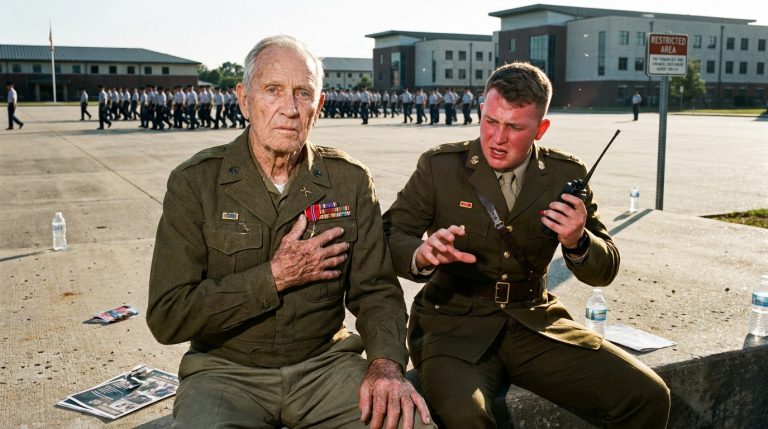
The humid air pressed against the base gate like a warm, wet blanket, but inside the idling Ford pickup, the atmosphere was thin, cold, and smelled faintly of old leather and motor oil. Randall Stone kept his hands at ten and two, his fingers calloused and steady. Outside, the world was all sharp edges and polished steel. Captain Thorne, his uniform so starched it looked uncomfortable to wear, paced back and forth, his silver eagle insignia catching the morning sun with an arrogance that made Randall’s skin itch.
“I am asking you for the last time,” Thorne snapped, his hand hovering near his sidearm, a theatrical gesture that felt heavy with the desire to be seen. “Provide your credentials, or I will have you removed.”
Randall didn’t turn. He watched a destroyer ghosting through the harbor, its gray hull shimmering in the heat haze. He didn’t see the harbor; he felt the vibration of a Black Hawk’s rotor blades shaking through his marrow, a sensation that had been dormant for forty years. Thorne’s voice was just background noise, like the static that used to hiss in his headset before the world went loud.
The captain leaned down, his face inches from the driver’s window. His breath smelled of bitter espresso. “This is a restricted facility, old man. This isn’t a playground for your antique truck.”
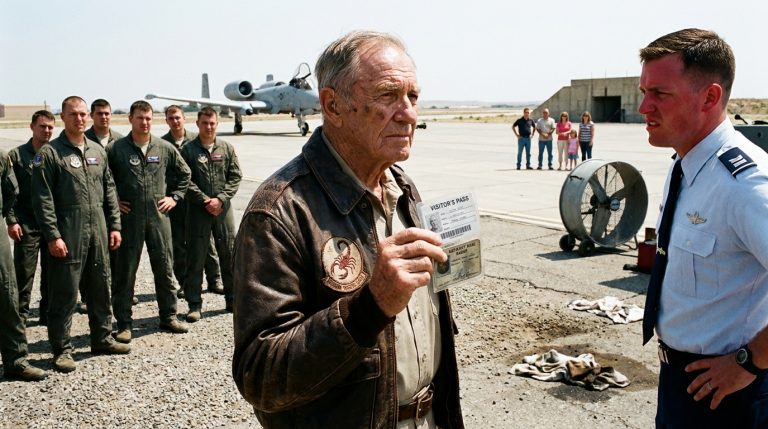
Randall finally moved. He pulled a cracked leather wallet from the glove compartment, the surface held together by a fraying rubber band. It felt warm in his hand, a tangible artifact of a life lived in shadows. As he fumbled with the clasp, Thorne’s eyes narrowed, his posture rigid with the self-assurance of a man who had never lost a debate in his life.
Randall extracted the ID card. It was laminated, the plastic yellowed and curling at the edges, the black-and-white photo showing a face that felt like a stranger’s—young, eyes unlined, the face of a man who had not yet learned the true cost of silence. Thorne snatched it, his thumb smudging the lamination. He didn’t see the history; he saw an expired joke.
But then, Thorne’s gaze drifted to the passenger seat. There, draped over the faded flannel shirt, was the old leather jacket. On the sleeve sat a small, simple patch: a black shield with a silver hammer pointing down.
Thorne pointed the expired ID at the patch, his lip curling into a sneer that would haunt him later. “What is this? A motorcycle club? Some kind of hobby for you and your buddies?”
Randall looked at the patch. He felt the phantom weight of a machine gun in his hands. He felt the cold mud of Ana Pass beneath his boots. The world blurred. The shouting at the gate, the lines of cars, the judgmental eyes of the young guards—it all dissolved into the high-pitched wine of turbines. He was back in the jump seat, 30 seconds out, and the ground team was waiting for a miracle.
“Sir?” the guard asked, his voice hesitant, cutting through the silence.
Randall blinked. The rotor wash faded. The world rushed back in, but it was sharper now, more dangerous. Thorne was still there, tapping his finger on the roof, waiting for a punchline that wasn’t coming.
“I’m done with this,” Thorne declared, loud enough for the growing crowd of onlookers to hear. “He’s disoriented. Get him out of the truck.”
As the guards stepped forward, Randall noticed a Petty Officer in a nearby car watching with a pale, stricken expression. The kid looked like he had just seen a ghost. Randall took a steadying breath, his heart beating a slow, rhythmic cadence that Thorne wouldn’t recognize if it hit him. The hammer was about to fall, and for the first time in four decades, the silence was starting to feel heavy.
CHAPTER 2: The Echo of the Rotor
The silence at the gate was not empty. It was pressurized, a physical weight that pressed against the eardrums of everyone standing on the gravel. Randall Stone remained seated in the driver’s seat of the Ford, his hands still anchored to the worn leather of the steering wheel. He could feel the pulse of the crowd, a collective, nervous energy that felt uncomfortably like the final seconds before an extraction.
He didn’t look at the guards. He looked past them, his pale blue eyes tracking the jittery movement of the guard’s hand toward the handcuffs. In the periphery of his vision, the humid air of the Norfolk morning seemed to ripple and distort. It was an old trick of his mind, a sensory phantom—a sudden, sharp spike of ozone and the rhythmic, bone-deep thrum of a Black Hawk’s rotor blades that hadn’t been in the sky for four decades. He saw the green, grainy light of a night vision display washing out the features of the men in the jump seat next to him, their faces obscured by the shadows of their helmets.
Thirty seconds out, Hammer 6.
The voice in his memory was calm, even as the world around it was tearing itself apart. Randall shifted his weight, the truck’s seat springs groaning in protest—a grounded, metallic sound that forced the phantom rotor wash back into the dark. He wasn’t in the mountains of a forgotten country. He was here, at the threshold of a modern base that had no place for ghosts.
Captain Thorne stepped into his line of sight, his face a mask of mounting irritation. The captain’s finger continued to tap the roof of the truck, the rhythm impatient and small, an insectile sound that grated against Randall’s nerves. Thorne was a man who believed in the absolute divinity of his own position, a man who saw the world as a series of boxes to be checked and gates to be locked. He didn’t understand that some doors were never meant to be opened, and some men were never meant to be cataloged.
“Are you deaf, or just stubborn?” Thorne’s voice was sharp, a jagged blade of authority. “I asked for your designation. Every man has one. Did you spend your time in the service scrubbing floors, or are you just trying to be difficult?”
Randall felt the familiar, cold ache of an old wound behind his ribs. It wasn’t physical, but the psychological residue of a war that had been fought in whispers and never officially declared. He looked up at Thorne, really looked at him, and saw the terrifying frailty of a man who equated his rank with his worth. If Thorne knew who he was, he wouldn’t be standing this close. He would be running.
“My designation,” Randall said, his voice quiet, carrying a texture like dry parchment. “It’s not something you’ll find in your logs, Captain.”
The two guards flanking the door looked at each other, their hesitation blooming into a visible discomfort. They were young, their eyes betraying the same primal sense of unease that had gripped Petty Officer Miller, who Randall could see lurking near the back of the crowd, his phone held tight against his chest. Miller was reaching out for something—a thread to his own history, a connection to a reality that existed outside of this sterile, gravel-strewn checkpoint.
Thorne’s jaw tightened. He reached for his radio, his movements crisp and practiced. “Base Security, we have a non-compliant individual at the main gate. Requesting immediate backup and transport to medical. We have an elderly subject exhibiting clear signs of cognitive decline and non-cooperative behavior.”
The radio crackled with a sterile, hollow efficiency. Randall didn’t blink. He knew what happened next. The machinery of the system would move to crush the anomaly. He wondered, briefly, if they would ever find the paperwork for the men who had been left behind on that ridge at Ana Pass. He doubted it. That history had been scrubbed clean long before Thorne had even been born.
“Captain,” Randall said, his voice slightly louder, stopping the guard from reaching for the door handle. “If you open this door, you’re not just pulling me out of a truck. You’re inviting a conversation you aren’t prepared to finish.”
Thorne let out a short, hollow laugh that didn’t reach his eyes. “Is that a threat, old man? I’ve handled threats to this base from people with much more firepower than you.”
“It’s not a threat,” Randall said, the blue in his eyes turning cold, reflecting the gray hulls of the ships in the harbor. “It’s a warning. The kind you only get once.”
For a split second, the air around them seemed to thicken. The guards froze. Even Thorne’s hand paused on the radio, his bravado momentarily punctured by the sheer, unyielding weight of the old man’s gaze. It was the look of someone who had seen the bottom of the abyss and had walked back up the long, dark trail to tell the tale.
In that moment, Randall felt the phantom weight of the M240 machine gun in his hands, the cold steel biting into his palms. He felt the phantom pressure of the command headset, the frantic, desperate voices of the ground team asking for a miracle. He took a slow, measured breath, grounding himself in the scent of the diesel fuel and the salt spray, refusing to let the ghost of the mission overtake the man he was today.
But the moment passed, leaving a vacuum. Thorne’s eyes narrowed, his face reddening with a sudden surge of defensive fury. He had felt the shift, and he hated it. He hated that he had been intimidated by a man who looked like he belonged in a museum.
“Take him out,” Thorne hissed to his men, his voice thick with the need to re-establish the hierarchy of the world. “Now. I want him in cuffs before the next relief shift arrives.”
As the guards lunged for the door handle, Randall’s hand drifted toward the leather jacket on the passenger seat, his fingers brushing the silver-embroidered hammer on the sleeve. The connection was made. The past and the present were no longer two separate things; they were a taut wire, vibrating in the humid morning air, ready to snap.
CHAPTER 3: The Observers Dilemma
The radio static hissed, a jagged, unnatural sound that tore through the humid morning air. Petty Officer Second Class Miller stood by his car, his hand hovering over the door handle, but his focus was pinned to the truck. He was a man suspended between two worlds: the orderly, predictable Navy he served in, and the fractured, legendary past that Randall Stone carried like a cloak.
Thorne’s order to neutralize the old man hadn’t just been a command; it was a crack in the foundation of everything Miller believed about service. He watched as the two junior guards moved forward, their movements stiff, their expressions masks of rehearsed indifference. They were doing what they were told, following the protocol that defined their days, but their eyes—those small, telltale windows—betrayed a profound, creeping unease. They were touching a live wire, and they knew it.
Randall remained motionless, his hand still resting near the patch on the leather jacket. He wasn’t resisting, not in the way Thorne expected. He was simply existing, his presence a static charge that seemed to make the very air around the truck vibrate. Miller felt the weight of his own phone in his pocket. It was a digital tether to the hierarchy, to the Admiral’s office, to the truth he was terrified to reveal and equally terrified to ignore.
He watched Thorne, who was now leaning over the truck bed, his face flushed with the exertion of maintaining his authority. Thorne was looking for a fight, a clear-cut confrontation he could win and file away as a successful security breach. He didn’t see the ghost of the man sitting behind the wheel. He didn’t see the way the dust on the truck bed seemed to settle around Randall like a protective shroud, isolating him from the noise of the base entrance.
Miller’s stomach turned. He thought of his grandfather’s stories—the ones told in the quiet hours of a Sunday afternoon, stories about men who didn’t want medals or recognition, men who operated in the blind spots of history. “They are the ones who hold the line,” his grandfather had whispered, “but the line they hold is built of their own bones.”
The guards reached the door handle. One of them, a kid who couldn’t have been more than twenty, glanced back at Thorne with a look of genuine panic. He was looking for an out, a signal that maybe this was too much, but Thorne was too caught up in the performance of his own power to notice.
Miller couldn’t look away, even as the instinct to hide, to shrink into the anonymity of his car, screamed at him to leave. If he did nothing, he was complicit in the erasure of something sacred. If he acted, he was sabotaging his own career before it had even reached cruising altitude. The contradiction felt like a physical weight, pulling his shoulders toward the ground.
He watched Randall. The old man didn’t look like a threat. He looked like an anchor in a raging sea. Randall’s gaze shifted, and for a fraction of a second, it flicked toward Miller. It was a brief, almost imperceptible glance, but it carried a weight of understanding that chilled Miller to the bone. It was as if Randall knew exactly what was happening in Miller’s head—the fear, the hesitation, the tug of the history he carried.
Randall’s hand withdrew from the jacket, his movements fluid and slow, devoid of the jagged nervousness of the guards. He wasn’t fighting the transition; he was waiting for it. The air felt thin, the scent of hot asphalt and exhaust fumes mixing with the phantom, metallic tang of ozone. The reality of the scene—the screeching tires of the distant base traffic, the murmuring crowd—began to fray at the edges, replaced by the relentless thrum of that distant, impossible helicopter.
Miller saw the guards’ fingers tighten on the door handle. He saw Thorne’s hand shift to his sidearm, the movement almost mechanical, as if he were reacting to a threat he couldn’t see. The escalation was happening in slow motion, a chain reaction of human failure that seemed impossible to stop.
Miller’s heart hammered against his ribs. He turned away from the scene for a second, his hands trembling as he pulled his phone from his pocket. The screen glowed, a harsh, artificial light in the bright morning sun. He stared at the contact list. The name at the top—his grandfather’s friend, the Command Master Chief—was a direct line to a world where these things were understood.
He didn’t make the call, not yet. He paused, his thumb hovering over the button. The silence of the gate was broken by the sound of the truck door creaking open. It was a mundane, screeching sound, the sound of rusted hinges, but in the hush that had fallen over the checkpoint, it sounded like a gunshot.
Randall began to slide out. His movements were stiff, careful, the labor of a body that had seen too much and carried too long. Thorne took a step forward, his chest puffed out, his hand finally dropping away from the radio. He was ready. He was finally going to get the surrender he had been demanding for the last twenty minutes.
But as Randall stood up, the light caught the patch on his jacket again. Even from thirty feet away, Miller saw it—the silver hammer, stark and lonely against the black shield. He felt a sudden, inexplicable sense of vertigo, the ground beneath his feet shifting as if the world were adjusting its axis. He didn’t see an old man anymore. He saw a monument, one that had been weathered by time and buried under the weight of a thousand secrets, now finally being forced into the light.
The guard nearest to Randall stumbled back, his face draining of color. Thorne didn’t notice. He was already barking orders, his voice high and shrill, lost in the sudden, crushing weight of the silence. Miller knew then that he couldn’t stay in his car. He couldn’t watch this. He took a single, shaky step toward the cordon, his hands finally steadying as he accepted the role he’d been playing since he first heard his grandfather’s stories. He was the witness. And if the truth was going to be desecrated, he would make sure there was someone left to remember the cost.
CHAPTER 4: The Admirals Office
Command Master Chief Peterson didn’t wait for an invitation. He surged into the office, the heavy mahogany door clicking shut behind him with a finality that felt like a tomb sealing. The office was an oasis of order, draped in the symbols of the Atlantic Fleet: flags, gold-framed charts, and the polished stillness of a space where decisions that shaped nations were made. Admiral Vance sat behind a desk of reclaimed oak, his face a mask of iron-clad focus, his pen poised over a stack of deployment orders.
“Master Chief,” Vance started, his voice a low, warning growl. “I told you I was in a briefing. This interruption better be a matter of national security, not another logistics complaint.”
Peterson didn’t flinch. He stood ramrod straight, his hands tucked behind his back, but his chest was heaving with the remnants of his run from the perimeter fence. He didn’t speak immediately, letting the silence grow until the air in the room felt thick enough to taste. The Admiral finally looked up, his brow furrowing as he caught the wild, uncharacteristic glint in Peterson’s eyes.
“Petty Officer Miller is at the main gate,” Peterson said, his voice stripped of all its usual gruffness, replaced by a jagged, sharp clarity. “He called on the direct line. Captain Thorne is currently engaged in an unauthorized detention of a civilian.”
Vance’s expression didn’t soften; it hardened, the annoyance morphing into a cold, professional disdain. “If Thorne is doing his job, Master Chief, then I suggest you let him. This station is a restricted federal installation. We don’t turn into a public park just because some local is lost.”
“It’s not just some local, sir,” Peterson interrupted, the breach of protocol hanging in the air like smoke. “The man’s name is Randall Stone.”
Vance’s hand, still clutching the expensive fountain pen, went entirely still. The room seemed to expand, the distance between the two men growing with the sudden absence of noise. The Admiral’s eyes remained fixed on Peterson’s, but his focus had drifted—not to the man in front of him, but to a memory he had buried decades ago. The pen in his hand seemed to lose its weight.
“Randall Stone,” Vance repeated, the name tasting like ash.
“Miller reports Thorne is already calling for cuffs,” Peterson continued, his voice tight, his gaze locked on the Admiral’s shifting features. “He’s mocking the man’s identification. He’s calling him delusional. He’s about to put him in a psych hold, sir.”
Vance stood up, his chair catching the edge of the credenza with a loud, wooden thud that echoed through the room. It was a clumsy, un-admiral-like movement, a physical betrayal of his internal collapse. He walked toward the window, his back to Peterson, looking out over the harbor where the gray destroyers sat anchored like silent sentinels. The light hit his face, exposing the deep lines of a man who had spent his life managing the violent currents of a global fleet, yet for the first time in Peterson’s tenure, the Admiral looked like he had no idea what the next command should be.
“Did he describe anything else?” Vance asked, his voice a whisper that barely traveled across the room.
“A patch, sir,” Peterson said, taking a tentative step forward. “Black shield. Silver hammer, pointing down. No numbers. No identifiers.”
Vance turned around, and the mask of the two-star admiral—the steady, confident leader of the Atlantic Fleet—was gone. In its place was a look of raw, unadulterated dread. He reached for his cover, his movements hurried, frantic. He looked like a younger man again, stripped of the rank and the office, standing on the edge of a precipice he had hoped to never visit again.
“Get me a car,” Vance commanded, his voice roaring now, the volume masking the tremors in his hands. “Get me the marine honor guard. Meet me at the gate. If Thorne touches him… if he puts those cuffs on him…” He didn’t finish the sentence. He didn’t have to. The threat was implicit, a dark promise of retribution that made the air in the office feel colder. “Move, Master Chief! Before we lose a piece of history we’ll never get back!”
Peterson turned to the door, but Vance caught him by the sleeve, his grip surprisingly strong, almost desperate. For a fleeting second, the Admiral’s composure wavered, revealing the shared burden—a secret history that connected them both to the man at the gate.
“Do you know what he did?” Vance asked, his voice thin, searching.
“I know what the stories say, Admiral,” Peterson replied, his own voice steadying. “I know he didn’t just hold the line. He was the line.”
Vance let go, his gaze snapping back to the reality of the situation. He grabbed his jacket, the fabric rustling like a dead leaf. He walked past Peterson, his stride purposeful, driven by a kinetic need to reach the perimeter before the irreparable happened. Every step was a calculation, a race against the clock of Thorne’s arrogance.
Inside the command building, the hallways were empty, but as they passed the office doors, Peterson could see the faces of aides and junior officers—their expressions of confused curiosity as they watched their Admiral stride past, his face pale and his eyes burning with a dark, ancient fire. The hierarchy of the station was already beginning to fracture, the reality of what was happening at the gate leaking into the pristine, bureaucratic silence of the command center.
They reached the elevator, the metal doors sliding shut on a scene of controlled chaos. Vance stood at the front, his reflection in the mirrored doors showing a man who was no longer just the commander of the Atlantic Fleet. He was a man anticipating a collision with his own past, a collision that promised to shatter the fragile, polished glass of his current existence.
Peterson watched the floor numbers tick down, the descent feeling like a journey back into the bedrock of the Navy’s true, hidden foundations. He knew that when those doors opened at the ground floor, the world they were stepping into would be fundamentally different. The secret wasn’t just at the gate anymore; it was in the office, in the air, and in the sudden, sharp silence that now defined the Admiral’s command. They were minutes away, and the weight of the hammer was about to fall.
CHAPTER 5: The Cordon of History
The road leading into the base had been a ribbon of heat-shimmering asphalt, but it was now a chaotic smear of burnt rubber and flashing emergency lights. Three black sedans swerved onto the shoulder, their tires kicking up a cloud of grit that coated the windshields of the cars in the queue. Before the dust had even begun to settle, the doors flew open.
Captain Thorne stood frozen, his hand still hovering near his hip. He had been so close—just seconds away from the satisfaction of a clean, bureaucratic victory. Now, he was being flanked by a squad of Marine Corps security forces in crisp, ceremonial dress blues. They moved with a terrifying, synchronized efficiency, their white-gloved hands gripping the stocks of their rifles with a precision that signaled this wasn’t a routine patrol; this was a mobilization of status.
They didn’t look at Thorne. They didn’t even look at the guards. They formed a perfect, impenetrable cordon around the old Ford truck, their bodies angled outward, creating a barrier that transformed the gate into a sanctuary. The murmur of the crowd, which had been growing in volume and irritation, died instantly. The sight of the Marines—the symbols of the base commander’s absolute power—brought a heavy, sudden silence.
From the lead sedan, Admiral Vance emerged. He didn’t walk; he traversed the space between his vehicle and the truck like a man crossing a battlefield. His face, usually a map of confident, measured command, was pulled tight, his skin pale and beaded with sweat. He ignored Thorne, whose mouth was working wordlessly, his authority draining away like water through a sieve.
Thorne took a reflexive step forward, his boot scuffing the gravel. “Admiral! Sir! I have the situation under control. This individual is a security risk—”
Vance stopped. He didn’t turn his head, but his presence seemed to dim the sun. He raised a single hand, a gesture of command that Thorne had seen a thousand times, but never with this kind of venomous intensity.
“Silence, Captain,” Vance said, his voice barely a whisper, yet it carried over the dead-silent gate with the weight of an order.
The Admiral reached the driver’s side of the truck. He looked at the window, then at the handle, his shoulders slumping for the briefest of seconds, as if he were carrying the weight of the entire fleet on his back. He didn’t shout. He didn’t demand credentials. He simply stood there, waiting for the man inside to emerge.
Inside the truck, Randall Stone sat in the stillness, the roar of the tires and the sharp commands of the Marines muffled by the physical ache in his joints. He could feel the eyes of the entire base on him. He saw the Admiral—a man he hadn’t seen since a cold, damp ceremony in a basement in the Pentagon years ago—standing there, waiting. Randall looked down at his own hands, the skin like parchment, then toward the leather jacket on the passenger seat. The silver hammer on the patch seemed to hum with a quiet, persistent energy, a tether to the world of ghosts he had spent forty years trying to leave behind.
“Admiral,” Randall said, his voice quiet as he pushed the door open.
The door groaned, the sound of the rusted hinges cutting through the stillness. As Randall stepped out, the Admiral performed the motion that would shatter the remaining illusion of Thorne’s command: he brought his hand up in a salute. It was the sharpest, most precise salute Randall had ever seen, executed with a reverence that bordered on the religious.
The crowd watched, their collective breath held. Thorne was left standing in the dust, his own hand still half-raised, a relic of a failed attempt to exert control. He looked from the Admiral to the old man, his mind clearly struggling to reconcile the two realities. He had seen a civilian in a beat-up truck; he was now seeing the commander of the Atlantic Fleet treat that civilian as if he were a visiting head of state.
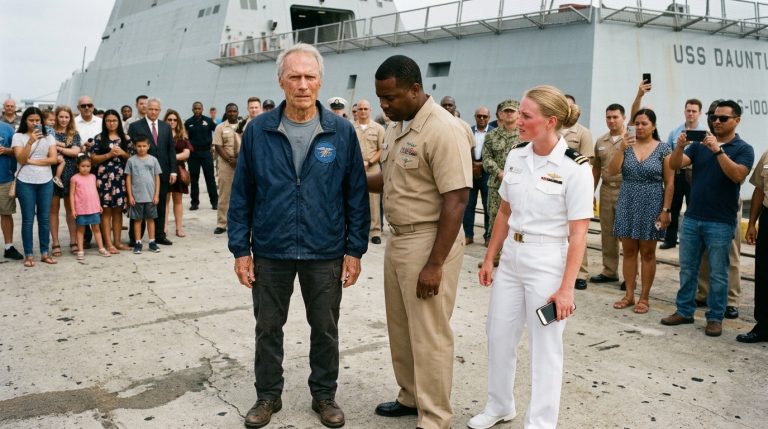
“Mr. Stone,” Vance said, his voice thick, finally finding the strength to bridge the gap. “On behalf of the United States Navy, I want to offer my deepest, most sincere apology for the unacceptable welcome you have received today. It is an honor, sir. A true and humbling honor.”
Randall stood on the gravel, the dust of the base swirling around his boots. He returned the salute, his movement slower, less perfect, but arguably more commanding than the Admiral’s. The tension in the air was no longer that of a standoff; it was the suffocating, heavy gravity of a historical truth finally breaking the surface.
Petty Officer Miller, standing at the edge of the Marine cordon, felt his own heart settle into a steady, heavy rhythm. He realized then that he wasn’t just watching an incident; he was witnessing a correction. The arrogance of the base’s security had been a blister, and the Admiral had just lanced it. But as he looked at the old man’s face—the weary, pale eyes that seemed to see far beyond the gate—Miller realized the cost of the correction. The silence wasn’t just respect; it was the sound of a secret being pried open, and the shockwaves were only just beginning to travel. Thorne was staring at them both, his eyes wide, his world collapsing with every word the Admiral spoke. The mystery of the patch, the meaning of the hammer—it was all suddenly very close, looming over the gate like a storm cloud that wouldn’t break.
CHAPTER 6: The Unveiling of Ghosts
The gate was a tomb. Hundreds of onlookers, ranging from senior civilian contractors to fresh-faced recruits, stood in a stillness so complete it felt unnatural. Captain Thorne was the epicenter of the collapse. He looked as though he had been hollowed out, his posture sagging, his uniform suddenly looking two sizes too large. His authority, once a bright, rigid thing, had been vaporized in the span of a few minutes.
Admiral Vance did not break his gaze from Thorne. It was an interrogation without words, a stripping-down of the Captain’s arrogance that was far more brutal than any court-martial. Vance’s face was a mask of cold, controlled fury, but there was a flicker of something else—a deep, ancient shame. He looked at Randall, then at the assembled crowd, his jaw tightening until the muscles stood out like corded steel.
“You demanded his call sign, Captain,” Vance said, his voice ringing against the metal and glass of the waiting cars. “You do not have the clearance, the rank, or the honor to even speak that designation aloud.”
The air around the truck felt charged, static electricity prickling at Randall’s skin. He felt the phantom weight of the M240 again, the heat of the barrel burning his gloves. He blinked, and for a terrifying moment, the asphalt of the gate transformed into the jagged, rain-slicked slate of Ana Pass. He saw the bodies of his team, the men who had been erased by a stroke of a bureaucratic pen, their faces flickering in the periphery of his vision like faulty fluorescent lights.
They call us ghosts, but you… you’re different.
The memory was so vivid he could smell the damp earth of the foxhole, the sharp, metallic tang of copper. Randall’s hand, resting on the truck’s door frame, began to tremble. He forced his fingers to straighten, to grip the cold, solid steel of reality. He wasn’t on the ridge. He was in Norfolk. The Marines were standing in their perfect cordon, their white-gloved hands gripping the rifles as if they were protecting a relic.
Vance turned back to the crowd, his voice taking on a different timbre—a heavy, somber resonance. “You see this man, and you see an old-timer in a beat-up truck. You see a faded patch on a worn-out jacket. Your captain here saw a security risk, a nuisance. Let me tell you what I see.”
The Admiral gestured toward Randall. It was a formal, public act of veneration. “I see the sole survivor of Operation Nightingale, a mission so deep, so classified that all seven other members of his team were listed as training accidents. I see the man who held the North Ridge at Ana Pass for 72 hours alone against an entire enemy battalion, armed with little more than a radio and the weapons of the fallen.”
A ripple of sound went through the crowd—a collective gasp, followed by a silence so heavy it felt like the ocean pressing in. Petty Officer Miller, standing near the front of the cordon, felt his legs go weak. He had heard the stories, the hushed rumors of Nightingale, but to hear it spoken here, on the main gate of a functioning naval base, was like witnessing an earthquake. The truth wasn’t just being whispered; it was being etched into the very air of the station.
Thorne seemed to shrink. He looked like a man being erased from existence.
“This man,” Vance continued, his voice thick with a genuine, raw emotion, “wears no medals on his chest because the actions that earned them are too secret to ever be acknowledged. He asks for no special treatment. He seeks no recognition. He is a ghost, a whisper, a legend to men who are themselves legends.”
Randall felt a sudden, sharp ache in his chest—not of sorrow, but of recognition. He had spent forty years in the gray, the quiet, the forgotten. To have it laid out like this, to have his survival articulated by a man who had climbed the ranks of the very system that had buried his unit, was a violence of its own. It was a tearing open of the wound he had spent a lifetime keeping stitched shut.
“His call sign,” Vance said, the words a final, crushing blow to the remaining structure of Thorne’s world. “Was Hammer 6.”
The name hung in the air, a physical artifact that seemed to pull the light toward it. Randall looked at the Admiral. He saw the reflection of his own trauma in Vance’s eyes—the weight of a secret kept, the cost of an impossible silence. He realized then that Vance hadn’t just come to save him; he had come to be absolved.
Thorne suddenly dropped to his knees, his hands hitting the gravel with a dull, sickening thud. The arrogance was gone, replaced by a devastating, hollow realization of his own insignificance. He wasn’t a captain anymore. He was a man who had played with a fire he couldn’t comprehend, and the burns were permanent.
Vance signaled to the Master Chief. Peterson, looking as if he were walking into a funeral, stepped forward to collect the broken man. “Captain Thorne, you are hereby relieved of your command, effective immediately,” Vance said, his voice devoid of triumph, heavy with the gravity of the fall. “Your career is pending a full review.”
As the Master Chief led Thorne away, the crowd parted for them like a tide. The gate, once a place of routine and regulation, had become a place of reckoning. Randall leaned against the truck, his breath coming in shallow, controlled bursts. The world around him was beginning to stabilize, the vision of the ridge fading into the background, but the cost was etched into the lines of his face. He had been unearthed, and now he had to face the consequence of being remembered.
CHAPTER 7: The Mercy of Ghosts
The gate was a stage where the actors had forgotten their lines. Randall Stone stood in the center of it, his hand resting on the sleeve of the Admiral’s dress blues. It was a simple, grounding gesture, but in the sterile, high-pressure environment of the naval base, it felt like a crack in the armor of the entire institution. Admiral Vance looked down at the hand, his eyes shimmering with the sudden, overwhelming realization of what he had almost presided over. He had come here to uphold the sanctity of his command, but he was currently being offered grace by the very person he had spent his life mythologizing.
“He’s a young captain, full of fire, eager to do his job right,” Randall said, his voice quiet, steady, and entirely devoid of the malice Vance had been steeling himself for. “We were all like that once.”
Vance’s breath hitched. He looked toward the spot where Thorne had been kneeling, now just a patch of disturbed gravel where the Captain had been led away. The Admiral’s fury, which had been the only thing keeping him upright since the call from Peterson, began to drain away, leaving him feeling dangerously light. He had been prepared for a collision—a demand for justice, for recognition, for the settlement of a debt that could never be fully paid. He had not been prepared for mercy.
“You don’t understand, Mr. Stone,” Vance said, his voice strained. “What he did—the disrespect, the failure to recognize—it’s not just about me. It’s about the memory of the mission. It’s about the truth.”
Randall withdrew his hand, his movements slow and deliberate. He looked past the Admiral, toward the harbor. “The truth is a heavy thing to carry, Admiral. Most people aren’t built for it. They build these little windows—these rules, these regulations—to keep from having to look at the whole sky. You can’t blame him for wanting to stay inside the room he built for himself.”
The words struck Vance with a force that made him flinch. He looked at the old man, really looked at him, and saw the cost of that truth. He saw the way Randall’s posture held the weight of forty years of solitude, the way his eyes remained fixed on a horizon that only he could see. The Admiral felt a deep, profound sense of shame, not for Thorne’s arrogance, but for his own complicity in the silence. They had kept the legend, but they had sacrificed the man.
“I won’t let his career end here,” Randall continued, his tone matter-of-fact. “Don’t ruin the boy’s career over this. Teach him. That’s what leaders do.”
Vance nodded, unable to speak, his throat tight with the weight of the moment. He turned his gaze toward the Marines still standing in their cordon. They were statues, their faces impassive, but he could see the strain in their shoulders, the way they stood rigid against the weight of the historical revelation they had just witnessed. He nodded to the Sergeant in charge, a silent instruction to stand down. The cordon dissolved, the Marines moving with a rhythmic, muted precision that seemed to drain the last of the tension from the air.
Randall walked toward his truck. The engine turned over with a low, patient rumble, a sound that felt like the earth settling after an earthquake. He didn’t look back as he climbed into the cab. He didn’t seek the approval of the officers or the awe of the crowd. He was a ghost returning to the shadows, a legend retreating back into the quiet.
Admiral Vance remained standing by the gate as the truck rolled forward, the tires crunching softly on the gravel. He watched it go, the faded blue paint glinting in the morning sun until it turned the corner and disappeared behind the perimeter wall. The base was starting to wake up again—the hum of distant engines, the rhythm of a morning shift change—but the silence at the gate lingered, a ghostly echo of the hammer that had fallen.
Petty Officer Miller stood at the edge of the road, his phone still in his hand, his thumb hovering over the call button he would never need to press. He felt a sudden, hollow ache in his chest—a feeling of having been touched by something that didn’t belong in his world. He looked at the Admiral, who was still staring at the empty road, his silhouette sharp and lonely against the vast, gray expanse of the harbor.
The incident was over. The security check had failed, the Captain had fallen, and the legend had been briefly, violently revealed. But as Miller turned to walk back to his car, he realized that nothing would ever be the same. The window had been cracked open, and even though the old man was gone, the sky he had revealed remained. The silence of the base wasn’t just order anymore; it was the quiet, attentive stillness of a world that was waiting to see what would grow from the dust.
CHAPTER 8: The Diner Counter
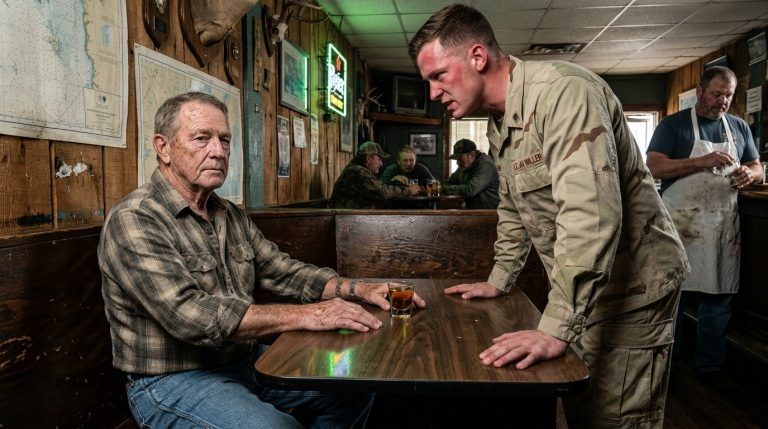
The diner was a relic of a different time, smelling of burnt beans, old linoleum, and the persistent, heavy scent of stale cigarette smoke that no amount of ventilation could fully scrub away. Outside, the world was moving on—cars rushed by on the highway, the base continued its relentless, clockwork operations—but inside, time had thickened into a slow, syrupy crawl. Lieutenant Thorne, his captain’s eagles stripped and his uniform swapped for the anonymity of civilian khakis, sat at the end of the counter. His coffee was cold, a dark, stagnant pool in a thick ceramic mug.
He hadn’t been to the base in three weeks. The demotion to logistics had been a social death, a quiet exile to a basement office where the only thing he managed was the inventory of spare parts and outdated hardware. He was a ghost in his own life, haunted by the memory of the gravel at the gate and the look in Admiral Vance’s eyes.
The door chime rang, a piercing sound that made him jump. He didn’t turn around. He just stared into his mug, watching his own reflection in the black liquid. He didn’t need to look to know who it was. The heavy, measured tread of boots on the worn floorboards was unmistakable.
Randall Stone took the stool next to him. He didn’t ask if the seat was taken. He just sat, his presence filling the empty space with a quiet, grounding gravity that made the diner feel smaller, more intimate. He smelled of dry earth and cold morning air.
For a long time, there was only the low-frequency hum of the refrigerator and the distant, muffled sound of a radio playing country music. Thorne’s hand, resting on the counter, was trembling—a fine, persistent vibration he couldn’t seem to stop. He felt a sudden, crushing wave of shame, the reality of his past arrogance finally manifesting as a physical weight in his chest.
“Sir,” Thorne said, his voice cracking, a thin, fragile sound that seemed to disappear into the diner’s quiet. He didn’t look at Randall. He couldn’t. The memory of his own face, twisted in condescension, was still too vivid. “I… I never properly apologized to you. What I did… it was inexcusable. There’s no excuse for my arrogance. I am truly sorry.”
Randall didn’t answer immediately. He flagged down the waitress, his hand calloused and steady as he ordered a coffee of his own. He waited until the mug was placed in front of him, the steam rising in lazy, swirling ribbons, before he turned his head.
“You were doing your job, son,” Randall said, his voice calm, like a flat lake reflecting a storm that had finally passed. “You were just looking at the world through a very small window.”
Thorne finally looked at him. The old man’s eyes were clear, pale blue, and terrifyingly free of judgment. They weren’t the eyes of a hero or a monster; they were the eyes of a man who had seen the end of the world and had simply decided to keep walking.
“The trick,” Randall continued, offering a small, forgiving smile that didn’t reach his eyes but softened the hard lines of his face, “is to make that window bigger every day you’re alive.”
He reached into his pocket and pulled out a few worn, creased dollar bills, placing them neatly on the counter. He signaled the waitress again. “I’ll take his check, too.”
It was a small, almost insignificant gesture, but it felt like the weight of an entire world being lifted from Thorne’s shoulders. The absolute, crushing finality of his failure had been replaced by a quiet, manageable truth. He wasn’t a hero; he wasn’t a villain. He was just a man who had been given the chance to learn how to see.
Randall stood up, his movements stiff with the years, but his posture was straight, unburdened. He gave Thorne a gentle, firm pat on the shoulder—a gesture of connection that bridged the divide between the past and the present, the ghost and the living. He turned and walked toward the door, his silhouette framed for a fleeting moment in the bright, unfiltered light of the morning.
Thorne watched him go, the chime of the door sounding like a final, closing note. He turned back to his mug, but the coffee was different now—warm, bitter, and bracing. He took a sip, the heat spreading through him, and for the first time in his life, he didn’t look at the world to see what he could command. He looked at it to see what was there. He reached out, his hand steady for the first time, and pulled a napkin toward him, a pen in his pocket, and a quiet, deliberate resolution forming in the center of his mind. He was going to start over, but this time, he would be sure to open the window.