The Weight of Iron: A Veteran’s Silent Stand Against the Hollow Pride of Modern Command
CHAPTER 1: THE HULL OF MEMORY
The heat was a physical weight, pressing down on the flight line until the air shivered into liquid mirages. Captain Davis stood before the A-10, his posture a study in calculated arrogance—shoulders squared, chin tilted just enough to catch the light on his silver bars. He was a creature of sharp angles and polished chrome, a man who believed the world began and ended with the regulations printed in his pocket manual.
“Last chance, Grandpa,” Davis said, his voice dripping with a condescending amusement that made the airmen behind him shift, their eyes darting between the captain’s smirk and the old man’s stillness.
Roger Bentley didn’t look at the officer. He didn’t look at the crowd of onlookers, their murmurs sounding like the buzzing of distant insects. He kept his eyes locked on the weathered nose of the A-10, the paint slightly thinner where the GAU-8 Avenger cannon protruded like a serrated tooth. To the rest of the world, it was a static display, a relic of a bygone era. To Roger, it was a living, breathing predator. He could feel the cold hum of the hydraulic systems beneath the skin of the fuselage, a rhythmic pulse that matched his own heartbeat.
He reached out, his hand—knotted with veins and mapped with the history of eighty-two years—brushing the cool, rubbery surface of the landing tire. The leather of his jacket, cracked and stiff, groaned under his movement.
“The auxiliary power unit requires a ground check before ignition,” Roger murmured. His voice was a low, raspy grit, like gravel grinding against stone. “You don’t just turn a key. The pressure… it needs to be steady.”
Davis let out a sharp, incredulous laugh that cut through the silence. He jabbed a manicured finger toward the cockpit, then toward the crude scorpion patch stitched onto Roger’s chest. “We don’t need a lecture from a bingo-hall hero, sir. This is a restricted area. You’re a liability.”
The air grew tight. The captain took a step forward, closing the distance until his shadow swallowed Roger’s face, but the old man didn’t recoil. He was drifting. The humid, heavy air of the tarmac was thinning, replaced by the biting, thin cold of a high-altitude cockpit. He could see the flash of tracers in the distance, the smell of cordite thick enough to taste, and the desperate, frantic scramble of a Ranger unit pinned down in a hellish desert valley.
He felt his thumb find the trigger stud on the control stick—a memory so potent his own finger twitched in his pocket.
Davis watched the old man’s eyes go blank, seeing only a confused, aging trespasser. He didn’t see the ghost of a major who had once held the sky together while fire rained down upon the earth. He didn’t see the man who had brought a crippled bird home on a prayer and sheer, iron-willed stubbornness.
“Empty your pockets,” Davis commanded, his voice rising, sensing the shift in the crowd. “We’re done playing.”
Roger slowly pulled his hand from his inner pocket. He didn’t hold a weapon, but the way he moved—with a calm, terrifying fluidity—made the captain’s hand twitch instinctively toward his hip. The air in the flight line seemed to drop in temperature, leaving a hollow silence that felt like the moment just before an impact.
CHAPTER 2: THE ANATOMY OF A TRESPASS
Roger pulled his hand from the inner pocket. Between his thumb and forefinger, he held nothing more than a thin, laminated square of paper—a visitor’s pass, long expired, clipped to an old metal base access badge. He didn’t thrust it at the captain; he held it with the casual, practiced indifference of a man who had survived surface-to-air missiles and engine fires, only to be detained by a man who measured merit by the sharpness of a trouser crease.
The sunlight hit the plastic, casting a tiny, jagged glare into Davis’s eyes. The captain flinched, a flicker of genuine uncertainty crossing his face. He had expected a weapon, or perhaps the trembling surrender of a man realizing he was out of his depth. He had not expected this calm, rhythmic patience.
“Here,” Roger said. The word was a dry rasp. He didn’t relinquish the badge, he held it steady, waiting for Davis to reach out and take it.
The tension in the flight line was now a physical weight. The air smelled of hot concrete, ozone, and the faint, biting scent of jet fuel—a sensory echo of a different life. A younger airman near the perimeter of the crowd took an involuntary step back, his eyes fixed on the badge as if it were a live grenade. The silence was absolute, save for the distant, rhythmic whine of a power generator and the frantic beating of hearts that suddenly felt too loud in the stillness.
Davis’s jaw tightened. He could feel the eyes of his subordinates, the curiosity of the families, and the heavy, judgment-filled silence of his peers. He reached out to snatch the badge, but his fingers brushed against the rough, worn leather of Roger’s sleeve. The texture was jarring—a thick, unyielding grain that felt like armor.
“Confused,” Davis muttered under his breath, a desperate attempt to reclaim the narrative. “You’re clearly not in possession of your faculties, sir. This badge is decades old.” He looked up, his eyes meeting Roger’s.
Roger’s gaze was fixed. He wasn’t looking at Davis anymore; he was looking through him. The captain saw a man who seemed to be reciting a mental checklist, his eyes sweeping across the tarmac with the detachment of an pilot assessing a kill-box. To Roger, the flight line wasn’t a pristine, paved exhibit; it was a terrain, a piece of geography where a man had to make choices that would either save lives or end them.
“I’m not a trespasser, Captain,” Roger said, his voice dropping into a tone that carried an authority Davis had never encountered in his years of service. “And this machine isn’t a museum piece. It’s an asset. And it is being left unmonitored.”
Davis felt a cold jolt of alarm. The veteran’s technical language was precise, disturbing, and altogether too familiar with the nuances of base security protocol. The captain’s ego, the defensive wall he had spent years constructing, began to fracture. He had been taught that authority came from the rank on the collar, but looking at this man, he sensed an authority that came from something far more dangerous—experience that couldn’t be quantified or commanded.
“You are done here,” Davis said, his voice rising, a sharp, metallic edge of desperation creeping in. He turned to the two young airmen standing nearby, his face pale. “Get security forces. Now. And have them bring a medical evaluation team. I don’t care what he says, he’s a hazard to the flight line.”
The airmen hesitated, their boots scraping against the concrete. They were caught in a vice of conflicting commands: the immediate, direct order of their superior versus an instinctive, primal recognition of the man standing before them. The atmosphere shifted from annoyance to something darker—a, “predator-prey” dynamic where the protagonist, despite his physical age, was the only one who truly understood the rules of the environment.
Roger dropped his hand. He didn’t protest. He didn’t plead. He simply shifted his weight, his eyes tracking a patrol vehicle that was still far off in the distance. He had been a guest, a man invited to be near his machine. Now, he was a variable in a high-stakes equation he was forced to solve. He began to calculate the risk, noticing the way Davis’s hands shook just slightly, the way the airmen refused to meet his eyes, the way the perimeter was tightening.
He was being boxed in, just like the old days. The only difference was that this time, there were no flares to pop, no altitude to gain, and no target to engage. Just the heavy, dragging friction of a system that had forgotten its own history.
“Do it,” Davis barked, his face flushed with the exertion of maintaining his grip on a situation that was spiraling out of his control.
Roger took a single step back, his boots crunching on a bit of loose gravel. He watched the airmen scramble away, their radios crackling with static. He felt the cold, hard reality of his position. He was alone, isolated by a man who couldn’t see the depth of what he was dealing with. But as he looked at the nose of the A-10—that massive, seven-barreled maw—a grim, quiet satisfaction settled in his chest.
If they wanted a fight, he would show them exactly what it meant to stand one’s ground.
CHAPTER 3: THE COMMAND SHIFT
The sound of the approaching SUV was a low, guttural growl that stood in stark contrast to the sharp, nervous chatter of the airmen. Roger didn’t move. He kept his posture loose but ready, a habit etched into his physiology after decades of volatile skies. He watched the perimeter of the crowd. The young airman who had tried to intervene earlier—the one who had been pale and clearly uncomfortable—now stood frozen, his eyes wide, watching the dust kick up as the vehicle surged forward in defiance of the base’s speed regulations.
This wasn’t a routine patrol. The way the vehicle cut across the apron, taking the shortest distance to the A-10 rather than following the marked taxiway, signaled an operational emergency. Roger felt a flicker of grim satisfaction. He didn’t know who was in that vehicle, but he knew the silhouette of urgency.
The SUV skidded to a halt, the tires biting into the concrete and leaving faint, dark arcs of rubber. A second maintenance truck followed, trailing a plume of grit that drifted over the flight line. The doors of the SUV swung open with a synchronized, mechanical snap. Colonel Mat emerged, his gait steady and devoid of the nervous, peacocking energy Captain Davis had been projecting just moments ago. Behind him, a Command Chief Master Sergeant—a man whose face was a map of hard-won experience—disembarked, scanning the scene with the practiced eye of someone who had spent his life maintaining the delicate balance between rank and reality.
Davis was still standing near the aircraft, his back to the arriving vehicle, clearly expecting the security detail he had ordered. He didn’t see the colonel yet. He was mid-sentence, lecturing a junior airman, his finger stabbing at the air with practiced, rhythmic arrogance.
“They’ll be here in a minute,” Davis was saying, his voice loud enough to carry over the settling dust. “We’ll have this cleared up, and then I’m going to make sure he’s processed for a full psychiatric review. We can’t have these wandering civilians contaminating a secure site.”
Roger said nothing. He watched the colonel’s face—a study in controlled, glacial coldness—as the man took in the scene. Mat didn’t look at the crowd; he looked at the aircraft, then at the old man leaning against the tire, and finally, with a look of profound, weaponized disdain, at the back of Captain Davis’s head.
The silence that descended upon the flight line was not the tentative silence of the previous standoff; it was the absolute, suffocating quiet of a command structure suddenly shifting under the weight of an unmitigated error.
Colonel Mat walked forward. He didn’t run, and he didn’t shout. His presence was like a drop in barometric pressure. Every airman within twenty paces straightened, their bodies snapping into a posture of rigid alertness. Davis, sensing the sudden change in the atmosphere behind him, stopped speaking. His finger hung in the air for a second, then dropped. He turned around, his smug expression already transitioning into a mask of confused deference.
“Colonel, sir,” Davis began, stepping forward with a salute that was far too fast, far too eager. “I’m glad you’re here. We’ve had a—”
Mat ignored the salute. He walked straight past the captain as if he were a ghost, a piece of irrelevant geometry in the space between the colonel and the veteran. The colonel’s eyes were locked on Roger. The distance closed in measured, purposeful steps. When Mat stopped, he was exactly three feet away—the standard distance for an officer addressing a superior, or in this case, a legend.
The colonel snapped to attention. It was an impeccable, rigid salute that seemed to pull the very air out of the scene. It was a gesture of profound, almost religious recognition.
“Mr. Bentley,” the colonel said, his voice ringing out with a clarity that silenced the distant hum of the base. “It is an honor to have you on my flight line, sir.”
Davis’s hand, still hovering near his brow from his interrupted salute, slowly lowered. His face went through a rapid series of colors—a pale, sickly shade of grey that highlighted the sudden, devastating realization of his mistake. He looked at the old man, then at the colonel, then back at the A-10. The world he had built, with its rigid rules and clear-cut hierarchies, was crumbling in real-time. He looked smaller, somehow, his flight suit suddenly appearing too loose, his polished boots incongruous against the hard, gritty reality of the tarmac.
Roger nodded once, a slow, tired motion of his head. He didn’t return the salute—he was, after all, retired—but the way he stood, the sudden stillness of his frame, made him look like a monument carved from the very stone beneath their feet. He wasn’t the “confused civilian” Davis had described. He was a force of history that had finally found its proper anchor.
“The auxiliary power unit check wasn’t completed, Colonel,” Roger said, his voice low but audible enough to reach the silent, awestruck crowd. “The hydraulic pressure is critical. If your people are going to display this, they need to know that a static display is still a machine that demands respect.”
Mat didn’t blink. “I will personally oversee the correction, sir. You have my word.”
The chief, standing just behind the colonel, took a step toward the maintenance team. He began barking orders, his voice clipped and efficient, as the reality of the situation solidified for everyone present. The airmen who had previously been following Davis’s lead now looked at Roger with a dawning, reverent shock. They weren’t looking at a relic anymore; they were looking at the man who had written the manual on how to keep that bird in the sky.
Davis stood rooted to the spot, a marooned figure in the center of a developing storm. He tried to speak, to offer some kind of excuse, but the words withered in his throat. The colonel hadn’t even looked at him. He didn’t need to. The silence that the colonel projected was a verdict in itself—a condemnation of judgment, of leadership, and of the fundamental lack of understanding that had led to this moment.
Roger let his hand drop from the landing gear. He could feel the pulse of the aircraft, the quiet vibrations that meant the internal systems were cooling down. He had done what he came here to do. He had stood his ground. But as he watched the colonel’s face—a face he knew was hiding a deep, professional horror at what had transpired—he realized the battle wasn’t over. The aftermath would be as complex as the fire he had once faced in the desert. He watched a senior airman, Garcia, move toward the colonel with a look of frantic intent, his phone clutched in his hand. The narrative was shifting, expanding beyond the tarmac, and for the first time in years, Roger felt the weight of the past not as a burden, but as a bridge back to a world that was just beginning to remember what it owed.
CHAPTER 4: THE COLLISION OF CONVICTION
Roger remained standing by the A-10’s landing gear, his hand still resting on the rubber. He watched the back of Colonel Mat’s uniform as the command team strode toward the headquarters. Captain Davis remained behind, a solitary, drifting anchor in the middle of the flight line. The captain’s breathing was audible—a shallow, ragged rhythm that suggested a man hyperventilating under the weight of his own sudden insignificance.
The air around the tarmac felt thinner now, stripped of the casual heat of the family day. The crowd had been quietly dispersed by the security team acting under the chief’s direct orders, leaving the apron unnervingly empty. The only sound was the faint, rhythmic ticking of cooling metal from the nearby aircraft.
Davis took a hesitant step toward Roger. His face was a map of confused, shattered pride. “I didn’t know,” the captain whispered, his voice cracking. “They didn’t tell us… they didn’t put it in the briefing.”
Roger turned slowly. He didn’t look at the captain; he looked past him, at the horizon where the sun was beginning to dip, casting long, bruised-purple shadows across the concrete. The smell of ozone—the smell of the cannon’s propellant—suddenly flooded his senses, a psychological phantom that pulled him back to the desert. He was in the cockpit again, the canopy glass rattling against the vibration of the strafing run, the desert floor a blur of incinerated armor.
“The briefing,” Roger repeated, his voice a low, raspy grind. “You’re looking for a file, Captain. You’re looking for an entry in a database to tell you who to respect.”
He felt the phantom weight of the flight stick in his hand, the familiar resistance as he wrestled the crippled aircraft into a climb, the screams of the Ranger unit still ringing in his ears from the radio. He remembered the blood, not his own, but the blood of the men he had shielded. He hadn’t been an officer that day; he had been a wall of lead and noise, a desperate, final solution for men who were about to die.
Davis was waiting for an answer, his eyes darting back to the headquarters as if seeking a lifeline. He wasn’t seeing the man; he was seeing a threat to his survival. “I’m just doing my job,” Davis insisted, though the conviction had drained from his tone. “I have to maintain the integrity of the base.”
Roger finally met the captain’s eyes. He saw the fear there—the fear of a man who realized he had spent his life building a temple of rules, only to realize the foundation was hollow. “Integrity,” Roger said, the word dripping with the irony of a lifetime of combat. “You think that’s what this is? You’ve been policing a grave, Captain. You’ve been guarding a monument you never bothered to understand.”
The psychological weight was crushing. Roger felt the exhaustion of his years—the bad knees, the hum of tinnitus that always intensified when he stood near a flight line, the constant, low-level grief that he had learned to carry like an invisible pack. He was tired of the game, of the posturing, of the need to prove that the past wasn’t just dust.
Davis took another step closer, his hand reaching out in a gesture that was half-apology, half-plea for mercy. “Just tell me,” the captain said, his voice dropping to a near-whisper. “What do you want me to say to the colonel?”
Roger looked at the scorpion patch on his own jacket, the threadbare stitching that symbolized a debt that had never truly been cleared. He didn’t want the captain to say anything to the colonel. He wanted the system to stop—the cycle of hollow rank and performative discipline that turned men into cogs and heroes into myths.
He didn’t speak. He reached into his pocket and pulled out the old access badge again. He didn’t hand it to Davis; he let it slip from his fingers, watching it clatter onto the hot, unyielding tarmac. The sound was small, metallic, and final.
Davis stared at the badge as if it were a physical injury. He didn’t pick it up. He just watched it, his shoulders hunching as if he were trying to shrink away from the reality of it. The wind kicked up a small dust devil, swirling the loose grit around their feet, and for a moment, the flight line felt like a graveyard.
The silence dragged on, stretched to the point of breaking. Roger turned his back on the captain, his gaze returning to the aircraft. He walked a slow, heavy circle around the nose of the A-10, his hand trailing over the scarred, weathered metal of the fuselage. He was looking for the ghosts, for the familiar, tactile reminders of the struggle—the dents, the heat-scorched rivets, the places where the machine had been patched up and sent back out to earn its keep.
He was the ghost, and he had come back to check on his kin. He was done with the living, with the captains and the colonels and the endless, shallow demands of a military that had forgotten how to bleed. He started to walk toward the exit of the flight line, his steps heavy, purposeful, and entirely indifferent to the man he left behind in the deepening shadows.
CHAPTER 5: THE DISCIPLINARY FALLOUT
The walk to the edge of the flight line felt longer than the sorties he had flown decades ago. Each step was a measured strike against the pavement, the impact traveling up through his stiffening joints. Behind him, the captain’s silhouette remained motionless, a dark blot against the greying tarmac. Roger didn’t turn back. To look at Davis was to acknowledge the man as a peer, and Roger knew, with the cold clarity of a combat veteran, that the captain had already ceased to exist in the architecture of this base. He was a system error, a glitch that was currently being purged.
The air grew sharper, the sunset bleeding oranges and bruised purples over the hangars. As Roger reached the security perimeter, the gates stood open. The base was in a state of quiet, high-alert flux. He could see the flash of a security cruiser’s light rotating in the distance, a blue, pulsating rhythm that marked the frantic movement of the base’s internal affairs. They were moving to contain the fallout, to smooth over the jagged edges of a public humiliation that the wing commander could not afford to let fester.
He walked past a guard station, his gait steady despite the persistent, dull ache in his hip—a souvenir from a rough landing during the war. The guard at the gate, a young man who couldn’t have been more than twenty, stood to attention as he approached. The boy’s eyes weren’t looking at Roger’s civilian clothes; they were locked onto the scorpion patch on his jacket. There was no mockery there, only a profound, silent confusion that bordered on awe.
Roger didn’t offer a salute, but he offered a nod—a brief, acknowledging dip of his chin. The boy returned it, his hand trembling just slightly. It was a small exchange, a ripple in the fabric of the base’s hierarchy, and it reminded Roger that the legacy was not contained in the brass or the flight suits. It was held in the stories told in the quiet corners of the maintenance hangers, in the shared language of the mechanics who knew the tail numbers of the planes that had stayed in the air long after they should have fallen.
He reached his car, an older, battered sedan that looked incongruously out of place against the sleek, modern jets parked in the nearby lots. As he leaned against the driver’s side door, his hand trembled—not from fear, but from the sudden, jarring withdrawal of adrenaline. The “Butterfly Detour” hit him then: a sharp, searing pain in his shoulder, the exact spot where a piece of flak had grazed him years ago. It was a physical reminder that he was no longer the man in the cockpit. He was an aging pilot in an aging body, carrying the weight of a war that most people had relegated to the back pages of a history textbook.
A shadow fell over him. He looked up to see Chief Wallace standing a few yards away. The chief, a man who possessed a quiet, granite-like stability, was watching him with a gaze that understood exactly what Roger had just survived. He didn’t approach immediately, respecting the space that Roger needed to anchor himself back into the present.
“The colonel is handling the captain,” Wallace said, his voice low, lacking any pretense of rank. “The wing is being cleaned up, Mr. Bentley. We’re making sure it stays that way.”
Roger leaned his forehead against the cool metal of his car’s roof. He didn’t answer right away. He was thinking of the Rangers, the young captain in the desert, and the way the world had felt when he had realized he was, for a fleeting, incandescent moment, a god of iron and fire. That memory was the Layer 2 reality—not the combat itself, but the terrifying realization that his life had been the currency used to buy the lives of those men. It was a debt that could never be repaid, and yet, here he was, being thanked for it by a man who had never felt the sting of a missile hit.
“The badge,” Roger said, his voice rasping. “Tell them to leave it.”
Wallace frowned, a flicker of confusion crossing his face. “Sir?”
“The badge Davis dropped. Leave it on the tarmac.” Roger looked back at the flight line, the shadows now stretching across the concrete like long, thin fingers. “Let them walk over it. Let them realize that their rules mean nothing if they aren’t built on the truth of what it costs to do the job.”
Wallace stood still for a moment, then nodded slowly. The chief understood. He was a man who worked with the wreckage of planes and the wreckage of men; he knew that the most important lessons were often the ones you had to step over in the dark. He turned and walked away, his stride rhythmic and silent, moving toward the headquarters with the purposeful intent of a man who was about to finish the job he had started.
Roger watched him go, then pulled himself into the driver’s seat. He didn’t start the engine immediately. He sat in the quiet, smelling the faint scent of old leather and stale air—the sensory texture of a life lived on the fringes of the sky. He had forced the system to look at its own reflection, and now, he had to drive home and find a way to live with the truth that he had, for an hour, been the ghost he was trying to leave behind. He turned the key, the engine groaning into life, and he pulled away from the fence, leaving the base and the weight of its hollow pride behind in the rear-view mirror.
CHAPTER 6: THE QUIET ACCOUNTING
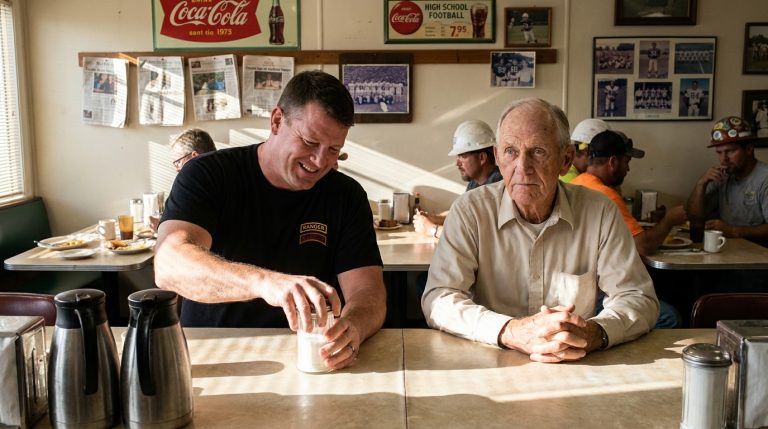
The bell over the coffee shop door chimed, a thin, silver note that cut through the low-level drone of the early morning. Roger didn’t look up from his newspaper. He sat in a corner booth, the shadow of the tall display rack shielding him from the rest of the room. The paper was spread out before him, a shield of headlines and ink, but his eyes were fixed on the reflection in the polished glass of the condiment stand.
The door closed, and the man who entered was not the crisp, polished officer who had stalked the flight line. The former Captain Davis—now stripped of his bars and the certainty of his uniform—walked with his shoulders hunched, his eyes scanning the room with the tentative, raw vulnerability of a man who had lost his identity. He spotted Roger, hesitated for a long, agonizing moment, then moved slowly toward the booth.
Roger didn’t invite him to sit. He turned a page of the newspaper, the sound loud in the hushed space. Davis pulled out the seat opposite him, the chair scraping against the linoleum with a harsh, jarring protest.
“I was told I could find you here,” Davis said. His voice was stripped of its former arrogance. It was thin, weary, and honest. “The colonel—he made me go through it all. Every sortie. Every after-action report from the desert.”
Roger finally set the newspaper down. He looked at Davis. The man’s face was drawn, dark circles under his eyes, the remnants of a sleep-deprived night spent confronting the ghosts of a war he had never lived. This was the Payoff—not a victory of force, but the forced acknowledgment of the truth. Davis hadn’t been defeated by a superior officer; he had been dismantled by the weight of the reality he had tried to dismiss.
“They want me to write a formal apology,” Davis continued, his hands clasping the cold, ceramic mug he had brought with him. “But I don’t think that’s what this is about.”
“No,” Roger said. His voice was a rasp, but it held the authority of a man who had seen the end of the line. “It isn’t about an apology. It’s about the fact that you finally stopped looking at the uniform and started looking at the person inside it.”
Davis took a long, shaky breath. He looked out the window, his gaze settling on the distant hangar lights of the base. “I saw the report about the Ranger platoon. I read what you did—how you brought that bird back. I realized that for all the years I spent perfecting my salute and memorizing the regs, I had never once thought about what it actually meant to be the person who holds the line.”
This was the Poetic Justice. The antagonist was not destroyed by a court-martial, but by his own recognition of his mediocrity. He was forced to confront the fact that he was a mirror image of the protagonist—just as tired, just as determined, but ultimately empty of the substance that had defined Roger’s life.
Roger leaned forward. He reached into his jacket and pulled out a small, worn piece of metal—a memento he had kept for decades, a spare key to a hanger that had long since been demolished. He set it on the table and pushed it toward Davis.
“You think you’ve lost everything, Captain,” Roger said softly. “But you’ve only lost the costume. If you want to keep the uniform, you have to earn the right to wear it every single day. Not by enforcing the rules, but by remembering that every person you command is someone else’s child, someone else’s hero.”
The Denouement felt like the cooling of hot metal. The shop seemed to quiet, the refrigerator’s hum the only sound in the room. Roger reached out and adjusted the salt shaker on the table, straightening it—a small, physical act of maintenance, a symbolic repair of the order he had felt slipping away for so long.
Davis stared at the key. He didn’t pick it up, but his posture changed. The slouch in his shoulders diminished, replaced by a tense, new-found gravity. He wasn’t the man he had been a week ago, and he never would be again.
“I won’t forget,” Davis said, and for the first time, there was no subtext, no performance. It was a simple, brutal statement of fact.
Roger nodded. The connection, brief and deeply emotional, anchored him. He felt the heavy ache in his hip, the fatigue of the long road he had traveled, but for the first time, he felt the peace of a debt settled—not for himself, but for the men he had shielded in the desert. He stood up, his movements slow and deliberate. He didn’t offer a handshake; he didn’t need to. He left the newspaper on the table, folded neatly.
As he walked out, the bell chimed again, letting in the cool, morning air. He stepped into the sunlight, and for a fleeting moment, he didn’t feel the age or the tinnitus or the grief. He felt the vast, open space of the sky, a horizon that had once been his home, and now, finally, belonged to the new generation. He walked toward his car, his gait steady, leaving the shop and the broken man behind, moving toward the quiet, atmospheric peace of a life that was finally allowed to settle.