The Weight of Iron: A Sergeant Major’s Final Line in the Dust of North Carolina
CHAPTER 1: THE SALUTE OF RUSTED IRON
The tent had become a vacuum. Every oxygen molecule felt sucked toward the center aisle, where General Alden’s hand was locked at his brow, a salute that hung like a guillotine blade over the silence.
Walter sat, the folding chair groaning under his slight weight. He felt the pin—that ragged scrap of metal—pressing into his collarbone through the fabric of his jacket. It was cold. It didn’t belong here, amidst the smelling salts of floor wax and fresh-cut grass of a modern North Carolina afternoon. It belonged to the frost-bitten mud of a place that didn’t exist on any map he was willing to name.
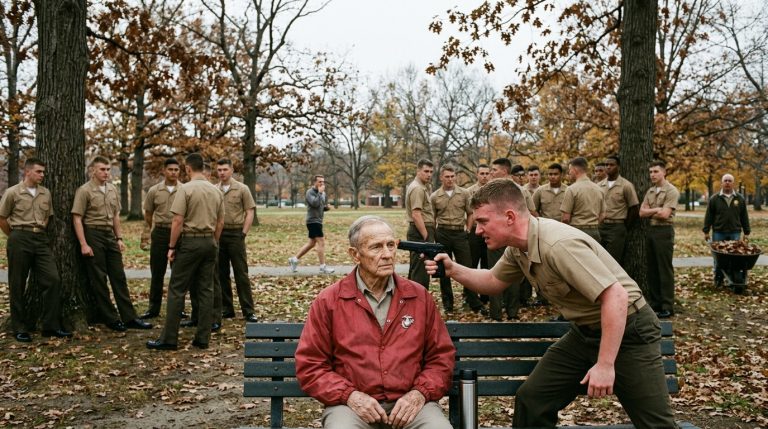
Corporal Briggs was still there, standing at attention, but the starch had drained out of him. He looked like a man who had suddenly realized he was standing on a trapdoor. His eyes, once bright with the arrogant hunger of the uninitiated, were now fixed on the dirt between his own boots.
General Alden broke the silence first, though he didn’t break the salute. He held it, a bridge of respect that felt heavy enough to crush the breath out of the room. When he finally dropped his hand, the sound of his stiff trousers snapping echoed like a gunshot.
“I didn’t come here to be honored, General,” Walter said. His voice was the sound of gravel shifting under a heavy boot—gritty, worn, and impossible to ignore.
Alden took a step forward, his polished black leather boots crunching on the dust. “You don’t get to choose that, Sergeant Major. You’re a witness.”
Walter looked at him, his pale blue eyes clear and piercing. He saw the General’s polished surface, the ribbons that looked like stained glass, and the carefully curated history of the division. It was all so clean. Too clean.
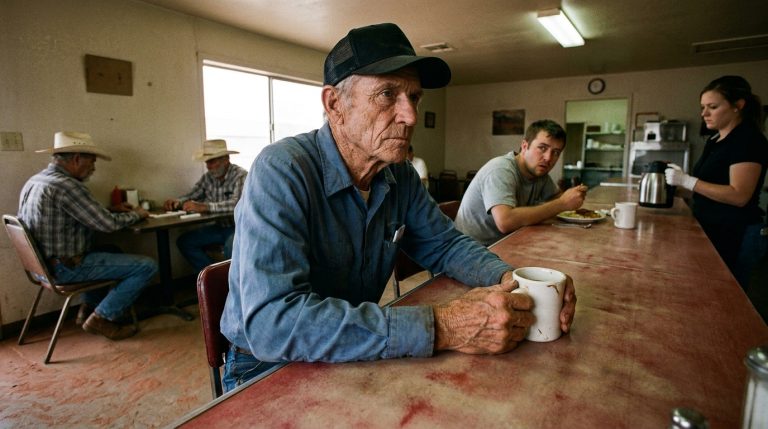
“Witnesses are a burden,” Walter murmured. He leaned forward, his hands tightening on the polished black handle of his cane. The wood was slick with years of friction. “They take up space that belongs to the living.”
The General didn’t blink. He glanced toward Briggs, who was vibrating with the effort of not trembling. “Corporal, step out into the sunlight. Give us the aisle.”
Briggs didn’t argue. He moved with a stiff, unnatural gait, his retreat marked by the scuff of rubber soles on the dry earth. As he passed, he didn’t look at Walter. He couldn’t. The weight of the old man’s presence was a physical force, a wall of history that Briggs had spent all morning trying to dismantle, only to realize he hadn’t even scratched the surface.
Once the corporal was gone, the tent felt suddenly, dangerously open.
“The records,” Alden said, keeping his voice low, a tone meant only for the inner circle. “The office in Quantico is pulling the restricted file, Walter. The ones from the winter line.”
Walter felt a spike of sharp, jagged panic—the same feeling he got when a radio relay died in the dark. He touched the pin again. It felt like a circuit board, a piece of wire and burnt solder. “Those files were sealed for a reason, Richard. And it wasn’t for the sake of the Corps.”
“It was for the sake of the men you left behind,” Alden countered, his gaze unwavering.
Walter stopped breathing. The air in the tent turned to ice. A memory, cold enough to shatter bone, clawed its way up his throat: the sound of a relay dying, the smell of ozone and burning snow, and the sight of a captain shoving this jagged piece of metal into his palm, a silent order to run while the rest stayed to face the dark.
He wasn’t a hero. He was a survivor, and that was the one thing the military could never quite figure out how to put on a plaque.
CHAPTER 2: THE GENERALS INVITATION
The silence in the heritage tent wasn’t empty; it was pressurized. Every time the tent flap shivered in the humid North Carolina wind, the sound seemed to resonate against the cold iron of the pin at Walter’s collar. He felt the weight of it, a localized gravity that pulled at his skin, dragging his focus back to the frozen ridge at the Reservoir. He could almost smell the ozone of the dying radio relay—a smell that had nothing to do with the grass-scented dust of this tent.
General Alden remained motionless, his gaze anchored to Walter’s face. He wasn’t looking at the uniform or the age; he was looking at the ghost of a decision made seven decades ago.
“The files are being pulled, Walter,” Alden repeated, his voice barely a murmur.
Walter shifted, his grip on the cane tightening. The black wood was smooth, almost oily under his palm. He looked toward the side of the tent where Gunnery Sergeant Mercer stood, his arms crossed over his chest, his face a mask of disciplined concern. Mercer was a good Marine, but he was a creature of the system, and the system was about to turn on itself.
“Sealed records have a habit of leaking, General,” Walter said, his voice grating like dry stone. “Especially when people decide that a man’s life is a ledger that needs balancing.”
“It’s not about balancing a ledger,” Alden replied, though his eyes darted toward the entrance where the rest of the command group hovered. “It’s about the line. You held it. People need to know why.”
“They don’t need to know why,” Walter snapped, the sudden sharpness of his tone cutting through the hum of the distant generator. He caught himself, consciously loosening his fingers on the cane. “They need a reason to salute. They don’t need the truth of what it costs to hold a position when the wires go dead and the reinforcements are three days of walking away.”
The memory flared: the cold was so intense it felt like liquid nitrogen pouring into his lungs. The radio, a temperamental beast of vacuum tubes and soldered wire, had let out a long, dissonant shriek before turning into a piece of useless scrap. He had been the one to fix it, to cannibalize the casing for a makeshift antenna, to leave a mark on the earth. He had survived because he had been the one working on the relay while the others…
Walter blinked. The tent walls were olive drab again. The heat was real.
“You’re shaking, Sergeant Major,” Alden said, not as an insult, but as an observation.
“I’m eighty-eight years old,” Walter lied. He looked past the General toward the far corner of the tent where the black-and-white photograph of the First Marine Division hung. The faces of the men in that unit were blurred by the low-resolution print, but he could see every one of them in his mind’s eye. He could hear their breathing, slow and shallow, as they waited for a signal that would never come. “I’m allowed to shake.”
“You were the only one who made it back to the command post that night,” Alden said, his voice dropping another octave. He stepped closer, invading Walter’s personal space with the deliberate rhythm of a superior officer. “The restricted file contains an account that claims you were ordered to abandon the line. We both know that’s not what happened.”
Walter’s heart hammered against his ribs—a frantic, uneven rhythm that betrayed his outward calm. If the file said he was ordered to retreat, it meant the brass had rewritten history to save their own reputations. It meant he wasn’t just a survivor; he was a convenient narrative device.
“Why are you telling me this, Richard?” Walter asked, using the first name with a reckless disregard for rank. He needed to know if Alden was an ally or an investigator.
“Because the Assistant Chief of Staff is three minutes away,” Alden said, checking his watch. “And they’re bringing the division historian. They’re looking for a hero, Walter. A clean, polished, indisputable hero to anchor the centennial display. If you let them talk, they’ll turn your service into a recruitment poster. If you keep the pin and the truth, they might just decide you’re a liability.”
“I’ve been a liability since 1950,” Walter said.
He stood up, the movement agonizingly slow. His knees protested, the joints clicking with the dry sound of aging hardware. He needed to leave. He needed to get out of this tent, away from the smell of fresh cut grass and the prying eyes of men who had never seen the sun go out behind a ridge.
But as he put weight on his cane, he saw Briggs lurking near the rear flap. The corporal was staring at him, his face a bruised mix of shame and lingering curiosity. The kid was watching Walter like he was a specimen under a microscope.
“You,” Walter said, pointing his cane toward Briggs.
The corporal jumped, snapping to a position of stiff, uncomfortable attention. “Yes, Sergeant Major?”
“You wanted to know about the rank,” Walter said, his voice echoing in the sudden stillness of the tent. “You wanted to know about the chain of command. Come here.”
Briggs hesitated, his glance flickering toward the General for approval. Alden gave a curt nod. Briggs moved forward, his boots heavy and clumsy on the packed dirt. When he stopped in front of Walter, he looked smaller than he had all morning. The arrogance had been replaced by a raw, naked uncertainty.
“The chain of command,” Walter said, tapping the cane against the dirt. “It’s not about the stripes on your sleeve. It’s not about who salutes who. It’s about who you’re willing to die for when the radio relay melts into a pile of slag. Do you know who you’re willing to die for, Corporal?”
Briggs stared at the floor. “I… I think so, sir.”
“You don’t think,” Walter corrected, the words hard as flint. “You either know, or you’re just wearing the uniform for the sake of the applause.”
Walter turned back to Alden, ignoring the boy’s misery. “General, if you want the truth, get the historian out of my sight. I have no interest in being a monument. If I stay, it’s on my terms. I talk to no one about the Reservoir unless I’m the one who decides what gets said.”
Alden watched him, weighing the request. He knew that by agreeing, he was effectively shielding a potential security risk—or perhaps, shielding a truth that the Corps wasn’t ready to stomach. “You understand the implications of that, Walter? You’re asking me to bury a piece of official record.”
“I’m asking you to protect the memory of men who don’t have a voice,” Walter replied. He looked down at the blackened pin on his collar. It was just a piece of rusted, bent metal, but in this moment, it felt like a detonator. “You don’t want a monument, General. Monuments crumble. You want a witness. But witness testimony is rarely clean.”
“Fine,” Alden said, his voice tight. “But the General Staff is going to be breathing down our necks. They want this display finished.”
“Let them want,” Walter said. He looked toward the tent flap. The sound of heavy vehicles—the distinctive, grinding roar of military transport—was getting louder. The command group was arriving, and with them, the circus.
Walter took a step, then another, his cane biting into the dirt. He wasn’t going to hide. If they wanted the Sergeant Major, they would get him. But he would make sure they understood that some things in the dark were never meant to be brought into the light of a heritage event. As he walked toward the exit, he felt Briggs trailing a few paces behind, a shadow in the rust and dust of the afternoon.
CHAPTER 3: THE ARCHIVISTS SHADOW
The gravel path outside the heritage tent crunched with the arrival of a staff car. Walter didn’t look back. He kept his stride rhythmic, a controlled, measured pace that forced Corporal Briggs to keep an uncomfortable distance behind him. Every muscle in Walter’s legs felt like it was strung with rusted wire, tight and prone to snapping, but he kept his posture rigid. He couldn’t afford the luxury of a limp in front of the young Marine.
“Sir,” Briggs said, his voice hesitant, echoing the uncertainty in his posture. “I should probably—I mean, I don’t know if I’m supposed to be following you.”
“You aren’t,” Walter said, not stopping. “You’re just walking in the same direction because you’re afraid to be the first one to admit you have nothing to do.”
He could hear Briggs’s boots stumble on a loose stone. It was a petty observation, but in this moment, it was the only thing grounding him. The memory of the relay—the smell of ozone and burnt hair—was still clinging to the edges of his vision like a fading Polaroid. He needed to reach the motorpool. He needed to see the physical reality of the machines, the grease and the cold steel, to push back the encroaching frost of the past.
They reached the edge of the display area, where the sunlight hit the metal of the parked trucks with a blinding, white-hot intensity. A group of men stood near a makeshift archive desk—a folding table laden with binders and laptop computers. At the center of them was a civilian in a sharp, tan suit, clutching a tablet with the frantic energy of someone who had never spent a day in the dirt. The division historian.
Walter slowed. He could see the man flipping through pages, pointing at a file, his face bright with the discovery of some obscure roster entry.
“That’s him,” Briggs whispered, his voice catching. “That’s Dr. Aris. The one the General mentioned.”
Walter felt a cold prickle of sweat crawl down his spine. Aris wasn’t just a historian; he was a scavenger. He looked for the gaps in the record, the places where the narrative broke, and he filled them with his own theories. If Aris got his hands on the restricted oral account, he wouldn’t see a man; he would see a thesis statement.
“Corporal,” Walter said, his voice dropping into that low, dangerous register that had made Mercer stop in his tracks earlier. “You want to redeem yourself?”
Briggs looked up, eyes wide. “Sir?”
“Get over to that desk. Tell Aris that the Sergeant Major is tired and the interview is postponed until tomorrow. If he tries to show you anything, if he tries to offer you a peek at a file, you tell him the record is closed under direct order of the Commanding General.”
“But, sir—”
“Do you want to keep standing in the dust, or do you want to be useful?”
Briggs took a breath, looked at the historian, and then back at Walter. For a second, the boy looked at him not with the arrogance of a Marine, but with a sudden, dawning respect for the game being played. He straightened his shoulders, squared his jaw, and marched toward the table.
Walter turned away, ducking into the relative shadow of a supply truck. His hands were shaking again, a fine, high-frequency tremor that betrayed the adrenaline still pumping through his system. He pulled the leather wallet from his jacket and took out the ID card, then tucked it back in, his thumb brushing against the pin hidden in his collar.
He was being reckless. Engaging the Corporal was a move that could blow back on him, but he had no choice. He had to keep the archives at bay. He had to keep the past contained until he could reach the one person who still carried the burden with him.
The shadow of the truck was cool, smelling of diesel and old grease. It felt like home. Walter leaned his back against the corrugated metal, closing his eyes for a second. He wasn’t the Sergeant Major they wanted. He was just a man who had lost his unit to a faulty relay and a bad command decision, and he was tired of being the anchor for their heritage.
“You’re not going to hide here forever, Walter.”
The voice was soft, melodic, and entirely out of place in the motorpool. Walter opened his eyes. Standing near the rear tire of the truck was a woman he hadn’t seen in twenty years. Her hair was shot through with silver, and she held a thin, worn folder against her chest—the kind of folder that contained death notifications.
She was the captain’s widow.
The sight of her was like a physical blow. The air rushed out of Walter’s lungs, leaving him gasping in the humid heat. He hadn’t expected to see her here, of all places, in the middle of a Marine Corps Heritage event.
“Elena,” he managed to say, his throat feeling as though he’d swallowed sand.
“I heard you were coming,” she said, taking a tentative step forward. The ground under her feet was dusty, disturbed by her movement. “I heard you were going to speak about the Chosen.”
Walter pushed himself off the truck, the metal groaning under his weight. “I’m not speaking about anything, Elena.”
“You have to,” she said, her voice trembling just enough to reveal the years of unresolved grief beneath the surface. She held out the folder. It was thick, stuffed with letters that had never been read by their intended recipients. “My husband didn’t leave you that relay piece so you could sit in a tent and wait for the General to sanitize your story. He left it so you could tell them why.”
Walter looked at the folder, then at the historian in the distance, then back at the woman who had lost everything because of the line he had held. He realized then that he wasn’t just fighting the historians or the Generals. He was fighting the promise he had made in the mud.
“If I speak, Elena,” he whispered, the words heavy and final, “there won’t be a heritage tent left standing.”
“Good,” she said.
CHAPTER 4: THE CORPORALS UNTOLD LESSON
The heat in the motorpool felt stagnant, a heavy blanket of dust and diesel fumes that pressed against Walter’s chest. Elena stood her ground, her gaze fixed on his with a clinical intensity that made him feel as though he were the one in the folder. She didn’t look like a woman who had spent decades mourning; she looked like a woman who had spent decades waiting to be heard.
“If you won’t talk,” she said, shifting the folder toward him, “then you’re just another piece of hardware they’re cataloging for the display.”
Walter felt the familiar, sharp pang of irritation. He hated the way they all wanted the story to be clean. He looked past her to the archive table. Dr. Aris was still there, his head bent over a laptop, his fingers flying across the keys with an alarming, rhythmic precision. And there was Corporal Briggs, hovering a few feet away, watching Walter with a look that defied simple categorization. The boy wasn’t looking at him with the disdain of a superior officer anymore; he was looking at him with the dawning, terrifying realization that there was a map of the world he hadn’t even begun to understand.
“Elena, go,” Walter commanded, keeping his voice low. “If they see you here, they’ll start connecting dots that were never meant to be connected.”
“The dots are already connected, Walter,” she said. She dropped the folder onto the corrugated surface of the truck’s fender, the sound a dull, hollow thud. “I’m not the only one. There are others. We’ve been waiting for this event for a long time.”
Before he could answer, she turned and walked away, disappearing into the maze of parked vehicles and maintenance sheds. Walter stared at the folder. It felt heavier than it should have, a concentration of ink and paper that contained the weight of an entire lost platoon.
He reached out and slid the folder into his jacket, his hand lingering on the pin for a moment. The metal was cool, a sharp contrast to the heat radiating off the truck’s engine block. He was being pushed from all sides—the General, the historian, the widow—and each one of them was looking for a version of the truth that fit their own needs.
He turned to see Briggs approaching. The young corporal moved with a newfound, tentative caution.
“Sir,” Briggs said, stopping just outside the range of Walter’s personal space. He glanced at the empty spot where Elena had been standing. “I told the historian that the archives are closed. He… he wasn’t happy, but he backed off.”
Walter nodded slowly, studying the boy’s face. Briggs’s eyes were bloodshot, his uniform rumpled from the long, hot day. “You did well, Corporal. But you’re going to get yourself in trouble if you keep taking orders from someone who doesn’t officially exist.”
“I think I’ve been taking orders from people who don’t exist for my whole career,” Briggs replied, a bitter edge to his voice that caught Walter off guard. “Everything in this place is a simulation. The heritage, the history, the ‘honored guests.’ It’s all just a way to make sure we don’t ask what happened when the lights went out.”
Walter felt a reluctant spark of respect. He didn’t answer, but his gaze sharpened, looking through the boy to the underlying frustration.
“The historian,” Briggs continued, gesturing vaguely toward the archive desk. “He’s got a file marked ‘Chosen Reservoir – Logistics Inquest.’ He kept talking about a ‘relay failure’ that shouldn’t have been possible. He thinks the logs were falsified.”
Walter’s fingers tightened on his cane. The logs. Of course. The military machine was obsessed with documentation, a bureaucracy that survived long after the blood had dried. If they were looking at the logs, they were looking for a technical fault. They were looking for a reason to blame a machine, not a man.
“You need to walk away from that table, Corporal,” Walter said, his voice flat. “Some things are restricted for a reason. Not because they’re shameful, but because they’re too big for a filing cabinet.”
“I’m not walking away from anything,” Briggs said, and for the first time, he met Walter’s eyes with a steady, unbreakable intensity. “I’m tired of being the guard for a museum that doesn’t tell the truth. If you’re going to tell it, I want to be the one who opens the door for you.”
Walter stared at him. He saw the same hunger that had once burned in his own eyes, back when he had been a young, foolish Marine who thought the truth could set things right. He realized then that he couldn’t just keep Briggs at a distance. He had to use him.
“If you want to open the door, then get that historian away from the motorpool,” Walter said, a plan forming in the back of his mind, cold and calculating. “Find out exactly what he knows about the ‘Inquest.’ Do not talk to him. Just watch what files he calls for. If he starts digging into the casualty lists, you come find me.”
Briggs nodded, his face hardening into a look of grim purpose. He didn’t ask why, and he didn’t ask for permission. He just understood the gravity of the situation.
“Yes, Sergeant Major,” Briggs said, turning on his heel.
Walter watched him go, the boy’s pace brisk and efficient. He reached into his jacket and felt the weight of the folder. He was already in too deep. The General was waiting, the widow was watching, and now he had a corporal who was starting to look behind the curtain. The tent was going to fall, he was sure of it, but he would make sure it collapsed on the people who had built the fake walls in the first place.
He pulled the folder out, just an inch, and glanced at the top letter. It was written in a hand he hadn’t seen in seventy years. The handwriting was cramped, hurried, and unmistakably that of his captain. The ink had faded to a sepia brown, a testament to the time that had passed. He tucked it back in.
He was going to the archives. Not for the General, and not for history. He was going to find out exactly what the military had been hiding in the shadow of the Reservoir.
CHAPTER 5: THE ENGINE OF DISCREPANCY
Walter moved with a measured caution, his cane marking the rhythm of his progress across the gravel towards the secondary maintenance facility, which served as a temporary archive annex. The heat had become oppressive, thick with the smell of scorched earth and the metallic tang of heavy machinery. Above, the sky was darkening, a bruised purple color rolling in from the coast. A low rumble of thunder vibrated through the soles of his boots—a sound that, for a fleeting, sickening second, mimicked the distant mortar fire of seventy years ago. He pushed the thought aside, forcing his focus onto the immediate friction of the world: the uneven path, the drag of his leg, the solid, uncomfortable presence of the folder pressing against his ribs.
Corporal Briggs remained in his periphery, trailing by exactly six paces. The boy had stopped looking at the ground. He was scanning the perimeter, his body language echoing a combat posture Walter hadn’t seen in civilians for decades. They reached the entrance of the maintenance bay—a corrugated steel structure that creaked in the rising wind.
“The archives are in the back,” Briggs said, his voice low, matching the darkening atmosphere. “The historian moved his primary equipment to the inner office. If you want access to the logistics logs, you’ll have to go through the supply inventory terminal. It’s an old system, strictly proprietary.”
“I don’t need a terminal,” Walter muttered. He reached the door and pushed it open. The interior was a cavern of shadows, filled with rows of metal shelving and the hum of industrial fans. “I need the physical manifests. If Aris is using the digital logs, he’s only seeing what they’ve allowed to be scanned.”
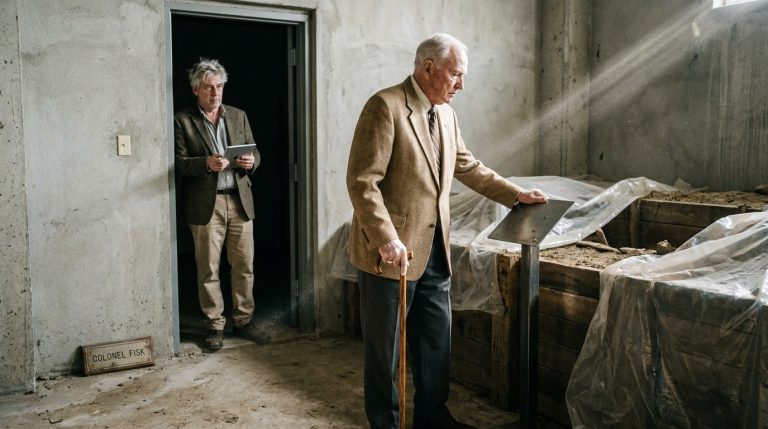
They moved into the interior, the air suddenly cool and smelling of dust and ozone. Walter’s eyes scanned the room. The shelves were packed with grey boxes, labeled in a shorthand that spoke of decades of neglect. He moved to a stack near the center, his fingers brushing the rough, fibrous cardboard.
“You said he was looking for a relay failure,” Walter said, his gaze fixed on the labels. “Aris is a fool. He thinks history is a matter of machinery. He thinks you can calculate the collapse of a line by measuring the voltage in a radio.”
Briggs followed him, his boots silent on the concrete floor. “What do you think he’ll find if he keeps digging?”
“He’ll find a discrepancy that doesn’t exist,” Walter said. He pulled a box from the middle shelf and set it on a workbench. The sound of cardboard sliding against steel rang out like a bell. “He’ll find that we were supplied with relay components that were already failing before we even deployed. But that’s not the secret. The secret is why the command staff didn’t report it.”
He flipped open the lid. Inside were folders, bound with decaying rubber bands. He started pulling them out, his hands moving with a practiced efficiency. He wasn’t looking for a document; he was looking for a specific type of ink—a purple, indelible stamp that indicated a field-level modification.
“Sir,” Briggs said, stepping closer. “If they knew the relay was failing, why send you to hold the line? That’s not just a logistics error. That’s a death sentence.”
“It’s not a sentence until the order is given,” Walter said, his voice hardening. He pulled a file, his breath hitching. There it was—a supply manifest dated November 1950, stamped with the mark of the field-level modification. It was a requisition for salvage parts, signed by a quartermaster who had never set foot outside the wire.
He opened the file. It wasn’t a request for a radio part. It was a request for a structural support bolt, the exact size and gauge of the piece of metal he had carried in his collar for seven decades.
The physical reality of the document hit him harder than the history itself. This wasn’t a log of a failure; it was a log of a sacrifice. The captain hadn’t just given him a piece of scrap. He had given him the physical evidence that the command staff knew the relay would fail because they had already stripped the parts to fortify the rear perimeter, leaving the forward line with nothing but structural bolts and hope.
“Walter?” Briggs whispered, seeing the old man’s face drain of color.
Walter didn’t look up. He stared at the stamp, the purple ink bright and accusing against the yellowed page. He had spent his life thinking the failure was his—that he hadn’t been fast enough, or clever enough, or strong enough. But the truth was far colder, and far more deliberate.
“The radio didn’t fail, Corporal,” Walter said, his voice a ghost of itself. “It was cannibalized. And we were never supposed to come home, because we were the evidence that they’d traded our lines for the safety of the base.”
A flash of lightning illuminated the workspace, casting long, frantic shadows across the shelves. The thunder followed immediately, a concussive blast that rattled the corrugated steel walls. Walter didn’t move. He stood there, the document held in his trembling hands, the weight of a lifetime of guilt suddenly shifting into something much more dangerous: a reason to finish the war he had been fighting in his head since the winter of ’50.
“We need to get this to the General,” Briggs said, reaching for the file.
“No,” Walter said, pulling the document away. “If we give it to him, it goes into the machine. It gets filed, it gets redacted, it gets forgotten. We need a different audience.”
He looked at the boy—really looked at him—and saw the reflection of his own young, angry self. “Do you still have your phone, Corporal?”
Briggs blinked, confused. “Yes, sir.”
“Good,” Walter said, a grim smile touching his lips. “Because we’re not going to be the ones who publish this. We’re going to make sure that Dr. Aris finds it, and that he has a direct line to the people who are currently waiting for the official ‘heritage’ report.”
He started stuffing the documents into the folder Elena had left him. The rustle of paper filled the room, a sound like dry leaves caught in a gale. The truth was out of the box, and for the first time, Walter didn’t feel the weight of the past. He felt the cold, hard focus of a man who finally knew exactly where the line was drawn.
CHAPTER 6: THE UNSCHEDULED VISIT
The storm had arrived with a vengeance. The North Carolina humidity had broken into a violent, driving deluge that turned the motorpool into a grey, churning landscape of mud and rushing water. The metal roof of the maintenance facility drummed with a deafening, irregular cadence, vibrating against the corrugated steel walls until the entire structure seemed to shiver. Walter stepped out of the heavy bay door, his cane sinking into the soft, water-logged earth. The cold rain felt like needles against his skin, a sharp, biting reminder of the Reservoir.
Corporal Briggs followed, his expression guarded. The boy was looking at the folder tucked under Walter’s jacket, his eyes darting toward the distant lights of the command headquarters. The vehicles there were illuminated by the occasional strobing of lightning, their black paint slicked with rain and mud.
“They’re starting the main program,” Briggs shouted over the roar of the downpour. “I can see the General’s detail moving toward the tents. If we’re going to move, we have to do it now, before they lock down the perimeter for the official address.”
Walter didn’t answer. He was listening. Beneath the chaotic noise of the rain and the wind, he could hear the high-pitched, rhythmic whine of static. It was an auditory phantom, a lingering resonance from the relay failure he had been carrying for seventy years. It pulsed in time with his heartbeat, rising and falling in a cruel mockery of a signal.
He moved toward the perimeter fence, the metal mesh slick with water. He was aiming for the press observation area, a cordoned-off section where Aris and his team had been seen setting up their cameras earlier that afternoon. If he couldn’t reach the General directly, he would make the truth impossible to ignore.
“You stay behind,” Walter said, not turning around.
“Sir, I’m the one who knows the guard rotations,” Briggs protested, catching up to him. “If I don’t help you, you won’t even get past the first checkpoint.”
Walter stopped. He turned to face the boy. The rain had plastered the hair to Briggs’s forehead, making him look less like a soldier and more like a frightened recruit. “I’m not asking for help, Corporal. I’m giving you a warning. Once I walk through that gate, you don’t know me. You haven’t seen me. You never heard a word about a relay, or a bolt, or a captain who died for a command decision.”
Briggs hesitated, the rain streaming down his face. He looked at the folder, then at the distant, glowing tents of the heritage event. “They’re going to burn you, Walter. You know that, right? They’ll strip you of the honored guest status, they’ll scrub the records, and they’ll call you a confused old man.”
“Let them,” Walter said. “A monument is static. A witness is a fire. If they want to burn, let them try to contain the smoke.”
He turned back to the fence. He found the section where the temporary barrier was weakest, where the wind had loosened the stakes. He pushed against it, the metal resisting, the wet earth beneath his boots sliding. The strain was immediate—his shoulder flared with a sharp, dull ache—but he drove through it, using the cane as a lever.
They slipped through the gap, onto the restricted grounds of the parade field. The wind was stronger here, unobstructed and cold, smelling of ozone and wet grass. They sprinted, a bizarre, disjointed run—the old man with his cane, the young Marine with his head down—toward the back flap of the heritage tent.
The tent was already humming with the sound of a microphone test. The General was inside. Walter could see the shadow of a silhouette through the thick, wet canvas.
They reached the rear of the tent, and Walter ducked into the lee of a supply pallet, gasping for breath. The static in his ears reached a crescendo—a wall of white noise that nearly brought him to his knees. He grabbed the fabric of his jacket, his hand clutching the pin. It was hot now, burning his palm, a searing contact that seemed to sync with the thunder overhead.
“They’re starting,” Briggs whispered, his voice frantic. “General Alden is at the podium.”
Walter looked up at the canvas. He could hear the General’s voice—smooth, controlled, practiced. “We honor those who held the line…”
Walter didn’t wait for the rest. He pulled the folder from his jacket. His hands were wet, the paper already beginning to curl at the edges, but the stamp—that indelible purple mark—remained clear. He looked at Briggs. “The historian. Where is he?”
Briggs pointed to a side entrance, where Dr. Aris was standing, checking his recording equipment, clearly waiting for his moment to present his “findings.”
“Go,” Walter said, thrusting the folder into Briggs’s hands. “Tell him you found these in the annex. Don’t tell him where. Don’t tell him how. Just tell him if he wants the truth about the logistics failure, he needs to ask the General about the structural bolt.”
Briggs grabbed the folder, his eyes wide. “What are you going to do?”
“I’m going to provide the distraction,” Walter said. He stepped out from behind the supply pallet and began to walk toward the main tent opening, his posture straight, his cane tapping a rhythmic, defiant beat against the wet earth. He didn’t care about the rain. He didn’t care about the General. He was finally going to finish the transmission.