The Weight of Silence: An Old Soldier’s Final Bridge Between the Frozen Past and Living Hope
CHAPTER 1: The Tuesday Notice
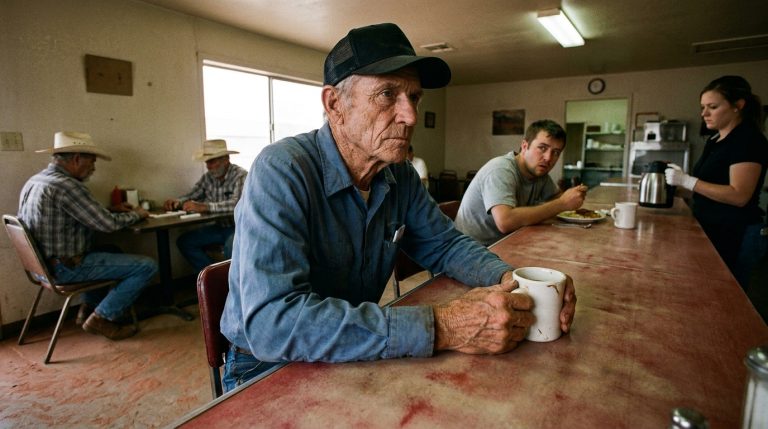
The morning coffee at the Brockton diner tasted like burnt beans and comfort, exactly the same as it had for the last decade. Walter sat in his corner booth, the sunlight filtering through the window in a hazy, amber shaft that caught the dust motes dancing over his white toast. He held his orange juice glass last, the condensation cool against his knobby knuckles, a habit inherited from a woman who had been gone for longer than the war had lasted.
He reached into his tan windbreaker pocket and pulled out the envelope. It was thick, professional, and bore the seal of the New England Military Heritage Center. Fisk had been sending him updates since he started the speaking program, usually filled with scheduling logistics or student feedback forms. This was different.
He slid the letter out. Modernization Initiative.
Walter’s eyes skipped over the corporate phrasing, the talk of “immersive digital engagement,” and the promise of “accessibility for a new generation.” His thumb, curled inward by habit, rubbed against the edge of the paper. It was a rhythmic, scratching sound. He didn’t need to read the fine print to understand the geometry of the situation. They were removing the BAR from the mount. They were removing the weight.
He looked up at the diner wall, where a faded photograph of a local veteran hung—a man he barely knew, now a ghost in a frame. The room felt suddenly too large, the air too thin. He wasn’t thinking about the museum. He was thinking about the freezing silence of the Chosin road, and the terrifying, precious sensation of his hands on the grip of the Browning, the only thing keeping him tethered to the earth when the world was trying to blow it out from under him.
If they took the metal, they took the anchor.
Walter finished his coffee in one long, deliberate swallow. He felt a sharp, familiar jab in his left hip—the traitor, as he called it—and he reached for his cane. He stood up, his movements slow, practiced, the motion of a man who managed his own decay with the precision of a watchmaker.
He didn’t leave a tip, not because he was cheap, but because he’d already left it on the table under the saucer. He stepped out into the crisp October air. The walk to the car was twelve paces. He counted them, as he always did, the rhythm of his cane tapping a steady, syncopated beat against the cracked sidewalk.
As he reached his Toyota Camry, he noticed something missing. The local newsstand on the corner, where the morning paper usually sat folded under a brick, was empty. Just a blank concrete slab. A small detail, but it threw the symmetry of his morning off. The street felt wider, emptier.
He gripped the steering wheel, his fingers settling into their familiar, driving-position curve. He didn’t head toward his house to finish his chores. He turned the key, the engine idling with a hum that sounded suspiciously like a whisper. He wasn’t ready to be alone with his thoughts today.
He drove toward Providence. The road ahead looked the same as always, but for the first time in sixty-eight years, Walter wondered if the history he carried was about to become a ghost, and if he was the only one left who could see it.
CHAPTER 2: The AmberLit Threshold
The engine cut out, and with it, the artificial warmth of the car’s interior vanished, replaced instantly by the crisp, biting October air that flowed in the moment Walter opened the door. He sat for a heartbeat longer than necessary, his feet planted on the pavement. The parking lot was a vast, desaturated canvas of gray asphalt under a pale, washed-out sky. It looked older than it had when he arrived; the lines painted on the ground were fading into a ghostly yellow, mirroring the slow erasure he’d read about in the letter.
Walter reached for the oak cane, the brass ferrule clicking against the asphalt—a sharp, singular sound that seemed to mock the surrounding quiet. He didn’t rush. He climbed out, the movement a calculated negotiation between his hip and the stubborn resolve in his spine. He locked the Camry, the chirp of the alarm feeling out of place, too sharp, too modern.
He didn’t walk toward the main entrance. He went toward the side service door, the one he’d noticed during his earlier visits, used by the staff and the supply trucks. A delivery man was struggling with a stack of cardboard boxes, his face flushed, a cigarette dangling precariously from his lip.
“Help you, sir?” the man grunted, not looking up.
“Just here for the center,” Walter replied, his voice raspy from disuse but steady, holding the authority of a man who didn’t ask for permission, he simply occupied space.
The man shrugged, kicking the doorstop into place. “Exhibits are closed for prep. Moving stuff around for the new tech. You’re early.”
“I’m never early,” Walter said, stepping past him into the muted, climate-controlled hallway of the museum.
The air inside was different—smelling of floor wax, old paper, and the sterile, slightly ozone-heavy scent of modern lighting systems. His cane clicked rhythmically. Step, click. Step, click. It was a metronome counting down his own history. As he navigated the corridor toward the elevator, the quietness of the building felt heavy, almost pressurized, like the silence that precedes a change in barometric pressure before a storm.
He didn’t take the elevator. The sign taped to the door—OUT OF SERVICE: MODERNIZATION IN PROGRESS—made him stop. He stared at the hand-written black marker, the jagged edges of the lettering feeling like a personal affront. He looked at the stairs. His hip sent a white-hot flare of warning up his thigh, a sharp reminder of the cost of movement. He ignored it. He gripped the handrail, the cool steel biting into his palm, and began the ascent.
One step. Then another. He didn’t use the cane for leverage; he used it to pace himself, placing it on the next step with the precision of a surveyor. Each landing was a victory. Each flight was a rehearsal of the endurance he had mastered seventy years ago. By the time he reached the second floor, his breath was coming in shallow, controlled bursts. His face, the texture of a walnut shell, was pale, but his eyes were sharp, focused on the entrance to the Korean War wing.
He didn’t see the curator. He saw the museum’s transition.
The wing, usually bathed in that warm, amber light, was harsh, flooded with industrial white lamps. Plastic sheeting hung from the ceiling, obscuring the trench diorama. And there, at the center, the steel mount stood naked. The BAR was gone.
Walter stopped, his hand tightening on the oak handle. His heart didn’t race; it slowed, dropping into the rhythmic, low-frequency thrum of combat readiness. He felt the phantom weight of the weapon in his hands, the balance point at twenty-two inches, the way the wood would feel against his cheek. It wasn’t just a memory; it was a physical displacement, as if a limb had been amputated.
He walked into the room, his boots making no sound on the plastic-covered floor. He reached the empty mount and placed his palm on the cold, bare steel. It was still warm from the workers’ touch.
“Corporal,” a voice said.
Walter didn’t jump. He turned slowly, the motion fluid, his body shifting the weight onto his good hip. Colonel Fisk stood near the doorway, holding a digital tablet like a shield. He looked tired. The silver hair was slightly disheveled, the sharp posture of a retired officer softened by the slump of a man burdened by administrative failure.
“You’re not supposed to be here today, Walter,” Fisk said softly.
“The letter said the end of the week,” Walter replied, his gaze flickering back to the empty mount. “It didn’t say the beginning of the week.”
“The contractors were ahead of schedule.” Fisk stepped into the room, his shoes crunching on the plastic. “They wanted to get the digital projectors in before the weekend. I… I couldn’t stop them.”
Walter looked at the curator. He didn’t see an officer; he saw a man trying to explain a retreat. “You gave up the ground,” Walter said.
“I’m keeping the museum open,” Fisk countered, his voice rising a fraction. “I’m keeping it funded. If I don’t adapt, the whole floor closes. The whole history goes into storage.”
Walter looked at the space where the BAR had been. He could still see the boy in the basketball jersey holding it—the 12 seconds of struggle, the 30 seconds of Walter’s own stillness, the shared, silent acknowledgement of the weight. That wasn’t just metal. That was a connection.
“You’re not saving history, Colonel,” Walter said, his voice dropping into the register of a man who had seen things broken beyond repair. “You’re just changing the lighting. You think this,” he gestured to the room, “is what they need to see? A screen? A loop of video?”
Fisk stepped closer, his expression earnest. “It’s what the board wants. They want engagement.”
“They don’t want engagement,” Walter said, his knuckles white against the oak of his cane. “They want the story without the work. But the weight is the point.”
He turned away from the mount, moving toward the hallway. He felt his age now, the adrenaline of the stairs fading into the deep, grinding ache of bone-on-bone friction. He had come here to protect a memory, but the memory had been pulled from the cradle before he could even defend it. He walked to the threshold, pausing only when Fisk called out.
“Walter, wait. We have the artifact in the back. It’s safe. It’s just… it’s being cataloged for the digital transition.”
Walter didn’t look back. He started the long, slow descent back toward the ground floor. Every step was a negotiation with gravity, every landing a reminder of the distance he had to travel. He didn’t know yet how he would fix this. But as he reached the lobby, he saw the student from the previous month—the girl, Maya, sitting on a bench with a notebook, sketching the entrance. She looked up, and her face lit up with the kind of hope that only exists in someone who hasn’t yet learned how heavy the world truly is.
He wouldn’t let her down. He wouldn’t let the weight vanish.
CHAPTER 3: The Weight of the Curators Desk
The lobby was a cavern of echoes. Walter stood at the base of the grand staircase, his breathing measured, his internal rhythm recalibrated. The disappointment of the empty mount upstairs had shifted into something colder, more tactical. He had spent his life responding to threats by assessing terrain and leverage. The museum was no longer a sanctuary; it was a front line.
He didn’t head for the exit. He turned back toward the administrative wing, the corridor that housed the archives and the curator’s office. He walked with a deliberate, low-impact stride, his cane tapping out a signal that didn’t belong in these halls. He passed the closed elevator and reached the heavy oak door labeled COL. RAYMOND FISK, CURATOR.
He knocked. Not a polite, visitor’s rap, but the firm, rhythmic strike of a man who expected his presence to be accounted for.
“Enter,” Fisk’s voice called from within, sounding thin and preoccupied.
Walter pushed the door open. The office was a paradox—a mixture of high-tech monitors and relic-filled cabinets. Fisk was hunched over his desk, surrounded by schematics that glowed blue in the low light of the room. He didn’t look up immediately.
“I told you, Walter, I’m tied up with the contractors—”
“You’re dismantling the spine of the wing, Colonel,” Walter interrupted, his voice low but carrying the resonance of a command.
Fisk finally looked up. The fatigue in his face was etched deep, the lines around his eyes holding a history of their own. He looked at Walter, then at the cane, then back to the older man’s eyes. “It’s not dismantling. It’s upgrading. We’re losing visitors, Walter. The engagement metrics are abysmal. If I don’t give them something dynamic, the state pulls the funding.”
Walter didn’t sit. He remained standing, his posture a tripod of bone and history. “Engagement isn’t found in a headset. It’s found in the struggle. You take the struggle away, you take the meaning away.”
Fisk stood up, his movements stiff. He walked around the desk, his hands open in a gesture of helplessness. “I served too. You know I respect what you did. But you’re talking about a world that doesn’t exist anymore. These kids, they don’t have the context. They need to be guided.”
Walter moved to the desk, his hand reaching out to touch a stack of folders. One of them, slightly offset, caught his eye. It was labeled PHASE 1: ARTIFACT RETIREMENT. He didn’t open it; he simply tapped the cover with his brass ferrule.
“Guidance isn’t replacement,” Walter said. “You think you’re helping them understand. You’re just shielding them from the physical truth.”
As he leaned in, his gaze shifted from the folders to a framed photograph on the corner of the desk—Fisk in uniform, back in Iraq, standing before a destroyed structure. Beside it was a smaller, older frame. Walter felt a sudden, sharp hitch in his chest. It was a photo of the Chosin Reservoir—the very road he had walked, the very frozen hellscape he had spent seven decades burying.
Fisk noticed the shift in Walter’s focus. “My father was in the 31st, too. Different company. He didn’t come back.”
The room went silent. The hum of the computer monitors seemed to grow louder, an insistent, electric drone. Walter looked at the curator, seeing him not as an antagonist, but as a mirror. The guilt in the room was thick, layered like dust on an uncleaned mantle. Walter’s hands curled—that familiar, involuntary grip.
“Then you know,” Walter whispered, his voice cracking just enough to be audible. “You know it’s not about the artifact. It’s about the fact that it’s the only thing left that still holds the shape of the men who carried it.”
Fisk looked at the Chosin photo, then at Walter. The tension between them, the “weaponized silence,” felt like an physical weight. Fisk finally moved toward a cabinet, unlocking it with a key on a lanyard around his neck. He pulled out a box—a small, nondescript crate marked for Off-Site Storage.
“They wanted the BAR gone by noon,” Fisk said, his voice barely a murmur. “The digital team is going to use the space for the projection rig. I have to move it to the warehouse.”
Walter watched as Fisk opened the crate. The Browning was there, lying on soft packing foam, its steel cold and indifferent. It looked smaller in the box, stripped of its context, a piece of deactivated machinery.
“I can’t let you keep it out, Walter. I’d lose my position.”
“I’m not asking you to keep it out,” Walter said, his eyes fixed on the weapon. “I’m asking you to let me finish the session with the students.”
“There’s no mount left.”
“I don’t need a mount,” Walter said. He reached down, and for the first time since he’d arrived, he felt the cool, rough texture of the Browning’s forearm. He didn’t lift it yet. He just touched it, a grounding, tactile connection that bridged the distance between the curator’s office and the frozen ridges of Korea.
Fisk hesitated. He looked at the door, then back at Walter. The “Sovereign Protector” instinct in him, the officer’s duty to his own, clashed with his administrative role. He saw the tremor in Walter’s chin—not from weakness, but from the sheer force of his resolve.
“One hour,” Fisk said. “I’ll tell them it’s a ‘private conservation study.’ After that, it goes to storage.”
Walter nodded once. He reached into the box and took the weight. His hand wrapped around the balance point—twenty-two inches from the butt plate. He held it for a heartbeat, his spine aligning, his hip settling, the geometry of the platform returning to him with the familiar, aching clarity of home.
He didn’t just hold the weapon; he possessed it. And in that moment, the museum’s plans, the digital projectors, the metrics—they all felt like shadows. The only thing that was real was the weight in his hands, and the name he had never spoken, now caught in his throat like a shard of ice.
He turned toward the door, leaving Fisk alone in the blue glow of the monitors. He had his hour. And in that hour, he would show the girl, Maya, that some things cannot be digitized.
CHAPTER 4: The Shadow of the Reservoir
Walter moved down the hallway, the Browning balanced against his hip. He didn’t carry it like a soldier on patrol; he carried it like a part of his own anatomy, the weight distributed through his shoulder and spine with the subconscious ease of long-dormant reflex. Every step felt heavier, not because of the steel, but because of the geography his mind was beginning to traverse. The museum’s hallways, with their pristine linoleum and soft, amber-tinted lights, were beginning to blur at the edges, dissolving into the jagged, snow-swept ridgelines of the Chosin Reservoir.
He reached the Korean War Wing. It was still empty, the industrial white lighting buzzing with a sterile, insect-like persistence. He walked to the center of the room, to the spot where the mount had stood for years. He placed the Browning on the floor, the metal clinking softly against the concrete—a sound that, for a split second, echoed like a rifle bolt sliding home in the freezing dark.
Maya, the student, was still in the wing, standing by the now-taped-off diorama. She looked up, her eyes widening as she saw him—and then, more importantly, saw the weapon on the floor. She didn’t ask how he had it. She simply stared, her breath hitching in the sudden, sharp silence of the room.
“You said it was a conservation study,” she whispered, stepping toward him.
“I said what needed to be said,” Walter replied. He didn’t look at her. He was staring at the wall where the diorama had been. The plastic sheeting billowed in the draft from the HVAC system, creating a shifting, ghostly curtain. In the movement of the plastic, he saw the flickering shadow of men in parkas, their faces obscured by the gray haze of a blizzard that had never truly stopped blowing in his memory.
He felt the cold. It wasn’t the air conditioning. It was a deep, bone-marrow chill, the kind that came when the temperature plummeted to forty below and the only thing keeping the blood moving was the rhythmic necessity of keeping the fire going. He saw the face of Private Miller—not the name, not yet—but the face. The way Miller had looked at him just before the mortar strike, a look of profound, quiet resignation.
“Mr. Kazlauskas? Are you okay?” Maya’s voice was distant, coming from the other side of a frozen expanse.
Walter’s fingers tightened on the Browning’s grip. He felt the checkering of the wood, the wear-and-tear of decades. He forced himself to look at Maya, to bring the museum back into focus. The amber light, the plastic, the girl. He needed to anchor himself. If he let the Reservoir take him, he wouldn’t be able to finish the hour. He wouldn’t be able to teach her.
“I am fine,” he said, the words coming out hard and flat. He pointed his cane toward the Browning. “You wanted to know about the weight. You wanted to know why it stays with you.”
“I… I think I do,” she said, her voice small.
Walter sat on the floor, his hip popping with a sharp, audible click that he ignored. He pulled the Browning closer. “It’s not just the object. It’s the silence that comes with it.” He ran his hand over the receiver, his movements precise, almost tender. “When you hold a thing like this, you aren’t just holding steel. You’re holding the people who carried it when you couldn’t. You’re holding the memory of the mistake you made, and the grace of the one who didn’t survive it.”
He didn’t mean to say the last part. It slipped out, a jagged stone from the bottom of a riverbed. He caught himself, his jaw locking. He looked at Maya, who was watching him with a wide, earnest intensity that demanded a honesty he hadn’t prepared for.
“Did you… did you have someone?” she asked, gesturing vaguely toward the weapon.
“I had many someones,” Walter deflected, his voice hardening. He looked away, back to the plastic-covered diorama. He remembered the sound of the wind, the way it whistled through the gaps in their thin, inadequate gear. He remembered the feeling of being the only one left to hold the line, the crushing, existential weight of being the survivor. The guilt wasn’t a sharp pain anymore; it was a constant, dull vibration, like a tuning fork that had been struck once and never stopped ringing.
“The museum wants to make this digital,” Maya said, her gaze dropping to the floor. “They say it will be more ‘relatable’ if you can see it on a screen.”
Walter let out a dry, rattling laugh. “Relatable. As if you can relate to the freeze. As if you can relate to the moment your hands go numb and the only thing you have left is the feel of the wood against your palm.” He reached out, his hand hovering over the Browning. “Digital doesn’t have a weight. Digital doesn’t have a memory.”
He looked up at the ceiling, at the track lighting that had replaced the history of the room. He felt a sudden, fierce protectiveness. Not for the weapon, but for the girl. She was the witness. She was the one who would carry the story when he was gone, and if she only knew it through a screen, the history would die with him.
“Maya,” he said, using her name for the first time. “Pick it up.”
She hesitated, then stepped forward. She reached for the weapon, her hands hovering, nervous.
“Don’t fight it,” Walter instructed, his tone shifting into the sharp, transactional cadence of a drill instructor. “Don’t try to muscle it. Build your platform. Feet apart. Hips squared. Let the weight drop into your bones.”
She knelt, her small hands finding the grip. She lifted, her face flushing with the effort. She swayed, her balance wavering as the十九 pounds pulled at her thin frame.
“Square your shoulders,” Walter said, his voice steadying her. “Breathe into it. It’s not just in your arms. It’s in your spine.”
She adjusted, her feet shifting on the plastic, her body locking into a more stable, grounded geometry. She held it for five seconds. Ten. Her arms began to shake, a fine, rhythmic tremor.
“Look at the wall,” Walter commanded. “Don’t look at the gun. Look at the wall.”
She looked. She held it for another five seconds, her breathing shallow, her eyes focused on the far, shadowed corner of the room. She was doing it. She was finding the balance. For a moment, the distance between the eighty-one-year-old man and the thirteen-year-old girl evaporated, replaced by the shared, heavy reality of the steel.
She set it down, exhaling a long, shuddering breath. She looked at Walter, and for the first time, she saw the Reservoir in his eyes. She saw the blizzard, the cold, and the long, terrible road of the survivor.
“I feel it,” she whispered. “The weight. It’s… it’s not just heavy. It’s sad.”
Walter nodded, his chin trembling just enough to be noticeable. “Yes,” he said. “It is.”
CHAPTER 5: The Architect of Memory
Walter remained seated on the concrete floor, the cold seeping through his trousers, but he didn’t care. The presence of the girl, Maya, was a variable he hadn’t accounted for, a soft point in the museum’s armor that he found himself instinctively wanting to protect. She was kneeling now, not touching the rifle, but looking at it with a new kind of distance—not as an object of curiosity, but as a vessel.
“You said it’s sad,” Walter murmured, his gaze tracing the worn finish of the rifle’s stock. “Sadness is a form of weight, too. Most people spend their lives trying to drop it. They think if they set the burden down, they’ll be lighter, faster, better.”
“Isn’t that the point?” Maya asked, her voice hushed. “To not be weighed down?”
Walter leaned forward, his knuckles brushing the cold steel. “If you set it down too fast, you lose the balance. You’ve been holding a thing for seven decades, Maya. It becomes the architecture of your bones. If you take it away, you don’t just feel lighter—you feel lost.”
He watched her, seeing the way she absorbed his words. She wasn’t just a student; she was a witness. He felt a sudden, fleeting phantom sensation—the smell of diesel and frozen pine, the sound of a distant, muffled explosion, and the weight of Miller’s body against his own during the withdrawal. The sensation was so visceral that Walter’s vision blurred. For a heartbeat, the plastic-sheeted museum walls seemed to turn into canvas tents, and the hum of the fluorescent lights morphed into the howling, desolate wind of the Reservoir.
He blinked, forcing the hallucination back into the shadows. Structural, he reminded himself. Triangle. Shoulder, spine, hip.
“They’re coming back,” Walter said, his voice returning to its sharp, clipped standard. “The contractors. The board. They’ll want this cleared out.”
Maya stood up, her movements graceful and unhurried. “Why are you really doing this? It’s not just about the museum.”
Walter looked at her, truly looked at her. He saw the genuine, unvarnished curiosity in her face, and for the first time in years, the wall he had built around his silence felt porous. He didn’t answer with a story. He answered with a movement. He reached into his windbreaker pocket and pulled out a small, tarnished brass casing. He held it out on his palm.
“I found this in my pack, years later,” he said. “It wasn’t even from a BAR. It was just a casing that rolled in. I kept it because it was the only thing from that day that didn’t feel like it was trying to kill me.”
She took it, her fingers delicate as she examined the scratched brass. “It’s so small.”
“It’s the only thing that proves the day happened,” Walter said. “Everything else—the cold, the fear, the men who didn’t come home—they fade into stories. The stories get cleaned up. They get polished. They get put on screens. But this?” He gestured to the casing. “This is the weight. This is the truth.”
He stood up, the effort a silent, grinding struggle he hid behind a mask of practiced indifference. He picked up the Browning. It felt lighter now, as if sharing the story had bled off some of the metaphysical density that had been pinning him to the floor.
“They’re going to put that in a crate,” Maya said, her eyes tracking the rifle. “They’re going to lock it away until the ‘modernization’ is done.”
“Then we make sure it isn’t forgotten while it’s in the dark,” Walter replied. He looked toward the door. He could hear the faint, echoing footsteps of the maintenance crew approaching from the lobby. The time he had been granted by Fisk was coming to a close.
“How?”
Walter didn’t have a plan. He only had his presence, and the knowledge that he was the only one in this building who knew how to hold a line. He walked to the window, the autumn light hitting his face and highlighting the deep, walnut-shell creases of his skin. He looked out at the parking lot, where his Camry sat, a small, reliable island of silver in the gray sea of asphalt.
“We stop being invisible,” Walter said. “You’re a student of history, Maya. You know that history isn’t just what’s written on placards. It’s what stays behind when the writing is erased.”
He stepped out into the hallway, the Browning tucked firmly against his side, his cane rhythmically striking the floor. He didn’t know what he would do when he reached the main lobby, but he knew he wouldn’t go home. Not until the weight was acknowledged. Not until the ghost of the man who died for him had been given his due, even if he had to carve that truth out of the museum’s silence himself.
He stopped, realizing Maya was following him. He turned, his expression unreadable. “This isn’t a classroom anymore.”
“I know,” she said, her chin set in a line of quiet, stubborn resolve that reminded him, painfully, of himself at eighteen.
Walter nodded once. He turned and continued his march toward the lobby, the sound of his cane and the weight of the steel the only two things that mattered.
CHAPTER 6: The Anatomy of a Compromise
The corridor leading to the service entrance was a narrow artery of beige walls and harsh, flickering lighting. Walter walked with his head held high, his cane clicking against the linoleum in a steady, aggressive rhythm. Maya followed close behind, her footsteps softer, more hesitant, but her resolve was clear in the way she kept her eyes fixed on his back.
He stopped at the heavy steel door that separated the public museum from the logistics and storage wing. This was the territory of the unseen—the boxes, the packing foam, the deactivated histories waiting to be processed. He reached for the handle, expecting resistance, but found the door unlocked. Fisk had left the path open, a silent, fragile bridge of complicity that Walter accepted with a curt nod.
Inside, the warehouse was a cavern of shadows and towering metal shelves stacked with crates. It smelled of cardboard, desiccant, and the metallic, slightly dusty scent of long-dormant equipment. The light here was sparse, coming from high, caged bulbs that cast long, distorted shadows across the concrete floor.
“Stay close,” Walter said, his voice dropping into the low, guarded register of a man moving through hostile terrain.
They navigated the aisles, the Browning heavy in his grip. As they pushed deeper into the storage area, the temperature dropped, the air feeling thin and stagnant. Walter scanned the labels on the shelves: 18TH CENTURY TEXTILES, WWII DOCUMENTS, KOREAN WAR – WEAPONS COLLECTIONS.
He stopped in front of a shelf labeled INCOMING – PENDING CATALOG. On the workbench beside it lay a stack of documents—the logistics manifests for the upcoming “digital transition.” Walter leaned his cane against the shelf and set the Browning down on a folded shipping blanket. He didn’t want to read the papers; he wanted to understand the mechanism.
He flipped through the top manifest, his eyes scanning the technical specs for the digital projectors. Beneath the technical data, he found something else: a handwritten note in the margin, scrawled in Fisk’s precise, military handwriting. “Need to ensure the tactile artifacts are shielded during the transition—the donor families wouldn’t accept total removal.”
Walter’s fingers tightened on the edge of the paper. Fisk hadn’t been planning on destroying the history; he had been trying to hide it, to tuck it away where the board wouldn’t notice, maintaining a secret sanctuary for the artifacts that mattered.
“He’s protecting it,” Maya whispered, reading over his shoulder.
“He’s hiding it,” Walter corrected, his voice tight. “There’s a difference. Protection is a stand. Hiding is a retreat.”
He looked around the warehouse, the crates stacking up like monuments to an era that was being systematically erased. He felt the weight of his own silence, the seventy years of keeping his history tucked away in the “storage” of his own mind. He realized then that he and Fisk were two sides of the same coin—both of them trying to survive in a world that didn’t have room for the old ways, both of them burdened by the ghosts they couldn’t afford to lose.
A sound echoed from the front of the warehouse—a heavy clatter of metal, followed by the muffled voices of the contractors. They were earlier than expected.
“They’re here,” Maya said, her voice rising in panic.
Walter didn’t move. He picked up the Browning, the weight of the rifle grounding him in the immediate, physical reality of the moment. He saw the layout of the warehouse—the narrow aisles, the stacks of equipment, the way the light fell across the workbench. He saw a defensive position, a way to hold the space.
“Do you trust me?” he asked, looking at Maya.
“What are you doing?”
“I’m going to finish the session,” Walter said. He looked toward the front of the warehouse, where the silhouettes of the crew were beginning to emerge against the light. “If they want this history to disappear, they’re going to have to walk through me to do it.”
He didn’t mean it as a threat. He meant it as a statement of fact. He moved to the center of the main aisle, setting his cane aside. He stood in the middle of the workspace, the Browning held at a low ready, his posture shifting into the same, rigid geometry he had used on the ridgeline in 1951. He wasn’t a veteran visiting a museum; he was a sentry.
The contractors, two men in high-visibility vests, rounded the corner. They stopped dead, their expressions shifting from annoyance to confusion as they saw the old man standing in the aisle with an automatic rifle.
“Hey, pops! What the hell are you doing with that?” one of the men shouted, stepping forward.
Walter didn’t blink. He felt the phantom cold of the Reservoir, the biting wind, the sound of the enemy closing in—but he also felt the weight of the girl behind him, the witness who needed to see that the line still held.
“This isn’t a museum piece,” Walter said, his voice cutting through the noise like a blade. “It’s a responsibility. And until you understand what it weighs, you don’t touch it.”
He held his ground, the Browning steady in his grip, the silence of the warehouse stretching between them like a taut, invisible wire. The contractors hesitated, the sheer, undeniable gravity of his posture making them stop and reconsider. For a few seconds, the warehouse was a front line, and Walter Kazlauscas was the only thing keeping the past from being packed into a crate.
CHAPTER 7: The Fragile Architecture of Defiance
The guard’s name tag read TYLER. He was perhaps twenty-two, his uniform crisp, his eyes bright with the misguided certainty that his presence and his radio were enough to command any space. He stopped five feet from Walter, his posture a mirror of the contractors’ confusion, yet flavored with the nervous aggression of someone who had never had to consider the reality of what they were guarding.
“Sir,” Tyler began, his voice tight, “you need to set the weapon down. Now. This is restricted property, and you’re making people uncomfortable.”
Walter didn’t shift his weight. The Browning remained at a low, controlled ready, the steel radiating a coldness that seemed to bleed out into the stagnant warehouse air. He wasn’t looking at the guard; he was looking at the way the light caught the dust motes dancing between them—dust that felt, for a fleeting, terrifying moment, like the fine, powdered snow of the Reservoir.
“I’m not making you uncomfortable, son,” Walter said, his voice flat, devoid of heat. “The history you’re trying to pack into crates is what makes you uncomfortable. You’re afraid of it because you haven’t earned the right to carry it.”
“I don’t know what you’re talking about,” Tyler stammered, his hand finally reaching for the radio on his shoulder. “I’m calling the supervisor.”
“Wait!” Maya’s voice sliced through the tension. She stepped out from behind the stack of crates, her face pale, her hands open. She walked directly into the space between Walter and the guard, a reckless, human intervention that made Walter’s heart stutter.
“Tyler, stop,” she said, looking at the guard. “He’s not a threat. He’s a veteran. He’s just… he’s trying to hold onto something that’s about to be erased.”
The guard looked at Maya, then at Walter, then at the Browning. The weapon was the variable they couldn’t process—it was a machine of war in a room meant for logistics, an anachronism that defied the logic of their corporate environment.
“He’s got a rifle, Maya!” Tyler hissed. “Deactivated or not, he’s trespassing and brandishing.”
Walter felt the structure of his stance beginning to fray. His hip, the traitor that had been quiet for the last hour, flared with a white-hot reminder of his age. He forced his weight onto his good leg, the movement subtle, hidden behind the steady positioning of his feet. He could feel the exhaustion creeping into his shoulders—not the fatigue of the war, but the deeper, more insidious weariness of a body that had been holding its breath for seven decades.
“I’m not trespassing,” Walter said, his voice straining against the grit in his throat. “I’m protecting.”
From the front of the aisle, a new voice arrived—sharp, authoritative, and deeply concerned. Colonel Fisk had come down from his office, his face a map of conflicting loyalties. He stopped twenty feet away, his hands raised in a gesture that was meant to calm, but his eyes were darting from the contractors to the guard to Walter.
“Walter,” Fisk said, his tone measured. “This isn’t how we do this. I gave you the time. You said you’d respect the arrangement.”
“The arrangement is a lie, Colonel,” Walter replied, not turning his head. “You aren’t protecting the history. You’re just waiting for the dust to settle before you put it in the ground.”
Fisk stepped forward, ignoring the guard’s caution. He stood close enough to see the sweat beads on Walter’s forehead, the fine, involuntary tremor in the old man’s hands—the only sign that the weight was finally beginning to exact its price.
“I have my orders, Corporal,” Fisk said softly, using the rank as a plea. “The board is coming for an inspection in twenty minutes. If you’re here like this, it’s not just the display that’s going to be removed. It’s your access. It’s your connection to the museum. You’ll never be allowed back in this wing.”
The words hit Walter like a physical blow. He looked at Maya, who was watching him with wide, terrified eyes. He looked at the Browning, the steel that had defined his youth, the companion that had been his silent weight for so long. He realized then that he was fighting a war he had already lost—a war against time, against relevance, against the slow, inevitable grinding of a world that didn’t have space for the old truth.
The failure was not in his stance. The failure was in the fact that he was the only one who remembered.
He felt the structure buckle. His hand on the Browning’s grip loosened. The weight—the nineteen pounds of steel and walnut—suddenly felt like a mountain, a mountain he no longer had the strength to hold up. He didn’t drop it; he surrendered it, slowly, carefully, resting it back onto the folded blanket on the bench.
The silence that followed was heavy, stifling, a vacuum of sound where the only thing he could hear was his own ragged breathing. He reached for his cane, his hand trembling as he leaned on it, the wooden oak feeling brittle, like it might snap under the sheer pressure of his disappointment.
He didn’t look at Fisk. He didn’t look at the guard. He looked at Maya.
“You see?” he said, his voice barely a whisper. “The weight doesn’t vanish. It just gets harder to carry.”
He turned away, his gait uneven, his shoulder slumped. The defiance was gone, replaced by a profound, hollow weariness that made him look every one of his eighty-one years. He walked toward the exit, past the men who were now rushing forward to secure the rifle, past the guard who was already reporting a ‘success.’
He wasn’t walking home. He was walking out of the museum, and as he reached the service door, he knew that the bridge he had tried to build was gone. He felt the phantom cold of the Reservoir rushing into the space where the Browning had been, a draft that promised to never stop blowing.
CHAPTER 8: The Public Defense of the Forgotten
Walter stood beneath the overhang of the service entrance, the rain lashing against the concrete in sheets of gray, translucent static. It was a cold, driving rain, the kind that turned the world into a blur of muted colors and slick surfaces. It reminded him, with a sudden, aching clarity, of the nights spent huddled in the trenches, waiting for the dawn that often didn’t bring warmth.
He gripped the oak handle of his cane until his knuckles turned white. He was defeated. The Browning was in a crate, the museum’s “modernization” was proceeding, and he had been effectively barred from the wing he had considered his final post. His hip throbbed—a deep, persistent ache that echoed the systemic fatigue settling into his bones.
“Mr. Kazlauskas?”
Maya emerged from the service door, wrapping a thin cardigan tightly around her shoulders. She looked out at the rain, then at Walter, her expression a mix of concern and burgeoning determination.
“I heard them talking,” she said, her voice barely audible over the drumming of the rain. “The contractors. They’re planning to ship the weapons to the regional storage facility in the next two hours. They aren’t just putting them away; they’re clearing the space for the digital rigs by nightfall.”
Walter didn’t turn. He watched the water pool in the uneven pavement of the parking lot. “It’s over, Maya. They have the authority. They have the logistics. They have the support of the board.”
“They don’t have the truth,” she replied, stepping closer. “And they don’t have the witness.”
She pulled her phone from her pocket, her thumb hovering over the screen. “I’ve been recording. Not just today. I’ve been recording the sessions—the way you talk about the weight, the way you hold the line. I have audio, I have footage of the school groups. If the museum won’t honor the history, maybe the public will.”
Walter looked at her, truly seeing the fire in her eyes. It was a dangerous impulse—the need to broadcast, to expose, to fight back in the theater of public opinion. He had spent his life avoiding exactly this kind of attention, protecting his silence as if it were a tactical position.
“You don’t know what you’re inviting,” Walter said, his voice gravelly. “Once you put that kind of weight into the world, you can’t put it back. People will ask questions you aren’t prepared to answer.”
“I’m prepared to ask the ones they aren’t,” she countered.
He leaned against the doorframe, his gaze drifting back to the parking lot. He thought of the Browning in its crate, and he thought of Private Miller—the soldier whose life had been snuffed out on the frozen road, whose story had been folded away like a discarded uniform. Miller had no one to record him. He had no one to witness his weight. He had simply been erased by the momentum of the retreat.
If Miller’s story was going to be forgotten, then his own silence was not a badge of honor—it was an accomplice.
“Fisk is a good man, in a bad position,” Walter said, his voice softening. “If you go public, you’ll burn him, too. He’s the only one who even tried to keep the artifacts out of storage.”
“Then he shouldn’t have been hiding them,” Maya said, her voice cold. “If they’re worth keeping, they’re worth fighting for.”
The storm intensified, the wind whipping the rain into a frenzy that obscured the edges of the parking lot. A delivery truck pulled into the loading dock, its headlights cutting through the gray like twin lances. It was the logistics crew. They were here for the crates.
Walter felt a surge of something he hadn’t felt since the war—not fear, not hope, but a hard, crystallized clarity. He had spent seventy years walking the gauntlet of his own memories, and he realized he was tired of being the only one walking it.
“Give me the phone,” Walter said.
Maya froze, her eyes widening. “What?”
“If you’re going to do this,” Walter said, his voice steadying into the rhythm of a command, “you do it right. You don’t just dump the files. You curate the weight. You explain the geometry. You make them understand why it matters.”
He held out his hand. He didn’t know what he was doing, or where it would end, but as his fingers closed around the plastic frame of the phone, he felt the first shift in the internal architecture of his life. The silence he had maintained for seven decades was no longer a shield; it was a resource.
“We don’t need a riot,” Walter said, turning to look at the delivery truck as it backed up to the bay. “We need a realization. We’re going to show them exactly what they’re throwing away.”
He stepped out from under the overhang, the rain hitting his shoulders with a rhythmic, percussive force. He was no longer waiting for the museum’s permission. He was no longer acting as a guest. He was a veteran of the 31st Infantry, and for the first time in a very long time, he was moving forward without checking to see who was watching. He walked toward the truck, the cane tapping a new, urgent rhythm against the wet asphalt. The weight was changing, and for the first time, he was the one shifting the balance.
CHAPTER 9: The Weight Transferred
The driver, a burly man in a rain-slicked jacket, stared down from the high cab of the truck. He looked at the old man blocking the bay, then at the small, earnest-looking girl with a smartphone held out like a digital shield. He leaned out of the window, his voice barely audible over the roar of the downpour.
“Get out of the way, pops! I’ve got a schedule to keep. This isn’t a parking spot.”
Walter didn’t move. He stood perfectly still, his weight distributed across his tripod—shoulders, spine, hip. He didn’t look like a trespasser; he looked like a monument. “The crates inside,” Walter said, his voice carrying with a resonant, unnatural clarity. “They contain more than inventory. They contain the last physical evidence of a company that doesn’t exist anymore. You move them, you erase the men who didn’t come home.”
The driver scoffed, reaching for the door handle. “I don’t know what you’re babbling about. I’m just here to clear the floor.”
“Maya,” Walter said, not turning his head. “Start the feed.”
The girl held the phone higher. The blue light from the screen illuminated her face, transforming her expression into something hard, determined. “This is live, Mr. Miller. We’re at the New England Military Heritage Center. I’m broadcasting the removal of the Korean War collection. We’re here with Corporal Walter Kazlauscas, one of the few survivors of the 31st Infantry Regiment. Tell them what’s in those crates.”
The driver paused, his hand frozen on the door latch. The word ‘live’ acted as a sudden, sharp puncture in the mundane reality of the parking lot. He looked at the camera, then back at Walter, his bravado wavering as he realized the optics of the situation.
“I’m just doing my job,” the driver muttered, but his voice was thinner, devoid of the earlier certainty.
“I know,” Walter said, stepping closer to the bumper. “I’ve spent my life doing jobs that didn’t feel right. But this—this is different. You aren’t just moving steel. You’re moving the only thing that remembers.”
The warehouse door behind them creaked open. Colonel Fisk stepped out, his uniform jacket soaked through, his face pale in the driving rain. He looked at the phone, then at the truck, then at Walter. There was no anger in his eyes, only a profound, exhausted resignation.
“Walter,” Fisk said. “You’re going to destroy your reputation. You’re going to force my hand.”
“Your hand has been forced for a long time, Colonel,” Walter replied. He reached into his pocket and pulled out the small, brass casing. He held it up, the tarnished metal catching the cold, gray light of the storm. “I’ve spent sixty-eight years keeping the secret of who really died in the Reservoir. I kept it because I was afraid of the weight. I was afraid that if I spoke the name, the guilt would finally break the platform.”
The rain seemed to stop, or perhaps it was just that Walter had ceased to notice it. The silence in his chest, the one he had protected with such disciplined ferocity, finally cracked.
“It was Miller,” Walter said, the name sounding like a gunshot in the wet air. “Private Miller. He gave me his magazine when I ran dry. He took the fire so I could move. I held the line because he couldn’t, and every day since, I’ve felt the weight of his name in my throat.”
He looked at Fisk, then at the camera, his gaze piercing, unblinking. “The weight isn’t the rifle. The weight is the story we refuse to tell. You want to modernize? You want to be relevant? Then tell the story of the man who died so that I could stand here today.”
Fisk stood motionless, the rain running down his face like tears. The driver, the guard, the contractors—they all went quiet, the roar of the storm muted by the sheer gravity of the moment. The truth, long buried in the silence of the museum’s storage, was finally being spoken.
Walter felt a strange, profound lightness. The physical pain in his hip, the grinding ache in his spine—it was still there, but it no longer felt like a prison. It felt like history. He turned to Maya, who was still recording, her eyes glistening.
“Keep the camera on the crates,” Walter said, his voice steady, the rhythm of his life finally finding its cadence. “We’re not finished yet.”
He moved to the side of the truck, his cane finding purchase on the slick asphalt. He didn’t look back at the museum. He didn’t look at the Colonel. He walked toward the back of the bay, where the crate containing the Browning waited. He was going to open it, and he was going to show them exactly what the weight meant, and for the first time in sixty-eight years, he wouldn’t be doing it alone.
CHAPTER 10: The Clearing
The crate gave way with a splintering crack that sounded like a dry bone breaking. Walter didn’t look at the contractors, the guard, or the camera. He looked only at the rifle. Stripped of the museum mount, lying in the dim, warehouse light, it seemed smaller, stripped of its mythic proportions. It was just a machine, nineteen pounds of cold steel and checkered walnut, yet to Walter, it was the entire landscape of his past.
“This is it,” Walter said, his voice carrying clearly to the gathered onlookers and the open lens of the phone. “This is the nineteen pounds that defined the life of a boy who didn’t even have a beard yet. When Miller gave me this, he wasn’t just giving me a weapon. He was giving me his tomorrow.”
He lifted the Browning. He didn’t shoulder it; he simply held it in his right hand, the weight pulling at his shoulder, his spine, the structure of his entire body. He looked at Fisk, who had moved closer, his face no longer guarded, but raw with the weight of the confession he had just witnessed.
“You wanted to modernize the wing,” Walter said, addressing the room, his voice gaining strength. “You wanted to make it accessible. But you cannot make a tragedy ‘accessible’ if you strip away the weight of the people it actually cost. Miller died in the snow so that I could walk out. I have been walking out for sixty-eight years. Every step I took, I took for him.”
He reached out and placed the Browning in Fisk’s hands.
The Curator startled, his arms instinctively snapping up to catch the sudden, dead weight of the weapon. Fisk staggered backward a step, his breath catching as the sheer, undeniable heaviness of the BAR settled into his own grip. He looked at the rifle, then at Walter, the physical reality of the service—the burden he had only ever read about in dissertations—finally sinking into his own muscle and bone.
“It’s heavy,” Fisk whispered, his eyes wide.
“It is,” Walter agreed. “That’s the point. It’s supposed to be heavy. You don’t get to lighten the load for the audience just to make them feel better about the history.”
The contractors stood back, their hostility replaced by a hushed, tentative respect. The guard, Tyler, lowered his hand from his radio, his gaze fixed on the rifle Fisk was struggling to stabilize. The silence in the warehouse wasn’t heavy anymore; it was clear, a space where the truth had been spoken and, for the first time, shared.
Fisk eventually set the weapon back down on the crate. He looked at Walter, then at Maya, who was still holding the phone, her hands trembling.
“I’ll cancel the shipment,” Fisk said, his voice firm, shedding the indecision that had plagued him for months. “We’ll restore the mount. And we’ll rewrite the placards. We’ll tell Miller’s story.”
Walter felt a sensation in his chest—a quiet, sweeping thaw. The phantom chill of the Reservoir began to recede, replaced by the warmth of the humid, rain-soaked air bleeding in through the open loading bay. He took his oak cane from the floor and stood straight, his spine aligning with a lightness that felt foreign, yet perfect.
“You do that, Colonel,” Walter said.
He walked out of the warehouse, his stride steady, his cane clicking against the concrete with a new, definitive rhythm. Maya followed him, and as they stepped out into the parking lot, the rain had stopped. The clouds were breaking, revealing a sliver of pale, late-afternoon sun that turned the wet asphalt into a mirror of liquid gold.
He walked to his Camry, the silver paint glinting in the dying light. He didn’t use the cane to get into the car; he simply stepped inside, the hip that had betrayed him for years feeling, if not painless, then finally at rest. He started the engine, the hum of the machine a comfort rather than a whisper.
He drove back to Brockton. The streets were clean, washed by the storm. He went to the diner, but it was closed, so he went home. He sat in his kitchen, the silence of the house no longer oppressive. He opened the kitchen drawer where he kept his silverware and reached for the salt shaker. Beside it, the card Fisk had given him months ago lay on the counter, but he didn’t look at it. He didn’t need it.
He sat at the kitchen table and looked across the empty chair. For the first time in sixty-eight years, the seat wasn’t empty. It was filled with the memory of Miller, not as a casualty, not as a weight, but as a friend. He closed his eyes, and the image of the frozen Reservoir dissolved, leaving only the quiet, amber glow of his own kitchen and the feeling of a long, arduous march finally coming to a peaceful halt.
He was home. The weight was down. The platform held.