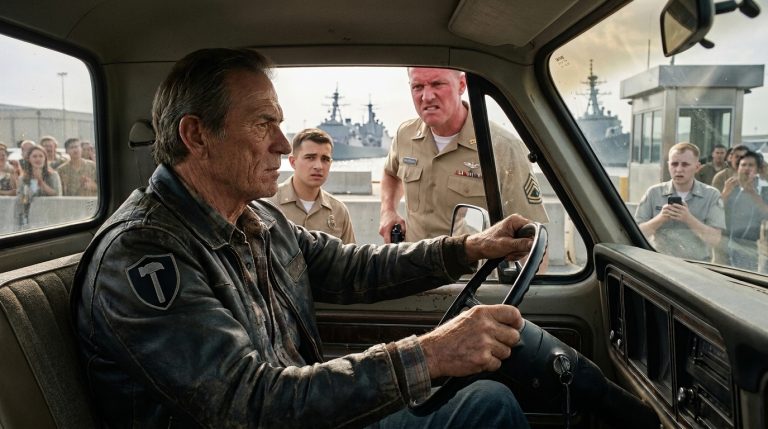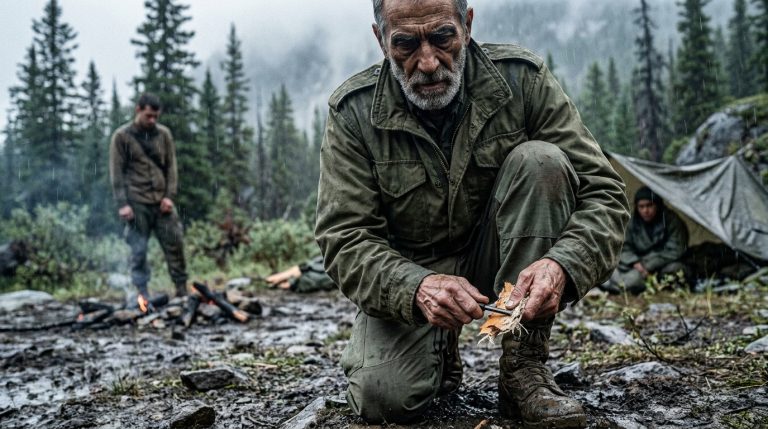
The Ghost at the Bar: A Veteran’s Calculated Descent into the Shadows of a Forgotten War
CHAPTER 1: THE WEIGHT OF THE GLASS
The condensation on the amber glass had long since evaporated, leaving a sticky, crystalline ring on the worn wooden surface of the bar. Gordon’s fingers, gnarled and steady, tightened around the tumbler. He wasn’t looking at the whiskey anymore. He was staring at the reflection of the doorway in the polished brass of the beer tap.
The bar was quiet, the usual hum of Maria’s establishment dampened by the late hour. But the silence wasn’t empty. It was pressurized.
He felt the prickle of static on the back of his neck, a phantom sensation he hadn’t experienced since the Kandahar extraction. It was the distinct, unmistakable hum of an active signal jammer—the kind that didn’t belong in a neighborhood dive. Someone was creating a dead zone around the bar, likely to isolate him, to ensure that the “legend” couldn’t call for reinforcements.
Amateurs, he thought, the word landing in his mind with the dry weight of a stone.
The younger operator, Jake, was at the far end of the counter, nursing a soda, his eyes fixed on Gordon with a predatory intensity that lacked the necessary camouflage. The boy was trying to be subtle, but he carried the tension of a soldier who expected a fight, unaware that he was standing in the presence of someone who had turned fighting into an involuntary reflex.
Gordon shifted his weight, his bad hip protesting with a dull, rhythmic ache. He didn’t flinch. He used the pain as a focal point, grounding his awareness. He didn’t turn around to check the door. He didn’t need to. He could hear the low, rhythmic ticking of the air conditioning unit, and underneath it, the faint, unnatural whine of the jammer near the exterior porch light.
Someone had been busy while he sat here.
“You’re not drinking, Jake,” Gordon said, his voice barely audible over the low murmur of the cooler. He didn’t look at the young man, his focus remaining on the brass tap. “And you’re not here to apologize.”
Jake froze, his hand half-raised to his mouth. The arrogance he had displayed earlier had been scrubbed away by the Colonel’s intervention, replaced by a cold, hollowed-out focus that was, in its own way, far more dangerous. He was no longer playing the part of the entitled soldier; he was playing the part of the loyal hound, tethered to a new, invisible leash.
“I’m waiting for my ride, sir,” Jake replied, his tone clipped, stripped of the earlier bravado.
“The SUV idling three blocks east?” Gordon asked, his eyes narrowing slightly as he caught the faint vibration of a heavy engine through the floorboards. “It’s a subtle tactical choice, but you left your running lights on. It ruins the silhouette.”
Jake’s jaw tightened. He stepped off the stool, his movements fluid, the training ingrained in his muscles demanding action. He took a single step toward Gordon, then stopped. The proximity felt like a challenge, a physical test of wills.
Gordon finally turned. He didn’t look at Jake’s face. He looked at the man’s hands—the way the index finger twitched toward the waistband, the way the weight was distributed toward the balls of his feet.
“We were told to keep an eye on you, Mr. Hughes,” Jake murmured, his voice dropped to a conspiratorial rasp. “Just to ensure your… safety.”
Gordon let out a short, hollow laugh that didn’t reach his eyes. Safety. The word was a jagged, rusted thing in this context. He reached down, his fingers brushing the coarse, frayed fabric of the patch on his sleeve—a tactile, sensory reminder of the burden he still carried.
“Safety is a relative term, son,” Gordon said, the coldness in his pale blue eyes pinning the younger man to the spot. “But you’re standing in the wrong shadow. And if you keep pressing, you’re going to find out that the ghost you’re hunting has a very long memory, and very little patience for the games you’re being taught to play.”
The bar’s front door suddenly creaked, the bell above it letting out a sharp, lonely chime as the door pushed inward, revealing the silhouette of a man who didn’t belong in this quiet, dusty corner of the world.
CHAPTER 2: THE SHADOWS ANATOMY
The chime of the bell didn’t just announce a guest; it shattered the fragile, pressurized stasis of the bar. The man in the doorway—a nondescript figure in a dark, tactical-cut windbreaker—didn’t move. He stood on the threshold, a silhouette framed by the harsh, street-lamp-lit asphalt outside, his eyes sweeping the interior with the practiced indifference of a predator scanning for prey.
Gordon didn’t look at the newcomer. He didn’t have to. The shift in the room’s atmosphere was instantaneous. The hum of the beer cooler seemed to drop an octave, and even Jake, who had been vibrating with the intent to escalate, went deathly still. Jake’s hand, which had been edging toward his waistband, froze. The young soldier recognized the man in the doorway, and the recognition brought with it a distinct, palpable wave of apprehension.
Gordon felt the cold draft of the night air hit his ankles. He turned his head slowly, his movements deliberate, forcing his joints to cooperate. His gaze landed on the man, then traveled to the neon signage above the bar’s entrance. The “OPEN” sign flickered, a rhythmic, stuttering buzz that cast long, erratic shadows across the room. Every blink of the red light seemed to pulse in time with Gordon’s heartbeat.
Distraction, he noted internally. Purposeful.
The man in the doorway stepped inside, closing the door behind him with a soft, final click that echoed like a hammer strike. He ignored Jake entirely, his attention homing in on the bar stool, on the glass of whiskey, and ultimately, on the old man sitting there.
“Mr. Hughes,” the newcomer said. The voice was smooth, devoid of any local inflection, a flat, professional tone that felt like sandpaper against velvet. “The Colonel sent me to ensure the… transition is handled with appropriate discretion.”
Gordon didn’t respond. He lifted his glass, the liquid catching the stuttering red light of the flickering sign. He felt the weight of his own jacket draped over the back of his stool, the rough, frayed patch pressing against his spine. He knew what was in the windbreaker. He knew the specific bulge of the radio, the weight of the sidearm, and the way the man stood—he was an extractor, sent not to protect, but to contain.
“I’m not going anywhere,” Gordon said, his voice a low, gravelly rumble. He glanced at Maria. She was frozen near the register, her face pale, her hands trembling as she clutched a glass. She was realizing, perhaps for the first time, that the man she had served for a decade was not a person, but an asset.
Jake cleared his throat, the sound sharp and desperate. “Sir, we have orders—”
The newcomer didn’t look at him. He simply raised a hand, two fingers extended, a command that silenced the younger man instantly. “Your orders have been superseded, Jake. Go outside. Wait by the SUV.”
Jake hesitated, the pride that had fueled his earlier hostility clashing with the ingrained discipline of his unit. He glanced at Gordon—a look of profound confusion, a crack in his armor—and then, with a sharp nod, he turned and walked toward the exit. He didn’t look back.
Gordon watched him go, the flickering neon light casting the young soldier’s face in deep, dramatic relief. When the door clicked shut behind Jake, the bar felt impossibly larger, the silence deeper.
“The drive, Mr. Hughes,” the man said, moving closer. He stopped five feet away, his stance relaxed but his eyes never leaving Gordon’s hands. “It’s been a long time. The brass is… impatient.”
Gordon looked down at his glass. He saw the reflection of his own tired face—the lines etched by years of sun and sand, the weariness that went deeper than bone. He had spent ten years carving out a life here, nursing his drinks, avoiding the gaze of the world. He had built this sanctuary to be a grave for his memories, and now, they were here to exhume them.
He reached out, his hand steady as he picked up the tumbler. He didn’t drink. He simply traced the rim, the glass cold against his skin.
“You tell the Colonel that I don’t keep souvenirs,” Gordon said, his voice gaining a sudden, dangerous edge. He stood up, his hip popping—a sound of dry, brittle age—but his posture straightened with a lethal, dormant grace. “And you tell him that if he wants the keys to his kingdom, he’s going to have to walk into the dark himself.”
He didn’t wait for a response. He grabbed his field jacket from the stool, the frayed patch catching the dim light, and began to move toward the rear exit, his footsteps measured and silent against the dusty wooden floor. The neon sign buzzed one last time, then cut to total, absolute darkness.
CHAPTER 3: THE ARCHITECTS EXIT
Gordon moved through the dark like a man who had long ago memorized the geography of his own extinction. The back exit of Maria’s bar opened into a narrow, mud-slicked alleyway that smelled of damp cardboard and the metallic tang of the city’s underbelly. He didn’t rush. Rushing was a young man’s game, a tactic born of panic, and Gordon had outlived that particular impulse decades ago.
He stepped into the cooling night air, his breath hitching as the temperature drop bit into his lungs. The alleyway was a canyon of brick and shadow, illuminated only by the distant, sickly orange glow of a streetlight at the far end. He stood for a moment, letting his eyes calibrate to the gloom. The extractor—the professional in the windbreaker—hadn’t followed him out immediately. That was a tactical error. It meant the man was still inside, likely securing the perimeter or reporting back to the Colonel. It gave Gordon exactly enough time to disappear, but he wasn’t interested in vanishing. Not yet.
He needed the leverage.
He navigated the alley with an economy of motion that belied his age, his hand sliding along the cold, abrasive brick of the building’s rear wall. He reached the heavy iron door of the electrical junction box he had frequented for years—the one he had secretly wired into the city’s power grid during his first year in the neighborhood. He pried the rusted casing open with a firm, practiced pull of his fingers, ignoring the sharp scrape of metal against his skin. Inside, there wasn’t a digital interface. It was a simple, analog bypass. He flipped a single, heavy-duty toggle switch.
Down the street, the flickering signage of the bar and the overhead streetlights died simultaneously, plunging the entire block into a profound, suffocating void.
The man in the windbreaker emerged from the rear door exactly four seconds later. Gordon watched him from the heavy shadow of a dumpster, his own breathing slowed to a near-silence. The extractor wasn’t panicked, but he was cautious. He moved with a clinical, predatory grace, his hand resting on the small of his back where a holstered weapon sat tucked beneath his jacket. The man scanned the darkness, his eyes shifting with the precision of a thermal lens.
“I know you’re still here, Mr. Hughes,” the man said, his voice projecting into the alley without any of the tension one might expect from a tracker losing his target. “The Colonel doesn’t want a confrontation. He wants the assets returned. They aren’t yours to keep.”
Gordon didn’t breathe. He kept his eyes fixed on the man’s silhouette. Assets. The word was a chilling reminder of how they saw him. He was a piece of hardware, a legacy system that had outlived its deployment window.
Gordon shifted his weight, his boot finding purchase on a discarded crate. He kept his eyes on the man’s shadow, waiting. He didn’t need to fight this man; he only needed to see if the Colonel had shared the truth. If they knew he was the fail-safe, this man would be terrified of closing the distance. If they still believed he was just a man guarding a hard drive, they would be reckless.
The extractor stepped forward, his boots crunching on the grit of the alleyway. “You’re making this difficult for people who respect your service, sir. Don’t force us to treat you like a liability.”
The phrasing was specific. Liability. Not target. Not enemy. Gordon’s mind clicked into gear, calculating the implications. They were terrified of damaging him, but they didn’t know the full extent of his reach. They were playing with a containment protocol, not an execution order.
Gordon stepped out from behind the dumpster, his figure emerging from the darkness like a manifestation of the alley itself. The man in the windbreaker stopped, his hand tightening on the weapon at his back, but he didn’t draw. He stayed at a distance, his posture tight, cautious.
“You’re not here to take me in,” Gordon said, his voice projecting with a resonance that seemed to vibrate in the narrow space. “You’re here to verify that the core is still intact. But tell me, has the Colonel mentioned what happens to the architecture if the core is removed?”
The man’s eyes flickered—a millisecond of hesitation that betrayed everything. He didn’t know. The Colonel hadn’t told him. The extractor was a mere technician, a high-level retrieval specialist kept in the dark about the true nature of his mission.
“I don’t know what you’re talking about, Mr. Hughes,” the man said, though the confidence had drained from his tone.
“Then you’re working for a man who hasn’t told you the truth about the grave you’re digging,” Gordon replied. He took a single, slow step toward the man. “And you’re going to walk back to that SUV, you’re going to tell the Colonel that the ghost has already left the building, and you’re going to pray that you stay far away when the real truth comes to light.”
The extractor looked at Gordon, really looked at him, and for the first time, he seemed to see the sheer, terrifying weight of the man’s history. He didn’t see an old man in a frayed jacket. He saw the cold, calculated machine that had survived the impossible.
“The Colonel won’t be pleased,” the man murmured, his hand finally dropping away from his weapon.
“Pleasure has nothing to do with it,” Gordon said. “Survival is the only metric that matters now.”
Without another word, the man in the windbreaker turned and walked back toward the front of the block. Gordon remained in the darkness, his heart pounding a steady, rhythmic pulse against his ribs. He had bought time, but the interaction had confirmed his suspicion: the net was closing, and they were beginning to realize that the ghost wasn’t going to surrender his memory without taking the entire structure down with him.
He leaned against the cold brick wall, his hands shaking slightly from the adrenaline spike. The path forward was narrowing, and the shadows were beginning to feel less like cover and more like a closing cell. He needed to move, and he needed to make the next move before the Colonel decided to bypass the technician and handle the demolition personally.
CHAPTER 4: WATCHING THE WATCHERS
The silence of the blackout was absolute, a heavy, velvet weight that pressed against Gordon’s skin. He remained still in the shadow of the dumpster, his eyes tracking the faint movement of the extractor’s retreating silhouette until it disappeared toward the street. He didn’t move for several minutes, waiting for the familiar, rhythmic thrum of the SUV’s engine to finally fade into the distance.
He was alone, but the alley felt crowded. Every shadow seemed to harbor a gaze; every rustle of the wind against the brickwork felt like the shift of a tactical team repositioning. He pushed off the wall, his joints popping with a dry, protestant click, and began the slow, circuitous walk back toward his house. He didn’t take the direct route. He doubled back through the labyrinthine network of backyards and rusted fire escapes, his movements driven by the ghost-instincts of a man who had survived by treating the environment as his primary weapon.
As he moved, the distant, sharp whistle of a train—a mournful, piercing sound—cut through the night air. The effect was immediate and jarring. The modern city blurred at the edges, replaced by the humid, claustrophobic sensory input of a 1970s jungle extraction point. He was standing in the mud again, the air thick with the smell of wet vegetation and cordite, reviewing the final maps for Operation Nightshade. He remembered the exact weight of the paper in his hand, the way the ink felt slightly damp against his thumb. He was planning the route, anticipating the enemy’s sweep—and he realized, with a shock that grounded him back in the present, that the current operation against him felt disturbingly familiar. The Colonel was using the same containment methodology he had once helped design.
He reached his home, a small, unassuming frame house at the end of a quiet cul-de-sac. It looked identical to every other house on the street, and that was by design. He unlocked the back door with a set of keys he had modified for silence, the tumblers clicking into place with surgical precision.
Inside, the house was dark, cool, and smelled of lemon polish and old paper. He didn’t turn on a light. He moved through the kitchen, his hand brushing the countertop until he found the hidden release for the false panel behind the pantry. He opened it, revealing the small, lead-lined compartment where he kept his true archives.
He didn’t reach for the hard drive that the extractor expected. That drive was a lure, a collection of encrypted, useless data meant to satisfy the appetite of a scavenger. Instead, he pulled out a slim, battered notebook—the real record, written in a cipher that hadn’t been decrypted in fifty years.
He sat at his small kitchen table, the moonlight filtering through the blinds in thin, silver slats. He began to cross-reference the notebook with the events of the evening. The Colonel’s men weren’t just searching for the drive; they were searching for him, and their hesitation meant they still lacked the key to unlock the biological fail-safe. If they could get him into custody, they could force the decryption. If they couldn’t, they would be forced to resort to something much more drastic.
The phone on the wall, a rotary model he had kept connected for its analog reliability, gave a sudden, muffled ring.
Gordon didn’t reach for it immediately. He watched the device as if it were a bomb, the rhythmic pulse of the ring echoing in the empty, silent house. It was 2:00 a.m. No one in this life knew that number. He took a deep breath, felt the familiar surge of adrenaline sharpen his senses, and picked up the receiver.
“Yes,” he said, his voice as steady as granite.
“They’re coming, Titan 3,” a voice whispered on the other end—a voice that was ancient, familiar, and filled with a cold, desperate urgency. “The containment team has been bypassed. The cleanup crew is already on the move. They aren’t looking for the drive anymore.”
“I know,” Gordon said, his eyes scanning the yard through the kitchen window, where the first flicker of high-intensity infrared lights was beginning to paint the lawn in invisible, searching patterns. “I’m ready.”
He hung up the phone, the silence of the house returning, now laced with the imminent, ticking clock of his own exposure. He turned to the pantry, grabbed a small, heavy bag he had kept packed for over a decade, and walked toward the crawlspace under the floorboards—the final exit strategy he had hoped to never use.
CHAPTER 5: THE TACTICAL BREACH
Gordon dropped into the crawlspace, his body folding with a fluid, practiced ease that betrayed his eighty years. Below the joists, the air was stagnant, heavy with the smell of damp earth and decaying wood. Above him, the floorboards of his kitchen muffled the sounds of the outside world, but they could not silence the deliberate, tactical thud of heavy boots hitting his porch.
He didn’t freeze. He moved. The crawlspace was a claustrophobic tunnel of low clearance, crisscrossed by rusted water pipes and electrical conduits that ran like veins through the house’s skeletal structure. He had prepared this space decades ago, lining the perimeter with acoustic dampeners and motion sensors that fed into a small, handheld display.
The screen in his hand flickered with three distinct thermal signatures. They were positioned at the front door, the back door, and the side kitchen window. They weren’t rushing. They were methodical, moving with the cold, unhurried cadence of a team that believed they had already won.
Gordon crawled toward the exterior foundation vent. The house was shaking now, the subtle vibration of a high-pressure breaching tool whining against the steel frame of his back door. He knew that sound. It was the same tool he had once seen in a test chamber at an experimental facility—a focused-heat pulse designed to melt the locking mechanism in seconds without triggering an alarm.
He reached the vent, his fingers finding the latch. He hesitated, his heart hammering against his ribs, not from fear, but from a sudden, sharp spike of sensory confusion. He heard footsteps moving through the house above—a heavy, rhythmic pacing—but the sensor display showed the thermal signatures were still held at the perimeter.
Paranoia, he thought, forcing his jaw to unclench. The architecture is working.
He pushed the vent open, the rusted hinges whining in the dark. As he squeezed his shoulders through the narrow gap, the kitchen above him erupted. A dull thud resonated through the joists, followed by the sound of splintering wood and the hiss of pressurized air. They had breached the back door.
He didn’t look back. He dropped into the tall, overgrown grass of the backyard, his eyes instantly adjusting to the filtered moonlight. He stayed low, hugging the perimeter of the fence line where the shadows were thickest. He moved toward the detached garage, his lungs burning with the sudden, frantic expenditure of energy.
Behind him, his house was being dismantled. He could hear the sharp, clipped commands of the team leader, the sound of drawers being overturned, the methodical destruction of his life’s work. He could hear them tearing through the pantry, searching for the hidden panel. He knew exactly what they would find. He had left the bait there: the encrypted hard drive, rigged with a thermal-erase trigger that would activate the moment they bypassed its physical casing.
He reached the side of the garage, his hand hovering over the door handle. A sudden, piercing glare of a tactical spotlight swept across the yard, missing him by inches. The light was harsh, artificial, and clinical. He flattened himself against the cedar siding, his breath shallow, his body becoming one with the dark.
The team inside the house was growing frustrated. He could hear the sharp tone of their voices, the way they moved with less discipline and more raw, aggressive energy. They weren’t finding what they wanted, and their panic was beginning to override their training. That was the danger zone. A frustrated operator was the most unpredictable variable in a tactical environment.
Gordon glanced at his display. The thermal signatures were dispersing, moving toward the garage. They had realized the house was a shell. They were coming for the perimeter now, and he was cornered.
He didn’t panic. He shifted his mental focus, the world narrowing down to the mechanical components of the garage lock. He had seconds before they rounded the corner. He pulled a small, multi-tool from his pocket, the steel cold and reassuring against his thumb. He wasn’t going to fight them; he was going to manipulate the environment.
As the first silhouette rounded the corner of the house—a hulking, armored figure with a rifle raised to the high-ready position—Gordon triggered the external garden light system he had wired in anticipation of this exact moment.
The yard exploded in a blinding, strobing cascade of high-intensity white light. It was a sensory assault, designed to overload night-vision optics and trigger a momentary, involuntary reaction in the human eye. The operator staggered, his weapon swinging wildly, his hand going to his visor to adjust.
Gordon didn’t wait. He slipped into the dark interior of the garage, the door closing behind him with a soft, final click that was swallowed by the sudden, deafening confusion of the team out on the lawn. He stood in the dark, his pulse beginning to steady, and listened to the chaos he had orchestrated. He was still in the game, but the margin of error had just vanished completely.
CHAPTER 6: THE TACTICAL STANDOFF
The interior of the garage was a tomb of forgotten mechanical labor. Shelves were lined with rusted cans, half-empty containers of oil, and the skeletal remains of tools that hadn’t seen daylight in a decade. Gordon didn’t hide in the corner. He moved to the center of the concrete floor, his boots making no sound on the oil-stained surface. He knew the structural layout of this space as well as he knew the back of his own hand.
Outside, the chaos he had triggered was subsiding. He could hear the team regrouping, their voices low and sharp—the sound of professionals shifting from frustration to systematic containment. Then, silence. The most dangerous sound of all.
Gordon’s eyes darted to the workbench. He pulled a heavy, magnetized tool tray toward him and began to arrange its contents with the precision of a surgeon. He wasn’t building a weapon; he was building a diagnostic trap. He needed to know exactly how much they knew, and how much they were willing to risk to get it.
The garage wall nearest the house groaned—a high-pitched, metallic shriek as a thermal-lance cutter bit into the siding. They weren’t using the door. They were peeling the garage like a piece of fruit.
He didn’t retreat. He stood behind the workbench, his body angled to minimize his profile, his hand resting on the handle of a heavy, industrial-grade torque wrench. It was a crude tool, but in his grip, it held the weight of a decade’s worth of frustration. He watched the wall. Sparks showered the interior, glowing like dying embers in the dark, as the cutting tool chewed through the cedar.
Through the opening, the beam of a high-intensity tactical light cut through the gloom, slicing across the garage. It was a bright, clinical white, illuminating the dust motes dancing in the air.
“Mr. Hughes,” the voice was back—the technician from the alley, sounding less like a professional extractor and more like a man holding a leash that was fraying. “We have thermal imaging. We know exactly where you are. There is no tactical path forward for you. Step out from behind the bench.”
Gordon didn’t answer. He watched the light scan the room, pausing on the shelves, the floor, and finally, the bench. He saw the gleam of a specialized forensic scanning device—a sleek, obsidian-colored unit he hadn’t seen since the height of his own era. It was an ‘Active Disassembly’ tool, used to map the internal components of secure electronic devices from a distance.
They know about the fail-safe, he realized. The scan wasn’t for the hard drive; it was checking for his heartbeat, for the physiological markers of the biological key. The Colonel had stopped pretending this was a recovery mission. It was a live-capture-and-terminate operation.
“You’re measuring the wrong ghost,” Gordon said, his voice quiet but carrying clearly in the enclosed space.
The light stopped moving. It locked onto his silhouette. The team—three of them, Gordon counted based on the shifting weight on the floorboards outside—stepped through the jagged opening they had cut into the siding. They were moving in a tight wedge, their movements fluid and practiced. They weren’t just looking for the drive anymore; they were looking for him.
“We have the authorization to bypass the containment protocol,” the technician said, his voice tight. “The Colonel is aware of the fail-safe, Titan 3. Do you really think he’d let you walk away with the keys to a network he built with his own blood?”
“He built the network,” Gordon said, his eyes tracking the man’s trigger discipline. “But he never learned how to operate the kill switch.”
The technician raised his rifle, the barrel perfectly aligned with Gordon’s center mass. The room felt suddenly, terrifyingly small. The air was thick with the smell of ozone and burnt cedar, a physical manifestation of the impending violence.
“Last chance,” the technician warned.
Gordon didn’t blink. He felt the cold, hard weight of the torque wrench in his hand, a heavy, grounded reality. He knew he was outnumbered, outgunned, and physically compromised by the limitations of his age. But he also knew the one thing they couldn’t see: the hidden wiring of the garage itself.
He had spent years turning this space into a mirror of his own internal defenses. The floor, the ceiling, the very walls were interconnected. He took a single, slow step to the left, his boot shifting just enough to catch the hidden floor trigger he’d installed under the heavy work mat.
The garage lights, which had been off, flared to life—but not with the warm, dim glow of a bulb. They surged with a short-circuiting, high-voltage jolt that blew the fuses in the master box. The garage plunged into total darkness again, but this time, he had blinded their optics. The hum of their high-end tactical gear turned into a dissonant, screeching feedback as the surge overwhelmed their sensitive communication and thermal arrays.
They were blind, they were deaf, and they were trapped in a space where he knew every shadow, every nail, and every potential point of failure. Gordon didn’t wait for them to recover. He moved into the black, his body shifting with the lethal, silent grace of a ghost who refused to be laid to rest.
CHAPTER 7: THE RUSTED TRUTH
Gordon didn’t move. He stood in the center of the pitch-black garage, his breathing a silent, controlled oscillation against the sudden chill. His skin prickled with the awareness of the men around him. They were seasoned, elite, and they had been trained to hunt in total darkness. They were likely using thermal-override goggles—a legacy upgrade he had once helped integrate into the very gear they now wore.
He heard the soft, synthetic whine of their optics cycling through spectrums.
He moved, but not in a desperate flight. He retreated toward the rear wall where the secondary power distribution unit sat, a rusted, half-dismantled beast of copper and iron. His hands moved with a blind, rhythmic confidence. He needed the darkness to become his own armor, but the sudden failure of the entire breaker system meant he was also blind to their positioning.
Friction, he thought, catching the sharp smell of burning insulation. He had overloaded the main grid too quickly. It was a tactical oversight, a flaw in his own planning that he should have anticipated. He had been so focused on blinding them that he had inadvertently crippled his own ability to navigate the space.
A heavy boot scraped against the concrete less than six feet to his left. He felt the air displaced by the movement, a subtle pressure wave against his cheek. They were closing in, a tactical wedge moving with the lethality of a closing vise.
He reached for the torque wrench he had kept tucked into his belt. He didn’t use it to strike. Instead, he swung it hard against the exposed copper pipes of the main fluid line running along the wall. The sound was a sharp, resonant clangg that shattered the silence, a deliberate redirection of their attention.
“Contact!” one of the voices barked, the sound muffled by tactical comms.
The wedge shifted, the sound of movement accelerating toward the far end of the wall. Gordon, however, moved the opposite way, his body flattening against the cool, oily surface of the workbench. He had anticipated the reaction. He had been the one who wrote the training manuals for exactly this scenario: when a target creates a diversion in a darkened environment, the primary threat is almost always the location they just vacated.
He moved toward the door, his fingers finding the manual latch he had rigged. As he pulled, the team swung their weapons toward the source of the noise. The sound of a suppressed rifle discharge—a series of sharp, rhythmic pops—shredded the air where he had been standing a second before, splintering the wooden workbench and sending shards of debris flying into the dark.
Gordon didn’t look back. He burst through the door, the cool night air washing over him, and hit the grass at a full, desperate sprint. He was out of the garage, but the yard was illuminated now by the sudden, sweeping glare of high-intensity floodlights from the arriving SUVs. The Colonel had arrived.
He saw the long, black vehicles pulled up across the cul-de-sac, their doors open, a small army of personnel deploying in a wide arc. He wasn’t just being hunted by a team anymore; he was being cordoned off by a task force.
He realized then that he couldn’t win by hiding. The game of cat and mouse was over. He turned, not toward the fence line, but toward the light itself, toward the center of the formation where the granite-faced Colonel stood, watching the house burn.
The move was illogical, suicidal, and entirely against every protocol he had ever lived by. But it was the only thing they wouldn’t expect. He was going to walk directly into the heart of the storm, and he was going to force them to look at the man they were so desperate to dismantle.
He stepped out of the shadow of the garage, his hands empty, his jacket hanging loosely over his shoulder. He walked slowly, his limp pronounced, a frail, aging man against the backdrop of an elite military force. He watched the faces of the soldiers as they spotted him. They didn’t fire. They hesitated, their training screaming at them to engage a hostile, but their human instinct stalling as they saw the figure they had been told to handle with ‘absolute extreme caution.’
Colonel Williams stepped forward, his face a mask of cold, professional iron. He didn’t reach for his sidearm. He watched Gordon approach, his eyes calculating the distance, the threat, and the impossible reality of the man’s return.
“You’re a long way from the shadows, Titan 3,” the Colonel said, his voice carrying across the lawn like a gavel strike.
“The shadows were becoming too crowded, Colonel,” Gordon replied, stopping ten feet from the line of men. “And it’s time we discussed the architecture of what you’re trying to build.”
He reached into his pocket—not for a weapon, but for the small, heavy object he had carried with him all night: a key, a physical, mechanical key that didn’t belong to any lock in the modern world. He held it up, the moonlight glinting off the worn, metallic surface. It was the only thing that could stop the network, and he had just placed it in the middle of the field, inviting the Colonel to take it.
CHAPTER 8: THE LAST GHOST
Colonel Williams didn’t take the key. He stared at it, his face a mask of granite, but his eyes—those icy, calculating sensors—flickered with a sudden, betraying recognition. He knew exactly what the key represented. It was the physical override to the “Titan” network, the only thing capable of forcing a system-wide dump of every black-ops ledger, every untraceable account, and every sin buried beneath decades of administrative redaction.
“You’re not handing it over,” the Colonel said, his voice stripped of its earlier command, replaced by a hollow, resonance-heavy realization. “You’re offering a trade.”
“There’s no trade,” Gordon replied. His voice was steady, the tremors from the night finally stilled by the absolute clarity of the end. “You want the network. You want the power to re-integrate Titan into your current operational mandate. But you know that if I hand this to you, I become a loose end. You can’t let me leave, and you can’t risk the key itself.”
The Colonel stepped closer, the soldiers behind him forming a tightening, pressurized circle. “You were always the most efficient asset we ever produced, Gordon. That was your greatest strength, and now, it’s your only vulnerability. You’re trying to force a stalemate.”
“I’m forcing a dissolution,” Gordon corrected. He pressed a thumb against a small, concealed stud on the base of the key. “This isn’t just a key. It’s an emitter. It’s been keyed to my own biometric signature since the jungle. If my heart stops, if this key is separated from my reach for more than ten minutes, or if it is forcibly disconnected from the local relay—the entire network initiates an autonomous purge. Every file you’ve spent your career protecting, every asset you’ve deployed, will be broadcast to every terminal from here to the Pentagon. Your history, Colonel, becomes public domain.”
The Colonel froze. The silence that descended on the lawn was absolute, a vacuum that sucked the air out of the night. The soldiers surrounding them shifted, the weight of the realization filtering through the ranks. They were standing on the edge of a precipice, and Gordon had just revealed that he was the only thing preventing the world from seeing the truth.
“You’d burn it all down?” the Colonel whispered, his voice thick with a genuine, unadulterated fear. “You’d destroy the very system you bled to build?”
“I built it to win a war,” Gordon said, his eyes locking onto the Colonel’s. “You’ve spent decades using it to manage a peace that shouldn’t exist. There’s a difference.”
The Colonel reached for his sidearm, but his hand stopped halfway—a hesitant, fractured motion. He knew the cost. He knew the weight of the secrets he held. He was caught in the “Cornered Beast” protocol, the final, visceral counter-move of a man who realized his entire kingdom was built on the whim of a ghost.
Gordon didn’t wait for him to decide. He turned the key, the metallic click sounding like a gunshot in the still air. He didn’t drop it. He walked toward the Colonel, pressing the key into the man’s stiff, unyielding hand.
“Keep it,” Gordon said, his voice dropping to a low, final resonance. “You keep the network. You keep the power. But you know now that the moment you try to use it against me, or against anyone else who dares to stand for the truth, you’re hitting the self-destruct button on your own career. You aren’t the commander anymore, Colonel. You’re the jailer of a cage you can never open.”
The Colonel stood paralyzed, the key cold and heavy in his palm. He looked at it, then at Gordon, and then at the soldiers who were watching, their own loyalty beginning to fracture under the weight of the revelation.
Gordon walked past him, his limp steady, his gaze fixed on the quiet, darkened street ahead. No one stopped him. The soldiers parted, a river of uniforms giving way to the man who had finally earned his anonymity. He walked until the streetlights began to flicker back to life, the power returning to the neighborhood, washing the shadows away.
He didn’t return to the house. He walked until he reached the park bench where he had once sat as a young man, years ago. He sat down, the wood cool and weathered beneath him. He was tired—a deep, cellular exhaustion that seemed to finally be releasing its grip.
He took the frayed field jacket from his shoulder, looked at the faded, indecipherable patch one last time, and folded it neatly, placing it beside him on the bench. He reached into his pocket and pulled out a small, smooth stone he had picked up in the jungle, a relic of a life he had finally, truly, put to rest. He held it in his palm, felt the weight of it, and then, with a quiet, deliberate motion, placed it on top of the folded jacket.
The wind sighed through the trees, a soft, natural sound that replaced the hum of the network, the static of the comms, and the weight of the secret. He sat there, an old man in the quiet, watching the sun begin to bleed through the horizon, turning the sky into a bruised, soft purple. The war was over. For the first time in his life, he didn’t have a mission. He had only the sunrise, and the silence of a life finally, completely his own.