Beyond the Wire: How Bitter Cold and Unexpected Compassion Forged an Unbreakable Bond in the Canadian Snow
CHAPTER 1: THE FROZEN ARRIVAL
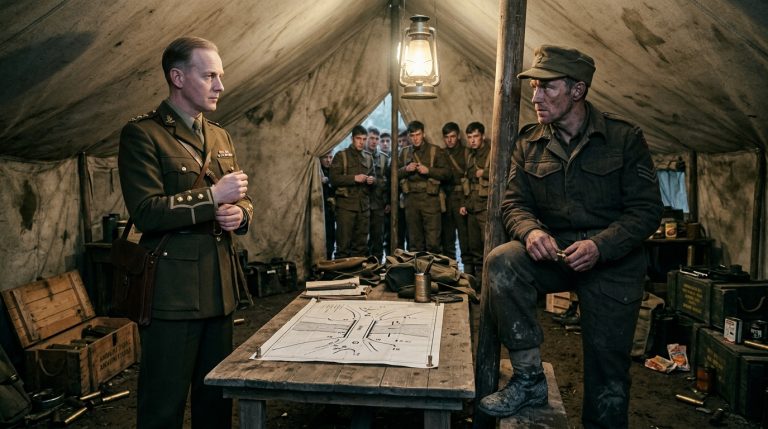
The train brakes shrieked against frosted iron, echoing across the silent Ontario hills. Ernst stared through the grime-streaked window at a landscape that seemed to stretch into infinity, a white desert swallowed by the grey winter sky. His fingers curled tighter around the thin wool of his standard-issue German coat, fabric that felt as flimsy as paper against the biting draft leaking through the wooden frame. The propaganda ministry back in Berlin had painted a terrifying picture of this place, a frozen wasteland where prisoners were left as statues of ice. Beside him, Klaus shifted on the hard wooden bench, his breath fogging the glass as he watched armed guards step out onto the snow-packed platform. They didn’t move like conquerors or executioners; they moved with calm, steady efficiency, stamping their heavy boots to shake off the drifting powder. Ernst swallowed the dry lump in his throat, bracing himself for the cold that was supposed to kill them. The heavy iron door slid open with a jarring groan, letting in a knife-edge of sub-zero air that stole the breath right out of his lungs. A guard stood there in a thick sheepskin jacket, his breath pluming white, holding out a wooden crate without a single word of threat.
CHAPTER 2: THE FIRST THAW
The heavy wooden door swung open without warning, letting in a gust of crisp morning air and a stocky guard carrying a massive pine crate.
He didn’t bark an order or slam a rifle butt against the floor.
Instead, he dropped the crate near the central stove with a dull thud that rattled the tin mugs on the nearby table.
Ernst watched him through half-narrowed eyes, his muscles tense from weeks of bracing for hostility.
The guard—a weathered man with a grease-stained parka and deep lines around his eyes—flipped the metal latch with bare, calloused fingers.
Inside lay thick bundles of grey wool socks, neatly stacked pair upon pair, alongside stiff leather mittens lined with rabbit fur.
—These are for the ends of the barracks, the guard said, his voice flat and devoid of any mocking triumph. Put them on before you step outside to empty the ash bins. Frostbite takes fingers faster than you can blink out here.
Klaus remained frozen on his bunk, staring at the grey wool as if it were a trick engineered to weaken their resolve.
The guard didn’t wait for a thank-you or a salute, simply turning on his heel and heading back toward the snow-choked doorway.
A rusted spoon clattered against the wooden floorboards near Ernst’s boot, dropped by a younger prisoner whose hands were shaking too badly from the chill to hold his tin.
Ernst bent down slowly, his joints stiff, and picked up the spoon while noting a faint, curious scratch carved into the metal handle—a small anchor mark that didn’t belong to any standard military issue.
He slipped the spoon into his pocket, keeping his gaze locked on the empty doorway as the heavy bolt slid shut from the outside.
CHAPTER 3: THE HEARTH AND THE MESS
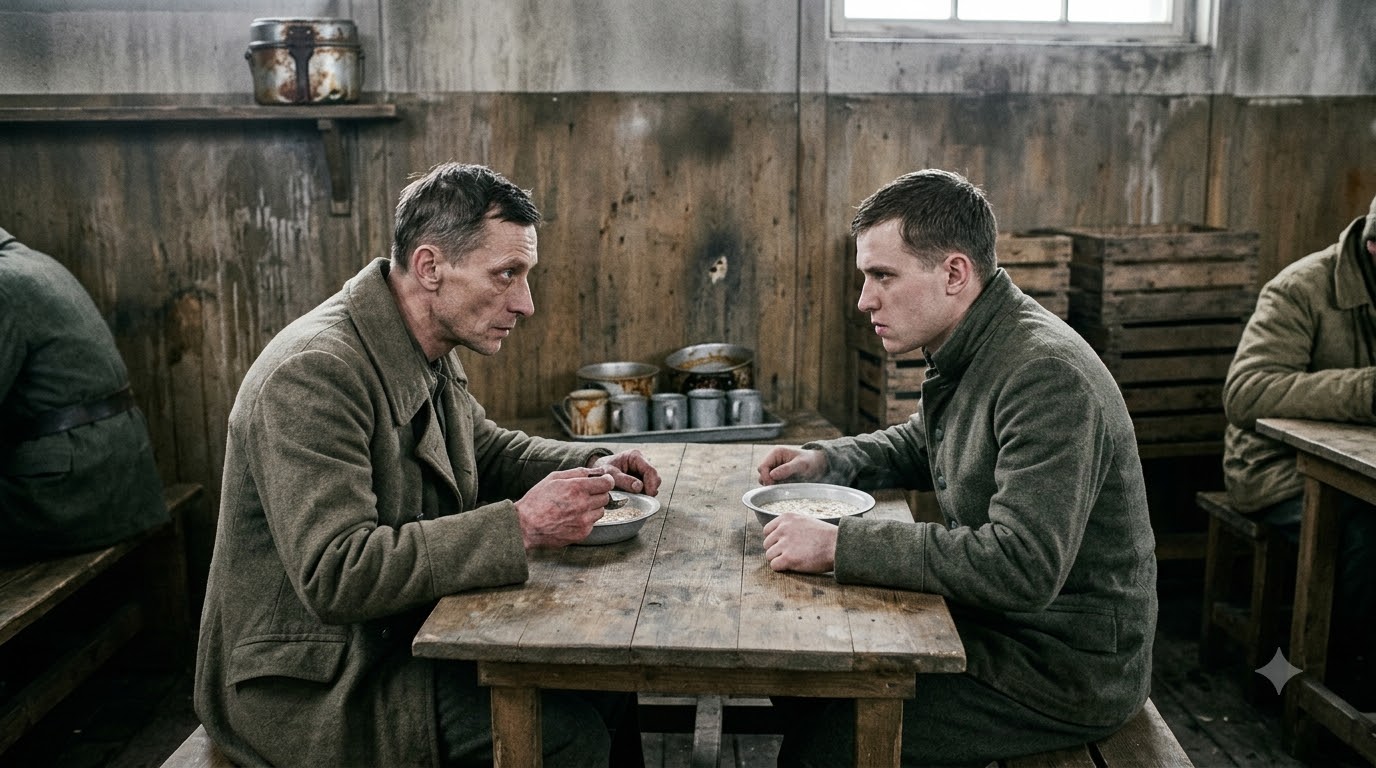
Steam curled off the aluminum bowl, carrying the rich, undeniable aroma of hot oats and brown sugar.
Ernst stared down at the thick slice of fresh bread sitting beside a pat of real butter, his mind struggling to reconcile the luxury with his status behind barbed wire.
Across the wooden bench, Klaus wiped condensation from his metal cup, refusing to touch the food until he had checked every corner of the room.
—Eat it before it forms a skin, a guard muttered, sliding past with a heavy tray of empty pots.
The guard’s fingers were raw and chapped from the wind, bearing the exact same signs of labor and exposure visible on the prisoners’ hands.
Klaus glared at the steaming bowl, his jaw tightening as he gripped the edge of the table until his knuckles turned white.
—They are fattening us up for some bureaucratic display, Klaus whispered, his voice sharp with bitter suspicion. It is a trick to lower our guard.
Ernst picked up the heavy iron spoon, feeling its cold weight before dipping it into the porridge.
—Look around you, Klaus, Ernst said, his voice dropping to a low, gravelly cadence. Berlin hasn’t seen butter like this in two years, and the guards aren’t eating steak while we chew sawdust.
A sharp clatter echoed from the kitchen door as a wooden crate slipped from a guard’s grip, spilling a cascade of fresh carrots across the floorboards.
Several prisoners instinctively lunged forward to help scoop them up, moving with a sudden, unprompted coordination that startled the guards into silence.
Ernst knelt down to retrieve a thick carrot, handing it back to the weary kitchen worker without a single word of forced deference.
The worker nodded, taking the vegetable back with a short, respectful dip of his chin that bridged the gap between captor and captive more effectively than any official decree.
CHAPTER 4: THE BLIZZARD TEST
Whiteout conditions pressed against the frosted windows, blotting out the guard towers and turning the compound into an isolated island of grey.
Ernst pressed his forehead against the cold glass, watching the snow pile into high drifts that threatened to block the doors completely.
Beside him, Klaus paced the wooden floorboards with short, anxious strides, muttering about rations running low while the storm locked them inside.
—No one can move in this, Klaus snapped, his voice tight with rising panic as the wind shrieked through the timber seams. We are cut off until the ice takes us.
Before Ernst could answer, a dull rumble vibrated through the frozen ground beneath their boots, followed by the heavy chug of an engine fighting low gear.
Heavy wooden double doors at the end of the compound creaked open, letting in a blinding swirl of diamond-dust snow and the scent of woodsmoke and boiled broth.
Local townspeople stood in the gap, their wool caps crusted with ice, hauling massive steel kettles past the line of startled sentries.
—Keep back from the threshold, a guard shouted over the roar of the gale, though his tone was entirely devoid of malice as he helped steady a steaming pot.
An older woman wrapped in a heavy plaid shawl caught Ernst’s gaze, pushing a steaming ladle into the hands of a trembling prisoner without demanding a word of gratitude.
Ernst stared down at the hot broth in his tin cup, the heat radiating into his frozen palms, finally shattering the last wall of his old world view.
CHAPTER 5: THE RUINS OF HOME
Ernst gripped the damp wooden rail, watching the jagged shoreline of Hamburg emerge through the greasy mist like a graveyard of broken teeth.
The air carried a heavy, sickening reek of wet ash and stagnant sewage that clung to the wool fibers of his heavy Canadian coat.
Around him on the deck, returning men moved in silence, their eyes hollow as they stared at the vast fields of brick rubble where entire neighborhoods once stood.
—Keep your duffel bags close to your boots, an official shouted from the gangplank, his voice clipped and exhausted.
Ernst hoisted his canvas sack, feeling the weight of the Canadian winter gear and the agricultural textbook pressed against his side like a foreign artifact.
He stepped off the ramp and onto the pulverized pavement, immediately surrounded by ghost-like figures—women pushing wooden carts piled high with charred timber and children digging blindly through grey debris.
A frail elderly woman in tattered layers of newspaper hobbled past him, her fingers blue with frostbite, shivering violently despite the mild spring drizzle.
Ernst pulled off his heavy wool mittens without a second thought, pressing them into her freezing palms before she could utter a word of hollow pride.
—Take them, Ernst said, his voice flat and hardened by the bitter realization of what his homeland had become. Layer them properly, or the damp will take your hands before nightfall.
CHAPTER 6: THE RETURN HOME
Ernst stepped across the wooden threshold of the Saskatchewan farmhouse, stomping his heavy boots twice against the mat to shake off the drifting prairie frost.
The kitchen air was thick with the scent of fresh yeast and roasted coffee, a warmth that chased the lingering ghost of the old years far from his shoulders.
Outside the frosted window, the endless white fields stretched flat to the horizon under a clear, pale winter sun.
Klaus set a heavy cast-iron skillet onto the iron stove with a dull clank, his movements measured and unhurried as he checked the temperature of the oil.
—The northern fence line needs banking before the night wind picks up, Klaus said, his voice steady as he handed Ernst a chipped enamel mug filled to the brim.
Ernst wrapped his fingers around the hot ceramic, feeling the familiar weight of the handle and tracing a faint, scarred scratch across its side.
He didn’t answer with words, simply lifting the mug in a silent, grounded salute to the man standing across the stove.
The wood fire crackled softly in the hearth, throwing long, steady shadows across a home built not on conquest or iron wills, but on the quiet, enduring labor of shared survival.
Ernst took a slow sip of the hot coffee, knowing the bitter cold would always return, but the ground beneath his feet finally belonged to a neighbor.