Iron Dust and Manila Hemp: The Farm Boy Who Rewrote Aerial Combat
CHAPTER 1: Dawn on Henderson Field
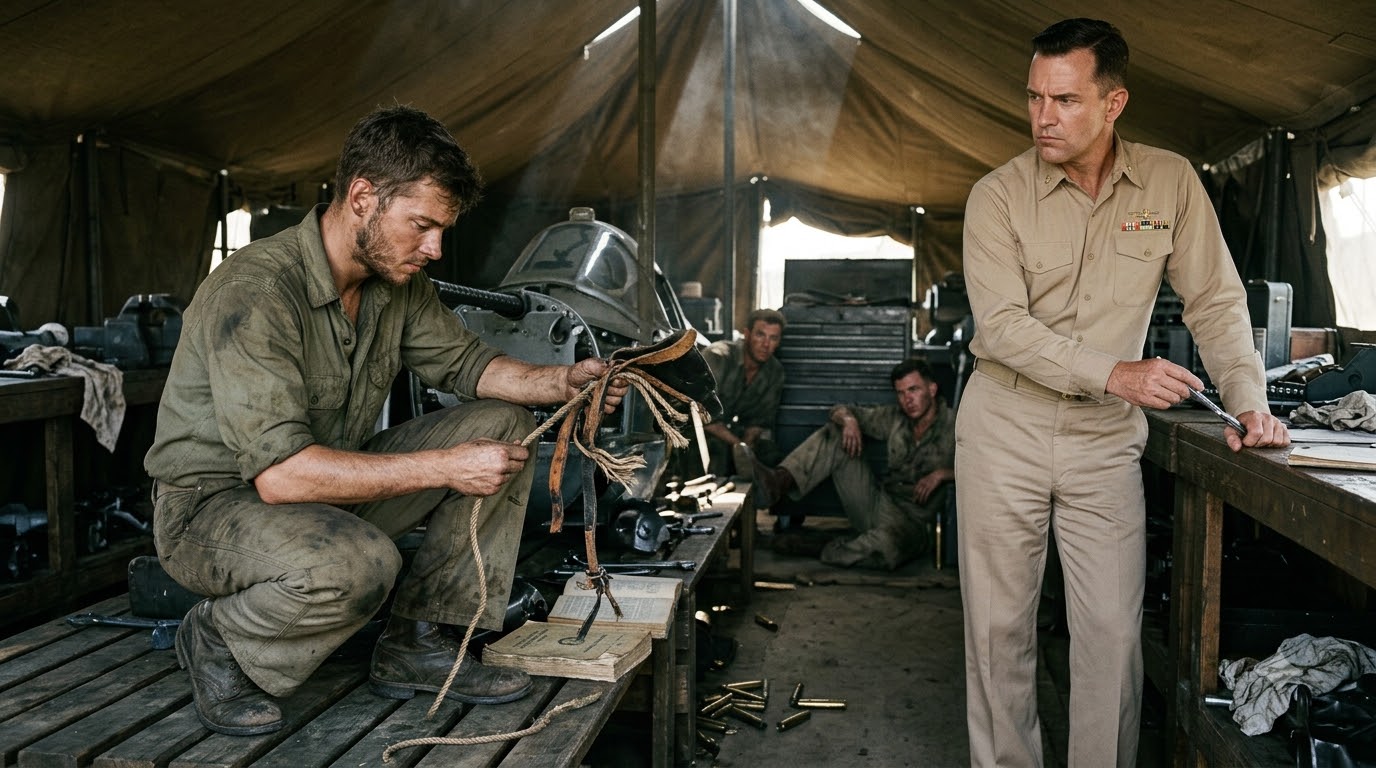
The heat inside the canvas tent was thick enough to chew. Sweat rolled down the back of Red Harmon’s neck, soaking the collar of his grease-stained utility shirt.
Between his calloused fingers, a frayed length of Manila hemp twitched every time the generator outside sputtered. He didn’t look up when the mechanics two benches over burst into laughter.
“Farm rope,” one muttered, kicking an empty 20 millimeter casing across the duckboards. “Next thing you know, the kid’s fixing magnetos with bailing wire.”
Red said nothing. He kept his eyes fixed on the frayed strands, sliding his thumb over the rough fiber to test its tension.
The training manuals on the shelf behind him promised absolute precision in synchronized gear systems. But the pilots coming back from the flight line didn’t look like diagrams in a textbook. They looked like shattered glass.
A heavy pair of combat boots crunched against the coral gravel outside. The laughter in the tent died instantly.
Captain Robert Westbrook ducked under the canvas flap, his face set in lines carved by fifteen years of naval aviation discipline. He didn’t smell like machine oil; he smelled like soap and authority.
“Harmon,” Westbrook said, his voice cutting through the heavy air without raising a decibel. “I hear you’re wasting good hemp on airframe hardware.”
Red didn’t snap to attention. He kept his grip on the rope, feeling the coarse fibers bite into his palm as he measured the distance to the ammunition feed.
CHAPTER 2: Resistance from Above
“You think a piece of farm twine is going to out-maneuver a twenty-millimeter cannon shell, Harmon?” Westbrook’s voice dropped into a low, flat register that carried the weight of fifteen years in naval aviation.
The captain tapped a polished silver fountain pen against the edge of Red’s workbench, the metallic click echoing harshly inside the cramped canvas tent.
Red didn’t flinch. He kept his fingers steady on the rough Manila hemp, feeling every microscopic splinter of the fiber bite into his skin.
“The training manuals say a pilot needs three-quarters of a second to react to a deflection shot,” Red replied, his voice flat and unhurried. “A Zero’s rounds are crossing twenty feet per millisecond. By the time a man blinks and yanks his stick, his oil lines are already perforated.”
Westbrook’s pen stopped tapping. He leaned closer, his eyes narrowing as he scanned the crude spring-loaded linkage rigged to the P-38’s central nacelle.
“And you expect me to stake squadron lives on agricultural rope,” Westbrook said, not as a question, but as a challenge. “Engineers at Lockheed spent thousands of hours designing these airframes. They didn’t put bailing principles in the blueprints.”
“The blueprints aren’t flying over New Georgia, Captain,” Red said, sliding a scorched leather strip—salvaged from a blown-up flight jacket—over a sharp friction point to protect the hemp. “The boys coming back in perforated crates are.”
Westbrook’s jaw tightened, a faint twitch of muscle betraying the quiet fury of a career officer whose worldview was being picked apart by an enlisted kid from Nebraska.
“If this rig fails mid-flight,” Westbrook whispered, stepping entirely into Red’s personal space, “it will throw uncommanded control inputs right into a four-G bank. You aren’t saving a pilot, Harmon. You’re giving him a second executioner.”
Red didn’t back down. He pulled the hemp taut until the fibers groaned under the tension, holding the line between a pilot’s survival and a bureaucratic court-martial.
CHAPTER 3: The First Broken Test
The metal frame hummed with the vibration of the ground generator outside, shaking the calibration table beneath Red’s calloused hands.
He pulled the Manila hemp tight across the primary guide channel, his knuckles scraping raw against an unfiled aluminum edge.
A sharp, acrid smell rose instantly from the contact point. Friction without a bearing surface was eating the fiber alive.
“Told you so, Harmon,” a mechanic muttered from the corner, watching the frayed strand shred into white dust under high-speed tension. “The heat alone will snap that string before the plane even clears the revetment.”
Red didn’t answer. He reached into his pocket and pulled out the scorched leather strip salvaged from the ruined flight jacket.
With steady, deliberate motions, he wrapped the leather tightly around the metal burr, anchoring it with heavy-gauge twine borrowed from a crate of spare spark plugs.
There were no official replacement bearings to requisition, and no supply officer on Henderson Field was going to sign off on experimental riggings for an enlisted farm boy.
He tested the tension again, pulling hard enough to make the wooden blocks groan. The leather held, absorbing the bite of the metal without shredding the core fiber underneath.
“It’s not about the manual,” Red muttered, wiping a streak of black grease across his forehead. “It’s about making what’s under your nose actually work.”
CHAPTER 4: The Humidity Rot
The morning air felt like a wet wool blanket dropped over Henderson Field. Moisture hung so dense in the maintenance tent that condensation beaded along the cold steel spars of the P-38 fuselage.
Red ran his thumb across a freshly spliced section of Manila hemp and pulled back with a scowl. The tropical mold had already started to bloom inside the twisted fibers, turning the natural tan rope a sickly, damp grey.
If the moisture stayed trapped in the core, the rope would swell, bind tight in the metal guides, and freeze the trigger mechanism solid before a pilot even cleared the revetment.
“Looking for a miracle, Harmon?” Captain Westbrook’s voice broke the heavy silence of the tent.
The senior maintenance officer stood a few paces back, his arms crossed over his chest, watching the mold bloom with a cold, professional detachment.
“The humidity is rotting the fibers from the inside out, Captain,” Red said, not looking up as he scraped a patch of grey fungus away with the edge of a pocketknife. “At ten thousand feet, damp hemp freezes stiff. The whole system locks up.”
Westbrook stepped closer, his boots crunching on the wet coral dust. “Which proves my point. Engineering isn’t a guessing game played with twine and kitchen grease.”
“It’s not guessing,” Red snapped, his voice dropping an octave as he reached for a tin of discarded engine oil and salvaged canvas wax. “It’s surviving what the manual forgot to cover.”
Red slathered a heavy, greasy paste across the rope’s surface, sealing the weave against the relentless moisture while maintaining just enough flexibility for the release trigger to snap under shock.
Westbrook stared at the glistening, oil-soaked line, his jaw tightening into a hard, unyielding line. He didn’t offer a supply requisition, and he didn’t offer approval.
CHAPTER 5: Blood Over New Georgia
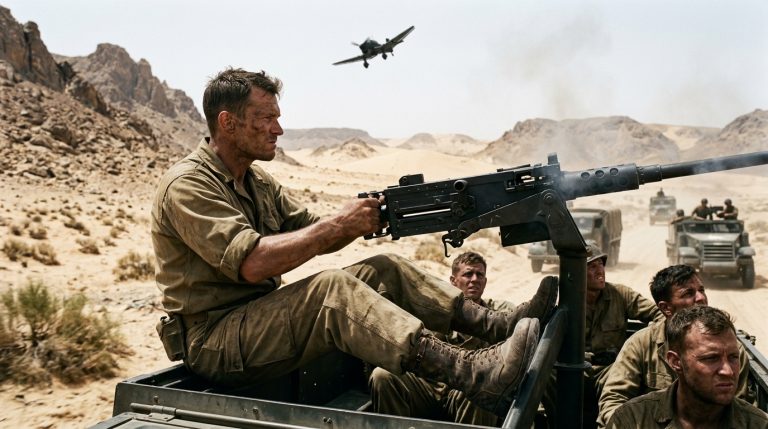
Captain Thomas Maguire yanked the control yoke hard to the left, his shoulder slamming violently against the armor plating.
Behind him, in the central nacelle, the oil-sealed Manila hemp tightened with a sharp, metallic twang that vibrated straight through his spine.
A stream of twenty-millimeter tracers ripped through the empty space his cockpit had occupied half a second prior.
The enemy Zero banked sharply out of the clouds, its pilot expecting a predictable American recovery arc.
Instead, the improvised hemp linkage jerked the control surfaces autonomously, snapping the twin-boom fighter into an erratic, jarring evasive roll before human muscles could even register the threat.
Maguire fought the G-forces pressing his chest flat against the seat, his teeth clenched as he checked his instruments.
The airframe was intact, the oil-soaked fibers had held against the sudden mechanical shock, and the enemy pilot was overshooting his firing solution in absolute confusion.
The makeshift rigging worked. But down below, across the dispersal strips of Henderson Field, the higher brass was still staring at the logs with arms crossed.
CHAPTER 6: The Devil Reflex
“Forty-three percent lower loss rate,” Westbrook said, his voice flat, stripped of all prior condescension.
He didn’t look up from the casualty reports spread across his desk. The fountain pen stopped tapping, its polished silver clip catching the glaring Pacific light through the tent flap.
Red stood on the other side of the desk, his boots planted firmly on the coral dirt, his calloused fingers resting on the brim of his utility cap.
“The pilots are coming back alive, Captain,” Red said. “That’s what the rigging was built to do.”
Westbrook looked up, his eyes locking onto Red’s with the weary acknowledgment of an officer who had finally run out of administrative excuses.
The command reports from the 339th Fighter Squadron didn’t lie; the enemy was already whispering about an invisible reflex that defied tactical doctrine.
Higher headquarters had quietly signaled authorization for field production across all P-38 wings, bypassing the standard procurement channels entirely.
Westbrook pushed the official authorization order across the scarred wooden surface, his fingers lingering on the paper for a fraction of a second before pulling back.
“HQ wants these blueprints standardized,” Westbrook muttered, though a faint, tired wryness touched the corner of his mouth. “They want engineering diagrams, proper specs, and clean documentation.”
“Tell them to look in the salvage bin behind the maintenance tent,” Red replied, turning toward the flap. “The rope doesn’t care about paperwork.”
The sun dipped low over Henderson Field, casting long, sharp shadows across the coral revetments as the evening mechanics began their work in silence.
Red walked back to his workbench, picking up a frayed length of Manila hemp and sliding his thumb across the rough, oil-sealed fibers.
The tent was quiet now, stripped of the shouting, the skepticism, and the frantic urgency of a losing campaign.
He threaded a new coil through his fingers, tying off a knot that had nothing to do with textbooks and everything to do with common sense.
The work was simple, the materials were rough, and the road ahead was long, but the job was finally done.