Forging the Unsinkable Anchorage: How Granite Resolve and Dredged Seabeds Shattered the Atlantic Chokehold
CHAPTER 1: THE IMPOSSIBLE HORIZON
The wind off the Great Sound carried the sharp bite of salt and the heavy, unchanging heat of a limestone shelf that refused to give an inch.
Lieutenant Commander Vance jammed a wooden survey stake into the crumbling earth, his palm stinging from the impact of the mallet. The ground beneath his boots was nothing more than a fractured spine of rock, tilted at an unforgiving angle toward the churning surf.
Around him, the island of Bermuda offered twenty-one square miles of fragmented hills, hidden reefs, and narrow coves. It was a picturesque paradise for tourists, but for a military needing to land heavy four-engine bombers and patrol flying boats, it was a cruel joke of geography.
Every engineer who had walked these ridges before him had shaken their head and delivered the exact same verdict. There was simply no room to build. No flat expanse for a tarmac, no natural apron for a hangar, and no margin for error.
Vance pulled a crumpled blueprint from his back pocket, the paper damp with sweat and curling at the edges against the humid air. The lines drawn in Washington assumed broad, level plains that simply did not exist beneath his feet.
Across the water, the colonial officials in Hamilton were already registering their quiet, furious protests against an occupation they had never agreed to. They viewed the incoming machinery and surveyors as an invasive nuisance disturbing their peaceful isolation.
Vance did not care about their politics, nor did he care about the comfort of the bureaucrats three thousand miles away. He stared down at the shallow, turquoise water lapping against the base of the ridge, watching the dark shadow of a coral reef shift beneath the surface.
The mainland was starving for fuel and steel, and the Atlantic shipping lanes were bleeding ships faster than the shipyards could lay keels. If the land above water was entirely unusable, the answer would have to come from somewhere else entirely.
He gripped the heavy iron handle of his transit scope, adjusting the lens until the salt-crusted horizon snapped into sharp, unforgiving focus. The margin between survival and disaster was measured in inches of displaced water and tons of compressed stone.
Vance adjusted his grip on the scope, his knuckles white against the battered brass, and turned his back on the disapproving whispers drifting up from the town. The mountain would not move, so they would have to build the ground beneath it.
CHAPTER 2: THE SECRET DISPATCH
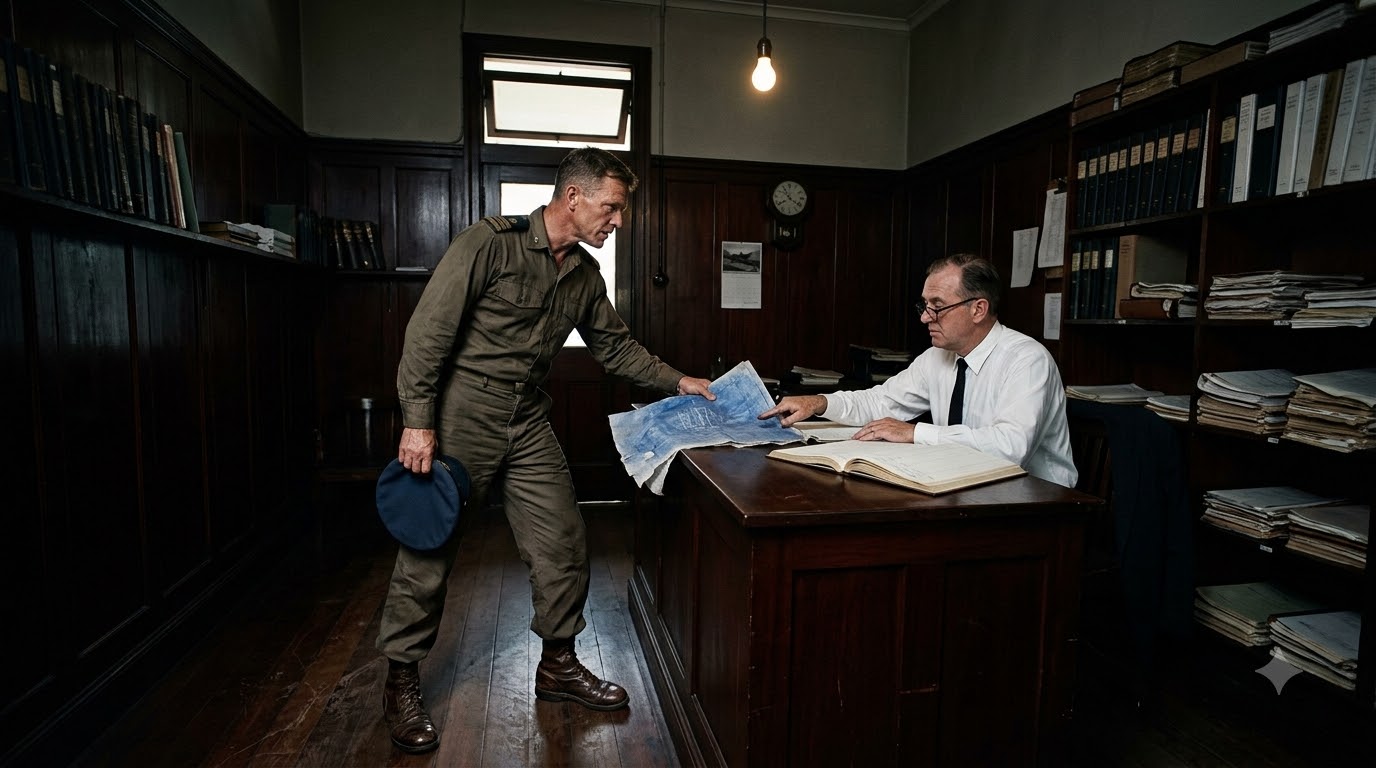
The clerk behind the mahogany counter did not look up from his ledger. He adjusted a pair of wire-rimmed spectacles, his thumb tracing a column of figures with deliberate slowness.
Outside, the distant hum of civilian tugboats in Hamilton Harbor provided a steady, irritated counterpoint to the ticking clock on the wall.
—We received your survey markers on the western ridge, the clerk said, his voice flat and devoid of warmth. They have a rather unfortunate habit of disturbing local property boundaries.
Vance stepped closer, planting his boots on the polished floorboards. He laid the damp blueprint down directly over the clerk’s ledger.
The paper hissed softly as moisture met dry ink.
—Those markers define the only path to keep a convoy afloat in the mid-Atlantic, Vance said, his tone low and level. U-boats aren’t waiting for your zoning board to finish tea.
The clerk slid the blueprint back across the wood with a single ink-stained finger. He didn’t blink.
—The Crown does not appreciate being bypassed by executive signatures from Washington. Your engineers have no local permits, no allocated labor pools, and certainly no authority to level private coves.
A faint, out-of-place scent of diesel oil drifted in through the open transom window, smelling entirely wrong for a quiet colonial courtyard. Vance caught the subtle scent instantly, his eyes narrowing as he scanned the harbor view.
Someone was moving heavy equipment through the back channels without customs clearance, bypassing the very bureaucracy that was trying to choke his project.
—You call it a permit problem, Vance muttered, pressing his palms against the edge of the counter. I call it a five-hundred-mile gap in the sky where merchant sailors are drowning every twenty-four hours.
The clerk finally raised his chin, his expression hardening into a wall of unyielding administrative obstruction.
—You may find, Commander, that paper is much harder to move than rock. You have no workforce here, and no amount of American blueprints will turn coral sand into a runway.
CHAPTER 3: THE DREDGE AND THE DEPTH
The clamor of iron teeth scraping against submerged coral echoed across Ellie’s Harbor long before sunrise.
Vance stood on the bouncing deck of a utility barge, his boots vibrating against rusted steel plates as the massive crane lowered a steel bucket into the murky turquoise green.
The substrate below was soft, unstable limestone sediment—material that every local contractor swore would slide back into the sea the moment a heavy hangar roof touched down.
—We are dumping three tons of crushed aggregate per minute, and the current is washing half of it back into the channel, shouted Miller, the chief dredge operator, wiping grease from his forehead with a filthy rag.
Vance didn’t answer right away. He reached down and scooped a handful of the wet, gray spoil from the hopper, feeling the sharp, jagged edges of crushed coral grind against his palm.
It was unstable only if they treated it like dry earth.
—Stop dumping in mounds, Vance shouted back over the roar of the diesel generator. Layer it. Compact every single foot before you drop the next lift.
The operator stared at him through a mask of sweat and salt spray, his jaw tightening in stubborn resistance.
—We don’t have the heavy rollers for that kind of systematic packing, Commander. The equipment list from Washington left them off the manifest.
—Then weld steel tracks to the bulldozers and drag the weight across it ourselves, Vance muttered, tossing the wet grit back into the bin. We aren’t waiting for another supply ship.
The bucket dropped again with a heavy, muffled thud that vibrated straight up through the soles of Vance’s boots, driving deeper into the harbor floor to carve out the foundation of an impossible airfield.
CHAPTER 4: THE BLACK PIT
The wireless receiver in the makeshift operations hut spat out Morse code with a relentless, clicking stutter that grated on raw nerves.
Outside, the Atlantic rolled in unbroken swells across a thousand miles of water where no friendly aircraft could reach.
—Another three tankers went down off the southern corridor before midnight, muttered Jennings, wiping the grease from his telegraph key with a stained sleeve.
Vance leaned over the chart table, his finger tracing the blank expanse of ocean between Newfoundland and the islands. It was a vast, lawless corridor where wolf packs hunted in broad daylight without fear of a shadow overhead.
—They are running on the surface because they know the sky is empty, Vance said, his voice dropping into a flat, heavy monotone.
The silence in the room stretched thin, broken only by the steady, rhythmic thrum of the diesel pumps outside trying to manufacture land where the maps said none could exist.
—If we don’t get these seaplane ramps finished before the next moon cycle, Jennings added, tapping a pencil against the map edge, the supply lines won’t just stretch—they’ll snap entirely.
Vance did not look up from the grid coordinates, his eyes locked on the narrow window where the sun was beginning to bleed red over a hostile sea.
CHAPTER 5: THE FIRST STRIKE
The Martin Mariner cleared the limestone ridge with inches to spare, its wings shuddering under the heavy load of depth charges slung beneath the fuselage.
Lieutenant Schrader didn’t look back at the makeshift tarmac behind him as he pointed the nose southeast toward the open Atlantic.
—Radio direction-finding just pinned a transmission thirty miles west of Bermuda, Jennings shouted through the open hatch, his voice competing with the deafening thunder of the radial engines.
Vance stood on the observation ramp, his boots braced against the saltwater spray kicked up by the seaplane’s hull as it planed across the newly dredged channel.
The enemy had spent two years treating these waters as an open resort, surfacing in broad daylight because no land-based eye could reach them.
—They think the distance protects them, Vance muttered, gripping the cold iron stanchion as the aircraft lifted clear of the swells.
There was no room for hesitation, and no luxury of pre-existing perfection; they had carved this runway out of submerged coral silence specifically for this exact second.
The engines roared higher, driving the heavy flying boat straight into the blinding glare of the midday sun where an arrogant target was idling on the surface.
CHAPTER 6: THE UNBROKEN LINE
The heavy vibration of the concrete apron beneath the maintenance sheds had finally settled into a dull, permanent hum.
Local officials who had once sworn that federal surveyors would never alter a single stone of their pristine coves now walked past reinforced tarmac without raising a word of protest.
—The fuel tanks are fully pressurized, and the second batch of patrol aircraft just touched down on schedule, Jennings reported, tossing a clipboard onto the heavy oak desk with a satisfying clatter.
Vance didn’t look up from the master logistics ledger, his thumb tracing the column of figures that proved every ton of dredged coral had served its purpose.
The impossible geography of an isolated limestone archipelago had met an immovable wall of common-sense engineering and sheer, stubborn execution.
—Let them keep their protests in the filing cabinets, Vance said, his voice dropping into a quiet, gravelly cadence. The supply lanes across the Atlantic are wide open, and the wolf packs have lost their dark playground.
Outside, the late afternoon sun glinted off miles of flat concrete where deep ocean water had once rolled completely unchecked.
The base was built, the manufactured land was holding firm against the tides, and the vital highway of ships was finally secure.