The Dusty Convoy That Broke the Luftwaffe Over the Tunisian Sands Through Relentless Iron and Common Sense
CHAPTER 1: THE ROUTINE RUN
The grit of the Tunisian desert worked its way into the seams of the canvas seats and coated every dry throat in the column.
Staff Sergeant Miller wiped a greasy thumb across his forehead, smearing sweat and fine dust into a dark stain.
Around him, thirty trucks and half-tracks crawled forward in a ragged, dusty line, their tires grinding against the sun-baked sand.
For months, the talk along these supply roads had been simple survival and the constant expectation of death from above.
The British columns had suffered for years under the casual, unchallenged strafing runs of the Luftwaffe veterans.
Miller adjusted his grip on the steering wheel, his knuckles scarred and dry from the relentless wind.
He didn’t consider himself a tactician or a hero; he was just a mechanic trying to keep a heavy engine running under impossible conditions.
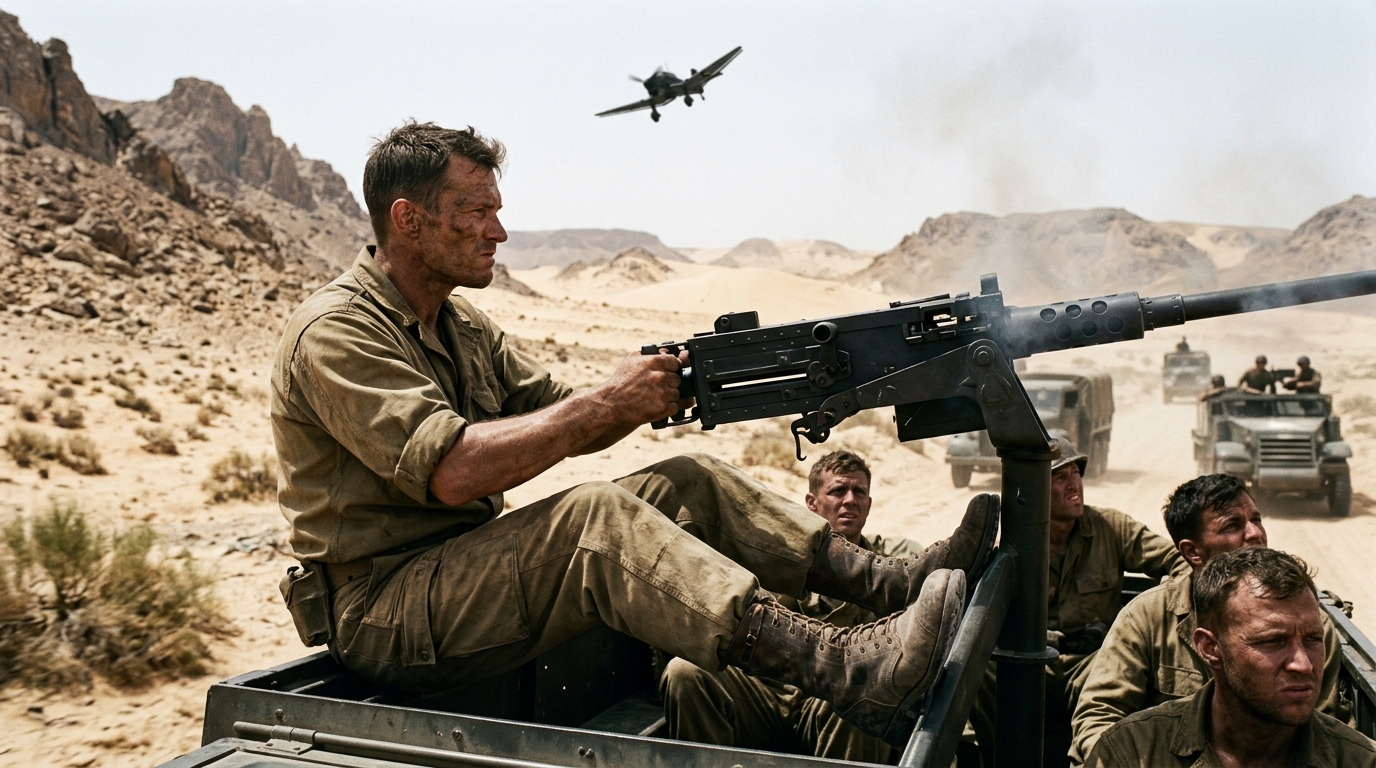
Behind him in the bed of the half-track, the heavy steel receiver of a Browning M2 sat bolted to its pedestal mount.
The sun beat down on the dark metal, making it too hot to touch with bare skin without a rag.
Up ahead, the horizon wavered behind shimmering waves of heat, hiding the jagged contours of the mountain passes.
The air was dead and heavy, carrying only the grinding mechanical rhythm of the convoy and the dry rasp of breathing.
Then the steady roar of truck engines was abruptly punctured by a sharp, descending whine from the upper atmosphere.
Miller didn’t waste time looking for a radio or waiting for an order.
His boots slammed onto the floorboards as his right hand dropped instantly from the steering wheel to grasp the cold, scarred steel charging handle of the heavy gun behind him.
CHAPTER 2: THE FIRST DIVE
The heat coming off the metal receiver bit into Miller’s palm, but he ignored the sting as he yanked the heavy bolt back and let it slam forward with a sharp, metallic clack.
Above them, the German fighter dropped out of the blinding glare of the sun, its tapered wings leveling off into a steep, terrifyingly familiar descent.
Miller squinted through the flying sand, his boots braced hard against the vibrating floorboards of the half-track as the engine beneath him roared in protest.
Veterans along the column knew this routine all too well from the long, miserable months of watching British supply lines get chewed to pieces without a proper word of defense.
The enemy pilot was coming in low, banking slightly to line up the center of the convoy with the casual arrogance of a hunter targeting tethered livestock.
Miller didn’t waste breath shouting orders over the deafening mechanical clatter of thirty trucks grinding through the rifts of sand.
Instead, his eyes locked onto the dark, receding speck of the aircraft, calculating the exact angle of the dive while his left hand tightened its grip on the butterfly trigger.
The enemy aircraft grew larger in the frame of the gun sight, its wings spreading wide as the pilot prepared to walk his fire straight down the packed column of vehicles.
A faint, out-of-place scent of scorched oil drifted past Miller’s nose from the half-track’s straining radiator, anchoring him completely to the gritty reality of the moment.
The Messerschmitt crossed an invisible threshold in the sky above the lead vehicles, its nose dipping lower as the pilot committed fully to the strafing run.
Miller tilted the heavy barrel upward, his muscles locking tight against the weight of the gun as he tracked the screaming shadow tearing across the sky.
CHAPTER 3: THE WALL OF IRON
The nostalgic illusion of an easy target shattered the second Miller squeezed the dual butterfly grips.
The Browning roared to life with a violent, rhythmic slamming that rattled teeth and rattled the very chassis of the half-track.
Streams of orange tracer fire converged into the sky, weaving an inescapable web of heavy metal directly into the path of the diving fighter.
Beside him, the gun barrel smoked under the fierce desert sun, radiating intense heat that stung his forearms.
Down the column, thirty other heavy weapons erupted in unison, transforming the dry highway into a ferocious defensive fortress.
The sheer volume of converging projectiles tore through the air, creating a wall of steel that defied the standard rules of aerial combat.
The enemy pilot tried to pull up and bank away, but the calculated lead of the ground fire was already rewriting the mathematics of survival.
Heavy rounds tore through the aircraft’s thin aluminum skin with terrifying ease, punching clean holes through the engine cowl and shattering the cooling system.
Thick black smoke belched from the stricken machine as it shuddered violently under the impact of half-inch armor-piercing projectiles.
Miller kept his shoulders braced against the recoil, his eyes locked on the twisting trajectory of the failing aircraft until it stalled sharply and tumbled toward the dunes.
CHAPTER 4: THE ABORT REFLEX
The acrid smell of cordite hung thick and greasy around the half-track, stinging the back of Miller’s throat as he let go of the warm grips.
Up ahead, the second attacking fighter pulled out of its dive with a violent, banking jerk, its engine screaming under emergency throttle.
The pilot had seen what happened to his wingman and was taking zero chances with the wall of half-inch lead rising from the convoy.
Miller wiped a streak of black soot from his cheek, watching the enemy aircraft streak back up toward the blinding blue sky with its bomb loads still attached.
They weren’t pressing the attack anymore; the casual confidence of the Western Desert had evaporated into pure, raw self-preservation.
Across the stationary vehicles, other drivers were lowering their barrels, their shoulders slumping slightly under the sudden weight of the quiet.
A gravelly voice broke through the silence from the cab of the truck behind him—We just ruined their whole afternoon, Sergeant.
Miller didn’t smile, instead reaching down to check the ammunition belt feeding smoothly into the receiver tray.
The doctrine up in the high command offices might have taken years to sort out, but out here on the dusty tracks, the math was simple and brutal.
You give an everyday truck driver a heavy gun that reaches six thousand meters, and suddenly the sky stops belonging to the bullies.
CHAPTER 5: THE SHATTERED SQUADRON
Deep inside the tactical command tents behind enemy lines, veteran officers stared at daily loss returns that painted a grim and unsustainable picture.
Elite formations that had dominated the skies over three continents were being systematically ground down to absolute nothingness by ordinary truck drivers.
Senior commanders tried to issue rigid directives demanding alternate approaches, refusing to accept that their entire operational blueprint had broken down.
They insisted that aggressive low-level passes must continue, blaming pilot hesitation rather than acknowledging the sheer wall of heavy metal waiting below.
Yet the pilots on the ground knew the lethal math far better than the planners miles away in the rear.
When orders came down to press the attack against American supply columns, veteran fliers exchanged dark, exhausted looks across cold briefing tables.
One squadron leader slammed his leather glove onto the map desk—They expect us to fly into a wall of half-inch lead and call it strategy.
The institutional arrogance of the high command collided hard with the brutal reality of massed ground firepower in every briefing room.
Every surviving veteran understood that the skies over North Africa were no longer a safe hunting ground, but an open graveyard for anyone flying low.
Miller didn’t need to see the command reports to know the enemy was fracturing; he could see it in the way the remaining fighters stayed high, distant, and utterly powerless.
CHAPTER 6: THE NEW NORMAL
The grinding roar of the convoy finally died down as the last truck rolled to a halt in the designated staging area.
Miller cut the engine, the sudden quiet ringing sharply in his ears as the hot radiator hissed in the dry air.
Around him, drivers climbed down from their cabs, stretching stiff backs and wiping sweat from tired eyes without a word spoken.
They didn’t celebrate or boast about the fight; they simply went to work checking oil levels and clearing dust from the heavy receivers mounted behind their seats.
The enemy pilots had learned their lesson the hard way, leaving the supply routes open and quiet under the blazing North African sun.
Miller reached down into the footwell of the half-track, his fingers brushing against a single, unspent brass casing resting quietly in the dust.
He picked it up, feeling the smooth, cold metal contrast against the searing heat of the surrounding desert.
It was just a piece of shaped copper and lead designed by a mechanic from Utah decades ago, but it had entirely rewritten the rules of modern war.
A common-sense doctrine of giving every working vehicle a heavy voice had turned ordinary drivers into an impenetrable shield against airborne arrogance.
Miller slid the cold brass shell into his pocket, climbed back into the driver’s seat, and waited for the signal to roll forward into the silence.