The Concrete Covenant: A Hardboiled Neo-Western of Stolen Soil and Federal Retribution
CHAPTER 1: DUST AND CONCRETE
The desert grit in my combat boots hadn’t even settled before the red clay of Corner Meadow scraped against my soles. Twelve months in the sandbox, managing logistics under mortar fire, and the smell of diesel fuel still clung to my fatigue jacket. I expected the quiet. I expected the hush of the old white oak tree where I’d scattered Sarah’s ashes three years ago after cancer ate her down to forty pounds.
Instead, three three-story stucco monstrosities stared back at me.
Freshly poured concrete driveways cut straight through the wild clover. Manicured turf covered the soil where Sarah’s garden used to bloom. On the upper balcony of the middle mansion, a guy in a tailored polo shirt was sipping espresso, looking down at my battered Ford F-150 like I was a lost delivery driver.
I didn’t yell. I didn’t reach for anything in my truck. I rolled the brass Zippo lighter in my right pocket, my thumb clicking the heavy metal lid open and shut in a slow, steady cadence. Snap. Click. Snap. Click.
My eyes mapped the ground automatically. The old property iron marker—a rusted iron pin my grandfather Ezra drove into the dirt in 1952—was gone. In its place stood a white surveyor’s stake painted in blinding pink. They had cut forty feet into my lot line. Minimum.
A white Range Rover pulled up onto the gravel shoulder, its tires crunching with heavy precision.
The driver’s door opened, and Vivien Ashworth stepped out. Forty-eight years old, immaculate blonde bob, manicured pink nails sharp enough to strip copper wire. She held a clipboard like a shield.
“Marcus,” she said. Her voice was smooth, dipped in the fake warmth of a high-end realtor. “You’re back early. We handled your… situation.”
“My situation,” I said. My voice was low, flat, stripped of juice.
“The county issued an abatement order four months ago,” she replied, sliding a sheet of paper off her clipboard. She didn’t hand it to me; she held it out just far enough that I’d have to step into her space to read it. “Abandoned structure, pest harboring, unmaintained brush. The HOA had to step in to protect community standards. It was all handled through proper legal channels.”
I didn’t reach for the paper. I looked past her shoulder at the foundation wall of the nearest mansion. The concrete footings sat directly over the root system of the stump where Ezra’s oak had been felled. Fresh saw-dust still drifted in the weeds near the property edge.
“That oak was planted in 1952,” I said.
“It was a hazard, Marcus,” Vivien said, her smile tightening by a millimeter. The fake warmth slipped, revealing the cold porcelain underneath. “You should be thanking us. Your remaining land value tripled the moment we broke ground on these lots. You were gone. The neighborhood couldn’t wait for a ghost.”
Snap. Click. The Zippo lid closed in my pocket.
“My grandfather bought this two point three acres with his GI Bill,” I said softly. “The deed is registered at the county courthouse.”
“And the county courthouse signed off on the boundary adjustments,” Vivien countered instantly. She turned back toward her Rover, her heels clicking against the asphalt. “If you have questions, contact the HOA legal representative, Mr. Crest. But don’t cause a scene, Marcus. People live here now. High-value families.”
She got back into her SUV and pulled away, kicking up a small cloud of red dust that settled on my boots.
I stood in the driveway for a long minute. The espresso drinker on the balcony had gone inside. The silence of the meadow was gone, replaced by the low hum of central air conditioning units running on stolen ground.
I walked over to the edge of the new asphalt driveway. I knelt down, pushed my fingers into the loose dirt right at the edge of the encroachment line, and pulled up a chunk of concrete slag left by the construction crew. Underneath it, half-buried in the clay, was a torn plastic plant tag from Sarah’s memorial garden—Rosa rugosa.
I wiped the red mud off the tag and slid it into my breast pocket next to my discharge papers.
They thought I was just another broke, grieving veteran who’d sign a settlement check and disappear into a VA apartment. They thought three deployment years meant my brain was fried and my pockets were empty.
They didn’t know about Ezra’s foot locker sitting in the basement. They didn’t know about the survey maps drafted before Vivien Ashworth was even born.
I turned back to my truck, cranked the engine, and put it in gear.
CHAPTER 2: PAPER WEAPONS
The vinyl steering wheel of the F-150 was cold against my palms. Morning sun glinted off the pitted glass of the windshield, casting long shadows across the passenger seat where Ezra’s manila envelope lay flat.
I didn’t open it yet. I knew the contents by heart—the crisp typewritten lines from the Department of Veterans Affairs, dated November 14, 1952. 2.3 Acres, Parcel 402, Corner Meadow.
I shoved the truck’s heavy driver-side door open. The hinge groaned—a dry metal-on-metal rasp that cut through the early municipal quiet of the county courthouse square.
The basement of the Land Records Administration smelled of ancient paper, damp concrete, and the bitter tang of industrial floor polish. A solitary clerk sat behind a scratched Plexiglas counter, chewing on a plastic straw while tapping rhythmically on a mechanical keyboard.
“Public terminals are on the left,” she said without looking up. “Ten cents a page for digital prints. Quarter for microfilm.”
“I need the original plat maps for Corner Meadow,” I said. “Parcel 402. Specifically the utility and abatement filings from the last twelve months.”
Her eyes flicked up, taking in my faded field jacket, the dust still clinging to my boots, and the flat tone in my voice. She didn’t offer a polite greeting. She just slid a metal request slip toward me across the counter.
“Parcel ID and date range.”
I filled it out in block letters using a stubby graphite pencil chained to the desk. Ten minutes later, she returned from the rear archives lugging a heavy ledger and a stack of blue-lined survey printouts, dumping them onto the scarred wooden counter with a dull thud.
I turned the pages slowly. Every leaf was a record of legal violence.
There it was. An emergency easement filing dated eight months ago—right while my unit was conducting convoy security through the Syrian border corridor.
The signature at the bottom belonged to Derek Ashworth. Chief Building Inspector for the district. Vivien Ashworth’s brother-in-law.
I pulled my thumb across the paper. The county seal was pressed deep into the heavy bond, but the ink on the inspector’s signature was strangely sharp, unfaded by the humidity of the basement vault.
“Look at the date,” I muttered to myself.
I flipped to the attached survey overlay. The original boundary line—the one drawn by the federal land agent in 1952—had been traced over in black ink. But underneath the heavy line, if you angled the paper against the buzzing fluorescent light overhead, the original blue ghosting was still visible.
They hadn’t re-surveyed the land. They had simply drawn a new line forty feet to the east and stamped it ABATED / ABANDONED.
The math was brutal. By declaring my front acreage an abandoned pest hazard, the HOA had cleared the path for a municipal variance. Ashworth Premier Properties—Vivien’s firm—had purchased the “abated” setback rights for six hundred dollars at a closed county auction. Two weeks later, they sold those same forty feet to the residential developers for four hundred and twenty thousand.
A sudden white glare hit the counter beside my arm.
I didn’t flinch. I turned my head slowly.
Standing by the archive entrance was a man in an ironed navy suit, holding a crisp white envelope in his left hand. His leather oxfords didn’t have a single speck of county dust on them.
“Mr. Holloway,” he said. His voice was smooth, trained, and completely devoid of inflection. “I was told I might find you here. I’m Jonathan Crest. I represent the Corner Meadow Homeowners Association.”
He didn’t offer to shake hands. He simply set the white envelope directly on top of my grandfather’s 1952 plat map.
“You’re trespassing on common property, Mr. Holloway,” Crest said, leaning his hands slightly on the counter. “Walking the perimeter line this morning constituted a direct violation of the updated HOA covenants. Section 4, Paragraph B. We’ve issued a cease-and-desist.”
I looked at the legal paper. Notice of Intent to Pursue Injunction for Harassment and Property Defamation.
“Your client built a foundation over my wife’s grave site,” I said. My thumb tapped the edge of the wooden counter once.
“The county records indicate the parcel was abated due to owner negligence,” Crest replied smoothly, leaning closer. “The current homeowners bought their titles in good faith through Ashworth Premier Properties. They have full title insurance. If you continue to harass the residents or disrupt the survey markers, my firm will file for an immediate emergency restraining order. You’ll be picked up before nightfall.”
He turned on his heel, his soles clicking with calculated rhythm against the linoleum floor as he walked toward the exit stairs.
I didn’t run after him. I didn’t shout.
Instead, I reached into my pocket, pulled out the graphite pencil stub, and carefully wrote down the document filing number from the bottom of Derek Ashworth’s fake abatement permit.
Then, I looked closely at the margin of the original 1952 plat map beneath Crest’s notice. Tucked into the fine print near the bottom border, where the federal surveyor had signed his name, was a small, faded blue stamp I hadn’t noticed before:
Subject to Federal Drainage Easement — The Blackwood Stream System. Non-transferable.
I pulled my phone from my jacket, dialed a local number I’d saved three years ago, and waited for the line to connect.
“Rebecca?” I said when the voice answered. “It’s Marcus Holloway. I’m at the courthouse. I need an independent surveyor who doesn’t take checks from the county board.”
CHAPTER 3: THE LINE IN THE DIRT
“I’m sending Miller,” Rebecca said through the speaker. Her voice was clipped, surrounded by the background clatter of a busy legal office. “He doesn’t owe Ashworth Premier Properties a dime. But Marcus—if he puts his tripod on that lot, Vivien’s going to notice.”
“Let her,” I said into the receiver, my hand still resting on the cool wood of the archive counter. “I’m heading back to the meadow.”
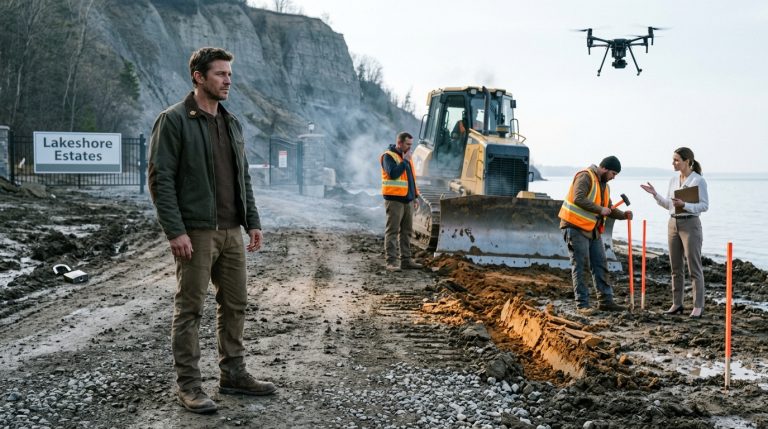
Three hours later, the afternoon heat was baking the damp earth along the northern border of Parcel 402.
Miller was sixty, thick-waisted, and wore a sun-faded canvas vest packed with brass plumb bobs and field notebooks. He didn’t talk much. He just set up his total station tripod on the gravel shoulder, leveled the sights with steady hands, and walked the perimeter with a yellow steel measuring wheel.
Click-click-click-click.
The metallic ticking of the wheel was the only sound in the meadow, cutting through the hum of the air conditioners humming inside the three new mansions. I stood near the edge of my drive, a cold paper cup of gas station coffee in my hand, watching the red laser point freeze on the corner of the middle mansion’s garage.
Miller stopped. He squinted through his lens, checked his digital readout, then looked down at a faded blue topographical map pinned to his clipboard. He took off his hat, wiped his forehead with the back of his forearm, and turned to me.
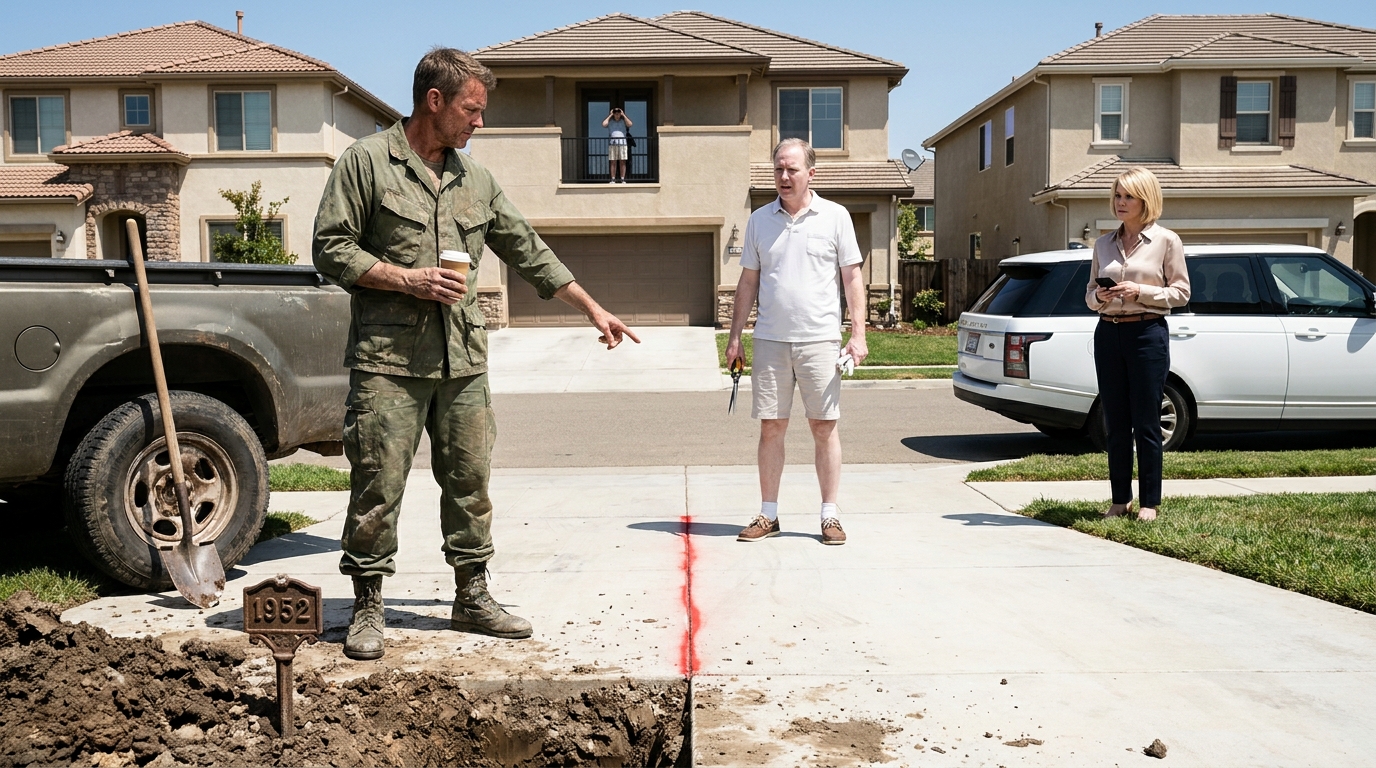
“Your pin isn’t gone, Marcus,” Miller said, pointing a calloused finger toward the manicured lawn of House 2. “They buried it under six inches of decorative river rock and topsoil.”
I walked over. He handed me a small entrenching spade from his truck bed.
I didn’t hesitate. I drove the blade through the fresh sod, turning over a square of lush green grass until the spade struck solid steel with a sharp clink.
I scraped back the dark mud. There it was. Ezra’s original iron marker, heavily oxidized, stamped with the federal survey mark from 1952.
Miller set his prism pole directly on the iron head. He pressed the button on his receiver. The device beeped twice.
“Forty-two feet,” Miller said softly. He pulled out a red grease pencil and drew a bright line across the fresh concrete driveway of House 2, continuing the mark right across the stone walkway. “The entire southwest corner of this house sits squarely on your deeded parcel. Same for the septic tank on House 1 and the rear patio on House 3.”
“Total square footage?” I asked.
“Point six-six acres,” Miller replied. “Over twenty-eight thousand square feet of physical encroachment. Combined structure value sitting on your dirt? Easily three million.”
A screen door slammed.
David, the tech executive who lived in House 2, came down the front steps. He was in shorts and a polo, holding a pair of garden shears, looking bewildered by the red grease mark spanning his pristine driveway.
“Hey,” David called out, his voice hesitant. “What’s going on out here? You can’t draw on the concrete, man.”
“I’m not man,” I said, setting the spade down against my truck tire. “I’m your neighbor. And this line marks where my grandfather’s property begins.”
David stopped ten feet away. His gaze moved from the red line on his driveway down to the exposed iron pin sitting in the muddy hole I’d dug. His knuckles whitened around the handles of his shears.
“What are you talking about?” David asked. His voice dropped an octave, the arrogance slipping into genuine confusion. “We bought this house through Ashworth Premier six months ago. Clean title. Everything was clear.”
“Ashworth forged the abatement variance,” I said flatly. I pulled a folded copy of the county record from my field jacket and held it out. “Your garage sits on my late wife’s garden. Your title insurance is about to become a very expensive piece of paper.”
David didn’t take the paper. He looked at the red grease line, then up at the balcony of House 3, where another neighbor was watching through the glass. The color drained from his face, leaving his skin a pale, sallow gray under the afternoon sun.
Before he could answer, the sharp blare of a horn echoed down the lane.
Vivien Ashworth’s white Range Rover pulled up onto the grass shoulder, blocking Miller’s survey truck. She slammed her door and marched toward us, her manicured hands tight around her smartphone.
“Miller!” she shouted, ignoring me completely. “I know who pays your license! You take that tripod down right now or I’ll have county sheriff’s deputies on this road in five minutes!”
Miller didn’t even look up from his notepad. “Call ’em, Vivien. I’m marking a registered federal benchmark. Interference with a licensed survey is a Class B misdemeanor in this county.”
Vivien’s jaw tightened. She turned her glare onto me, her eyes burning with a cold, calculated fury that had nothing to do with property lines and everything to do with authority slipping through her fingers.
“You think this makes you clever, Marcus?” she hissed, her voice low enough so David wouldn’t hear every word. “You think some old dirt map stops a multi-million-dollar development? You’re a broke veteran living in a rotting ranch house. I have six board members and three law firms on retainer.”
“You have three houses built on stolen soil, Vivien,” I said. I tapped the Zippo in my pocket with my thumb. Snap. “And an emergency HOA meeting scheduled for tomorrow night. I suggest you bring your brother-in-law.”
She stared at me for three long seconds, her chest rising and falling beneath her silk blouse. Then she turned on her heel, her phone already pressed to her ear as she marched back to her SUV.
“Crest,” she barked into the receiver as she pulled away. “Get the board together. Tomorrow at six. We’re executing the emergency assessment.”
David remained standing on his marked driveway, staring at the exposed iron pin in the dirt. He looked at me, his eyes wide with a sudden, suffocating realization.
“My daughters’ bedrooms,” David whispered, his voice trembling. “They’re on the second floor… right over that line.”
“I know,” I said softly, picking up my spade. “You’d better call your bank.”
CHAPTER 4: THE WEAPONIZED SERVICE
David’s hands remained clamped around the handles of his garden shears, his knuckles white, his eyes fixed on the red grease mark spanning his driveway. I didn’t offer him empty comfort. I simply pulled my entrenching spade out of the turf, kicked the sod back over Ezra’s iron pin, and walked back to my truck.
The next twenty-four hours passed in a blur of calculated preparation.
At six o’clock the following evening, the community center hall smelled of industrial carpet cleaner, stale drip coffee, and damp raincoats. The room was packed shoulder-to-shoulder with thirty residents, split down the middle—the long-time owners from the south side sitting in silent discomfort, and the new homeowners from the hillside sitting close together in polished fleece jackets and designer coats.
Vivien Ashworth sat at the center of the folding head table, flanked by Attorney Crest and her brother-in-law, Derek.
A heavy projector screen hung behind them, casting a pale blue glow across the front row. On the table before Vivien sat a thick stack of fresh, collated packets bound in blue cardstock.
“We will come to order,” Vivien announced. Her voice didn’t need a microphone; it cut through the room’s ambient hum like a razor through cardboard. She didn’t look at me where I sat in the third row, my brass Zippo resting inside my pocket, my thumb resting quietly against its steel hinge.
“Tonight’s emergency session addresses an escalating safety and financial risk to our development,” Vivien continued, resting her manicured hands flat on her presentation binder. “Over the past forty-eight hours, former resident Marcus Holloway has engaged in unauthorized, aggressive land surveying and verbal intimidation of our homeowners.”
A quiet rustle rippled through the audience. Mrs. Naomi, sitting two seats to my left, gripped her vinyl handbag so tightly the synthetic leather groaned.
Crest stood up, adjusting his tie with a quick, practiced flick of his fingers. He clicked a remote. The projector flashed a slide onto the screen: a cropped photo of me standing on David’s driveway holding the entrenching spade, my face cast in deep shadow beneath my cap.
“Mr. Holloway returned from military deployment three days ago,” Crest said, his tone measured, clinical, and completely stripped of heat. “While we respect military service, we must recognize the reality of high-stress combat transitions. Mr. Holloway has repeatedly exhibited disoriented behavior, claiming property rights based on obsolete maps and refusing to acknowledge valid county abatement orders.”
He clicked the remote again. A second slide appeared—a scanned copy of an assessment invoice made out to my address.
“To protect property values and secure our perimeter,” Crest said, “the board has voted to levy an emergency legal defense assessment of fifteen thousand dollars against Parcel 402, due immediately. Furthermore, a daily non-compliance fine of five hundred dollars will accumulate until Mr. Holloway removes his equipment and signs a formal acknowledgement of the board’s boundary authority.”
A collective sharp intake of breath echoed through the room. Fifteen thousand dollars was designed to force a immediate foreclosure lien before the month was out.
Vivien leaned forward toward the microphone, her eyes locked onto mine for the first time all night. Her expression was a masterclass in practiced concern.
“Marcus,” she said softly, her voice amplified across the hollow room. “We know you’re struggling. Re-adjusting after twelve months in a war zone is difficult. But you cannot project your trauma onto this neighborhood. The board has already reached out to Veterans Affairs social services to request a formal evaluation for your own safety—and the safety of the families around you.”
The room went dead silent. The weapon was obvious: paint the combat veteran as erratic, unhinged, and dangerous, making every legitimate survey map look like the delusion of a man suffering a breakdown.
Beside me, Mrs. Naomi’s breath hitched in anger. I didn’t move. My pulse stayed at a steady fifty-eight beats a minute—the same rhythm I kept when mortar sirens went off over the supply yard in Iraq.
I stood up slowly.
The metal legs of my chair scraped against the linoleum floor with a sharp, piercing screech. Crest instinctively stepped back half a pace toward the table.
“I don’t need a VA evaluation, Vivien,” I said. My voice wasn’t loud, but it carried to every corner of the ceiling rafters. “I had one on my way out of Fort Bliss last Tuesday. Passed with full clearance.”
I reached into my field jacket pocket and pulled out a single, folded sheet of paper—not the survey map, but a certified copy of the original 1952 deed I’d pulled from the courthouse vault that morning.
“You talked a lot about county abatement tonight,” I said, stepping into the center aisle. “And Mr. Crest spent three minutes showing a photo of me holding a shovel. But nobody opened the master covenant.”
Vivien’s smile didn’t fade, but her eyebrows twitched upward by a fraction of a millimeter. “The master covenants were updated by majority board vote four years ago, Marcus. You were notified by mail.”
“You updated the HOA bylaws,” I corrected, stopping five feet from the head table. “You didn’t touch the original federal deed. You couldn’t. Because Ezra Holloway didn’t buy this land from a private developer.”
I laid the paper flat on the table, right over Crest’s blue cardstock packets.
“1952 Veterans Settlement Covenant,” I said quietly, pointing my forefinger at the bold header near the bottom stamp. “Granted under federal land grant statutes. Clause 12-A clearly states that no municipal variance, county abatement, or private covenant can alter the original perimeter boundaries without a direct decree from the Department of the Interior.”
Derek Ashworth, sitting on Vivien’s right, suddenly leaned forward, his face turning the color of wet chalk as his eyes scanned the paragraph I was pointing at.
“Furthermore,” I continued, looking straight at Derek, “Clause 12-B states that any permanent structure erected within seventy-five feet of the northern line incurs an automatic daily federal penalty of two thousand dollars per structure, payable to the land grant holder, retroactive to the date of ground-breaking.”
Derek looked up at Vivien, his mouth opening slightly, but no sound came out.
Vivien didn’t look at the paper. She didn’t let her gaze drop for a second. But her right hand, resting on her binder, slowly clenched until her knuckles turned ivory beneath her polished skin.
“This meeting is adjourned,” Vivien said sharply, her voice dropping its artificial warmth completely. She slammed her binder shut. “Mr. Crest will handle all further communications with Mr. Holloway in writing.”
Nobody in the audience stood up. David, sitting four rows back, was staring at the back of Vivien’s head, his jaw tight, his hands clamped flat against his knees.
I picked my paper up off the table, folded it carefully along its original creases, and slid it back inside my jacket.
“See you in court, Vivien,” I said.
CHAPTER 5: PSYCHOLOGICAL SIEGE
The air outside the community center felt heavy with coming rain. I slid the folded 1952 deed into my breast pocket, my boots making a slow, deliberate cadence against the wet asphalt as I walked toward my truck. Behind me, the hall was still dead silent, the crowd watching Vivien Ashworth pack her leather briefcase with quick, jerky motions.
She didn’t wait for morning to hit back.
By 0700 the next day, the low rumble of heavy diesel engines rattled the glass in my kitchen windows. I stepped onto the porch with a mug of black coffee.
An unmarked orange utility truck sat parked on the gravel shoulder directly opposite my driveway. Two men in high-visibility vests were setting up traffic cones, dragging heavy black rubber conduits across my entrance line.
I walked down the steps. The morning air smelled of ozone and wet grass.
“County water district?” I asked, stopping at the boundary edge.
The supervisor—a guy with a stubbled jaw and an Ashworth Premier Properties logo stitched onto the chest pocket of his denim jacket—didn’t look up from his clipboard. “Main line inspection. Complaint filed regarding unmaintained plumbing creating a potential backflow hazard for the lower sub-division. Standard procedure.”
“You’re blocking my right-of-way,” I said softly.
“You got a complaint, talk to the HOA board,” he said, turning his back to drag a heavy iron shut-off wrench out of his truck bed.
Ten minutes later, my kitchen sink tap spluttered twice and went dry.
It was just the opening move. By noon, a letter arrived via courier—not from Crest’s firm, but from a private security agency operating out of the county seat. A notice that “perimeter surveillance cameras” were being installed along the common boundary paths to “monitor unauthorized vehicular access.” By three o’clock, a pair of black dome cameras on fifteen-foot steel poles were aimed directly at my front porch and my workshop garage door.
Every time I stepped onto my own porch, the motorized lenses hummed, tracking my movement like a pair of mechanical eyes.
I didn’t break windows. I didn’t yell at the security techs. I walked into the workshop, pulled my grandfather’s old battery-powered transistor radio off the shelf, tuned it to an empty AM frequency full of loud, static hiss, and set it on the windowsill directly beneath the nearest camera pole.
At five o’clock, Mrs. Naomi knocked on my side door.
She didn’t come up the front steps. She walked through the treeline along the eastern boundary, her blue canvas coat pulled tight around her shoulders, her hands tucked deep inside her pockets. Her face was pale, the skin around her eyes drawn tight with exhaustion.
“Marcus,” she whispered, stepping inside before I could even open the screen door all the way. She looked back toward the road twice. “They came to my house an hour ago.”
“Who?” I asked, pulling out a kitchen chair for her.
“Vivien and that lawyer,” she said, her voice trembling slightly as she sat down. She set a small, black handheld digital recorder on the formica table between us. “They offered to pay off my remaining municipal property taxes for the next five years. All I had to do was sign a statement saying I’d seen you acting erratically around the neighborhood… that you were making threats about burning down the new construction.”
I sat down across from her. “What did you tell them, Mrs. Naomi?”
“I told them my late husband fought in Normandy so people wouldn’t have to sign lies written by thieves,” she said. Her hands were shaking, but her jaw was set like cured oak. She pushed the digital recorder toward me with one finger. “I bought this at the pharmacy three years ago when Ezra told me to keep my eyes open. I kept it in my coat pocket while they were standing on my porch.”
I picked up the recorder. The casing was scratched, the plastic cheap, but the red LED indicator light was still glowing.
I hit play.
The tinny speaker crackled, then Vivien’s voice filled the quiet kitchen. Stripped of her public softness, her words were sharp, fast, and entirely businesslike.
…doesn’t matter what maps he pulled from the vault, Naomi, Vivien’s recorded voice said through the static. The county permits are logged under Derek’s office. The abatement is sealed. He doesn’t have the capital to fight a prolonged injunction. If you sign the affidavit regarding his mental state, we secure the temporary restraining order by Friday. He’ll be barred from within five hundred feet of the parcel boundary. The bank will foreclose on his remaining lot before winter.
Then came Derek Ashworth’s voice in the background, nervous and thin: Vivien, what if he brings up the old water survey from 1952? The one in the basement vault?
He doesn’t know about the easement details, Vivien snapped back on the tape. He thinks this is just a land dispute over forty feet of lawn. He has no idea what’s running under those foundations. Just get the affidavit signed so we can lock him out.
The recording clicked off. The kitchen was quiet except for the hum of the refrigerator.
I looked at the small black device resting in my hand.
They thought I was fighting for forty feet of dirt and a dead rose garden. They thought the forged county abatement was their shield—Layer 1, the decoy permit scam they’d used to fleece the county and pocket four hundred thousand in commissions.
They had no idea that the real trap wasn’t the abatement. It was the land itself.
“Keep this safe, Marcus,” Mrs. Naomi said softly, standing up and pulling her coat collar higher against her neck. “She’s going to try something worse before the week is out.”
“Let her try,” I said, sliding the recorder into my field jacket alongside my grandfather’s deed.
I walked her to the edge of the treeline, keeping my body between her and the security cameras on the pole. As she disappeared into the dusk toward her cottage, a cold rain began to fall, slicking the red clay along the property line.
I walked back to my porch, stopped under the black lens of the tracking camera, and took out my brass Zippo.
Snap. Click.
The small flame flickered in the dark, reflecting off the wet glass of the camera eye before I snapped the lid shut and went inside to lock the door.
CHAPTER 6: THE UNEARTHING
The bolt slid into the strike plate with a dull, heavy thunk. Outside, rain lashed the tin eaves, but beneath my boots, a low, rhythmic gurgling rose from the floorboards.
I stepped toward the cellar stairs. The air coming up from the basement smelled of wet lime, mud, and stagnant iron.
I grabbed my heavy flashlight off the kitchen peg and descended the wooden steps one at a time. The bottom two risers were submerged in three inches of murky brown water. The utility crew’s “backflow test” from earlier that morning hadn’t just shut off my clean line—they had capped the pressure valve, forcing groundwater up through the uncased sump drain.
My workshop was drowning.
Cardboard supply boxes floated near the stairs. I waded through the ice-cold water toward the far wall, my boots sloshing against the submerged concrete. Water was pooling heaviest behind my grandfather Ezra’s oak workbench—a six-hundred-pound monster built from rough-sawn two-by-fours and bolted straight into the foundation studs.
I set the flashlight on a high shelf, pulled an iron pry bar from my pegboard, and wedged the claw behind the workbench’s rear leg.
Creak. Snap.
The rusted lag bolts sheared off with a sharp crack that echoed off the damp masonry. I braced my legs against the wet floor, leaned my shoulder into the heavy oak table, and shoved.
The bench slid forward six inches, its iron legs scraping along the concrete floor.
Behind where the bench had rested for seventy years, tucked into a narrow dry recess behind the galvanized water heater, sat a long rectangular object wrapped tightly in oilcloth.
I reached into the dark alcove, my fingers brushing against coarse canvas stiff with age. The bundle was heavy—thirty pounds of solid metal. I lifted it out, water dripping from my sleeves, and laid it flat across the dry top of the workbench.
I unbuckled two cracked leather straps and unrolled the oilcloth.
Sitting inside was Ezra’s Foot Locker—a battered olive-drab steel chest stamped with faded yellow stenciling: PVT. E. HOLLOWAY — 1952. The brass latch was green with verdigris, sealed shut with a small iron padlock.
I didn’t have the key. I set the edge of my pry bar against the shackle and brought down a hard steel hammer with a swift, heavy blow.
Clang.
The shackle snapped. I lifted the heavy lid.
Inside, beneath a folded wool garrison cap and a tarnished Purple Heart medal, lay a thick manila folder marked with red grease pencil: EMERGENCY COVENANT — PARCEL 402.
My hands were cold, leaving damp smudges on the heavy bond paper as I lifted the top document.
It wasn’t a standard land survey. It was an official blueprint from the United States Army Corps of Engineers, dated September 1952. The map was detailed in faded white lines over cobalt blue paper.
A heavy dashed line traced a winding diagonal path straight across my property line, extending directly beneath the foundations of what were now Houses 1, 2, and 3.
Above the line, stamped in dark red ink, were three words: The Blackwood Stream.
I held the flashlight closer. The text in the accompanying field report wasn’t legal jargon; it was environmental engineering data. The stream was a subterranean glacial spring, feeding directly into the regional county watershed. Under the terms of the Veterans Settlement Covenant granted to my grandfather, the land had been classified as an active federal drainage reserve.
The easement didn’t just ban temporary structures. It imposed an absolute federal prohibition on ground disturbance within one hundred feet of the stream bed.
I pulled out my phone and took five clear, high-resolution photos of the blueprint, the federal seals, and the Corps of Engineers registration numbers.
Then my thumb traced the bottom page of the field report. Attached was a secondary geological survey map from 2018—stamped by the regional planning board.
A familiar signature was written in blue ballpoint at the bottom of the regional clearance approval: Derek Ashworth, Deputy Inspector.
They hadn’t just overlooked the stream when they drew up the mansion lots. They knew it was there. They had buried the 1952 survey, forged the environmental clearance, and built three million-dollar structures on top of an active subterranean waterway.
The ceiling above my head creaked.
Heavy footsteps echoed across the floorboards directly above the basement workshop. Someone was standing on my front porch.
I shoved the manila folder inside my field jacket, zipped it tight against my chest, and grabbed my flashlight from the shelf.
I climbed the wet basement stairs, killed the light, and stepped quietly into the dark kitchen.
Through the front window, framed by the pouring rain and the hum of the motorized camera on the pole outside, I saw a tall figure standing near my door. It wasn’t a security tech.
It was David from House 2, his rain jacket soaked, his hand raised as if preparing to knock again, his face pale under the amber porch light.
I unlocked the bolt and pulled the door open.
“Marcus,” David said, his voice raw, barely cutting through the sound of the rain lashing the porch roof. “My basement sump pump just tripped. The water coming out of the foundation wall… it’s running red.”
CHAPTER 7: FEDERAL ARTILLERY
Rain streamed off the edge of the porch roof, cutting heavy lines through the glow of the amber light bulb above us.
“Show me,” I said.
I didn’t grab an umbrella. I pulled my cap down tight, stepped off the porch, and followed David across the soggy expanse of stolen lawn. Our boots sank three inches into the oversaturated turf, leaving deep, water-filled ruts in the dark clay.
We entered House 2 through the garage side door. Inside, the house smelled of fresh drywall, expensive paint, and the sharp, iron tang of raw mud.
David led me down a carpeted staircase into his finished basement. A pair of pink plastic dollhouses sat pushed into a corner, their plastic roofs splashed with dirty brown water. Near the rear foundation wall, where the concrete met the framed drywall, water was pulsing in steady, rhythmic surges—not clear tap water, but thick, red-tinged silt carrying the mineral stench of an unsealed underground spring.
The sump pump in the pit was humming frantically, its motor whining as it struggled to push the slurry up through a two-inch PVC pipe.
“It started twenty minutes ago,” David said, his voice cracking as he pointed a trembling finger at the floor seam. “My bank called this afternoon. They got an anonymous tip about a boundary cloud on the title, and now they’re threatening to freeze our equity line. If this basement floods…”
“It’s not just a boundary cloud, David,” I said. I unzipped my field jacket, pulled out my phone, and opened the high-resolution photo I’d taken ten minutes ago in my basement. I held the screen six inches from his face. “Look at the cobalt sheet.”
He squinted at the blue-printed Corps of Engineers survey from Ezra’s Foot Locker. His eyes tracked the dashed line running straight under the floor slab we were standing on.
“The Blackwood Stream,” David read aloud, his thumb brushing unconsciously against his soaked fleece jacket. “What is that?”
“An active subterranean glacial feeder,” I said. “Classified under the 1952 Veterans Settlement Covenant as an unalterable federal drainage reserve. Your house isn’t sitting on a property dispute. It’s sitting on a protected federal waterway.”
David’s jaw worked silently. He looked down at the red water swirling around his shoes, then back at the phone screen.
“Vivien knew,” he whispered. “She sold us this lot knowing the foundation cut directly into a spring.”
“She needed the lots cleared before the county survey caught up,” I said. “And her brother-in-law rubber-stamped the environmental waiver.”
I reached into my pocket, pulled out a small business card Rebecca Torres had handed me two days ago, and pressed it into David’s wet palm.
“Her name is Dr. Emily Watson,” I said. “Regional director for the Army Corps of Engineers environmental compliance branch. Call her right now. Tell her you have a structural foundation breach over a tagged federal water reserve.”
David looked at the card, then at me. “If I call the federal government, they’ll condemn this house, Marcus. I’ll lose everything I put into the down payment.”
“You’ve already lost the house, David,” I said, my voice hard, direct, and stripped of fluff. “The moment they poured concrete over the stream, the clock started ticking. You call Watson, you get victim status under federal fraud statutes. You stay silent, and when the bank forecloses, you carry the environmental liability yourself.”
His hands shook, but he pulled his phone from his pocket and tapped the number on the card.
I didn’t wait to hear him speak. I walked back out through the garage into the pouring rain.
Across the lane, the lights were burning bright inside Vivien’s three-story home.
I didn’t knock on her door. I walked straight to my truck, sat in the cab, and dialed Rebecca’s cell phone.
“It’s moving,” I said as soon as she answered. “The water’s breached House 2’s slab. David’s calling Watson.”
“I just finished uploading the federal filing,” Rebecca replied, the sharp sound of her mechanical keyboard clicking in the background. “We filed simultaneous complaints with the Environmental Protection Agency, the Department of Veterans Affairs, and the Inspector General’s office for the Department of Justice. Because the land was granted under a 1952 federal veteran’s covenant, the local county board has been completely bypassed. Jurisdiction transferred twenty minutes ago.”
“What’s the immediate action?” I asked, my thumb resting flat on the steering wheel.
“Federal marshals will issue an emergency cease-and-desist on the entire development by nine tomorrow morning,” Rebecca said. “And Marcus? The daily statutory fine for unpermitted encroachment on a protected watershed isn’t two thousand dollars.”
She paused, taking a short breath.
“It’s fifty thousand dollars per structure, per day,” she said softly. “Compounding daily. Retroactive to the date the first footing was poured. Three houses, eighteen months… Ashworth Premier Properties is facing over forty million in federal environmental penalties.”
I looked through the rain-streaked windshield at the three gleaming mansions standing on my grandfather’s soil.
The trap was sprung. The paper weapons were live.
“I’ll be waiting at the boundary,” I said, and hung up the phone.
CHAPTER 8: THE DESPERATE BLAZE
The rain had tapered off to a cold, clinging mist by 0430.
I was still sitting in the cab of my F-150, my thumb resting flat against the metal edge of my Zippo lighter, when the dark outline of the garage across the lane flickered orange.
It wasn’t a porch light.
A thick, greasy column of black smoke rose into the damp air from the side window of the converted garage—Vivien Ashworth’s HOA administrative office. Within thirty seconds, bright yellow flames licked up the vinyl siding, popping the glass panes with sharp, rhythmic cracks like small-arms fire.
I opened my truck door and stepped out onto the gravel road.
The acrid stench of burning petroleum and melted plastic hit my lungs immediately. A metal trash drum sat tipped over in the driveway near the office door. Next to it, dark liquid trailed across the gravel, smelling strongly of charcoal lighter fluid and diesel.
Standing twenty feet back on her manicured lawn was Vivien Ashworth.
She was wearing a silk bathrobe over heavy pants, her hair unstyled, her face smeared with a streak of soot across her cheek. In her right hand, she gripped a red plastic gas canister.
She didn’t run. She stood there in the pre-dawn mist, watching the flames devour the filing cabinets inside the office window.
Sirens wailed in the distance—the county fire department responding to the automatic alarm.
The moment my boots crunched on the driveway gravel, Vivien turned her head. Her eyes were wide, glassy, and fixed on me with a sudden, wild intensity.
She threw the red gas canister down onto the gravel, fell to her knees on the wet turf, and began to scream at the top of her lungs.
“Help! Someone help me!” Vivien shrieked, her voice echoing across the silent neighborhood. She tore at the collar of her robe, smearing more soot onto her neck. “He set it! Marcus Holloway burned the records! He’s unhinged!”
Windows snapped open across the lane. David stepped out onto his porch, his phone held high as he recorded the blaze. Two other neighbors ran down their driveways, stopping twenty yards back as two county police cruisers pulled into the lane, their red and blue strobes flashing against the burning structure.
Officer Martinez swung his door open before his car fully stopped, his hand resting flat on the butt of his sidearm.
“Holloway!” Martinez shouted, his boots splashing through the water on the road. “Step back from the structure! Put your hands where I can see them!”
Vivien stayed on her knees, sobbing violently, pointing a trembling, soot-stained finger at my chest. “He threatened me at the meeting! He came onto my property with lighter fluid! He tried to destroy the county permits!”
I didn’t move. I didn’t reach into my pockets. I stood flat-footed on the gravel road, keeping my hands open at waist height.
“Check her hands, Martinez,” I said. My voice was low, steady, and completely flat. “And check her shoes.”
“Shut up, Holloway!” Martinez barked, stepping between me and the burning garage. “You’re under suspicion of arson and commercial destruction.”
“He was at the VA hospital in the county seat at four o’clock,” a quiet voice called out from the darkness near the treeline.
Agent Sarah Naomi walked out of the shadow of the oak trees, wearing a dark blue windbreaker with yellow FBI lettering printed across the back. Beside her stood Dr. Emily Watson from the Army Corps of Engineers, holding a sealed federal dossier under her arm.
“Mr. Holloway was checked into the Department of Veterans Affairs outpatient clinic sixty miles from here at three-forty5 AM for a scheduled federal medical baseline,” Agent Naomi said, pulling a laminated federal credential from her pocket and showing it to Martinez. “His presence is logged on federal security video, verified by two attending staff members. He didn’t set this fire.”
Officer Martinez froze. He looked from the FBI credential down at Vivien, who was still kneeling on the wet grass, her frantic sobbing suddenly cutting off like a choked valve.
“Furthermore,” Agent Naomi continued, stepping toward the tipped-over gas drum, “fire marshals are already en route. The accelerant trail originates inside the locked office door. Only two people held keys to that facility—Mrs. Ashworth and her chief inspector.”
Derek Ashworth, who had been standing near the bumper of his truck at the edge of the crowd, suddenly turned and tried to walk briskly toward his vehicle.
“Mr. Ashworth,” Agent Naomi called out calmly without turning her head. “Don’t touch that door. Two federal marshals are waiting at the end of the lane.”
Derek stopped in his tracks. His shoulders slumped, his face turning the color of wet newsprint as two armed deputy marshals stepped out from behind a parked utility van and placed him in zip-ties.
Vivien slowly got up from the wet grass. The dramatic tears were gone, replaced by a cold, hollow stare.
“You think this saves your land, Marcus?” Vivien whispered, her voice barely audible over the crackle of the dying flames as the volunteer fire truck pulled into the driveway. “The HOA has three million in legal reserves. Crest will file an emergency injunction in state court before noon.”
“There is no state court injunction, Mrs. Ashworth,” Dr. Watson said, stepping forward and opening her heavy dossier. “As of midnight, the Department of Justice has seized all assets, bank accounts, and property filings associated with Ashworth Premier Properties under Title 33 of the United States Code.”
She pulled a thick red-bordered document from the file and held it up in the flashing light of the police cruisers.
“The Blackwood Stream is a protected federal waterway,” Dr. Watson said, her voice clear and precise. “You have sixty seconds to step onto the public road before federal marshals execute the primary seizure warrant.”
Vivien looked at the paper, then at her burning office, and finally at me. Her right hand twitched toward her coat pocket, but she didn’t pull anything out.
The decay of her paper empire was complete.
CHAPTER 9: THE RECKONING
The cold wind carried the acrid smell of scorched vinyl across the road as two federal marshals stepped up behind Vivien Ashworth. Steel handcuffs clicked around her manicured wrists with a double metallic snap that cut through the low rumble of the idling fire trucks.
She didn’t scream anymore. She didn’t look at her burning office. As they guided her into the back seat of an unmarked black sedan, her eyes met mine through the rain-streaked glass—empty, cold, and entirely stripped of the polished arrogance that had defined Corner Meadow for six years.
By seven o’clock that evening, the rain had stopped, replaced by a sharp, crisp autumn draft.
The community hall was packed beyond capacity. Over two hundred residents from every corner of the district filled the folding metal chairs and lined the rear walls. Bright halogen broadcast lights mounted on television news cameras cast long, stark shadows across the head table where federal agents and legal representatives sat.
Rebecca Torres stood at the center podium, her laptop plugged into the hall’s projector.
“What you are looking at is not a property dispute,” Rebecca said, her voice amplified through the hall’s PA speakers as a giant digital map flashed onto the screen behind her. “It is a systematic real estate fraud operation spanning forty-eight months.”
She pointed a pen at the screen. The blue line of The Blackwood Stream glowed brightly, cutting straight under the footprints of Houses 1, 2, and 3.
“Ashworth Premier Properties utilized backdated abatement notices to seize boundary land,” Rebecca explained, her tone methodical, unhurried, and backed by paper evidence. “They suppressed the 1952 Veterans Settlement Covenant pulled from Ezra Holloway’s original deed, forged environmental clearance signatures through Chief Inspector Derek Ashworth, and pocketed over four hundred thousand dollars in illicit commissions while exposing homeowners to catastrophic federal liability.”
A quiet, furious murmur swept through the rows of seats.
Agent Sarah Naomi stepped up to the second microphone. She held a thick manila folder stamped with the seal of the Department of Justice.
“As of six o’clock this morning,” Agent Naomi announced, “federal grand jury indictments were unsealed against Vivien Ashworth, Derek Ashworth, and Jonathan Crest. Charges include wire fraud, conspiracy to defraud the United States, falsification of federal land records, and civil rights violations targeting disabled veterans under the Veterans Land Settlement Act.”
She looked out across the audience, her gaze pausing briefly on David, who sat in the front row holding his wife’s hand.
“The federal government has initiated asset forfeiture proceedings against Ashworth Premier Properties,” Agent Naomi continued. “All families displaced by these illegal structures have been granted immediate federal victim protection status, ensuring full financial restitution, mortgage relief, and relocation assistance funded directly through seized corporate assets.”
David let out a long, ragged breath, his shoulders dropping two inches as his wife leaned her head against his arm.
I stood near the back door of the hall, my back resting against the concrete wall, my hand inside my field jacket pocket. My thumb rested against the cool brass casing of my Zippo lighter.
I didn’t step up to the microphone. I didn’t give a speech.
Mrs. Naomi walked over to where I stood, her blue coat folded over her arm, a thermos of black coffee held in her hands. She set two paper cups on the window ledge beside us and poured.
“Ezra would have been proud, Marcus,” she said softly, watching the TV crews pack up their cables near the front. “He always said paper lies when men write it for profit, but the dirt remembers who worked it.”
I took a sip of the coffee. It was hot, bitter, and tasted of the same ground beans my grandfather used to brew on cold October mornings before heading out to clear brush along the meadow.
“The stream’s still running under the mud, Mrs. Naomi,” I said.
“It always was,” she replied with a faint, quiet smile. “It just needed someone to pull the concrete off its chest.”
Outside the double doors, the night air was clear and quiet. The red stroboscopic lights of the police cars were gone, replaced by the soft moonlight reflecting off the wet pine needles along the perimeter path.
The battle for Corner Meadow was over. The soil was returning to the deed.
CHAPTER 10: SOIL RESTORED
The cool autumn air washed over my face as I stepped off the concrete porch of the community hall. Behind me, the muffled chatter of neighbors and news crews faded into the rustle of the surrounding pines.
I didn’t take the truck. I walked the mile back to Corner Meadow along the shoulder of the gravel road, my boots making a steady, rhythmic crunch in the dark.
By six o’clock the following morning, the sun rose over a clean sky.
A heavy yellow excavator from the Army Corps of Engineers stood idling on the road, its diesel engine emitting a low, rhythmic thrum. Dr. Emily Watson stood near the machine’s tracks, holding a set of waterproof field blueprints—the same blueprints I’d pulled from Ezra’s Foot Locker three weeks ago.
Beside her, David watched in silence as the crew set up orange safety netting along the northern boundary line.
“We begin with the encroachment footings on House 2,” Dr. Watson said, pointing to the rear corner where the concrete foundation sat directly over the subterranean spring. “The federal remediation grant covers complete structural removal and site stabilization. We’re opening the surface channel to let the natural drainage restore itself.”
David didn’t object. He looked at me, a faint nod passing between us. He had already signed his federal relocation paperwork; his family was moving into a newly surveyed home two miles down the valley, funded through the seized assets of Ashworth Premier Properties.
The excavator’s hydraulic arm hissed. The heavy steel bucket swung wide, its steel teeth biting into the concrete slab of the middle mansion’s garage wall.
CRACK.
The sound of shattering concrete echoed through the meadow like a rifle shot. Dust rose into the morning light, drifting across the dirt before being swept away by the fresh valley breeze.
I walked over to the edge of the excavation line. As the hydraulic breaker pounded through six inches of unpermitted foundation concrete, red clay gave way to wet, dark gravel.
A clear trickle of groundwater burst through the broken seam, bubbling up through the rubble—The Blackwood Stream returning to the surface for the first time in four years. The water ran cold and bright over the stones, washing away the stagnant silt and red mud.
I knelt in the dirt at the boundary edge.
I pulled my entrenching spade out of my truck bed one last time and dug out the square of sod covering my grandfather’s original iron marker. I scraped away the dirt with my bare fingers until the rusted steel head sat clear and unburdened in the open air.
From my field jacket pocket, I pulled out the small brass Zippo lighter Ezra had carried through Korea. The hinge was slightly loose from three weeks of constant, restless snapping in my pocket.
I set the spade down, pulled a small jeweler’s screwdriver from my pocket kit, and carefully tightened the tiny steel hinge pin until the brass cap closed with a crisp, perfect, solid thunk. No wobble. No play.
I slid the lighter into my breast pocket alongside the 1952 Veterans Settlement Covenant.
Three months later, the three mansions were gone, their foundations crushed and hauled away to county recycling centers.
In their place lay a wide, gently sloped meadow of native prairie grasses, wild rye, and young willow saplings planted along the stone banks of the restored creek. A simple granite marker sat embedded near the water’s edge, bearing a small bronze plaque: Dedicated to the Veterans of Corner Meadow and the Soil They Defended.
Mrs. Naomi walked down her porch steps, leaning gently on a carved wooden cane, and set a small basket of fresh wild rose cuttings near the granite stone—clones taken from Sarah’s original garden before the bulldozers had come.
I stood beside her at the edge of the water. The stream ran clear over the smooth river rocks, making a soft, continuous murmur against the quiet of the morning.
My field jacket felt lighter on my shoulders. The grit of the desert deployment was finally gone from my boots, replaced by the damp, rich earth of my grandfather’s land. The fight was over. The soil was whole again.