The Anatomy of a Suburban Siege: How a Retired Combat Engineer Dismantled His HOA Tyrant
CHAPTER 1: THE PERIMETER BREACH
The scent of crushed cedar and damp soil was the first breach.
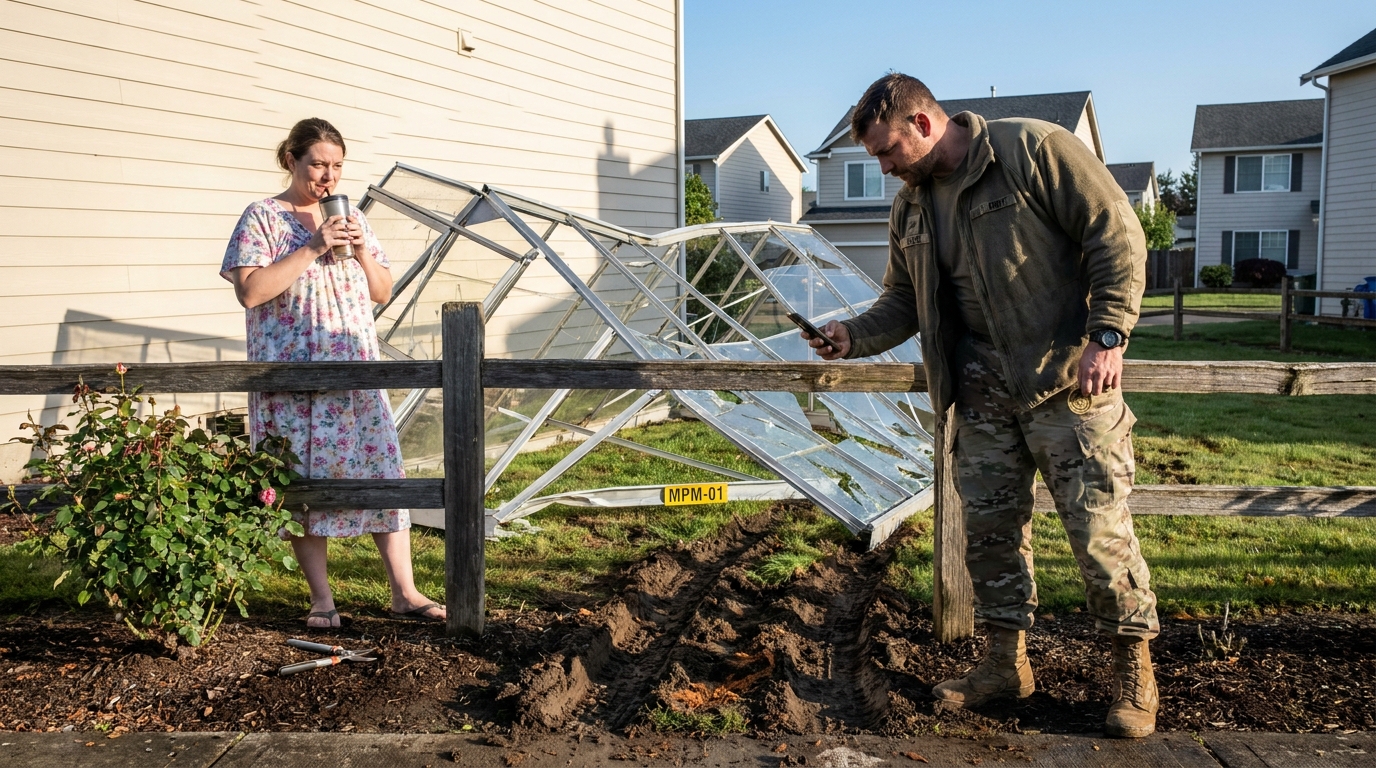
I stood on the wet grass of my property line. Twelve hours ago, this was a twelve-by-twenty custom sanctuary. Automated misting nozzles. Custom-milled framing. A temperature-controlled climate built for Sarah’s orchids after twenty years of base-hopping.
Now, it was a pile of twisted aluminum and shattered tempered glass. The frame had been crushed inward, folded like cheap tin under the hydraulic weight of heavy machinery. Shards lay scattered across the turf, reflecting the cold grey morning light like jagged teeth.
“That pile of glass and twisted metal is what happens when you think the rules don’t apply to you, Mr. Davies.”
Karen Miller stood three feet across the property line. Floral mumu. Plastic coffee tumbler. A smirk carved deep into her soft, pale face.
“Consider it a $5,000 lesson in community standards,” she said. She didn’t look at the wreckage. She looked at me.
My thumb moved automatically, pressing hard against the raised ridges of the brass challenge coin tucked into my right pocket. The metal was cold. I pressed until the edge bit into my skin, using the physical pain to ground the roar in my ears. Twenty years as an Army combat engineer teaches you one absolute rule: never react in the kill zone.
“The board voted,” Karen added, taking a deliberate sip from her cup. “It was an unapproved detached structure. You were warned.”
I didn’t yell. Yelling is noise. Noise gives the enemy target data.
I reached into my jacket and pulled out my phone. I didn’t point it at her face. I angled the lens down toward the ground, catching the fresh, deep tire ruts cut three inches into my soil—ruts that crossed my surveyed property boundary by two feet.
“For the record,” I said, my voice dropping into the flat, gravelly register I used during site clearing in Fallujah. “State your full name and your position on the Willow Creek Board.”
Her smirk flickered. The coffee cup dropped half an inch.
“You know who I am, Mark.”
“I know,” I said, keeping the lens steady on the tire treads before panning up to the crushed cedar. “The sheriff’s deputy won’t. State your name.”
“Karen Miller. President of the Willow Creek Homeowners Association.” She squared her shoulders, pulling her authority around herself like a heavy blanket. “And the board authorized the removal of an unapproved structure in strict accordance with the CC&Rs.”
“Which contractor did you hire to cross my property line?” I asked.
I caught a micro-detail in the wreckage—a yellow plastic tag pinned beneath a bent support beam. It wasn’t standard commercial demolition tape. It was an unmarked equipment tag bearing a hand-written code: MPM-01.
“The paperwork is in order,” Karen snapped. Her eyes darted toward the yellow tag, then back to my face. “You’ll receive the invoice for the removal costs.”
“I need three things right now, Karen.” I stepped forward. Just one pace. Heavy, deliberate boots pressing into the mud. “The board meeting minutes showing the vote. The three written notices required by Article 4, Section 2. And the state license number for the contractor who brought heavy equipment onto my land.”
“This isn’t an interrogation,” she said, taking a swift step backward onto her lawn. Her heels sank into the turf.
“This isn’t an interrogation,” I agreed, hitting stop on the recording and locking the screen. “This is discovery.”
She turned and waddled toward her porch, her floral dress flapping in the breeze. Her front door slammed hard enough to rattle the glass carriage lights on her garage.
I didn’t follow her. I turned toward the house. Sarah was standing at the kitchen window, her silhouette framed by the white blinds. She wasn’t crying. She was just staring at the empty space where her flowers used to be, her hand resting flat against the glass.
The rage in my chest cooled into something hard, dense, and dark.
I tapped the screen and dialed the non-emergency dispatch line.
“Dispatch,” the operator answered.
“My name is Mark Davies. 142 Willow Creek Lane,” I said, looking down at the hand-written yellow tag wedged in the mud. “I need an officer on site to report a felony destruction of property exceeding ten thousand dollars.”
CHAPTER 2: TACTICAL RECONNAISSANCE
The card Deputy Vance left in my palm was cheap stock, the case number scrawled in blue ballpoint that had smeared slightly at the margin. 26-0814-CR.
I rolled the brass challenge coin across my knuckles, feeling the dull clack-clack of metal hitting bone before slipping both the card and the yellow MPM-01 tag into my pocket. The diesel rumble of Vance’s cruiser faded down Willow Creek Drive, leaving only the quiet drip of water falling from the shattered cedar rafters onto the sodden grass.
I didn’t go inside. Sarah didn’t need to see me sitting at the kitchen table, radiating static. She needed a perimeter.
I pulled out a small black field notebook—the same grid-lined vinyl book I’d carried through two tours in Al Anbar—and walked past the property line toward the cul-de-sac. The sun was up now, burning through the morning mist, casting long, sharp shadows across identical manicured lawns and pale beige siding.
My first target was Arthur Henderson. His house sat directly east of mine, sharing forty yards of split-rail fence. He was sixty-eight, retired telecommunications engineer, a man who spent four hours every morning pruning hybrid tea roses with surgical precision.
Arthur was already at the edge of his driveway, hand clippers hanging loose in his right grip. He looked at my boots, wet with mud and crushed glass, then at the notebook in my hand.
“Heard the heavy equipment at six,” Arthur said, his voice dropping into the thin whisper reserved for funeral homes and precinct waiting rooms. “Sounded like a skid-steer with a claw attachment. Saw Karen standing on your curb at six-fifteen, watching the operator load the cedar onto a flatbed.”
“Did you see the rig’s logo?” I asked, flipping the notebook open.
“White cab. No door graphics,” Arthur said. He shifted his weight, his thumb running nervously along the rusty spring of his clippers. “Just a serial stencil on the bumper. Same rig that trimmed the oak trees in the common area last fall. The invoice came out of the HOA operational pool—three grand higher than the regional quote.”
“You saw the invoice?”
Arthur let out a dry, bitter cough and looked back toward his porch. “I was on the budget committee two years ago, Mark. Until I asked why we were paying three hundred dollars a cut for common lawn care to a company that listed a P.O. box in the county seat. Karen removed me from the review panel the next month. Said I had a ‘personal conflict of interest.'”
I wrote down the detail. Unmarked flatbed. Bumper stencil. Budget committee purge.
“Did she give you a paper trail on the roses, Arthur?”
The old man’s mouth set into a hard, pale line. He reached into his sweater pocket and pulled out a folded slip of yellow carbon paper—a standard HOA violation warning, worn soft at the creases from months of being folded and refolded.
“One hundred dollar fine for a bronze garden gnome my granddaughter gave me,” he said. He didn’t offer me the paper; he held it like a weapon that had failed to fire. “Said it exceeded the maximum eight-inch threshold for exterior decorative fixtures. When I refused to pay, she placed an administrative hold on my home resale certificate.”
“She’s using civil liens to enforce compliance,” I said.
“She’s using silence,” Arthur corrected. “Most people here bought these places with thirty-year notes. They’re scared of a cloud on the title. They pay the hundred bucks, put the gnome in the garage, and shut the door.”
“I’m not putting anything in the garage,” I said.
I left Arthur by his rosebushes and worked down the northern arc of the street. It was tactical mapping, step by step. You don’t fight an entrenched position by attacking the bunker head-on; you cut the supply lines and find the soldiers who have already been starved out.
At 118 Willow Creek, Maria Santos answered the door behind a rusted copper screen. Her youngest child was clutching her hip, staring at the grid-lined notebook in my hand.
“I can’t talk about the board, Mark,” she said, her knuckles whitening on the screen frame. “I’m still contesting the trim fine.”
“Three thousand to repaint the front door?” I asked softly, checking my notes from the block walk three months ago.
“Thirty-two hundred,” she said, her voice tight with suppressed anger. “She sent a certified letter claiming the shade of slate grey I used had faded past the approved palette code. The painter she recommended—the only one she said the Architectural Review Committee would automatically clear—charged double the local rate. I had to take it out of my daughter’s dental fund.”
“Did the painter’s receipt have a company header?”
Maria hesitated, her eyes flickering toward Karen’s house two doors down. She stepped back into the shadow of the entryway, reached into a console drawer, and slipped a torn paper stub through the narrow gap in the screen.
I looked at the header printed in faded blue thermal ink: Miller Property Maintenance — Emergency Remediation & Coatings.
There it was. The same name from the yellow tag in my mud.
“Keep it,” Maria whispered. “She told me if I brought it up at the annual meeting, she’d fine me fifty dollars a day for unapproved driveway parking while the painters were here.”
I tucked the receipt stub into my notebook, right next to the MPM-01 code. The pattern wasn’t just petty spite. It was a closed loop. Karen identified a infraction—or created one—forced the homeowner into a corner using the threat of property liens, and directed the paid remediation toward a single vendor.
By two in the afternoon, I had walked two miles within a three-block radius.
Nine houses. Nine paper trails.
David Vance—no relation to the deputy, a former Logistics Sergeant who flew an eight-inch brass-grommeted American flag from his porch—showed me three consecutive citations for ‘unauthorized structural modifications’ to his mailbox post.
“She tried to tell me the timber frame was a safety hazard for the mail carrier,” David said, leaning against his porch rail, his eyes tracking a delivery van moving down the avenue. “I pulled the Postal Service guidelines. It was four inches within code. She didn’t care. She assessed a fifty-dollar monthly recurring penalty directly to my HOA ledger. When I tried to access my online account to pay just the base dues, the portal locked me out. Said my balance was in dispute.”
“She blocked your payment to force a default,” I said.
“She blocked the ledger so I couldn’t see where the fine money was being routed,” David said grimly. “I’m a logistics guy, Mark. Money leaves an footprint just like fuel. She’s hiding the tracks.”
“I have the footprint,” I said, holding up the black notebook.
I walked back to 142 Willow Creek. The heat of the day had baked the crushed soil around the greenhouse site into a hard, dark crust. The smell of torn orchids was gone, replaced by the bitter tang of drying cedar sap.
Sarah was sitting on the back patio steps, a mug of cold tea resting between her ankles. Her fingernails were stained with black potting soil from the three clay pots she had managed to salvage from the edges of the debris field.
I sat down beside her on the cold concrete.
“It’s not an isolated incident,” I said, setting the notebook between us. “She’s been doing this to Arthur, to Maria, to David. She’s running the neighborhood like an occupied sector.”
Sarah looked down at the grid paper, her eyes tracking the names, dates, and amounts I’d listed in neat, technical block print.
“She destroyed my sanctuary, Mark,” she said quietly. Her voice didn’t shake. The softness that usually sat around her mouth was gone, replaced by the same flat composure she’d carried through three of my overseas deployments. “She took my peace.”
“She didn’t take it,” I said, turning the page to the rough schematic of the HOA board structure I’d sketched out. “She borrowed it. And the interest rate just went up.”
I reached into my pocket, pulled out my phone, and dialed Tom Prescott.
“Prescott,” the voice came through the speaker, sharp and backgrounded by the ambient clack of an office mechanical keyboard.
“Tom. It’s Mark,” I said, watching Karen’s second-story curtain twitch across the fence line. “I have the paper trail. She’s using a single contractor named Miller Property Maintenance for forced remediation across at least nine properties.”
A three-second pause on the line. I heard the scuff of a pen being uncapped.
“Miller?” Tom asked. “Spell it.”
“M-I-L-L-E-R,” I said. “And Tom? The name on the property record for Karen’s house isn’t just Miller. Her maiden name on the county deed search was Miller-Cross.”
Tom let out a low, breathy whistle through his teeth.
“A self-dealing loop,” Tom said. “If she’s directing HOA funds or forced homeowner repairs to a family-owned entity without board disclosure, that’s not just a CC&R violation, Mark. That’s a breach of fiduciary duty. And if she’s using the HOA bank account to settle those invoices…”
“It’s fraud,” I finished.
“Send me the photos of those receipts,” Tom said, his tone shifting instantly from friendly veteran to trial counsel. “I’m drafting the formal litigation hold tonight. By tomorrow morning, every member of that board is going to get a certified demand that freezes every server, every text thread, and every bank ledger associated with Willow Creek Estates.”
“Include Reserve Account 402,” I added, reading the account line off Arthur’s old budget audit slip.
“What’s Account 402?”
“That’s where the capital improvement funds sit,” I said, looking over at the twisted wreckage of the greenhouse frame. “And I have a feeling that’s where the money for my demolition came from.”
I hung up the phone and looked at Sarah. She reached over, her dirt-stained fingers wrapping around my wrist, right over the pulse point where the brass coin was resting inside my palm.
“What’s the next step?” she asked.
“Tomorrow morning, we drop the flyers,” I said. “We stop fighting her in the dark.”
As the sun dipped below the tree line, casting long, bruised-purple shadows across the lawn, I walked to the edge of the fence line. Tucked into the gap between two fence pickets on Karen’s side was a small white slip of paper—a fresh notice, left while I was sitting on the porch.
I pulled it free.
Notice of Unregistered Vehicle/Equipment on Turf. Fine: $150. Immediate removal required.
I didn’t tear it up. I opened my black notebook, flattened the paper against the grid lines, and slid it into the back pocket of the vinyl binder, right beneath the entry for MPM-01.
She was still playing by her rules. She didn’t know the game had already changed.
CHAPTER 3: THE DISCOVERY MINEFIELD
The red ink bled slightly into the map grid on my kitchen counter.
Four hundred and thirty hours. The house was quiet except for the hum of the refrigerator coil and the faint, rhythmically steady hum of the printer finishing the last dozen sheets. Two hundred pages of crisp, twenty-four-pound paper stacked neatly beside my field notebook.
At the top of each page, printed in stark black, sixty-point font: IS THIS HOW YOUR HOA DUES ARE SPENT?
Below it, a high-resolution, black-and-white printout of the photograph I’d taken at seven-fifteen yesterday morning: the jagged, buckled aluminum skeleton of Sarah’s greenhouse, the crushed cedar posts, and the deep tire ruts running straight across my surveyed property line. Beneath the photo, I hadn’t written an opinion piece. I hadn’t called Karen names. I listed three cold, numbered metrics:
Structure demolished without a public board vote or hearing.
Contractor dispatched without proof of state licensing or architectural review disclosure.
Annual Meeting scheduled for Thursday, 1900 hours, at the Community Clubhouse.
David Vance met me at the end of my driveway at 0445. He wore a dark grey hoodie, his hands tucked deep into his pockets against the damp morning chill. He didn’t say a word. He just reached down, took a stack of one hundred flyers off the counter where I’d left them on the porch, and looked at the red sector lines I’d drawn across the map.
“Sector Alpha,” David said, his voice barely louder than the gravel crunching under his soles. “I’ll take the north loop—Willow Creek Drive through Aspen Court.”
“Leave no paper on the grass,” I said. “Door slots or screen door jams only. If Karen’s security system picks us up, it’s a civil informational drop, not solicitation.”
David gave a single, sharp nod and turned into the dark towards Aspen Court.
I took Sector Bravo—the southern cul-de-sacs. I moved fast and silent, my boots rolling heel-to-toe across the damp pavement. At 0512, I slid a folded flyer into the brass door handle of 104 Oak Ridge. At 0518, I wedged another behind the mailbox mounting plate at Maria’s house. At 0532, I slipped one into Arthur’s screen frame.
By 0615, as the first grey light began to streak the sky, all two hundred flyers were seated in two hundred door frames across the subdivision.
By 0800, the neighborhood wasn’t quiet anymore.
I sat on my front porch, a mug of black coffee cooling between my hands, watching the street. At 0812, Arthur walked out to his driveway in his slippers, picked up his flyer, and stood there for three full minutes, reading it twice. Then he looked across the fence line toward Karen’s two-story colonial. He didn’t go back inside. He walked straight across the asphalt to speak to his neighbor, holding the paper out like a subpoena.
At 0840, Karen’s garage door rattled upward.
She stepped out onto her driveway wearing a burgundy tracksuit, a coffee mug in one hand and her phone pressed hard against her ear. She took three steps toward her mailbox, froze, and stared at the white paper tucked into her own front storm door.
I watched her through the porch screen. She didn’t read it standing up. She snatched it out of the frame, crumpled it instantly in her fist, and began pacing her driveway in rapid, frantic circles, her voice rising into a sharp, hysterical pitch that carried across the seventy feet between our lawns.
“—unauthorized solicitation on private property!” she was shouting into the receiver. “I want a cruiser out here immediately, Gary! He’s distributing inflammatory materials! He’s destabilizing the community!”
She stopped pacing and turned toward my house. I lifted my mug, took a slow sip, and set it back down on the porch rail. I didn’t smile. I didn’t blink.
Her jaw clicked shut. She turned on her heel, slammed her garage button, and ducked beneath the descending door before it hit the concrete.
By noon, the Willow Creek community Facebook group—a forum usually reserved for reports of loose golden retrievers and complaints about lawn aeration—had turned into a battlefield.
Arthur texted me a screenshot. Karen had locked the group, posting a single administrative update: Notice: Unlawful flyers containing defamatory statements regarding board operations have been distributed. Legal counsel has been engaged. Any resident attempting to circulate these materials will face immediate fines for covenant disruption.
Below it, twelve residents had already commented before she turned the commentary feature off.
Maria S.: What about the $3,200 I paid to Miller Property Maintenance? Where is that receipt logged?
Arthur H.: Why wasn’t the greenhouse demolition voted on in an open meeting? Article 3 requires public notice.
David V.: See everyone at the clubhouse Thursday at 1900.
At 1400 hours, a white sedan pulled into my driveway. A man in a sharp charcoal suit stepped out, carrying a thick Manila envelope. He walked up my steps with the practiced, neutral stride of a process server.
“Mark Davies?” he asked.
“Yes.”
He handed me the envelope. “Cease and desist letter from the firm of Harrison & Cole, representing the Willow Creek Homeowners Association Board.”
I took the envelope, opened the clasp, and pulled out the top sheet. The language was thick with boilerplate legal intimidation: Intentional interference with contractual relations… tortious defamation… immediate demand for public retraction.
My phone buzzed in my back pocket. It was Tom Prescott.
“Did you get it?” Tom asked.
“Just handed to me,” I said, leaning against the porch pillar.
“Good,” Tom said, his voice deadpan. “Read paragraph four out loud to me.”
I scanned down the page. “‘Mr. Davies is hereby instructed to cease all informal communications with subdivision members regarding corporate financial ledgers, specifically Reserve Account 402, pending formal legal review.'”
“They panicked,” Tom said, and I could hear the dry chuckle in his throat. “They just gave us explicit confirmation that Reserve Account 402 is the nerve center. If they weren’t hiding something in that capital account, they wouldn’t have named it in a cease-and-desist.”
“How’s the motion to compel looking?” I asked.
“I filed it two hours ago in Circuit Court,” Tom said. “I attached your photos, your video recording from yesterday morning, Maria’s receipt stub for Miller Property Maintenance, and Arthur’s affidavit regarding the budget committee. Judge Miller—no relation to Karen—signed an order setting an expedited hearing for next Tuesday. But more importantly, Mark, the board is legally required to hold that annual meeting on Thursday. They can’t cancel it without violating state non-profit corporate statutes.”
“They’ll try to gavel it down in five minutes,” I said.
“Then you make sure there are fifty people in that room who won’t let her touch the gavel,” Tom replied.
At 1845 hours on Thursday night, the parking lot of the Willow Creek Community Clubhouse was completely full.
Cars were parked bumper-to-bumper along the grass shoulders of Willow Creek Drive. The clubhouse—a beige-painted structure designed to hold maybe forty people for summer potlucks—was packed to the doors.
Over ninety residents stood shoulder-to-shoulder inside the room. The air was thick with the hum of murmured conversations, the smell of damp coats, and the tense, electric charge of an impending storm.
At the front of the room sat a long folding table. Karen Miller sat in the center, flanked by Gary—a thin, nervous man with wire-rimmed glasses who served as vice president—and Brenda, the board treasurer, who sat clutching a thick black binder to her chest like a shield.
Karen banged her wooden gavel against the folding table. The sharp thack-thack echoed off the drywall, but nobody sat down. There weren’t enough chairs.
“This meeting will come to order,” Karen said, her voice strained through a microphone that gave off a high-pitched squeal of feedback. Her face was powdered pale, but her neck was flushed dark red. “We have a strict agenda tonight. We will review the landscaping reports, approve the annual pool maintenance budget, and then adjourn.”
“Point of order, Madam President,” a voice called out from the third row.
It was David Vance. He stood straight, holding a blue-bound copy of the Willow Creek Covenants, Conditions, and Restrictions.
Karen’s knuckles turned white around the gavel handle. “Mr. Vance, public comments are reserved for the end of the meeting, subject to a two-minute limit.”
“Article 7, Section 2 of our bylaws states that any motion regarding unbudgeted expenditures exceeding five thousand dollars takes precedence over routine business,” David said, his voice easily cutting through the room without a microphone. “I move that we suspend the reading of the landscaping report and address the emergency expenditure used to hire Miller Property Maintenance on Tuesday morning.”
A wave of assent went through the room—a low, rumbling groan of agreement from ninety people.
“The motion is out of order!” Karen shouted, banging the gavel twice. “Board operations regarding covenant enforcement are confidential!”
I stepped forward from the back wall where I’d been standing. The crowd parted slightly, creating a clear lane down the center aisle.
I didn’t yell. I walked down the aisle until I was standing three feet from the front table, right in front of Brenda, the treasurer. I reached into my jacket, pulled out my vinyl field notebook, and set it flat on the plastic table surface.
“It’s not confidential, Karen,” I said, my voice level and cold. “State Statute 607 requires full disclosure of all corporate vendor contracts to any member upon written request. I submitted that request forty-eight hours ago.”
Gary, the vice president, flinched back from the table. He looked at Karen, then down at my notebook, his lips trembling slightly.
“Karen,” Gary whispered, turning off his microphone with a quick click. “Did we clear that vendor contract with legal?”
“Shut up, Gary,” Karen hissed under her breath, though the room was quiet enough that the front three rows heard it clearly.
She glared at me, her eyes narrow slits, her chest heaving under her blue jacket.
“You think you’re very clever, don’t you, Mr. Davies?” she said, her voice dropping into a harsh, vibrating whisper that carried over the silent room. “You come in here with your military attitude and your flyers, thinking you can bully this board. You violated community covenants. You built an illegal structure. The board acted to protect property values!”
“Show us the vote,” Arthur Henderson called out from the second row, standing up alongside David. “Show us the board meeting minutes where that demolition was authorized!”
“Show us the invoices!” Maria Santos shouted from the back.
The room erupted into a barrage of voices. People were standing up, holding copies of the white flyer I’d printed at four in the morning. Gary looked like he was going to vomit. Brenda pulled her black binder closer, her fingers digging into the vinyl cover so hard the plastic creaked.
Karen slammed the gavel down three times in rapid succession—thack! thack! thack!—the sound sharp as pistol shots in the enclosed room.
“This meeting is adjourned!” she yelled, standing up so fast her folding chair scraped violently backward against the linoleum. “This meeting is adjourned due to community disruption!”
She grabbed her handbag and made a move toward the side exit behind the table.
“Karen!” David’s voice boomed across the room, stopping her in her tracks. He raised a white paper sheet in his right hand. “We have seventy-two signed signatures on a petition for a special recall election under Article 9. You can adjourn the meeting, but you can’t adjourn the recall.”
Karen turned back for one second. Her face was completely devoid of its usual smug composure. It was tight, pale, and twisted with a pure, bitter fury.
She didn’t say a word. She pushed through the side door and vanished into the night, Gary and Brenda scrambling after her like scuttling crabs.
I stood by the front table, picked up my black notebook, and closed the cover.
David walked up beside me, handing me the petition clipboard stacked four pages deep with fresh signatures.
“We have the numbers for the recall,” David said softly.
“The recall is just the perimeter,” I said, looking at the empty chair where Brenda had been clutching her black binder. “The real fight is inside that ledger.”
I looked down at the table surface. In her rush to leave, Brenda had left a single white slip behind—a discarded bank deposit receipt tucked under the corner of the water pitcher tray.
I picked it up.
Printed across the top was the bank logo: First National County Bank.
Account ending: 402.
Transaction: Internal Transfer – $3,000.00.
Memo: Remittance — MPM Line Item.
I held the slip up to the fluorescent light, feeling the smooth, thermal texture of the paper.
The decoy was starting to fracture. The paper trail wasn’t just leading to a bad demolition; it was leading straight into the bank’s vault.
CHAPTER 4: THE FRAUD PATTERN
The oak gallery bench in Courtroom 3B was ice cold through my trousers.
Nine-fifteen on a Tuesday morning. High clerestory windows let in a sharp, pale bar of sunlight that cut across the mahogany counsel tables below. My thumb pressed hard against the brass coin in my pocket, feeling the cold, stamped lettering dig into my callus while my left hand held my black notebook flat against my knee. Inside the back cover, the thermal deposit slip from First National County Bank sat flat and dry.
At the plaintiff’s table, Tom Prescott stood with his feet shoulder-width apart, adjusting his dark grey tie with a single, deliberate tug.
Across the carpeted aisle, Karen Miller sat beside a junior associate from Harrison & Cole whose collar was half an inch too loose. Karen wasn’t wearing her floral mumu today; she wore a navy tailored suit that looked stiff, the tag probably tucked inside the collar. Her hands lay flat on the table, but her thumb was nervously picking at a loose thread on her sleeve, picking until the blue silk began to fray.
Judge Miller—a thin man with silver hair and wire-rimmed spectacles—looked down over his bench through a pair of half-moon bifocals.
“Mr. Prescott,” the judge’s voice was dry, echoing in the tall room. “This is a motion to compel discovery regarding a residential homeowner association dispute. Your petition references emergency injunctive relief, corporate spoliation, and non-profit corporate mismanagement. Summarize your threshold standing in two minutes.”
Tom didn’t look at his notes. He set his palms flat on the wooden podium.
“Your Honor, six days ago, the Willow Creek HOA board authorized the physical demolition of a permitted, city-inspected structure on my client’s real property,” Tom said, his voice dropping into a steady, resonant baritone. “They claimed authority under CC&R covenant enforcement. However, when my client requested the mandatory board meeting minutes and vendor disclosures required under State Statute 607, the board issued a blanket refusal and a cease-and-desist letter.”
The defense attorney stood up, his chair legs scraping sharp against the hardwood. “Your Honor, the association was exercising its fiduciary duty to enforce architectural uniformity. The structure was non-compliant—”
“Save it for the response, Counsel,” Judge Miller cut in without looking up from his tablet. “Mr. Prescott, did your client submit a formal written demand for corporate records prior to this motion?”
“We did, Your Honor,” Tom said, reaching into his leather briefcase and pulling out a blue-backed exhibit binder. “Served via certified mail seven days ago. Signed for by Board President Karen Miller. To date, zero pages of open meeting minutes, zero vendor bid sheets, and zero bank ledgers have been produced.”
Tom stepped forward and handed the exhibit copy to the bailiff.
“Furthermore, Your Honor,” Tom continued, turning slightly to face the defense table, “we have uncovered preliminary physical evidence indicating that the vendor dispatched to execute this demolition—operating under the trade name Miller Property Maintenance—is an unregistered entity sharing a primary residential address with the board president.”
Karen’s head snapped toward her attorney. Her mouth opened, a quick, silent gasp, but her lawyer immediately laid a flat hand on her forearm, pinning her to her seat.
Judge Miller’s eyebrows lifted over his spectacles. He looked down at Karen, then at her counsel.
“Counsel,” the judge said, his tone dropping an octave into dangerous calm. “Is Miller Property Maintenance an independent, arms-length vendor contracted through competitive bidding?”
The young attorney stammered, pulling at his collar. “Your Honor, the… the board president had emergency authorization under Article 5 to address immediate safety—”
“Is it an arms-length vendor?” Judge Miller repeated, his voice cut like glass.
Silence hung in the courtroom for three full seconds. The air conditioner hummed in the wall vents.
“We… we are currently compiling those records, Your Honor,” the attorney muttered, staring flat at his blotter.
Judge Miller didn’t hesitate. He picked up his pen, dipped his head, and began writing directly across the top margin of the order in fast, violent strokes.
“Motion to compel is granted in full,” Judge Miller declared, the ink scratching loud against the heavy paper. “The Willow Creek HOA board will produce all unredacted bank account statements, vendor ledgers, meeting minutes, and digital correspondence for the preceding twenty-four-month period. Deadline is Friday at 1700 hours. Failure to comply will result in an immediate order for a court-appointed receiver and personal contempt citations for individual board members.”
He struck the desk once with his gavel—a sharp, dull thud that closed the hearing like a trap door.
“Ten days,” Karen hissed as she pushed past our bench in the gallery aisle, her navy suit jacket rustling stiffly. She didn’t look at Tom. She looked straight into my eyes, her face pale, her lips pulled back in a thin, tight line. “You think you won something today, Davies? You just cost this neighborhood fifty thousand dollars in legal fees. We’ll assess every home on the block to pay for this.”
“You won’t assess anything, Karen,” I said, my voice barely above a whisper, keeping my hands resting flat on my knees. “The recall petition goes to the county supervisor of elections at noon tomorrow.”
Her left eyelid twitched twice. She turned and hurried down the marble corridor, her high heels clicking out a ragged, uneven cadence against the stone.
At 1630 hours on Friday afternoon, a courier van double-parked outside Tom’s downtown office.
Two heavy cardboard banker boxes were wheeled into the conference room. Inside were eighteen months of unredacted bank statements from First National County Bank, three hundred loose invoices, and two spiral-bound ledger books with worn black covers.
Tom and I sat across from each other at the long glass table, two cold cups of black coffee sitting between three highlighters and a digital calculator.
For three hours, we didn’t speak. The only sounds were the crisp snap of paper pages turning and the rhythmic clicking of my thumb against the brass coin in my pocket.
I worked through the bank statements line by line, cross-referencing every debit against the official HOA budget ledgers Arthur Henderson had saved from his time on the committee.
At 1945 hours, I stopped.
My red highlighter was resting over page fourteen of the August bank statement for Reserve Account 402.
“Tom,” I said, my voice flat. “Look at line item 114.”
Tom leaned across the glass table, pulling the paper toward his side of the light.
The entry read: Debit — $7,000.00 — Vendor: Miller Property Maintenance — Memo: Emergency Covenant Remediation.
“Okay,” Tom said, squinting through his reading glasses. “That’s the demolition bill for your greenhouse. She overcharged the association seven grand for a two-thousand-dollar skid-steer rental.”
“Keep reading,” I said, pointing my pen at the matching entry in the general operational checking ledger two pages back.
In the operational checking account, a second entry appeared on the exact same date: Internal Transfer — $3,000.00 — Source: Reserve Account 402 — Memo: Remittance — MPM Line Item.
Tom pulled a legal pad over, his pen moving fast as he calculated the math.
“Wait,” Tom muttered, stopping his pen mid-stroke. “The cousin’s company, Miller Property Maintenance, billed seven thousand to the reserve account. But the bank statement shows the actual check cleared to the vendor for only four thousand dollars.”
“Where did the other three thousand go?” I asked.
Tom flipped to the back of the binder, hunting through the personal correspondence emails turned over under Judge Miller’s order. He found a printed printout of an internal email dated two days after the demolition—a message sent from Brenda, the board treasurer, to Karen’s private email address.
Karen, Brenda had written, the bank reconciliation for Account 402 shows a $3,000 variance between the MPM invoice clearing price and the reserve withdrawal. Frank says he only received $4,000 for the equipment and crew. Where is the remaining $3,000 logged?
Below it, Karen’s reply was timestamped forty minutes later:
Handled. Deposited to reserve slush under petty administrative overhead. Do not alter the ledger line.
Tom looked up from the paper, his eyes wide behind his frames. The room was deathly quiet.
“It wasn’t deposited back,” Tom said, his voice dropping into an awed whisper. “I have the full deposit ledger for Account 402 right here for that whole month. There is zero deposit for three thousand dollars.”
I leaned back in my leather chair, feeling the cool glass of the conference table against my forearms.
The decoy secret—the shell-company overbilling by her cousin’s fake maintenance business—had just cracked completely open. The cousin hadn’t stolen the extra three thousand dollars. Karen had. She had used the chaos of the emergency demolition to write a fraudulent seven-thousand-dollar check off the reserve account, pay her cousin four grand for his heavy machinery, and slip the remaining three thousand directly into her pocket.
“It’s not just a bad demolition,” I said, looking at the red highlighter mark bleeding through the paper. “It’s a kickback scheme. And she’s been doing it on every forced remediation for two years.”
Tom grabbed his desk phone and began punching in a ten-digit number.
“Who are you calling?” I asked.
“Detective Miller—no relation—at the County Economic Crimes Unit,” Tom said, setting the phone to speaker as the line began to ring. “This isn’t a civil property dispute anymore, Mark. This is felony embezzlement under State Statute 812.”
The speaker chirped twice, then a deep voice answered: “Economic Crimes, Detective Miller.”
Tom looked across the table at me, his finger hovering over the red-marked ledger page.
“Detective,” Tom said. “I have two boxes of court-ordered bank ledgers on my table, and I think you need to see Reserve Account 402.”
CHAPTER 5: THE AMBUSH AT THE CLUBHOUSE
The hum of the digital projector was a low, steady vibration against the drywall behind my head.
Nineteen hundred hours. The air in the clubhouse was warm, smelling of damp wool coats, burnt coffee, and the faint metallic tang of ozone from the cooling fan. Over seventy neighbors sat tightly in rows of gray plastic chairs, their faces illuminated by the stark white beam cutting across the darkened room.
Beside me at the back doors stood Detective Vance Miller—a broad-shouldered man in a charcoal windbreaker, his hands resting loose over his belt, his eyes fixed on the front row.
In that front row, Karen Miller sat rigid. Her hands were clamped around the strap of her leather handbag so tightly the knuckles looked like white bone. Beside her, Brenda, the treasurer, kept her chin tucked into her chest, her breathing shallow and ragged.
Tom Prescott stood at the podium. He didn’t use notes. He held an infrared laser pointer in his right hand.
“Good evening,” Tom said. His voice was calm, carrying across the room without the microphone. “This is an emergency informational session of the Willow Creek Homeowners Association. Under court order Case 26-0814-CR, we have completed a preliminary review of the corporate records.”
He clicked the remote.
A high-resolution scan of a bank ledger appeared on the screen. The header read: First National County Bank — Reserve Account 402.
“What you see on screen,” Tom said, tracking the red dot to a line item midway down the page, “is the capital reserve account funded by your quarterly dues over the last twenty-four months. Notice line 114, dated eleven days ago: a withdrawal of seven thousand dollars payable to Miller Property Maintenance for emergency demolition.”
A low murmur stirred through the plastic chairs. Arthur Henderson leaned forward in the second row, his spectacles catching the glare.
“That check cleared,” Tom continued smoothly. “However, the subpoenaed bank records from Miller Property Maintenance show a cleared deposit of exactly four thousand dollars for the equipment operator. The three thousand dollar variance was diverted directly into an unlisted account controlled exclusively by Board President Karen Miller.”
“That’s a lie!” Karen snapped, her voice cracking as she bolted upright in her chair. She turned toward the room, her handbag swinging wildly. “This is a witch hunt! A disgruntled homeowner using forged documents to destroy this board!”
“Sit down, Ms. Miller,” Detective Miller’s voice cut through the room from the back wall. It wasn’t loud, but it had the weight of iron.
Karen froze. Her eyes darted to the detective’s windbreaker, catching the gold shield pinned to his belt. She didn’t sit down, but her legs trembled under her navy skirt.
Tom clicked the remote again.
“It wasn’t a single occurrence,” Tom said, his laser pointer highlighting a column of red figures spanning two full years. “This brings us to The Fiduciary Audit. When we cross-referenced every vendor payment issued under Miller Property Maintenance against the primary operating ledgers, a systematic pattern emerged.”
The screen shifted to a spreadsheet. Three columns of figures, lined up with mathematical precision.
“For twenty-six consecutive months,” Tom explained, “every forced covenant remediation—every repainted door, every mailbox replacement, every lawn citation—was routed through Miller Property Maintenance. In each case, the work was over-invoiced by forty to sixty percent. The contractor received the base rate. The remainder was transferred directly to an off-book ledger.”
Tom paused, letting the red dot rest on the final calculation at the bottom right corner of the screen.
“The total unauthorized diversion from Reserve Account 402 and the operating fund over twenty-four months,” Tom said, “is forty-nine thousand, eight hundred and twenty dollars.”
The room went dead silent. Nobody moved. Nobody breathed.
Then Maria Santos stood up. She didn’t yell. She looked at Brenda, the treasurer, whose face had gone completely gray.
“My daughter’s dental money,” Maria said, her voice small and sharp as a needle. “You took thirty-two hundred dollars from me for a coat of gray paint, and you put it in your pocket?”
Brenda broke. She covered her face with both hands and began to sob, her shoulders shaking violently against her chair back.
“It… it was Karen,” Brenda wheezed through her fingers, her voice echoing off the linoleum. “She said… she said it was administrative fees! She said the board approved it in executive session! I just signed the checks she gave me!”
“Brenda, shut your mouth!” Karen screamed, her composure shattering into raw, unadulterated panic. She turned toward the side exit, her high heels skittering across the floor as she grabbed her coat. “This meeting is illegal! I’m calling my attorney!”
She took two steps toward the double doors before Detective Miller stepped casually into her path, his frame blocking the exit frame.
“Karen Miller?” Detective Miller asked, pulling a folded paper from his jacket.
“Get out of my way!” she shouted, her voice reaching a shrill, breathless peak. “You have no right to hold me here!”
“I have a felony warrant for grand larceny and scheme to defraud,” Detective Miller said calmly. “You have the right to remain silent. Anything you say can and will be used against you in a court of law.”
The detective turned her around with practiced, efficient leverage, catching her wrists behind her back. The metallic clack-click of handcuffs closing echoed sharply through the quiet room.
Karen didn’t look at the crowd as she was led out the side door. She looked down at her feet, her navy jacket bunching awkwardly around her shoulders, her heels dragging against the threshold.
The room remained motionless for ten seconds after the door closed.
Then David Vance stood up at the front, turning to face the seventy neighbors.
“I move that we immediately accept the formal resignations of Gary and Brenda,” David said, his voice steady. “And that we appoint an interim committee to oversee the transition until a formal election next month.”
“Seconded,” Arthur Henderson called out.
“All in favor?” David asked.
Every hand in the room went up. Seventy hands, held high in the quiet light of the projector.
I didn’t raise my hand. I stood at the back wall, my thumb resting flat against the brass coin in my pocket. The weight in my chest—the cold, dense fury that had sat there since the morning I found Sarah’s orchids crushed in the mud—had finally begun to settle.
Tom walked over, packing the projector into its canvas case with a swift zip.
“The criminal charge freezes all her personal assets, Mark,” Tom said, looking toward the open side door. “The civil suit for your greenhouse is a straight summary judgment now. She can’t hide behind the HOA insurance policy for intentional fraud.”
“What’s the timeline?” I asked.
“The judge will sign the damages order on Monday,” Tom said. “Replacement costs, punitive damages, and full legal fees. It’s going to wipe her out.”
I nodded once, turning toward the main exit.
Outside, the night air was clear and cold. A light mist was falling, reflecting the red and blue flashes of Detective Miller’s cruiser as it pulled away down Willow Creek Drive.
I walked back toward 142 Willow Creek. The street was quiet, but for the first time in two years, the porch lights at Maria’s house, at Arthur’s house, and at David’s house were all burning bright against the dark.
CHAPTER 6: CHECKMATE AND CLEARANCE
The four-by-six cedar beam settled into the galvanized steel saddle with a heavy, solid thunk.
I kept my left hand clamped over the timber, feeling the rough grain press against my palm, while David Vance lined up the two-inch carriage bolt through the pre-drilled bracket. Eighty-two days had turned the raw dirt where the old structure stood into a level, crushed-stone foundation.
“Hold it steady, Mark,” David said, his knuckles grimy with grease as he tapped the bolt tail with a dead-blow mallet.
The metal seated home. I took the ratchet from my belt loop, fitted the socket onto the nut, and cranked it down until the steel washer bit three millimeters deep into the cedar face. Three clicks. Sealed.
In the center aisle of the structure, Sarah set a heavy terracotta pot onto the lower cedar bench. Inside, a Cattleya orchid stretched three pale mauve blooms toward the UV-coated polycarbonate roof panels. Her fingers were coated in black potting mix, but her hands were steady. She didn’t look over her shoulder at the fence line anymore. She didn’t jump when a car door shut down the block.
Tom Prescott leaned against the doorway frame, holding a manila folder under his arm, a paper cup of lukewarm coffee cooling in his grip.
“The clerk entered the final entry on the docket at noon,” Tom said, his voice easily carrying through the open cedar frame. “Case closed, Mark.”
I backed down the stepladder, setting my ratchet onto the workbench beside a row of stainless steel screws. “Give me the final numbers.”
Tom opened the folder, his thumb flipping past the court seals to the summary judgment sheet.
“The $92,000 award stood,” Tom said, pointing a finger at the signed decree. “Twelve thousand for full structural replacement and specialized climate equipment. Fifty thousand in punitive damages for malicious destruction and fraudulent conversion. Thirty thousand in court-ordered attorney fees. The insurance carrier invoked their fraud exclusion clause the moment Detective Miller filed the official embezzlement indictment, leaving Karen personally liable for the full balance.”
David wiped his hands on a shop towel and leaned back against the framing post. “And the house?”
“A junior lien for $80,000 was placed against 140 Willow Creek three weeks ago,” Tom replied, looking out across the lawn toward the adjacent property. “With the criminal trial set for next month on the grand larceny counts, her defense firm demanded a forty-thousand-dollar retainer up front. She tried to refinance to raise cash, but our judgment cloud on the title blocked the mortgage underwriting. The bank initiated foreclosure proceedings on Tuesday.”
I walked to the open double doors of the greenhouse, pulling my black field notebook from my back pocket. I opened it to the back cover, pulled out the worn yellow MPM-01 tag, the thermal bank deposit slip from Reserve Account 402, and the preliminary report for The Fiduciary Audit.
The paper trail was complete. Every line item had been accounted for; every fraudulent dollar pulled from the neighborhood fund had been mapped, logged, and submitted to the county prosecutor.
Across the fence line, a yellow moving truck backed onto Karen’s driveway, its brakes letting out a sharp, pneumatic hiss.
Two men in gray work shirts opened the rear roll-up door and began hauling wrapped mattresses and cardboard boxes out through the front entrance. Standing near the porch steps was Karen.
She wore a faded canvas jacket over dark slacks. Her hair was pulled back into an unkempt knot, the sharp, arrogant posture she had carried for six years completely crushed out of her spine. She looked smaller, her shoulders hunched forward against the wind, her hands thrust deep into her jacket pockets.
She turned her head and saw us standing in the doorway of the new greenhouse—David, Tom, Sarah, and me.
She didn’t raise her voice. She didn’t pull out a clipboard. She didn’t cite a covenant. She stood on her brown, unwatered lawn for three long seconds, staring at the cathedral roof framing, the gleaming glass, and the mauve orchid sitting on the cedar bench.
She took three slow, hesitant steps toward the property line, stopping right at the edge where the tire ruts from the skid-steer had finally been leveled and re-seeded with fresh rye grass.
“It’s bigger than the old one,” Karen said. Her voice was raspy, dry, stripped clean of the sharp, condescending cadence that used to rule the block.
I stepped out onto the grass, my boots sinking slightly into the fresh sod, and stopped two feet on my side of the line.
“It is,” I said, keeping my hands at my sides.
She looked down at her shoes, her fingers twitching inside her coat pockets. “I… I hope your wife gets her plants settled.”
The words were clumsy, heavy, awkwardly delivered—the closest a woman built on absolute authority could ever come to acknowledging the ruin she had manufactured.
“Every action carries a structural cost, Karen,” I said, my tone flat, calm, and final. “You built this frame. Step by step, invoice by invoice.”
She gave a single, stiff nod. She didn’t offer a defense. She didn’t mention the board, the rules, or community standards. She turned, walked back to the moving truck, and climbed into the passenger seat without looking back. Five minutes later, the diesel engine roared, the truck pulled off the curb, and the tail lights disappeared around the curve of Aspen Court.
The neighborhood was dead quiet.
At 104 Oak Ridge, Arthur Henderson walked out to his front porch, carrying a small cast-bronze garden gnome. He walked down his steps, set the fixture right on the edge of his driveway pavers, and stood back to admire it under the afternoon sun.
At 118, Maria Santos was painting her front door frame—not in slate gray, but in a bright, vibrant crimson that caught the light like a flare.
David clapped a heavy hand on my shoulder. “Board meeting is at seven tonight, Mark. We’re passing the revised architectural rules. Clear timelines, written responses in thirty days, and a three-member independent appeal committee.”
“Good,” I said. “Make sure David’s flag pole clause is on the first page.”
David chuckled, turning back toward his house. Tom shook my hand, tucked his manila folder into his briefcase, and walked down the driveway toward his car.
I walked back into the greenhouse.
The air inside was warm, smelling of damp earth, fresh cedar shavings, and blooming flora. The automated misting line gave a soft click, sending a fine, translucent veil of water vapor through the air, catching the sunlight in tiny prisms over the orchids.
Sarah was kneeling beside the lower bench, adjusting a clay pot containing a rare fern Arthur had brought over from his garden that morning. She looked up at me, her eyes clear, her face relaxed into a quiet, unbroken peace that I hadn’t seen since before my last deployment.
I reached into my pocket, pulled out the brass challenge coin, and set it flat on the corner of the workbench beside the new irrigation control panel.
I opened the black field notebook, pulled the yellow MPM-01 tag and the old bank receipts from the back pocket, and tossed them into the metal scrap bin under the bench.
I didn’t need the evidence anymore. The perimeter was secure.
I walked over to Sarah, reached down, and helped her set the last orchid into place under the glass.