The Silent Perimeter: A Cold War in Whispering Pines
CHAPTER 1: THE TACTICAL PERIMETER
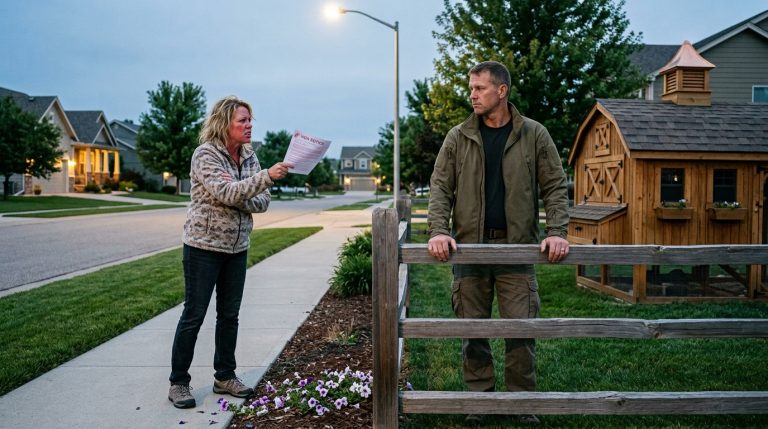
The brushed aluminum helix spun at forty RPM, catching the 2:00 p.m. glare and throwing sharp, rhythmic slivers of light across the driveway asphalt.
I didn’t look at her face. I looked at the three-ring binder.
Vinyl cover. Black. Four inches thick, bulging at the rivets. The weight pulled her left shoulder down three degrees, shifting her center of gravity forward onto her heels.
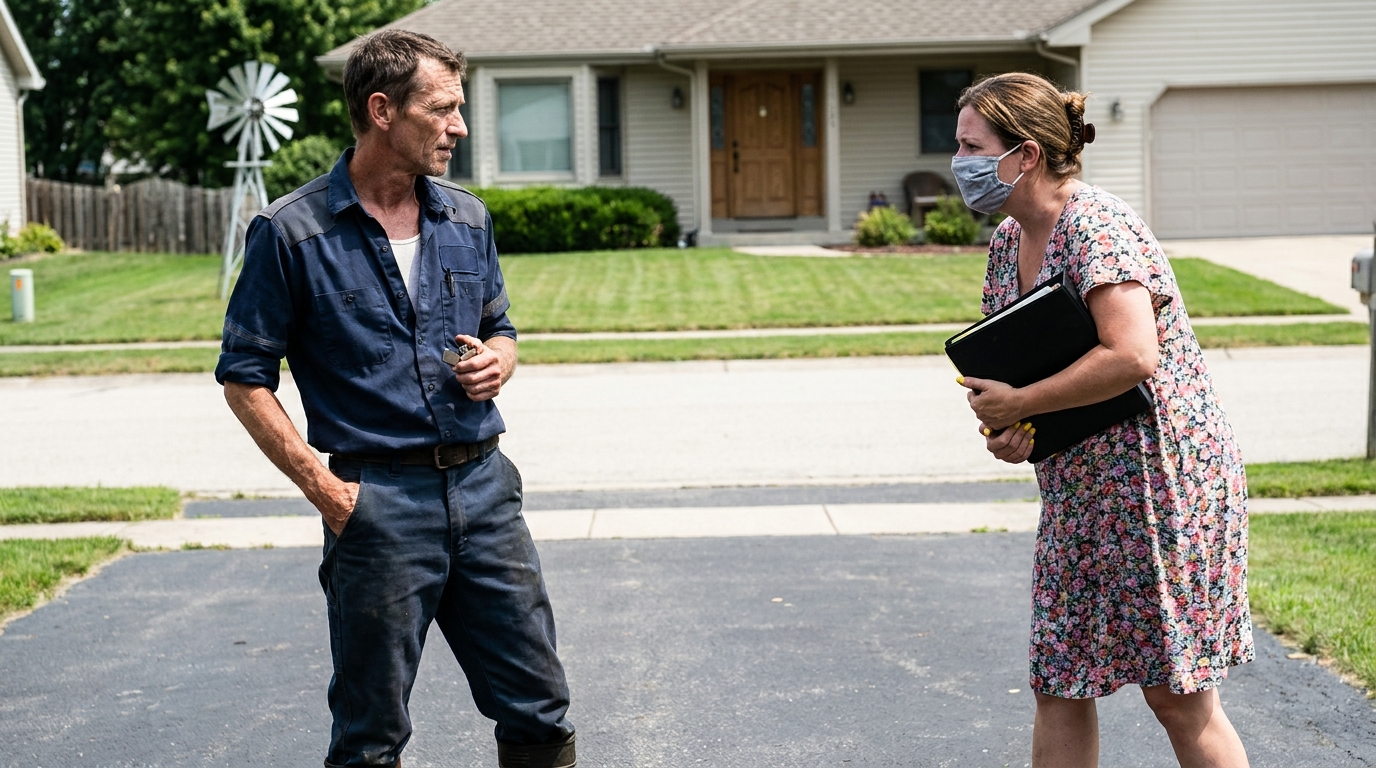
“That metallic eyesore on your roof will be gone by Friday,” Karen said. Her voice had the brassy rattle of a dry radiator hose. “Or I will have it removed and bill you for every last cent. This is not a negotiation, Mr. Davis.”
I kept my hands flat inside my front pockets. My right thumb pressed against the cold, unlit casing of my steel Zippo. Click. Clack. Silent pressure against the hinge.
“Article Nine,” I said. My voice stayed down in my throat. Low. Flat. “Section Three.”
Her eyes blinked once, hard. The floral mumu she wore fluttered in the muggy thermal breeze coming off the asphalt. “What?”
“That’s what you’re going to quote,” I said. “Section Three covers vertical projections. Satellite dishes over one meter. Antennas.”
“It’s an unapproved structural modification,” she snapped. Her knuckles turned yellow where they dug into the binder’s spine. “Article Nine and Article Twelve. Aesthetic harmony. It lowers property values.”
I didn’t answer. Silence is an physical mass. Throw it into a room, and people start reaching for anything to break it.
Her right foot began to tap. Thump. Thump. Dry grass under a heavy heel.
“I’m waiting for your assurance of compliance,” she said.
I took three seconds. Counted the pulse in my jaw. Seventy-two beats. Normal.
“Put it in writing,” I said. “Certified mail. Citing the specific sub-clauses and the date of the Architectural Review Committee’s vote.”
“The board doesn’t need to—”
“Certified mail, Karen.” I turned my torso toward the porch step, exposing my flank to her sightline while cutting her angle of approach. “Have a good afternoon.”
I took three steps, reached the threshold, and pulled the oak door shut until the latch clicked home.
Through the brass peephole, the optical distortion rendered her six feet wide. She stood on the turf for twenty-eight seconds. Her mouth worked silently. A carp in shallow water. Then her heel dug into the sod, leaving a torn brown crescent in the green, and she marched toward her gas golf cart.
I walked straight to my desk. Opened a fresh local directory. Created a folder: HOA_INTEL_01.
Twenty years calling air strikes in the Helmand meant one thing: you don’t fight the man with the gun. You fight the man supplying his ammunition.
My thumb flicked the Zippo. Snap. The steel felt cold against my palm. The war was officially on the clock.
CHAPTER 2: THE PAPER TRAIL
The hum of the desktop tower filled the quiet office like a distant jet turbine idling on a tarmac.
My thumb remained anchored to the cold, brushed casing of the Zippo resting beside the mechanical keyboard. On the monitor, the blank directory string sat blinking. HOA_INTEL_01.
I didn’t open a browser first. I opened a local terminal prompt and pulled up the county property tax registry through an offline archive I’d mirrored during the closing process six months ago.
Karen Peterson thought in terms of local dominance—lawn heights, fence stains, trash cans left out past six on a Tuesday. But bullies who rely on arbitrary power always leave a structural gap. They don’t check the foundations because they assume no one will ever look beneath the porch.
Click. Clack.
I worked my thumb against the Zippo’s unlit hinge, the metallic snap echoing against the pine-paneled walls.
The original developer for Whispering Pines Estates was recorded in 2006 as Cinder Ridge Properties LLC. I ran the tax parcel map for Lot 42—my two acres—and cross-referenced it with the surrounding public access corridors.
A anomaly appeared on the secondary layer of the plat map.
A eight-foot utility corridor ran parallel to my southern property line, cutting straight toward the small beige transformer shed near the front gates. In the legal notes at the bottom of the 2008 filing, the easement wasn’t labeled under the regional power company.
It was tagged under a dormant sub-entity: Project Cinder.
My eyes narrowed. The name didn’t sound like a suburban utility company. It had the dry, sterile weight of a defense logistics contract.
The mail arrived two days later, precisely at 1:15 p.m., signaled by the heavy clunk of the aluminum mailbox door at the end of the gravel driveway.
I didn’t rush out. I let twenty minutes pass, watching the tree line from the kitchen window while a kettle came to a low simmer on the stovetop. When I finally walked down the drive, the sun was high and brutal, baking the red clay along the road until the air smelled like hot iron.
Inside the box sat a single white envelope. Cheap paper. White weave. The return address carried the stylized oak tree logo of the Whispering Pines Homeowners Association.
I didn’t open it until I was sitting at the workbench in my detached garage, surrounded by the organized rows of torque wrenches, multimeter leads, and spare aluminum stock for the turbine.
I used a steel razor to slice the top edge cleanly.
The letter was printed in a jagged, dark ink that suggested a dying toner cartridge. It was signed by Karen Peterson in a thick, sloping scrawl that dug deep into the paper fibers.
NOTICE OF FORMAL VIOLATION AND DEMAND FOR REMOVAL.
It cited Article 9, Section 3B—Exterior Attachments and Projections—and Article 12—Aesthetic Harmony and Community Standards. It gave me fourteen calendar days to remove the “unauthorized apparatus” from the roofline or face a retroactive fine of $50 per day, with an explicit warning that a property lien would be attached for non-compliance.
I read it twice. Not with anger, but with the cold, clinical eye of an intelligence officer evaluating an enemy order of battle.
Section 3B specifically governed television receiver dishes and whip antennas under two feet in diameter. It made zero mention of kinetic energy generators or wind-capture hardware. Article 12 was her catch-all trap—the subjective “harmony” clause used to crush dissent through administrative fatigue.
She had laid her kill-zone. But she’d used a template.
I reached for my phone, dialed the county records clerk’s office in downtown Canton, and leaned back against the workbench. The cold steel of an industrial vice pressed against my elbow.
“County Records, this is Miller,” a tired female voice answered.
“Good afternoon, Miller,” I said, keeping my voice low, measured, and completely devoid of urgency. “My name is Mark Davis. I’m reviewing a parcel easement on Lot 42 in Whispering Pines, record year 2008. I need the full instrument file for the cross-covenant filed under Cinder Ridge Properties.”
A heavy sigh came through the speaker, followed by the clatter of a membrane keyboard. “Whispering Pines… okay. Parcel 04-112. Hold on.”
Silence stretched over the line for forty seconds. Outside, the wind picked up, setting the turbine on my roof into a low, harmonic spin that vibrated almost imperceptibly through the garage’s steel support beams.
“That’s strange,” the clerk said, her voice dropping its automated fatigue.
“What is?”
“The main plat shows the easement filing from October 2008, but the actual instrument PDF is flagged as restricted archive. It says ‘Transferred to State Infrastructure Registry – Node-09’.”
I held my breath for two seconds, letting the name settle in my mind. Node-09.
“Is there an auxiliary file attached to the original homeowner of record?” I asked smoothly. “Frank Vance?”
“Let me check his name…” More keyboard clatter. “Yeah, there’s a variance cross-file from ’08. It’s an physical paper backup in room 104, box 7B. It’s not digitized.”
“Thank you, Miller. You’ve been very helpful.”
I hung up, lowered the phone to the workbench, and picked up the steel Zippo.
Karen Peterson thought she was fighting a stubborn retiree over a rooftop windmill. She had no idea that her paper trail was intersecting with a restricted state infrastructure tag.
I picked up a fresh sheet of white paper, loaded it into my printer, and began drafting my response. It wasn’t an appeal. It wasn’t a plea for leniency.
It was a precise, cold demand for formal administrative discovery—a legal wedge designed to force her to put her hand on the record under penalty of procedural fraud.
CHAPTER 3: RECONNAISSANCE AT TWILIGHT
The printed response letter felt stiff between my thumb and forefinger, the ink still faintly warm from the roller heads. Across the open floor of the garage, dusk settled over the gravel driveway in long, blue shadows.
I folded the paper once, sliding it into the breast pocket of my work shirt. The steel Zippo sat on the corner of the workbench. I picked it up, slipping it into my right front pocket beside a small aluminum penlight.
To anyone watching from the street, I was just a retired homeowner stepping out for an evening walk to stretch my legs.
I cut through the treeline along the southern property border, where thick loblolly pines formed a natural sound barrier against the county road. Damp needle cast crunched under the rubber soles of my boots. The humidity had turned thick and heavy, hanging in the underbrush like wet wool.
Three hundred yards down the slope, the utility shed sat tucked behind an overgrown row of wax myrtles near the development’s stone entrance gates.
It was a windowless square of painted concrete block, twelve feet by twelve, capped with a plain asphalt shingle roof. On the surface, it looked like every generic pump shelter built in north Georgia suburban tracts during the mid-2000s expansion boom.
I didn’t head for the front door. The heavy brass padlock hanging from the iron latch was caked in orange rust, untouched for months.
Instead, I stepped around the eastern wall, crouching beneath the low-hanging branches of an azalea bush where the ground dipped into a drainage swale.
Beside the concrete foundation sat the main green transformer housing. A thick steel conduit pipe ran out of its base, sinking straight into the red clay. But six inches to the left, half-buried under rotting pine bark, ran a secondary conduit line.
It was galvanized steel, three inches in diameter, wrapped in weathered black heat-shrink tubing.
I pulled the penlight from my pocket, shielding the lens with my left palm so only a thin slit of amber light leaked onto the metal.
Stamped directly into the collar of the pipe’s heavy mounting bracket were raised block letters:
BLACKWOOD-7 / INFRASTRUCTURE SEC.
My index finger traced the cold metal ridges of the seal. The paint had chipped away in flakes, revealing dull gray zinc underneath. Blackwood-7. Not a commercial power contractor. Not a municipal water district.
A faint vibration hummed through the soles of my boots.
I pressed my ear against the damp concrete block of the shed wall. It wasn’t the clattering idle of a diesel emergency generator, nor was it the clean sixty-cycle whine of a standard commercial power inverter.
It was a dry, high-frequency signal chatter—a rapid, rhythmic ticking like a telegraph relay operating inside a sealed box.
I reached down and scraped away two inches of damp topsoil where the black-wrapped conduit entered the foundation wall. Tucked against the joiner ring sat a small inline junction box. The seal was fresh. Silicone sealant, clear and still pliable, had been smeared around the seam within the last thirty days.
Someone had serviced this junction recently. And it hadn’t been a plumber.
A pair of headlights swept across the asphalt of the main entrance road, casting long, moving shadows through the myrtle bushes. I stayed motionless in the swale, knee resting against the wet earth, until the engine noise faded deeper into the subdivision.
When I stood up, my right hand was coated in a thin sheen of conductive grease from the junction box casing.
Karen Peterson thought she held the leash on this neighborhood through HOA fines and threat letters. But she was sitting on top of an active, tapped signal trunk line—and whoever was maintaining that junction box had a far bigger stake in Lot 42 than an unapproved rooftop wind turbine.
I wiped my hand on a clean shop rag from my back pocket, turned back toward the dark treeline, and started the climb back up to my workshop.
CHAPTER 4: THE CLUBHOUSE COLLISION
The grease-stained rag dropped into the red steel trash canister beside the workbench with a heavy, wet thud.
I stood in the center of the garage, wiping my hands on a clean micro-fiber towel while the quiet hum of the workshop computer monitor flickered against the shadow-draped walls. On the screen rested the drafted demand for formal administrative discovery.
Seventy-two hours later, the fluorescent lights of the Whispering Pines community clubhouse buzzed with a low, sixty-cycle drone.
The air inside smelled of damp carpet, burnt drip coffee, and thirty suburban residents sweating through a humid Tuesday night. Folding chairs scraped against the linoleum as people shifted, their faces washed out beneath the harsh overhead tubes.
At the front of the room, behind a long plastic banquet table, sat Karen Peterson.
She wore a heavy knitted cardigan despite the heat, her floral binder propped upright like a sandbag wall between her and the gallery. To her left, Bob, the treasurer, kept his eyes glued to a ledger pad, his right thumbnail rhythmically picking at a loose strip of woodgrain laminate on the table edge.
“Item Four,” Karen announced. Her voice tore through the room like a dry file pulled across sheet metal. “Landscaping budget adjustments for the western perimeter swale. The board has reviewed the bids and—”
I stood up from the third row.
The metal legs of my folding chair shrieked against the tile floor. Thirty heads turned in unison.
“I’m jumping the queue, Karen,” I said, keeping my tone at a conversational forty decibels. “We’re going straight to New Business.”
Karen’s spine went rigid. Her hands clamped down on the edges of her binder, her knuckles turning the color of lard. “Sit down, Mr. Davis. You are out of order. Open forum is at the conclusion of official board business.”
“Under Georgia Code Title 44, Chapter 3,” I said, stepping past an elderly woman in the second row, “any member in good standing who has served a certified notice of administrative discovery is entitled to an immediate procedural response during open session.”
A murmur rippled through the back rows.
“This is not a courtroom, Mr. Davis,” she snapped. Her chin hitched up two inches, exposing the red blotches climbing her throat. “And you are not in good standing. You are currently in default of active covenant violations.”
“Show the board the ARC vote,” I said.
I reached the center aisle, stopping six feet from her table. I didn’t lean forward. I didn’t raise my hands. I kept my thumbs tucked loosely inside my front pockets, my right thumb resting against the flat steel casing of my Zippo.
“The Architectural Review Committee,” I repeated, letting the words sit in the quiet room. “Show the community the dated minutes of the committee vote that declared my structure non-compliant.”
Karen flipped a page in her binder with a violent, paper-ripping snap. “The board acts on behalf of the committee under Article Twelve. Your rooftop apparatus lowers property values. It disrupts community harmony.”
“Article Twelve covers paint tones and unkempt lawns,” a sharp voice called out from the side wall.
Maria Rodriguez stepped forward from where she’d been leaning against an emergency exit door. She wore a tailored gray blazer, her arms crossed over a slim leather portfolio.
“And Article Twelve,” Maria continued, taking two measured steps toward the table, “does not grant this board the legal authority to retroactively redefine structural variances without a recorded three-fourths vote of the entire membership.”
Karen’s eyes darted from Maria to me, her teeth visibly clenching. “This is a private board matter, Maria. You are not on the docket.”
“She isn’t,” I said, “but my certified discovery request is. You received it on Monday. Signed for by your legal agent.”
I reached into my shirt pocket, pulled out a folded white sheet of paper, and laid it flat on the plastic table directly in front of Bob. The treasurer flinched, pulling his hands back as if the paper were hot iron.
“That’s a formal notice of intent,” I said softly, looking directly into Karen’s eyes. “If this board levies a single dollar against Lot 42 without producing the recorded ARC minutes, you aren’t just violating your own bylaws. You’re committing procedural fraud under county jurisdiction.”
Karen stared at the paper. For three seconds, the room was so silent that the hum of the air conditioning compressor outside sounded like an engine room.
Her jaw worked side to side. “The board… will take this under advisement,” she whispered, her voice tight enough to snap. “Meeting adjourned.”
She slammed her binder shut.
Behind me, the room didn’t disperse. A quiet, shifting energy filled the space as two homeowners stood up, stepping toward Maria, while George gave me a single, slow nod from the back row.
The wedge was set. Karen hadn’t backed down—she had retreated into a corner. And a cornered tyrant always reaches for the dirtiest weapon on the rack.
CHAPTER 5: LEGAL AMBUSH
The side door slammed shut with a heavy aluminum hollow thud that echoed across the linoleum.
Beside me in the aisle, Maria Rodriguez didn’t look at the exit. She unzipped her leather portfolio, pulled out a thick yellow legal pad, and uncapped a black gel pen with a sharp plastic click.
“She’s going to run straight to the HOA law firm in town,” Maria said, her voice dropping into a clean, measured cadence that cut through the background hum of lingering neighbors. “She can’t produce those ARC minutes because they don’t exist. She signed those violation notices herself.”
“Good,” I said, my thumb tracing the unlit hinge of the Zippo in my pocket. “Let her run to her lawyers. That means she has to create a paper trail.”
We walked out into the humid night air together. A sudden summer rain shower had swept over the parking lot while we were inside, leaving the asphalt slick and black, reflecting the cold yellow glow of the streetlights.
“My office at six tomorrow morning?” Maria asked, stopping beside her crossover. She tapped the pen against her portfolio. “I’ll have the formal discovery demand formatted on county bar letterhead. We give her firm seventy-two hours to produce the complete chain of custody for Lot 42.”
“Make it forty-eight,” I replied. “Force them to cut corners.”
Maria gave a quick, razor-sharp nod. “Forty-eight it is.”
Forty-eight hours later, a courier van bearing a faded county logistics decal pulled into my driveway, leaving two deep tire tracks in the damp gravel. The driver didn’t wait for a signature; he dropped a thick manila envelope onto the hood of my truck and drove off.
I took the envelope into the kitchen, where Maria was already sitting at the oak table with a portable scanner and two cups of black coffee.
I sliced the envelope open with a brass letter opener.
Inside sat twenty-four pages of single-spaced documentation, backed by a blue cover sheet from Vance & Miller Attorneys at Law. Attached to the front was a sworn affidavit bearing a red notary seal and Karen Peterson’s signature.
I laid the affidavit flat on the table between us.
“Read paragraph four,” Maria said, her finger pointing to the middle of the second page.
I leaned over, scanning the dense legalese.
I, Karen Peterson, in my capacity as President of the Whispering Pines Homeowners Association, do hereby swear under penalty of perjury that a full and diligent search of all association archives for Lot 42 has been conducted. The attached records represent the absolute complete inventory of all easements, variances, and architectural approvals recorded for said property since its platting in 2006.
I turned to page twelve. It listed the original deed, the standard plat map, and my closing documents.
Conspicuously missing was the 2008 supplemental power covenant. Missing was any reference to the utility corridor. Missing was the filing for Project Cinder or the Blackwood-7 infrastructure seal.
“She swore out an affidavit stating this is the complete file,” I said softly.
“She didn’t just deny your variance,” Maria said, her eyes lighting up with a dangerous calm. “She swore under oath that no recorded easement exists for your lot. I can pull the 2008 county clerk index right now and match her signature against a perjured filing.”
I reached for my coffee mug, feeling the dry heat of the ceramic against my palm.
Karen Peterson had taken the bait, just as predicted. In her rush to protect her local authority and conceal her arbitrary enforcement, she had signed a sworn affidavit denying the existence of a recorded county instrument.
She thought she was suppressing a troublesome homeowner. In reality, she had just committed a felony on the public record—and locked herself into a trap from which no HOA attorney could pull her out.
CHAPTER 6: THE SHADOW NETWORK
The glass bed of the portable document scanner hummed, its green LED bar casting a cool, flickering band across Maria’s knuckles.
“She committed felony perjury under county jurisdiction,” Maria said, her pen tapping the margin of the printed scan. “That affidavit locks her in. If she tries to retract it now, her own firm will have to withdraw to avoid subornation.”
“She won’t retract,” I said, leaning back as the scanner head returned to its home position with a soft mechanical whine. “People like Karen don’t reverse gear when they hit friction. They press down harder on the pedal.”
I pulled my phone from my shirt pocket and laid it beside the affidavit. The screen displayed a draft page sent thirty minutes earlier by Jenny and Lee, the two software engineers from down the road.
“They set up the independent server,” I said. “Offshore host, encrypted routing, restricted to verified property owners within the Whispering Pines survey boundary.”
Maria leaned closer, her eyes scanning the simple, unadorned interface displayed on the glass. At the top sat a clean header in bold slate font: Whispering Pines Truth & Transparency Forum.
“She controls the official social media page,” Maria observed quietly. “Deletes every thread that asks about budget line items or maintenance logs.”
“Now she won’t be able to,” I replied. “By six tonight, every mailbox in the neighborhood will have an index card with a one-time access token. No names, no handles—just verified parcel numbers.”
I picked up the physical affidavit, sliding it into a clear plastic sheet protector before filing it into my black binder behind the 2008 county clerk easement copy.
Two hours later, as twilight settled over the gravel driveway, I walked down to the mailbox post to drop the first batch of sealed security envelopes for the evening route. The air was cool after the storm, carrying the clean, sharp smell of crushed pine needles and damp earth.
Across the street, parked on the shoulder fifty yards past my western fence line, sat a silver sedan with dark tinted glass.
It wasn’t a local vehicle. The rear bumper carried a small, faded decal: a white circle enclosing three stacked geometric shapes and the serial tag Node-09.
The driver didn’t roll down the window. The engine idled with a low, rhythmic vibration that resonated faintly through the soles of my boots—the exact frequency I had heard through the foundation wall of the utility shed two nights ago.
I didn’t stare. I reached into my pocket, my right thumb pressing against the cool steel casing of my Zippo, feeling the smooth edge of the hinge snap closed.
The HOA dispute was no longer just an administrative skirmish over an unauthorized rooftop turbine. By pushing Karen to file that perjured affidavit, we had disturbed the static file on Lot 42—and whatever signal routing was embedded beneath the utility shed had just blinked on someone’s operational dashboard.
I turned on my heel and walked back toward the house.
Inside the garage, the turbine’s digital interface terminal flickered on the workbench. The green telemetry line spiked, showing an anomalous six-hertz signal modulation riding on top of the auxiliary ground line running from the front gate conduit.
The shadow network was live. And the real perimeter was beginning to leak.
CHAPTER 7: THE ESCALATING LIEN
The green trace line on the diagnostic screen spiked twice more, forming sharp, symmetrical sawtooth waves that pulsed at six-hertz intervals.
I didn’t turn around toward the garage bay door. I kept my eyes on the telemetry array while my thumb worked the unlit hinge of the Zippo in my pocket. Snap. Click.
Outside, the silver sedan shifted gears. The wet crunch of gravel echoed off the pine trunks as it reversed thirty feet, turned sharply onto the county bypass, and accelerated into the dark.
The six-hertz signal modulation on my monitor vanished instantly. Zero baseline.
The next morning at 8:00 a.m. sharp, a yellow courier vehicle bearing the insignia of the Cherokee County Sheriff’s Civil Process Division pulled up to the porch.
The deputy didn’t get out of the squad car. He rolled down his window, handed me a thick, stapled packet bound in heavy green cover stock, and drove off without a word.
I stood on the porch, feeling the cold humidity of the morning fog stick to my forearms.
The top document was a Notice of Intent to File Lis Pendens and Immediate Administrative Assessment. Karen Peterson had moved past the $50 daily fines. The new billing schedule levied a revised $150 per day, backdated twenty-one days to the original notice, totaling $3,150—payable within ten business days or subject to an automated lien against the deed of Lot 42.
I walked the document out to the garage, laying it flat on the workbench beside the digital multimeter.
The paper smelled of cheap ink and warm copier drum.
Sarah stepped into the garage five minutes later, her coffee mug held between both hands. She didn’t look at the packet; her eyes went straight to the window overlooking the southern tree line.
“Mark,” she said softly, her thumb rubbing a small ridge along the ceramic handle of her cup. “There was a contractor truck parked near the front gate at dawn. Two men in high-vis vests taking telephoto shots of our roof.”
“I saw them,” I replied.
“This is getting out of hand,” she said. Her voice didn’t waver, but her knuckles were white against the ceramic. “A lien on the house? If they freeze the title—”
“They can’t freeze what isn’t legally encumbered,” I said, taking two steps toward her and placing a hand on her shoulder. The fabric of her sweater felt soft, warm against my palm. “She’s accelerating because the board’s legal timeline is collapsing. She needs a physical lien on file before Maria submits the perjury motion to the county clerk.”
Sarah took a slow breath, nodding once, though her eyes stayed fixed on the turbine spinning overhead. “Just… don’t let her drag us into the mud, Mark.”
“I’m not in the mud,” I said. “I’m on the perimeter.”
After she returned to the house, I picked up the Zippo, sliding it into my pocket alongside a small handheld signal analyzer I’d pulled from my military field kit in the storage locker.
I walked down to the southern fence line where the contractor truck had been idling earlier.
The clay near the drainage swale was soft from the rain. Two sets of heavy boot prints—vibram lug soles, size eleven—dinted the red mud. Beside the tracks lay a discarded strip of yellow waterproof tape.
I knelt down, brushing away a layer of pine needles.
Printed along the inside band of the discarded tape in bold, sans-serif block letters was a serial string:
PROPERTY OF PROJECT CINDER — DO NOT REMOVE.
I took out the signal analyzer, switching the band receiver to the 400-470 MHz spectrum. The digital floor noise jumped three decibels the moment I pointed the directional antenna toward the utility shed near the main gate.
Karen thought she was using administrative fines to force a surrender. But the external pressure wasn’t coming from her binder anymore.
The surveillance teams weren’t taking photos for an HOA violation file. They were measuring the electromagnetic footprint of my turbine—because my local grid connection was actively interfering with whatever signal relay was sleeping inside Node-09.
I folded the signal analyzer, slipped it back into my coat pocket, and headed up the gravel drive toward Maria’s house. The storm clouds to the west were beginning to stack, turning the sky the color of bruised slate.
CHAPTER 8: THE GATHERING STORM
The front door behind me opened before my hand reached the railing. Maria stood in the entryway, her gray blazer replaced by a dark oiled canvas raincoat.
She held a printout in her hand, the paper damp along the edges from the rising fog.
“The bar complaint went through,” she said, her voice cutting clean through the low rumble of thunder rolling in from the west. “Karen’s legal representative called my cell ten minutes ago. He sounded like a man standing on a sinking barge with a bucket.”
“Did he try to settle?” I asked, stepping up onto the top porch plank.
“He tried to ask for a ninety-day continuance on the discovery response,” Maria replied, a grim smile touching her mouth. “I told him forty-eight hours was already generous for a sworn affidavit containing felony perjury. He hung up.”
I turned, looking back toward the western ridge where the storm front was swallowing the afternoon light. The sky had turned a dark, bruised violet, the air smelling sharp and heavy with ozone.
“It’s not just a storm front,” I said, pulling the signal analyzer halfway out of my coat pocket so she could see the digital screen. The LED array flickered continuously now, the 400-470 MHz spectrum saturated with a steady, pulsing carrier wave. “The utility corridor is drawing maximum load.”
Maria looked at the screen, her brow furrowing slightly. “Node-09?”
“It’s warming up,” I said. “Whatever relay is sitting underneath that transformer shed, it’s designed to auto-kick when the regional commercial grid experiences a voltage drop. And this Category One is coming straight down the county transmission line.”
Three hours later, the wind hit Whispering Pines like a physical wall.
The rain didn’t fall—it drove sideways across the gravel drive in thick, blinding sheets that rattled against the metal roof of my garage like buckshot. Outside, the pine canopy groaned under seventy-mile-an-hour gusts, branches snapping in the dark distance with sharp, dry cracks.
I stood at the main distribution panel inside the detached workshop. The air smelled of cold copper and damp concrete.
My hands moved methodically across the high-voltage transfer box I’d installed three weeks ago. I checked the heavy mechanical contactor points, ensuring the copper bus bars were clear of oxidation. Beside the panel, four 12-volt deep-cycle marine batteries sat wired in series, their digital charge indicators showing a solid 51.2 volts.
Click. Clack.
My right thumb worked the hinge of the Zippo inside my pocket out of sheer mechanical rhythm.
Through the small reinforced glass window in the bay door, I looked up at the turbine.
The three brushed aluminum blades were spinning at maximum rated velocity. Instead of screaming under the force of the gale, the vertical-axis design absorbed the violent crosswinds with a low, deep-throated hum that vibrated directly through the concrete slab under my boots. It was throwing fifty amps of clean, regulated direct current straight into the charge controller.
On the workbench laptop, the telemetry monitor flickered.
The commercial power feed from the county grid was oscillating wildly—118 volts… 94 volts… 102 volts. The storm hadn’t even made full landfall yet, and the regional infrastructure was already buckling under the strain.
I reached for the main manual transfer switch—a heavy iron lever encased in a red industrial housing mounted to the main breaker box.
I didn’t pull it yet.
Karen Peterson was sitting in her house down the road, her windows taped, her binder tucked under her arm, waiting for the wind to knock my turbine off the roof so she could issue her next fine. She had no idea that within the hour, the grid would die—and my rooftop apparatus would be the only power source keeping her neighborhood from plunging into total dark.
I locked the transfer lever in the ‘ARMED’ position, pulled my raincoat tight around my neck, and stepped out into the howling storm to check the primary ground line.
CHAPTER 9: GRID BLACKOUT
The beam of the waterproof flashlight cut through sideways rain, illuminating the thick copper braid where it bolted into the grounding rod.
Streamers of vapor rose off the damp metal as sixty amps of rectified direct current surged through the charge leads, feeding clean power straight into the battery bank inside.
At 2:17 a.m., the sky above Cherokee County split with a blinding white sheet of cloud-to-ground lightning.
A sharp, metallic pop echoed from the main road two hundred yards away. A transformer blew.
Instantly, the ambient glow of the neighborhood vanished. Whispering Pines went pitch black. The distant streetlights along the entrance boulevard extinguished. The decorative fountain choked to a dead stop. Darkness swallowed every house from the front gate to the western ridge.
I stepped back inside the garage, pulling the heavy door down until the bottom rubber seal compressed against the concrete.
Inside, there was no blackout.
A heavy mechanical relay inside the transfer panel clicked with the sharp, solid authority of a bolt cycling into a rifle chamber. The emergency overhead LEDs flickered once and held a bright, steady white. The inverter’s cooling fan hummed to life, a clean, even pitch that didn’t waver.
I walked to the desk monitor. The county grid voltage read zero. But my local bus bar was sitting at a stable 120 volts AC, drawing 1.8 kilowatts from the battery bank while the rooftop turbine continues its silent, high-speed spin in the gale.
Then my phone vibrated against the desk.
A notification popped up from the Whispering Pines Truth encrypted forum. Jenny Lee had posted a screenshot of her home dashboard.
Main gate security camera feed is back online, her text read. Water pressure just restored. Is the well pump running on your loop?
“It’s running,” I muttered to the empty workshop.
The dedicated underground line—the 2008 easement conduit that Karen Peterson had sworn under oath did not exist—was drawing power from Lot 42, feeding the community’s central well head, security gates, and street lighting array directly through the subterranean junction.
At 8:30 the next morning, the storm had moved east, leaving behind a gray, dripping canopy and streets littered with torn pine branches.
I walked down to the mailbox in my boots, the air cold and smelling of washed clay.
The main regional grid was still completely dead. Linemen trucks were parked three miles back on the highway, working on downed main-line trunks. Yet, at the front of Whispering Pines, the entrance gates swung open automatically as a neighbor’s car approached, and water ran clean and hot through every faucet in thirty homes.
I pulled out my phone and logged into the public HOA Facebook page—the official platform Karen controlled.
A fresh announcement sat pinned to the top of the feed, posted forty minutes prior from her mobile device.
Good morning residents, the post read. Thanks to the board’s foresight and diligent maintenance of our community emergency backup generator inside the main utility shed, essential services remain fully operational during this regional blackout. Your HOA dues at work.
I stood beside the mailbox, a cold breeze rustling the damp pine needles around my boots.
I didn’t reply to the post. I didn’t comment.
I took a high-resolution screenshot of the message, saved the file timestamp to my phone’s secure drive, and forwarded the image directly to Maria Rodriguez.
Three seconds later, my phone chimed with her reply.
She just claimed public ownership of your private power feed, Maria wrote. She’s taking credit for the very apparatus she fined you for installing.
Click. Clack.
My thumb worked the steel hinge of the Zippo inside my coat pocket. Karen had just stepped onto the trapdoor. She had posted a public, documented claim taking credit for infrastructure powered by the “unauthorized metallic eyesore” on my roof—hours before the open community meeting where we would bring down the hammer.
CHAPTER 10: THE CLUBHOUSE AMBUSH
The screen of my phone dimmed, reflecting the cold gray overcast of the morning sky as Maria’s text message locked into memory.
Five days later, the air inside the Whispering Pines clubhouse was thick enough to leave a damp sheen on the windows.
The regional power grid had been restored forty-eight hours prior, but the fallout of the blackout had packed forty-five residents into the room. Folding chairs lined the walls three rows deep. The smell of wet wool, stale percolator coffee, and collective relief filled the space.
At the head table sat Karen Peterson, draped in a bright violet jacket that clutched tightly at her shoulders. Her floral binder lay open in front of her, but she wasn’t looking at its pages. She was smiling—a tight, triumphant expression as she took in the applause of three neighbors in the front row thanking her for keeping the well pump running during the storm.
“It is simply a matter of proactive leadership,” Karen announced, her voice booming across the fluorescent-lit room. “When this board invested in our community backup infrastructure years ago, we ensured Whispering Pines would never be left in the dark.”
I stood against the back wall beside Maria and Lee. My right hand rested flat inside my jacket pocket, holding a small black plastic casing no larger than a key fob.
“Look at her,” Lee whispered under his breath, his eyes fixed on the front table. “She actually thinks she’s taking a victory lap.”
“Let her finish the lap,” I said quietly. My thumb rested over the tactile rubber button on the transmitter.
Karen tapped her pen against her glass. “Now, before we move to open forum, we have a minor administrative item under Property Compliance. Mr. Mark Davis has submitted a request regarding the ongoing enforcement actions on Lot 42.” She looked up, her gaze scanning the back rows until it locked onto me. “Mr. Davis, if you wish to address the board, you have three minutes.”
I didn’t rush. I walked down the center aisle with a steady, unhurried gait, the rubber soles of my boots silent against the linoleum.
I stopped four feet from the table. I didn’t open a binder. I didn’t pull out a speech.
“Thank you, Karen,” I said, my voice cutting through the room at a level, conversational tone. “I’m not here to debate my rooftop apparatus tonight. I’m here to clarify the operational status of the community emergency generator you just took credit for.”
Karen’s posture stiffened, her smile turning brittle at the edges. “The board’s maintenance record for community assets is a matter of record, Mr. Davis. This is not open for debate.”
“Then let’s look at the record,” I said.
Behind me, Lee tapped a key on his laptop, launching a high-resolution projection onto the white screen mounted beside the table.
The room went silent as an archived webpage filled the frame. Dated October 2008, the header read Cinder Ridge Properties — Whispering Pines Phase II. Beneath it, a bold paragraph detailed a “first-of-its-kind green integration deal with Lot 42 to supply auxiliary emergency power via a private, dedicated renewable line.”
A low rustle swept through the chairs as neighbors leaned forward to read the screen.
“That is an obsolete marketing draft,” Karen snapped, her voice rising an octave. “It has zero legal standing!”
“Then let’s look at what does,” Maria said, stepping out from the aisle and holding up a blue-backed document bearing a red wax seal. “This is a certified copy of the 2008 County Easement Covenant. It grants Lot 42 an unalterable variance for renewable energy hardware in exchange for feeding the neighborhood’s essential infrastructure.”
Karen’s face flushed a deep, blotchy crimson. She slammed her hand flat against her binder. “Fabrication! I signed a sworn affidavit last week confirming no such document exists in the HOA files!”
“You did,” I said softly, looking directly into her eyes. “And that sworn affidavit is currently under review by the Cherokee County District Attorney’s office for felony perjury.”
The room gasped. Bob, the treasurer sitting to Karen’s right, visibly shrank back in his chair, his hands sliding completely under the table.
“You don’t own a generator in that shed, Karen,” I continued, holding up the small black remote control in my right hand. “You never did. For six months, the well pump, the entrance lights, and the security gates have run on one thing: the brushed aluminum turbine on my roof.”
“Lies!” Karen shrieked, standing up so fast her folding chair clattered backward onto the floor. “He’s trying to hijack our community! The power in that shed belongs to the HOA!”
“If the power belongs to your shed,” I said, my thumb settling over the rubber switch, “then turning off my system won’t affect a thing.”
I pressed the button.
CHAPTER 11: THE KILLSWITCH EXECUTION
The internal relay inside the transmitter clicked with a dry, plastic snap.
Outside the clubhouse windows, the high-intensity floodlights along the entrance boulevard killed instantly, plunging the asphalt into ink. On the projection screen, the live video feed of the main entrance gate cut to static, replaced by a flickering gray signal error box: FEED OFFLINE — LOSS OF POWER.
Inside the room, the silence lasted two full seconds.
Then the crowd erupted.
Forty chairs scraped violently against the floor as residents stood up. Shouts broke out from the middle rows—not directed at me, but aimed straight at the front table.
“Where’s the generator, Karen?” George’s voice bellowed from the second row, his fist coming down onto the back of an empty chair. “You’ve been billing us six hundred dollars a year for maintenance on a machine that doesn’t exist!”
Karen’s knuckles were white where they dug into the vinyl cover of her open binder. Her chest heaved beneath the purple jacket, her throat blotched with dark, furious red. “This is an illegal disruption! He’s tampering with HOA property!”
“It’s my property, Karen,” I said. My voice stayed down in my throat, cutting beneath the rising noise. “My turbine. My inverter. My batteries. You retrofitted an illegal lien onto Lot 42 because you realized the original developer’s covenant bound this whole subdivision to my feed.”
Bob, the treasurer, scrambled out of his seat, his hands raised in front of him like a man shielding himself from flying glass. “I didn’t sign off on the affidavit! I told her we needed to review the 2008 records! She drafted the filing herself!”
“Bob, sit down and shut your mouth!” Karen shrieked, grabbing her heavy wooden gavel from the felt runner. She slammed it onto the plastic table so hard the sounding block cracked down the middle. “This meeting is adjourned! Security, clear the room!”
“There is no security, Karen,” Maria said, stepping to the center of the podium rail, her leather portfolio open in her left hand. “And under Section 4, Article 8 of the community bylaws, a sworn affidavit containing false material statements presented to the membership constitutes automatic grounds for immediate administrative removal by floor vote.”
“You can’t do this!” Karen screamed. Her voice cracked, turning thin and wild as she pointed the gavel straight at Maria’s face. “I built this association! I kept this neighborhood clean for ten years! You’re a pack of ungrateful—”
“I motion for an immediate vote of no confidence,” George shouted from the front row, his hand shooting straight into the air.
“Seconded!” four voices called out simultaneously from the back.
“All those in favor?” Maria announced, her voice ringing clear above the uproar.
Thirty-five hands went up in an unbroken forest across the room.
Karen stood behind the table, her breath coming in ragged, shallow gasps. She looked around the room, searching for a single face to anchor her authority. She met Bob’s eyes—he looked at the floor. She looked at Brenda, the secretary, who slowly drew her hands off the table and folded them in her lap.
“The motion carries,” Maria declared softly. “Karen Peterson is removed as President of the Whispering Pines Homeowners Association, effective immediately.”
Karen’s hands began to tremble. For three seconds, she stood frozen, the heavy binder clutched against her ribs like a cracked shield. Then, with a low, guttural sound of pure, helpless rage, she turned, shoved past the empty head table chairs, and bolted out the emergency side exit.
The heavy steel door slammed behind her with a hollow, echoing thud that signaled the absolute death of her decade-long reign.
I stood in the center aisle, my thumb settling back over the rubber casing of the remote control. I pressed the button a second time.
Outside, the streetlights along the boulevard flickered back to life, casting a warm amber glow through the clubhouse glass. On the screen, the security feed re-established its link, showing the gates swinging silently open.
The room didn’t disperse. A slow, collective exhale passed through the crowd, followed by a sudden burst of applause that started with George and swept through every row.
I didn’t join the applause. My eye caught a movement past the window—a dark, unmarked utility van bearing the small geometric logo of Project Cinder pulling onto the shoulder near the utility shed.
The HOA battle was over. But the subterranean node beneath Node-09 was waiting for its primary technician.
CHAPTER 12: THE REBUILT PERIMETER
The dark utility van sat idling on the wet asphalt, its exhaust pipe blowing a steady stream of white vapor into the cold night air. The small geometric logo on its side panel—three stacked triangles inside a circle—was barely visible under the amber glow of the restored streetlights.
Project Cinder.
Beside me, Maria exhaled a long, slow breath, her breath fogging the clubhouse window. “She actually thought she could hold this neighborhood hostage with a three-ring binder.”
“She didn’t know what she was sitting on,” I said, my thumb rubbing the smooth, cold casing of the Zippo. Click. Snap.
I watched the heavy driver-side door of the van open. A man stepped out, wearing a dark rain slicker and holding a thick, ruggedized tablet. He didn’t look toward the clubhouse. He walked directly toward the utility shed—the shed Karen had claimed held the HOA’s emergency generator.
He pulled a small electronic keycard from his pocket, swiped it over a hidden reader embedded in the concrete block wall beside the rusted padlock, and pulled the heavy steel door open.
“I need to secure the primary junction,” I said, turning away from the window. “Hold the board transition here. Make sure Bob signs the formal retraction of the lien.”
Maria nodded, her eyes already scanning the remaining residents. “The provisional board is being seated now. The lien will be dead before midnight.”
I walked out of the clubhouse, the night air hitting my face with the sharp, clean smell of ozone and wet pine.
I didn’t jog. I maintained a steady, measured pace along the shoulder of the main entrance road, staying in the shadow of the loblolly pines. The damp gravel crunched softly under my boots.
When I reached the swale behind the utility shed, I stopped.
The heavy steel door stood wide open. Inside, illuminated by the harsh white glare of a portable LED work light, the space was not a simple pump room.
The floor was a solid plate of reinforced steel grating. The concrete walls were lined with thick, black EMI shielding—electromagnetic interference baffles designed to block stray radio frequencies. In the center of the room, a heavy steel access hatch was bolted into the floor, its thick locking wheel currently spun open.
The technician in the rain slicker was kneeling beside the open hatch, running a diagnostic cable from his ruggedized tablet down into the darkness below.
I stepped into the doorway, letting my silhouette block the amber streetlight from outside.
“You’re drawing too much amperage off the primary ground,” I said, keeping my voice flat and even. “The six-hertz modulation is causing harmonic distortion on the main inverter bus.”
The technician froze. He didn’t jump, and he didn’t reach for a weapon. He slowly turned his head, his eyes scanning me with the cold, practiced assessment of a military contractor.
He saw the stance. He saw the stillness. He recognized the perimeter.
“You’re Davis,” the technician said, his voice a low, gravelly baritone. “Lot 42.”
“I am.”
He unhooked the diagnostic cable and stood up, wiping his hands on a grease rag. “Your turbine kicks out a remarkably clean DC wave. The auto-switch over protocol executed flawlessly when the grid dropped.”
“It executed because the 2008 easement required it,” I said, my thumb resting over the unlit hinge of the Zippo in my pocket. “Frank Vance knew what he was building when he tied his solar array into this line.”
The technician looked down at the open hatch, then back at me. “Vance was a retired signals engineer for Air Force Space Command. When Project Cinder decommissioned the primary radar array on the western ridge, they needed a secure, off-grid relay point to maintain the regional contingency loop.”
He pointed a thick finger down into the dark hole.
“This isn’t an HOA pump shed, Davis. This is Node-09. A classified, subterranean signal routing hub. And the heavy conduit running to your property? That’s the Blackwood-7 infrastructure trunk. It provides the isolated, localized power feed required to keep the node active without drawing attention on the commercial grid.”
The final piece of the architecture clicked into place. The cold, heavy logic of the military supply chain. Karen Peterson’s petty tyranny had been a fragile layer of suburban noise laid over a hardened federal asset.
“The HOA president thought she owned the grid,” I said.
The technician snorted, a dry, humorless sound. “We monitored her administrative interference. If she had actually succeeded in forcing you to sever the connection, we would have had to execute a federal eminent domain seizure on the entire front acre of the subdivision to secure the power feed. You saved us the paperwork.”
He reached into his slicker and pulled out a small, heavy brass padlock. Not the rusted decoy that had hung on the outer latch, but a solid, high-security core lock.
“The structural variance on Lot 42 is permanent, Mr. Davis,” the technician said, tossing the lock onto the steel grating. “Maintain your turbine. Keep the lines clean. We’ll handle the subsurface relays.”
“Understood,” I said.
I turned and walked back out into the cool, damp night.
The storm had fully broken. Above the silhouette of the pine canopy, the heavy clouds were beginning to tear apart, revealing the sharp, cold light of a scattered star field.
When I reached my driveway, the house was dark, save for the warm yellow glow of the kitchen window where Sarah was waiting. Overhead, the brushed aluminum blades of the vertical turbine spun in a slow, rhythmic arc, catching the faint starlight.
I stopped at the edge of the garage slab. I pulled the steel Zippo from my pocket.
It was scarred, the matte black finish worn down to the bare metal along the edges from a thousand unconscious calculations. I popped the hinge. Click. The smell of cold flint and empty wadding hit the air.
I closed it, sliding it deep into my pocket, and walked inside.
The perimeter was secure.