The Silent Pulse: A Nurse’s Quiet Revolution to Mend the Fractured Heart of a Broken Healthcare System
CHAPTER 1: The Weight of a Choice
The ER lobby air is thin, recycled, and tastes faintly of industrial cleaner. It is a space designed for transit, not for lingering, but the man sitting across from Clare refuses to fade into the background. His name is Walter Briggs, and the gash on his calf is a map of a life spent in service to a country that seems to have misplaced his file.
Clare moves with the practiced efficiency of eleven years. She doesn’t reach for a chart. There is no chart for a man who doesn’t exist in the hospital’s billing software. She reaches into her personal locker instead, pulling out the small, worn kit she keeps for her own hiking trips.
“You don’t have to do this, ma’am,” the man whispers. His voice is raspy, like dry leaves skittering across pavement.
Clare doesn’t look up. She focuses on the texture of his jeans—torn, grimy, saturated with the dust of the road—and then on the jagged, angry red of the wound beneath. “The system is a machine, Walter,” she says, her voice low enough to be a secret. “Machines don’t feel pain. People do.”
She applies the antiseptic. The sting is sharp, visceral. Walter grips the edge of the plastic waiting room chair, his knuckles turning white, but he doesn’t cry out. He is trained to endure, a habit that feels like a weight sitting between them in the sterile room.
Clare’s fingers tremble, just once, as she reaches for the antibiotic ointment. It is a small movement, but in the silence of the room, it feels like an earthquake. She knows the administrator, Richard Hail, is monitoring the supply logs. She knows that treating a patient without an intake number is a red flag that will scream across his digital dashboard before she even finishes wrapping the gauze.
She is reaching for a bandage when she notices it: his dog tag, resting against his collarbone. It is scratched, the silver worn dull, but the letters are still readable.
Briggs, W.
He hasn’t just served; he has been erased.
“You’re not a burden,” she repeats, pressing the tape firmly to secure the dressing. As she does, she glances toward the reception desk. The clerk is staring at them, her phone held just below the edge of the counter, thumbs dancing in a rhythm that suggests a message is already being sent to the top.
The elevator dings. It is a sharp, metallic sound that cuts through the lobby’s hum. The doors slide open to reveal Administrator Hail. His tie is perfectly knotted, his expression a mask of practiced indifference. He isn’t looking for patients. He is looking for departures from the script.
He stops. His eyes land on the kit. His eyes land on the wound.
The silence that follows is not empty. It is heavy, pregnant with the exact cost of her compassion. Clare holds her breath, the smell of iodine sharp and biting in her nose. The choice is made. She just doesn’t know yet that the man standing behind the administrator is already holding a phone, ready to report that a nurse has dared to be human in a place built for statistics.
CHAPTER 2: The Corridor of Cold Stares
The silence that stretched between Clare and Administrator Hail was not merely a pause in conversation; it was a physical barrier, as thick and unyielding as the reinforced glass of the nursing station. Hail did not retreat. He held his ground, his gaze shifting from Clare’s hands—still dusted with the residue of the antiseptic—to the man sitting quietly in the chair behind her. Walter Briggs didn’t look up. He stared at his own hands, calloused and mapped with the grime of the road, a ghost brought back into the land of the living.
“You are creating a liability, Nurse Morgan,” Hail said. His voice was not loud, but it possessed that precise, clinical crispness that usually signaled the end of a career. “A hospital functions on protocols. When those are ignored, the integrity of the entire institution is compromised.”
Clare felt the ghost of a memory—her father’s desk, covered in stacks of medical bills he couldn’t pay, the way his shoulders had slumped under the weight of an unpayable debt. It was a phantom, an intrusive thought that clawed at her chest, reminding her of why she had chosen nursing in the first place. She hadn’t entered this field to guard ledgers; she had entered it to fight the decay that turned people into line items.
She stood straight, her height seemingly eclipsed by the cold, sterile polish of the corridor floor. “The integrity of this hospital isn’t found in a ledger, Mr. Hail,” she replied. Her voice was steady, lacking the tremor she felt in her pulse. “It’s found in the people who come through those doors when they have nowhere else to go. Walter isn’t a liability. He’s a patient. That is the only protocol that matters.”
Hail’s face remained a mask, but for a split second, the light caught the fine lines of strain around his eyes. He didn’t look like a man who enjoyed cruelty; he looked like a man drowning in a rising tide he couldn’t control. He turned his attention to the security guard hovering near the breakroom door. “Escort the gentleman out,” Hail commanded. “And Nurse Morgan, you are relieved of your duties until further notice. Leave your badge at the desk.”
Clare felt the cold sting of the command, but she didn’t flinch. She watched as the security guard hesitated, his boots scuffing the linoleum. He didn’t move toward Walter. He looked at Clare, then at the man in the chair, and finally down at his own radio. The internal friction of the room was rising, a tangible pressure that made the very air feel heavy.
“I said, escort him out,” Hail repeated, his voice climbing an octave.
Clare stepped between them. She didn’t touch the guard or the Administrator; she simply stood as a pivot point. “He has an infected wound that needs monitoring,” she said, her eyes locked onto the guard’s. “If you move him now, the risk of systemic infection is his. Are you prepared to take responsibility for that, or are you just following orders?”
The guard stopped. The question hung in the air, a blunt instrument of moral accountability. He looked at Walter, who finally looked up—not with anger, but with a weary, hollowed-out resignation that was far more haunting.
“I’ll leave,” Walter said, his voice quiet. He began to push himself up, favoring the leg that Clare had just cleaned. “I don’t want no trouble for the lady.”
“No,” Clare said, her voice firm. She looked back at Hail, whose jaw was set, his expression reflecting a deep, simmering frustration that went beyond mere hospital policy. He wasn’t just defending a rule; he was defending a dam, and he clearly believed the structural collapse was imminent. “You can suspend me, Mr. Hail. But you cannot tell me to ignore a patient in need. That is not in my oath.”
She reached for her lanyard, unclipping the plastic badge that represented eleven years of service. It felt lighter than she expected, a hollow piece of plastic that had suddenly lost its tether to her identity. She laid it on the edge of the nursing station counter.
“I’m going to finish dressing his wound,” she said, her tone devoid of defiance, filled only with the simple, brutal necessity of the task. “And then I will walk out the door. You won’t have to worry about me being a ‘liability’ after that.”
She turned her back on the Administrator, a move that in any other context would have been professional suicide. She knelt back down beside Walter, picking up the sterile gauze. She didn’t look to see if Hail was still there. She focused on the texture of the wound, the way the skin was beginning to knit back together under the care, the warmth of the living human presence in the sterile, air-conditioned hall.
She could feel Hail’s presence behind her, a shadow that seemed to grow longer, darker. She felt the heavy silence of the nurses in the nearby ward, their eyes fixed on screens, their breaths held, as the hospital’s clock ticked off the seconds of her remaining tenure. Every move she made was calibrated, every action a choice that would ripple out into the lobby, and then out into the world beyond the automatic doors. She knew, with a sinking, cold clarity, that when she walked out of this building, she wouldn’t just be losing a job. She would be stepping into the center of a storm she hadn’t yet named.
CHAPTER 3: The Empty Kitchen Table
The automatic doors of Riverside General slid open with a hiss that felt like an exhale, releasing Clare into the humid, heavy air of the parking lot. She didn’t look back. She didn’t need to; the silhouette of the building, lit by the harsh, unnatural glow of halogen, was burned into her mind like an afterimage. She walked toward her car, a reliable sedan that had carried her through eleven years of shift work, its paint dulling under the evening streetlights.
Her keys felt cold in her palm. The absence of the plastic lanyard—the weight that had defined her hip for over a decade—created a strange phantom sensation, a drag on her consciousness. She unlocked the door and slid into the driver’s seat. The smell inside was familiar: coffee, stale air, and the scent of old paper. She sat there for a long moment, the engine silent, watching the flow of traffic on the boulevard beyond the parking lot fence. Life was moving at its usual, indifferent pace. People were heading home to dinners, to families, to the fragile continuity of their own lives, completely unaware that a small, quiet rebellion had just been stifled a few hundred yards away.
She drove home in silence. The radio remained off. Every stoplight, every turn, felt deliberate, an act of navigation through the wreckage of a career she had built brick by brick. Her apartment was waiting for her—a modest space that had served more as a charging station for her exhaustion than a home.
When she stepped through the door, the silence of the room was sudden and suffocating. She tossed her purse onto the kitchen table, the sound of it hitting the wood sharp and final. She moved to the kitchen, her movements mechanical, a set of habits built on years of fatigue. She filled the kettle. The hum of the burner, the soft tick of the cooling metal, the steady, rhythmic drip of the faucet—these were the sounds of a life stripped down to its barest components.
She sat at the kitchen table, staring at the stack of nursing textbooks she had left there earlier. They were heavy, authoritative volumes, filled with the promise of order and the clinical precision of medical law. Tonight, they looked like relics from a different century. She ran a hand over the spines, feeling the texture of the cloth bindings. They had taught her how to save lives, but they hadn’t mentioned that, sometimes, the biggest threat to a patient wasn’t the infection—it was the environment that allowed it to fester.
Her phone, sitting on the table, buzzed once. Then again. A vibration that skittered across the surface like a frantic insect. She didn’t look at it. She knew what it was: the start of the digital noise, the incoming tide of messages from colleagues who had seen the incident, or perhaps the curious, hungry inquiries of strangers. She reached out and flipped the phone face down.
She needed to think. Not about the career she had lost, but about the man she had treated. Walter Briggs. The way he had looked at her—a mixture of disbelief and a quiet, crushing gratitude that suggested he was entirely unaccustomed to being seen. It wasn’t the look of a veteran who expected a handout; it was the look of a man who had forgotten that basic human dignity was even an option.
Clare stood up and walked to the window. The city lights were flickering to life, a sprawling, chaotic constellation that stretched into the darkness. She remembered the General, the way his presence had briefly tilted the axis of the hospital, the sudden, sharp vulnerability of Administrator Hail. That flicker of power hadn’t come from a position or a title. It had come from a fundamental, unshakable alignment with truth.
She walked back to the table and picked up her phone. She didn’t turn it over yet. She stood there, feeling the weight of the air, the pressure of the quiet. She was a nurse. That wasn’t a badge or a designation written on a document; it was a function of her spirit. If the hospital had decided that compassion was a breach of contract, then the contract was the problem.
She turned the phone over. The screen illuminated the room with a cold, blue glow, revealing a dozen new notifications. Most were from coworkers, their tone ranging from wary to supportive, but one message caught her eye—a string of numbers she didn’t recognize, followed by a simple, two-word request: I know.
The air in the room seemed to thin. She stared at the screen, her heart drumming a steady, insistent rhythm against her ribs. She was alone in the apartment, but in the silence, she could hear the distant, growing rumble of a world she had only just begun to touch. She sat back down, the chair scraping against the floor, and began to read. The path forward was obscured by the dark, but for the first time in eleven years, the direction was entirely her own. She wasn’t just a nurse anymore; she was an witness to a systemic fracture that was, inch by inch, starting to pull apart.
CHAPTER 4: The Digital Tide
Clare’s fingers hover over the keyboard. The glow of the laptop screen illuminates the dust motes dancing in the air of her living room, painting the familiar space in an alien, ghostly blue. She stares at the message on her screen. The sender remains anonymous, a ghost in the machine, but the implication is sharp enough to cut through the lethargy of her shock.
She clicks on the link attached to the message. It isn’t a social media post or a news article. It is a portal—a restricted access point to an archived database of hospital intake logs from the last fiscal quarter. Clare’s brow furrows. She has worked here for eleven years; she knows the system, knows the rigid, impenetrable wall of “proprietary data” that Hail and the board use to keep their finances shielded from scrutiny. Accessing this shouldn’t be possible from a home network.
As the data begins to scroll, her breath hitches. These aren’t just patient records; they are deletions. Row after row of entry numbers, timestamped and then immediately voided, all categorized under a code she has never seen: S-909.
She begins to trace the pattern. Her mind, trained to observe the subtle shifts in a patient’s vitals, now treats the data as a physiological scan of the hospital itself. She cross-references the dates of the voided entries with the hospital’s announced budget cuts. The coincidence is absolute. The hospital isn’t just turning away veterans; it is purging any patient who carries the weight of “unprofitable” care to stabilize a sinking financial ship. The S-909 code isn’t just a protocol—it’s a digital guillotine.
The silence of the room feels different now. It is no longer the silence of reflection, but the heavy, expectant quiet of a storm front. She feels a cold knot of realization settle in her stomach. Hail’s coldness, his desperate, clipped insistence on “structure”—it wasn’t about the rules for the sake of rules. It was about concealment. If the public found out the hospital was sacrificing the vulnerable to hide a catastrophic shortfall, the reputation of the institution would evaporate overnight.
She navigates deeper into the archive. Her mouse clicks sound like gunfire in the quiet apartment. She finds a folder titled Internal Audits. She opens it. It is empty, save for a single PDF dated three weeks prior. She opens the document. It’s a memorandum from the Board of Directors, a brutal, candid assessment of the hospital’s liquidity. The language is clinical, stripped of any pretense of care. It speaks of “operational sustainability” and “risk mitigation,” but the numbers tell the true story: the hospital is months away from insolvency.
Clare leans back, the sudden chill of the apartment soaking into her skin. She had thought she was fighting a battle of ethics, a struggle between the rigid letter of the law and the warm pulse of human mercy. But this is something much darker. She is holding the match that could burn the entire structure down.
Her phone vibrates again. Another message, this time a screenshot. It’s a list of names—a list of patients who were denied care in the last month alone. At the top of the list is Walter Briggs. Below him, names of people she recognizes: a local teacher, a young mother, a retired worker from the nearby mill. The list is long, a roll call of the erased.
She looks at her own reflection in the darkened window. She looks tired, yes, but there is a steadiness in her eyes that hasn’t been there for years. The “I know” message wasn’t just a statement; it was an invitation. She realizes now that she isn’t alone in this. There are others inside the walls of Riverside, others who have been watching, others who have been waiting for someone to break the silence.
She reaches for her notepad—the one she uses for shift planning—and begins to jot down the connections. She doesn’t need to be a whistle-blower; she needs to be a navigator. She needs to understand how this machinery of exclusion works if she is going to dismantle it without crushing the people it is supposed to serve.
The weight of the secret is heavy, a physical pressure in the small room. She looks at the screen one last time, the data glowing like embers in a fireplace. Tomorrow, she has to return to the world. She has to find out who sent these files, and more importantly, how to use them. She shuts the laptop, the screen going black, and sits in the dark for a long time. The hospital is a beast, vast and hidden in its own bureaucracy, but every beast has a heart, and every heart has a rhythm that can be interrupted. She knows the pulse now. She knows where to apply the pressure.
CHAPTER 5: The Generals Arrival
The morning air is damp, clinging to Clare’s skin as she exits her car. The hospital looms ahead, its glass facade reflecting the pale, washed-out light of a sun barely struggling above the horizon. She isn’t here to beg for her job back. She is here to finish the assessment she started in the dark of her apartment. Her bag is slung over her shoulder, containing not a nurse’s kit, but the hard, tangible evidence of a systemic rot that reaches far deeper than a few bad administrative decisions.
As she approaches the automatic doors, they shudder, stalling for a moment before groaning open. The lobby is unusually quiet. The usual hum of the intake area—the rhythmic clicking of keyboards, the muffled urgency of paging bells—is subdued, replaced by a sharp, high-pitched whine from the overhead lighting. She steps inside, the heels of her shoes clicking sharply on the polished tile.
She sees them before they see her: a group of suits huddled near the main desk, their faces pale, their voices low and frantic. Administrator Hail is in the center, his posture rigid, his hands gesturing with a nervous, staccato energy. He is staring at a monitor that flickers with the same intermittent static Clare saw on the hospital logs.
“It’s a network-wide instability,” one of the technicians is saying, his voice barely audible over the hum. “We’re losing the archival access. Whatever hit the system is purging the logs.”
Clare freezes. The purge. She hadn’t expected it to happen this fast. The hospital is scrubbing the evidence before anyone else can see it. If the logs go, the proof of the S-909 codes disappears. She moves toward a side pillar, staying in the shadow of the emergency directory. She needs to reach the IT server room on the fourth floor, but the hallway is already swarming with staff and security personnel on high alert.
Suddenly, the lobby lights strobe, the power dipping before surging with a blinding, white intensity. The air smells of ozone—sharp, electric, and dangerous. The building groans, a deep, structural vibration that seems to rattle the very foundations of the ER. For a heart-stopping second, total darkness blankets the room.
Then, the emergency lights kick in. A dull, crimson glow washes over the lobby, turning the sterile white tile into a blood-stained landscape. Clare uses the cover of the shift to break from the pillar, moving toward the stairwell. She needs altitude. She needs access.
She reaches the stairwell door just as the main elevator dings—a sound that feels like a gunshot in the tense silence. The doors slide open.
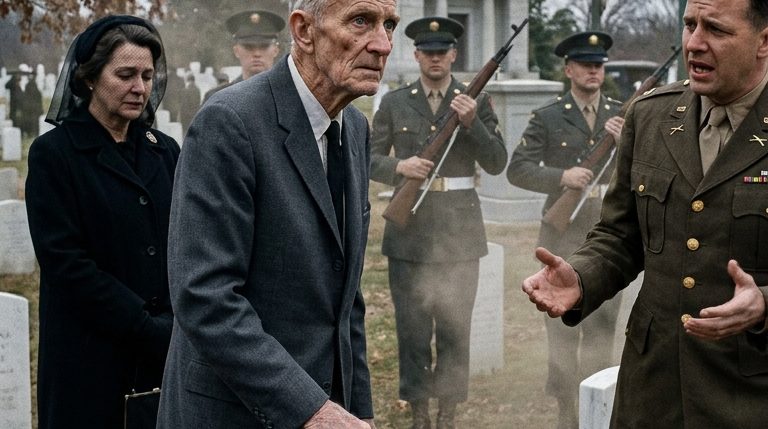
General Thomas Avery steps out. He is alone, his uniform crisp, his presence an anchor of absolute, terrifying calm in the midst of the chaos. He isn’t wearing a ribbon of rank; he is wearing the posture of a man who has walked through fire and is prepared to do it again. He surveys the lobby, his eyes locking onto Hail with a gaze that makes the administrator look like he is physically shrinking.
“Administrator,” Avery says. His voice carries perfectly in the ringing silence. “I believe we have a matter of record to discuss. And I believe Nurse Morgan is nearby.”
Clare stops, her hand on the stairwell handle. She is exposed. She can see Hail looking around, his eyes darting toward the emergency doors, then toward the stairwell where she stands. The tension in the room is a physical weight, a pressure building behind the eyes of everyone present.
The General takes a step forward, his boots hitting the floor with a rhythmic, measured cadence. He isn’t rushing. He is moving with the inevitability of a turning tide.
“I’m here, General,” Clare says. She pushes the stairwell door open and steps back into the light.
Hail’s face goes slack. He sees her, then he sees the General, and for the first time, he doesn’t look like a man defending a policy. He looks like a man who knows the walls have finally collapsed. The staff in the lobby go completely still. The hum of the electrical failure seems to drop away, leaving only the sound of their breathing.
The General turns to face her, a ghost of a smile touching his lips. “I told you, Nurse. Someone had to draw the line. Today, we define where that line is.”
He reaches into his jacket and pulls out a thin, leather-bound folder. He doesn’t hand it to Hail. He hands it to Clare. “This is the authorization for a full federal audit of the Riverside archives. And this,” he gestures to the lobby, now filled with the confused, watchful eyes of the staff, “is the place where we begin.”
Clare takes the folder. The weight of it is immense—not just paper and ink, but the potential to restore the dignity of everyone who was turned away. She looks at Hail, then at the General, and she knows the real fight is just beginning. The hospital is going to tear itself apart to protect its secrets, and she is the one who has to hold the pieces until the truth can be spoken. She looks at the General and nods.
“Let’s get to work,” she says.
The air in the room is electric, vibrating with the sudden shift in gravity. The Administrator is already reaching for his phone, his finger hovering over a contact, his eyes wild with the desperation of a cornered animal. Clare knows what he’s going to do. He’s going to try to trigger the final purge. She has to be faster. She has to move now.