Forged in Iron and Shadow: How a Quiet Engineer Outmaneuvered a Neighborhood Tyrant and Won the Ultimate Legal Reckoning
CHAPTER 1: THE WEIGHT OF TIMBER AND FIRST BLOOD
The plastic tore before it hit the water, a wet, tearing sigh that vibrated straight up through the soles of my boots.
I didn’t blink. Years in uniform taught you to treat a hostile action not as an insult, but as a data point. Across the muddy bank, half-swallowed by the creeping river fog, Karen stood with her arms locked tight across her chest, her chin tilted at that familiar, predatory angle. She wasn’t hiding. She wanted the distance between us measured in silence, and she wanted me to feel the weight of her intrusion pressing against my ribs.
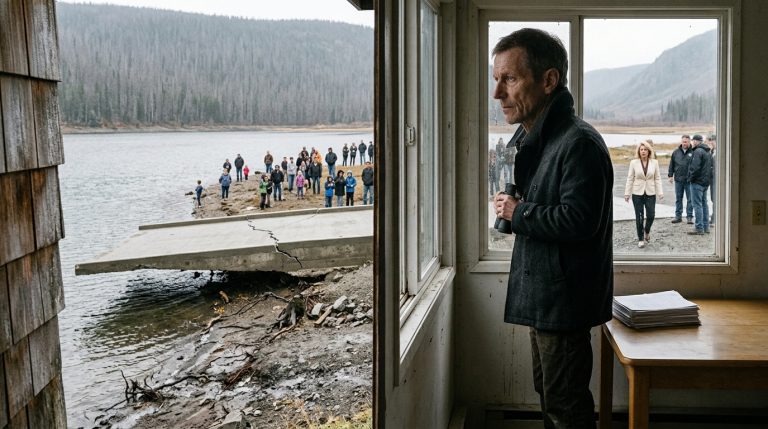
Underneath my palms, the cedar railing of the bridge felt cold, dense, and unyielding—anchored to the steel trusses I had welded into its belly three summers ago. My grandfather had built these bones out of reclaimed oak and stubborn grit when the world was still recovering from its own violent fractures, and my father had spent his weekends teaching me how to sand down splinters without ever losing the grain. This land wasn’t real estate; it was an heirloom written in hardwood and iron. Every bag of drywall scraps, every shardy piece of broken tile she hurled into the current was an attempt to rewrite that language.
“You’re missing the point,” she called out, her voice cutting through the rush of the runoff with a brittle, practiced clarity. She didn’t raise her volume; people who believe they own the air don’t need to shout. “Some spaces are too heavy for a single set of hands.”
I kept my weight balanced on my heels, eyes fixed on the small tear in the black plastic where a sliver of pink insulation dust drifted toward the current. The chemical tang caught in the back of my throat—sharp, synthetic, and entirely foreign to the pine-scented dampness of the valley. It was a signature. A deliberate provocation designed to force an explosion, a raised fist, a shattered voice that she could capture on a hurried smartphone memo and replay for the neighborhood committee.
Instead, I let the silence stretch, heavy and absolute, refusing to hand her the currency she had walked across my property line to collect.
“The river’s choking,” she added, stepping half an inch closer to the boundary wire, her heel sinking into the moss with deliberate insolence. “And the county’s tired of waiting for someone to grow up and manage it.”
She turned on her heel before I could form a syllable, her jacket snapping against her hips with the rigid authority of a badge that didn’t exist. I watched the sway of her shoulders, noting the slight hitch in her left stride—the physical tell of someone unaccustomed to uneven ground, someone who lived entirely inside the smooth, paved illusions of the subdivision behind the ridge.
When the rustle of her jacket faded into the dripping underbrush, I reached down, my fingers brushing against the rough timber where the edge of the railing met the post. My thumb caught on something cold and out of place—a small, metallic scratch embedded in the grain right beneath the top bolt, sharp enough to draw a bead of dark blood. I didn’t pull my hand away. I just stared at the fresh scar in the wood, feeling the slow, rhythmic thud of my own pulse matching the current below. The trash was gone, but the scratch remained, carrying a cold geometry that didn’t match anything a falling branch or a shifting truck could leave behind.
CHAPTER 2: THE ARCHITECTURE OF ENTITLEMENT
The droplet did not fall. It pooled against the whorl of my thumb, dark and viscous in the predawn light, before soaking silently into the dry cedar grain.
I did not wipe it. In the military, you learn to catalog pain as diagnostic data—a sign of where the material has failed or where your own guard slipped. The scratch on the railing wasn’t accidental. It had the precise, deliberate geometry of a carbide scriber or the edge of a hardened steel clip, dragged across the wood at an angle that required someone to lean over the side, bracing their weight against the current. Someone who knew the exact grain of the timber and wanted to leave an unerasable signature.
The river rushed below, churning gray foam against the steel trusses I had welded three summers ago. I turned my hand over, flexing the fingers until the skin pulled taut, then stepped off the bridge planks onto the damp earth of the embankment.
Karen’s tracks were already blurring under the heavy morning mist, but the impression of her heels remained crisp along the soft clay of the path—shallow, distinct, and angled toward the old service road where the subdivision’s rear boundary met the state forest. She wasn’t just walking away; she was mapping lines. Every complaint about the trees, every fabricated rumor about emergency access, every bag of construction debris she had dragged across my timber had a structural logic to it. It wasn’t random malice. It was a pressure test.
I walked the length of the property line, boots sinking silently into the pine needles. The forest here was dense, choked with a natural thicket of hazel and wild blackberry that my grandfather had deliberately left untouched as a natural windbreak. Yet, twenty yards north of the bridge, a patch of ferns had been crushed flat. Not by a deer, and not by a passing raccoon. The stems were sheared cleanly at a uniform height, as if a heavy tripod or a land-surveying rod had been planted there within the last forty-eight hours.
A sudden, sharp breeze cut through the valley, carrying with it the faint, synthetic tang of laundry detergent and cheap musk—the exact scent Karen left lingering in her wake.
My spine went rigid. The phantom smell of cold motor oil and wet wool—a vestige of old motor pool days in the mountains—flashed through my mind, triggering an immediate, hard-wired reflex to drop my center of gravity and sweep my blind spots. I didn’t turn around instantly. I let my eyes scan the reflective surface of a discarded oil can half-buried in the silt near the bank, using the distorted metal curve as a wide-angle mirror.
Nothing moved in the immediate brush, but the stillness was too deliberate. The local crows, which usually mocked anyone crossing their territory at first light, were entirely silent.
I kept my pace measured, walking back toward the edge of the clearing where my truck sat parked beneath a canopy of elderberry. Inside the cab, resting on the passenger seat, lay the brown cardboard box containing the four commercial-grade security units I had purchased the previous afternoon—wide-lens, infrared-capable, and equipped with independent solar panels that required no visible wiring. They were tools designed for commercial job sites where theft and corporate sabotage ran high. They were not meant for a quiet family inheritance.
But quiet was a luxury that expired the moment someone decided your land belonged to a committee.
I opened the truck door, the latch clicking with a sharp, metallic snap that echoed off the valley walls. I pulled out the first camera, running my thumb over the matte-black housing, checking the rubber weather-seal around the lens. If Karen wanted to test the boundaries of ownership, she was about to discover what happened when an engineer stopped keeping score on paper and started recording in high-definition metadata.
CHAPTER 3: THE PAPER WAR AND THE YELLOW SLIP
The matte-black housing of the security unit was cold against my palm. I sat on the tailgate of the truck, the rough-hewn metal digging slightly through my canvas work pants as I tested the tension of the mounting bracket.
My thumb brushed the side of the plastic casing, pausing over a faint, greasy smudge near the lens perimeter. It wasn’t mine. I hadn’t touched the optical glass since pulling it from the factory seal inside town. Someone had handled it before it reached my truck bed—or worse, someone had brushed past the open shipping carton while I was clearing the morning debris from the water line. The detail was small, almost microscopic, but on a 40-acre spread where every footprint had an owner, an uninvited fingerprint was an intrusion before the device was even powered on.
I did not let the irritation register as a spike in pulse; in engineering, frustration is just an uncalibrated variable. Instead, I wiped the smudge clean with a dry rag from my back pocket, the fabric rasping harshly against the sealed lens.
Footsteps crunched on the gravel behind me—light, hurried, and carrying the jerky, self-important cadence of someone who practiced their posture in hallway mirrors.
I didn’t turn around right away. I let the metal screw thread into the bracket with a slow, deliberate click-whir, giving the sound enough room to hang in the damp morning air.
“You’re making a spectacle of yourself,” a voice snapped from the edge of the access road.
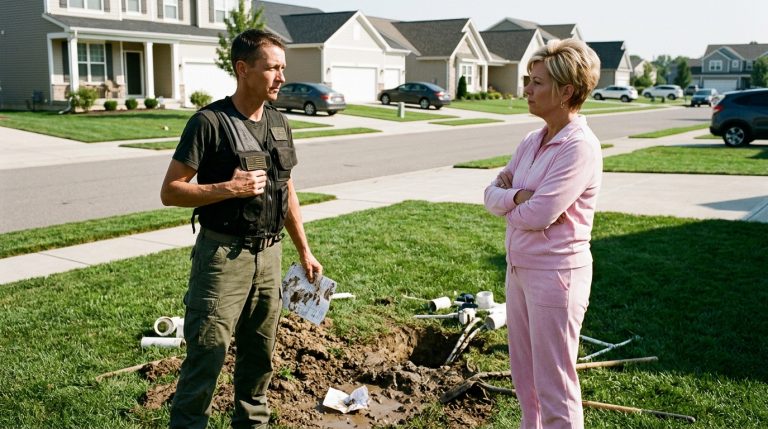
Karen stood six feet past the cattle guard, her arms uncrossed this time, one hand clutching a sheaf of yellow legal paper like a shield. She had swapped her jacket for a tailored trench coat that looked entirely out of place against the rotting stump line of the valley, but her expression wore the same hard, brittle lacquer of unearned authority.
“Private property, Karen,” I said, my voice dropping into that flat, uninflected register that usually unnerved people because it refused to acknowledge their drama. I didn’t look up from the bracket. “You’re past the boundary marker.”
“Boundary markers are administrative suggestions when public welfare is on the line,” she fired back, taking two sharp steps forward before checking herself at the edge of the timber shadow. Her eyes darted to the black box in my hands, then to the truck bed filled with the remaining three units. A flicker of genuine panic crossed her features—fast, involuntary, and instantly masked by a sharper sneer. “The board received another formal complaint this morning. The county health department has been notified about the chemical runoff you’re letting rot by the southern bank.”
I finally raised my head, locking my gaze onto hers. The sunlight caught the edge of her collar, highlighting the tight, grey-threaded fabric.
“There is no chemical runoff,” I said evenly. “There are only bags of drywall and concrete chunks that someone dumped here under cover of darkness.”
“Don’t play dense with me,” she hissed, stepping closer despite her initial hesitation, brandishing the yellow paper like an indictment. “Everyone in the ridge knows what you’re doing. You’re blocking access, you’re hoarding land that belongs to the drainage basin, and you’re daring the community to break you.”
She tossed the yellow slip onto the hood of my truck. It skidded across the dusty green paint before coming to a rest against the windshield wiper.
I didn’t touch it. I watched the way the edges curled slightly from the morning humidity. The handwriting on top was sloppy, rushed, written with the jagged slant of someone trying to disguise their hand while issuing an ultimatum. It wasn’t a formal HOA letter; it was a rough draft of intimidation.
“You’ve been very busy writing notes,” I said softly, standing up from the tailgate. The metal frame of the truck creaked under my weight. “Must take a lot of hours to draft letters for an organization that doesn’t even hold jurisdiction over this acreage.”
Karen’s jaw tightened, the skin pulling white around her mouth. “Jurisdiction is a legal fiction when the people holding the deeds are children playing with their grandfather’s toys. You think because there’s a blue line on an old county map you’re untouchable. But maps change. Ordinances get amended. And when the planning commission re-evaluates the watershed zone next month, that bridge won’t be yours to defend.”
She delivered the line with a sharp, triumphant flick of her chin—the exact verbal tell of someone who had practiced a script in front of an audience that didn’t exist yet.
It was a slip. A precise, dangerous structural leak. The planning commission didn’t review watershed zones on private agricultural land unless a major commercial re-zoning variance had already been filed and paid for by an adjacent entity.
I kept my face entirely neutral, letting the silence stretch between us until her eyes flickered with sudden uncertainty. She realized she had given away an internal timeline, a future coordinate in a battle she thought she was commanding from behind the scenes.
“Next month,” I repeated quietly, tasting the words like iron on the back of my tongue. “That’s good to know, Karen. I’ll make sure the cameras have a clear view of the commission’s route.”
Her face drained of its remaining color, the lacquer cracking completely. Without another word, she spun on her heel, her trench coat whipping around her legs as she scrambled back up the gravel rise toward the subdivision, her footsteps fast, heavy, and entirely lacking grace.
CHAPTER 4: THE MEETING IN THE HORSESHOE ROOM
The yellow paper fluttered violently against the glass, caught by the downdraft sweeping off the ridge before I reached out and pinned it with two fingers.
The ink was cheap, bleeding slightly where morning condensation had kissed the margin. I folded it once—crisp, mechanical, deliberate—and slid it into the breast pocket of my shirt, right over my collarbone where I could feel its stiff edge pressing against my ribs. Karen’s retreat had left behind a heavy, vibrating silence, but the echoes of her slip regarding the planning commission’s timeline hung in the damp air like carbon monoxide. You don’t mention next month’s zoning calendar unless you’ve already paid the filing fee.
I climbed into the driver’s seat of the truck, the vinyl bench groaning under my weight, and turned the ignition. The engine caught with a low, heavy rumble that rattled the rusted dashboard plates—a sound of raw combustion and mechanical survival.
Instead of heading down toward the county road, I shifted into low gear and steered the truck up the narrow, unpaved perimeter track that hugged the outer ridge. The community center sat three-quarters of a mile away, nestled just inside the horseshoe-shaped boundary of the subdivision. It was a modest single-story building of red brick and white vinyl siding, surrounded by manicured turf that looked aggressively sterile against the tangled, living wall of the state forest.
The parking lot was mostly empty save for a silver sedan belonging to the board’s treasurer and a battered utility van. I cut the engine three hundred yards out, letting the truck coast into the shade of a massive, double-trunked oak tree whose roots had buckled the asphalt years ago.
I didn’t go inside to storm the front doors; that was what Karen expected, a loud, reactive spectacle that she could frame on a clipboard. Instead, I walked the perimeter line where the subdivision’s manicured turf abruptly surrendered to wild briar and sumac.
Right at the property intersection, half-hidden behind an electrical utility box, stood a weathered wooden stake bearing a small brass plate: Subdivision Easement Marker 14-B. I crouched down, brushing away a layer of decaying oak leaves. The bolt securing the plate to the stake had been loosened, and the wood beneath it was freshly scarred by a pry bar. Someone had checked the coordinates recently. Someone who needed to verify whether the drainage culvert running beneath my bridge connected directly to the subdivision’s main stormwater grid.
A sharp metallic click echoed from the side entrance of the community center.
I didn’t flinch. I stayed low behind the utility box, letting the rusted steel enclosure shadow my profile. The door opened half an inch, held by a rubber stopper. Muffled voices drifted out into the cool morning air—sharp, hurried, and unmistakably anxious.
“…she’s moving too fast,” a man’s voice muttered, dry and clipped, carrying the thin authority of a board treasurer counting pennies. “If the county environmental officer pulls the original deeds before the variance goes to vote, the whole commercial easement package collapses.”
“She’s handling it,” a second voice replied—smoother, pitched lower, belonging to someone accustomed to smoothing over council disputes with a tight smile. “Karen knows what’s at stake. The drainage corridor is the only viable access point for the heavy machinery required for the new utility line extension. Without that bridge crossing, the commercial developer drops our option.”
There it was. Not a neighborhood dispute. Not a passionate crusade for visual harmony or environmental safety. A commercial utility easement pipeline, disguised behind a curtain of fake civic outrage, designed to slice right through my family’s legacy to line the pockets of a silent developer. Karen wasn’t an independent enforcer; she was the battering ram.
The voices dropped back into a murmur as the door clicked fully shut, the rubber stopper sliding across the concrete threshold.
I stood up slowly, the joints in my knees popping softly in the quiet air. I reached into my shirt pocket, my fingers brushing against the folded yellow slip. The illusion of a messy neighbor feud had completely dissolved, replaced by the cold, precise machinery of corporate land theft wrapped in a suburban badge.
I walked back to the truck, my boots crunching rhythmically on the gravel. I pulled the door open, slid behind the wheel, and turned the key. The engine roared back to life, steady and unyielding. The paper war was over; the engineering survey had just begun.
CHAPTER 5: THE DIGITAL EYES IN THE CEDARS
The steering wheel vibrated against my palms, transmitting every imperfection of the unpaved service track straight up through my wrists.
I kept the truck’s speed down to a slow crawl, the engine idling low so the noise wouldn’t carry across the ridge toward the subdivision’s back fence. On the passenger seat, the brown cardboard box was empty now, its flaps torn open to reveal the vacant molded slots where the four surveillance units had rested. In their place sat a roll of weather-resistant zip ties, a compact digital monitor, and a roll of black tactical tape.
The time for passive observation had expired. When a board treasurer and a proxy enforcer map out a commercial easement pipeline behind a closed rubber stopper, they aren’t waiting for a polite invitation. They are drafting coordinates for a hostile takeover.
I killed the engine fifty yards short of the timber line, letting the truck glide into a thick shadow cast by a cluster of deadfall maples. The silence that rushed in to fill the void was absolute, save for the rhythmic dripping of melting dew from the pine boughs overhead.
I grabbed the first camera housing, its matte-black surface ice-cold against my fingertips, and stepped out onto the damp moss. My boots made no sound as I began the ascent toward the northern ridge.
The climb was steep, the earth loose and slick with decaying organic matter, but my pace remained methodical. Every movement was calculated to conserve energy and eliminate silhouette exposure against the skyline. Halfway up the slope, a sudden wave of fatigue made the rusted surface of my truck down in the clearing look distorted through the trees—a fleeting, paranoid flash that the decay eating at the boundary markers was somehow infecting my own tools. I shook the thought off, grounding my weight onto a thick root system, and kept moving.
At the apex of the ridge, overlooking the western approach to the bridge, stood a towering, multi-stemmed cedar whose lower branches had died off years ago, leaving a straight, vertical trunk that offered an unobstructed field of view across the entire creek bed and the approach road.
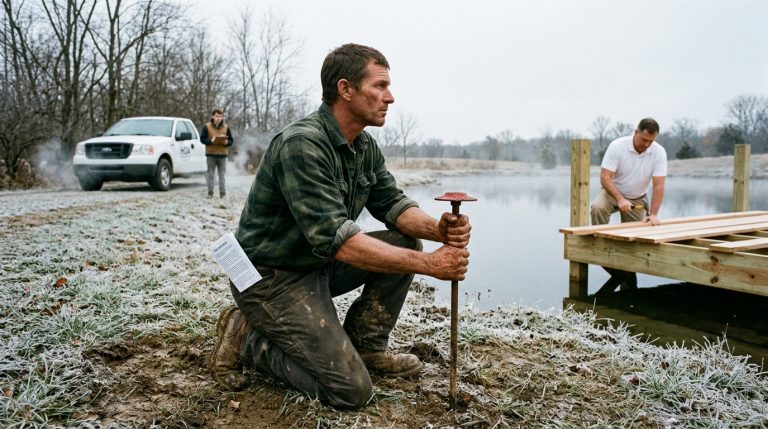
I slung the camera strap over my shoulder, gripped the rough bark with both hands, and began to climb. Years of military obstacle work returned instinctively—muscle memory overriding thought as my boots found purchase in the deep furrows of the cedar bark.
When I reached the ten-foot mark, I wedged myself securely into a natural fork between two thick lateral limbs. From here, the bridge looked like a fragile wooden spine laid across a dark scar of water.
I pulled the first unit from my tactical vest, looped the heavy-duty mounting strap around the trunk, and pulled it tight with a sharp, mechanical ziip. The lens clicked as I adjusted the wide-angle pan, linking it via encrypted local frequency to the handheld monitor waiting in my pocket. On the small screen, the live infrared feed flickered to life, rendering the dark riverbank in stark, high-contrast monochrome. Every blade of grass, every pebble on the approach road, and every inch of the timber railing was rendered with brutal, unblinking clarity.
I secured the second unit forty feet away, angled directly toward the subdivision’s rear service gate where the utility box stood.
As I tightened the final securing bolt, a sharp snap of dry brush echoed from the ravine below.
I froze instantly, melting back against the rough cedar bark, my breathing dropping to a slow, controlled cadence. Down on the approach road, half-swallowed by the early afternoon mist, a figure was moving with jerky, purposeful strides. Even from a distance, the rigid posture and the sharp swing of the arms were unmistakable. Karen was back, and she wasn’t carrying a clipboard this time. She held a heavy wooden mallet in one hand and a spray can in the other, marching straight toward my bridge with the blind, furious momentum of a cornered animal.
CHAPTER 6: THE MIDNIGHT BREACH AND THE BOLT CUTTERS
The snap of the dry sumac twig echoed sharply across the ravine, carrying up through the damp air right to the fork of the cedar where I sat wedged against the bark.
I didn’t shift my weight. Every muscle in my upper back locked tight, maintaining a motionless silhouette against the dark canopy. Down on the approach road, Karen’s movements had lost their erratic, hurried edge. They were rhythmic, deliberate, and backed by the ugly confidence of someone executing a final phase. In her left hand, she gripped a heavy wooden mallet by the neck; in her right, a long-handled pair of red-gripped bolt cutters swung with a pendulum-like swing against the thigh of her trousers.
The air around her carried a sharp, chemical reek—not the artificial musk of her usual perfume, but the biting, solvent-heavy stench of industrial paint stripper.
She reached the cattle guard at the base of the bridge and stopped. For a long, stretched moment, she stood entirely still, her head tilted back as if she were inspecting the wooden planks for unseen alterations. Her eyes swept the timber rails, lingering on the fresh steel plates I had bolted into place. She didn’t look like a frustrated neighbor anymore; she looked like an operative clearing an obstacle from a designated right-of-way.
My right hand drifted slowly to my pocket, wrapping around the cold, textured surface of the handheld monitor. The infrared screen glowed faintly against my palm, casting a tiny, ghost-white square of light onto the inner lining of my jacket. The four remote cameras mounted around the perimeter were humming silently in the high branches, their lenses tracking her vector with unblinking, timestamped precision. Every micro-action—the flex of her wrists, the precise angle of the bolt cutters, the stubborn set of her jaw—was being locked into an immutable chain of digital custody.
Karen stepped across the boundary line, her boots striking the timber of the bridge with a hollow, resonant thud.
She didn’t hesitate. She dropped the wooden mallet onto the planks with a heavy clatter, hoisted the red-gripped cutters, and jammed the steel jaws around the hardened steel shackle of the secondary safety gate I had installed the previous week. Her face flushed a mottled, furious red under the moonlight, the veins in her neck caving and swelling as she braced her right foot against the railing and threw her full body weight into the handles.
The metal shackle groaned under the leverage—a high-pitched, metallic shriek of stressed alloy—before snapping apart with a sharp, pistol-crack report that echoed down the river canyon.
Karen staggered back a half-step, catching her balance against the warped rail. Instead of looking startled, she laughed—a short, jagged sound of pure, unadulterated triumph. She kicked the broken gate wide open, letting it bang violently against the cedar post, and hauled a heavy, plastic-wrapped bundle from the brush line behind her. Without a second thought, she heaved the mass over the side of the bridge.
The bundle hit the rocks below with a wet, heavy crunch, bursting open to scatter jagged chunks of gray concrete and frayed fiberglass insulation across the shallow water line.
Up in the cedar, my thumb pressed down gently on the screen capture button of the monitor, logging the exact second, angle, and evidentiary value of the destruction. The trap wasn’t just set; it had been sprung by the very hands meant to dismantle it.
CHAPTER 7: THE INTERROGATION ON THE PORCH
The damp pine needles gave way beneath my boots with a muted, compressing hiss as I dropped from the lower lateral branch of the cedar.
My knees absorbed the impact with a sharp, familiar thud, the vibration traveling straight up through my spine and echoing the phantom sting of old shrapnel pulling against bone. Down on the approach road, the dust kicked up by Karen’s hurried retreat was still settling in the amber shafts of moonlight. She hadn’t bothered to pick up her wooden mallet or the discarded strap of the plastic tarp; they lay scattered across the scarred planks of the bridge like tools abandoned by a retreating sapper who suddenly realized the perimeter was compromised.
I didn’t rush to clear them. I reached into my coat pocket, extracted the handheld monitor, and confirmed the storage indicator. The server had backed up every frame to the encrypted cloud node before she even reached the property line.
The time for indirect observation had run its course. When someone brings bolt cutters and industrial solvents onto private engineering structures to clear an illegal right-of-way for a commercial utility pipeline, a polite phone call is no longer a tactical option.
I walked the three-quarters of a mile up the perimeter track, keeping to the deep shadows of the cedar line until I reached the paved cul-de-sac at the edge of the subdivision. The houses here looked identical under the streetlamps—manicured, silent, and aggressively uniform, their trimmed lawns glowing like green plastic under the sodium glare.
Karen’s house sat on the corner, distinguished only by the small, self-righteous “Neighborhood Watch Coordinator” plaque bolted to the cedar porch post.
The front windows were fully illuminated, casting a harsh, yellow light through the slatted blinds. Inside, a shadow moved rapidly back and forth—short, jerky pacing that betrayed a system under critical structural failure.
I didn’t use the doorbell. I mounted the two wooden steps of the porch, the floorboards groaning under my boots, and rapped three flat, heavy knuckles against the core of the front door. The sound was dry, authoritative, and stripped of all neighborly pretense.
The pacing inside stopped dead.
Footsteps rushed toward the entryway, the deadbolt threw itself back with a sharp, clacking mechanical shriek, and the door jerked inward.
Karen stood in the threshold, her face flushed a blotchy, mottled crimson, her blouse untucked on one side where she had frantically torn off her jacket. The moment she saw me standing in the yellow porch light, her eyes didn’t widen with fear; they narrowed into a hard, defensive squint of pure, unadulterated entitlement.
“You have no business being on subdivision property,” she spat out instantly, her voice rising an octave, vibrating with the practiced hysteria of someone attempting to seize narrative control before a word could be spoken. “I’ve already called the board president. You’re harassing me.”
I didn’t step back. I didn’t raise my voice. I kept my weight balanced on my heels, looking down at her with the flat, unblinking register of an engineer inspecting a failed load-bearing beam.
“You crossed the boundary line forty minutes ago, Karen,” I said quietly, the words dropping into the space between us like heavy lead shot. “You used bolt cutters on a private access gate. You dumped seventy pounds of uncontained concrete and hazardous construction debris into a protected watershed. And my cameras logged every frame of it from four separate angles.”
Her face went from crimson to a sickly, mottled gray. Her mouth opened, a dry, clicking sound escaping her throat as she searched for a procedural loophole, a fake citation, an imaginary ordinance to shield her.
“The… the bridge is a public hazard,” she stammered, her voice cracking sharply around the edges, losing its artificial polish. “The community needs that easement cleared for the utility expansion. The board approved the survey—”
“The board has no jurisdiction over my grandfather’s land,” I cut across her sentence, the steel in my tone slicing cleanly through her defense. “And the planning commission’s commercial easement package doesn’t exist on any legal county registry. You were acting as a proxy for a corporate developer, using fake HOA notices to bully a private citizen out of an access corridor.”
She stepped back, her hand flying up to grip the edge of the doorframe for support as the final structural support of her delusions collapsed entirely.
“The environmental protection unit received the complete metadata file ten minutes ago,” I added, turning slightly on my heel to let the porch light catch the edge of my jacket. “Officer Ramirez is already reviewing the footage. I’d suggest you sit down and draft a very thorough explanation before he knocks on this door.”
I didn’t wait for her to answer. I turned my back on the threshold, stepped off the porch into the cool evening air, and left her standing alone in the bright, exposed light of her own unravelling.
CHAPTER 8: THE HAMMER OF LAW AND THE CLEARED RIVER
The yellow porch light of Karen’s house shrank behind me as I walked down the paved cul-de-sac, the glare dissolving into the deep, natural shadow of the cedar line.
I didn’t look back. The friction of the confrontation was already cooling into cold, mathematical certainty. My boots crunched rhythmically against the gravel service track, each step carrying me back toward the valley floor where the river cut through the center of my grandfather’s land. By the time I reached the cattle guard, the eastern sky was beginning to fracture into pale, cold bands of gray—the exact hour when the night shift surrenders to the weight of day.
The county utility trucks arrived precisely at sunrise, their orange safety strobes painting rhythmic, amber flashes across the wet pine trunks.
Officer Ramirez stepped out from the lead cruiser, boots splashing through the thin rim of mud near the bank. He didn’t offer a greeting; he handed me a heavy, laminated folder containing the court-stamped injunction and the environmental restoration warrant.
“We pulled the original municipal annexation registries from nineteen-eighty-two,” Ramirez said, his voice flat and professional as he gestured toward the subdivision’s rear fence line. “The commercial easement the HOA was pushing for the utility line extension? It was filed under a dormant developer shell corporation that shared direct financial ties with three members of the board—and Karen’s personal holdings.”
The final piece of the architecture clicked into place with the cold precision of a machined gear. It had never been about neighborhood aesthetics, and it had never been about an accidental pile of construction debris. The entire campaign—the fake citations, the weaponized HOA letters, the manufactured public safety crisis, the midnight dumping—was a deliberate, multi-stage proxy operation designed to devalue the land, manufacture a public nuisance, and force an emergency municipal condemnation that would hand the bridge corridor over to the corporate developer for pennies on the dollar.
“Where is she?” I asked, looking past him toward the bridge.
“Inside her lawyer’s office downtown, answering to a federal environmental misdemeanor and an emergency injunction for fraud,” Ramirez replied, snapping his clipboard shut. “The court ordered full restitution for the structural damages, plus the complete remediation of the riverbed. Her self-appointed enforcement career is officially closed.”
As Ramirez walked back to his cruiser to coordinate the cleanup crews, I turned toward the wooden bridge.
The county workers moved with quiet, methodical efficiency, descending into the ravine with industrial containers to haul away the concrete chunks and frayed fiberglass insulation Karen had hurled into the current. They replaced the snapped safety gate with a heavy, galvanized steel latch, securing the bolts with a torque wrench that hummed through the crisp morning air.
I walked out to the exact center of the bridge, stopping right where the planks met the steel trusses I had welded three summers ago.
I knelt down, resting my palm against the rough grain of the cedar. The wood was solid, cool, and completely free of the scars and chemical residue left behind by the weeks of conflict. The river below rushed over the cleared stones, its current running clear and fast, carrying the morning light straight through the valley without obstruction.
The final pillar of the catharsis settled into the quiet space around me. The financial payoff was absolute; the poetic justice had stripped the antagonist of the very authority she weaponized; and the physical space had returned to its pristine, unyielding balance.
I pulled a small, multi-tip screwdriver from my back pocket and tightened the loose screw on the central support plate—the symbolic closure of a repair that had spanned generations. The land was quiet now, anchored by the weight of history and defended by the unyielding rules of law and physics. Standing there alone in the rising sun, I took a long, steady breath, knowing the bridge would outlast any storm, any committee, and any illusion of control that dared to test its bones.