A Precise Siege at Willowbrook: The Engineering of Retribution Against an Entitled Neighbor’s Calculated Deceit
CHAPTER 1: THE WAKE OF THE GARDEN
The cardinal didn’t come to the dock this morning. I suppose it sensed the change in the atmosphere, or maybe it just didn’t recognize the yard anymore. Where there should have been the soft, familiar scent of Queen of Sweden roses—a fragrance Martha used to say smelled like promise—there was only the stagnant, suffocating odor of churned Ohio mud and exhaust.
I sat on the dock, the wood biting into my palms, clutching a coffee mug that had gone stone-cold ten minutes ago. My eyes weren’t on the lake; they were fixed on the raw, open wound in the earth where the herb spiral used to sit. Twenty-seven bushes. Fifteen years of growth, of Martha’s laughter, of soil testing and pruning, reduced to a jagged landscape of broken pottery and flattened dirt by a woman who wouldn’t know a perennial from a weed.
Sloan Kensington. The name tasted like ash. I watched her house, a sprawling, hollow monument to status, its white siding gleaming with a sterile, offensive perfection. She was probably inside right now, sipping something imported, already sketching out the next phase of her deck, utterly oblivious to the fact that she hadn’t just destroyed a garden; she had declared a structural failure in her own immediate future.
I didn’t move. I didn’t shout. I simply watched the way the shadow of the excavator’s arm hung over my property line, a dark, permanent finger pointing at my failure to stop her.
My knuckles were white as I tightened my grip on the mug. Thirty years at Akron Steelworks. Thirty years of ensuring every bolt, every weld, every micron of tolerance was accounted for. I had spent my life building things that could withstand the crushing weight of industry, yet I had let a woman in designer workout clothes tear down my wife’s legacy because I was too polite to scream.
The air shifted, carrying the sound of a screen door sliding shut next door. I didn’t turn my head, but I felt the weight of her gaze. She was watching me from her kitchen window, waiting for the old, grieving widower to break. She expected a scene, a pathetic display of weeping, something she could record on her phone and laugh about with her friends over dinner.
Instead, I focused on the property pin at the corner of my dock. It was buried, rusted, and silent, but it was there. It was the only thing in this yard that didn’t lie. I felt a cold, hard resolve settle in my chest, replacing the grief that had hollowed me out for eighteen months. I wasn’t just sitting on a dock anymore; I was surveying a site.
I set the mug down on the dock—a sharp, deliberate clack of ceramic on wood—and stood up. I didn’t look at her house. I looked at the mud. I needed to know exactly how deep the damage went.
As I took my first step off the dock, my toe caught on a jagged piece of terracotta from one of Martha’s heirloom pots. I looked down and froze. Wedged into the mud, half-buried by the treads of the excavator, was a small, brass garden marker I hadn’t seen in weeks. It was engraved with the date: May 2010.
It wasn’t supposed to be there. I had cleared this section days ago. The realization hit me with the force of a physical blow—the ground hadn’t just been churned; it had been moved. She wasn’t just building a deck. She was systematically erasing the physical evidence that this land had ever belonged to anyone but her.
CHAPTER 2: THE FIRST BREACH
The brass marker was heavier than it looked. A simple thing—a scrap of stamped metal meant to identify an heirloom variety of rose—but it felt like a lead weight in my hand. I stood there in the churned, lifeless muck, my boots sinking into the wet Ohio clay. I could still hear the distant, rhythmic hum of a luxury sedan’s engine over at Sloan’s place, the sound of progress.
I didn’t turn around when I heard the screen door slide open again. I didn’t have to. I knew the cadence of her steps now—light, expensive, impatient.
“You’re trespassing, Dale,” she called out, her voice sharp, polished, and entirely devoid of anything resembling a conscience.
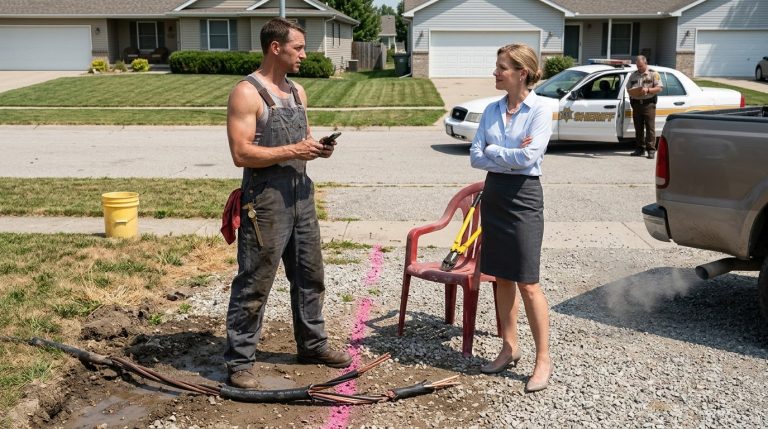
I turned slowly, wiping the mud from the marker onto my bathrobe. The bathrobe felt thin against the morning chill. She was standing on the edge of her pristine, synthetic-grass patio, a tablet in one hand and a green smoothie in the other. She wore athleisure that looked like it had never touched actual sweat. She looked like a catalog advertisement for a life that didn’t exist, standing over the grave of one that did.
“I’m standing on my land, Sloan,” I said. My voice sounded gravelly, unfamiliar to my own ears. It lacked the steady, calm tone I used to pride myself on at the plant. It was thin, frayed at the edges.
“Are you?” she asked, not even bothering to look up from her tablet. “Because the contractor said he cleared the property line exactly as the previous owner described. If you’re going to act like a scavenger, do it somewhere else. I’ve got a crew coming at nine to prep the foundation for the hot tub.”
I held up the brass marker. The sun caught the stamped letters, casting a long, jagged shadow across my palm. “You didn’t just clear the line, Sloan. You erased history. This was buried. You didn’t just dig to the surface; you ripped the foundation out of this yard.”
She finally looked at me, her eyes narrow, assessing. It was the same look the floor managers used to give when they were trying to calculate how much a mistake would cost the company. She wasn’t looking at a grieving widower; she was looking at a liability.
“That garden was a blight,” she said, her tone dropping into that syrupy, patronizing register she used when she wanted to convince someone they were the irrational one. “It was decaying, it was unkempt, and frankly, the neighbors have been complaining about the smell of rot for months. I’m doing everyone a favor by upgrading this strip of dirt into something functional. You should be thanking me for the investment.”
A phantom scent hit me—the faint, sweet, impossible smell of the Queen of Sweden roses. My brain was playing tricks, trying to map the memory of the garden onto the reality of the mud. I saw Martha standing where Sloan was standing now, holding a trowel, her face smudged with dirt, smiling because the first bloom had opened.
Don’t let them take the space, Dale, a whisper, entirely my own, echoed in the back of my skull. If you yield the space, you yield the memory.
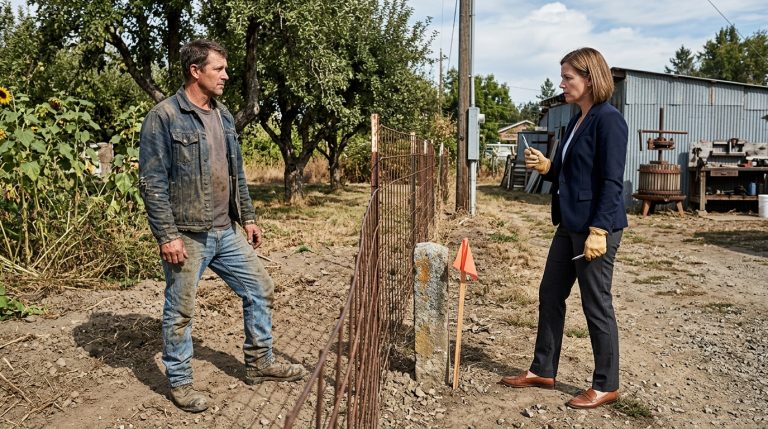
I didn’t answer her. I didn’t have the energy for a debate about property values. I walked toward the property pin at the corner, my boots squelching, the sound unnervingly loud in the quiet morning. I knelt, ignoring the dampness seeping into my knees, and began to dig with my bare hands.
“What are you doing?” she snapped, her composure finally showing a hairline fracture. “That’s property damage. I’m calling the police, Dale. I mean it.”
“Call them,” I said, my voice cold. I felt the edge of the metal pin under the mud. It was cold, solid, and rooted deep. “Tell them I’m measuring my own property. Tell them you’re terrified that a retired steel worker is using a tape measure.”
I pulled the mud away, revealing the top of the pin. It was barely visible, buried deep, but it was exactly where it had been for twenty years. I knew these pins. I knew the history of them. They didn’t lie. They didn’t care about property values or hot tubs or the opinions of pharmaceutical sales reps. They were the only absolute truth in a world that felt increasingly ephemeral.
I stood up, the mud drying on my skin, and looked directly at her. She was staring at me, and for the first time, she looked uncertain. She had expected me to retreat into the house. She had expected me to fold.
“Nine o’clock?” I asked, my voice steady now, echoing the precision of the work I used to do.
“What?”
“You said the crew is coming at nine to prep the foundation.” I checked my watch. “It’s 7:45. You have an hour and fifteen minutes to call them off, Sloan. Because if that excavator crosses that line again, I’m not calling the police. I’m going to make sure the county building inspector sees exactly what you’ve done to the structural integrity of this lakefront property.”
I didn’t wait for her response. I turned and walked back toward my house, my gait purposeful, the brass marker tucked firmly into my pocket. My heart was hammering, not with fear, but with the familiar, humming intensity of an engine coming up to speed. I had the start of it now—the baseline. I had the location, I had the threat, and I had the motivation.
As I walked into my kitchen, the silence of the house hit me, but it was different this time. It wasn’t the silence of grief; it was the silence of a workshop before the first shift. I pulled open my desk drawer, moving past the bills and the old greeting cards, and pulled out the property survey map I’d filed away months ago.
I laid it out on the table. The lines were beautiful. Clean, precise, mathematical. And as I stared at the blueprint, I realized something that made my skin prickle. Her deck—the one she was so desperate to build—didn’t just lean over the line. Based on the way she’d bulldozed the garden to widen the patch, she was planning to extend the concrete foundation for the hot tub at least fifteen feet past the registered boundary.
She wasn’t just being a bad neighbor. She was building a structure that legally belonged to me.
I grabbed my phone and started searching. I didn’t need a lawyer yet; I needed facts. I needed the building codes, the zoning restrictions for lakefront structures, and the exact process for filing an injunction. I worked with the speed of a man who had suddenly found a target. My fingers danced across the screen, documenting every regulation, every potential violation, every single point of leverage.
The kitchen clock ticked toward 8:15. Outside, the distant rumble of a diesel engine started up.
I didn’t panic. I watched the clock. I had the measurements. I had the records. And most importantly, I knew exactly how a structure like that was supposed to be built—and more importantly, how it could be pulled apart.
I picked up the landline, my finger hovering over the dial for the local building inspector’s office. This was the first move in a game she didn’t even know she was playing. I wasn’t going to just stop her; I was going to make the cost of her progress so high that she’d never want to hear the word ‘renovation’ again.
I took a deep breath, the smell of my cold coffee and the dried mud on my hands filling the room. It was time to start the paperwork.
CHAPTER 3: THE WATCHFUL EYE
I didn’t wait for the building inspector to return my call. People like that—bureaucrats in small-town offices—they needed a paper trail before they’d even consider getting out of their air-conditioned trucks. I spent the next three hours at the kitchen table, not with coffee, but with a stack of HOA bylaws I had pulled from the attic and a legal pad.
The house next door was quiet, but it was a deceptive kind of quiet. The excavator was parked right on the edge of the line, its yellow arm pointing toward my dock like a frozen finger. Every time the wind gusted, the tarp covering the machine flapped against the metal, a hollow, rhythmic sound that grated on my nerves.
I needed eyes. Not my own—I couldn’t stand on my dock all day staring at her—but something that didn’t blink, something that recorded, something that would provide the irrefutable, digital geometry she lacked.
I found the system in the garage, tucked inside a dusty cardboard box labeled Steelworks – Q.C. Surplus. It was a high-end, four-camera setup I’d snagged from a plant closure auction three years ago. It had night vision, motion-tracking, and a GPS timestamp feature that was accurate to the millisecond.
Installing it felt like reconnecting a nervous system. I started at the corner of the garage, running the cabling through the eaves, keeping the wires flush against the trim so she wouldn’t see them. I worked with the slow, deliberate movements of a man who was used to fitting tolerances measured in thousandths of an inch. Each screw was seated perfectly; each cable was tensioned so it wouldn’t sag.
By the time the sun reached its zenith, I had the first two cameras mounted. One covered the rear garden plot—the site of the massacre—and the other was angled specifically to capture the encroachment zone of her deck.
I sat back on my heels, wiping a smudge of grease from my cheek. My back ached, a deep, grinding pain that reminded me of my age, but my hands were steady. I felt a strange sense of clarity. Every wire I ran, every lens I pointed, was a line I was drawing back in the dirt.
As I tightened the final bolt on the second camera, a flash of movement caught my peripheral vision. Sloan was out on her patio again. She wasn’t holding a smoothie this time. She was on her phone, pacing, her movements jerky and erratic. She kept looking toward the property line, then back at her house, then at her phone again.
I stayed still, crouching behind the garage trim. I didn’t want her to know she was being watched—not yet.
“I don’t care what the surveyor said,” she hissed, her voice carrying easily across the short distance. “Just find a loophole. I have the bank breathing down my neck about the refinancing, and if that deck foundation isn’t poured by Friday, the appraisal won’t hold. I’ll lose the bridge loan. You hear me? Just make it work.”
She stopped pacing and shoved her hair back, her face twisted into a mask of frustration that lacked any of the polish she wore for the neighbors. It was a face of pure, unadulterated fear.
She wasn’t just being greedy. She was drowning.
I held my breath, listening. The wind shifted, and for a second, I caught a snippet of the other side of the conversation—a muffled, indistinct male voice, likely the contractor or a lawyer.
“I don’t care about the line,” she snapped back. “I’ve already invested too much. If he wants to fight it, let him. By the time he gets a court date, the concrete will be set. And in this state, possession is ninety percent of the law, isn’t it?”
She slammed her phone down onto the patio table and walked inside, slamming the sliding glass door so hard the frame rattled in its casing.
I remained still for a long time. The realization settled over me, heavier than the physical labor of the cameras. Possession. She was counting on the fact that I was an aging man, grieving, slow to act, and easy to intimidate. She was planning to pour concrete over the truth.
I finished the installation, my movements now faster, sharper. I ran the master unit into my basement, routing the main feed into my old computer monitor. When I turned it on, the screen flickered to life, showing the four quadrants of my yard in crisp, high-definition.
There it was. The encroachment. The view from the garage camera was perfect. It showed the entire footprint of her planned foundation, clearly overlapping the metal pin I’d uncovered that morning.
I didn’t just feel satisfied; I felt a grim, icy sense of purpose. I had the evidence. I had the intent. I had the documentation of her own words about the bridge loan and the appraisal.
I reached into the box and pulled out a small, handheld digital audio recorder. I placed it near the basement window, which opened directly toward her patio. If she was going to have those conversations, I was going to make sure they were archived.
As I sat there in the dim light of the basement, surrounded by the smell of concrete and old tools, I caught sight of myself in the reflection of the computer screen. I looked old. My hair was gray, my face lined with months of solitary grief. But my eyes… they looked different. They were focused, calculating, and for the first time since Martha had passed, they were looking forward to something.
I wasn’t just watching her. I was waiting for her to make the one mistake that would justify tearing everything she’d built down to the foundation. She thought she was fighting a neighbor. She had no idea she was fighting an engineer who understood that every structure, no matter how expensive or shiny, had a breaking point.
I reached out and clicked the Record button on the camera system. The little red light blinked to life, a steady, rhythmic pulse in the darkness.
The game had officially begun. I leaned back in my chair, listening to the hum of the cooling fan, and began to draft the formal letter to the county building inspector. I was going to invite him over for a personal inspection of the property lines, and I was going to provide him with a copy of everything I’d seen and heard today.
It was time to see if she was as confident when a government official with a clipboard was standing on her precious hot tub deck, pointing out exactly where the law was about to shut her down.
CHAPTER 4: THE MEASUREMENT OF TRUTH
The email notification on my phone was a sharp, digital chirrup, cutting through the low-frequency drone of the server cooling fans. I clicked the link, the screen illuminating the basement in a pale, sterile glow. It was a PDF file. The survey results.
I didn’t open it immediately. I sat there, the air smelling of dust and ozone, and listened to the house. Upstairs, it was quiet. Outside, through the camera feed, I saw Sloan’s BMW pull out of the driveway, the tires crunching against the gravel with a dismissive, aggressive sound. She was gone.
I stood up, my knees popping, and walked over to the workbench. I picked up my heavy-duty tape measure, the casing cold and scratched, a relic of years spent in the steelworks. I needed to see it for myself. Documentation was one thing; walking the ground with a steel blade was another.
I climbed the basement stairs, the transition from the dim, controlled world of the server room to the harsh, unforgiving light of mid-afternoon almost blinding. The sun was high, bleaching the color out of the lawn, turning the muddy churn of the garden into a landscape of parched, cracking gray.
I walked out to the property pin I had uncovered that morning. I hooked the end of the tape measure onto the metal stake and pulled. The yellow ribbon of fiberglass extended, a thin, bright line cutting across the emptiness. I walked toward the edge of Sloan’s deck construction, my boots marking the ground.
Twenty feet. Twenty-one feet.
I didn’t stop. I kept pulling, the tape measure snapping taut. Twenty-three feet. The end of the tape rested squarely on top of her half-poured concrete footer.
She wasn’t just encroaching. She was deep. Nearly three thousand square feet of my land was currently under her thumb.
I took a picture of the tape measure with my phone, the timestamp clear in the corner of the frame. I looked back toward her house. It was empty, a monument to a woman who thought that money could buy gravity, that she could bend the laws of property just like she bent the ears of the HOA board.
A sudden, sharp gravel crunching sound from the driveway made me stiffen.
It wasn’t a BMW. It was a white county truck. A surveyor’s vehicle.
My stomach dropped. I hadn’t called the county yet—I was waiting for the official PDF—but someone had. I watched as a man in a neon-yellow vest stepped out, clutching a clipboard and a long-range transit level. He looked toward the house, then toward me.
“Dale Hutchinson?” he called out, his voice echoing in the stillness of the lakefront.
“That’s me,” I replied, my voice sounding distant to my own ears. I didn’t move. I stayed right where I was, one hand still gripped on the tape measure, the line still marking the territory.
“Got a call about a boundary dispute on this stretch,” the surveyor said, walking toward me with the practiced, unhurried gait of someone who had seen a thousand neighbors lose their tempers over six inches of dirt. “Someone claimed the markers were moved.”
I looked at the surveyor, then at the empty, silent house next door. Sloan. She hadn’t been waiting for me to act; she had been trying to get ahead of the story. She had likely called the county herself, trying to preemptively ‘fix’ the boundary before I had a chance to present my own findings.
“The markers weren’t moved, they were bypassed,” I said, my voice quiet, devoid of the agitation she wanted to provoke. “I have the survey from three weeks ago. I have the pins.”
The surveyor stopped a few feet away, glancing at the tape measure still stretched across the dirt. He didn’t look at me, but at the site. He looked at the deck footers, then at the metal pin I had cleared.
“That’s a lot of encroachment,” he noted, his tone professional, clinical. He didn’t sound angry or shocked; he sounded like a man assessing a structural failure. “You realize this is a civil matter, Mr. Hutchinson? I can report the discrepancy to the county, but the physical removal… that’s on you.”
“I know,” I said. “But the legal implication—the encroachment on a recorded deed—that’s not civil. That’s a liability.”
The surveyor nodded slowly. “I’ll do the scan. But if these pins are accurate, she’s going to have a very bad afternoon.”
I watched him set up his transit level, the tripod legs sinking into the dust. As he worked, I felt the familiar weight of the steel-worker’s perspective settle back into place. He was measuring the physical reality of the situation, but he was missing the psychological dimension. He didn’t know about the bridge loan. He didn’t know about her desperation, the way she was using the land as collateral.
I stood there for an hour, watching the surveyor’s laser dance across the surfaces of her deck. Each time he signaled a measurement, I wrote it down in my notebook. My handwriting was neat, precise.
I wasn’t just observing. I was gathering the ammunition.
When the surveyor finally packed up, he looked at me, a hint of sympathy in his expression. “She’s going to fight you on this, you know. People with decks like that… they don’t like to be told they’re sitting on someone else’s foundation.”
“I’m not looking for a fight,” I said, and for the first time, it was almost true. “I’m looking for a resolution. And according to these numbers, the resolution is quite simple.”
He drove away, leaving me alone in the oppressive, hot silence of the yard. I walked back to the property pin and picked up my tape measure, the yellow ribbon retracting with a sharp, metallic snap.
I looked at my house, then at hers. The gap between them was shrinking, the air thick with the coming storm. I wasn’t going to call the police, and I wasn’t going to get into a shouting match on the dock. I was going to wait for the report. And when it arrived, I was going to go to the HOA board meeting with a map that showed exactly how far she had fallen.
I walked back to the garage, the heat radiating off the asphalt, and opened the door. I needed to check the fence controls. If she was going to continue to build, I needed to make sure my defenses were ready. The steel, the hydraulics, the planning—it was all coming together.
Martha used to say that you couldn’t rush the growth of a rose. You had to feed the soil, protect the roots, and let the bloom happen in its own time.
I looked at the fence control box, my fingers hovering over the switches. I wasn’t planting roses. I was building a barricade. And the bloom, when it finally arrived, was going to be anything but beautiful for Sloan Kensington.
CHAPTER 5: THE DECIEVING DEEP
The garage air was stale, smelling of cold grease, cut cedar, and the metallic tang of hydraulic fluid. I moved toward the workbench, the concrete floor vibrating slightly with the heavy-duty hum of the pump system I’d hidden beneath the floorboards. I should have felt the triumph of a man who held all the cards, but as I looked at the blueprints spread across the table—the CAD schematics for the hydraulic fence sections—a chill that had nothing to do with the temperature crawled up my spine.
I picked up the tablet linked to the basement server, the screen glowing in the dark, and opened the latest folder of intercepted metadata.
I’d been so focused on the property lines, on the geometry of the war, that I hadn’t looked at the economics.
The documents I’d been gathering—the ones I was preparing for the HOA—now seemed like paper shields against a cannon blast. I tapped into the public records portal again, cross-referencing Sloan’s name with the latest filing from the county clerk. My heart hit a jagged rhythm in my chest.
She wasn’t just building a deck to increase the property value for a standard refinance. She had already signed a listing agreement for an “exclusive, private-pool lakefront rental” on a real estate platform. The listing was active. The photos were professional, heavily edited, and featured a sweeping view of the lake—taken from the perspective of the very land she had stolen from me.
She was selling the experience of my property.
I leaned against the workbench, the edge digging into my ribs. The sound of a bird caught my ear—a clear, sharp whistle. I froze. It sounded like the cardinal, that same bird that had frequented the Queen of Sweden roses. I turned toward the garage window, my breath hitching, but there was nothing there—only the distorted reflection of the garage light on the glass.
I was seeing ghosts again. The stress was warping my perception. I had to focus.
The logic was undeniable: she didn’t care about the legalities because she was already monetizing the violation. Every day the deck stood, every day the hot tub occupied my land, she was pulling in rental fees. She wasn’t just a bad neighbor; she was an opportunist who had calculated that the cost of legal fees and fines was lower than the profit she’d make before the court could move to stop her.
She’s not afraid of the court, I realized, the coldness in my marrow deepening. She’s banking on the bureaucracy.
I began to move with a frantic, sharp-edged precision. I went to the hydraulic controller, my fingers flying over the keypad. If she wanted to play a business game, I would have to disrupt the asset itself. I could, with a single command, lock the valves and render the entire deck foundation structurally unsound—effectively triggering a “safety violation” that would force an emergency shutdown of her rental operation.
But as I reached for the master override, the intercom system I’d installed near the perimeter fence chirped. A voice, amplified and grainy, cut through the garage.
“Dale? Are you in there?”
It was Beth Tatum, my neighbor from the other side. She sounded breathless, frantic.
I grabbed the handheld mic, my thumb hovering over the toggle. “I’m here, Beth. What’s going on?”
“It’s Sloan,” she said, the words tumbling out. “She’s got a crew out there right now—not the usual guys. They’re moving fast. They’re installing massive floodlights and security cameras around the pool area, and they’re putting up a ‘Private Property – Trespassers Will Be Prosecuted’ sign right at the edge of your dock. She’s claiming you’re the one trespassing on her rental facility!”
I looked at the monitor. The feed showed the back of Sloan’s house. Two men in heavy-duty jumpsuits were hauling a massive industrial floodlight pole toward the line.
She was escalating. She wasn’t just stealing the land; she was declaring it an armed zone.
“She’s got papers, Dale,” Beth continued, her voice rising. “Some kind of ‘temporary injunction’ she’s waving at the neighbors. She’s telling everyone you’re a stalker who’s been harassing her and that the police have already cleared her to secure the area.”
The lie was elegant, systematic, and entirely, terrifyingly effective.
I set the mic down. I didn’t need to check the records to know she’d lied to the sheriff’s office to get that paperwork. She was turning the neighbors, turning the law, and turning my own quiet life into a public spectacle.
I looked at the hydraulic controls, then at the image of the men putting up the floodlights. I could stop this. I could trigger the fence now, mid-installation, and watch her entire project collapse into the earth. It would be a total, absolute victory.
But as my hand moved toward the lever, a sickening thought stalled my momentum. If I activated the fence now, while those contractors were on the property, I wouldn’t just be reclaiming my land—I would be opening myself up to a physical injury lawsuit that would end me. She was daring me to act. She was baiting the trap.
I pulled my hand back, my palm slick with sweat.
I had misjudged her. She wasn’t just a bully; she was a predator, and she was waiting for me to lose my temper so she could finalize my ruin.
I backed away from the console, my heart thumping against my ribs like a trapped bird. The silence of the garage suddenly felt oppressive. I realized, with a clarity that was almost physically painful, that I couldn’t win this by playing the game she had set up. The legal route was too slow, and the mechanical route was now a liability.
I walked to the small, circular mirror I had mounted in the corner of the garage—the one I used to check my blind spots when I was working on the car. I looked at myself. The lines around my eyes weren’t just signs of age; they were evidence of a man who had spent his life thinking in straight lines and right angles.
I looked at the blueprints on the desk, then at the camera monitor. There was a detail on her deck foundation plan I’d overlooked—a secondary drainage pipe that ran deep under the garden plot.
If I couldn’t stop the deck, I would have to change the foundation.
I grabbed a pencil, the wood feeling sharp and aggressive in my grip. I started to sketch, not the fence this time, but the flow of the water—the natural drainage path of the lakefront. I was going to turn the ground itself against her.
I had to be faster than her. I had to be smarter. And most importantly, I had to be invisible.
The cardinal’s whistle echoed again, louder this time. I closed my eyes, forcing the sound out of my mind, and focused on the math. The soil was saturated; the lake was high. If I could redirect the subterranean runoff—if I could break the seal on the drainage line she’d installed—the land itself would do the work for me.
The structural failure wouldn’t be an act of war. It would be an act of nature.
I looked at the garage door, the sunlight bleeding in through the cracks. It was time to leave the workbench. It was time to go back out into the yard, not as a neighbor, but as an engineer who was about to design a catastrophe she would never see coming.
CHAPTER 6: THE SILENT SUBTERFUGE
The transition from the garage to the outdoors was like stepping into a different world. The evening air was crisp, smelling faintly of lake water and pine, a stark, clean contrast to the grease and machine oil of my workshop. My boots crunched against the gravel as I moved toward the perimeter, my shadow stretching out long and distorted across the yard. I kept my movements low, deliberate, following the path I had mapped out in my mind—the path that would eventually make the land itself work against her.
I reached the garden plot, the site of the original destruction. The dirt here was still raw, freshly turned in places where I’d been working on the raised beds. I knelt, my hands finding the grip of a hidden access hatch I’d installed earlier in the week under the guise of “landscape maintenance.” It was a simple, sturdy metal plate, flush with the ground, nearly invisible under a layer of mulch. I slid it open, the movement smooth and well-lubricated. Beneath, the pipes pulsed with a faint, low-frequency hum—the sound of the hydraulic fluid waiting for the command.
I pulled out my toolkit, the steel tools cool and reassuring in my grip. I wasn’t just digging; I was surgical. I traced the line of the main supply conduit, the one that ran parallel to the drainage pipe. If I could tap into the overflow, I could create a subtle, persistent moisture release that would slowly undermine the integrity of the concrete footers Sloan’s contractors had poured. It wasn’t an explosion. It wasn’t a wrecking ball. It was erosion, slow and inevitable.
As I worked, a large delivery truck pulled up to Sloan’s driveway. I stayed hunched behind the trellis, watching. The truck was emblazoned with the logo of a high-end catering and decor company. Men in uniforms began unloading tables, folding chairs, and silk-draped lighting rigs.
I paused, my wrench suspended in mid-air. She was planning an event. A launch party for her ‘exclusive lakefront rental’ operation. The audacity of it—holding a gala on the very land that was currently the subject of a legal dispute—was almost impressive. But it was also a tactical blunder. She was inviting the neighborhood to witness her trespassing.
I turned back to the pipe, my resolve hardening. I began to loosen the coupling, the metal groaning under the pressure of the wrench. My mind, usually a clean, logical machine, kept drifting back to Martha. I could see her, not in the garden, but in the house, organizing our retirement finances with that same sharp, meticulous focus I was applying to this pipe.
What would she say, Dale? I wondered.
She would tell me that we were meant to build, not destroy. But then, she hadn’t been here to see the rose bushes ripped out. She hadn’t seen the arrogance in Sloan’s eyes, the way she treated the land as a commodity rather than a home.
The coupling gave way with a sharp, crisp hiss. A thin stream of water trickled out, soaking into the soil. I adjusted the bypass valve, setting it to a microscopic drip—a release that would, over the next forty-eight hours, turn the ground beneath her hot tub into a sponge. By the time her guests arrived, the foundation wouldn’t be failing, but it wouldn’t be solid. It would be a waiting game.
I closed the hatch, smoothing the mulch over the surface until it looked as undisturbed as a forest floor. I stood up, stretching my aching back. The yard felt different now. It felt charged, a silent, ticking clock hidden beneath the grass.
As I walked back toward my house, I saw Sloan walking out onto her deck, holding a glass of wine, inspecting the progress of the caterers. She looked triumphant. She was the queen of the lake, holding court on her stolen throne. She didn’t see me in the shadows, didn’t see the man who had just re-engineered the very ground she stood on.
She turned, her gaze sweeping toward my dock, but I was already gone, moving into the darkness of my own porch. I sat down on the bench Martha had loved, the wood familiar and worn. I didn’t reach for my phone to check the cameras. I didn’t reach for the paperwork.
I just sat there, listening to the hum of the lake. I had set the trap. I had done the work. The precision of the engineering was flawless; the logic was sound.
The question that lingered in the back of my mind wasn’t whether the deck would hold—it was whether I would still be the same person once it finally fell. I was a man of measurements and specifications, but looking out at the water, I realized that I had become something else entirely. I was an architect of consequences, and for the first time, I wasn’t waiting for the morning to start again. I was waiting for the ground to shift.
The party would be tomorrow night. I had twenty-four hours. And in that time, I had to ensure that every single one of my documents was ready to be presented to the HOA the moment the music started to fade.
CHAPTER 7: THE BREAKING POINT
I stood in the darkness of my basement, my eyes locked on the monitor. The feed was grainy, illuminated by the harsh, over-saturated glow of the security floodlights. Sloan was there, a silhouette of frantic motion. She was screaming—I couldn’t hear the words, only the jagged, ugly cadence of her voice—and she was swinging the sledgehammer with a wild, undisciplined strength.
Clang. Clang. Clang.
The sound vibrated through the foundation of my own house, a rhythmic tolling of a funeral bell for her stolen empire. She was hammering the decoy control box, the one Tom had installed precisely to draw her out. She thought she was disabling my fence; she thought she was cutting the legs out from under my protest. She was, in reality, hammering the very switch that would turn my property line into a barricade.
I watched her face in the high-contrast light. It was smeared with dirt, her hair a wild, frantic halo. The pharmaceutical sales rep, the polished executive, the queen of the lake—all of it had evaporated, leaving behind something raw, something desperate. She looked like a cornered animal, and for a fleeting second, I felt a strange, cold pang of pity. She was terrified. She was losing her leverage, her money, her control, and she was doing it all to protect a foundation built on air.
I moved to the real control panel, the one buried in the concrete of my basement floor. My hands hovered over the heavy-duty breakers.
If I do this, I thought, the memory of Martha’s voice filtering through the static, there is no going back.
But then the image on the screen shifted. Sloan had stopped hammering. She was panting, her head bowed, and she raised the hammer one last time, swinging it with everything she had into the center of the housing.
The hydraulic sensors—the redundant, multi-layered connections I had spent weeks calibrating—didn’t just register the impact; they interpreted it as a structural emergency.
Activation sequence: Initiated.
The ground outside began to groan. It wasn’t the screech of metal, but the deep, resonant thrum of high-pressure fluid displacing earth. I saw the movement on the monitor—the garden plot, the patch of ground where the roses had once stood—rippling like water.
Sloan froze. She stood over the shattered decoy box, the hammer still in her hand, as the first cedar post surged up from the deep.
It rose with a terrifying, smooth inevitability, a six-foot pillar of solid, weathered cedar breaking through the surface of her expensive deck. It didn’t just push through; it splintered the wood, cracked the tiles, and sent a spray of pulverized concrete into the air.
I watched, mesmerized. The fence posts followed, one after another, emerging in a perfectly timed sequence along the surveyor’s line. They sliced through her hot tub deck like a knife through soft dough. I saw the hot tub itself—the centerpiece of her illegal rental business—suddenly heave to the side as a post emerged squarely through its center. Four hundred gallons of chlorinated water spilled out in a massive, white-capped wave, sweeping across the patio and down toward the lake.
Sloan stumbled, the water catching her at the knees, knocking her sideways into the wreckage of her own deck. She dropped the hammer, the metal sliding across the tiles with a harsh, discordant screech.
She wasn’t screaming now. She was just staring, her mouth open, watching the forest of cedar emerge from the ground, turning her private resort into a fenced-off grave.
The system hit its final pressure limit, the pumps locking into place with a definitive, heavy thud that echoed all the way to the basement.
The silence that followed was absolute.
I leaned against the wall, my breath coming in short, shallow bursts. The monitor showed a static, perfect, six-foot-tall cedar fence, stretching from the dock to the garden edge, carving her stolen land back into two distinct halves. The water from the hot tub was still gurgling away, draining into the crevices of the mud.
Outside, a light flickered on in the Johnsons’ house across the street. Then another. The Johnsons, the Petersons, the Tatums—they were all waking up, drawn by the sound of the water and the sheer, impossible geometry of the fence.
I didn’t turn away. I watched as the blue and red lights of a patrol car finally began to rotate at the end of the driveway, the sound of the siren beginning a low, mournful wail that grew louder as it approached.
She had wanted to play a game of possession. She had wanted to show me how much money could buy. But she had forgotten that, in a dispute over land, money doesn’t hold the ground—geometry does. And I had spent thirty years making sure my geometry was perfect.
I walked to the stairs, my legs feeling heavy, grounded, like I had finally been bolted to the earth. I needed to go outside. I needed to stand on my side of that cedar fence and watch as the reality of my actions became the reality of her life.
The struggle was over. The structure had failed. Now, all that was left was the cleanup.
CHAPTER 8: THE PRECISION OF PEACE
The world outside was a cacophony of flashing blue light and shouting voices. As I stepped out of the basement door, the humidity of the evening struck me, heavy and charged with the scent of damp earth and churned-up mulch. My boots met the solid ground of my own property, and for the first time in eighteen months, the ground felt level.
Sloan was surrounded. Two officers were standing over her, their hands hovering near their belts. She wasn’t fighting anymore. She was folded, her shoulders slumped, staring at the cedar fence as if it were a physical manifestation of a fever dream. The floodlights she’d installed—the ones meant to secure her “private rental facility”—now only served to highlight the jagged, splattered ruins of her deck and the stagnant, dark water pooling in the shattered remains of her hot tub.
I walked to the edge of the fence, the wood cool and smooth under my hand. It stood perfectly vertical, an architectural monument to the laws she had tried to ignore.
“Mr. Hutchinson,” one of the officers called out, spotting me. He was young, his expression a mix of bewilderment and forced professionalism. “You’re the owner of this property?”
“I am,” I said. My voice was calm, resonant. The adrenaline that had fueled me for days had drained away, leaving behind a strange, quiet lucidity. I didn’t feel the need to shout or point. The fence said everything that needed to be said.
“She’s claiming you sabotaged the site,” the officer said, gesturing toward the wreckage.
I pulled the folder from under my arm—the documents I had prepared for the HOA, the surveys, the deeds, the copies of the local building codes, and the transcripts of the public filings. I handed it to him, the paper crisp and organized. “Everything is documented, Officer. The fence is on my land, installed according to county specifications. The damage to her deck is the result of her attempting to destroy my equipment at three in the morning.”
He looked at the folder, then at Sloan. She didn’t look at me. She didn’t even acknowledge my presence. She looked at the lake, her eyes glassy, her posture that of someone who had just realized that the math of her life no longer balanced.
The revelation hit me then, a slow, aching wave of understanding that transcended the property dispute. Sloan wasn’t just a criminal or a bully; she was a woman who had tried to build a life out of stolen parts, hoping that if she made the exterior look perfect, no one would notice the rot in the foundation. She had projected her own financial terror onto the world, believing that if she took enough, she could finally feel secure.
But she hadn’t just lost the land. She had lost the illusion.
As the officers began to read her the citations—trespassing, destruction of property, harassment—I turned my back on the scene. I didn’t need to hear it. The payoff wasn’t in the charges or the arrests; it was in the silence that had finally returned to the lakeshore.
I walked toward the garden, the place where it had all started. I knelt down, my fingers brushing the soil. It was still dark, still rich, still full of the potential for something to grow. I pulled out a small, worn trowel—the one Martha had used for years—and began to push the soil back into place, smoothing over the ruts left by the excavator.
I took the brass marker I had saved—the one dated May 2010—and pressed it firmly back into the center of the herb spiral.
The Poetic Justice wasn’t just the fence. It was the fact that while she was being led away, her professional world dissolving into legal briefs and debt, I was still here, tending to the things that actually lasted. I wasn’t just fixing the dirt; I was fixing the space.
I spent an hour in the garden, working in the fading light, the air finally quiet. The cardinal, as if on cue, landed on the top of the fence post, a splash of brilliant red against the weathered cedar. It didn’t sing, it just watched me, a silent witness to the restoration.
When I finally stood up, my knees were sore, but my heart was steady. The house, usually so empty and hollow, looked different in the moonlight. It looked like a home again. I had realized that my obsession with the fence wasn’t just about boundary lines—it was about creating a space where the memory of Martha could exist without being threatened. I had spent so long trying to keep the world out that I had forgotten to let the light in.
I walked to the garage, the sledgehammer leaning against the wall in the corner. I picked it up, feeling its weight, and then set it down. It was just a tool. It had served its purpose, but it no longer had a place here.
I walked back to the dock, the wood warm beneath my feet. I sat down on the bench, the one Martha had loved, and looked out over Willowbrook Lake. The water was calm, reflecting the stars. The dispute was settled; the boundaries were clear. There was no more fighting to do, no more calculations to run, no more enemies to outmaneuver.
There was only the quiet, and for the first time in two years, that was enough. I sat there, breathing in the scent of night-blooming jasmine, a man who had finally measured his life and found that, despite all the losses, the center still held. I was, at last, home.