The Rust-Stained Covenant: A Tactical Masterclass in Dismantling Suburbia’s Petty Tyrants Through Calculated Malicious Compliance
CHAPTER 1: The Threshold of Contempt
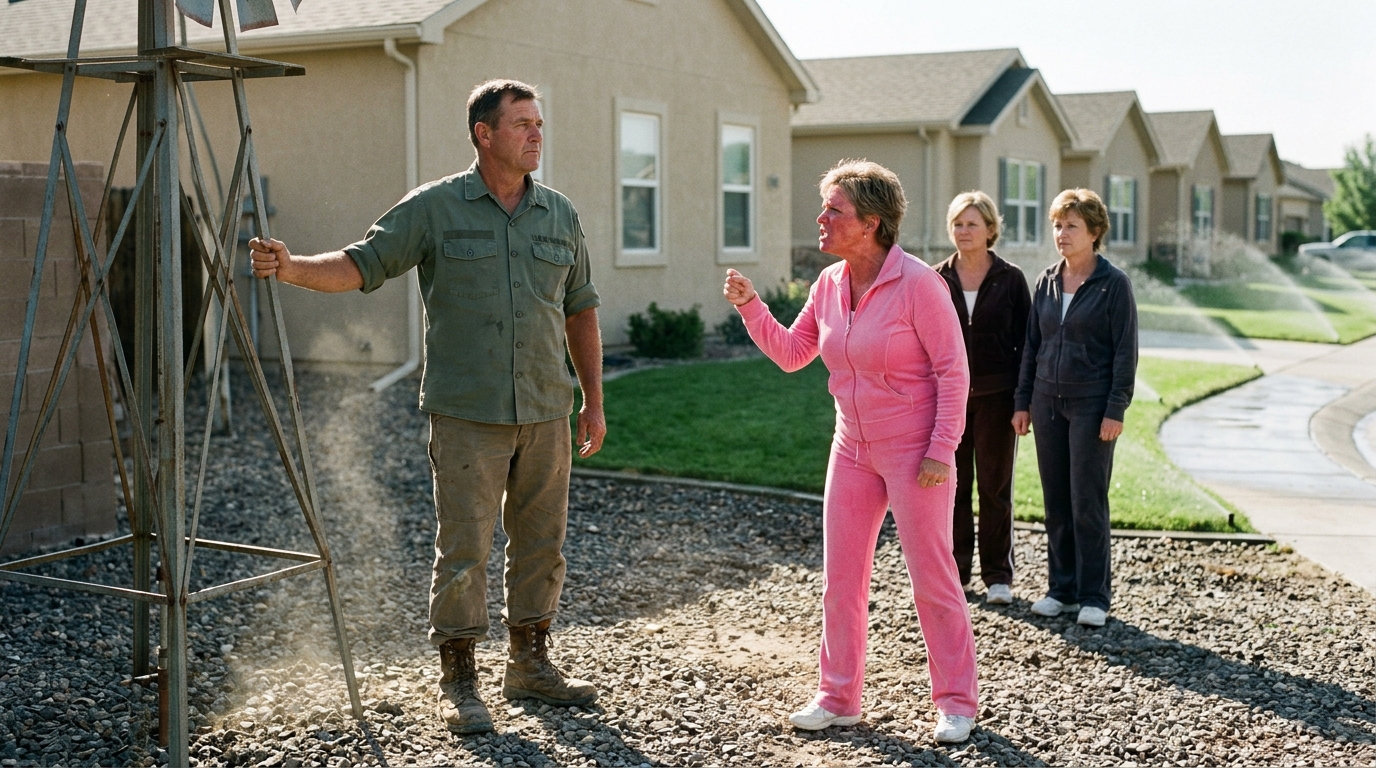
The windmill didn’t care about the HOA covenants. It only cared about the wind, and this morning, the breeze was steady, pushing the blades into their rhythmic, bone-deep creak. It was a sound that had anchored my grandfather for seventy years, and it was currently driving the woman in the pink tracksuit into a state of visible, shivering hysteria.
“That rustic monstrosity has to go,” Karen said. Her voice was thin, sharp, and entirely unburdened by the weight of facts. She stood exactly three inches over the property line, her feet planted on the edge of my manicured gravel drive as if she were marking territory for an invading army. “You have thirty days, Jack. Or the fines will be biblical.”
I kept my hand on the cold, weathered steel of the lattice. I didn’t look at her. I looked at the horizon, where the heat haze was already starting to shimmer off the asphalt. Twenty years in the Army Corps of Engineers had taught me one fundamental truth: petty tyrants only gain power when you acknowledge their relevance.
“Biblical,” I repeated, the word tasting like dry dust.
“Don’t get cute,” she snapped. Barb and Janice, her two loyal shadows, shifted behind her, nodding in synchronized, vapid rhythm. They looked like they were waiting for a signal to start tearing the steel beams down with their bare hands.
I turned then, slowly. I moved with the calculated economy of a man who spent his life analyzing structural integrity and load-bearing failure points. Karen blinked, momentarily taken aback by the stillness in my gaze. She was used to people stuttering, apologizing, or fumbling for their checkbooks.
“I’ve spent two decades building things that lasted, Karen,” I said, my voice as level as a transit level. “I understand rules. But you are mistaking a municipal ordinance for a divine decree.”
Her face flushed a mottled, dangerous red. “This is Oakidge Estates. We have standards. That—that eyesore violates every section of our architectural code. If you don’t remove it, we will levy the maximum daily fine until you leave.”
I looked past her, toward the cul-de-sac. Beyond the manicured hedges and the perfectly synchronized sprinkler systems, ten houses stood in a silent, compliant row. They were all connected to me. They were all drawing life from the deep-earth pressure tank buried beneath the windmill’s foundation.
“You’re very concerned about aesthetics,” I said, my voice dropping an octave, becoming something like the grinding of gears. “But are you sure you want to pull this specific thread? Because once you start dismantling things, it’s hard to predict what’s actually holding your world together.”
Karen laughed, a sharp, brittle sound that vanished into the morning air. “Threats? Really? You’re just a man with a broken antique.”
I turned my back on her then, letting the silence stretch between us until it became heavy and suffocating. As I walked toward the barn, I reached into my pocket and touched the cold, brass key to my grandfather’s roll-top desk. Inside that desk lay the 1978 easement, a document so powerful it would render her entire existence in this neighborhood legally void.
She thought this was a battle over a lawn ornament. She had no idea she’d just declared war on the water supply.
I opened the barn door, the wood groaning, and realized with a sudden, icy clarity that something was different. The pressure tank wasn’t just humming—it was vibrating. A hairline crack had appeared on the main gauge, and the needle was trembling, dipping into the red.
CHAPTER 2: The Ledger of Shadows
The barn was a relic of a different era, a dark, cool cathedral of rough-hewn timber and the smell of ancient motor oil. I stepped inside, the groan of the door fading behind me, and focused on the pressure gauge. The needle was dancing erratically, a frantic, red-tipped heartbeat that signaled a catastrophic loss of integrity in the system.
I didn’t panic. Panic was a waste of caloric energy. I stripped off my work gloves, placed them on the workbench, and reached for the heavy, leather-bound folder that had sat on my grandfather’s desk for a decade. It was thick, the edges of the pages worn soft like velvet from years of his calloused hands turning them.
The memory hit me with the force of a physical blow—the summer of ’98, overseeing a drainage stabilization project in a monsoon-drenched valley. We had been fighting the soil, fighting the rain, trying to keep a temporary bridge from sliding into the mud. I remembered Sergeant Miller—not my grandfather, but a different Miller, a man who had taught me how to read the tension in a cable before it snapped. He’d told me that everything in engineering was a conversation between the forces acting on the object and the object’s own structural memory.
The windmill was currently having a very loud conversation with the geology beneath our feet.
I opened the folder, the smell of aged paper and ink rising to meet me. My eyes scanned the blueprints, the hand-drawn schematics of the well-casing, and finally, the document that was the linchpin of everything: the 1978 Utility Easement.
It was a piece of art in its own right. The legal language was thick, impenetrable to the layman, but to me, it was as clear as a battlefield map. Henderson, the original developer, had been a pragmatic man. He knew that granite and shale were unforgiving mistresses. He had signed away the right to aesthetic control over this five-acre plot in exchange for the life-blood of his development. It was all there, filed, stamped, and notarized in Deed Book 412, Page 88.
An unbreakable covenant that ran with the land.
I traced the line of the signature with my thumb. Karen’s obsession with “neighborhood values” was a hollow shell. She was attempting to enforce rules that had been legally extinguished before she had even likely learned to drive. The irony was exquisite. She was standing on the precipice of her own destruction, screaming about plastic flamingos and mailbox colors, while the very pipes that quenched her morning coffee were managed by the “eyesore” she wanted to tear down.
I turned the page to the maintenance logs. My grandfather’s handwriting was meticulous—small, sharp, and precise. Every greasing of the bearings, every adjustment to the sucker rod, every check of the pressure tank was recorded with the dedication of a man who understood that infrastructure was the invisible spine of civilization.
He hadn’t built this for himself. He had built it for the land. And now, the land was being encroached upon by people who viewed “community” as a collection of aesthetic guidelines rather than a shared, living utility.
A metallic clink from outside pulled my attention back to the present. I stepped toward the barn window, peering through the dust-moted glass. Karen was still out there, her back to me, engaged in an animated conversation with Barb and Janice. They were pointing at the windmill blades, which were catching the morning sun like spinning knives.
I didn’t need to hear her voice to know exactly what she was doing. She was rallying the troops, defining the enemy, and preparing for the next phase of her little crusade. She was gathering the power she thought she possessed, oblivious to the fact that I was currently holding the only key that mattered.
My gaze returned to the desk. I needed to act, but not with the blunt force she expected. A soldier doesn’t fire into the fog; he waits until he has a clear line of sight and a solid target. I reached for my laptop, the screen flickering to life. It was time to build the file. I began to scan the easement, the deeds, and the maintenance logs, creating a digital mirror of the physical evidence.
Every document was a brick in a wall I was building around my property. Every scan was a trap, waiting to be sprung. I would not argue with her. I would not beg for an exemption. I would present the legal reality of the situation in such a cold, clinical fashion that she would be forced to acknowledge the ground was shifting beneath her feet.
But for now, the tension in the barn remained. I stood in the silence, listening to the windmill’s rhythmic creak, and felt the weight of the responsibility. I wasn’t just protecting a plot of land or a vintage structure. I was the keeper of a system that allowed ten families to exist in the middle of a geological nightmare.
I checked the pressure tank one last time. The needle had stabilized, but only barely. The system was strained, but it was holding. I closed the leather folder, the snap of the clasp echoing like a closing bolt-action rifle.
The battle lines were drawn. Karen had brought her petty grievances to my doorstep, but I was going to force her to see the architecture of the reality she lived in. I picked up my phone, my thumb hovering over the contact for David Chen. He was the only person who would appreciate the sheer, devastating beauty of what I was about to do.
I didn’t call him yet. First, I needed to see how the neighborhood reacted to the initial round of pressure. I walked back out of the barn, the sunlight hitting my eyes with the intensity of a searchlight. Karen was gone, but the atmosphere of the cul-de-sac felt different—sharper, tenser. The silence was no longer peaceful; it was waiting.
I walked to the edge of my drive, looking down the street. Marcus was standing on his porch, his posture rigid, his gaze locked onto the windmill. He knew. He might not have known the legal details yet, but he had been around long enough to know when a structure was being threatened and when a man was preparing for a fight.
He didn’t wave. He simply stood there, a silent sentinel of the old guard.
I looked at the windmill, then back at the houses. The water was still flowing, but the clock was ticking. Every rotation of those blades was a moment closer to the climax of this petty, suburban war. And I was going to ensure that when the dust settled, Karen would be left standing in the center of a desert she had created all by herself.
CHAPTER 3: The Paper Siege
I didn’t rush. Rushing was for people who didn’t have the law on their side. I watched the printer arm slide back and forth, the black ink bonding with the high-quality bond paper I’d pulled from my grandfather’s stash. It was heavy, textured, the kind of paper that demanded to be taken seriously.
I picked up the first sheet. The ink was still fresh, slightly tacky to the touch. To the Architectural Review Committee, care of President Karen Miller. The salutation felt like a scalpel incision. I wasn’t just writing a letter; I was drafting an architectural blueprint for a trap.
My grandfather had been a man who believed in the power of documentation. “Jack,” he’d told me once, while we were cleaning the gear housing in the heat of a July afternoon, “you can’t win a war with just steel. You need the paper trail to back it up. If it isn’t written down, it doesn’t exist.”
I followed his logic to the letter. I laid out the response with the same precision I’d once applied to the logistics of a bridge construction project. I didn’t get into the easement. Not yet. The easement was the queen, and I wasn’t about to expose her on the first move. Instead, I focused on the classification. I attacked her definition of the windmill.
Regarding your Notice of Violation dated current month, please find the following request for documentation regarding the classification of said windmill as a ‘temporary structure’.
I let the sentences stay short. Professional. Cold. I questioned their criteria. I asked for the structural engineering reports—reports I knew she didn’t possess. I asked for the peer-reviewed assessment of the windmill’s impact on local aesthetics, knowing that the only “review” she’d conducted was a glance from her front porch while nursing a glass of iced tea.
The printer stopped. I pulled the pages and placed them on the desk, the stack growing. Each one was a brick, and by the time I was finished, I would have built a structure around her that she wouldn’t be able to climb over.
As I worked, the shadows in the barn lengthened. The late afternoon sun filtered through the gaps in the siding, casting long, dusty spears of light across the concrete floor. Outside, the world of Oakidge Estates continued to churn. I heard the muffled sound of a lawnmower, the distant, playful shouting of children, and the hum of an air conditioner kicking on. They were all living their lives, completely unaware that their very infrastructure was, at this moment, the subject of a bureaucratic siege.
I felt a strange sense of detachment. I was the one pulling the strings, yet I was also the most isolated person in the neighborhood. Marcus was a solid ally, but he was a soldier, not a strategist. The Petersons were terrified, still clutching their slide violation as if it were a life raft. I was the architect of this friction, the man standing in the eye of a storm that only I could see coming.
I finished the final page and sat back, the chair groaning beneath my weight. I didn’t feel triumph. Triumph was a messy, loud emotion. I felt only a grim, mechanical satisfaction. It was the same feeling I had when a complex, 500-ton span finally touched down on its abutments. Everything aligned. Everything held.
I stood up and walked to the window. Across the cul-de-sac, Karen’s house was dark, but a single light flickered on in her home office—the room where she sat, likely typing up more arbitrary rules, convinced of her own righteousness. She was so sure of her power. She had the clipboard, the title, and the loud, echoing support of Barb and Janice. She had everything except the ground beneath her feet.
I moved back to the desk and collated the papers. I didn’t use staples. I used a simple, formal paperclip, a small, silver detail that emphasized the bureaucratic nature of the strike. I walked over to the corner of the barn and opened the small, floor-mounted safe where my grandfather had kept the original county files.
I pulled out the certified mail forms. I was going to send this properly. I was going to make sure every step was tracked, every signature collected. This wasn’t just a letter; it was a deposition waiting to happen.
I turned off the desk lamp, the sudden plunge into darkness feeling like a physical weight lifting. I walked out of the barn and stood by the windmill. The wind had died down, the blades now motionless, pointing toward the twilight sky like a skeletal hand. The silence was absolute.
I picked up the stack of papers and tucked them under my arm, the edges sharp against my ribs. I had my strategy. I had my ammunition. Now, I just had to wait for the post office to do its work. I looked toward the neighborhood one last time, the rows of silent houses hiding the reality of their reliance on me, and then I turned back toward my own house.
The first shot of the paper siege had been fired. Now, it was just a matter of waiting for the impact. I walked toward my front door, the crunch of the gravel under my boots sounding unnaturally loud in the evening air. The game wasn’t just on; it was already entering the phase where the outcome was a mathematical certainty.
I stopped at my door, the brass key feeling heavy in my hand. I wasn’t just Jack Miller, the guy with the windmill. I was the one who held the shut-off valve, and the irony of Karen’s impending downfall felt like a cold, sharp blade against my palm. I pushed the door open, the interior of the house quiet, cool, and waiting.
CHAPTER 4: The Culdesac Summit
The central island was a pathetic strip of land, an overgrown patch of grass anchored by a single, struggling oak tree that looked as tired of the neighborhood as I was. Yet, to Karen, it was her stage. She was already there when I arrived, positioned near the trunk like a general reviewing troops before an ill-advised charge. She held her clipboard—that white, sterile plastic scepter of her authority—at chest level, scanning the arriving neighbors with a predatory intensity.
I didn’t stop to mingle. I kept my distance, leaning against the rough, fissured bark of the oak, crossing my arms. I wanted to see who showed up. I saw the Petersons, huddled together near the back, their eyes darting nervously toward Karen. They looked like they were expecting a public shaming. I saw the Millers, the Joneses, and a few others I barely recognized—folks who usually kept their heads down, their lives neatly tucked away behind closed garage doors.
Karen cleared her throat, a high-pitched, practiced sound that cut through the low murmur of the crowd. “Thank you all for coming,” she began, her smile fixed and terrifyingly bright. “I know we’re all busy, but I’ve had to call this emergency meeting to address a serious issue of non-compliance that threatens the aesthetic unity and the long-term property values of Oakidge Estates.”
She didn’t name me. She didn’t have to. Every head in the circle turned toward the corner lot, toward the windmill that stood against the blue sky like a silent, defiant sentry.
“We are a community governed by rules,” she continued, her voice rising with an evangelical fervor that made my skin crawl. “Rules that we all agreed to when we moved here. But unfortunately, there are those who believe that a five-acre plot at the end of the street grants them immunity from our standards.”
I watched the crowd. The reaction was a slow-motion ripple of conflicting emotions. A few of the newer residents—people who had bought into the ‘perfect home’ narrative—nodded in vigorous agreement. They were the ones who hadn’t yet realized that the price of their perfect lawn was a slow, creeping loss of autonomy. But then, my eyes shifted to Marcus. He was standing near the edge of the circle, his hands deep in his pockets, his posture relaxed but his jaw tight. He caught my eye for a fraction of a second, his expression one of bored contempt. He wasn’t buying the performance.
“This rustic eyesore,” Karen said, gesturing toward my house without turning her head, “lowers the curb appeal for every single one of us. It is an aesthetic blight that, left unchecked, will inevitably lead to a decline in our collective value.”
“And what exactly are the daily fines?” one of the newer neighbors asked, a man in a crisp golf shirt.
Karen’s face lit up. “Two hundred dollars, retroactive to the date of notice. It is a necessary measure to ensure compliance.”
I shifted my weight, the oak bark digging into my shoulder. The “two hundred dollars” comment was a classic escalation. She was betting on the fact that the group would find the number reasonable, that they would view the fine as a protection of their own portfolios rather than an act of petty extortion. It was a good play. It leveraged their greed and their fear.
“It’s not just about one structure,” she hammered home, sensing the crowd’s support. “It’s about the principle. If we allow one person to ignore our covenants, we set a precedent that will degrade our neighborhood into nothing more than a collection of unkempt lots.”
She was good. She had the rhythm of a populist demagogue down to the syllable. She wasn’t asking for support; she was demanding it in the name of their own self-interest.
“Karen,” Tim Peterson spoke up, his voice cracking slightly. All eyes swung to him. He looked like he was about to faint, but he held his ground. “The windmill has been here since before the houses were built. Isn’t there… I don’t know, a historical clause or something? It’s been here seventy years.”
Karen’s smile didn’t reach her eyes. It hardened into a thin, white line. “Tim, the bylaws are clear. We are a modern, planned community. We don’t live in the past. We live by the standards we set today.”
“But who set those standards?” Marcus’s voice boomed, deep and resonant, vibrating through the small group. “Because if I recall, the original covenants were filed by someone who had a much more pragmatic view of this land.”
Karen spun around, her face flushing a dangerous shade of crimson. “That is an old, irrelevant document, Marcus. We have updated the bylaws twice in the last decade. They are the governing body of our community.”
I looked at the crowd. The murmuring had started again, but this time, it was different. It wasn’t the sound of agreement. It was the sound of confusion. People were looking at each other, comparing notes, realizing that Karen’s “standards” were fluid, defined only by her own whims. She had overreached. By dismissing the history of the neighborhood so aggressively, she had highlighted the very instability she claimed to be protecting them against.
I didn’t speak. I didn’t need to. I watched as the seeds of doubt, once microscopic, began to take root in their minds. They had come here expecting a simple condemnation of a “blight.” Instead, they were being asked to participate in a power struggle they didn’t fully understand.
“This is not a debate,” Karen snapped, her voice losing its melodic, persuasive quality. She sensed the shift. She saw the doubt in the Petersons’ eyes, the skepticism in Marcus’s posture. “The violation is clear. The board has voted. This is final.”
She turned on her heel, her supporters Barb and Janice trailing behind her like confused ducklings. The meeting dissolved into small, fractured knots of conversation.
I stayed under the tree, watching them walk away. I hadn’t said a word, yet I had accomplished exactly what I needed. I had let her speak. I had let her show her hand. And I had let the neighborhood see, with their own eyes, that their president wasn’t interested in them—she was interested in the exercise of her own will.
The air felt colder now. The sun was dipping below the horizon, casting long, sharp shadows across the cul-de-sac. The windmill sat silently on the hill, its silhouette a dark, unyielding shape against the bruised sky. They didn’t know it yet, but that windmill was the only thing standing between them and a disaster they couldn’t even comprehend. And for the first time, I felt a genuine, cold thrill of anticipation. The trap was ready.
CHAPTER 5: The Coalition of the Disenchanted
The screech was visceral—a high-pitched wail of tortured steel that tore through the evening quiet. I didn’t wait for it to stop. I grabbed my flashlight and a heavy-duty wrench from the rack, my movements sharp, efficient, and devoid of hesitation. The pump house, normally a sanctuary of rhythmic mechanical order, felt suffocating. The air was thick with the scent of overheated grease, a sharp, cloying smell that coated the back of my throat.
I dropped to my knees, the concrete floor biting into my skin, and shone the beam directly into the gearbox. The culprit was clear: a seized thrust bearing. It was a failure of maintenance, sure, but a strange one—it had been greased only days ago. I moved with the muscle memory of twenty years in the field, tearing the casing apart with a speed that left my hands bloodied by the abrasive grit of metal shards.
This wasn’t just a breakdown; it was a distraction.
While I wrestled with the gear housing, the heavy barn door swung open. A silhouette blocked the sliver of dying light. I didn’t look up. I knew the cadence of the footsteps, the heavy, deliberate weight of someone who spent their life walking on hardened surfaces.
“Major,” Marcus said. His voice was a low growl, perfectly calibrated to the confined space.
“Gunny,” I replied, not breaking my rhythm. I pried the mangled bearing loose, the metal ringing against the casing. “You’re late.”
“I was busy ensuring that the neighbors were ready for the… transition,” he said, stepping into the dim beam of the flashlight. He knelt beside me, his large hands immediately helping me stabilize the sucker rod. “Karen’s out there now, telling anyone who’ll listen that the ‘eyesore’ is making suspicious noises. She’s trying to call the county inspector. Says the structural integrity is compromised.”
I laughed, a short, sharp bark that sounded like the metallic click of the wrench. “Let her. The inspector will find exactly what he’s looking for: a perfectly functional piece of equipment that happens to be an eyesore to people with no sense of history.”
“The Petersons are terrified, Jack,” Marcus continued, his grip on the rod unwavering. “They’re talking about moving. They feel like they’re under a microscope. Every time they leave their driveway, she’s there, checking the lawn length, the color of their shutters.”
I yanked the new bearing from my tool kit and pressed it into place, the friction between the parts a tactile reminder of the stakes. “They don’t need to move. They just need to see that she doesn’t have the power she claims to have. Once they realize that the ‘authority’ of the HOA is a polite fiction, the fear will evaporate.”
“It’s not just the Petersons,” Marcus said, his eyes darkening. “There’s a group of them now. A silent coalition. They’re tired, Major. Tired of the letters, the fines, the constant, low-level surveillance. They’re looking for a reason to push back. They’re looking for you to provide the spark.”
I tightened the housing bolts, the metal biting into the gasket. “The spark is coming. I’ve been coordinating with David Chen. The legal trap is set, and her latest attempt to interfere with a private utility—which she just confirmed by calling an inspector on my pump—is going to be the final nail.”
I pulled my hands away, wiping the grease onto a rag with clinical precision. The pump started again, the rhythmic thump-creek returning, smooth and steady. The house, the cul-de-sac, the irrigation systems—the entire hidden network pulsed back to life, indifferent to the chaos brewing on the surface.
“She doesn’t know, does she?” Marcus asked, looking up at the drive shaft as it rotated.
“She thinks she’s winning,” I said, standing up and brushing the concrete dust from my knees. “She thinks that by putting pressure on me, she’s refining the neighborhood. She has no idea she’s just accelerating the collapse.”
“She’s scheduled a vote for the end of the month,” Marcus said. “A formal motion to classify the windmill as a public nuisance, requiring its total removal.”
“Let her call the vote,” I said, my voice cold. “It’ll be the last piece of documentation we need to prove bad faith. It will be the evidence David needs to hold the entire board liable for damages when the water stops.”
Marcus stood, his eyes meeting mine. There was a look in them—a mix of grim admiration and the seasoned caution of a man who had seen too many battles to take anything for granted. “You’re playing a dangerous game, Jack. This isn’t just about the windmill. If this goes wrong, they’ll come for you, too.”
“They can’t,” I said, my voice as hard as the steel lattice I’d spent my life protecting. “I have the deed. I have the easement. I have the history of the land. They are the ones playing on my property. They just don’t know it yet.”
I walked toward the barn door, the night air cool against my skin. Outside, the cul-de-sac was still, a row of silent, beige boxes under the moonlight. But behind the closed doors, the coalition was forming. I could feel it—a shifting of the air, a tension that hadn’t been there a week ago. The neighborhood was waking up, and it was starting to realize that the person who claimed to be their protector was actually their jailer.
“We have work to do, Gunny,” I said, looking back at him. “Spread the word to the Petersons and the others. Tell them that on Saturday, the day of the vote, they don’t need to argue. They don’t need to shout. They just need to show up. I’ll provide the rest.”
Marcus nodded once, a quick, soldierly movement, and stepped out into the night. I watched him go, then turned to the windmill. It stood against the stars, an iron-wrought witness to everything. The gears groaned, the sucker rod pumped, and beneath our feet, the water flowed, entirely unaware of the storm that was about to break.
CHAPTER 6: The JAG Protocol
I reached the porch and paused. The house was silent, but my mind was screaming with the cadence of the legal maneuver David Chen had laid out. I walked inside, the floorboards groaning under my boots, and set the manila folder on the kitchen island. It was heavy with proof, a collection of documents that were, in their own way, more destructive than any physical explosive.
David didn’t work in guesswork. When I finally sat down to call him, the connection felt like a link back to a more sensible world—a world where actions had predictable, verifiable consequences.
“Jack,” his voice came through the receiver, crisp and untroubled. “I’ve been reviewing the correspondence. You’ve given them more than enough rope to hang themselves.”
“She’s scheduled a vote, David. End of the month. A public motion to classify the windmill as a nuisance,” I said, my voice cutting through the ambient hum of my refrigerator.
There was a moment of silence on the other end, the kind of silence that precedes a tactical strike. “Perfect,” he finally replied, and I could hear the smile in his tone. “A formal board vote based on bad-faith premises? That’s not just a procedural error, Jack. That’s a willful violation of the fiduciary duty they owe to the homeowners. It’s exactly what we need.”
I leaned back, my eyes tracing the shadow of the windmill cast against the kitchen wall. “What’s the move?”
“We draft a final notice. Not a request, not a complaint. A notice of liability. We inform the board, formally, that their proposed action triggers an immediate review of the 1978 easement by the county and a potential class-action suit for damages from the other homeowners. We don’t sign it as ‘your neighbor,’ Jack. We sign it as a party with a vested interest in the integrity of the utility infrastructure.”
He began dictating the language, and I typed it out, the clatter of the keyboard a staccato rhythm of inevitability. Every word was sharp, every clause designed to pin the HOA board to the board of a legal investigation. It wasn’t just a threat; it was a map of their ruin.
“And the capitulation letter?” I asked. “The one we talked about—the ‘removal plan’?”
“Keep it ready,” David said. “We don’t release it until after the vote. We want them to feel like they’ve won. We want them to stand up in front of those neighbors, take that vote, and feel the weight of their own authority. Only then do we serve them with the notice of liability. Only then do we show them the letter. It has to be a shock to the system. It has to happen when their ego is at its absolute peak.”
I nodded, even though he couldn’t see me. It was brilliant. It was the same logic we used in the field—let the enemy overextend, let them move into the valley where you have the high ground, and then, and only then, seal the exits.
“What about the neighbors?” I asked. “I have a coalition forming. Marcus and the Petersons are ready to push back.”
“Keep them quiet,” David warned. “If the board catches wind of the legal strategy, they might try to pivot, apologize, or back out. We need them to commit to the public mistake. Let them hold the vote. Let them declare the windmill a nuisance. Let the homeowners feel the sting of the board’s arrogance when they realize what that vote actually costs them. If they try to backpedal now, they might survive. We need them to fail.”
I hung up the phone and looked at the screen. The document was finished. I printed it, the pages sliding into the tray one by one, each one a systematic dismantling of Karen’s little empire. I sat there for a long time, listening to the house breathe. It was a strange sensation, being the catalyst for so much upheaval in a neighborhood that just wanted to stay beige and quiet.
I thought about the windmill again. It was a beautiful, functional piece of engineering, and it had become a lightning rod for everything broken about Oakidge Estates. It wasn’t the windmill’s fault. It was just an object, a collection of steel and gears that did exactly what it was designed to do: pump water. It was the people around it who had twisted it into a symbol of non-compliance.
I picked up the printed letter, the paper stiff and uncompromising against my fingers. I realized then that I wasn’t just defending my property. I was correcting a trajectory. The neighborhood had been drifting, losing its connection to the reality of the land, and Karen had been the one steering it toward the cliff.
I went to my desk, opened the safe, and placed the final notice next to the original easement. I was ready. The board had set the date for the vote. The neighbors were starting to talk, the pressure was mounting, and Karen was so blinded by her own reflection that she couldn’t see the trap closing in around her.
I stood up and walked to the door, the cool night air greeting me as I stepped out onto the porch. The windmill was visible in the distance, a dark tower against the Milky Way. It didn’t care about the lawsuits, the board votes, or the HOA notices. It just kept turning, the steady, rhythmic heartbeat of the five acres that had anchored my grandfather, my father, and now me.
I wasn’t going to let them touch it. But more than that, I was going to ensure that when this was over, there wouldn’t be a trace of Karen’s influence left on this street. I walked down the steps, the gravel crunching under my boots, and started the long, solitary walk toward the mailbox. The letter was sealed, stamped, and addressed.
Everything was in motion.
CHAPTER 7: The Saturday Execution
The cul-de-sac was already buzzing. It was 9:45 a.m., and the neighborhood looked like a set piece for a suburban satire. Karen had set up her folding table on the central island, a bright, garish blot of yellow polyester against the muted greens of the lawn. She was holding court, a carafe of coffee in one hand and her clipboard in the other, her posture radiating a smug, absolute confidence. Barb and Janice were flanking her, giggling at something she’d said, their lawn chairs arranged in a perfect semi-circle to provide a front-row view of my “capitulation.”
I walked out to the driveway, my boots heavy and rhythmic on the gravel. I was wearing my old army work fatigues—the ones I’d saved from the Corps, the fabric stiff and faded, carrying the weight of a professional life spent solving problems that actually mattered. Beside me, Mike and Rick from M&R Contracting stood by their white work truck, their expressions a professional mask of indifference that hid the fact that they were holding back laughter.
“Everything’s prepped, Jack,” Mike said, his voice dropping to a low, professional pitch. “The crane is locked. The rigging is set. We’re just waiting on your word.”
“Keep it surgical,” I said, my gaze flickering toward the central island. Karen’s eyes locked onto mine. She didn’t look away. She actually straightened, lifting her chin, and gave me a patronizing, slow-motion wave. She was treating this like a coronation.
I ignored her. I walked toward the base of the windmill, the tower looming over us like a giant’s skeleton. The air was cool, smelling of damp earth and the faint, metallic scent of ozone. I reached for the access panel on the housing. My fingers found the familiar grooves of the bolts.
“Proceed,” I said, my voice steady.
Mike moved up the ladder with the fluidity of a man who didn’t fear gravity. Below us, the cul-de-sac went silent. Even the chatter from the central island died away. They were all watching, mesmerized by the sight of a “demolition.” They thought they were witnessing a surrender.
At 10:00 a.m., the first metallic clank echoed off the silent houses. It was a clean, sharp sound—the wrench against the steel bolt. Mike worked with a rhythmic, mechanical intensity. He wasn’t dismantling the tower; he was performing a bypass. Clank. Clank. Clank. Four bolts came away, falling into his canvas bucket with a hollow, final thud.
I stood at the base of the tower, hand resting on the primary support leg. I could feel the vibration of the sucker rod deep inside the casing. It was a living, breathing pulse, the heartbeat of ten houses, completely oblivious to the fact that its connection was about to be severed.
Mike leaned in with the pry bar. There was a sudden, grating screech of metal on metal—a sound that made even me flinch—and then, with a heavy, dead-weight thump, the drive shaft disengaged.
The windmill’s blades, freed from the mechanical resistance of the pump, didn’t stop. They didn’t fall. They simply changed. They began to spin faster, lighter, silent. The rhythmic creek-thump that had defined the morning for seventy years vanished, replaced by a soft, whistling sigh of air moving through the lattice.
And then, the quiet hit.
It was a vacuum of sound that seemed to expand across the street. I looked toward the central island. Karen’s smile was still fixed, but her eyes were darting toward her house, then toward Barb, who was looking at her own lawn.
“Karen,” Barb said, her voice small, thin, and strangely audible in the sudden hush. “My sprinklers. They just… stopped.”
A moment later, a man from three doors down came sprinting out of his front door, his face pale. “My water! It’s gone! The pressure just vanished!”
The reaction was a domino effect. Phones started ringing—a chaotic, polyphonic chorus of confusion. Neighbors emerged from their homes, some holding half-filled glasses of water, others looking toward their faucets with dazed, angry expressions. The celebration on the central island turned into a frantic scramble. Karen was on her phone, her thumb stabbing at the screen, her composure beginning to unravel in real-time.
“It’s just a city error,” she shouted, her voice shrill, but nobody was listening.
I didn’t move. I stood by the base of the tower, my hands buried in my pockets, watching the reality of the situation dawn on them. They were staring at their beige, perfect homes—houses that were suddenly, violently disconnected from the life-blood of the homestead.
“Karen,” Marcus said, his voice booming from his porch. He hadn’t left his property; he had simply been waiting for the exact moment the sound of the pump died. “You asked for the windmill to be taken offline. Jack complied. It’s no longer pumping.”
Karen turned, her face a mask of shock and dawning, terrifying comprehension. She looked at the windmill, then at me, then at the frantic, thirsty neighborhood. She tried to say something, but no words came. She was a woman who had built her entire world on the assumption that rules were just words, and that she was the one who got to define the meaning of those words.
She was about to learn that physics and property law are the only things that don’t care about the bylaws of an HOA.
The chaos surged. The neighbors were moving now, the confusion shifting into a cold, hard anger. They were beginning to move toward the island, toward the clipboard, toward the yellow pantsuit that had become the target of their frustration. I took a step back, the gravel crunching under my boots, and watched the trap close. The “aesthetic eyesore” had been removed, and in its place was a reality so harsh, so immediate, and so undeniable that no amount of bureaucratic jargon could ever patch it.
The execution was perfect. And it was only just beginning.
CHAPTER 8: The Final Accounting
The U-Haul was parked at a slight angle, its back doors yawning open like the mouth of a hungry beast. It was a mundane sight—cardboard boxes, mismatched plastic bins, a single, sad-looking floor lamp—but in the late afternoon light, it looked like a structural dismantling of a life. Karen didn’t look at the houses. She didn’t look at the cul-de-sac. She didn’t look at me. She moved with a jerky, erratic pace, tossing bundles of packing tape into the back of the truck with a desperation that was almost pitiable.
The neighborhood watched from behind curtains and closed doors. The news cycle had finished its harvest, and the library meeting had laid the carcass of her presidency out for all to see. Now, there was nothing left but the removal of the debris.
Marcus walked up the drive, his stride easy and measured. He stopped at the foot of my porch steps, looking past me toward the truck. “She’s finally going,” he said, his voice stripped of the gravelly edge it had held for weeks. “House sold in three weeks. Discounted, of course. She just wanted out.”
I leaned against the railing, feeling the wood vibrate slightly—a low, distant resonance from the pump still doing its job, still feeding the pipes that ran beneath the asphalt. “She was trying to build a castle on top of a sinkhole, Marcus. Eventually, the ground wins.”
He nodded, a small, genuine smile touching the corners of his mouth. “The interim board is finalized. We’re moving forward with the city connection engineering study, but it’s going to take time. A lot of time. In the meantime, the neighbors are actually… talking. People are stopping by to say thanks. Seems like nobody really liked the ‘beige perfection’ after all.”
“They just needed to realize that the rules weren’t for them,” I replied. “They were for the person who wrote them.”
We stood there for a while, just watching the truck. It was a strange sense of closure. The “malicious compliance” hadn’t just been a tactic; it had been a cleansing fire. It had burned away the arbitrary social architecture of the Oakidge Estates and left behind the simple, grinding reality of a community that was starting to understand that survival was a shared endeavor.
As the truck finally pulled away, tires crunching slowly over the gravel, I felt a shift in the air. The tension, that sharp, stinging edge that had defined every interaction for months, was gone. It was replaced by a quiet, atmospheric peace. The windmill creaked—a slow, rhythmic, comforting sound that had been my only companion for seventy years.
I turned away from the cul-de-sac and walked back toward the base of the windmill. The housing for the drive shaft was still open, the internal gears gleaming with fresh grease. I picked up a set of wrenches from the small tool rack, the metal cold and solid in my grip. It was time to close the casing, to seal the heart of the homestead back up again.
I tightened the final bolt, the metal giving a satisfying, firm resistance. I wiped my hands on a rag, the oil staining the cloth, and looked up at the blades. They were turning, driven by the evening breeze, pumping water that would reach ten houses down the street. It wasn’t a “rustic monstrosity” anymore; it was a functioning, essential component of a living community.
I walked over to the split-rail fence that had once been cited as “non-compliant.” A few of the rails were loose, the wood weather-beaten from a decade of neglect. I picked up a hammer and a few nails from the bench. I spent the next hour working, the physical rhythm of the labor settling the last remnants of the adrenaline in my system. I replaced the loose boards, tightened the stakes, and stood back to look at the result. It was sturdy. It was honest.
The sun was dipping toward the horizon, painting the sky in deep, muted oranges and purples. I walked back toward my porch and sat down, the wooden swing giving a familiar, welcoming creak.
I looked down the cul-de-sac. One of the neighbors, a man I’d seen at the emergency library meeting, was out in his yard. He caught my eye, hesitated, and then gave me a simple, respectful nod. I returned the gesture.
The story was over. The tyranny of the HOA presidency had been dismantled by the very thing she’d tried to destroy. And in the silence that followed, I found what I had been looking for all along—not the quiet of a recluse, but the quiet of a man who had finally settled a long-standing debt with his own history. The windmill would keep turning, the water would keep flowing, and the cul-de-sac would carry on, no longer a manicured lie, but a real place, with real people, living on real, solid ground.
I closed my eyes, listening to the rhythmic, comforting heartbeat of the homestead. The wind was picking up, and for the first time in a long time, everything was exactly where it needed to be.