The Cold Calculus of the Iron Colonel: How an Unyielding Soldier Dismantled a Suburban Empire
CHAPTER 1: The Line in the Mud
The hoof of the sixteen-hand quarter horse struck a limestone embedded in the earth with a dry, ceramic clink. It was a precise, unhurried sound that cut through the shrill cadence of Karen Miller’s accusations.
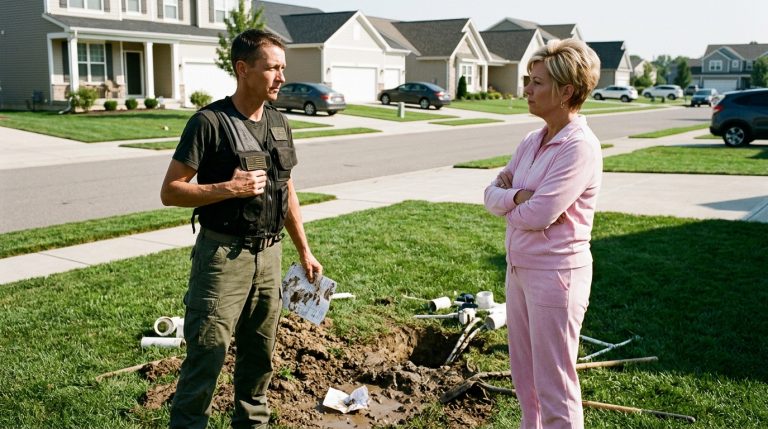
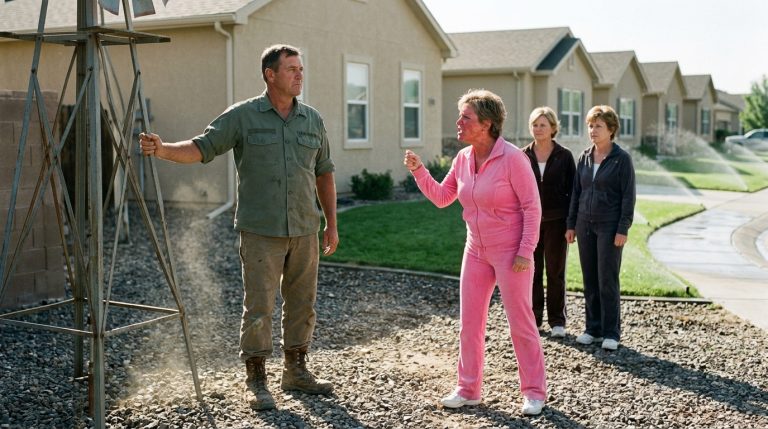
“The vote was unanimous,” she said, her arms locked across her chest with such aggressive tension the synthetic fabric of her pink tracksuit seemed to strain at the seams. “We start paving on Monday, Mr. Evans. That muddy little ditch is becoming a community walkway.”
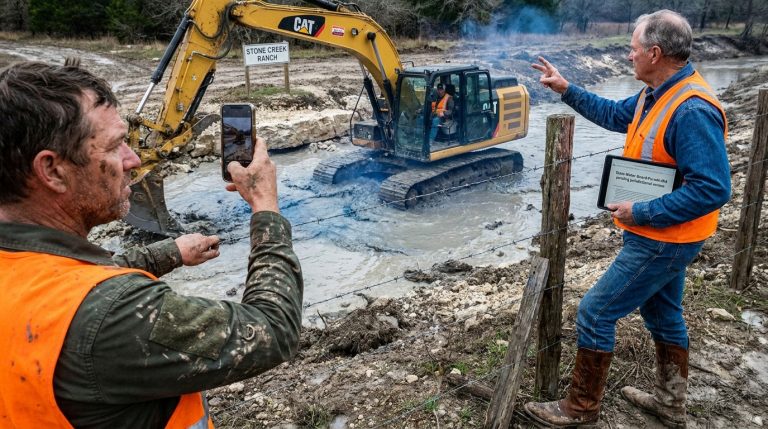
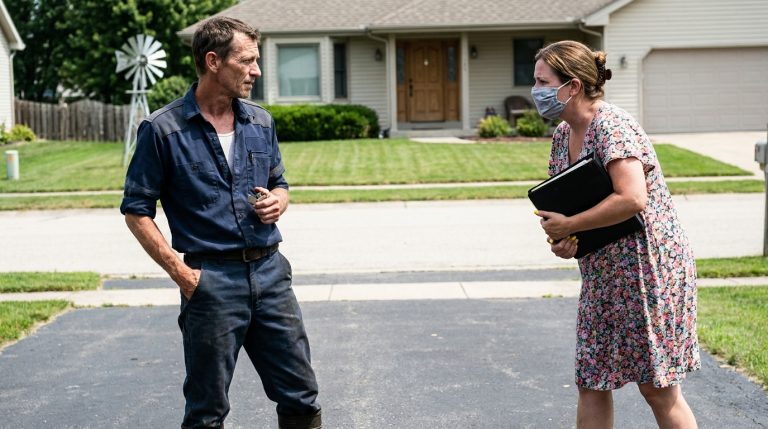
Colonel Evans did not shift his weight in the saddle. His hands remained steady on the braided leather of the reins, the leather cool and worn to the exact contour of his palms. He looked down past the twitching ear of Valor, past the plump, magenta-tinged face of the Lakeside Meadows Homeowners Association president, toward the shallow depression of the Bridalwood Heritage Path. For two hundred years, that ditch had carried water, trade, and the silent debris of history. It was protected by a state conservation easement and anchored by a deed he had spent six months verifying with surveyors before he ever drove a single fence post into the fifty-acre parcel.
“Karen,” he said. His voice was modulated, dropped into the lower register he had used to brief division commanders when logistics failures threatened bridge-building schedules in the rainy season. “We have reviewed this. The path is not HOA property. It is twenty feet inside my western boundary.”
Her nostrils flared, her mouth tightening into a thin, white-edged line. She had brought a sheath of papers like a talisman, clutching them as if the mere presence of printed text could alter geometry. Behind her, a golf cart idled on the manicured turf of the subdivision edge, its plastic roof panel vibrating with the rough idle of a small gas motor.
“Our attorney calls it an implied easement,” she snapped, stepping closer, though Valor’s shoulder shifted an inch forward—just enough to make her check her advance. “The community has voted. Property values require improvement, Mr. Evans. You are standing in the way of progress.”
Evans studied her eyes. There was no curiosity in them, no room for data or legal precedent. There was only the hot, corrosive hunger of a petty administrator denied absolute jurisdiction. She expected volume. She expected him to hoist his chin, roar back, and hand her the emotional leverage she needed to paint him as the volatile outsider to the suburban board.
He gave her nothing. He let the silence stretch between them until the autumn wind rustled the dry oak leaves overhead, carrying the sharp scent of woodsmoke and damp earth.
“Your attorney is either incompetent or he is committing fraud,” Evans said, his tone flat, surgical, and utterly devoid of heat. “If a single blade of machinery touches this soil on Monday morning, it will be treated as criminal trespass and felony destruction of a historical site. The state conservation office is already copied on the file.”
The mask slipped an inch. A dull, mottled purple crept up from her collar, staining the bright pink polyester. She shook the papers violently at him.
“You will not threaten me! We have the votes, we have the funds, and we have the will! On Monday, we bring the pavers, and if you stand in the way, we’ll have the sheriff clear you off your own land!”
She spun on her heel, her sneakers grinding harshly into the loose gravel as she retreated toward the idling golf cart, her back rigid with the stiff fury of a monarch whose peasants had forgotten to bow.
Evans watched her go, his eyes narrowing slightly not with anger, but with the cool calculus of an engineer measuring load limits on a failing bridge. As the cart zipped away, kicking up a plume of pale dust that settled dully on the wild grass, he reached down to pat Valor’s warm, muscular neck. The horse blew out a long, shuddering breath, sensing the shift from parley to preparation.
Evans turned the gelding toward the barn, his mind already cataloging the contents of the oak flat file in his office: the original 1840 land grant, the county surveyor’s GPS markers, and the state conservation code. But as he crested the rise near the paddock fence, a strange, out-of-place glint caught the low autumn sunlight—a strip of yellow plastic surveyor’s ribbon tied tightly to the lower branch of an ancient oak twenty feet inside his private boundary line, a mark that had certainly not been there when he checked the perimeter at dawn.
CHAPTER 2: The Command Center
The strip of yellow plastic fluttered with a thin, plastic rattle against the rough gray bark of the white oak. Colonel Evans did not dismount immediately. He sat the quarter horse in the damp stillness of the afternoon shade, his eyes tracking the taut line of the ribbon back toward the subdivision’s manicured turf line. It was twenty-two feet inside his western boundary stone—a measured, deliberate trespass that could not be blamed on stray livestock or a careless hiker.
It was a stake driven by an adversary who believed territory could be claimed by the sheer persistence of bad intentions.
“Easy, boy,” Evans murmured, feeling Valor’s chest tighten beneath his thighs as the gelding caught the shift in his rider’s posture.
He swung his right leg over the saddle, his boot heels hitting the dry loam with a muffled, solid thud. The physical act of dismounting cleared the static from his mind, replacing irritation with the cold, measured rhythm of standard operating procedure. He untied the survey ribbon with a single, sharp jerk of his thumb and forefinger, pocketing the slick plastic strip without a word. If Karen Miller wanted to play a game of markers and boundaries, she would find that the terrain was governed by written deeds rather than plastic ribbon.
He led Valor up the slope toward the heavy timber-framed barn, the horse’s iron-shod hooves crunching rhythmically on the gravel driveway. The barn smelled of dry timothy hay, aged cedar, and the clean, metallic tang of horseshoe nails. After stabling the gelding, loosening the cinch, and offering a handful of crushed oats, Evans did not pause. He crossed the yard, his heavy field jacket rustling in the crisp wind, and walked past the main living quarters toward his private office in the rear wing.
The room was a fortress of functionality. No ornamental clutter softened the sharp lines of the oak furniture or the heavy steel flat file cabinet against the far wall. The air inside smelled faintly of printer toner and old paper—the permanent scent of verification.
Evans sat down at the heavy oak desk, his movements economical and deliberate. He switched on the desktop terminal, the screen casting a pale, clinical blue light across the precise rows of document folders stacked by the side of the keyboard. He bypassed the living room entirely, ignoring the domestic comforts of a retired life, because a commander does not retreat to the hearth when the perimeter has been violated.
His fingers moved over the keyboard with steady, unhurried precision. He opened a blank document template, setting the margins to standard legal specifications, and began to draft the formal instrument that would transition the dispute from a verbal warning to an immutable paper record.
CEASE AND DESIST NOTICE.
He did not waste words on emotional appeals or accusations of malice. He cited the county tax assessor’s parcel identification map 75B12, the original 1840 land grant boundaries, and the explicit statutory language of the state conservation easement administered by the State Historical Preservation Office. Every clause was anchored by a specific code number; every restriction was laid out with the cold, unyielding clarity of a structural engineering blueprint.
The room remained silent save for the rhythmic clack of the mechanical keyboard and the low, steady hum of the computer tower. Through the window, the autumn shadows lengthened across the lawn, stretching long and slate-gray toward the boundary fence of Lakeside Meadows.
Evans reviewed the text paragraph by paragraph, checking for ambiguities the way an engineer checks rivet spacing on a load-bearing beam. When he reached the section detailing the civil penalties and personal liability for destroying a protected historical site under state statute 18C, he paused, his eyes narrowing as he remembered the purple polyester tracksuit and the frantic clutching of papers at his front door. Karen Miller was operating on the assumption that volume and local voting majorities could override real property law. She believed the homeowners association was a sovereign state.
He printed the document on heavy, twenty-four-pound bond paper—the kind that held its crease and resisted tearing. He slid it into a clean, windowless manila envelope, sealed the flap with a firm swipe of his thumb, and pressed his brass stamp across the back seam.
The first layer of defense was complete. But a defense alone only delays a siege; it does not break it.
Evans leaned back in the leather chair, the springs groaning softly under his weight, and pulled a secondary file toward him—the one containing the community bylaws and the roster of the Lakeside Meadows HOA board members. If Karen was pushing this initiative through with unanimous votes and compliant directors, there had to be a paper trail of authorizations, budget allocations, and architectural reviews authorized behind closed doors. And where there was a budget, there was a paper trail of money.
The phone on his desk sat silent, but the quiet of the room was the quiet before an engagement. He reached out and picked up the receiver, dialing a local number that would set the next phase of the counter-offensive into motion long before Monday morning’s confrontation ever reached the headlines.
CHAPTER 3: The Doorstep Delivery
The heavy diesel engine of the F-350 turned over with a deep, authoritative rumble that seemed to swallow the quiet dusk settling over the acreage. Colonel Evans did not rely on postal sorting or impersonal courier services for a message of this magnitude. When a perimeter is breached, the commander delivers the terms of engagement in person, reading the adversary’s micro-expressions at close range to measure their true depth of resolve.
He shifted the transmission into gear, the heavy transmission whining softly as the truck rolled down the gravel drive and turned toward the pristine, curving asphalt streets of Lakeside Meadows.
The transition from the wild, oak-shaded boundaries of his fifty-acre parcel to the planned uniformity of the subdivision was marked by a sudden, sterile shift in architecture. The houses grew closer together, their manicured lawns mirroring one another like rows of identical barracks. Karen Miller’s house sat near the center of the development—a sprawling, pretentious two-story structure distinguished from its neighbors by an excess of ornamental accessories. A faux-Tuscan stone fountain trickled a pathetic stream of recycled water near an oversized American flag that strained against its halyard, technically violating the subdivision’s own strict height and scale covenants.
Evans brought the truck to a halt at the curb, cutting the engine. The silence that followed was heavy, broken only by the sharp tick of the cooling exhaust manifold.
He stepped down onto the asphalt, his boots hitting the pavement with a firm, deliberate cadence. He carried the heavy manila envelope containing the cease-and-desist notice in his right hand, the stiff bond paper acting as a rigid instrument rather than a polite letter. He walked up the paved walkway past the stone fountain, his eyes scanning the windows for movement. There was no hesitation in his stride; he moved with the relaxed, unhurried posture of a man who owned his coordinates completely.
He reached the front porch and struck the brass knocker twice—a sharp, double rap that echoed loudly against the hollow-core wooden door.
For a long moment, there was only the hum of the neighborhood cicadas and the distant drone of a lawn sprinkler. Then the lock clicked with a metallic snap. The door swung open a bare four inches, held back by a brass security chain.
A pale, thin face peered through the gap. It was Gary, Karen’s husband, his eyes darting nervously toward the corners of the porch as if expecting an explosion. He always wore the expression of a man who had apologized for breathing oxygen earlier that morning.
“Mr. Evans,” Gary stammered, his fingers tightening whitely around the edge of the door frame. “Karen’s… she’s not really receiving visitors right now. We’re in the middle of dinner preparations.”
“This isn’t a social call, Gary,” Evans said, his voice flat, low-register, and carrying an absolute gravitational pull that kept the smaller man pinned to the jamb. “Open the door.”
Before Gary could frame another nervous objection, a sharp, authoritative voice boomed from the dim hallway behind him. “Who is it, Gary? Is it that man? Don’t you dare let him cross this threshold!”
Gary flinched as though struck, his shoulder hunching involuntarily. The security chain rattled violently as a heavier weight hit the interior side of the door. The brass links slipped from their slot with a metallic clatter, and the door swung wide.
Karen Miller filled the entryway, her frame poured into a vibrant, eye-watering purple tracksuit that seemed designed to project aggressive authority. Her face was flushed, her chin lifted in a posture of calculated indignation, but beneath the superficial veneer of outrage, Evans caught the faint, telling twitch of a muscle near her left eye. She knew the papers in his hand weren’t neighborhood gossip.
“What do you want?” she demanded, planting her hands firmly on her hips. “You are trespassing on private subdivision property by standing on this porch, and I am warning you—”
“You are out of your jurisdiction, Karen,” Evans interrupted, his tone cutting cleanly through her rhetoric without raising a decibel. He extended the manila envelope across the threshold, holding it steady until her instinctive urge to swat it away was overridden by the sheer weight of his gaze. “This is a formal cease-and-desist notice. It establishes the legal baseline for the Bridalwood path, complete with county parcel identifications, certified survey coordinates, and the exact state statutes governing protected historical easements.”
She snatched the envelope from his hand as if it carried an electrical charge. Her fingers tore aggressively at the flap, ripping the heavy bond paper with theatrical contempt as she yanked out the contents. Her eyes scanned the first paragraph, her breath hitching slightly as her gaze hit the statutory references to civil penalties and personal liability.
“More of your little papers,” she scoffed, though the volume of her voice lacked its previous conviction. A thin sheen of sweat had broken out across her forehead under the harsh hallway light. “Our attorney has reviewed everything. He assures the board that an implied easement overrides your little maps. A county judge will throw this out by noon on Monday.”
“Your attorney is inviting disbarment if he advises you to cross that property line,” Evans said, his eyes locking onto hers with unblinking precision. “The state historical preservation officer has already been briefed on your board’s resolution. When the heavy machinery rolls onto my land on Monday morning, it will not be a local dispute. It will be a state-level enforcement action.”
He let the sentence hang in the crisp evening air, letting the implications settle deep into the silence of the foyer. Gary hovered anxiously in the background, his mouth opening and closing like a stranded fish, but he lacked the agency to intervene.
Karen’s hands trembled—just slightly—as she crumpled the legal notice into a loose, angry ball against her chest. The mask of untouchable suburban royalty fractured at the edges, revealing the brittle, frantic core of a fraudster who realized her bluff was being systematically called by someone who actually understood the terrain.
“The paving will proceed,” she spat out, her voice rising in a desperate crescendo as she tried to reclaim the narrative. “We have the votes. We have the mandate of this community. Get off my porch before I call the sheriff and have you removed for harassment!”
She slammed the solid wood door so hard the brass house numbers rattled against the brick facade.
Evans stood motionless on the porch for three seconds, listening to the frantic double-click of the deadbolt sliding home. He did not blink. He turned slowly on his heel, descended the steps with measured strides, and climbed back into the F-350. The trap was set, the warning was delivered, and her reaction had confirmed every tactical projection. She was cornered, and a cornered tyrant always makes the fatal mistake of striking first.
CHAPTER 4: Coalition of the Burdened
The gravel driveway of the Garcia residence crunched softly beneath the heavy tread of Evans’s boots as he crossed the property line away from the glow of Lakeside Meadows’ uniform streetlights. The Garcias lived on the fringe of the subdivision—a modest, immaculately kept home where the grass was trimmed with care and the front porch light cast a warm, steady amber glow against the gathering dusk.
Carlos Garcia answered the door before Evans’s knuckles had finished rapping against the wood. The young schoolteacher looked exhausted, the lines around his eyes etched with the chronic strain of someone living under an invisible, petty tyranny.
“Colonel,” Carlos said, stepping back and holding the door wide. “Come in. Elena made coffee.”
Evans stepped across the threshold, ducking slightly beneath the doorframe. The interior smelled of roasted coffee beans and faint cinnamon, a sharp contrast to the antiseptic sterility of Karen Miller’s foyer. Elena Garcia sat at the kitchen table, her hands wrapped tightly around a ceramic mug, her expression anxious.
“We saw you heading toward the center of the development,” Elena said, her voice dropping to a cautious whisper as if fearing invisible microphones in the drywall. “Did she accept the notice?”
“She crumpled it,” Evans said, taking the seat Carlos offered. He rested his forearms on the laminate table, his movements deliberate and calm. “Which means she intends to force the issue on Monday morning. Her reliance on bad legal advice is absolute. But a commander does not defend a perimeter alone when the enemy is mounting a collective assault.”
Carlos exchanged a heavy look with his wife. “What do you need us to do, Colonel? We’re already paying fines for imaginary violations. Last month it was our garbage cans; the month before, it was the shade of beige on our side fence.”
“I don’t need you to charge the front lines,” Evans replied, his voice steady and grounding. “I need you to anchor the flanks. Karen rules through engineered isolation, making each homeowner feel like an individual offender rather than part of a collective. If we establish that others are willing to stand on the record, her monopoly on administrative intimidation collapses.”
He pulled a small folded sheet from his breast pocket—a petition outline drafted to demand a formal, independent review of community operational standards and transparency. It was the preliminary phase of opening a second front.
“Bill Peterson is already circulating a parallel petition on the north side,” Evans continued, sliding the paper across the table. “He understands the bylaws better than the board’s own counsel. If you are willing to sign your names to an open request for a documented review of the HOA’s recent vendor allocations, it provides the legal weight we need before Monday’s confrontation.”
Elena reached out without hesitation, taking the pen Carlos offered. “She’s bled this neighborhood for two years with quiet threats,” Elena said, her pen scratching firmly against the paper. “My little girl, Maria, shouldn’t be afraid to ride her pony near the trail just because Karen wants a monument to her own vanity.”
Evans watched the ink dry on the page, noting the precise, resolute strokes. The alliance was forming—not through emotional appeals, but through shared exposure to a common vulnerability.
“Keep this quiet until Sunday night,” Evans instructed, retrieving the signed sheet and securing it inside his jacket. “Let her believe she holds uncontested ground. On Monday morning, when her paving crew rolls up to the boundary line, the legal response will not come from me alone. It will come with an organized front.”
He stood up, bidding the Garcias a brief, respectful farewell, and stepped back out into the cool autumn night. The air was biting now, carrying the metallic scent of frost settling over the dark fields. There was one final stop required before the night was through—an intellectual sparring partner who had spent years cataloging the quiet rot in the subdivision’s ledger.
Ten minutes later, the F-350 rolled to a quiet halt near the sprawling ranch house of Bill Peterson, the retired corporate lawyer. Bill was already waiting on his dimly lit porch, an unlit pipe clamped between his teeth and a thick binder of municipal bylaws resting on his knees like tactical maps.
“I saw you heading toward Karen’s fortress earlier,” Bill rumbled, his voice dry and gravelly as Evans walked up the steps. “She’s still howling about her ‘implied easement,’ isn’t she?”
“She thinks a vote of the board repeals state statute,” Evans said, taking a seat in the Adirondack chair opposite him.
Bill chuckled, a low, humorless sound that rattled in his chest. “Let her march her pavers right into the trap. But tell me, Colonel—did you look closely at the maintenance budgets she pushed through last quarter? Something smells worse than old mulch in those financial disclosures. I suspect the trail isn’t the only thing she’s trying to pave over.”
Evans stared into the dark line where the subdivision met the edge of his property, his tactical instincts locking onto the new variable. The trail was the visible battleground, but the true infrastructure of her control lay hidden in the ledgers.
CHAPTER 5: The Infiltration
The cab of the F-350 was dark, save for the faint green luminescence of the dashboard clock glowing 8:14 PM. Colonel Evans sat behind the wheel with the engine cut, parked fifty yards down the asphalt strip from a modest, weather-beaten office park on the commercial fringe of the county. The sign above the glass door read Pearson Associates: Legal Counsel and Community Management Services.
It was a two-bit operation masquerading as a corporate entity—a narrow suite sandwiched between a shuttered dry cleaner and an all-night bail bondsman.
A single fluorescent tube flickered behind the tinted glass of the office window, casting an erratic, jaundiced stripe across the asphalt. Through the binoculars resting against the steering wheel, Evans tracked the silhouette moving behind the blinds. It was a man hunched over a cluttered desk, tossing folders into an industrial-sized shredder with frantic, jerky motions. Franklin Pierce, Karen Miller’s first cousin and the legal architect of the so-called “implied easement,” was destroying evidence under the cover of night.
Evans did not rush. Impatience was an operational failure. He waited, letting the rhythmic mechanical whine of the shredder register against his tactical awareness, measuring the volume of paper passing through the teeth.
The strategy formulated with Bill Peterson and reinforced by Sarah’s upcoming arrival depended on catching the friction point between the HOA’s public resolutions and their private paper trails. Pierce was operating like a panicked lieutenant burning field dispatches before an overrun. But a shredder leaves residue—micro-fragments, fiber dust, and discarded draft pages that miss the hopper.
Evans stepped down from the truck, his boots making no sound on the damp pavement. He walked along the shadowed perimeter of the building, keeping below the line of the security floodlights. The night air was sharp, smelling of cold asphalt and decaying autumn leaves. He reached the rear service alley where a row of rusted green metal dumpsters stood shoulder-to-shoulder against the brick wall.
The lid of the second dumpster was unlatched—an oversight born of haste.
Evans flipped the heavy lid back quietly, the metal hinges creaking in protest before he muffled the sound with his gloved hand. He reached down into the dim interior, his fingers brushing against damp cardboard boxes, crumpled legal pads, and discarded mail sorting trays. He pulled out a discarded sheaf of invoices—rough drafts and sub-contractor balance sheets that had missed the shredder’s maw.
By the harsh amber glow of his tactical flashlight, shielded carefully against his jacket, Evans scanned the lines of text.
The names of regular landscaping suppliers were crossed out in red ink, replaced by a recurring corporate entity: Greenscape Solutions. Underneath it, sums totaling tens of thousands of dollars were allocated for routine maintenance and soil conditioning along common property lines that border no public zones—only the Bridalwood Heritage Path. But the physical address listed for Greenscape Solutions was a vacant post office box two counties away.
It was a ghost corporation, a financial conduit designed to absorb community assessments and funnel them away from public oversight.
Evans folded the invoices with methodical precision and slipped them into his breast pocket. The decoy structure was beginning to crack, revealing the crude mechanical skeleton beneath Karen’s administrative empire. Pierce was panicking because he realized the paper shield was transparent.
A sudden clatter echoed from the front of the strip mall—a car door slamming shut, followed by the sharp crunch of gravel. Evans extinguished his light instantly, merging into the absolute blackness of the brick wall’s shadow. Through the gap between the buildings, he watched Franklin Pierce emerge from the front office carrying two heavy plastic trash bags stuffed tight with shredded paper, heaving them into the large municipal bin with an audible grunt of exertion before speeding away into the night.
Evans stepped out from the alley, his expression set in cold, unyielding lines. The paper trail had yielded its first tangible breach. Monday morning would not just be a defense of a property line; it would be the intersection where their fabricated authority collided with immutable documentation.
CHAPTER 6: The Iron Morning
The dawn of Monday broke over the rolling foothills with a hard, unyielding clarity, the sky overhead a pale, washed slate and the ground stiffened by a thin layer of overnight frost. Colonel Evans stood on the gravel shoulder of his property line, his breath pluming in the cold air as he watched the eastern horizon. The physical preparations were already complete: the F-350 truck was parked square across the path’s entry point, acting as an immovable steel bulkhead, its tires chocked and the parking brake pulled to maximum tension.
At precisely 7:55 AM, the low, guttural vibration of a heavy diesel engine broke the quiet stillness of the valley, accompanied by the high-pitched mechanical stutter of a backup alarm.
A bright yellow paving machine, looking like an ungainly prehistoric insect, rumbled around the subdivision curve, followed closely by a heavy dump truck laden with dark, crushed gravel. Emblazoned across the side of both commercial vehicles was the logo for Clearcut Landscaping and Paving. Right behind them rolled Karen Miller’s white golf cart, its plastic roof panel rattling against the vibration of the heavy machinery.
Karen wore a hard hat perched comically over her vibrant yellow tracksuit, her expression radiating the brittle, aggressive certainty of a monarch riding at the head of a punitive expedition.
The convoy came to a halt twenty yards from the rear bumper of the F-350. The foreman of the paving crew—a weathered man with deep lines around his eyes and a heavy denim jacket—swung down from the cab of the paver. He strode across the frosty gravel, wiping his hands on a greasy rag, his expression a mask of professional exhaustion.
“Morning, Colonel,” the foreman grunted, nodding toward the truck blocking the path. “Look, we’ve got a valid work order signed by the Lakeside Meadows HOA board. I need you to move the vehicle so we can lay the aggregate base.”
Before Evans could answer, Karen’s golf cart buzzed forward, stopping abruptly on the grass verge. She vaulted out, her face flushed with righteous indignation, pointing a trembling, manicured finger toward the truck.
“Don’t negotiate with him!” she shrieked, her voice cutting through the crisp morning air like a siren. “He’s trespassing on common community infrastructure! Call the sheriff right now and have his truck impounded!”
Evans did not look at her. His gaze remained locked on the foreman, steady and level. He reached into his coat pocket and withdrew the document binder, flipping open the protective plastic sleeve to the official survey map and the state conservation notice he had reviewed the night before.
“You have a work order, Dave,” Evans said, using the name stenciled on the foreman’s work shirt with calm precision. “Your client is paying you to perform construction on private deeded land covered by an immutable state conservation easement. If your equipment crosses that fence line, your company is committing felony destruction of a historical site under state statute 18C. The civil penalties start at fifty thousand dollars per incident, and the liability attaches directly to the operating company and its principals.”
He extended a printed business card bearing the direct contact numbers for the State Historical Preservation Office enforcement division.
The foreman’s eyes flicked from Evans’s steady gaze to the official state seal on the document. The warning carried the unmistakable weight of verified law. Without a word to Karen, the foreman pulled out his cell phone, punched in the number printed on the card, and turned away to place the call.
“What are you doing?” Karen screamed, storming across the gravel toward them. “You’re under contract with us! Do your job or I’ll sue your company into bankruptcy!”
The foreman ignored her completely, holding the phone to his ear as he spoke in low, clipped tones to the state official on the other end of the line. For nearly two minutes, the only sound was the diesel idle of the dump truck and Karen’s frantic, escalating demands.
Then the foreman lowered the phone. His face had gone pale under his weather-beaten tan. He looked at Karen with a mixture of disgust and disbelief, then turned back to Evans.
“The lady from the state just told me if my tractor drops a single blade onto that path, she’ll impound my entire fleet and initiate felony proceedings against my corporate license,” the foreman said flatly. He turned to his crew, raising his voice. “Pack it up, boys. Job’s canceled.”
“You can’t do that!” Karen shrieked, her face twisting into a mask of pure fury as the crew began throwing levers and securing their gear. “I have a signed contract! I am the president of this association!”
“Lady, your lawyer’s a hack and your contract isn’t worth the paper it’s printed on,” the foreman snapped, climbing back into the cab of the paver.
Realizing her authority was evaporating in real time, Karen whipped out her own phone, her fingers punching numbers with trembling desperation. “Yes! Get the sheriff out here immediately! There’s an unstable man threatening workers and blocking public access on our property. You need to get here right now!”
Within ten minutes, the wail of twin county sheriff cruisers cut through the valley, their overhead light bars flashing bars of red and blue against the autumn frost. Deputies Miller and Chen stepped out of the vehicles, their expressions all business as they surveyed the confrontation.
Karen rushed toward them, her voice cracking with manufactured panic. “Officers! Thank God! He’s parked illegally, threatening our contractors, and refusing to respect our community easement!”
Deputy Miller held up a hand, silencing her with a stern look, and walked directly toward Evans. “Sir, can you account for this vehicle and your presence here?”
Evans calmly handed over the document binder. “My name, my deeded parcel number, the certified 2012 survey map, and the state conservation easement are cataloged in tab A through D, Deputy. The land beneath your boots is twenty feet inside my private boundary.”
Deputy Chen flipped through the binder, his eyes tracking the legal descriptions before meeting Miller’s gaze and giving a sharp, affirmative nod. Deputy Miller walked back toward Karen, his boots crunching heavily on the frost.
“Ma’am,” Miller’s voice dropped into a dangerous, gravelly register. “I’ve just confirmed the tax assessor records and the state police database. This land is private property, and the path is a state-protected heritage site. Instructing a crew to pave it wasn’t just a boundary dispute—it was an attempt to solicit a felony. And calling in a false emergency report to clear your own illegal obstruction compounds the offense.”
The word felony hung in the frosty air like a guillotine blade. Karen stood frozen, her mouth opening and closing silently as the reality of her administrative collapse finally set in. The deputies turned on their heels, climbed back into their cruisers, and drove away, leaving her standing alone on the cold asphalt as the paving trucks rumbled down the road behind them. The tactical defense of the boundary was complete, but the true battlefield—the financial ledgers of the HOA—was now fully exposed.
CHAPTER 7: The Ledger of Ruin
The mahogany double doors of the county municipal courthouse opened with a heavy, dry groan that seemed to mock the tension inside. Colonel Evans stepped across the threshold, his boots clicking rhythmically against the polished terrazzo floor. Beside him walked his daughter, Sarah, her briefcase laden with three years of subpoenaed bank records, ledger printouts, and forensic accounting summaries. Behind them strode Bill Peterson, his face set with the grim, satisfied expression of an attorney who had waited a decade to cross-examine a fraudster on the record.
The courtroom was packed to capacity. Benches on both sides were crowded with Lakeside Meadows residents who had traded their morning routines for front-row seats to the collapse of Karen Miller’s administrative empire.
At the plaintiff’s table sat Franklin Pierce, Karen’s cousin and legal counsel, his posture stiff, his skin the color of old parchment. He was frantically flipping through a thin stack of papers, his jaw tight as he tried to mask the tremor in his hands. Karen sat beside him in her customary vibrant attire, though the bright colors looked incongruous against the severe, gray-paneled walls of the judicial chamber. Her chin was lifted in a brittle imitation of defiance, but her eyes darted constantly toward the courtroom doors, searching for an escape route that no longer existed.
Judge Marian Price entered from the chambers door to the left, her black robes sweeping with crisp authority.
“Be seated,” she commanded, her voice dropping the room into an immediate, heavy silence as she settled behind the high oak bench.
The preliminary motions moved with the cold, mechanical efficiency of a well-oiled engine. Franklin Pierce stood to present his motion for dismissal, his voice strained as he argued that the homeowners association’s counterclaims were a baseless, vindictive attack on a dedicated public servant. He spoke of community standards, property valuations, and the procedural integrity of the board.
Judge Price listened without a single nod, her fingers resting lightly on a closed manila file before her. When Pierce finally sat down, wiping a thin layer of sweat from his upper lip, the judge looked over her reading glasses directly down at the defense table.
“Mr. Pierce,” Judge Price said, her tone dangerously quiet, cutting through the stagnant air of the courtroom. “Your motion characterizes these counterclaims as baseless. Yet the court has reviewed the preliminary audit filed forty-eight hours ago by independent forensic accountants appointed under this bench’s order.”
She opened the file, her gaze shifting to the dense rows of numbers printed across the page.
“That preliminary report documents over eighty thousand dollars funneled through a corporate entity known as Greenscape Solutions—an enterprise with no physical address, no active business license, and no employees. Furthermore, the sole signatory on that shell corporation’s depository account is registered as Gary Miller.”
A sharp, collective gasp rippled through the gallery benches behind them. Karen stiffened, her head snapping toward her cousin as if waiting for a miracle argument to materialize.
“Your honor,” Pierce stammered, scrambling back to his feet, his tie slightly askew. “That—that report is entirely preliminary. It has not been subjected to full cross-examination. It is an unsubstantiated shadow cast by a disgruntled property owner seeking to—”
Judge Price raised a single hand, stopping him mid-sentence. The gesture was absolute.
“Motion to dismiss is denied, Mr. Pierce,” she ruled, her gavel coming down with a sharp, echoing crack that vibrated through the floorboards. “Furthermore, the scope of discovery is expanded immediately to include all personal communications, retainer agreements, and financial wire transfers between your law firm and the defendants over the past three calendar years. This court will reconvene for the full evidentiary hearing on Friday morning.”
Evans watched the color drain completely from Pierce’s face. The legal sword Karen and her cousin had forged to intimidate the neighborhood had shattered into jagged fragments in their own hands. The decoy structure of the micro-landscaping embezzlement scheme was fully exposed, but Evans knew from the dense weight of the forensic files Sarah had compiled that the true architecture of the conspiracy—the systemic kickback cartel bleeding the community through fraudulent litigation—was waiting to be unlocked in the final accounting.
CHAPTER 8: The Fall of the Queen Bee
The community clubhouse was packed to a suffocating density, nearly two hundred residents spilling over the threshold and clustering along the walls under the glare of institutional pendant lights. Colonel Evans stood near the podium at the front of the room, his movements deliberate, unhurried, and anchored by absolute preparation. Beside him, Sarah’s laptop rested on the folding table, projecting the final, unassailable chain of evidence onto the pull-down screen behind them.
Karen Miller sat in the front row. Her vibrant purple tracksuit felt like a theatrical costume stripped of its stage; her posture was stiff, her hands clenched so tightly in her lap her knuckles showed white. Beside her, Franklin Pierce had long since retreated from public view, leaving her isolated inside the community she had ruled through calculated fear and manufactured infractions.
“The audit is complete,” Evans began, his voice carrying the calm, low-frequency resonance of a commander briefing an objective. He did not yell. He let the silent weight of the facts fill the room. “For three years, the administration of Lakeside Meadows has operated under a system of engineered intimidation. Fines were levied not to maintain standards, but to silence dissent. But minor citations were only the smoke screen.”
He clicked the remote. The screen shifted to display a complex web of financial wire transfers cross-referenced with bank routing numbers and sub-contractor accounts.
“The funds collected through special community assessments did not vanish into routine maintenance,” Evans continued, stepping forward. “Through shell entities like Greenscape Solutions and Patriot Security, nearly one hundred and sixty thousand dollars was siphoned from your reserve accounts directly into private accounts controlled by the HOA president and her husband, Gary Miller. And behind every fraudulent contract stood legal representation designed to bleed this community through inflated, engineered litigation kickbacks managed by her cousin, Franklin Pierce.”
A violent murmur surged through the crowded room like a rising tide. Neighbors who had paid arbitrary fines for unkempt lawns or visible trash cans stared at the glowing financial trails on the screen, realization hardening into collective fury. Karen tried to rise, her voice cracking in a desperate shriek.
“Lies! It’s a conspiracy orchestrated by an outsider trying to steal our community land!” she shouted, pointing a shaking finger toward Evans. “You’re all fools for believing him!”
The crowd did not shout her down with chaotic noise this time; they simply turned their backs on her, an act of absolute, chilling rejection that stripped away her remaining authority faster than any gavel could.
The interim board president, Tom, stood up at the head table and called for the vote. A forest of hands shot into the air instantly across the entire room. The motion for immediate removal and permanent expulsion from the association was unanimous.
Karen stood frozen, her chest heaving as she stared at the wall of raised hands. She turned on her heel and stormed toward the double doors, pushing past the residents who parted silently before her like cold water.
When she burst through the exit into the gravel parking lot, her escape was cut short. Two plainclothes officers from the county economic crimes unit stepped out from the shadows of an unmarked cruiser, their badges catching the amber wash of the parking lot lights.
“Karen Miller?” the female officer asked with professional calm. “We have a warrant for your arrest on multiple felony counts of embezzlement, wire fraud, and conspiracy. Please place your hands behind your back.”
The heavy steel cuffs clicked shut with a sharp, definitive snap, echoing across the quiet evening air. Through the wide glass windows of the clubhouse, the assembled residents watched in unbroken silence as the deposed queen of Lakeside Meadows was guided into the back of the cruiser.
Months later, the landscape of the valley had transformed from a theater of conflict into a quiet study in restoration. The legal proceedings concluded with guilty pleas, state prison sentences for Karen, multi-year probation and full restitution for Gary, and permanent disbarment for Franklin Pierce. The new HOA board, operating under transparent leadership and open budgets, formally expunged every bogus violation from the neighborhood records and refunded the extorted fines.
To seal the healing of the community, the board co-sponsored the first annual Bridalwood Heritage Day. On a brilliant Saturday afternoon in late spring, families strolled down the unpaved heritage path, guided by educational signs Sarah had designed to detail the trail’s two-hundred-year history. Children rode ponies near the fence line, and neighbors gathered by the big timber barn to share food and conversation without the shadow of arbitrary rules.
That evening, as the last of the visitors headed home and twilight painted the rolling hills in shades of bruised gold and slate blue, Evans walked out onto his front porch. The heavy leather reins of Valor hung neatly on the tack room peg, clean and supple. He walked down the steps and ambled slowly along the Bridalwood path. The earth beneath his boots was soft, damp, and completely unchanged by human vanity. The micro-adjustments of the land—the steady flow of the small ditch, the deep roots of the ancient oaks, the quiet resistance of history—had outlasted the tyranny that sought to flatten it. Justice, he realized, was never merely about punishment or a won argument. It was about taking a fractured boundary, standing firm against the noise, and letting the land settle back into its own quiet, unyielding truth.