A Ghost Recalled: The Final Mission of Arthur Jenkins to Reclaim a Life Buried in Shadow
CHAPTER 1: THE GHOSTS COMMUTE
The engine of the sedan sputtered before turning over, a mechanical gasp that mirrored Arthur’s own exhaustion. He didn’t look back at the base. The lights of the Officers Club blurred into a smear of artificial gold, a beacon for people who believed in medals and rank. Arthur shifted the car into gear, the leather of the steering wheel cracked and smooth under his calloused palm. He steered away from the perimeter fence, his eyes tracking the dark tree line. He was a man out of time, and the world was currently tilting on its axis because he had simply spoken his own name.
He felt the envelope against his chest—he had snatched it from the windshield with a reflex that hadn’t aged a day—and the heavy, wax-sealed weight of it felt like lead. It wasn’t the kind of mail a janitor received. It was the kind of mail that signaled the end of a long, cold hibernation.
He drove in silence, avoiding the main arteries of the base. The town of Ramstein was quiet, the streets slick with a light evening mist that clung to the storefronts like a shroud. He felt a phantom ache in his left leg, the old shrapnel wound pulsing in time with the rhythmic thump of the tires on the asphalt. He wasn’t “Viper One” tonight; he was just Arthur, a man who had spent three decades scrubbing floors to hide the fact that he knew exactly how the world was put together, and more importantly, how it could be torn apart.
His apartment was a second-floor walk-up in a building that smelled of damp concrete and boiled cabbage. He ascended the stairs, each step a deliberate negotiation with gravity. His apartment door, scarred and painted a lifeless beige, opened to a space where light was a luxury he rarely afforded himself. He tossed his keys onto the small, scratched kitchen table and walked to the window.
From here, the base looked like a sprawling, electrified toy set. He pulled the cream-colored envelope from his jacket. The wax seal, a stylized hawk, was brittle. As he broke it, the faint scent of ozone and dry, metallic earth wafted up—a scent he hadn’t smelled since the dark, windowless cells of The Kennel. His thumb hovered over the contents. He knew the handwriting. It was crisp, slanted, and entirely, terrifyingly familiar. It was the hand of a man who had signed his death warrant in 1982. Arthur took a slow breath, his hand steadying, and unfolded the paper. There was only one sentence written in the center, and it was a question that turned the air in the room suddenly, impossibly thin: Are you ready to stop hiding, or should I finish what they started?
CHAPTER 2: THE PAPER CAGE
The letter trembled in Arthur’s grip, not from age, but from the sudden, sharp dissonance it introduced into his reality. He stood in the center of the living room, the air thick with the smell of stale dust and the faint, ozone-metallic tang that had just drifted off the parchment. It was a scent that didn’t belong in a German walk-up. It belonged to the humid, suffocating darkness of a cell that supposedly never existed.
The transition was violent. One moment, Arthur was standing in his quiet home, watching the lights of Ramstein flicker like distant embers; the next, his peripheral vision swarmed with the shadows of The Kennel. He could hear the low, rhythmic drip of water against stone and the distant, muffled sound of a radio playing a broadcast in a language he had spent years trying to scrub from his mind. His heart hammered a steady, frantic beat against his ribs, a physical reminder of a body that had been conditioned to survive, not to rest.
He closed his eyes, forcing his breath into a slow, controlled cadence. Not now. The mantra was a physical weight he pressed against his own mind. He was Arthur Jenkins, the janitor. He was the man who polished brass and cleaned up after men who hadn’t seen the world he had walked through. He was not the prisoner.
He looked down at the letter again. The handwriting was elegant, almost academic, a stark contrast to the brutality of the message. It was a calling card, a summons from an old ghost. Arthur walked to his small, wooden desk—a piece of furniture he had acquired at a secondhand shop years ago because it was solid, unassuming, and devoid of history—and sat down. He didn’t turn on the overhead light. The blue-gray glow of the streetlamp outside was enough to see the lines of text.
He didn’t need to read it again. The question was burned into his retinas. Are you ready to stop hiding, or should I finish what they started?
The “they” was the operative word. It implied that the Agency hadn’t just forgotten him; they had curated his invisibility. The realization shifted the perspective of his entire life. The low pension, the constant, subtle surveillance he had always attributed to his classification, the inexplicable way his file had been buried—it wasn’t neglect. It was management. He was a piece of intelligence that had been marked ‘Do Not Circulate’ and left in a drawer to collect dust.
He stood up, his knee protesting with a sharp, familiar jab of pain. He began to pace the narrow room. He checked the window, pulling the thin, fraying curtain just enough to peer at the street below. A black sedan, its paint dull and unwashed, was idling near the curb, its lights off. It wasn’t the kind of car a neighbor would drive. It sat there, motionless, a predator waiting for the prey to acknowledge the bait.
Arthur’s hand moved to his belt, his fingers tracing the cold, hidden edge of a small lockpick set he kept tucked into the leather. It was a habit, a remnant of a career that had demanded he always have an exit strategy. He hadn’t used it for anything more than opening a stuck locker in three decades.
He needed to know if the pension error was a mistake or the first crack in his cage. He walked to the kitchen, where a small, locked filing cabinet sat disguised as a stand for his microwave. He knelt, his movements fluid and precise, the limp momentarily forgotten. He inserted the pick, felt the pins give way with a soft, satisfying click, and pulled out a manila folder. It was thin, containing nothing but his initial discharge papers and a series of quarterly receipts from the Agency’s ‘Black-Ops Retirement Fund’—a label that had always seemed like a cruel joke.
He flipped through the receipts. There was a discrepancy. The signature on the 1994 authorization was not the one he remembered. It was a digital imprint, a crude forgery meant to look official. Below it, scribbled in the margins, was a series of numbers that hadn’t been there before: 71-CAM-09.
It was a coordinate. Or a mission identifier. The cold sweat that had been prickling at his skin intensified. He realized then that he wasn’t just being hunted by an enemy; he was being audited by his own masters. The letter wasn’t a threat of violence; it was a warning that the box he was kept in had been opened, and the contents were being moved.
He heard the crunch of gravel outside—a heavy, deliberate step. The person in the sedan was getting out. Arthur didn’t reach for a weapon, because he didn’t have one, and he didn’t need one. He simply moved to the door and turned the deadbolt, his face settling back into that mask of practiced, harmless neutrality. If they wanted the janitor, they would get the janitor. But if they wanted Viper One, they were going to find that the ghost had been practicing his haunting.
He looked at his hands—calloused, stained with years of bleach and hard labor—and realized that the dirt of this life was the only thing that had kept him human. The moment he reached for the tools of his old trade, he would be back in the darkness. He took a breath, the stale air of the apartment suddenly tasting of ozone again, and stepped away from the door, moving into the shadows of the hallway to wait.
The knock came, light and rhythmic, a mockery of polite society. Three taps, then two. It was a signal he hadn’t heard in forty years. His grip on the door handle tightened, the wood groaning slightly under the pressure. He wasn’t hiding anymore. He was simply waiting for the first move.
CHAPTER 3: THE VISITOR AT THE THRESHOLD
The knock was not repeated. It hung there, a deliberate statement of patience. Arthur remained pressed against the shadows of the hallway, his breathing shallow, calibrated to the absolute silence of the building. He watched the base of the door through the narrow crack he’d left earlier. A shadow flickered across the bottom edge—a pair of sensible, heavy-soled shoes, dark leather, polished not for a parade, but for utility.
“I know you’re in there, Arthur,” the voice said. It was thin, reedy, like paper being rubbed together, but it carried the unmistakable inflection of a man who had commanded rooms for a living. “And I know you’re listening. You never did like to be the first one to speak. You always preferred to let the other side exhaust their options.”
Arthur’s muscles coiled. The voice was familiar, yet it felt like a ghost trying to inhabit a living throat. It was his old handler, Elias Thorne—no relation to the loud-mouthed Brigadier General who had shamed himself at the club, but a man who had been the architect of Arthur’s erasure. He had been dead for twenty years, or at least that was the story the files had told.
Arthur reached out, his fingers grazing the latch. He didn’t turn it. Instead, he leaned closer to the door, his voice a gravelly, rasping echo of a man who had barely spoken for three decades. “Elias was buried in Arlington,” Arthur murmured, barely loud enough for the vibration to carry. “I saw the report. I saw the casket.”
A soft, mirthless chuckle came from the other side of the wood. “Reports are just ink on paper, Arthur. You of all people should know how easily a narrative can be rewritten. Open the door. It’s raining, and I’m too old to be standing in a drafty hallway playing games with a man who should have been retired in a beach house in Florida instead of scrubbing brass for boys who don’t know the difference between a skirmish and a war.”
Arthur slowly turned the lock. The bolt slid back with a dull, heavy clunk that sounded like a gunshot in the cramped space. He pulled the door open, keeping his body positioned behind the heavy oak, his eyes scanning the landing.
There was no one there. The hallway was empty, the flickering fluorescent light overhead humming with a discordant, buzzing energy. The damp smell of cold rain drifted up from the open stairwell, but the landing was bare. Arthur stepped out, his hand instinctively dropping to the small of his back where he kept a flat, iron-hard piece of tempered steel—a tool for cleaning vents that could easily serve a more permanent purpose.
He looked down the stairwell. At the very bottom, a single, cream-colored envelope sat on the bottom step, identical to the one he had received earlier. He descended, his footsteps silent, his focus locked on every shadow. When he reached the bottom, he didn’t pick it up. He scanned the front entrance. The heavy, glass-paneled door was swaying gently, as if someone had just exited.
He pushed it open and stepped out into the night. The street was deserted. The black sedan he had seen earlier was gone, leaving behind only the wet sheen of oil on the asphalt and the oppressive, damp cold of a German autumn. He looked up at the sky, the clouds churning in thick, charcoal layers.
He was being led. The visit wasn’t a confrontation; it was a breadcrumb trail. He looked back at the apartment building, his home for thirty years. It suddenly looked like a tomb. Every object inside, from the cheap furniture to the framed prints of landscapes he didn’t remember buying, felt like a prop in a play he had been performing without realizing it.
He walked back to the sedan he had parked in the alleyway. As he touched the door handle, he realized he wasn’t just being watched—he was being curated. The Agency had never let him go. They had simply changed his duty station from the field to a life of quiet, unending solitude, ensuring he remained a standby asset, a weapon kept under glass.
The weight of the realization didn’t make him angry. It made him tired, a deep, bone-crushing fatigue that moved through him like cold water. He pulled a small, silver lighter from his pocket—a Zippo he had carried since 1971—and flicked it open. The flame danced in the damp air, casting long, wavering shadows against the brick wall.
He wasn’t going to hide anymore. If they wanted him to play the game, he would show them that he hadn’t forgotten the rules. He looked at the empty street once more, the silence now feeling like a heavy, suffocating blanket. He knew where the trail led. It led back to the beginning, back to the secrets he had been holding in the dark for so long that they had become a part of his own marrow. He sat in the car, the interior smelling of old fabric and damp rubber, and started the engine. He didn’t head for the base. He headed for the only place he knew where the truth was kept: the old records facility in the outskirts of the Black Forest, a place that wasn’t on any map issued after 1985.
The road ahead was dark, a winding ribbon of wet pavement cutting through the trees. Arthur kept his eyes on the beams of his headlights, his hands steady on the wheel. He felt the cold iron of the tool in his belt, a reminder that whatever was waiting for him at the end of this journey, it was going to be a reckoning. The ghost was finally waking up.
CHAPTER 4: THE ARCHIVE BREACH
The sedan shuddered, a heavy, metallic rattle that vibrated through the steering wheel before the engine gave one final, dying wheeze. Arthur coasted, his eyes scanning the road for a turnout, his hand instinctively shifting to the ignition to ensure the lights were off. He rolled the vehicle into a dense thicket of pines, the branches scraping against the metal like skeletal fingers.
He didn’t panic. Panic was a waste of calories, a luxury he hadn’t afforded himself since the jungles of Laos. He sat in the sudden, oppressive silence, waiting for his eyes to adjust to the deeper shadows of the forest. The air was frigid, biting through his thin jumpsuit, carrying the scent of damp moss and decay—the smell of a grave.
He didn’t bother trying to restart the engine. He knew a kill-switch when he felt one, and the way the power had cut—clean, surgical, total—pointed toward professional sabotage. They didn’t want him reaching the records facility. Or, more accurately, they didn’t want him reaching it while he was still thinking like a civilian.
Arthur stepped out into the mud, his boots sinking an inch into the soft, unforgiving earth. He adjusted his jacket, his movements methodical. He checked the iron tool in his belt, feeling the familiar heft of it against his hip. It wasn’t much, but it was steel, and in a world of ghosts, steel was the only thing that held a shape.
He started walking. The records facility was five miles away, a distance that would have been a casual stroll for him forty years ago. Now, it was a test of endurance. He kept his pace low, his eyes fixed on the treeline. The Black Forest lived up to its name; it was a labyrinth of black-barked pines and dense underbrush that seemed to swallow the dim moonlight.
Every step was an exercise in memory. He remembered how to move through terrain like this—the way to avoid the dry leaves that signaled one’s presence, the way to keep his breathing shallow to avoid the white plume of condensation in the cold air. He wasn’t just walking; he was re-mapping his own history.
An hour passed, then two. The forest began to thin, and in the distance, a silhouette emerged against the night sky—the jagged, brutalist concrete shape of the old archive building. It looked like a tombstone left behind by a forgotten civilization. He approached the perimeter, his body low to the ground. There was no fence, no motion-sensitive lighting, just the eerie, silent presence of the concrete bunker sitting in the middle of a clearing.
He reached the heavy metal door, its surface oxidized and orange with deep, creeping rust. He didn’t look for a keypad or a scanner. He knew these doors. They had been designed for the Cold War, built to withstand anything short of a direct nuclear strike. He pulled the lockpick set from his belt, his fingers finding the familiar grooves of the mechanism.
The lock was frozen with age, a stubborn, unyielding mass of internal tumblers that hadn’t moved in decades. Arthur worked them with a patience that bordered on the divine. He felt the cold iron shift, a minute vibration against his fingertip. He wasn’t just picking a lock; he was dismantling the barrier between his forced ignorance and the truth of his confinement.
Click.
The door groaned inward, a long, drawn-out sound of grinding metal that set his teeth on edge. He slipped inside. The interior was a cavern of stale air, filled with the scent of disintegrating paper and stagnant moisture. He flicked his small, pen-sized light on, shielding the beam with his palm.
Row after row of metal shelves stretched into the darkness, holding thousands of files. He navigated toward the back, his footsteps echoing softly on the concrete. He found the index—a manual, card-based system that had been obsolete for thirty years. He flipped through the ‘J’ section until he found Jenkins, Arthur.
The file was thick. He pulled it from the shelf and opened it, his light tracing the lines of text. There, under ‘Status,’ was a stamp he hadn’t expected. Asset: Long-term Dormancy. Assigned Custodial Duties, Ramstein. Objective: Monitoring local command structure.
He wasn’t there to clean. He was there to watch. He had been a sentinel for thirty years, and he hadn’t even known it. As he read further, the blood in his veins seemed to turn to ice. The pension error hadn’t been a clerical mistake; it had been a signal, a ‘reset’ command that had been sitting in his file for decades, waiting for someone to trigger it.
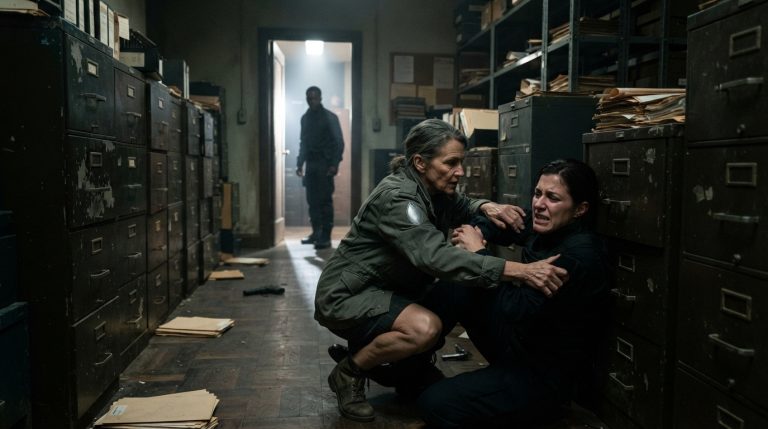
He heard a sound then—the sharp, metallic snick of a safety being disengaged. It came from the shadows at the end of the aisle.
“I was wondering when you’d show up, Arthur,” a voice said, low and steady. It was the same voice from the hallway, but it was closer now, colder.
Arthur didn’t turn. He closed the folder, his grip on the iron tool tightening until his knuckles turned white. He had been lured into the archive, and now, he was standing in the center of the trap. He wasn’t afraid of the death that waited in the dark; he was afraid of the fact that he had been an instrument of their power for all these years, and he had done it with such quiet, humble efficiency that he had nearly become the cage itself.
“You should have stayed in the club, Arthur,” the voice continued, moving slowly through the rows. “The janitor was such a quiet, obedient life. It suited you.”
Arthur turned slowly, his light cutting through the gloom. He didn’t see a face, only the silhouette of a man holding a weapon with the practiced, terrifying ease of an operator. “I’m not a janitor,” Arthur said, his voice a low, gravelly rasp that seemed to vibrate through the cavernous space. “And I’m tired of being your ghost.”
The man in the shadows didn’t laugh. He just tightened his hold on the weapon, the metal catching the faint sliver of light from the doorway. The trap had been sprung, but as Arthur shifted his stance, he felt the cool, reassuring weight of the iron in his hand. He wasn’t fighting for his life anymore. He was fighting for his history.
CHAPTER 5: THE CONFRONTATION OF MEMORY
The man stepped into the sliver of moonlight filtering through the high, reinforced vents of the ceiling. He was older, his face a landscape of deep-set wrinkles and a jagged scar that pulled at the corner of his mouth, but Arthur recognized the stillness. It was Elias—or the man he had believed to be Elias. The man he had seen buried in a ceremony that now felt like a cruel, elaborate stage play.
Elias lowered the weapon, his hand still firm but no longer leveled at Arthur’s heart. “You were always too good at finding things that were meant to stay buried, Arthur. That was your greatest asset. It was also your greatest flaw.”
Arthur didn’t lower his guard. He remained motionless, his senses calibrated to the sound of the man’s breathing, the way the light glinted off the barrel of the silenced pistol. “You’re supposed to be dead,” Arthur said, his voice flat, stripped of all emotion save for a cold, metallic curiosity.
“Dead is a state of mind in our line of work,” Elias replied, stepping closer. The clicking sound—a rhythmic, faint tick of a vintage mechanical transmitter—danced in the air between them. “We were never just assets, Arthur. We were the contingency. When the Agency decided to ‘clean’ the ledger after the Cold War, they didn’t just delete the files. They deleted the people. You were sent to Ramstein because you were the only one who didn’t question the order. You were the perfect janitor. You cleaned the mess without asking where the blood came from.”
Arthur felt a tremor of rage, not a hot, explosive fire, but a cold, heavy pressure building in his chest. “I was a sentinel,” Arthur corrected, his voice a low growl. “I was told I was maintaining the peace.”
“You were maintaining a cage,” Elias countered, his eyes flickering with a momentary, haunting sadness. “Every floor you swept, every brass plate you polished—you were marking time for a world that had forgotten you existed. The pension? The clerical errors? They weren’t mistakes. They were the bars. Every time you touched that money, you were renewing your contract with a silent master.”
Elias gestured toward the files surrounding them. “This whole place is a graveyard of people just like us. People who had the misfortune of being too effective. I was supposed to be the one to ‘decommission’ you years ago. I chose to disappear instead. I’ve been living in the gaps, watching you, waiting for the moment when you’d realize that the janitor was just a different kind of prisoner.”
Arthur looked at the iron tool in his hand, then back at Elias. The weight of the archive—the thousands of files of men and women who had vanished into the ‘long-term dormancy’ of the Agency—felt like a physical crushing force. “Why now?” Arthur asked. “Why bring me here?”
“Because the ledger is being wiped clean, Arthur,” Elias whispered, his voice losing its composure. “The people who signed our erasure are gone. A new generation of managers is taking over. They don’t care about the ghosts. They’re burning the archives. They’re erasing the evidence of the cage. If we don’t act now, we won’t just be forgotten. We’ll be unmade.”
Elias took a step back, his posture shifting. He wasn’t the hunter anymore. He was the desperate remnant of a dying brotherhood. “I can’t destroy them from the outside. I’m a ghost, and the new world doesn’t see ghosts. But you? You’re the one who walked into that club and forced them to look at you. You’re the only one who can drag the truth into the light.”
Arthur felt the cold steel of the archive wall against his back. The realization hit him with the force of a physical blow. He wasn’t the prey. He was the only thing standing between the history he had protected and the void that threatened to consume it. He looked at Elias, seeing not an enemy, but a man who had spent twenty years in the same kind of hell he had endured in the shadows of the base.
“If I go out there,” Arthur said, the silence stretching between them, “I won’t stop until the truth is laid bare. Not just for me. For every name in this room.”
Elias nodded, a slow, grim gesture. “Then we don’t have much time. They’re already on their way. They know I’m here, and they know you’ve opened the box. The cleanup crew isn’t coming to offer a pension.”
Arthur straightened his back, the limp that had haunted him for thirty years fading under the surge of adrenaline and long-repressed purpose. He looked at the rows of files, the thousands of lives that had been reduced to numbers and dates. He had been a cleaner his whole life. It was time he performed the final, most important task of his career: he was going to clean out the house, from the foundation up.
He moved toward the exit, his eyes fixed on the darkness of the forest. He could hear them now—the distant, rhythmic thrum of engines, the subtle, unmistakable approach of a team that didn’t leave witnesses. He didn’t look back at Elias. He stepped out of the archive and into the cold, unforgiving air, the iron tool gripped firmly in his hand. The stage was set, and for the first time in his life, he wasn’t playing the role they had assigned to him. He was playing his own.
CHAPTER 6: THE FINAL RECKONING
The gravel path outside the archive crunched under the weight of three approaching vehicles. Arthur didn’t retreat; he stood in the doorway, his silhouette framed by the dim, flickering light behind him. Beside him, Elias checked the action of his pistol, his expression one of calm, professional resignation.
“They won’t just walk in, Arthur,” Elias whispered, the sound barely audible over the wind. “They’ll secure the perimeter. They’ll try to smoke us out.”
“Let them,” Arthur replied, his voice devoid of the weariness that had characterized his existence for thirty years. He felt the cold iron tool in his hand, a humble, domestic object that was now the focal point of a decades-old war. He didn’t look at the darkness. He looked at the shadows, waiting for the flicker of motion that would signal the first move.
The headlights of the lead vehicle swept over the clearing, illuminating the rusted exterior of the bunker. A voice projected from a loudspeaker, tinny and artificial: “Mr. Jenkins, step away from the building. You are in possession of classified material that does not belong to you. Your status is ‘Terminated.’ Comply, and this ends quietly.”
“Quietly,” Arthur murmured, a thin, humorless smile touching his lips. He stepped out into the clearing, his hands raised slightly, away from his body. “Elias, stay inside. This is between me and the ledger.”
“Arthur, don’t—”
“I’m done being an asset,” Arthur said, his tone final. He walked forward, his gait steady, the limp entirely absent. He was a man approaching an old friend, or perhaps a long-overdue debt.
He reached the edge of the clearing, where the tactical team had formed a semi-circle. They were professionals, clad in dark, non-descript gear, their weapons leveled at his chest. The lead agent, a man in a crisp, expensive suit that looked entirely out of place in the Black Forest, stepped forward.
“Mr. Jenkins. You’ve had a long, productive retirement. It’s a shame you decided to ruin it for a stack of paper.”
“It wasn’t paper,” Arthur said, stopping ten feet from the agent. “It was a prison. You didn’t just hide me, you deleted me. You didn’t manage an asset; you committed a slow-motion murder of a human being, hoping the world would never notice the dust.”
The agent’s face remained impassive. “The world doesn’t care about a janitor, Arthur. And they certainly won’t care about a ghost.”
Arthur reached into his jacket. The movement was slow, deliberate. He pulled out the file he had retrieved from the archive—not the papers themselves, but a small, digital drive he had found hidden in the back of the folder, a redundant copy of every activation command, every ‘termination’ order, and every dollar diverted to his fake pension. He held it up.
“You’re right,” Arthur said. “They might not care about a janitor. But they’ll care when this hits the global feed. I’ve already set the timer. In sixty seconds, the entire history of the ‘Dormancy’ program—your program—goes live. Names, dates, locations. Even the ones you thought were lost in the fire.”
The agent’s calm vanished, his eyes widening in genuine, visceral panic. “You wouldn’t.”
“I’ve spent forty years doing exactly what I was told,” Arthur said, the iron tool in his other hand catching the moonlight. “It’s time I did what I wanted.”
The standoff lasted only a moment. The agent rushed forward, his hand clawing for his sidearm, but Arthur was already moving. He wasn’t a janitor. He was Viper One. With a speed that defied the laws of time and age, he stepped inside the agent’s reach, the iron tool striking a nerve center with surgical precision. The agent collapsed, his weapon clattering into the mud.
The rest of the team hesitated, caught in the conflict between their training and the sudden, terrifying reality that they weren’t dealing with a civilian, but a legend. Elias stepped out from the doorway, his own weapon held steady, pointed not at them, but at the lead vehicle’s engine block.
“Drop them,” Elias commanded, his voice carrying the authority of a man who had nothing left to lose.
One by one, the weapons hit the mud. The tension broke, leaving behind only the sound of the wind in the pines. Arthur stood over the agent, the drive still clutched in his hand. He looked at the team, his eyes hard and clear. “Go. Tell your masters that the ghost has walked out of the machine. And tell them if they ever come looking for me again, they’ll find that the basement is empty.”
They didn’t wait. They gathered their fallen lead and retreated, the vehicles spinning in the mud before disappearing into the forest. Arthur stood in the clearing, the weight of the last three decades slowly lifting from his shoulders.
Elias walked over, his expression one of quiet, profound relief. “You really did it, Arthur. You burned it all down.”
“It wasn’t mine to keep,” Arthur said. He looked at the drive, then cast it into the mud, stepping on it until it shattered. “I don’t need the evidence. I only needed to know that I was real.”
The years of struggle, the exhaustion, the quiet, hidden life of a man who didn’t exist—it all began to settle into a new kind of silence. It wasn’t the silence of the cage, but the silence of peace. He looked toward the treeline, where the first gray light of dawn was beginning to bleed into the sky.
He didn’t need to go back to Ramstein. He didn’t need to be anyone’s asset, or anyone’s janitor. He turned away from the archive, away from the path that had led him here, and started to walk. His step was firm, his breath deep and steady.
He found a small, rusted sign near the edge of the forest—the remains of an old trail marker. With a steady hand, he used the iron tool to clear away the moss and the grime, revealing the name of the trail, an old, forgotten path that led away from the forest and into the unknown. It was a simple, manual task, the kind he had spent his life performing. But this time, it was his own.
He stood for a long moment, looking at the road ahead, the world wide and open in the morning light. The ghost was gone. Arthur Jenkins, a man who had finally earned the right to be forgotten, stepped onto the path and started to walk home.