The Riparian Debt: A Calculated Dismantling of a Tyrant’s House of Glass
CHAPTER 1: THE VIOLATION
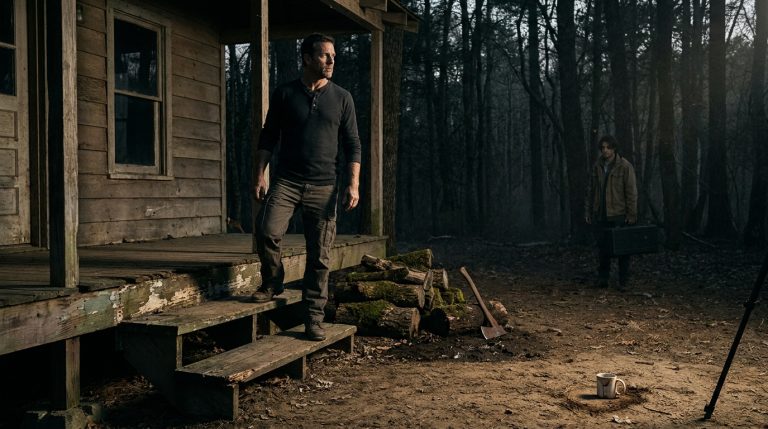
The air at Mirror Lake usually tasted of pine resin and wet stone, but this morning, it was tainted by the sharp, sterile scent of ozone and expensive perfume. Ezra Whitmore held his breath, his eyes tracing the jagged grain of the dock’s 1887 cedar pilings. His boots felt heavy on the damp wood, each step a rhythmic thud that reminded him of the military cadence he’d tried so hard to forget.
The crunch of high-end tires on his gravel drive was a jarring intrusion. A white Escalade sat idling, its grill gleaming with a predatory, chrome intensity that mocked the quiet sprawl of the pines.
Cordelia Blackwood stepped out. She moved with the fluid, practiced grace of someone who owned the air she breathed. Her blazer was charcoal, tailored to a razor’s edge, and her silver hair was pulled back so tight it pulled at the skin around her eyes. She carried a clipboard like a shield.
Ezra didn’t move. He watched her approach, his internal clock clicking into a familiar, cold assessment. Distance: twenty feet. Trajectory: aggressive. Payload: a single, crisp sheet of paper held with white-knuckled intent.
“You’re the new owner,” she stated. Her voice was not a question; it was a verdict. She didn’t wait for him to acknowledge her presence before she slapped the violation notice onto his truck’s windshield. The sound—a dry, sharp thwack—echoed across the water.
Ezra finally turned, his expression carefully neutral. He stepped off the dock, the gravel shifting under his heels. He looked at the paper, fluttering in the breeze. It was pinned under the wiper blade like a trophy.
“Five hundred dollars a month,” Cordelia said, her eyes scanning the dock with visible contempt. “Lake access fee. Retroactive to the start of the quarter. And the structure—your dock—is a clear violation of municipal safety codes. It needs to be demolished within thirty days.”
Ezra walked toward the truck, his pace measured. He didn’t look at her; he looked at the notice. The typeface was bold, authoritative, and completely fraudulent. He could smell the lingering scent of her perfume—cloying, artificial, a chemical mask over something rotting underneath.
“My great-grandfather built this,” Ezra said softly, his voice steady. He reached out and pulled the paper from the windshield. The paper felt brittle, cheap. “It’s been here since before this community was a fever dream in a developer’s head.”
“It’s a hazard,” she snapped, stepping into his personal space. Her eyes were hard, calculating, searching for a tremor of fear or a flash of anger. “The HOA has the power to condemn anything that threatens our vision. Don’t mistake my patience for weakness, Mr. Whitmore.”
Ezra folded the notice. He felt the weight of the original deed tucked into his jacket pocket—a heavy, dense reality that made Cordelia’s paper threat feel like confetti. He looked at her, really looked at her, and saw the subtle, frantic pulse in her neck. She wasn’t just a tyrant. She was desperate.
“Is that all?” he asked.
Cordelia’s jaw tightened. She’d expected a fight, a scream, a pathetic attempt at bargaining. She didn’t know how to handle the silence. She turned on her heel, her designer shoes clicking sharply against the gravel as she retreated to the Escalade. As she drove away, the scent of her perfume lingered, thin and fading, like a ghost in the morning air.
Ezra stared at the water. The ripples where the dock met the lake were calm again, but beneath the surface, he could see the shadows shifting, waiting. The game had begun, and he had the opening move.
CHAPTER 2: THE DUST AND THE DEED
The courthouse basement was a sanctuary of neglect. While the rest of the county lived in the light of the twenty-first century, this room was stuck in a perpetual, stagnant 1920, smelling of damp concrete, iron-rich dust, and the slow, inevitable decay of dead promises. The fluorescent lights overhead hummed with a low-frequency vibration that set Ezra’s teeth on edge, a sound he had learned to associate with long, sleepless nights in forward operating bases, waiting for intelligence reports that never arrived.
He pushed the heavy, oak-paneled door open, his boots muffled by a layer of grime that seemed to have settled decades ago. Behind the main counter, a woman sat hunched over a mountain of manila folders. Her skin was the color of old parchment, her spectacles thick enough to distort her eyes into magnified, curious orbs. She didn’t look up.
“Property records,” Ezra said, his voice clipped and precise. “Witmore. Mirror Lake. 1887 to present.”
The clerk tapped a key, the sound harsh in the silence. She didn’t acknowledge him with words, merely slid a heavy register across the counter toward him. It was massive, the spine cracked and mended with layers of yellowing tape.
Ezra didn’t start with the digital logs. He didn’t trust them. Computers were only as good as the bureaucrats who fed them data, and he knew how easily a record could be scrubbed or “updated” to fit a narrative. He moved to a narrow, metal-legged table near the back, cleared a space of dust, and began the work.
As he flipped through the brittle pages, the smell of the paper triggered an unwanted phantom memory: the taste of grit in the back of his throat, the specific, hollow feeling of checking a load-bearing beam for hairline fractures under the threat of a mortar strike. He pushed the memory down, anchoring himself in the present. He wasn’t building bridges in a war zone anymore, but the logic was the same. A structure was only as strong as its foundation. If the HOA’s claim to authority was a structural failure, he just needed to find the crack.
He turned page after page, his fingers moving with a deliberate, rhythmic care. Names appeared and vanished—family lineages, land transfers, mineral rights, logging permits. Then, he saw it.
A supplementary deed, stamped in red ink, tucked behind a standard land grant. It was an anomaly, a document that shouldn’t have existed in the standard flow of property law. He leaned in, the light of his small tactical flashlight cutting through the dimness of the room, illuminating the cursive script of a nineteenth-century clerk.
Silas Whitmore. 1887.
The language was archaic, dense with the legalese of the frontier, but the meaning was crystalline. It didn’t just grant ownership of the land; it codified riparian authority. It established the lake not as a communal amenity, but as a private ecosystem, with the right to flow-control and mineral extraction preserved in perpetuity, specifically exempted from future municipal or “association-based” zoning.
His pulse steadied. It was a perfect, elegant, and utterly devastating piece of leverage.
He cross-referenced the registry. Every subsequent developer, every HOA filing, every “community standard” update in the last fifteen years had systematically ignored this document. They had operated under the convenient, arrogant assumption that the passage of time had rendered the old deed a dusty irrelevance. They had built their entire kingdom on a foundation of sand, ignoring the granite bedrock beneath it.
He pulled his phone, the screen light harsh in the gloom, and began to scan the document, taking high-resolution photos of every clause, every stamp, and every signature. He wasn’t just collecting evidence; he was assembling a weapon.
A noise behind him—a soft, dry rustle of paper—made his muscles tense. He didn’t look back immediately. He waited, his ears straining against the buzz of the lights. The clerk was still at the desk, immobile.
He finished the final photo, the shutter sound muffled by the thick air, and stood up. He left the register open on the table, a silent witness to what he had found. The walk back to the heavy door felt different. He wasn’t a man being harassed by a neighborhood tyrant anymore; he was an engineer holding a structural demolition plan.
As he stepped out into the daylight, the sun felt blinding, sharp and unforgiving. He took the paper violation notice out of his jacket pocket, the one Cordelia had slapped onto his truck. It felt flimsy, a laughable scrap of nothing.
He didn’t tear it up. He wouldn’t give her the satisfaction of a reaction. Instead, he folded it neatly and placed it back in his pocket, next to the photos on his phone. The war for Mirror Lake wasn’t going to be won with shouts or threats. It was going to be won with the cold, unyielding precision of the law.
He climbed into his truck, the engine turning over with a steady, reassuring growl. He had the truth, and for the first time since he’d inherited the lake, the weight in his chest—the heavy, suffocating doubt of the last six months—began to lift. He knew what he had to do next. He needed someone who spoke the language of the enemy, someone hungry enough to wield this deed like the scalpel it was. He was going to find Tommy Reeves.
CHAPTER 3: THE DINER ALLIANCE
The diner was a relic, a box of stainless steel and cracked vinyl booths that smelled intensely of grease, stale coffee, and the pervasive, damp cold of the season. Ezra pushed through the door, the bell above it letting out a pathetic, tinny chirp. He scanned the room, his eyes instantly locking onto a booth tucked into the far corner, away from the windows.
Tommy Reeves was already there. He was young—fresh-faced in a way that Ezra associated with untested recruits—but his posture was frantic. He had a stack of legal texts piled up on the sticky table like a fortress, and he was currently chewing on the end of a ballpoint pen. When he saw Ezra, his eyes widened, the hunger and nervous energy in them unmistakable.
Ezra slid into the booth opposite him. The vinyl seat groaned in protest. He didn’t waste time on pleasantries. He placed the heavy manila envelope on the table, the sharp, rigid corners of the legal documents inside creating a definitive boundary.
“You said you wanted a fight, Tommy,” Ezra said, his voice low, measured. “I think I found the leverage.”
Tommy abandoned his pen. His hands hovered over the envelope, his fingers twitching. He didn’t open it immediately; he looked at Ezra, his gaze shifting from the man to the object, trying to gauge the gravity of what he was about to see. “Cordelia’s been stepping up the pressure, Ezra. Three different residents came to my office this morning. All of them served with ‘violation notices’ that aren’t worth the paper they’re printed on. She’s moving fast, like she’s trying to finish this before anyone realizes the foundation is crumbling.”
“Let her move,” Ezra replied, gesturing to the envelope. “Open it.”
Tommy peeled back the clasp. As he pulled out the high-resolution prints of the 1887 deed, his expression underwent a slow, mechanical transformation. The nervous, twitching energy faded, replaced by the cold, analytical focus of a man realizing he had just stepped onto a gold mine. He didn’t speak for a long time. He turned the pages, his eyes darting back and forth, tracing the script, verifying the stamps.
“This,” Tommy whispered, the sound barely audible over the hum of the refrigerator behind the counter, “is a nuclear option. This doesn’t just invalidate her violation notice, Ezra. This voids the entire jurisdictional mandate of the HOA regarding pre-existing properties. If this is authenticated—and the county clerk’s stamp suggests it is—she hasn’t just been bullying people. She’s been committing active, systemic fraud.”
“She thinks we’re just another couple of nuisances to be managed,” Ezra said, his eyes scanning the diner. He noticed the way the waitress hovered near the coffee pot, her eyes darting toward their booth. He lowered his voice, the tactical caution of his years in the field instinctual. “She thinks the law is a tool she controls. She doesn’t realize it’s a system with rules that don’t care about her designer suits.”
Tommy looked up, a slow, predatory grin spreading across his face. “She’s built a house of cards, Ezra. She’s been using the authority of the HOA to bypass due process, knowing that most people can’t afford the legal fees to challenge her. But with this deed, we don’t need a massive, expensive trial. We just need to stop her in her tracks with a summary judgment filing.”
“I don’t want to just stop her,” Ezra said, his tone sharpening. “I want to dismantle the mechanism that allowed her to do this in the first place.”
“That’s going to require more than just the deed,” Tommy warned, leaning forward, the booth shaking slightly. “We need to expose the motive. Why is she so fixated on your lake rights? It’s not just about the dock. It’s about the access, the flow, the control. There’s something else happening under the surface, something bigger than just a petty tyrant’s whim.”
As Tommy began to lay out his plan—a complex, multi-stage legal strike—Ezra’s phone buzzed on the table. It was a sharp, grating vibration against the Formica. He glanced down. Unknown Number.
He stared at the screen for a beat. He didn’t answer. He let it ring, watching the glow of the screen reflect in Tommy’s expectant eyes.
“Don’t,” Ezra said, his hand hovering over the phone. “If she’s calling, it means she’s feeling the friction. It means she’s already guessing that we didn’t just walk out of the courthouse empty-handed.”
“She’s panicking,” Tommy suggested, his excitement bubbling over. “She’s calling an emergency board meeting. I heard rumors. If she’s acting this fast, she’s losing control of her own timeline. We have the initiative, Ezra. We need to leverage it, not respond to her.”
Ezra stood up, the envelope tucked firmly back under his arm. The sticky atmosphere of the diner, the smell of burnt coffee, and the constant hum of the room all seemed to solidify around him. He felt the weight of the deed, the weight of the history he was defending, and the sharp, clean edge of the conflict to come.
“Let her call,” Ezra said, glancing out the window at his truck, sitting alone in the gravel lot. “We’ll show up to her emergency meeting. But we aren’t going to play by her rules. We’re going to bring the truth to the floor.”
CHAPTER 4: THE EMERGENCY ASSEMBLY
The community center smelled of industrial pine cleaner and repressed anxiety. It was a space designed for children’s craft fairs and bridge clubs, not for the systematic dismantling of a power structure. Folding chairs were arranged in rows that felt more like barricades, and the air was thin, recycled, and suffocating.
Ezra stayed in the back, his posture loose but ready. He watched the room through the filter of his experience: he noted the emergency exits, the lack of a clear line of sight for the speakers, and the way Cordelia Blackwood held court at the front. She was at the podium, backlit by a projector that cast a harsh, clinical glow onto a poster board display. The charts were impressive—glossy, color-coded, and entirely fictional. She was pointing at a grainy photograph of his dock, her finger tracing a red circle around a piling that looked, to the untrained eye, like a safety violation.
She was in her element. She moved with the fluid, practiced authority of an attorney who had never once faced a jury that didn’t have to listen to her. Her voice was modulated, calm, and terrifyingly reasonable.
“We have a responsibility,” Cordelia said, her tone dripping with manufactured concern. “Not just to our property values, but to the very environmental integrity of Mirror Lake. When one individual refuses to comply with basic safety standards, the entire community suffers the consequences.”
Ezra felt Tommy shift beside him. The young lawyer’s hands were steady, his briefcase resting against his leg like a piece of kit. “She’s going to call for an immediate vote on an emergency resolution,” Tommy whispered, his voice so low it was almost lost in the room’s ambient hum. “She’s banking on the fear of ‘environmental hazard’ to bypass the standard procedural requirements for land-use changes. She wants the room to vote before they have time to think.”
Ezra nodded once. He wasn’t looking at Cordelia; he was looking at the faces of the people in the room. The Hendersons, sitting in the third row, looked terrified. Mrs. Martinez, further back, looked resigned. They were being managed. They were being acted upon.
Cordelia clicked a button, and the screen flashed to a rendering of a proposed ‘restoration project.’ It was a sleek, modern structure that looked nothing like the natural shoreline of the lake. It was a sterile, concrete vision.
“This isn’t about one man,” she continued, her eyes sweeping the room, stopping just short of the back wall where Ezra stood. “This is about the future we choose. A future of safety, or a future of neglect. I move that the board authorize the immediate seizure of the dock structure under the emergency environmental protocols defined in the 2018 bylaws.”
A murmur of agreement rippled through the front rows. It was choreographed. Ezra recognized the pattern—the same way a platoon leader might guide a decision in a briefing by only presenting the favorable data.
He didn’t wait for the vote. He didn’t wait for the chairman to second the motion. He stepped out of the shadows. The floorboard under his heel creaked—a sharp, piercing sound that cut through the silence of the room.
The attention shifted. Cordelia froze, her hand still hovering over the remote control for the projector. She peered into the darkness at the back of the room, her expression flickering from irritation to a cold, hard recognition.
“Point of order,” Ezra said. His voice wasn’t loud, but it had the weight of a command. He didn’t shout; he didn’t need to. He walked down the center aisle, his stride measured, rhythmic, and entirely unhurried.
Every eye in the room was fixed on him. The tension in the air changed, shifting from the manufactured fear of a ‘hazard’ to the raw, visceral curiosity of an impending confrontation.
“The 2018 bylaws you’re citing, Ms. Blackwood,” Ezra said, reaching the front of the room. He stopped ten feet from the podium, his presence casting a shadow over the glossy charts. “They contain a fundamental error. They assume that the HOA possesses jurisdiction over the entirety of the lakefront. They don’t.”
Cordelia’s composure, usually as seamless as polished glass, cracked. She took a half-step back from the podium, her knuckles white as she gripped the edges. “Mr. Whitmore, you are out of order. This is a private meeting of the homeowner’s association. If you continue to interrupt, I will have you removed.”
“By whom?” Ezra asked calmly, glancing toward the door. “The meeting is public-record compliant, isn’t it? You invited the press.”
He placed the manila envelope onto the edge of the front table. It landed with a heavy, final thud.
“I’m not here to argue about dock safety,” Ezra continued, looking not at Cordelia, but at the board members seated behind her. They looked pale, uncomfortable. “I’m here to point out that this emergency vote is predicated on a lie. And before you vote to seize property, you should probably know what you’re actually signing your names to.”
Tommy stepped forward then, his briefcase snapping open. The sound was like a pistol shot in the quiet. He didn’t look at Cordelia. He looked at the board. “Ladies and gentlemen, we are entering the original 1887 deed into the record. It establishes that this association has zero legal standing over the Whitmore parcel. Any vote taken tonight based on these bylaws is not just a mistake—it is a criminal act of overreach.”
Cordelia was silent now. The hum of the projector seemed to grow louder, filling the void where her authority had been a moment before. Her face was a study in controlled, rising panic. She looked at the crowd, then at the board, then finally at Ezra.
She opened her mouth, but for the first time, no words came out. The room was no longer hers.
CHAPTER 5: THE INSPECTION RAIDS
The aftermath of the meeting was not a clean break, but a messy, bureaucratic disintegration. Cordelia had retreated into a tight-lipped, frantic efficiency, but the air around her was now distinctly different—it was no longer the air of an unchallenged leader, but the atmosphere of a cornered animal calculating its next, desperate scramble.
Three days later, the morning broke with the dissonant rumble of heavy diesel engines. Ezra was on his porch, a mug of black coffee cooling in his hand, when he saw them: three county vehicles, their markings distinct and authoritative, churning up the gravel of his drive. They moved with a tactical synchronization that Ezra recognized instantly. This wasn’t a routine visit; this was a show of force.
He set the mug down on the railing. The wood was cold, damp with the morning mist. He didn’t move to meet them. He watched as the doors swung open and the men climbed out—the building inspector, the septic specialist, and an environmental compliance officer. They looked miserable.
Pete, the building inspector, walked toward the porch with his clipboard held like a weapon. He didn’t look Ezra in the eye. “Mr. Whitmore,” he called out, his voice thin in the damp air. “We’ve had reports. Multiple anonymous complaints regarding unauthorized structural modifications and potential septic drainage issues. We have a mandate to perform an immediate, comprehensive inspection.”
“Anonymous,” Ezra repeated, the word tasting like ash.
He didn’t need to ask who had made the calls. He could almost smell the cloying, overpriced perfume Cordelia used, even from a hundred yards away. She was trying to bury him in administrative friction, hoping to stall the momentum he and Tommy had built before they could file the formal challenge to the HOA’s authority.
“Go ahead,” Ezra said, gesturing to the property. He stood up, his movements slow and deliberate. “Check everything. Measure the dock. Poke your rods into the leech field. But be warned, Pete: when you find that everything is up to code, I’m going to need a full, written report of your findings for my records. And I’ll be documenting every second of this process.”
The inspection took the better part of the morning. It was a tedious, grinding process designed to provoke, but Ezra remained the observer. He walked alongside the specialists, his phone camera recording the measurements, the water samples, and the way the septic specialist’s rod hit solid rock without a hint of moisture.
By noon, the atmosphere had shifted. The inspectors were tired, frustrated, and increasingly aware that they were being used as pawns in a petty, localized vendetta. Pete stood at the edge of the dock, his clipboard hanging limp at his side. He looked at the structure, then back at the house, then at the lake.
“Everything is… it’s all compliant, Ezra,” Pete said, his voice softer now, stripped of the bureaucratic armor he’d worn an hour ago. “If anything, the dock is over-engineered. The septic system is a newer model than required.”
“I know,” Ezra replied. He didn’t take any pleasure in the victory. It was a hollow, exhausting win that had cost him half a day and a mounting frustration.
“Look,” Pete said, stepping closer, lowering his voice. “We keep getting these calls. Same phone number. Same pattern. It’s making the department look like a private security firm for the HOA. We’re being pushed to find violations where none exist, and frankly, some of us are getting tired of being the ones who have to break the bad news.”
Ezra felt a small, sharp spark of possibility. “Who is the ‘we’, Pete?”
“The people who have to sign these reports,” Pete said, not quite meeting his gaze. “Just keep your nose clean. If she tries to push for another round of inspections, we’re going to have a hard time justifying it to the county board.”
As the trucks pulled away, leaving behind a plume of dust that settled slowly in the still air, Ezra felt the full weight of the exhaustion. This was the cost of the conflict: a relentless, grinding war of attrition. He turned toward the house, but stopped as his phone buzzed. It was an email from Tommy, flagged with a red urgency marker.
Cordelia is moving the funds. I’ve been tracking the HOA bank accounts, and there’s a mass transfer being initiated for ‘Emergency Legal Reserves.’ If she manages to shift that capital into those shell companies before we file the injunction, it’s going to take us months to claw it back.
Ezra stared at the screen. The logic was inescapable: Cordelia knew the inspection had failed, so she was skipping the tactical distraction and going straight for the treasury. She was preparing to run, or at the very least, to insulate herself before the structure collapsed.
He looked out at the lake. It was calm, serene, and entirely indifferent to the frantic greed of the woman who thought she owned its history. He realized then that he couldn’t wait for the legal process to move at the speed of the courthouse. He had to accelerate the timeline. He had to force her into a mistake that she couldn’t hide, not even with a hundred anonymous complaints. He pulled his keys from his pocket, the metal biting into his palm. It was time to go on the offensive.
CHAPTER 6: THE PAPER TRAIL COLLAPSE
Ezra didn’t walk back into the house. He turned directly to his truck, the steel door heavy and cold under his palm. The dashboard glowed with the familiar, amber light of the radio, but he didn’t reach for it. Instead, he pulled out his laptop, the screen reflecting the deep, restless gray of the afternoon sky.
He keyed in the secure link Tommy had provided, watching as the encrypted dashboard loaded. The numbers were staggering. It wasn’t just mismanagement; it was an anatomy of theft. Transaction by transaction, Cordelia had been siphoning the HOA’s maintenance reserve, routing it through “Lakeshore Property Management,” then to “Blackwood Environmental Solutions,” and finally into a private brokerage account.
A sudden, sharp memory cut through the focus—the collapse of a temporary bridge support in the Helmand province. He had miscalculated the stress load on a single primary strut. The result had been a deafening, grinding screech of steel bending, the structure buckling in slow motion, the failure inevitable once the stress point had been bypassed. Cordelia was doing exactly the same thing. She was overloading the struts, assuming the sheer mass of her position would hold the structure together. She didn’t realize the metal was already screaming.
He typed a quick, coded response to Tommy. Initiate the freeze. Trigger the state oversight audit now.
He didn’t wait for the confirmation. He pulled out, the truck tires biting into the gravel. He needed to get to the county clerk’s office before they closed. If the transfer was still pending, they might be able to intercept the authorization signature before it left the county banking system.
As he drove, the familiar landscape—the pines, the rolling hills, the way the road dipped toward the lake—looked different, stripped of its aesthetic appeal and rendered as lines on an engineering map. He was seeing the fractures in the community’s infrastructure. Every McMansion, every pristine bit of landscaping, felt like a component of a failing system.
He reached the courthouse with ten minutes to spare. The halls were echoing, empty. He sprinted toward the clerk’s office, the heavy, metallic sound of his boots ringing against the marble.
The clerk, a woman named Betty who had worked the archives for forty years, looked up with a frown that softened into recognition when she saw the intensity in Ezra’s eyes. “We’re closing, Mr. Whitmore.”
“I have a formal request for an emergency freeze on the Lakeshore Estates HOA accounts,” he said, sliding a thick, stamped document across the counter. “It’s signed by the state regulatory office. It’s an urgent oversight intervention.”
Betty took the paper, her glasses slipping slightly down her nose. She read it, her lips moving silently as she processed the legal implications. Her eyes went wide. She looked up at Ezra, then at the clock. “This… this is an audit freeze. Do you know what this triggers?”
“I know,” Ezra said, his voice hard. “It triggers the end of the game.”
As she tapped the keys, the room seemed to go quiet, the silence heavy and expectant. A monitor on her desk flickered. Transaction Suspended. The words glowed on the screen in a stark, bright green.
Ezra let out a breath he didn’t know he was holding. He had cut the power. Now, the structure would have to support its own weight, and he knew, with the cold, absolute certainty of an engineer, that it wouldn’t last the night.
He walked out of the courthouse, the evening air hitting him with a sharp, cooling bite. The sun was dipping below the horizon, casting long, angular shadows across the parking lot. He had paralyzed her finances, but he hadn’t destroyed her yet. She would be coming for the documents, for the witnesses, and for him. He looked at his phone—a new text from Tommy.
She’s trying to authorize a second transfer from her private holding account. She’s trying to liquidate the option agreements on the lakefront parcels. She’s going to attempt to flee the state before the audit team arrives tomorrow morning.
Ezra didn’t feel triumph. He felt a grim, focused exhaustion. The final move was at hand. He started the truck, the engine’s idle a low, steady thrum. He wasn’t going home. He was going to the one place where he knew she would attempt to finalize the fraud—the place where the entire foundation of her power was physically located. He was going to the lake house.
CHAPTER 7: THE SABOTAGE OF THE SANCTUARY
The estate was a sprawling monument to an arrogance that hadn’t accounted for the simple, brutal reality of engineering truth. Cordelia’s house was nestled into the shoreline, a glass-and-steel structure that aimed for transparency but felt, in the gloom, like a prison of her own design. Ezra moved with the silent, practiced efficiency of a man who knew how to navigate a site without triggering sensors. He kept to the shadows of the landscaping, the sharp, manicured edges of the hedges catching on his jacket, his breathing steady, rhythmic.
The discrepancy caught him near the side gate: it was left slightly ajar. A minor detail, a moment of sloppiness that didn’t fit the image of the woman who “ironed her money,” but it spoke volumes. She wasn’t managing her territory anymore; she was abandoning it.
He pushed through the gate, the metal latch clicking softly—a sound that felt like a bell ringing in a cathedral. He followed the perimeter of the house, his eyes scanning the windows. He spotted her in the study. She was at the desk, the room lit by the harsh blue glare of a high-end workstation. She was moving fast, her hands a blur over the keys, a series of hard-drives and thin, silver-cased laptops spread out before her like a desperate collection of talismans.
She was trying to purge the local server, wiping the digital fingerprints of her embezzlement scheme. She wasn’t just planning to leave; she was planning to evaporate.
Ezra didn’t use the front door. He circled around to the glass-paneled sliding door that led into the study. It was locked, but the frame, modern and lightweight, lacked the structural integrity of the century-old ironworks he had grown up with. He placed a hand on the glass, feeling for the vibration of the alarm system, then found the manual bypass—a standard, high-end security interface that he’d worked with in a dozen different contracts. It took him thirty seconds to isolate the circuit and ground it.
The lock clicked open with a faint, hollow sigh.
He stepped inside. Cordelia didn’t look up, her concentration so absolute that she didn’t hear him until the floorboards groaned under his weight. When she did, she didn’t scream. She froze, her hand stilling over the keyboard. She turned slowly, her face pale, the mask of the HOA dictator finally stripped away. She looked smaller, thinner, the designer blazer hanging loosely on her shoulders.
“You,” she whispered. The word carried no authority, only a brittle, sharp-edged disbelief.
“The bank freeze is active, Cordelia,” Ezra said, his voice quiet, steady. He didn’t step closer, but he watched her eyes, looking for the telltale signs of a bluff. “The state audit team is already in transit. There’s nowhere to move the money. There’s nowhere to move the records.”
She looked back at the screen, then at him. “You don’t understand what you’ve done. You think you’re protecting a lake, but you’re destroying the only plan that could have saved this community from a bankruptcy you can’t even fathom.”
“I don’t care about your plan,” Ezra said. He took a step toward the desk, the movement forcing her to back away. “I care about the theft. I care about the intimidation. You built this on a lie that the land and the water were yours to sell. You were wrong.”
She laughed—a dry, hacking sound that had no humor in it. She reached for one of the hard drives, her fingers closing over it with a frantic, protective grip. “You think you’re the hero, Ezra? You’re just a man with a grudge and a piece of paper that nobody will remember in ten years. I’m the one who had the vision to manage this, the one who saw the potential for what this place could actually be.”
“You saw an opportunity to rob your neighbors,” Ezra countered. He leaned over the desk, his shadow falling across her documents. “And you got caught by the very engineering you tried to ignore.”
She straightened up, her face setting into a mask of cold, hard defiance. She wasn’t going to break; she was going to fight. She pulled a phone from the desk, her thumb hovering over an icon. “I have contacts, Ezra. People who don’t care about deeds. If you think you’re walking out of here with an admission of guilt, you’re more naive than I thought.”
“I don’t need an admission,” Ezra said. He gestured to the open screen, the file directories still visible, the transfer protocols still running. “I have the logs. I have the bank statements. I have the PI’s records. You’re not being arrested by me, Cordelia. You’re being arrested by the evidence you spent three years creating.”
She glared at him, the air in the room thick, almost metallic. She was calculating the distance to the door, the time it would take to upload the final wipe command, the likelihood of him physically intervening. He watched her mind work, the same way he’d watched a structure fail—predicting the pressure points, knowing exactly where the collapse would begin.
The rain started then, a sudden, violent lash against the floor-to-ceiling glass, the sound filling the room and masking everything else. She looked at the window, then back at him, and he saw the moment the reality settled in. She realized she had run out of ground. She slammed the laptop shut, the sound final and hollow, and sank into the chair, her gaze fixed on the floor.
The fight was gone, leaving behind only the cold, sharp debris of her ambition. Ezra didn’t feel the need to say anything else. He stood there, watching her, waiting for the sirens he knew would be following the state police vehicles he had called from the truck. The structure of her life had failed, and now, all that remained was the aftermath.
CHAPTER 8: THE FINAL VERDICT
The transition from chaos to containment was swifter than Ezra anticipated. The officers who flooded the study were not the polite, hesitant inspectors of the week prior; they were professionals, their movements precise and devoid of hesitation. As they moved to secure the room, one of them—a sergeant with eyes that had seen too many white-collar busts—approached the desk, his hand hovering near his sidearm.
“Ms. Blackwood,” the sergeant said, his voice flat, professional. “You are under arrest for the misappropriation of community funds, systemic fraud, and the filing of fraudulent legal documents.”
Cordelia didn’t look up. Her silence was a final, desperate attempt to maintain control, but as the metallic click of the handcuffs resonated against the glass of the desk, the sound was louder than any confession. She was led out of the study, her expensive blazer catching on the doorframe, her posture slumped. She didn’t look back at the room, the data, or the lake she had spent three years trying to seize. She was a hollowed-out shell of the woman who had once dictated the lives of thousands.
Ezra watched the lights of the patrol cars wash the study in a repeating pattern of strobe-blue. He turned his attention to the desk. There, beneath the closed laptop, was a small, brass-bound ledger—a physical record, handwritten, documenting the true hierarchy of the fraud. It was the final, messy detail that the digital wipe had missed.
He didn’t touch it. He gestured to the sergeant. “You’ll find the primary ledger there. It tracks the shell companies and the direct deposits into her brokerage accounts. It’s all here.”
The sergeant nodded, his gaze shifting to the ledger with a flicker of respect. “We’ll take it from here, Mr. Whitmore.”
Ezra walked out of the house. The rain had subsided into a light, misting drizzle, the air sharp and clean against his face. The estate grounds, once a symbol of Cordelia’s exclusionary power, now felt merely like a place—a collection of landscape, stone, and water. He walked to the edge of the property where his great-grandfather’s boundary line met the water.
He reached into his pocket and pulled out the violation notice he had kept since the first day. The paper was worn, the ink faded from handling. He took a moment, the silence of the night returning to him, and tore it into small, jagged pieces, letting the wind catch them and scatter them across the surface of Mirror Lake. It was a small act, but it felt like the physical seal on a contract that had lasted a century.
His phone buzzed. It was Tommy.
I’m at the county clerk’s office, the text read. The preliminary injunction has been filed, and the board has scheduled an emergency open meeting for tomorrow to address the leadership vacuum. The community is already talking, Ezra. They know. Everything is out.
Ezra stared at the screen, but he didn’t type a reply. He walked down to the old wooden dock, the structure that had been the focal point of the entire struggle. He knelt, his hands brushing against the grain of the century-old cedar pilings. He found the loose bolt he had been meaning to secure for weeks—a small, tangible piece of maintenance that had been neglected during the fight. He reached into his coat, pulled out a wrench he kept in his kit, and tightened the nut, the metal humming with a solid, absolute finality.
The repair was minor, but it was earned. He stood up, his legs stiff, and looked out over the expanse of the lake. The water was dark, mirroring the sky, reflecting the stars that were beginning to burn through the clouds. It was no longer a pawn in a development scheme, no longer a battleground for legal extraction. It was just the lake—the same water his great-grandfather had settled, the same current that had flowed long before the McMansions and the HOAs and the pretenders had arrived.
He felt a deep, resonant calm settle in his chest. The chaos of the past months hadn’t been a detour; it had been a crucible. He had been forced to defend his foundation, to understand the weight of the legacy he had inherited, and in doing so, he had secured it. He wasn’t the same man who had walked into that lawyer’s office six months ago. He was an engineer who understood that no matter how complex the structure, truth was the only load-bearing element that mattered.
The morning would bring the difficult, grinding work of community restoration—the committee meetings, the legal cleanups, the painstaking process of rebuilding trust. But he wasn’t going to be fighting alone anymore. He listened to the water lapping against the shore, the sound a steady, rhythmic pulse in the dark. It was the sound of a history that had finally been allowed to breathe, a story that was no longer being written by those who wanted to steal it. He turned his back on the estate, the path home clear and steady beneath his feet, and began to walk, each step solid, reclaimed, and entirely his own.