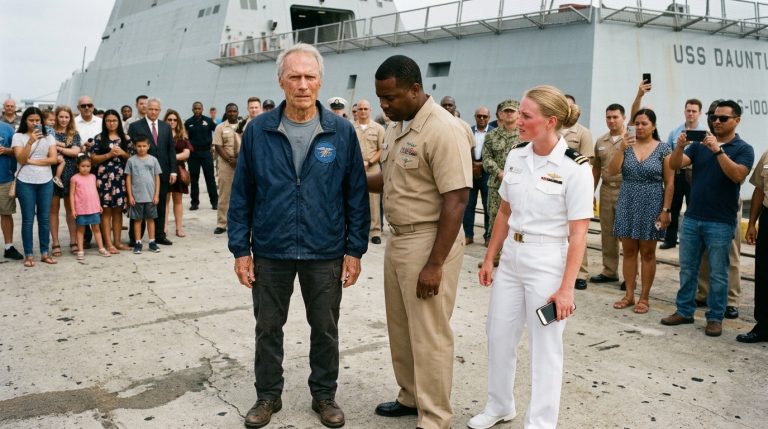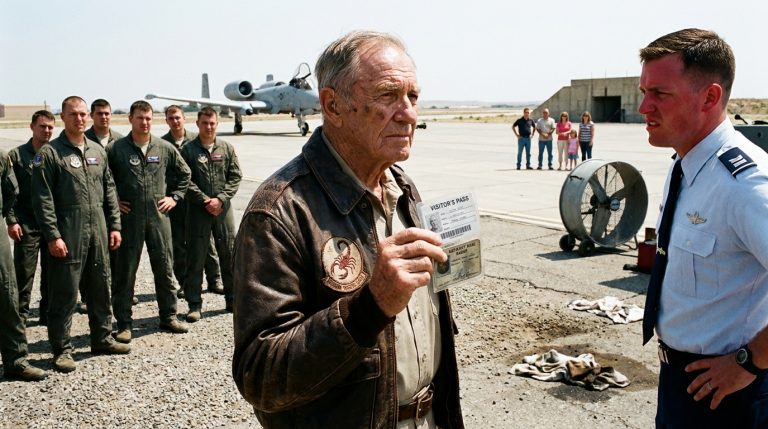
A Rhythm of Resilience: How One Colonel Found Her Voice Through the Quiet Grace of Healing
CHAPTER 1: The Weight of the Unrehearsed
The air in Fort Lunsford’s grand hall was thick with the scent of expensive perfume and the stale, lingering ghost of duty. I stood near the pillar, my uniform a stark, utilitarian charcoal against the sea of flowing silk and polished lapels. I wasn’t here to play the part; I was here because the invite was a summons, not a social grace.
Carson moved toward me, his martini glass held with the casual precision of a man who’d spent his entire civilian career calculating leverage. He stopped inches away, his smile a perfect, practiced curve that never reached his eyes.
“Stop acting like a nurse, Penny,” he murmured, loud enough to cut through the violins, soft enough to keep my reaction under the spotlight. “This isn’t your ER. You’re embarrassing the uniform.”
I didn’t reach for the medals on my chest. They felt heavy tonight, a physical weight pulling at the fabric. Instead, I looked past him, my eyes settling on the dark corner where Lieutenant Nathan Beckett sat, his wheelchair an anchor in the polished sea of indifference. He looked like a man waiting for an explosion that had already happened.
“I’m not acting, Carson,” I said, my voice steady, stripped of the defensive tremor he was fishing for. “I’m just watching.”
I turned my back on him. The room seemed to warp, the sound of the quartet fading into a dull hum as I crossed the floor. People shifted. A few stopped mid-laugh, their wine glasses suspended. I didn’t acknowledge the whispers. I reached the corner and knelt, the silk of my dress uniform straining against the marble.
“Lieutenant,” I whispered, holding out a hand—not a salute, just an offering. “Would you like to dance?”
He didn’t blink. He just stared at the floor, his hand twitching in his lap, a phantom nerve memory of motion. The silence that fell over the ballroom was heavier than any mortar round I’d ever heard. It was the sound of a hundred people holding their breath, waiting for the crack in the facade.
Then, Nathan’s hand shifted. He didn’t answer with words. He grabbed the side of his chair, his knuckles turning white, and he pushed. The brace on his leg caught on the floor, a sharp, metallic screech that echoed off the high ceiling. I didn’t reach out to steady him. If he was going to fall, he was going to fall on his own terms.
He rose, staggering, his weight shifting onto the fragile, mechanical architecture of his leg. When his hand finally found mine, it wasn’t for balance. It was for presence.
“Slow,” I said, the rhythm of my own boots setting the pace.
We moved, shuffle-breath-shuffle, the mechanical click of his brace providing a strange, jagged percussion to the haunting melody of the strings. Carson stood near the arch, his glass frozen, his face a mask of calculated fury. He had planned on me being the spectacle; he hadn’t planned on me being the catalyst.
As we turned, I saw my mother move backward into the crowd, her hand fluttering to her throat as if the air had suddenly gone thin. She was looking for an exit, but there was nowhere to go. I looked at Nathan. His eyes, just a moment ago hollow and vast, were beginning to sharpen, catching the light like glass shattered in the sun.
Then, a sudden, sharp realization hit me. In the center of his palm, pressed against my skin, he was shaking. Not from fear—but from the sheer, terrifying realization that he was moving again.
I looked up, meeting Carson’s gaze across the room. He realized it too. The mask slipped. For a fraction of a second, the predator saw that the prey had stopped running. And behind him, the General began to walk toward us, his steps heavy, his face unreadable, his eyes fixed entirely on the boy who was finally, painfully, taking his next step.
CHAPTER 2: The Pressure Cooker
The suspension of the luxury SUV absorbed the bumps of the city streets, but it couldn’t cushion the vibration of the tension inside. I sat directly behind the driver, staring at my own reflection in the darkened window. Outside, the city lights blurred into long, shimmering streaks of amber and white—a chaotic, living world that felt a million miles away from the gilded cage we had just exited.
My mother broke the quiet, her voice a sharp, brittle instrument. “Well, that was inappropriate,” she said, her fingers dancing nervously over the silk scarf at her throat, smoothing it as if trying to erase the very memory of the scene. “You couldn’t have just sat and clapped politely, Penelopey? Did you really need to turn that poor, broken boy into a public spectacle?”
I didn’t turn my head. I kept my gaze fixed on the reflection of the medals on my chest—crooked, tarnished by the dim light, yet stubbornly present. “I didn’t turn him into anything, Mother. He stood up because he chose to.”
“He stood up because you manipulated the environment,” Carson’s voice cut in from the seat beside me. He didn’t raise his volume, but the cold precision of his tone carried more impact than a shout. He was staring straight ahead, his hands folded neatly over his knee, his posture so perfect it looked artificial. “You read his file. You knew exactly which buttons to press to get a reaction. That wasn’t medicine. That was theater.”
I felt the familiar, dull ache in my chest—the residue of years spent being measured against Carson’s yardstick of “proper” ambition. He had always operated on the belief that everything, from people to national security, was a puzzle to be solved or a asset to be leveraged. He couldn’t grasp that sometimes, the only thing required was presence.
“It wasn’t theater,” I said, my voice barely audible over the hum of the tires on the asphalt. “It was a conversation between two people who know what it’s like to lose their footing.”
Carson scoffed, a short, dry sound that lacked any real humor. “You keep thinking you’re different, Penny. That makes you dangerous. You’re playing with optics that don’t belong to you. The General isn’t a fan of public displays, despite what he said in the moment. You’ve put a target on your own back, and by extension, on this family.”
“I’m not looking for protection,” I countered, finally turning my head to look at him. His profile was sharp, outlined by the intermittent streetlights. He looked less like a brother and more like an architect studying a failed blueprint.
“You don’t understand the repercussions,” he continued, ignoring my gaze. “I spoke with your CO two weeks ago. There’s a review regarding your high-visibility operational eligibility. They’re starting to see the liability in your methods. They want someone who follows the protocol, not someone who re-writes it mid-stride.”
The word liability hung in the air, tasting of copper and stale office air. It was a word I had heard before, usually whispered in hallways or buried in the fine print of after-action reports. It was the institutional way of saying that empathy was a glitch in the machine.
“You’ve been checking in on my career?” I asked, my voice remaining level despite the tightening in my stomach.
Carson flicked a glance at me, his eyes momentarily revealing a flicker of something—not concern, but calculation. “Someone has to keep track of the variables, especially when they’re prone to causing such massive deviations.”
The SUV slowed for a red light. Outside, a group of young men in civilian clothes stood by a bus stop, laughing, their movements loose and unburdened by the weight of the last decade. They looked weightless, as if the gravity of the life I’d led hadn’t yet claimed them. I looked back at Carson. He was watching me now, waiting for the crack, for the emotional outburst he could dismiss as “typically fragile.”
I didn’t give him one. I looked back at the glass, at the shadow of myself overlaying the city lights.
“I didn’t do it for attention, Carson,” I said, quiet and final.
“Then why?” he snapped, his composure fraying just enough to show the wire beneath. “Why risk everything for a moment that doesn’t advance a single objective?”
“Because I was there,” I replied, the words landing with a weight I hadn’t expected. “I was there, I saw him, and for the first time in a long time, someone else saw me, too.”
Carson looked away, staring out his own window as the light turned green and the SUV surged forward. The silence that filled the car was no longer just the absence of noise; it was a barrier, dense and impenetrable. I watched the passing scenery, feeling the cold, hard edges of the medal against my uniform, and for the first time in years, I didn’t feel the need to argue. I was a variable, as he said, but for the first time, I wasn’t just observing the equation—I was beginning to understand how to change it.
CHAPTER 3: The Ghost of Kandahar
The walk from the garage to my quarters was short, but every step felt calibrated by a ghost. The SUV’s door had clicked shut with a finality that echoed in my mind like the latch of a transport plane. I didn’t head for the kitchen or the light switch. I moved directly to my desk, where my field journal—that battered, leather-bound artifact of six years ago—rested under a stack of unread memos.
I didn’t turn on the overhead light. I let the blue, thin glow from the city outside bleed through the curtains, casting long, fractured shadows across the room. I sat down, the chair’s springs complaining under my weight. My hand hovered over the journal before I pulled it open. The pages were stiff, smelling of dust and dried blood, a sensory shorthand for a time when survival was the only metric that mattered.
June 14th, 2017. The date was written in frantic, hurried script.
I traced the lines. I remembered the heat—not the dry, sterile heat of a climate-controlled office, but the heavy, suffocating warmth that seemed to weld your uniform to your skin. The medical tent at FOB Mitchell had been a cluster of sagging canvas and broken promises, the generator’s hum a rhythmic, dying stutter in the background.
I flipped to a page near the end of the entry. There was a sketch, just a series of rough, charcoal lines describing the shape of a child’s face—a village boy, nameless to me then, mangled by a mine near the wire. I remembered the weight of him in my arms, the way his breath had hitched and failed while command’s voice crackled over the radio, ordering me to stand down.
Not our mission.
I closed my eyes, and for a second, the sound of the ballroom’s chamber music dissolved, replaced by the deafening, sharp crack of a mortar round nearby. I could feel the vibration of the earth in the soles of my boots. I reached out, my fingers brushing the desk surface, expecting the rough grit of sandbags, but finding only polished wood.
The discrepancy had always been there, hidden in the margins of my own memory. I’d been told to stay undercover, but I’d sprinted. I’d been told to prioritize stability, but I’d dragged Lindley from the debris of a collapsed structure, my own ribs screaming as I braced, pushed, and tore my way into a recovery that had never really felt like one.
My fingers brushed a loose sheet of paper tucked into the journal’s back cover. It was a copy of the after-action report, an official document that had been sanitized, processed, and filed until the reality was unrecognizable. I studied it in the low light. My eyes caught a discrepancy—a missing hour between the initial report of the mortar strike and the time I had requested evac.
Someone had doctored the timeline.
I shifted in my chair, the movement causing a sharp, familiar twinge in my left shoulder—the site where the shrapnel had gone in, a constant, nagging reminder of that day. I’d always assumed the report’s inconsistencies were just bureaucratic incompetence, the typical friction of a system trying to account for chaos. But looking at the paper now, the ink seemed to vibrate with a different kind of intent. It wasn’t incompetence. It was an edit.
A shadow shifted near the doorway. I didn’t jump, but my hand instinctively tightened on the edge of the desk. The silence in the quarters grew dense, textured by the cooling metal of the desk lamp and the faint, rhythmic ticking of the wall clock.
I hadn’t just saved Lindley that day. I had defied the narrative. And Carson, with his perfect suits and his defense consulting firm, had been the one to help oversee the post-deployment review for our sector. He’d told me to stay quiet, to let it pass. He hadn’t just been offering advice. He’d been managing the evidence.
The realization didn’t hit like a blow; it settled in like a cold, heavy fog. I looked down at the journal, at the sketch of the boy I couldn’t save, and the report of the man I did. The discrepancy in the timeline was a thread. If I pulled it, the whole tapestry of the “official record” would unravel.
I didn’t turn on the light. I sat there in the dark, watching the shadows dance against the wall, listening to the hum of the city, and slowly, methodically, began to compare the dates on the reports against the timestamps in my own handwritten notes. The truth wasn’t in the official files. It was in the margins, and it was finally starting to speak.
CHAPTER 4: The Static in the Lines
The blue glow of the city seemed to dim, receding into the periphery as the weight of the document centered itself in my vision. I didn’t reach for the desk lamp. I didn’t want the harsh, artificial light to bleach the edges of this revelation. The paper felt fragile beneath my fingertips, but the information it contained was jagged, cutting through the carefully constructed narrative Carson had spent years curating.
A sudden, phantom sound filled the room—the stuttering, dying gasp of the AC generator back in Kandahar. It was so vivid, so visceral, that I found myself gripping the edge of the desk until my knuckles ached. My breath caught in my throat, a dry, ragged intake of air that tasted like red dust and old terror. I closed my eyes, but the sensation of being back in that triage tent—the oppressive heat, the smell of antiseptic masked by something metallic and wet—wasn’t a memory anymore. It was an intrusion.
I forced myself to exhale, slow and deliberate, counting the seconds until the phantom noise faded back into the ambient hum of the city. It’s not happening, I told myself, the mantra familiar and frayed. It’s just paper.
But the paper wasn’t just paper. It was a breadcrumb trail leading straight to a boardroom in D.C. I reached out, my fingers trembling slightly, and picked up the phone. I didn’t call Carson. I didn’t call command. I dialed the secure line of a contact from the legal office, someone who’d understood the architecture of military bureaucracy long before I ever stepped onto a transport plane.
“Penny?” The voice on the other end was clipped, guarded. “It’s past midnight. You know better than to reach out on this line.”
“I have a discrepancy,” I said, my voice sounding hollow in the darkened room. “June 14th, 2017. FOB Mitchell. The casualty report. There’s a missing hour in the timeline, and the medical intake codes have been re-indexed. I need to know who signed off on the internal audit for that sector.”
There was a long silence on the line, the kind of silence that wasn’t empty—it was pressurized, waiting to explode. “You’re pulling on a loose thread, Penny. You know what happens to the whole rug when you do that.”
“I’m not interested in the rug,” I replied, my gaze fixed on the stark lines of the report. “I’m interested in why someone felt the need to rewrite the history of that tent. Someone took the time to erase the fact that we were cut off. They wanted it to look like we had support, like we had a choice.”
“And if you find the name?” the contact asked. “If you find out who authorized the edit, what then? You think they’ll just apologize?”
I didn’t answer. I looked down at the journal, at the sketch of the boy whose name I still didn’t know. The answer wasn’t a tactical maneuver; it was a necessity. I needed the truth because as long as the record remained corrupted, the ghost of that boy—and the reality of my own survival—would be tethered to a lie I hadn’t authored.
“I just need the name,” I said, my voice hardening.
The line went silent for a beat, the only sound the faint electronic hiss of the connection. “Check your secure mail in ten minutes. And Penny? Don’t leave a footprint. If this is what I think it is, you’re not just fighting a bureaucratic error. You’re fighting the people who write the rules.”
The connection dropped, leaving me with the silence again. But this time, it was different. It wasn’t the silence of isolation; it was the silence of anticipation. I stood up, moving away from the desk to the window. Outside, the city was still, a sprawling landscape of lights and lives, most of them oblivious to the gears turning beneath the surface of the world they lived in.
I thought of Carson—of the crisp suits, the perfect posture, and the cold, unyielding ambition that defined him. He had always believed that truth was a commodity, something to be traded or sold to achieve a higher position. He thought the silence he imposed was a cage. He hadn’t realized that for someone who had already seen the end of the world in a dusty tent, silence was just a place to wait for the right moment to strike.
I waited for ten minutes, watching the shadows stretch and retreat as the city light shifted. When the alert finally pinged on the secure server, I didn’t rush. I walked back to the desk with the measured, deliberate pace of a soldier moving through a minefield. I opened the file.
The name at the bottom of the audit wasn’t a stranger. It was a man I’d met at a defense conference years ago, a consultant who frequently collaborated with Carson’s firm. The link was direct, clean, and devastatingly efficient.
I took a breath, letting the cool air of the room settle into my lungs. The decoy was gone. The path ahead wasn’t just a mission; it was an unwinding of everything my brother had built to keep me in the dark. I didn’t feel the weight of it, though. I felt a strange, terrifying clarity—the kind that comes when you stop trying to fix the cracks and finally start looking at the structure itself.
CHAPTER 5: The Unraveling Thread
The silence of my room felt suddenly claustrophobic. I stood by the desk, the name on the screen—Meera Stanton—pulsing like a faint, rhythmic heartbeat. I hadn’t expected to hear from Carson’s ex-wife. She was a ghost from a life that existed before the medals, before the deployments, back when we were still just a family of polished surfaces and unspoken expectations.
I didn’t open the message immediately. I stepped back, letting the reality of the connection take hold. If the auditor was the link, Meera was the foundation. She had lived inside the architecture of Carson’s control. If she was reaching out now, it meant the walls he’d built weren’t just for me; they had been collapsing around her for years.
I clicked the file. It wasn’t just a message; it was a digital archive of a marriage turned into a managed asset. My breath hitched as I scrolled. There were spreadsheets detailing the systematic erosion of her independence—restricted joint accounts, manipulated insurance, non-disclosure agreements that felt more like shackles than legal instruments. It was a manual for erasure.
Then, there it was: a forwarded email thread, dated only three months ago.
If we can discredit Penelopey at the symposium, we’ll have enough momentum to shut down the pilot program at Walter Reed. Too much noise around female combat medics lately. She’s the symbol. Take her down. The narrative dies.
The words were cold, pragmatic, and entirely devoid of the familial connection I’d spent years trying to maintain. Carson wasn’t just my brother; he was the primary contractor for my professional demise. He didn’t hate me—hate would have been too human. He viewed me as an inefficiency in a system that required perfect, predictable, and compliant components.
My shoulder ached, a sharp, stabbing sensation that sent a wave of nausea rolling through my stomach. I gripped the desk, the wood grain biting into my palms. The memory of the medical tent generator surged again, but this time, it was clear. I wasn’t fighting an enemy force; I was fighting an architect who had spent six years making sure my story never reached the surface.
My phone chimed—a notification from the secure server. Meera again.
He’s watching the symposium logistics, Penny. He knows you’re scheduled to speak. He’s not going to wait for a formal review. He’s going to use the internal circulation to force a suspension before you even get on that stage.
I paced the length of the room, the floorboards creaking under the weight of the realization. I had the evidence of the audit, but I didn’t have the reach to override a pre-emptive suspension. Carson had leveraged the system to make my own integrity look like a tactical error. He was going to turn my advocacy for the medics into a “liability” that would be scrubbed from the record before the sun rose.
I stopped by the window. The city lights were dimming as the hour turned toward dawn. The world below was waking up, oblivious to the fact that the foundations of their stability were being recalibrated by a man who feared nothing more than being irrelevant.
I reached out and grabbed my field notebook. I didn’t need to write a plan; I needed to move. If he was going to force a suspension based on the Kandahar report, I needed to make that report an impossible obstacle for him to touch.
I picked up the file Meera had sent and began to print it, the hum of the machine sounding like a countdown. My hands were steady—not because I wasn’t afraid, but because fear was a luxury I couldn’t afford. The thread was unraveling, and for the first time, I wasn’t just a passenger in the narrative; I was the one pulling the fiber that would bring the whole, fragile structure down.
I folded the printed pages and slipped them into my inner coat pocket. The air in the room felt different now—thinner, colder, charged with the ozone of an approaching storm. I didn’t look at the journal one last time. I didn’t look back at the room. I opened the door, the hinges silent in the stillness of the pre-dawn house, and stepped out into the hallway.
The strategy was simple, if brutal: I wasn’t going to argue. I wasn’t going to defend. I was going to provide a reality so loud that even the people who thrived on silence would be forced to listen.
CHAPTER 6: The Pentagon Review
The air in the Pentagon was a different kind of thin—recycled, filtered, and stripped of anything resembling a human heartbeat. My heels clicked against the polished stone, a sharp, solitary sound that seemed to mock the solemnity of the place. I kept my chin leveled, not in defiance, but in steady acknowledgment of the stakes. The file in my inner coat pocket was a weight, a physical anchor connecting me to the reality of the Kandahar tent, pulling against the gravity of the room where my reputation was currently being disassembled.
I wasn’t surprised when I saw the legal liaison waiting by the entrance to the review chamber. He looked like a man who spent his life measuring the cost of silence. He nodded once, a gesture so faint it could have been dismissed as a twitch, and gestured toward the door.
“The board is assembled,” he murmured, his voice barely rising above the hum of the air conditioning. “They’ve reviewed the redacted version of the Kandahar report. They’re asking for your clarification on the chain of command directive.”
“I have no clarification to offer,” I said, my voice as cold and clear as the light reflecting off the floor. “Only the facts of what occurred, and the names of those who were there.”
I pushed the door open. The room was a circle of shadows and mahogany, dominated by a round table that looked as though it were designed to discourage anyone from ever sitting at it. At the far end sat Carson. He didn’t look up as I entered; he was reviewing a tablet, his posture that of a man entirely at ease with the gravity of the proceedings.
Then, he looked up. His eyes met mine, and for the briefest of seconds, I saw it—the flash of something that wasn’t anger or confidence, but a sudden, sharp recognition that I hadn’t been broken. He closed the tablet and placed it on the table with a slow, deliberate sound.
“Colonel Ward,” the committee chair began, a two-star general whose face was a map of institutional history. “We are here to resolve the internal inquiry regarding the forward operating report of June 14th, 2017. Your performance, specifically regarding the disregard of a command directive to ‘stand down,’ has been brought into question by recent internal circulation.”
“The report you’re referencing is a narrative construct,” I said, my voice steady, the words cutting through the stillness like a blade. “It ignores the presence of an onsite surgical lead and the medical necessity of the actions taken. It also omits the fact that the directive to stand down was issued without a situational assessment.”
Carson leaned forward, his hands clasped on the mahogany. “The report is a record of fact, Penelopey. Don’t confuse the necessity of protocol with your own emotional interpretation of the event. We were managing a sector, not a singular casualty.”
“You were managing a narrative, Carson,” I replied, not looking at him, but at the board. “You were managing the liability of an event that didn’t fit into the contracts you were negotiating.”
The room went silent. The general’s brow furrowed, his gaze shifting from me to my brother. “Colonel, that is a serious accusation. You are questioning the integrity of the audit process for that sector.”
“I am stating that the audit was conducted by individuals with a direct financial interest in the outcome,” I said. I reached into my pocket and pulled out the file Meera had provided—the evidence of the audit’s manipulation, the timeline discrepancies, and the emails linking the auditor to Carson’s firm. I placed the file on the table, the sharp thwack echoing like a gunshot.
“I’m not here to interpret the event,” I said. “I’m here to present the evidence that the event was systematically edited to protect specific institutional interests.”
Carson stared at the file, his face going unnervingly pale. He wasn’t looking at me anymore; he was looking at the folder as if it were a physical threat. The board members were silent, their attention shifting toward the folder with a sudden, predatory intensity.
I stood there, the weight of the moment pressing against my chest, but I didn’t tremble. I was the one who had walked through the fire, and for the first time, I wasn’t waiting for the smoke to clear. I was the one who had started the blaze. I looked at the general, then at the other faces around the table, their expressions shifting from clinical detachment to something dangerously, unmistakably focused. The silence was no longer their weapon; it was mine.
CHAPTER 7: The Breaking Point
The air in the chamber had shifted. It was no longer the sterile, pressurized environment of a bureaucratic review; it felt charged, heavy with the static of a secret finally exposed to the light. The file I’d laid on the table—the trail of redacted logs, falsified timelines, and the cynical emails linking my brother to the systematic degradation of my medical record—sat before them like an unexploded device.
Carson finally looked at me, his gaze no longer calculating but stripped bare. The perfection of his suit, the meticulous arrangement of his posture, and the cold, practiced logic that had defined our entire relationship felt thin now, like a veneer over rotted wood.
“You don’t understand the scope of what you’re doing,” Carson said, his voice quiet, almost intimate. “This isn’t about me, Penelopey. This is about the stability of the entire infrastructure. If these reports go public, if the defense contractors see this kind of fragility in the chain of command, it won’t just be my career that ends. It will be the entire pilot program.”
“You speak as if the program is something holy,” I replied, my voice steady, stripped of the reflexive urge to justify myself. “But it wasn’t designed to save lives, Carson. It was designed to preserve a version of war that you could monetize. You didn’t protect the chain of command. You protected your own relevance.”
The committee chair leaned forward, his face a study in grim realization. “Colonel, if the evidence presented here is accurate, the internal audit for FOB Mitchell was conducted under a significant conflict of interest. Mr. Ward, I need you to address the link between your firm’s consulting services and the audit team that signed off on these reports.”
Carson didn’t answer immediately. He looked at the file, then back at me. For a second, the mask flickered, and I saw the terrified, small man underneath—the brother who had spent a lifetime terrified that if I were allowed to be anything more than the “nurse,” he would be revealed as nothing more than a ghost in a sharp suit. It wasn’t the look of a mastermind. It was the look of a man who realized that his fear had finally outrun his control.
“It was a pragmatic decision,” Carson whispered, the words barely audible in the cavernous room. “The sector needed order. You were chaos. You were the anomaly that threatened to dismantle the logic of the entire deployment strategy.”
“I was a medic,” I said, my voice rising just enough to fill the space. “And I was there when the rules you talk about failed. The ‘chaos’ wasn’t my presence. It was your inability to account for the truth of what happened when the shells started falling.”
The board chair rose, his movements slow and final. “We are suspending this inquiry, pending a full external audit of all financial disclosures associated with Ward Defense Consulting. Mr. Ward, you are relieved of your advisory capacity, effective immediately. Security will escort you out.”
The transition was jarringly swift. Two security personnel appeared, their presence a silent, immovable reality. Carson stood up, his face pale, his hands trembling slightly as he buttoned his jacket. He looked at me one last time, not with malice, but with a strange, hollow sort of bewilderment. He had spent his entire life believing that he was the conductor of our family’s orchestra, only to realize he’d been playing to an empty room.
He didn’t speak. He turned and followed the guards, his gait no longer the measured, precise stride of a consultant, but the stumbling, erratic movement of a man who had suddenly lost his way.
I stayed in the room long after they left. The general sat back down, rubbing his temples, the weight of the exposure clearly settling onto his shoulders. “You’ve opened a door you can’t close, Colonel,” he said.
“I didn’t open it,” I replied, watching the last of the sunlight retreat from the high windows. “I just stopped holding it shut.”
The feeling wasn’t triumph. It wasn’t even the vindication I’d imagined years ago in the dim light of my quarters. It was the sensation of a fever breaking—the sudden, shivering chill of being fully, agonizingly awake. I walked out of the Pentagon into the cooling evening, the weight of the file gone, the weight of the truth finally balanced, and for the first time in six years, the silence wasn’t something to survive. It was something to inhabit.
CHAPTER 8: The Rhythm of Becoming
The lantern light flickered, casting long, soft shadows against the oak trees in the rehab center’s garden. It wasn’t the harsh, fluorescent glare of a review board, nor was it the oppressive, monochromatic dimness of my office. It was a golden, imperfect glow that turned the fraying edges of our uniforms into something almost beautiful, like Kintsugi—the art of finding value in the breaks.
The music playing from the taped-up speaker was a low-fidelity mix, scratching and skipping, but it possessed a rhythm that resonated in the chest. Nathan stood near the center, his tie slightly askew, his mechanical brace clicking rhythmically against the dirt. He wasn’t looking for a lead; he was simply swaying, feeling the cadence.
I didn’t step forward with the authority of a colonel or the caution of a sister. I moved into the circle as someone who had finally stopped apologizing for the space I occupied. The garden was crowded with soldiers—some with prosthetic limbs, others with invisible burdens—moving in a chaotic, unscripted dance. There were no uniforms here, only people finding their footing in the dark.
A young woman with a prosthetic arm guided her mother, their movements a slow, rotating shuffle that defied the geometry of their pain. Two veterans were bumping shoulders, laughing at a stumble, while an older nurse tapped a complex, steady beat on her cane. It was beautiful in its clumsiness, a living testament to the fact that healing doesn’t require a perfect sequence of events—only the willingness to keep moving.
I saw him then, standing at the periphery, just outside the radius of the lantern light. Carson. He wasn’t wearing a suit. He looked diminished, his shoulders sagging, his silhouette framed against the vast, dark expanse of the night. He was watching us, but for the first time, there was no calculation in his eyes. There was only the stunned, hollow realization of a man who had staked his entire existence on a game he no longer knew how to play.
We locked eyes. I didn’t approach him. I didn’t offer a platitude or a demand. I simply held his gaze, allowing the space between us to exist without being filled by his fear or my defense. He looked away first, turning his back to the light, and began to walk away, his steps dragging slightly, hesitant. I didn’t follow. The rhythm of the music—the scratchy, imperfect song—demanded my presence here, in the center of the fray.
Nathan leaned in, his voice low beneath the music. “Do you think he understands now? Not what you did, but why?”
“I don’t know,” I said, watching the shadows swallow my brother’s retreating form. “I think he’s finally realized that being the loudest voice in the room was never the same thing as being the strongest.”
The music shifted to a slower, resonant track. I turned, letting the rhythm dictate the next step, a subtle movement of weight and balance. I wasn’t leading Nathan, and he wasn’t following me. We were moving together, a shared burden that had become a shared grace.
The Payoff of this moment—the Poetic Justice—wasn’t found in a courtroom or a headline. It was found in the sheer, undeniable fact that the world kept moving, kept dancing, even after the structures Carson had fought so desperately to protect had crumbled. The antagonist hadn’t been defeated by a strike; he had been neutralized by the realization that his rigid, control-based reality simply couldn’t survive in a world capable of genuine connection.
The Cool Down took hold as the song began to fade. The dancers slowed, their laughter tapering into comfortable, tired smiles. The garden settled into a quiet, atmospheric peace. I felt the weight of the last few months—the exhaustion of the investigation, the sting of the sabotage, the coldness of the review—dissipating like mist in the morning light.
I walked over to the bench where I’d left my field notebook. I picked it up, running my thumb over the worn leather cover. I thought of the sketch I’d made six years ago—the boy in Kandahar. I pulled a pen from my pocket and, instead of drawing a face, I wrote a single, final note in the margin of the last page: The silence is broken, and the step is mine.
I sat down, the wooden slats of the bench cool against my back. Nathan sat beside me, his breathing rhythmic and steady. He didn’t ask for advice. He didn’t ask what came next. We simply watched the remaining lanterns blink, our shared stillness the ultimate arc of the journey.
I was no longer the colonel who was a liability. I wasn’t the sister who was a nuisance. I was Penelopey, and for the first time, I knew exactly what that meant. The dance wasn’t over—it never would be—but I finally understood that the music didn’t come from the system or the hierarchy. It came from the resilience of the steps we chose to take, even when the floor was uneven, and even when the light was dim. I looked up at the stars, feeling the steady, quiet hum of my own heart, and knew that I was exactly where I needed to be.