The Weight of Silence: A General’s Debt and the Unseen Echoes of a Forgotten Forest
CHAPTER 1: The Faded Thread
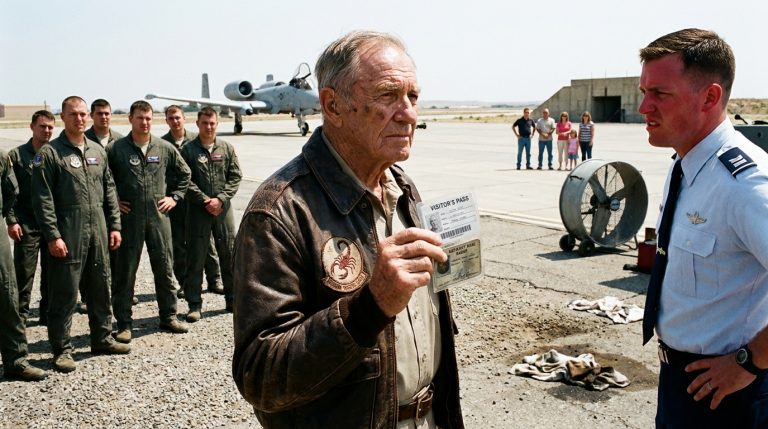
The air in the reserved section tasted of starch and ozone, a clinical cocktail that didn’t belong to the world Arthur Vance remembered. He stood, a thin, weathered island in the middle of a sea of spit-shined boots. His olive-drab jacket, worn to the softness of linen at the elbows, felt like a betrayal of the sharp, modern lines of the cadets practicing their drill in the distance.
A young man, Lieutenant Davies, stepped into Arthur’s peripheral vision. Every movement the boy made was a calculated display of geometry—shoulders back, chin angled to catch the afternoon sun, a uniform so pressed it looked capable of drawing blood.
“Sir, I’m going to have to ask you to move,” Davies said. His voice was a whip-crack, stripped of any deference. “This area is reserved for distinguished guests and active duty officers.”
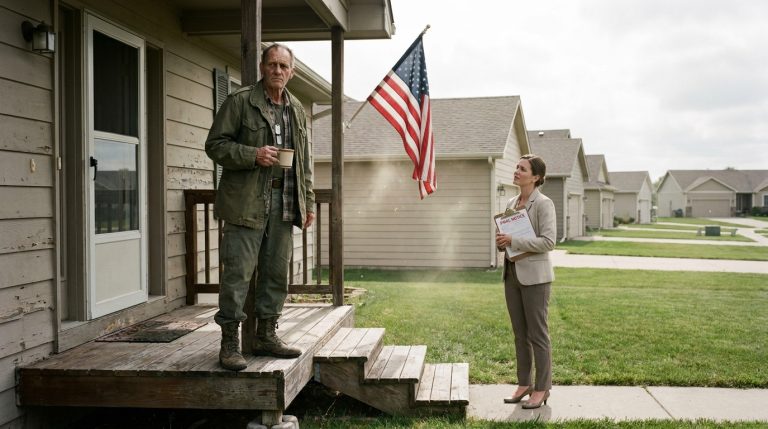
Arthur didn’t flinch. He was busy tracing the faint, frayed edge of the purple heart ribbon pinned to his chest. Under his gnarled thumb, the fabric felt like home. It was the only thing in this landscape of aggressive glass and steel that held any truth.
“I’m just here to see my grandson,” Arthur murmured. The words were small, but they seemed to pull the atmosphere in around them, a quiet gravitational tug that Davies seemed to perceive as an insult.
Davies stepped closer, his gaze drifting over Arthur’s chest. He didn’t see a human being; he saw a violation of protocol. He stared at the bronze star, its surface dull and lacking the sharp, machined luster of the modern decorations on his own chest. His eyes narrowed, the arrogance of the untested hardening his features. “We have regulations about the unauthorized wearing of military uniforms, old-timer. Stolen valor is a serious offense.”
Arthur’s hand moved instinctively to the metal. The touch was a spark. Suddenly, the parade ground didn’t exist. The scent of cut grass was replaced by the suffocating, metallic tang of pine needles and damp, frozen earth. He felt the phantom weight of a man slung over his shoulder—Captain Thompson—his breath ragged and warm against Arthur’s neck, whispering promises of medals that would never be recorded in any ledger.
Davies reached out, his gloved finger jabbing toward the bronze star. “Let me see that.”
The moment the younger man’s finger touched the cold metal, Arthur’s hand shot out. His grip was shocking—a band of weathered steel clamping onto the lieutenant’s wrist. For a split second, the polished, controlled exterior of the base vanished, and in Arthur’s pale blue eyes, Davies saw something primitive, a flicker of a frozen forest that no one had ever walked out of.
“I would ask you not to touch them,” Arthur said. The quiet in his voice was the quiet of a mountain before an avalanche.
Davies stumbled back, his face flushing a violent, humiliated red, his hand darting to his radio. It was a mistake—a frantic attempt to reclaim a dignity that had already been dismantled. And then, standing near the edge of the deis, Arthur saw the General turning, his brow furrowing as he caught sight of the old man’s face.
The recognition sparked in the General’s eyes—a devastating, silent collision of four decades of memories—and Arthur realized that the secret he had carried since the ice was about to be dragged into the light, whether he wanted it there or not.
CHAPTER 2: The Geometry of Regret
The silence on the dais was not empty; it was a physical weight, thick as the frozen fog of a memory Arthur Vance hadn’t visited in decades. Lieutenant Davies stood motionless, his hand still hovering near his radio as if it were a talisman that had suddenly lost all its magic. He was caught in the geometry of his own making, his eyes darting between the four-star general and the frail, olive-drab ghost standing before him.
General Thompson didn’t look at Davies. He didn’t look at the assembled officers who were beginning to shift, their polished boots clicking nervously against the concrete. The General’s gaze was anchored entirely on Arthur, searching the deep, unblinking blue of his eyes for the young medic who had hauled him through the killing fields of a nameless, frozen hell.
“Arty,” Thompson breathed again, the name a jagged stone in his throat.
Arthur felt the sudden, sharp pull of the past. It wasn’t a choice; it was a sensory reflex. He didn’t see the gleaming parade ground or the rows of pristine, hopeful cadets. He smelled the biting, metallic sting of ozone—the same ozone that had preceded the flash in the forest forty years ago. He felt the phantom pressure of the air thinning, the way the silence of the trees had been replaced by a low, vibrating hum that made the teeth ache. It was a memory that bypassed his conscious mind, dragging his pulse into a rhythm that matched a battlefield long since erased from every official map.
His hand drifted upward, fingers brushing the rough, frayed wool of his collar. The texture brought him back, but only partially. He was straddling two worlds: the sun-drenched, manicured lawn of a base that celebrated the future, and the cold, subterranean darkness of a history that had been sealed, scrubbed, and classified into non-existence.
“It wasn’t a place we were supposed to be,” Arthur repeated softly, his voice cutting through the General’s reverie.
Thompson’s eyes flickered. He knew. He looked at the tarnished bronze star on Arthur’s chest—the decoration for an act that, according to official records, never happened. He looked at the purple heart, a badge of a sacrifice that was supposed to have been buried with the unit itself. The General’s shoulders, usually braced with the iron-clad posture of a man who commanded thousands, sagged almost imperceptibly.
Davies, finally finding his voice, stepped forward, but his stride lacked the arrogant precision of moments ago. His steps were hesitant, clumsy. “General? Sir, I… I don’t understand. I was just following procedure.”
The General turned. The transition was instantaneous. The soft, haunted look in his eyes vanished, replaced by a cold, searing intensity that made the surrounding officers recoil. He looked at Davies not as a subordinate, but as a symptom of a systemic blindness.
“Procedure,” Thompson repeated, the word sounding like a curse. He took a single, measured step toward the lieutenant, forcing Davies to retreat. “You speak of procedure as if it were the bedrock of this institution, Lieutenant. You have spent your short career learning how to present yourself as a soldier. You have learned the polish, the stride, the posture. You have perfected the surface.”
Thompson pointed a finger, not at the medal, but at Davies’ own chest. “But you have never looked underneath. You assume that because you cannot see the history, it does not exist. You assume that because a man does not wear the uniform of today, he does not possess the soul of the service.”
Arthur watched the interaction with a detached, weary clarity. He saw the way Thompson was trying to bridge the gap—not just for Davies, but for the legacy he himself was desperate to preserve. But the General was looking at the past through the lens of a career-long struggle to maintain the honor of that memory. Arthur, however, knew the truth of the forest was not something that could be articulated in a speech or restored through a command. It was a burden that had to be carried in silence, or it would lose its meaning entirely.
As the General continued his dressing-down, his voice rising, Arthur felt the familiar, gnawing ache in his shoulder—the place where the shrapnel had torn through his jacket, and later, the place where he had carried Thompson to safety. He noticed Corporal Evans, the kid who had fetched the General, standing near the edge of the dais. The boy’s eyes were wide, fixed on Arthur with an intensity that bordered on reverence.
Evans was staring at the bronze star. He wasn’t seeing a trinket. He was seeing the rust, the wear, the way the metal had been pitted by time and neglect. He was seeing the discrepancy between the modern, machine-stamped medals on the officers nearby and the hand-finished, heavy metal of Arthur’s badge.
Arthur shifted his gaze, intentionally breaking the connection with Evans. He didn’t want the boy to see too much. The secret of the forest was a heavy, cold thing, and he knew that once the mystery began to unpack, it would pull everyone near it into the deep.
“Lieutenant,” the General concluded, his voice dropping to a dangerous, intimate whisper that carried across the entire assembly. “You are relieved of duty for the remainder of the day. You will report to the archives. You will spend the next twenty-four hours reading the redacted files of the 9th Reconnaissance Group. If you can emerge from that room and still feel as though you have the authority to judge a man by the cut of his cloth, then you are not the soldier I trained you to be.”
Davies stood frozen, his face pale, the shame now fully etched into the lines of his mouth. He offered a shaky, reflexive salute, turned on his heel, and walked away—a man who had just realized that the ground beneath his feet was not nearly as solid as he had believed.
The General took a deep breath, the anger draining from his posture, replaced by a profound, hollow exhaustion. He turned back to Arthur, his expression shifting into one of hesitant, quiet vulnerability. “Arty,” he started, his hand reaching out as if to touch Arthur’s arm, then pulling back. “How did you survive? After the evacuation… the report said the entire sector was leveled.”
Arthur looked past him, toward the parade ground where the cadets were beginning to reform their lines. He didn’t answer. He couldn’t. Not here, and not while the ghosts were still hovering in the corner of his vision, smelling of ozone and pine needles.
Instead, he pointed toward the bleachers where a young man—his grandson—was currently trying to locate him in the crowd. “James is looking for me, Tommy. Let’s not keep the future waiting.”
CHAPTER 3: The Unraveling Thread
The dais felt suddenly exposed, the space between the front row seating and the regimental colonels stretching into an immense, unbridgeable distance. General Thompson did not immediately turn away from Arthur. He lingered, his presence a shield against the curious eyes of the junior officers who were still reeling from his outburst. He was a man holding back a tide, his jaw set with the kind of rigid resolve that usually preceded a tactical deployment.
“They don’t know, Arty,” Thompson murmured, his voice barely audible over the distant, rhythmic thrum of the base’s public address system preparing for the ceremony. “They think it’s just old medals and ghost stories. They have no idea what it cost to keep the world spinning.”
Arthur shifted his weight. His old boots, polished but showing the deep, crisscrossing cracks of years of service, felt heavy. He looked at the General—not the four-star commander, but the boy he had dragged through the frozen hell of the 9th Reconnaissance Group’s final mission. “They shouldn’t have to know, Tommy. That was the agreement. That was the whole point of the silence.”
“The silence is rotting,” Thompson countered, a dark edge creeping into his tone. “Davies was just the first. People are starting to ask questions about the anomalies in the archives. When the records don’t match the reality, men like him get curious. And curiosity in this place is a dangerous contagion.”
Arthur looked away, his gaze drifting to the parade ground. The sky had turned a bruised, heavy grey. The air grew still, the kind of absolute, stifling quiet that often preceded a storm. It felt uncannily like the stillness in that forest, right before the hum started—the sound of something far larger and far more volatile than a patrol of men.
“I didn’t come here to start a fire,” Arthur said, his voice flat. “I came to see my grandson. James doesn’t know. Nobody knows. If you start pulling at these threads, you won’t just unravel my service. You’ll dismantle the foundation of everything you’ve spent forty years defending.”
“It’s already unraveling,” Thompson snapped, though he quickly lowered his voice, glancing at the surrounding colonels who were pretending to be preoccupied with their tablets. “I have a situation, Arty. A breach in the secure sector. They’re finding things—artifacts, technical schematics that don’t belong to any known program. My staff thinks it’s some kind of rogue operation, but I know better. It’s what we left behind.”
Arthur felt a cold prickle of dread crawl up his spine. He had spent decades believing that the secret was buried deep enough, encased in the frozen permafrost of a land that time had forgotten. But the General’s eyes were wide, bloodshot with the strain of a man who had been losing sleep to shadows.
“The resonance,” Arthur whispered, a realization hitting him with the force of a physical blow. “You’re saying it’s active?”
Thompson didn’t answer with words. He simply nodded, his face turning an ashen, sickly shade.
The atmosphere shifted. The ceremony, the graduation, the pomp and circumstance—it all felt like a fragile shell covering a tectonic instability. Arthur looked at the assembled officers. They were children, playing with the veneer of power, oblivious to the fact that they were standing on a powder keg.
“If it’s active, Tommy, you don’t call the MPs,” Arthur said, his voice suddenly sharp, commanding. “You don’t call the Pentagon. You seal it. You treat it like a contagion. You don’t know what you’re dealing with.”
“I know exactly what I’m dealing with,” the General retorted, his composure fracturing. “I’m dealing with the reason I have a permanent limp and the reason you never received the commendation you earned. I’m dealing with the end of the world, Arty, and it’s waking up.”
The sudden realization—that the “decoy” of his stolen valor was actually the only thing keeping the authorities from digging into the true, horrific nature of their mission—hit Arthur with the force of a wrecking ball. He had let Davies insult him. He had played the part of the confused, aging veteran because it kept the attention away from the real questions. But the General’s panic meant that the ruse was failing.
A young officer—an aide—approached the dais, looking harried. He clutched a folder to his chest, his eyes darting between the General and the old man in the faded uniform. “General, sir. Urgent notification from the subterranean secure facility. The seismic readings… they’re spiking again. The containment field is oscillating.”
Thompson’s hand trembled. He looked at Arthur, a silent plea for guidance that spanned the gap of forty years.
Arthur looked at the folder, then at the sky, which seemed to be darkening in real-time. He knew what that oscillation meant. It wasn’t a mechanical failure. It was a response.
“Get your men out of the sector,” Arthur commanded, stepping forward, his voice losing every trace of age and frailty. He was no longer the grandfather at a graduation; he was the medic of the 9th, the man who had walked into the fire. “And clear the parade ground. Now. If that field collapses, the sound alone will shatter every window in this zip code.”
The aide stared at him, bewildered by the tone, then looked to the General for confirmation. Thompson didn’t hesitate.
“You heard the man!” the General roared, his voice booming across the lawn. “Clear the field! Execute Protocol Zero-Nine! Now!”
The orderly chaos that followed was a violent, jarring contrast to the morning’s order. Officers scrambled, the orderly lines of cadets broke into a disjointed rush, and the sound of klaxons began to wail in the distance—a deep, rhythmic thrumming that Arthur felt in his marrow.
He didn’t run. He stood still as the world dissolved around him, the Faded Textures of his quiet life stripped away, leaving only the rusted, jagged reality of the secret he had sworn to keep. He looked at the General, who was watching him with a mixture of terror and hope.
“We have to go back, don’t we?” Thompson asked.
Arthur reached out, his hand finding the edge of the bronze star, his fingers brushing against the cold, unyielding metal. “We never really left, Tommy. We just waited for the silence to end.”
CHAPTER 4: The Echo Fades
The silence that followed the shutdown of the subterranean facility was heavier than the noise. Arthur Vance stood motionless, his hand still anchored to the tarnished bronze star on his chest. Beside him, General Thompson’s chest heaved, his face slick with sweat, the mask of the four-star commander completely stripped away to reveal the terrified young captain he had been forty years ago.
Around them, the parade ground was a tableau of frozen movement. Cadets were scattered in their flight, caught in mid-stride, their faces masks of confusion and lingering adrenaline. The massive, subterranean hum that had been vibrating the very air—a sound that Arthur knew was the resonance of the gate they had struggled to seal—was gone.
“Is it…” Thompson’s voice cracked. He couldn’t finish the sentence. He looked toward the secure sector entrance, where a plume of white, icy mist was venting from the ventilation shafts.
“It’s suppressed,” Arthur said, his voice steady, though he felt the bone-deep ache of the effort. He turned to the General. “It’s not gone. It was never gone. It’s just… contained. The seal held, Tommy. It held because the logic of the threshold hasn’t changed. It requires a specific frequency to trigger. My presence, and the proximity of the original artifacts, acted as a dampener. It didn’t want to wake; it wanted to return to equilibrium.”
Arthur stepped away from the General. He felt the weight of every year in his joints, but he moved with a sudden, sharp purpose. He walked toward the edge of the dais, his gaze scanning the crowd until he found his grandson, James. The boy was staring at him, not with the confusion of the other cadets, but with a look of dawning, horrified comprehension. James had seen the shift—the way the General had deferred to an old man in a faded, olive-drab jacket.
Arthur reached into his pocket and pulled out a small, heavy piece of metal—not a medal, but a piece of the original shielding they had pulled from the forest floor decades ago. It was dull, rusted, and innocuous to anyone who didn’t know what it truly was. He tucked it firmly back into his inner pocket, the Symbolic Closure of his long, hidden struggle. The object that had caused the war in his youth would remain buried, not in the ground, but in the silence of his own pockets.
General Thompson followed him. The other officers had retreated to the perimeter, leaving the two of them in a pocket of isolated quiet. The General looked at Arthur, the terror receding to leave behind a profound, hollow grief. “They’ll ask questions, Arty. The seismic logs, the evacuation of the sector… the Pentagon will want to know why a four-star General halted a graduation for a ‘ghost’.”
Arthur smiled, a thin, tired expression that didn’t reach his eyes. “Let them ask. Tell them it was a drill. Tell them it was a calibration error in the sensor arrays. You’ve spent forty years building a life out of secrets, Tommy. One more won’t break you.”
“And you?” Thompson whispered. “You can’t just go back to being a civilian. Not after this.”
“I was never anything else,” Arthur replied. He felt the tension in his shoulder loosen, the phantom weight of the past finally settling into something he could carry without bleeding. “I was a man who did what was necessary, and then I was a man who forgot how to live any other way. But that’s over. James is the future of this army. Let him have his graduation. Let him believe in the honor of the uniform, even if the history of it is as broken as mine.”
The General nodded, his expression softening into a deep, quiet respect. He didn’t offer a salute this time. Instead, he reached out and took Arthur’s hand—a grip that was firm, human, and devoid of military hierarchy. It was the grip of two survivors at the end of a long, dark road.
“Thank you, Arty,” Thompson said.
“Don’t thank me,” Arthur said, pulling his hand away gently. “Just keep the gate closed.”
Arthur walked down the steps of the dais, his boots scuffing on the pristine grass. He walked past Lieutenant Davies, who was standing at the edge of the assembly, his face pale and eyes cast downward. He didn’t acknowledge the boy, nor did he offer a reprimand. The lieutenant had seen the threshold; he had seen the reality beneath the surface. That was lesson enough.
Arthur reached his grandson, James. The young man stood straight, his own uniform crisp and perfect, his eyes wide as he looked at his grandfather. There were questions in James’ eyes—a lifetime of questions—but Arthur shook his head slowly.
“It’s a beautiful day for a graduation, isn’t it, James?” Arthur said, his voice soft, almost melodic.
James hesitated, then nodded, a faint smile touching his lips. “It is, Grandfather. It really is.”
Arthur looked back toward the dais one final time. The General was standing alone, watching them, his silhouette sharp against the clearing sky. Arthur turned away, putting his arm around his grandson’s shoulder. They walked together toward the parking lot, away from the base, away from the secret, and into the quiet, mundane sunlight of a world that would never know how close it had come to the edge. The rust of the past was finally settling, leaving behind only the steady, rhythmic sound of their footsteps on the dry earth.