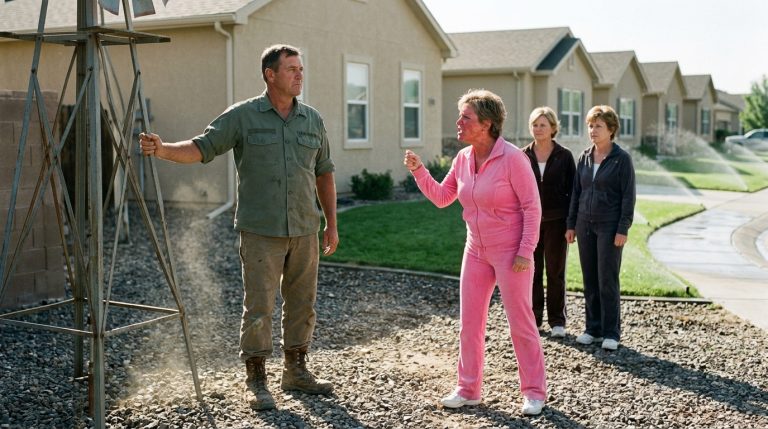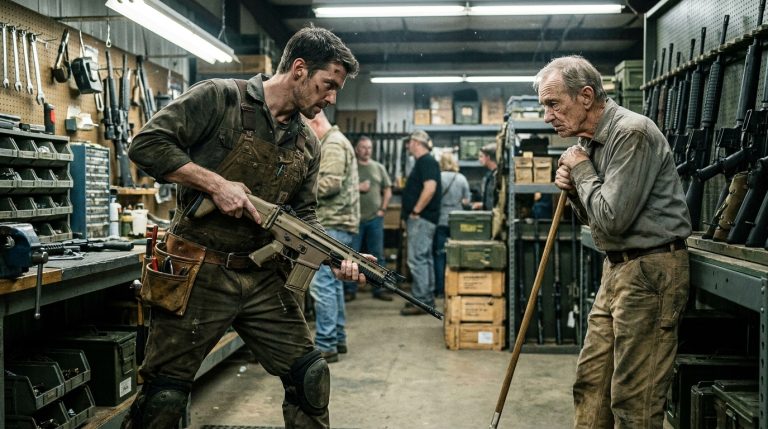
The Tactical Execution of Queen Bethany: A Hardboiled Chronicle of Suburban Counter-Intelligence
CHAPTER 1: THE MASTER KEY PROTOCOL
The deadbolt didn’t yield; the doorframe did. Pine wood sheared with a sound like a rifle shot at 4:17 a.m., spraying jagged splinters across the entry rug.
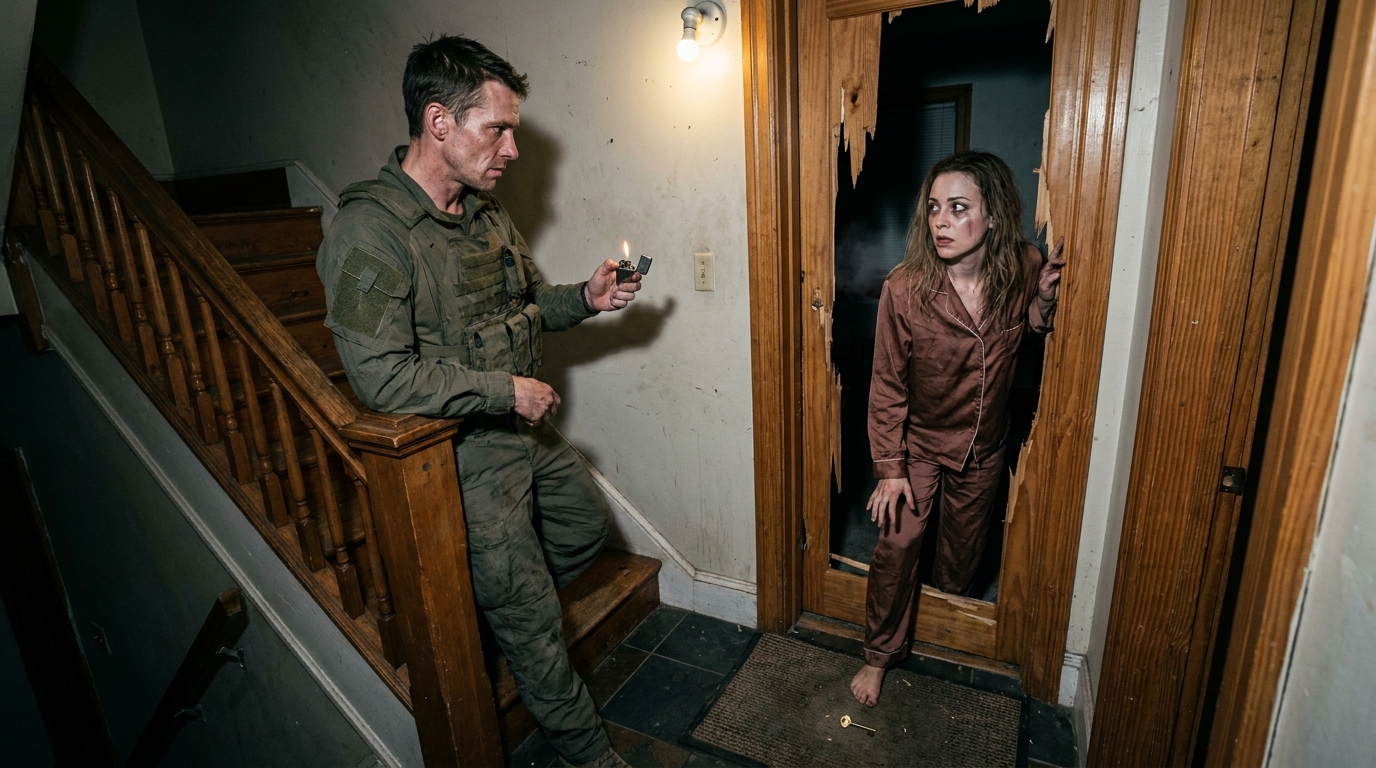
I didn’t reach for a sidearm. My thumb found the brass casing of my olive-drab Zippo, flicking the wheel once. Clack-snap. The small flame lit the hallway just as a silk-clad foot kicked the door the rest of the way off its hinges.
“I have master key authority!”
Bethany Crowe stood in the gap, breath smelling of cheap gin and synthetic vanilla. She wore silk pajamas the color of dried liver. Her hand trembled, clutching a brass skeleton key like a weapon.
“Your filthy mutts woke the entire street,” she spat, her voice pitched at a screech. “I am done with you military types acting like you’re above the rules, soldier boy!”
She took one step over the threshold. Bad mistake.
Ninety pounds of scarred Belgian Malinois muscle hit her chest before her heel touched the floor. Rex didn’t bark. He didn’t growl. He simply occupied her center of gravity, taking her down onto the hardwood with a dull, heavy thud. Luna pinned her left arm, ninety-two pounds of pressure locking the woman’s wrist to the floorboards without puncturing skin.
The brass key clattered against the entryway tile.
“Get them off me!” Bethany shrieked, her voice choking out as Rex placed one massive paw squarely over her sternum. Her eyes rolled back, pupils blown wide in the dim hall light. “They’re wild animals! I’ll have them destroyed!”
“They’re working,” I said. My voice was low, flat, stripped of pitch. I didn’t move from the base of the stairs. “You breached a deadbolted entrance at zero-four-hundred hours. You’re lucky they’re trained for restraint.”
I reached down, picking up the key she’d dropped. Cold brass. Cheap hardware-store duplicate. No serial numbers.
“This isn’t a master key, Bethany,” I said, thumbing the Zippo open and closed. Clack. “It’s a blank filed down to force a tumbler. That’s breaking and entering. Third-degree felony.”
“This is my neighborhood!” She choked against Rex’s chest weight, her manicured nails digging uselessly into his harness. Her white BMW sat idling in my driveway, headlights cutting through the rain outside, casting long, cage-like shadows across my ceiling. “You don’t belong here! Your kind brings down the whole street!”
“My kind?”
“You’re broken!” she hissed, saliva catching in the corners of her mouth. “Unstable! You bring your war back here to my community!”
I leaned down, stopping three inches from her face. I didn’t look at her eyes; I looked at the pulse hammering violently in the side of her neck.
“Rex, back,” I murmured.
The dog stepped off instantly, sitting on my left heel, ears pinned back, single eye fixed on her throat. Luna stayed low, low-frequency hum vibrating in her ribs.
Bethany scrambled backward on her elbows, scraping her silk pants against the splintered wood of the doorframe. She reached for her cell phone, dropping it twice before pulling herself upright against the porch railing.
“You’ll have the notice by noon,” she rasped, wiping her smeared mascara with the back of her wrist. “Two hundred dollars a day until those attack dogs are off my property!”
“Your property ends at the curb,” I said, pointing the small 4K lens hidden in the doorbell housing straight at her face. The green LED flickered twice. “And this entire frame just uploaded to a cloud server in Virginia.”
She froze, her hand hovering over the railing. For a fraction of a second, the entitlement vanished, replaced by a cold, calculating flicker of absolute panic. She looked at the camera, then down at the splintered jamb, then back at me.
“You think you’re smart, Thornton,” she whispered, her voice dropping into a raspy, flat tone that sounded nothing like her usual suburban shrillness. “You think some video saves you? Ask the Navy commander who lived here before you. See how long his pension lasted.”
She turned and marched down the wet steps, her heels clicking against the concrete like small hammers.
I didn’t watch her drive off. I knelt down, running my hand over Rex’s ribs, feeling the violent, rhythmic pounding of his heart slowing down. On the floorboards, right where her purse had hit the wall, lay a small folded piece of paper—a printout marked Willowbrook Enhancement Solutions.
My thumb clicked the Zippo. Clack.
CHAPTER 2: COLD REVENUE PAPER TRAILS
The cold mist didn’t stop at the porch. It crept through the shattered oak frame, pooling on the entryway tile around my bare feet.
I stayed on one knee for five long seconds. In my right hand, the damp paper marked Willowbrook Enhancement Solutions bled blue ink into my knuckles. In my left, the filed blank brass key felt heavy, cheap, and entirely illegal.
Rex sat beside me, his ribcage expanding against my forearm in slow, steady surges. His breathing had dropped back to baseline, but his ears stayed pitched toward the driveway, tracking the fading hum of Bethany’s white BMW as it turned off Elm Street.
“Ezra?”
Carmen stood at the top of the stairs. Her voice was low, barely a rasp above the wind cutting through the broken door. She wore her hospital scrubs—the faded dark blue ones she wore for double shifts in the VA trauma unit. Her fingers were hooked tight into the banister, knuckles white.
“Stay up there,” I said. My voice was flat, anchored low in my chest. “Broken glass on the runner.”
“I heard kicking,” she said. She didn’t stay up there. She came down three steps, her bare feet silent on the carpet, stopping just above the debris field. She looked at the door jamb—the splintered pine hanging by a single strip of painted casing—and then at the paper in my hand. “Was that her?”
“She had a blank,” I said. I stood up, joints cracking in the quiet house. “Filed down to force the tumbler. She called it master key authority.”
Carmen didn’t gasp. She’d spent twelve years taking shrapnel out of kids from Fort Campbell; panic wasn’t in her wiring. Instead, her mouth set into a thin, white line.
“She went past the threshold,” Carmen said.
“Rex took her down. No teeth, just weight. She dropped this.” I held out the damp piece of paper.
Carmen stepped over the glass, her scrub pants rustling. She took the slip, holding it under the yellow overhead light. The paper was heavy stock, but the margins were off by three millimeters—a classic alignment error from a budget inkjet printer trying to emulate professional letterhead.
WILLOWBROOK ENHANCEMENT SOLUTIONS
Notice of Emergency Maintenance Assessment & Asset Preservation Fee
Account: 408-B (Thornton)
Violation: Unauthorized Canines / Structural Alteration (PTSD Barrier)
Penalty: $200.00 / Daily
Remit To: Direct Processing – Operations Division
“Look at the footers,” Carmen whispered, pointing a neat, short-nailed finger at the bottom corner.
In faint gray text, half-cutoff by the paper border, ran a template string: Doc_ID: Vanguard Protocol File 4_Rev2.docx.
“That’s not a legal HOA invoice,” she said. “The HOA for Willowbrook is registered as Willowbrook Estates Homeowners Association Inc. with the secretary of state. I looked up the corporate filings when we signed the mortgage. I’ve never heard of ‘Enhancement Solutions’.”
“Neither has the state,” I said.
I walked over to the kitchen island, set the filed key down on the quartz counter, and flipped open my ruggedized Toughbook. The screen flickered to life, throwing harsh blue light across the dark kitchen. Outside, the rain picked up, rattling against the windowpanes like thrown gravel.
My fingers flew over the keys, pulling up the local property registry and the state’s division of corporations database.
“She’s using Microsoft Word templates to print her own money,” I said, my thumb flicking the Zippo open and shut. Clack-snap. The metallic click grounded the room. “No corporate tax ID. No registered agent on file for this ‘Enhancement Solutions’ entity. She’s billing residents under a phantom company name and collecting to a private account.”
“Ezra, look at the timestamp on that paper,” Carmen said, leaning over my shoulder. Her hair smelled of cold coffee and hospital antiseptic. “It says issued at 03:30 a.m. She printed this an hour ago, drove over here with a fake key, and tried to slip it into our door while we were sleeping.”
“She didn’t want to slip it in,” I said, pointing to the monitor. “She wanted a confrontation. She wanted Rex to bark. She wanted a noise violation on record before the city offices open at eight.”
I pulled up the primary security console feed. Eight camera thumbnails filled the grid, high-definition night vision rendering the front yard in crisp, desaturated green.
I dragged the timeline slider back to 04:12 a.m.
On the screen, Bethany’s BMW glided to a stop at the curb. The headlights shut off instantly, but the engine stayed idling. She stepped out, carrying her pink leather notebook and a heavy black flashlight. But she wasn’t alone.
In the passenger seat, illuminated only by the glow of a cell phone screen, sat a man in a dark suit. He didn’t get out. He held a tablet up against the side window, pointing it straight at my front porch.
“Who is that?” Carmen asked, her voice dropping an octave.
“Not a neighbor,” I said. I zoomed in on the passenger side mirror. Reflected in the tiny glass surface was a partial logo printed on a magnetic door decal—a stylized crest above two words: Pinnacle Property.
I stared at the screen. The name didn’t trigger an immediate hit in my memory, but the tactical posture was obvious. Bethany wasn’t executing a solo Karen raid; she was taking direction. The man in the car was watching the breach like an evaluator testing a defensive line.
“She’s collecting data,” I murmured, my eyes fixed on the passenger’s tablet glow. “Every time she pushes, someone else measures how we react.”
“We call the police,” Carmen said, reaching for her phone on the charger. “We have the broken door, the filed key, and the video.”
“No,” I said, placing my hand flat over her screen. Her skin was freezing. “We call the police, Officer Martinez comes out, takes a report for a civil dispute between an HOA president and a homeowner, and Bethany hands him a fake paper showing she had ‘inspection rights.’ It stalls in a deputy’s inbox for three weeks while she escalates.”
“So what’s the move?”
“We build the box first,” I said. “Then we drop the lid.”
I stood up, walked to the hallway closet, and pulled out a tactical field kit—a heavy black Pelican case containing four high-gain directional microphones and two auxiliary infrared illuminators.
“I’m wiring the perimeter,” I said, snapping the latches open. “If she comes back before sunrise, I want every word she whispers to that suit recorded on three separate channels.”
“Maya and Sophia wake up in two hours for school,” Carmen said, her voice shaking slightly for the first time. “They can’t see the door like this, Ezra. They’ll think we’re in danger.”
I looked at the shattered door jamb, the jagged wood hanging like exposed bone, then down at Rex, who was quietly licking a drop of rain off his paw.
“They aren’t in danger,” I said, my voice cold, hard, and absolutely certain. “Because by the time the sun comes up, Bethany Crowe isn’t going to be enforcing rules. She’s going to be trying to figure out how we got her financial records.”
I grabbed a cordless drill and a three-inch steel strike plate from my workbench. The first screw bit into the solid wall stud with a high-pitched whine that cut through the silence of the rainy morning.
CHAPTER 3: THE FINANCIAL DECOY
The cordless drill torque-clutched with a harsh, metallic rattle. The long steel screw sank flush into the solid wall stud, pulling the splintered casing back into alignment with a groaning sigh of stressed timber.
I didn’t back off. I drove two more three-inch fasteners straight through the reinforced strike plate, anchoring the frame deep into the house’s skeletal framing. The door wasn’t pretty, but it would take a battering ram to clear it now.
Rex lay three feet away, his chin resting on his crossed paws, tracking every turn of the bit. He knew the difference between construction noise and tactical breaching; his pulse didn’t even flicker.
“Hold the bit,” I murmured, backing the drill down.
I wiped cold metallic grease off my thumb onto my jeans. In the living room, the grandfather clock chimed 5:15 a.m. The rain had settled into a steady, gray sheet against the bay window, blurring the streetlights into smeared yellow dots.
Carmen came out of the kitchen carrying two ceramic mugs. The steam smelled of chicory and dark roast—strong enough to strip paint. She set my mug on the hall table, her eyes tracking the raw steel heads now embedded in the entry frame.
“Maya’s awake,” she said quietly. “She heard the drill.”
“What did you tell her?”
“Told her a hinge backed out from the damp weather.” Carmen took a slow sip, her shoulders braced tight. “She didn’t buy it, Ezra. She saw the glass in the trash.”
“I’ll talk to her before the bus comes,” I said.
“Talk to her with facts, not operational double-talk,” Carmen said, her thumb tracing the rim of her cup. Her left hand had a micro-tremor—the subtle involuntary twitch that only showed up after a night of high-level stress. “If this woman is coming onto our porch with filed keys, my daughters need to know why.”
“They’ll know.” I picked up the paper marked Willowbrook Enhancement Solutions from the counter. The blue ink had dried into a faded, smudged streak. “First, I follow the money.”
“You think she’s running a shell?”
“I know she’s running a shell,” I said, thumbing my brass Zippo. Clack-snap. “The question is whether she’s smart enough to hide the routing numbers.”
I sat back down at the Toughbook, pulling up the state’s judicial portal and the county clerk’s public records vault.
For three hours, as the sky shifted from pitch black to a bruised, wet slate gray, I dug into the paper trail of Willowbrook Estates. The house was quiet except for the hum of the refrigerator and the rhythmic click of my mechanical keyboard.
At 7:40 a.m., Maya and Sophia came down the stairs in their school uniforms, backpack straps pulled tight. Maya stopped at the bottom step, her eyes dropping immediately to the raw steel screws in the jamb. She didn’t ask. She just looked at me, her mouth setting into the exact same stubborn line as her mother’s.
“Dad?” she said.
“Door’s secure, kiddo,” I said, keeping my voice level, grounded. “An uninvited guest tried the latch last night. It won’t happen again.”
Sophia shifted her weight, holding Luna’s harness handle. “Was it the blonde lady in the BMW?”
“We’re handling it,” I said, standing up to kiss them both on the forehead. “Rex is riding along for the bus drop. Carmen, take the truck today.”
Once the front door closed behind them and the garage door lowered, I turned back to the dual monitors. The data was finally sorting itself into a clear structure.
What I found in the clerk’s digital archive wasn’t just administrative sloppiness; it was a full structural collapse of authority.
“Carmen, get over here,” I said.
She walked in from the laundry room, folding a towel. “Find something?”
“Layer one is totally rotted out,” I said, pointing the tip of a pen at the screen. “Look at the board filing dates. The original Willowbrook Estates Homeowners Association Inc. was chartered twelve years ago by the developer. According to the state registry, the corporate entity failed to file its annual public disclosures three years ago.”
“Failed to file?” Carmen leaned close, her eyes scanning the official state seal stamped on the PDF document. “What does that mean?”
“It means the corporate entity was administratively dissolved by the Secretary of State thirty-six months ago,” I said, tapping the glass. “Legally, there is no HOA. The non-profit entity doesn’t exist. It has no legal standing to issue fines, hold elections, file liens, or enforce covenants.”
Carmen stared at the document. “Then how has she been collecting monthly dues from sixty-four houses?”
“She changed the payment instructions,” I said, opening a second window containing a scanned copy of a canceled check from our own bank archives. “When we moved in six months ago, the welcome packet directed all dues to be made out to Willowbrook Enhancement Solutions—not the dissolved non-profit. She set up a dba account under her personal name at First National Bank.”
“She’s routing neighborhood funds directly into her personal account,” Carmen said, her voice barely a whisper as the magnitude of it hit her. “She’s stealing.”
“She’s embezzling,” I corrected flatly. “Every fine, every architectural review fee, every monthly assessment for the past three years has been going straight into a private account. I cross-referenced the county property tax records for her McMansion on Elm Street. She was served a notice of default on her primary mortgage fourteen months ago. Two months later, the default was cured with a lump-sum payment of twelve thousand dollars.”
“Stolen from the maintenance fund,” Carmen said, her hand dropping onto my shoulder, her grip tightening until it hurt. “The light repairs, the unpaved common area roads, the broken streetlamps—the money was never spent on the neighborhood. She was paying off her own mortgage.”
“It’s a textbook embezzlement scheme,” I said. “She used the illusion of an active HOA to intimidate people who didn’t know how to check corporate registries.”
I pulled up a fresh spreadsheet, logging the transaction dates, the dissolved filing numbers, and the fake invoice templates. The trap was springing together. With this data, a single call to the state attorney general’s white-collar crime unit would freeze her assets by noon.
It was a clean, decisive win. A complete financial takedown that would strip her authority and put her in handcuffs before the week was out.
I leaned back in my chair, reaching for my Zippo. Clack-snap.
“We’ve got her,” I said. “She’s just a common thief hiding behind a laminated badge.”
Then my phone buzzed on the desk.
It wasn’t a call. It was an automated alert from my primary perimeter camera console.
I clicked the notification. A high-resolution photo popped up on the secondary screen, captured three seconds ago at the corner of our street.
A heavy silver sedan was parked under the oak tree across from our driveway. The driver’s window was rolled down two inches. Sticking out of the gap was a long telephoto lens, aimed straight at our kitchen window.
On the sedan’s front door was a small, clean magnetic plate: Pinnacle Property Investments – Asset Management Division.
I froze, the Zippo flame hovering half an inch from my thumb.
The fake HOA was a fraud, yes. But Bethany wasn’t keeping the stolen money to buy clothes or cars. On the passenger seat of the silver sedan, visible through the digital zoom, lay a manila folder stamped in red ink: Vanguard Protocol File 4 – Target: 408-B Thornton (Eviction Timeline).
Bethany wasn’t the mastermind. She was just the cheap battering ram being paid to clear the block.
CHAPTER 4: TACTICAL ESCALATION
The Zippo flame flickered against my thumb before I snapped the lid shut. Clack.
“Pinnacle Property,” Carmen murmured, her fingers digging deeper into my shoulder as she leaned over the laptop screen. “Ezra, that’s the firm that bought the Martinez place after Bethany drove them out.”
“And the Johnson house,” I said. My voice dropped into the flat, low register I used when clearing rooms down in Helmand. “Six military properties in thirty-six months. All sold at thirty percent below tax assessment during active HOA harassment campaigns.”
“She’s not just stealing dues,” Carmen said. Her micro-tremor stopped completely, replaced by the rigid, stone-cold composure she brought to ER trauma resuscitations. “She’s clearing the block for them.”
“It’s a gentrification pipeline,” I said. “Drive out service members using targeted nuisance complaints, depress the appraised value, force a fast cash closing to Pinnacle, and flip the house to a corporate buyer six months later. Vanguard Protocol File 4 isn’t an HOA template. It’s a target acquisition ledger.”
Outside, the silver sedan put force to its rear axle, tires humming over the wet asphalt as it pulled away from the oak tree. It didn’t speed. It cruised at a steady fifteen miles per hour, heading toward Elm Street.
“What’s the cost, Ezra?” Carmen asked softly.
I looked at the kitchen window—the pane now dirty from rain, showing our reflected faces framed against the dark yard. “The cost is we can’t just hand the bank records to the local sheriff. If we trigger a local municipal investigation now, Bethany gets tipped off by her friends on the council, Pinnacle scrubs their paper trail, and the corporate entity vanishes into three Delaware holding companies.”
“So we go state?”
“Federal,” I said. “Housing discrimination under the Servicemembers Civil Relief Act, combined with wire fraud and interstate real estate conspiracy. But federal agents need more than a dissolved non-profit and an idle silver sedan. They need active, documented commission of a crime in progress.”
“And how do we give them that?”
“We let her strike again,” I said.
Carmen didn’t like the answer. Her jaw set tight, but she didn’t argue. She knew the mechanics of a sting as well as I did: you don’t cut the line while the shark is still biting the bait.
By 02:00 p.m., the sky had turned a dark, oily purple. The rain had backed off to a thick drizzle that clung to the siding. I spent two hours in the backyard with Rex and Luna, running perimeter checks around the property fence.
That was when the motion sensors on the north fence line tripped.
Not a dog. Not a squirrel. A sharp, localized trip on sensor four—right near the garden shed behind the garage.
I didn’t yell. I signaled Rex to heel with two fingers against my thigh. Luna stayed low on my left flank as we rounded the corner of the tool shed, boots squelching in the mud.
Bethany Crowe was crouched behind my lawnmower staging area.
She wasn’t in her silk pajamas. She wore a heavy black windbreaker, oversized yellow rubber gloves, and mud-smeared rain boots. She was frantically shoving heavy grey metal boxes underneath my timber woodpile.
“Step back from the stack,” I said.
She jumped, her head cracking against the overhang of the shed roof. Her designer helmet hair was soaked, strands plastered across her forehead like greasy strings. In her right hand, she held a pair of bolt cutters. On the grass beside her sat a canvas duffel bag, gaping open.
“You’re trespassing, Bethany,” I said, holding the Zippo in my palm. Clack-snap.
“This… this is an emergency inspection!” she gasped, her breath coming in ragged, high-pitched wheezes. She scrambled up against the woodpile, her gloved hands clutching a clipboard against her chest. “I have master authority under the Willowbrook Enhancement Solutions emergency safety charter!”
“You’re on private property behind a closed gate,” I said, taking two deliberate steps forward. “And your charter is an expired PDF template.”
Rex stepped into the light of the shed’s floodlamp, his ears pinned flat, his single working eye locked onto her neck.
Bethany’s eyes darted down to the duffel bag she’d dropped. Inside lay three heavy olive-drab metal canisters—surplus 50-caliber ammunition boxes—along with two mechanical assemblies from an old tractor engine.
I picked up one of the boxes. The paint was fresh, but right across the stenciled military lettering was a bright white sticker: $14.99 – Surplus World, Route 9.
She hadn’t even peeled off the price tags.
“You brought surplus ammo cans onto my property,” I said, my thumb rubbing the raw, sticky residue of the price sticker. “To plant them behind my shed.”
“They’re evidence!” she shrieked, her voice cracking into hysteria as she backed herself flat against the wet cedar fencing. “You’re storing illegal ordnance! You’re an unstable veteran threats-assessment hazard! The neighbors have a right to be safe from military stockpiles!”
“You bought these on Route 9 two hours ago, Bethany,” I said flatly, pointing to the bar code. “And you paid cash, but you left the store receipt sticking out of your windbreaker pocket.”
Her hand flew to her jacket, her fingers catching the corner of the white register slip hanging from her zipper. Panic—pure, raw, unvarnished terror—flashed across her eyes.
“You think you’re so smart!” she spat, her teeth clacking together from the cold. “You think you can come in here with your dogs and ruin everything I’ve built? Pinnacle has thirty properties in this county! You’re nothing! You’re just a line item on an eviction timeline!”
“There it is,” I said quietly. “Pinnacle.”
She froze. Her mouth stayed open, her chest heaving against her windbreaker as the realization hit her. She had spoken the name aloud.
Before she could move, the sharp, red-and-blue strobe of a patrol cruiser lit up the rain through the trees along the side fence. Tires crunched on the wet gravel of my driveway.
Officer Martinez walked around the corner of the garage, his heavy flashlight beam cutting through the gloom. He looked at Bethany crouched in the mud in her yellow rubber gloves, looked at the bolt cutters, looked at the surplus ammo box with the $14.99 price tag in my hand, and then looked at me.
“Mr. Thornton,” Martinez said, his voice exhausted. “We got a call about a prowler.”
“She’s right here, Officer,” I said, handing him the surplus box. “And she brought her own props.”
Bethany didn’t surrender politely. As Martinez pulled her arms behind her back to snap the steel cuffs on her wrists, she twisted against his grip, her heels skidding through the mud, screaming about emergency powers and military conspiracies until her voice went thin and raspy.
When the cruiser pulled away, its lights flashing silently against the wet oak trees, I stood by the open gate, the rain dripping off the brim of my hat.
In my hand, I held the canvas bag she’d left behind. Tucked into the side pocket, underneath a stack of fake violation notices, was a folded white envelope addressed to Pinnacle Property Investments – Legal Division.
Inside was a single typed memo: Target 408-B non-compliant. Requesting escalation to Phase 2 at Tuesday’s board assembly.
I closed my Zippo. Clack.
The preliminary skirmish was over. Tuesday night, she wasn’t just going to stand trial in front of the neighborhood; she was going to bring her handlers into the light.
CHAPTER 5: THE LIVE STREAM TRAP
The rain had cut down to a greasy mist by Tuesday evening, slicking the asphalt in front of the Willowbrook Community Center.
I stood by the rear entry of the hall, my boots resting on the concrete threshold. In my right hand, I carried a heavy, black pelican case housing the broadcast rig; in my left, I held my brass Zippo. Clack-snap. The metallic click sounded sharp against the low rumble of forty idling cars in the parking lot.
“Six angles,” I said, without looking over my shoulder.
Marcus Webb stepped out of the shadow of the brick overhang. He wore a crisp charcoal suit, but his collar was open, his neck scarred from a mortar strike in Fallujah before he took his law degree. He held a tablet displaying six live video feeds.
“All feeds green, Ezra,” Marcus said, his voice a low rasp. “Streaming simultaneously to three cloud mirrors and the public county docket feed. Broadcast latency is under two seconds.”
“And the federal link?”
“Special Agent Smith’s team is mirroring the uncompressed feed directly out of the field office,” Marcus said. His thumb rubbed his raw knuckle—an old nervous habit from his time in the infantry. “They aren’t just watching, Ezra. They’ve got three unmarked sedans parked down Elm Street.”
Inside the hall, fifty folding chairs scraped against the linoleum. The air smelled of damp wool coats, stale pot coffee, and cheap floor wax. Sixty-four homeowners had packed the room, three rows deep, their voices buzzing in a low, agitated hum.
Carmen sat near the front row beside Jennifer Santos. Between them lay three thick, black binders containing the forensic breakdown of Willowbrook Enhancement Solutions—every canceled check, every fake invoice, and the state dissolution decree stamped in red ink.
At 07:14 p.m., the front double doors banged open.
Bethany Crowe entered like a storm front. She out on bail, wearing a sharp cream coat, her blonde hair blown out, her jaw held high. But her eyes were wild—bloodshot, dark circles painted over with thick concealer.
Beside her walked a man in a tailored charcoal suit—the passenger from the silver sedan. He carried a leather briefcase, his face devoid of emotion, eyes scanning the room like a tactical operator assessing exits.
“Good evening, neighbors,” Bethany announced. Her voice boomed over the room’s PA system, shrill and grating. “I am calling this emergency executive session to order.”
She didn’t sit. She walked straight to the podium, slamming a stack of paper onto the wood.
“Before we begin regular business,” she said, pointing a manicured finger straight at me where I leaned against the back wall, “we must address the ongoing security hazard in our neighborhood. We have a resident operating unauthorized security equipment, keeping dangerous, unrestricted combat animals, and spreading malicious lies to undermine this board!”
The room shifted. A few older residents looked back at me, uncertain.
“Ms. Crowe,” Marcus Webb said, stepping forward into the center aisle. He didn’t raise his voice, but the acoustic tile ceiling carried every word. “Before you read from that script, I have a preliminary question for the record.”
“You are out of order!” Bethany shouted, her knuckles going white on the edges of the lectern. “You’re not on the board, Mr. Webb!”
“No,” Marcus said calmly, opening his leather portfolio. “But I represent forty-two property owners in this room. And my question is simple: under what legal authority are you presiding over this assembly?”
Bethany’s mask cracked. She let out a sharp, incredulous laugh. “I am the elected president of the Willowbrook Homeowners Association!”
“The Willowbrook Homeowners Association was administratively dissolved by the Secretary of State thirty-six months ago,” Marcus said. He pulled a sheet from his folder and held it up toward the primary camera lens mounted on the wall beam. “Document ID 881-A. You have no legal charter. You have no bylaws. You are an unvoted private citizen presiding over a non-existent entity.”
A collective murmur rippled through the chairs. Mrs. Patterson in row two stood up, looking around in confusion. “Wait… dissolved? Where have our monthly checks been going?”
“They’ve been going to a private account under the name Willowbrook Enhancement Solutions,” Jennifer Santos called out, standing up and opening her binder. “A dba registered solely to Bethany Crowe. Over forty-seven thousand dollars in community funds have been funneled directly into her personal mortgage payments.”
“Lies!” Bethany shrieked. Her voice hit a fever pitch, cracking against the drywall. “This is a coordinated hit! They’re fabricating documents! They’re military agitators trying to take over our private community!”
She turned frantically to the man in the suit beside her. “Tell them! Show them the legal notice!”
The man in the suit didn’t flinch. He slowly opened his briefcase, removed a single sheet of heavy bond paper, and stepped toward the microphone.
“My name is Richard Vance,” he said, his voice flat, razor-sharp, and entirely unbothered. “I represent Pinnacle Property Investments. While Ms. Crowe’s administrative oversight may contain procedural irregularities, the debt assigned to these properties is real. My client holds master lien options on nineteen homes in this sector under Vanguard Protocol File 4.”
He looked directly at me. No anger in his eyes. Just cold, corporate arithmetic.
“Mr. Thornton,” Vance said, his voice dropping into a quiet threat meant for the microphone. “Your property is currently in default of community covenant assessments totaling fourteen thousand dollars. If this assembly does not ratify the new corporate charter tonight, Pinnacle will execute immediate foreclosure proceedings against your parcel.”
The room went dead silent. The double-bottom had broken. Layer 1—the petty embezzlement—was swept aside. Layer 2 was standing in the center aisle in a three-thousand-dollar suit, holding a corporate foreclosure hammer.
“You don’t hold a master lien, Vance,” I said, stepping away from the wall. My boots clicked against the floorboards.
“I have the filed assignments right here,” Vance said, lifting the paper.
“You have forged assignments,” I said, thumbing my Zippo open. Clack-snap. “Executed through shell companies using an expired HOA as a fraudulent straw buyer. That’s not foreclosure, Vance. That’s wire fraud, mail fraud, and systematic housing discrimination against active and retired military personnel under federal law.”
Vance’s cold posture flickered. For three seconds, his jaw tightened.
“You can’t prove that,” he whispered.
“I don’t have to,” I said. “She did.”
I pointed toward the double doors at the back of the hall.
The heavy steel doors pushed open. Special Agent Smith walked in, flanked by two plainclothes federal agents in navy windbreakers displaying gold letters across the back: FBI.
“Richard Vance, Bethany Crowe,” Agent Smith said, her voice cutting through the hall like a steel blade. “Step away from the podium. Hands where we can see them.”
Bethany let out a strangling sound, dropping her clipboard. “You can’t arrest me! I have emergency authority! I am the president!”
“Ma’am,” Agent Smith said, pulling out a set of steel cuffs. “You aren’t the president of anything. You’re a co-conspirator in a federal indictment.”
As the cuffs clicked home over Vance’s and Bethany’s wrists, the room erupted into cheers and overlapping chatter. Carmen caught my eye from row one, her hand resting over her heart, a quiet, solid smile breaking across her face.
I stood by the broadcast rig, watching the live view counter on my monitor pass seventy thousand viewers.
The trap had sprung. The network was exposed.
CHAPTER 6: CHECKMATE AND RECONSTRUCTION
The heavy steel rear doors of the community hall swung shut behind Special Agent Smith’s team, cutting off the sharp, metallic echo of handcuffs.
Richard Vance didn’t look back. He kept his spine rigid, his three-thousand-dollar suit unwrinkled, but his left hand twitched against the steel restraint—a silent, involuntary micro-action that betrayed the panic swelling underneath his corporate armor. Bethany Crowe sobbed openly, her high heels skidding uselessly across the damp gravel outside as two agents ushered her into the back of an unmarked sedan.
In the hall, the silence lasted for three heartbeats before collapsing into a roar of overlapping voices.
I stood by the tripod, my fingers resting on the pelican case. The live view counter flickered once, settling at fifty-two thousand three hundred viewers before the stream stabilized. Marcus Webb stepped up beside me, closing his leather portfolio with a sharp snap.
“They’re executing search warrants on Pinnacle Property’s regional office right now,” Marcus said, his voice flat, low, and anchored. “Federal marshals frozen every bank account linked to Willowbrook Enhancement Solutions twenty minutes ago.”
“And Vance’s corporate structure?” I asked.
“Layer two is completely exposed,” Marcus said, pointing to the secondary laptop screen where a federal court docket was updating in real time. “Pinnacle wasn’t just acquiring parcels. They used Vanguard Protocol File 4 as a standardized operational playbook across four counties—identifying service members with active VA loans, manufacturing artificial HOA violations through illegitimate entities, inflating default fees, and forcing distressed sales to shell holding companies. It’s an organized racket.”
Carmen walked over from the front row, her steps unhurried. Her face showed the deep, bone-weary exhaustion of a trauma nurse after a twenty-four-hour mass-casualty shift, but her eyes were clear. She reached out, her cool hand sliding into mine, her thumb pressing against my knuckles.
“It’s over, Ezra,” she said softly.
“The breach is sealed,” I said.
The months that followed didn’t move in a dramatic blur; they moved in the steady, methodical cadence of hard-earned justice.
The federal prosecution was surgical. Faced with fifty thousand broadcast witnesses, physical surveillance logs, and six years of unedited digital bank ledgers, Bethany Crowe entered a blind guilty plea to fourteen federal counts, including wire fraud, mail fraud, and criminal conspiracy to violate federal housing protection laws. The federal judge sentenced her to seven years in a medium-security facility, alongside a restitution order that stripped her of every asset she owned, including her gaudy McMansion on Elm Street.
Richard Vance and the executive board of Pinnacle Property Investments fared no better. The corporate veil collapsed under RICO charges, yielding a two-million-dollar settlement fund that was redistributed to the six military families who had been forced out of Willowbrook Estates over the preceding three years.
The Martinez family moved back from Texas three months later, reclaiming their home on Elm Street at a judicial foreclosure auction funded by the settlement.
Six months after the meeting, I stood in our front entryway. The air smelled of sawed pine, fresh varnish, and the bitter dark roast coffee brewing in the kitchen.
I held a new piece of solid red cedar in my left hand—a hand-carved replacement jamb to repair the damage from Bethany’s midnight breach. My right hand held a hand-plane, smoothing the edge until thin, curling shavings rolled off onto the hardwood floor.
Rex sat on the rug near the open threshold, his single eye half-closed in the crisp morning sunlight, his chest expanding in slow, peaceful cycles. Luna lay across the porch steps outside, watching Maya and Sophia walk down the driveway toward the school bus stop without a single sideways glance or tense muscle.
“Door’s fitting clean,” Carmen said, leaning against the archway with her coffee mug in hand. She wasn’t wearing scrubs today; she wore an old flannel shirt, her shoulders loose, her posture relaxed for the first time since we moved to the neighborhood.
“Three-eighths clearance all around,” I said, setting the plane down on the workbench. “Reinforced steel backing behind the cedar casing. Solid.”
“The new board meeting is tonight,” she said.
I picked up my brass Zippo from the hall table, resting my thumb over the worn olive-drab casing. I didn’t flick the wheel. I just felt the cool, familiar weight of the metal against my palm.
“Jennifer Santos has the treasury reports ready,” I said. “Every line item posted to a public ledger. Every dollar accounted for.”
“And the community center?”
“Contractors start Monday,” I said. “The Willowbrook Veterans Sanctuary opens next month. Therapy dog facility in the back, legal aid desk in the front.”
I stepped up to the door, setting the cedar jamb into the rough opening. It fit with a quiet, satisfying friction, locking into the framing without a millimeter of play. I drove the final wood screw flush with the grain.
I closed my hand over the brass lighter, slipping it quietly into my pocket.
The perimeter was clear. The threat was eliminated. And for the first time in twenty-three years, there was nothing left to monitor.