A Silent Trident: The Cold Calculus of Justice in the Shadow of the Puget Sound
CHAPTER 1: THE TOLL OF THE AISLES
The air in O’Malley’s Market didn’t smell of food; it smelled of harsh floor wax and the low-frequency hum of fluorescent tubes, a sound that grated against Matthew’s nerves like a dull blade against bone. He gripped the handle of the shopping cart, his knuckles white and translucent as parchment, testing his balance against the sudden, dizzying wave of heat that hit him the moment the automatic doors hissed shut behind him.
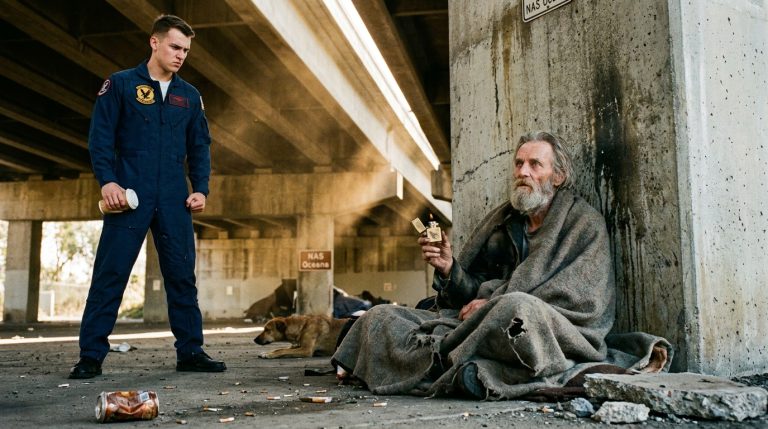
He was ninety years old. He was a frogman. He was a man who had navigated the freezing, black waters of the Han River, yet here, under the artificial glare of the center aisles, he felt exposed. His pockets were light, save for the heavy, jagged weight of the silver star and the challenge coin, and his stomach was a hollow, echoing chamber of knots.
He moved with the calculated, rhythmic gait of a man who understood the value of every movement, counting his steps, conserving the dwindling fire in his lungs. Produce was a trap—too much color, too much temptation, too much cost. He steered toward the bottom shelves, the graveyard of generic labels and budget-conscious survival.
A loaf of white bread, its plastic wrapping crinkling with a sound like shifting gravel. A jar of peanut butter, heavy and dense. A can of chicken noodle soup—a luxury of salt and warm liquid. And, for the phantom mutt that lived beneath his trailer, a small, paper bag of dry kibble.
The cost was fixed in his mind: $14.82. The precision of the figure was a cage.
He reached the register, his boots scuffing against the polished linoleum. Chloe, the girl behind the counter, didn’t look up from her phone. She looked like a ghost of the present, ethereal and detached, her thumbs dancing across a screen of infinite, shallow information.
“Find everything okay?” she droned, the words a script she had recited until they were meaningless.
“Yes, ma’am. Thank you.”
The items slid across the scanner—beep, beep, beep. The rhythm was a countdown. Matthew reached into the deep, dark well of his coat pocket, his fingers closing over the silver star. The metal was cold, biting into his skin, the sharp edges of the star’s points acting as a painful anchor to his own history.
He placed it on the belt, followed by the challenge coin. They landed with a heavy, metallic thud that cut through the sterile atmosphere of the store.
“That’ll be $14.82,” Chloe said, her eyes flicking up. When she saw the metal—the ornate silver, the faded ribbon, the solemn history resting in the plastic tray—she froze.
“I don’t have the cash,” Matthew whispered, the heat of shame climbing his neck. “But this… the silver is pure. I’m just looking for a trade. I’ll buy them back once my pension clears.”
He watched her eyes—the flicker of realization, the sudden, sharp prick of pity that he despised more than the hunger. She reached for the button under the counter, and Matthew saw his mistake. He had miscalculated the threat. The manager was coming, and with him, the sudden, intrusive observation of the store.
From the periphery, a shadow moved. A man with sharp features and eyes that didn’t see a veteran, but a market opportunity, stepped out from the line of customers, his hand hovering over the medal.
“Tell you what, old-timer,” the man said, his voice as smooth and oily as a well-oiled engine. “I collect this kind of thing.”
Matthew looked at him, and for a split second, the fluorescent lights seemed to dim, leaving only the man’s shark-like grin visible in the harsh, artificial light. He saw the trap closing, but he couldn’t step back. He was too deep in the aisle.
“Twenty bucks,” the man offered, his fingers brushing the star. “For the whole lot.”
Matthew felt the edge of the star dig into his palm, a final, stinging reminder of the honor he was about to trade for three days of existence. He looked up, and in that moment, he saw a movement near the entrance—a massive, sable-coated German Shepherd, ears pinned forward, eyes scanning the room with the lethal, singular focus of a predator that had just sensed a shift in the air.
The dog wasn’t looking at the food. He was looking directly at the man behind him.
CHAPTER 2: THE PREDATORS GAMBIT
The silence in O’Malley’s Market wasn’t empty; it was pressurized. It hummed in the gap between the grocery store’s fluorescent buzz and the low, gutteral vibration coming from the German Shepherd’s chest. The dog, Rex, was a statue of muscle and intent, his amber eyes fixed on Gordon Finch with a predatory focus that made the hair on Matthew’s arms stand up.
“I said twenty bucks, old-timer,” Finch repeated, his voice losing its oily veneer of benevolence. He didn’t look at the dog; he kept his eyes locked on the silver star, his hand twitching forward like a spider nearing a trapped fly. “I’m trying to help you. The manager isn’t going to budge, and you’re holding up the line. Don’t be prideful. Pride doesn’t fill a stomach.”
Matthew felt the old, familiar weight of a different kind of combat. This wasn’t the noise of an ambush in the delta or the suffocating dark of an underwater demolition run. It was quieter, filthier. It was the calculated pressure of a man who dealt in the erosion of others. Finch’s eyes weren’t those of a neighbor; they were the eyes of a scavenger assessing the caloric value of a carcass.
A sharp, intrusive memory slammed into Matthew’s mind—the smell of cordite in the Mekong Delta, the heat so intense it felt like drowning in liquid fire, and the way the squad used to watch the periphery for the ones who crawled through the mud with their eyes on the medals, not the mission. The memory was a sudden, freezing phantom in the middle of the heated store. He blinked, the vision of the jungle receding, replaced by the sterile, blue-tiled floor and the looming presence of the man in the leather jacket.
“The medal,” Matthew said, his voice a raspy, dangerous whisper that caught Finch off guard. “It isn’t for sale.”
“Everything is for sale, pal,” Finch snapped, his patience evaporating. He reached for the coin, his fingers inches from the cold silver.
Before he could make contact, the air in the aisle seemed to snap. The German Shepherd let out a short, sharp bark—a sound that echoed like a rifle shot through the deli section. Finch flinched, his hand jerking back as if he had touched a live wire.
“I wouldn’t,” a voice cut through the air, cool and sharp as a surgeon’s scalpel.
Matthew turned his head. Standing at the end of the aisle was a man who looked entirely out of place in the mundane surroundings of a Bremerton grocery store. He was younger, perhaps in his late twenties, with the rigid, kinetic posture of someone who spent his life expecting to be shot at. He wore a heavy, tactical-grade jacket that seemed to swallow the ambient light, and his eyes—flat, analytical, and devoid of the performative pity Matthew had seen in everyone else—were tracking Finch’s every micro-movement.
This was the Marine. Corporal Philip Miller. He walked with a slight, almost imperceptible hitch in his stride, but he moved with a fluid, predator-like grace that suggested he was always ready to shift into violence.
Finch bristled, his face reddening as he tried to regain his composure. “Who the hell are you? This is a private transaction between two neighbors.”
The Marine ignored him, his gaze dropping to the conveyor belt, then rising to meet Matthew’s. The look was a recognition—a silent, heavy understanding shared by those who had stood on the edge of the world and come back with the scars to prove it.
“He’s not your neighbor,” the Marine said, his voice flat, stripped of all unnecessary emotion. He reached the register, the massive German Shepherd keeping pace at his left side, a silent, furry blockade. “And you’re not a collector.”
Finch laughed, but the sound lacked conviction. He stepped back, his back hitting the cart behind him. “You’re making a scene, man. Look, I’m doing the guy a favor. He’s starving. I’m just taking a piece of junk off his hands so he can eat.”
“That piece of junk is a Silver Star,” the Marine said, moving into the space between Matthew and Finch. He was physically larger, a wall of dense, grounded potential. “And the coin is Naval Special Warfare. You don’t have the stomach to hold either of those.”
The Marine’s hand didn’t move toward a weapon, but his presence alone forced Finch to re-evaluate his position. The antique dealer’s eyes darted toward the manager’s office, then toward the exit, but the dog—the German Shepherd—took a single, deliberate step forward, effectively cutting off the line of retreat. The animal’s presence was heavy, a suffocating, physical fact.
Matthew felt his knees shaking, the hunger still gnawing at his ribs, but the shame—that cold, paralyzing weight—had begun to dissipate. He watched the Marine, watching the way he kept his center of gravity low, the way he ignored the curious, fearful gazes of the other shoppers.
“Step aside,” the Marine ordered, not to Matthew, but to the air surrounding Finch. It wasn’t a suggestion. It was a command that hung in the air, heavy with the weight of experience.
Finch let out a sharp, angry breath, his eyes narrow slits. He knew when a hand had been played, and he knew when a predator had out-maneuvered him. With a final, lingering glare at the medals, he grabbed his basket, the plastic handle clattering, and retreated toward the frozen food aisle, his movements hurried, desperate, and visibly agitated.
The Marine didn’t watch him go. He turned back to the register, his face softening only slightly, the tactical mask slipping just enough to reveal the exhaustion etched into the lines around his eyes. He reached into his back pocket, his movements practiced and economical.
“Ring it up,” the Marine said to the cashier, his card already extended. “Put the groceries on my tab.”
Matthew felt the breath leave his chest, a long, ragged exhale that sounded like a sob. He wanted to refuse—to demand the right to pay his own way—but the Marine was already looking at him, a silent, absolute understanding passing between them. A connection forged in the mud of different wars, standing in the middle of a grocery store that smelled of floor wax and broken promises.
“You’re not a charity case, Mr. Ryan,” the Marine said, his voice lowered, personal. “You’re a legacy. I’m just protecting the inventory.”
CHAPTER 3: THE MARINES PERIMETER
The door of the Ford F-250 slammed shut with the dull, heavy thud of a vault locking. Inside, the cab was a sanctuary of sorts, smelling of stale coffee, damp upholstery, and the sharp, clean scent of the German Shepherd’s fur. Dave didn’t start the engine immediately. He sat with his hands gripped tight at the ten and two positions on the steering wheel, his eyes scanning the parking lot through the rain-streaked windshield.
Matthew sat in the passenger seat, his hands resting on his cane. He was still vibrating—a low-level hum of adrenaline that hadn’t found its exit point. The grocery bags sat in the footwell, a tangible, heavy promise of sustenance, but they felt insignificant compared to the shifting tectonic plates of his reality.
“You didn’t have to do that,” Matthew said, his voice raspy, struggling to balance the weight of his pride against the reality of the Marine’s intervention.
Dave didn’t look at him. His gaze remained locked on the automatic sliding doors of O’Malley’s. “I told you, sir. It’s a debt. Every guy in my unit knew the history. You guys were the ones who wrote the manual on how to move in the dark. If we can’t look out for the people who turned the lights on for us, then the training was a waste of time.”
The engine turned over with a rough, stuttering cough before settling into a steady, rhythmic thrum. Dave put the truck in gear, pulling away from the curb with a deliberate, smooth acceleration. He checked his mirrors—not once, but twice, a lingering habit from a life where mirrors were the difference between a clean departure and an IED.
“Where are we going?” Matthew asked, though he already knew the answer. The trailer park was a destination, but it felt like a retreat.
“Home,” Dave said. “And then, we start looking at those papers. You said a man from the bank came to your house. A man named Harding.”
“Thomas Harding,” Matthew corrected, the name leaving a bitter taste in his mouth. “He was professional. Soft-spoken. He had a way of making the mountain of paperwork look like a molehill. I signed things I didn’t understand, but I trusted him because he carried a briefcase and a smile that looked like it belonged on a bank lobby poster.”
Dave’s jaw tightened. He steered the truck onto the main road, the wipers slashing through the grey curtain of Washington rain. “That’s the standard play. They identify the target, they isolate the target, and then they leverage the target’s need for simplicity. He wasn’t just managing your money, Matthew. He was managing your decline.”
“I don’t understand,” Matthew confessed, his gaze drifting to the window. The world outside was a blur of desaturated greens and greys, the pines standing like stoic sentinels against the encroaching fog. “Why me? I’m just an old man with a broken trailer and a collection of medals that don’t mean much to anyone but me.”
Dave turned the truck onto a narrower, potholed road that led toward the outskirts of the shipyards. “Because you have history. And history is a commodity. You think it’s just about the money, but it’s not. It’s about the erasure. They take the medal, they take the house, and eventually, they take the story. When a man like Harding gets finished, there’s nothing left to show you were ever here.”
The Marine’s voice was devoid of malice, which made it all the more terrifying. It was a clinical observation, the kind a scout might make about the structural integrity of a bridge before deciding whether or not to blow it.
Matthew felt a chill that had nothing to do with the draft coming through the truck’s seals. He looked at Rex, who had his massive head resting on the center console, his amber eyes tracking the movement of the wiper blades with a sleepy but vigilant alertness. The dog was a creature of absolute loyalty, a living anchor in a world that felt increasingly like a shifting, hostile landscape.
“I have the folder,” Matthew said, his voice gaining a sudden, hard edge. “The bank sent it. I kept everything, even when I thought it was just clutter. I thought it was the right thing to do.”
“Good,” Dave said. “Information is the only currency that matters in this fight. We’re going to sit down, we’re going to lay it all out on your table, and we’re going to map his movements. If he’s a predator, he has a pattern. And if he has a pattern, he has a weak spot.”
The truck hit a bump, the suspension groaning in protest, as they turned into the trailer park. It was a bleak place, rows of aluminum shells sitting in the mud, reflecting the fading light of a dying day. But as Dave pulled into the space next to Matthew’s home, the sight of the blue tarp flapping on the roof felt different—less like a symbol of defeat, and more like a tactical disadvantage that needed to be mitigated.
“We start tonight,” Dave said, killing the engine. The silence that followed was heavy, filled with the sound of the rain drumming on the metal roof. “We’re going to audit the audit. And then, we’re going to decide how to respond.”
Matthew looked at the trailer. For four years, it had been a tomb. Now, as he reached for his cane and stepped out into the biting, wet air, it felt like a bunker. A place to prepare. A place to strike back. He followed the Marine toward the door, his steps shorter than they used to be, but for the first time in an eternity, they carried the weight of a man who had a mission.
“I’m ready, Corporal,” Matthew said, as he fumbled for his keys.
“I know you are, Mr. Ryan,” Dave replied, his hand already on the latch, his posture coiled and ready. “That’s the only reason I’m here.”
CHAPTER 4: THE AUDIT
The interior of the trailer was a claustrophobic box of fading memories and cold aluminum. Matthew sat at the dinette table, the manila envelope spread before him like a battlefield map. Dave stood over him, the beam of his flashlight carving a sterile path through the gloom, illuminating the dense, bureaucratic typeface of the reverse mortgage agreement.
The air in the trailer had been warm, a humid, life-saving heat provided by the propane stove, but as Matthew reached for the first page, the flame suddenly sputtered—a low, dying hiss that echoed through the thin walls. The blue ring of fire shivered and vanished, leaving behind the faint, sharp smell of unburned gas.
“Breaker?” Dave asked, his voice immediate and calm, the tone of a man who dealt in constant, unexpected environmental shifts.
“No,” Matthew said, his fingers already stiffening in the sudden drop in temperature. “The tank. It’s empty. I didn’t think… I hadn’t budgeted for the refill.”
Dave didn’t curse. He didn’t waste time on the frustration of the situation. He simply stepped back, his movements precise and efficient. “We don’t need heat to read, Mr. Ryan. We have work to do.”
Matthew pulled his wool blanket tighter around his shoulders. The cold was a familiar enemy, one that sought to settle into his joints and make his hands tremble, but the task before him acted as a tether. He focused on the document, his reading glasses perched on the bridge of his nose, the light from Dave’s torch steady and unwavering.
Page forty-seven was an unassuming sheet, easily overlooked by a man whose mind was heavy with the recent loss of his wife. As Matthew’s eyes tracked the dense paragraphs, he felt a flicker of realization—a cold, sickening sensation that had nothing to do with the freezing air. It wasn’t just jargon. It was a mechanism.
“Look here,” Matthew whispered, pointing a gnarled finger at a clause buried in the center of the page. “Harding said this was for standard account management. Fees for ‘administrative oversight’ related to the reverse mortgage payout.”
Dave leaned in, the light of his torch pressing against the paper. His jaw hardened. “It’s not a fee, Matthew. It’s a recurring withdrawal authorization. It doesn’t specify a cap. It allows ‘Apex Holdings LLC’ to pull funds as needed for, and I quote, ‘servicing of the primary asset.'”
“My pension,” Matthew said, his voice hollow. “They were using my own money to pay for the ‘oversight’ of stealing it.”
“Exactly,” Dave replied. He pulled a notepad from his tactical pack, his pen moving with the rhythmic scratch of a man transcribing a mission briefing. He began mapping the transaction dates against the withdrawals. “Look at the timing. These pings happen every time your pension clears the bank’s hold period. Forty-eight hours after the direct deposit, Apex takes their pound of flesh. They kept the amounts low enough to avoid the automated fraud triggers. It’s not just predatory, Matthew. It’s technical.”
As Dave worked, the cold began to manifest as a physical presence, a weight that pressed down on the roof and seeped through the aluminum siding. Matthew’s vision blurred at the edges, his concentration wavering as the temperature plunged. He saw the numbers—two hundred here, one hundred there—and realized they represented not just currency, but the theft of his time, his security, and his dignity.
“They were draining me dry,” Matthew said, his voice gaining a hard, brittle strength. “They were waiting for me to run out of options so that when I finally hit zero, I’d be forced to liquidate the remaining assets. The medals. The house. Everything.”
“They weren’t just stealing your money,” Dave said, his eyes meeting Matthew’s in the dark. “They were erasing your autonomy. If you’re hungry, if you’re cold, you’re not thinking about the contract. You’re thinking about the next meal. You’re thinking about survival. They kept you in a constant state of low-level panic.”
Matthew looked at the Silver Star, which he had placed on the table next to the folder. In the harsh, artificial light of the flashlight, the tarnished silver looked like a badge of combat he had failed to win. But the Marine across from him wasn’t looking at the medal with pity. He was looking at the ledger like a target package.
“We have the dates, we have the routing numbers, and we have the entity name,” Dave said, his voice rising in intensity. “But we have a problem. Apex Holdings is a shell. If we just go to the police, they’ll see a paperwork error or a civil dispute. We need to find the bridge between Harding and the money.”
Matthew thought of the man in the store. Gordon Finch. The shark-like grin. The way he had reached for the star as if he were picking fruit off a tree. “The antique dealer,” Matthew said. “Finch. He knew what the medal was the second he touched it. He didn’t just want the silver—he wanted the history. He knew who I was. He knew what I had done.”
Dave paused, his pen hovering over the page. “That changes the game. If Finch is the one scouting the targets, then he’s not just a fence. He’s the intelligence officer. He’s the one providing the names to Harding.”
“He took Henry Caldwell’s watch,” Matthew remembered, his mind sharpening as the adrenaline fought the cold. “He used the same threats. Same tone. Same paperwork.”
Dave snapped the notebook shut and pocketed his pen. His posture had shifted from investigator to something else entirely—a tactical shift that signaled the end of the audit and the beginning of a different phase.
“If Finch is the link,” Dave said, his gaze fixed on the door, “then we don’t go to the bank first. We go to the source.”
Matthew stood up, his joints protesting the sudden movement, his breath hitching in the frigid air. The cold didn’t matter anymore. The documents on the table felt like the blueprints to a bunker, and for the first time in four years, he knew exactly where the weak point in the wall was.
“When?” Matthew asked.
“As soon as the sun breaks,” Dave said, his hand resting on the back of his tactical pack. “We’re not waiting for the authorities to build a case. We’re going to ensure there’s no case left to build.”
CHAPTER 5: THE BREACH
The drive to the financial district was a blur of rain-slicked asphalt and the rhythmic pulse of the truck’s tires against the seams of the highway. Inside the cab, the air was thick with a silence that felt heavier than the storm raging outside. Matthew sat with the manila envelope pressed against his chest, his fingers tracing the edges of the documents. Every document felt like a brick in a wall he was about to tear down.
Dave kept his eyes on the road, his hands steady on the wheel, though his fingers tapped a light, rhythmic cadence against the leather—a nervous, tactical energy that betrayed his outward calm. Rex was a solid, immobile weight in the backseat, his presence a low-frequency hum of absolute security.
“Harding’s office is in the Mariner’s Trust building,” Dave said, his voice cutting through the drumming of the rain. “It’s high-security, keypad entry, and private security patrols. If we walk in the front door, we’re just two guys with a grudge. We need a different approach.”
“I have the keys,” Matthew said, his voice gaining a newfound, jagged authority. “He gave me a key to the ‘Client Access Portal’ when he set up the accounts. He said it was so I could drop off physical documents after hours if I needed to.”
Dave glanced at him, his eyebrows arching in surprise. “He gave you the key to the building?”
“He thought I was a senile old man who couldn’t remember his own zip code,” Matthew said, a ghost of a smile touching his thin lips. “He didn’t think I’d ever actually use it.”
They pulled into the underground parking structure of the Mariner’s Trust building ten minutes later. The space was a cavernous, concrete tomb, illuminated by flickering orange sodium lights that cast long, distorted shadows across the rows of luxury cars. Dave killed the lights, and for a moment, the silence was total, save for the rhythmic dripping of water from a leak in the ceiling.
“Rex, stay,” Dave whispered. The dog didn’t whine; he simply sank into the darkness of the backseat, a shadow among shadows.
They moved toward the service elevator, their footsteps echoing with a sharp, metallic ring against the concrete. Matthew’s cane tip clattered—a sound that felt like an alarm bell in the vast, empty space. Dave moved ahead of him, his posture low, his eyes scanning the corners, checking for cameras, for sensors, for the silent watchers that defined a high-security environment.
The service elevator was a heavy, brushed-steel cage that groaned in protest as Dave pressed the button. When the doors slid open, they stepped into a lobby that smelled of expensive espresso and sanitized, synthetic air. It was a sterile, unforgiving environment—all glass, steel, and cold light.
“Harding’s suite is on the fourth floor,” Dave said, his voice a low hum. “We take the stairwell. If we trigger the elevator alarms, we lose the element of surprise.”
The climb was an agonizing exercise in endurance for Matthew. His lungs burned, and his knees clicked with every step, but he pushed through the pain, fueled by a visceral, burning need for vindication. When they reached the fourth-floor landing, Dave stopped, holding up a hand. He pressed his ear against the heavy, fire-rated door, his breathing slow and measured.
“Clear,” he whispered.
They pushed through into the hallway. The carpeting was thick, dampening the sound of their movements, but the silence felt artificial, a manufactured quiet that made Matthew’s skin crawl. Harding’s office was at the end of the hall, a grand expanse of mahogany and glass that seemed to loom over the rest of the floor.
Matthew inserted the key he had been given months ago—the key Harding had mockingly handed him—into the heavy brass lock. It turned with a smooth, oiled click. The door drifted open, revealing an office that was a masterclass in modern, predatory design. The desk was vast, a slab of dark, polished wood, and the view behind it offered a panoramic look at the Bremerton harbor, currently obscured by the driving rain.
Dave moved to the desk, his flashlight sweeping across the surface, illuminating a high-end laptop, a digital phone system, and a stack of folders. He didn’t waste time on the surface. He went straight for the drawers, his movements surgical, pulling files, cards, and ledgers into the light.
“It’s all here,” Dave said, his voice rough with frustration. “The names, the dates, the offshore routing numbers. It’s not just a file—it’s an archive.”
Matthew walked to the wall, his eyes drawn to a photograph sitting on a side table. It was Harding, smiling, his arm wrapped around a woman in a designer coat—Brenda. He looked so comfortable, so untouchable, in his world of paper and glass.
“He never thought we’d look at the fine print,” Matthew said, his voice heavy with the weight of his realization. “He never thought the people he was destroying were capable of reading the language of his own greed.”
Suddenly, the silence was shattered by a low, rhythmic vibration—the sound of a cell phone buzzing somewhere in the room. Dave froze, his light cutting through the dark toward the desk. A screen was glowing in the shadows, a name flashing in bright, neon text.
Finch.
“He’s calling him,” Dave whispered, his face tightening into a mask of cold, tactical focus. “He’s checking in. He knows something is wrong.”
Dave didn’t answer. He waited for the buzzing to stop, the silence returning to the room with a renewed, sharpened edge. He turned back to the files, his hands moving with renewed speed, capturing the evidence that would strip Harding of his sanctuary. They had the records, they had the names, and they had the physical evidence of the systematic, calculated erasure of their own brothers.
“We have what we came for,” Dave said, his voice a steady, grounding anchor. “But we’re out of time. Someone is going to be here, and they won’t be as soft as Harding.”
Matthew looked at the Silver Star he had retrieved from his pocket, holding it tight in his palm. The points of the star dug into his skin, a sharp, stinging reminder of the reality they had just uncovered. They weren’t just fighting for money. They were fighting for the memory of every man whose name had been erased by the stroke of a pen.
“Then let’s go,” Matthew said, his voice iron-hard. “We’ve got a ledger to balance.”
CHAPTER 6: THE FINAL ACCOUNTING
The drive from the Mariner’s Trust building back to Bremerton felt like moving through the cooling wreckage of a war. The rain had subsided, leaving the world slick with a cold, reflective sheen. Matthew sat in the passenger seat, the manila envelope resting on his lap like a holy relic. The evidence inside—the digital breadcrumbs of a thousand ruined lives—was no longer just paper. It was a catalyst for the end.
Dave drove with a focus that was terrifying in its intensity. His hands were fused to the steering wheel, his jaw set in a line of granite. They didn’t speak. They didn’t need to. The destination was already etched into the landscape of their intent: Finch’s Antiques and Curiosities.
When they pulled into the narrow street in front of the shop, the storefront was dark, save for a single, flickering amber light in the back office. The “Closed” sign swung listlessly against the glass. Dave parked the truck, the engine dying with a soft, final gasp. He turned to Matthew, his expression unreadable in the dim light.
“He’s still there,” Dave said. “He’s waiting for Harding to call back. He’s waiting for the storm to blow over.”
Matthew reached into his coat and felt the cold, hard edges of the Silver Star. “He doesn’t know that the walls have already collapsed.”
They exited the truck. Rex moved with them, a silent, disciplined shadow. The street was empty, the air smelling of wet iron and cold salt—the scent of a Pacific Northwest night. They reached the door, and this time, there was no need for keys. Dave simply stepped up to the glass, his hand resting on the frame, and pushed. The door yielded with a pathetic, splintering groan of wood against wood.
The shop smelled of dust and decaying history. Gordon Finch stood behind the counter, clutching a phone, his face bathed in the sickly yellow light of his back-office lamp. When the door chimed, he spun around, his eyes wide, his mouth opening in a silent gasp. He looked smaller than Matthew remembered—shrunken, brittle, a man composed of nothing but greed and poorly fitted suits.
“You,” Finch whispered, his voice cracking. He lunged for the baseball bat beneath the counter, his hands fumbling, panic overriding his coordination.
Dave moved with the speed of a closing trap. He didn’t use a weapon. He didn’t even raise his voice. He simply vaulted the counter, his movement fluid and unstoppable, and pinned Finch against the back shelving. The bat clattered to the floor, rolling away into the shadows.
“The party’s over, Gordon,” Dave said, his voice a low, vibrating growl. “Harding is burning. Your shell company is exposed. And the ledger… we have the ledger.”
Dave pulled the black leather book from his jacket and tossed it onto the glass counter. It hit with a heavy, final sound. Finch stared at it, his throat working as he tried to find a defense, a lie, a path of escape. But there was nowhere left to go. The paper trail had caught up to him.
“I… I was just a consultant,” Finch stammered, his eyes darting toward the back office safe. “I provided a service! Harding was the architect! I just helped organize the portfolios!”
“You didn’t organize portfolios,” Matthew said, walking slowly toward the counter, his cane clicking against the floorboards. “You scavenged souls.”
He pulled the Silver Star from his pocket and laid it on the ledger. It gleamed in the dim light, the only clean thing in the room. “You thought this was a curiosity. You thought it was an antique. But it wasn’t for sale, Gordon. And neither were the men you traded it for.”
Finch’s face collapsed. The arrogance, the shark-like confidence—it all evaporated, leaving behind a man who looked suddenly, brutally mortal. He slumped against the shelving, his shoulders shaking.
Dave grabbed Finch by the lapels of his expensive blazer and hauled him upright. “You’re going to walk into that back office. You’re going to open that safe. And you’re going to hand over every single medal, every watch, every heirloom you stole from these men. If you hold back a single pin, I’ll let the FBI know you were the one who suggested the offshore routing numbers. You’ll be the one taking the fall for the whole operation.”
Finch nodded, his eyes streaming with tears. He walked into the back office, his steps heavy with the finality of his defeat. He opened the safe, pulling out handfuls of gold, silver, and history—medals, watches, keepsakes—all of it piled in a disorganized heap on the counter. Dave methodically sorted through the items, verifying them against the ledger, his movements precise and uncaring.
When the last piece was placed on the pile, Dave reached out and grabbed Finch’s phone, dropping it into a glass of water on the counter. The electronics fizzed and died, a tiny, insignificant death in the wake of the larger collapse.
“Get out,” Dave commanded, stepping back. “Leave the keys. Leave the business. The authorities will be here in minutes. If you’re still in this building when they arrive, I can’t guarantee what will happen to you.”
Finch didn’t argue. He turned and fled, stumbling out the front door and disappearing into the darkness of the street.
The shop fell into a profound, heavy silence. Matthew picked up the Silver Star, the metal feeling warm and alive in his hand. He looked at the pile of stolen history on the counter—a mountain of service, sacrifice, and stolen lives. Dave stood beside him, his hand resting on the back of the ledger, his posture finally, visibly relaxing.
“We have it,” Dave said, his voice soft. “It’s all here.”
“Not just the medals,” Matthew replied, looking at the ledger that contained the names of his brothers. “We have the truth.”
They began the long, quiet process of gathering the heirlooms. Over the next hour, they packed everything into the canvas bags. The shop, once a place of exploitation, was now a tomb for Finch’s ambitions.
As they walked out to the truck, the morning light began to bleed into the sky, a pale, hopeful grey that promised a new day. Matthew leaned against the side of the Ford, his breathing steady, his heart at rest. He looked at the bag of medals—the Purple Hearts, the Bronze Stars, the insignias of UDTs and Army infantry units—and he knew that the war was over. Not just the battle against Harding and Finch, but the silent, gnawing war he had been fighting within himself.
“What now?” Dave asked, climbing into the driver’s seat.
Matthew climbed in beside him, Rex settling into the back with a satisfied huff. He looked at the list of names—the brothers he had yet to visit—and he felt a surge of warmth that had nothing to do with the heater.
“Now,” Matthew said, closing the door and looking out at the waking city, “we go home. And then, we get back to work.”
Dave started the engine. The truck rumbled to life, a steady, rhythmic sound that anchored them to the present moment. They pulled away from the storefront, leaving the past behind, driving toward a future they had reclaimed, one battle at a time.