The Ghost Protocol: A Veteran Operative Tests the Limits of America’s Most Secret Elite Facilities
CHAPTER 1: THE STERILE FLOOR
The silence in the hangar was absolute, pressed down by the weight of three hundred years of combined rank and the terrified stillness of the operators. Harold Morrison held the salute, his hand steady as a tombstone, while the air in the room seemed to lose its humidity, turning thin and metallic.
General Hayes didn’t move. Her gaze, usually sharp enough to dismantle a career in a heartbeat, was fixed on Morrison with a terrifying intensity. Behind her, the detachment of officers looked like statues in a museum of military failure.
Kain stood three paces to the left, his heart hammering against his ribs like a trapped bird. The realization was blooming in his gut, cold and sickening: he hadn’t just insulted a civilian; he had stepped on a landmine that had been buried in the floor of the American intelligence apparatus since the Cold War.
“Mr. Morrison,” the General began, her voice dropping into a register that barely cleared the ambient hum of the facility’s power grid. “The Director of the DIA is on a secure line. He is demanding a status update on the ‘Ghost Assessment.’”
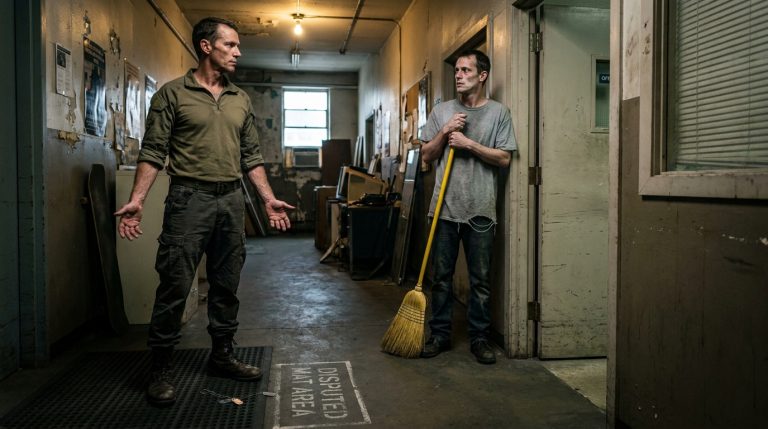
Morrison dropped his hand, his movements as fluid and efficient as a man half his age. He didn’t look at the General. He looked at the floor, where his mop stood leaning against a rack of state-of-the-art ballistic plates. A small, black light began to pulse on the handle of his mop—a rhythmic, faint amber glow that hadn’t been there a moment ago.
“The facility is compromised, General,” Morrison said. His voice wasn’t the voice of a janitor anymore. It was dry, raspy, and carried the sound of shifting gravel. “Not by the men standing in front of you. They are, as observed, functional but paranoid. The compromise is in the architecture.”
Kain’s hand twitched toward his holster before he caught himself. He glanced at the ventilation grate above the command team. A single, hairline fracture ran along the edge of the ducting—something he hadn’t noticed in five years of daily briefings.
“What are you talking about, Harold?” The General stepped closer, her posture losing its rigid formality. She wasn’t just a commander now; she was a partner in a shadow game Kain wasn’t invited to play.
Morrison finally looked up, his pale blue eyes pinning the General. “Someone is recording this conversation, and it isn’t anyone in this chain of command. Every time I test a security flaw here, the data doesn’t just reach the server. It vanishes into a sub-layer I didn’t authorize.”
Kain felt the floor shift. The “assessment” wasn’t about the Delta operators at all. He looked at Rodriguez, who was pale, his eyes darting toward the security cameras. The cameras weren’t turning. They were stuck on a continuous, looping feed of an empty hallway from three hours ago.
Morrison reached into his pocket and pulled out the small device he had shown earlier. It flickered, displaying a string of red text that caused the General to visibly recoil.
“We aren’t alone in this room,” Morrison whispered.
CHAPTER 2: THE SILENT PERIMETER
The emergency lighting engaged with a violent, rhythmic thrum—a deep, industrial groan that vibrated through the concrete soles of Kain’s boots. The bright, sterile white of the hangar was replaced by a dim, blood-orange haze. Shadows stretched and distorted, turning the high-tech equipment lockers into jagged, looming silhouettes.
Kain didn’t move. He couldn’t. His training screamed at him to secure the perimeter, to neutralize the anomaly, but his rational mind was held captive by the way General Hayes—the woman who commanded the most lethal operators on the planet—was currently looking at the janitor. There was no hierarchy in that look; there was only a shared, heavy burden.
“The frequency,” Morrison muttered, his voice barely audible over the low hum of the emergency generators. He shifted the mop handle, the amber light pulsing in synchronization with the facility’s dying electronics. “It’s being throttled. Someone is dampening the local output to prevent us from signaling Higher Headquarters.”
“That’s impossible,” Rodriguez interjected, his voice tight. “We’re on a hardened, redundant mesh. It’s physically impossible to suppress this signal from the outside without a massive facility-wide failure.”
Morrison turned, his movements agonizingly slow, calculated to avoid drawing attention from the ventilation ducts. “It isn’t being suppressed from the outside, Sergeant. Look at the data stream.” He gestured toward the small device.
Kain leaned in, his professional paranoia clawing at him. On the screen, a line of code was scrolling, erratic and broken, bleeding through a firewall that, by all rights, should have been impenetrable. It was a digital fingerprint, cold and precise.
“The leak,” General Hayes whispered, her eyes fixed on the device. “It’s not just a surveillance recording. It’s an extraction protocol.”
The reality of the situation hit Kain with the weight of a physical blow. The “assessment” wasn’t a game. It was a dragnet. They weren’t being tested on their skills; they were being vetted for their loyalty during a quiet, invisible war within the walls of the compound. He looked at his fellow operators—Chen, Williams, Rodriguez—and realized with a jolt of alarm that he couldn’t be sure who was watching whom.
“General,” Kain said, his voice hard, projecting authority despite the sweat slicking his palms. “If there’s an extraction occurring, we need to hard-line the servers and initiate a manual kill-switch. We have to isolate the network before the data egress completes.”
Morrison gave a thin, humorless smile. “And alert the entity on the other end that we know they’re there? That’s exactly what they want, son. They want us to burn the bridge so they can see which of us is holding the match.”
The hangar was cooling rapidly. The humidity, usually oppressive, vanished as the ventilation system adjusted to the emergency power state. The air grew sharp, smelling of ozone and old dust—the smell of a machine that had been running for too long without proper maintenance.
Morrison began to move, not toward the exit, but toward the corner of the hangar where the heavy, reinforced blast doors met the main server bank. His mop was abandoned now, replaced by a specialized tool that seemed to materialize from the folds of his worn, red work shirt.
“Stay here,” Morrison commanded, the authority in his voice cutting through the tension like a physical barrier. “General, secure the perimeter. I’m going to isolate the node. If I’m not back in six minutes, assume the facility is fully compromised and initiate the Protocol 9 evacuation. Do not—I repeat, do not—try to follow me.”
“Harold, wait,” Hayes stepped forward, her hand hovering near her sidearm, not out of aggression, but out of a desperate need to assist. “If you go in there alone, you’re a ghost. You know that. They’ll erase you.”
Morrison didn’t turn back. “I’ve been a ghost for forty years, General. It’s the only way to keep the truth from turning to ash.”
Kain watched him disappear into the shadows of the server bank, a small, hunched figure moving with a predator’s grace. The amber light on his device flickered one last time, casting a long, skeletal shadow against the wall, before vanishing into the darkness.
The hangar fell into a silence so profound it felt like a pressure vacuum. Kain looked at the General. She was staring at the space where Morrison had been, her expression a mirror of the confusion and burgeoning fear that Kain felt in his own chest.
“Sergeant,” Hayes said, her voice devoid of its usual command. She didn’t look at him, but her tone was unmistakable. “Keep your eyes on the ceiling, the floor, and the man next to you. If that door opens and it isn’t Morrison, you kill it.”
Kain nodded, drawing his sidearm, the cold weight of the metal offering the only comfort in a room that had suddenly become a tomb. He scanned the rows of lockers, the shadows, the vents. The facility felt different now—less like a training ground and more like a trap. Every sound, every flicker of the emergency lights, felt like a message he wasn’t cleared to read.
He looked at Rodriguez. Rodriguez looked away, his eyes fixed on a blind spot in the camera array.
The first of the six minutes had begun.
CHAPTER 3: THE BROKEN SEAL
Kain’s finger remained inside the trigger guard, his knuckle white against the matte-black finish of his sidearm. The hangar air felt thick, charged with the static of the server bank’s erratic power cycling. He kept his eyes on the server bank, but his mind was running a diagnostic of the room, looking for any shift in the dust or any vibration in the floor that would betray Morrison’s movement.
Beside him, Rodriguez had stopped pretending to watch the cameras. He was focused on his own console, his fingers dancing over the keys with a frantic, rhythmic intensity.
“Three minutes left,” Rodriguez whispered, his voice barely cutting through the low, guttural thrum of the emergency generators. “If he doesn’t cut the egress by then, the data will have fully migrated to an off-site relay.”
Kain stepped away from the General’s side and moved toward the secondary terminal near the lockers. He didn’t trust the official chain of command right now. If Morrison was a ghost—a relic of a system that didn’t officially exist—then the logs he was looking for wouldn’t be in the standard secure database. He needed to dig into the “rungs” beneath the surface.
He bypassed the secure interface, his movements practiced and efficient, accessing the raw directory of the facility’s historical traffic. The screen flickered, struggling against the low-voltage emergency flow. He pulled up the last forty-eight hours of activity.
“Rodriguez, check the timestamp on this node,” Kain commanded, his voice tight.
“Why?”
“Just check it.”
Rodriguez paused, then keyed into the node. A moment of silence passed, the only sound the distant, wet drip of a leaking pipe somewhere deep in the ventilation system. “That’s… that’s not right. The timestamp is synced to a 1984 architecture. That server bank shouldn’t even be able to talk to this network, let alone register a handshake.”
Kain leaned closer, his eyes scanning the lines of code. There it was: a recurring error, a phantom entry every eleven seconds. It wasn’t a glitch. It was a rhythmic pulse, a beacon disguised as a system error. It was exactly the kind of “security vulnerability” Morrison had spoken of, but it wasn’t just a flaw in the firewall—it was a back door, built into the very foundation of the building’s code.
“It’s not an external leak,” Kain said, his breath hitching as the implication sank in. “It’s an internal loop. Someone—or something—has been sitting inside our architecture for years, using our own security protocols to hide their traffic.”
“If that’s true,” Rodriguez murmured, his face losing all color in the amber light, “then every mission we’ve launched out of this facility for the last decade has been visible to whoever is on the other side of that loop.”
Kain felt a cold shiver crawl up his spine. The secrecy, the compartmentalization, the “need to know” basis of their entire operational lives—it had all been a farce. They weren’t the hunters; they were the bait.
He moved his hands to the keyboard, intending to isolate the loop, to find the source. But as his fingers hovered over the keys, a sharp, metallic screech echoed from the server room. It was the sound of heavy metal being torn, followed by a sudden, jarring silence. The emergency lights didn’t just flicker; they died completely, leaving the hangar in near-total darkness.
Kain spun, his weapon leveled at the darkness. “Morrison?”
There was no reply. Only the sound of something dragging across the concrete—slow, deliberate, and rhythmic.
General Hayes stepped up beside him, her shadow merging with his in the gloom. He could smell her adrenaline, sharp and metallic. “Kain,” she whispered, her voice barely a breath. “Get that terminal back online. Whatever is in that server room, it isn’t Morrison.”
Kain fumbled for his tactical light, but before he could activate it, a pale, flickering blue light began to emanate from the floor—not from the server room, but from beneath the very locker he was standing next to. It was the same light from the device Morrison had carried.
He knelt, his hand trembling as he reached for the locker handle. It was hot to the touch, the metal vibrating with a high-frequency whine that made his teeth ache. He pulled it open, expecting an enemy, but found only a small, rectangular box made of brushed steel, resting on a pile of rags. It wasn’t a weapon. It was an archive—a physical, tangible record of everything that had happened in this facility since the day it opened.
As he touched the box, the hangar doors began to moan, the heavy hydraulics straining against an immense, unseen pressure. Someone, or something, was on the other side, and they weren’t interested in testing the facility’s security anymore. They were here to ensure the “Ghost” stayed buried.
Kain grabbed the archive, his knuckles tight, his eyes burning as he scanned the darkness for a sign of where Morrison had gone. He realized then that the old man hadn’t gone into the server room to fix the leak. He had gone in there to lure the predator out into the open.
The hangar doors groaned again, a sound like tortured metal, and the locks began to disengage one by one, the heavy, archaic bolts sliding back with the finality of a guillotine.
CHAPTER 4: THE GRAY CORRIDOR
The sound of the locks retracting—a series of sharp, mechanical clicks followed by the groan of pneumatic seals breaking—ripped through the hangar. Kain didn’t wait for the doors to move. He tucked the steel archive box against his ribs, the cold weight of it pressing into his side, and lunged toward the maintenance crawlspace beneath the central server rack.
“General, get to the egress point!” Kain barked, his voice sharp with the urgency of a man who realized he was no longer playing a game of security protocols, but one of survival.
General Hayes didn’t argue. She moved with a speed that belied her rank, her boots silent on the smooth concrete. She reached the emergency exit as the hangar doors finally began to slide open, revealing not a team of base security or an investigative committee, but a wash of blinding, floodlit white light that turned the hangar into an overexposed photograph.
Kain flattened himself against the cold concrete of the crawlspace, his pulse hammering a frantic rhythm against his temple. The shadows under the server racks were long and suffocating, smelling of ionized dust and stale air. He could hear them now—the boots. Too many of them to be a standard response team. The pace was uniform, rhythmic, and entirely lacking the chaotic noise of a rescue mission.
Click. Thud. Click. Thud.
It was a march.
As he shifted his position, his hand brushed against a jagged piece of metal—a remnant of the server bank Morrison had decimated. The sharp edge sliced through his tactical glove, but he didn’t flinch. He focused on the rhythm of the approaching boots. It was a cadence he knew, a cadence he had practiced, but there was something fundamentally wrong with the timing. It was a millisecond off, a mechanical stutter in the stride that defied human biomechanics.
He looked down at the archive box. The brushed steel surface caught a sliver of light from the emergency exit, revealing a series of etched, alpha-numeric sequences. He didn’t have the clearance to read them, but he recognized the format. It was a file-tagging system used for “Black” projects—programs that ceased to exist the moment they were completed.
Click. Thud.
They were inside the hangar now. The light from the floodlamps spilled into the crawlspace, creating long, distorted blades of white across the floor. Kain held his breath. A pair of heavy, regulation-issue boots stopped just inches from his hiding spot. They were motionless, waiting. The air around the boots seemed to hum, a faint, high-pitched vibration that made the dust motes dance in the air.
He felt a sudden, intrusive thought—a phantom memory of his own selection training, the sensation of being watched from the dark—and for a fraction of a second, he wondered if he was experiencing a psychological break. Was this a test? Was the “leak” just a stress-induction drill that had gone too far?
But then, the boots moved. They pivoted, the heels grinding into the concrete with a sound like crushing bone. The figure standing above him wasn’t human. It was a drone of a different sort, a piece of surveillance architecture given the capacity for kinetic action.
Kain exhaled, a slow, controlled release of tension. He needed to move, but he was trapped. The general had made it out, but he was the one holding the evidence of a crime that spanned four decades. He looked at the server bank, now completely dark. He needed to bridge the gap between the archive he held and the network logs he’d seen earlier.
He realized then that Morrison hadn’t just lured the predator out. He had forced the predator to reveal its own signature. The rhythmic pulse he’d seen on the terminal earlier was the same cadence he now heard in the boots of the figures sweeping the room. They weren’t just searching for him; they were searching for the archive.
Kain pressed his back against the cool metal of the server rack, feeling the vibration of their movement through the steel. He had to cross the thirty feet of open concrete to the emergency tunnel, but the path was patrolled by three, maybe four, of the entities.
He didn’t need to fight them. He needed to confuse them.
He reached into his utility belt, pulling out a handful of plastic zip-ties and a small, magnetic dampener he’d used for bypassing electronic locks. If he could create a localized feedback loop—a small, artificial “ping” that simulated the presence of the archive somewhere else—he could create a window of opportunity.
His heart thrummed against the archive box, the rhythmic tapping in the crawlspace mirroring his own pulse. Was it a trick of the mind? He pushed the doubt aside. Paranoia was, in this instance, his only ally.
He shifted, the grit of the concrete biting into his knees. He began to crawl, his movements slow and deliberate, a shadow among shadows in the heart of a facility that was, for all intents and purposes, a living, breathing, and now hunting organism. He wasn’t just a soldier anymore; he was a relic being hunted by the very system he had spent his life defending.
The distance to the tunnel entrance seemed to stretch, the shadows deepening. He could hear them communicating now, not through voice, but through short, sharp bursts of static that resonated in his own tactical radio, as if they were overriding his gear.
He reached the edge of the rack. The first of the entities was standing ten feet away, its head tilted, listening for the sound of his breathing. Kain didn’t wait. He threw the dampener into the corner of the hangar. It hit the floor with a dull clink, and the effect was instantaneous. A high-pitched screech of feedback erupted, and the entities shifted in unison, their boots spinning on the concrete toward the noise.
Kain bolted. He didn’t look back. He hit the emergency tunnel door with his shoulder, the metal groaning as it swung open, and vanished into the pitch-black darkness of the sub-level passage.
He was out of the hangar, but he was deep in the bowels of the facility, and the shadows here were far, far older than the ones he had left behind.
CHAPTER 5: THE TACTICAL MISCALCULATION
The emergency tunnel was a vein of rusted steel and weeping concrete, a relic of the Cold War expansion that had never been properly decommissioned. Kain moved through the absolute dark, his movements hampered by the archive box, which felt heavier with every step. The tunnel floor was uneven, slick with a fine layer of condensation that made his boots slide against the metal grating.
He stopped, pressing his spine against the sweating wall, his breathing ragged. He allowed his eyes to adjust, though there was no light to catch. The silence here was different from the silence in the hangar. It was the silence of a tomb. He held his breath, listening for the rhythmic click-thud of the entities. Nothing. Just the slow, mournful drip of water into a pipe somewhere far ahead.
He needed a status check. He reached for his comms, but the device was dead—the dampeners in the hangar had fried the circuits. He was effectively blind, cut off from command, from the General, and from any hope of backup. He checked the archive box. The brushed steel was warm to the touch, humming with a low-frequency vibration that seemed to be synced to the rhythm of his own heartbeat. It wasn’t just a container; it was an active node, and he was carrying it through the bowels of the building like a burning coal.
He resumed moving, his pace slower now, more deliberate. He had to reach the peripheral relay station on the far side of the base, the only place where he could potentially piggyback a signal onto the civilian grid. He knew the path: three hundred yards of this crawlspace, then a ventilation junction that fed into the base’s logistics depot.
Ten yards in, he noticed something.
The dust on the tunnel floor was disturbed. It wasn’t the footprint of a soldier; it was a long, dragging furrow, as if something heavy had been pulled through the space recently. He knelt, his hand hovering over the indentation. It smelled faintly of ozone—the same scent that had permeated the hangar during the power suppression.
Morrison.
He had been here, and he had been carrying something massive. The realization tightened Kain’s chest. The “assessment” wasn’t just about the operators. Morrison was moving through the facility’s arteries, cleaning out the architecture as he went.
Kain pushed forward, his focus narrowing to the immediate physical reality of the tunnel: the weight of his gear, the burn in his thighs, the abrasive grit in his teeth. He reached the ventilation junction, a massive, echoing chamber where the air rushed through at a constant, chilling velocity. He peered through the slats. Below him, the logistics depot was a cavern of crates and forklifts, bathed in the same ghostly, blood-orange emergency lighting that had dominated the hangar.
And there, in the center of the floor, were the entities.
They weren’t just standing guard. They were syncing. Four of them, perfectly motionless, their heads angled toward a central point of interference—a localized distortion in the air that looked like a ripple in a pool of dark water.
Kain watched, paralyzed, as one of the entities reached into the distortion and pulled out a stack of manila folders—archives, identical in weight and substance to the box he held. They were collecting them. They were harvesting the history of the facility, erasing the very records that defined its existence.
He realized then that he had made a fatal error in his tactical assessment. He had assumed he was the one holding the evidence, the key to uncovering the leak. But he wasn’t holding evidence. He was holding a target. The archive wasn’t meant to be saved; it was meant to be eliminated.
The entity closest to the tunnel slats turned. It didn’t have eyes, but it possessed an uncanny, internal awareness of his location. It didn’t signal the others. It simply began to climb the vertical service ladder toward the junction.
Kain scrambled backward, his mind racing through the limited options available. He had no comms, no backup, and he was three hundred yards from the surface. He looked at the archive box, then back at the entity that was now visible through the slats, its mechanical joints clicking with terrifying efficiency.
He had to get out of the junction, but there was nowhere to go but forward, deeper into the bowels of the facility, into the very heart of the system he was trying to expose. He stood, his boots crunching on a loose piece of concrete, and sprinted into the secondary maintenance shaft. He didn’t look back to see if it followed; the sound of heavy, measured footsteps on the ladder told him everything he needed to know.
He was being herded. And for the first time in his career, Kain knew the sickening, hollow feeling of being outplayed by a shadow that knew his next move before he did. He turned a corner, then another, the tunnel narrowing until the ceiling brushed his hair. He was running out of tunnel, out of time, and out of options.
He slammed his shoulder into a heavy fire-rated door, the metal buckling slightly, and pushed into a room he didn’t recognize—a forgotten, subterranean archive vault filled with rows of empty steel filing cabinets. He shut the door and braced himself against it, his lungs screaming for oxygen. The lock clicked into place, but it was a pathetic, flimsy thing compared to the force now rhythmically dismantling the door frame on the other side.
He leaned his forehead against the cool, painted metal, his hand clutching the archive box. He had to see what was inside. If he was going to die here, he was going to die knowing why. He pried the seal of the box, the steel groaning as the vacuum pressure gave way with a hiss of stale air.
He didn’t find files. He found a series of glass slides, each one etched with a microscopic, golden circuit, and a handwritten note in ink that had long since faded to a pale, ghostly blue: The architecture is not the building. The architecture is the memory.
The door behind him groaned, the steel frame bowing inward. Kain didn’t scream. He simply stood in the dark, the weight of the realization finally settling in. He wasn’t the one who had been compromised. He was the one who had finally, against all odds, managed to break into the room where the truth was kept.
CHAPTER 6: THE SHARED SCARS
The steel door groaned, a long, agonizing shriek of metal on metal as the frame began to deform. Kain pressed his weight against it, but he knew it was a losing battle; the entities on the other side didn’t tire, didn’t panic, and didn’t stop until the task was complete.
He didn’t waste another second. He scrambled toward the back of the vault, his fingers brushing against the cold, empty filing cabinets until he found the floor vent he had spotted in the dim light. He clawed at the screws, his fingernails tearing against the rusted metal, until the grate gave way. He slid into the dark, narrow passage, dragging the archive box with him.
The passage was tight, the walls pressing against his shoulders, smelling of dead air and long-forgotten secrets. As he crawled, the rhythmic thud-thud of the entities against the vault door faded, replaced by a sudden, jarring silence. He stopped, his heart hammering against his ribs, and held his breath.
Click.
It wasn’t coming from behind him. It was coming from the darkness ahead.
“You were never meant to open it, son.”
The voice was dry, raspy—the sound of shifting gravel. Kain froze. In the pitch-black, he could see nothing, but he could feel the presence of a man—a man who had been a phantom in the hallways, a ghost in the machine.
“Morrison?” Kain hissed, his hand hovering over his sidearm.
A flashlight flickered to life, the beam weak and narrow, illuminating the cramped space. Morrison sat with his back against the wall, his faded red shirt torn and stained with grease. He held a complex, hand-wired detonator in one hand and a small, metallic cylinder in the other. He looked older, his face etched with a fatigue that went deeper than just physical exhaustion.
“They’re not entities, Kain,” Morrison said, his gaze fixed on the cylinder. “They’re mirrors. Protocols given a physical shape to clean up the messes that the agency decides should never have happened. If you carry that archive to the surface, you’re not taking evidence to the light. You’re leading the wolves to the only thing left that remembers the truth.”
Kain pushed himself forward, the archive box clattering against the metal floor of the passage. “They’re erasing us. They’re erasing the entire history of the program, and you’re letting them do it?”
Morrison’s pale blue eyes locked onto Kain’s. There was no apology in them, only a profound, hollow sense of clarity. “I’m not letting them do it. I’m making it impossible for them to finish. The archive you have—the slides, the circuitry—it’s not a record. It’s a dead-man’s switch. Every mission I’ve ever run, every ‘vulnerability’ I identified, it was all to build a map of the back doors they used to hide the program. If that box is destroyed, the back doors close forever.”
“And what about us?” Kain asked, his voice shaking. “What about the operators they’re hunting right now?”
“We were always expendable,” Morrison said softly. “The program didn’t need us to be heroes. It needed us to be clean slates.”
Kain felt a surge of rage. He lunged forward, grabbing Morrison by the collar of his faded red shirt. “I am not a slate! I am a human being! If you think you’re going to sacrifice this entire team to bury a secret that should have died thirty years ago, you’re as much a monster as they are!”
Morrison didn’t resist. He leaned into Kain’s grip, his face inches away. For a fleeting second, the old man looked like a young man again—the 38-year-old operative from 1984, haunted by the same decisions that were now breaking Kain.
“The truth isn’t the archive, Kain,” Morrison whispered. “The truth is what happens when you stop fighting the protocol and start acting for yourself.”
He reached out, his hand steady, and pressed the metallic cylinder into Kain’s palm. It was cold, heavier than it looked. “There’s a relay in the logistics depot. Use the dampener you used in the hangar to overload the local hub. It won’t stop them, but it will give you five minutes of absolute darkness. That’s all you get. Five minutes to disappear.”
Kain looked at the cylinder, then back at the old man. “And you?”
“I’m the janitor,” Morrison said, a faint, ghost of a smile playing on his lips. “I’m the one who cleans up the messes.”
Before Kain could respond, a low, guttural vibration shook the tunnel—a sound of intense, high-frequency kinetic energy being primed. Morrison turned toward the junction, his expression hardening. He shoved Kain toward a secondary access shaft he hadn’t seen.
“Go! Get to the depot and burn the loop! If you don’t, there won’t be a future for you, or for anyone else who remembers this day!”
Kain didn’t look back. He scrambled into the shaft, the metal groaning as he pushed through, his heart pounding in a rhythm that he realized, with a jolt of pure terror, was perfectly mimicking the clicking of the entities behind him. He was moving, he was surviving, but he was becoming part of the architecture he was trying to destroy.
He was halfway through the shaft when the junction erupted in a blinding, violet flash of light. The sound didn’t follow immediately; there was only a roar of rushing air, a feeling of weightlessness, and then the dark, crushing silence of the sub-level reclaiming its own.
CHAPTER 7: THE PAPER TRAIL
The shockwave from the junction didn’t shatter the concrete, but it stripped the air of oxygen, leaving Kain gasping as he tumbled through the maintenance shaft and into the logistics depot. The depot was no longer a cavern of shadows; the emergency power had failed completely, leaving the space bathed in the flickering, erratic strobe of backup lights.
He hit the floor, his shoulder taking the brunt of the impact, and scrambled to his feet. He was exposed. He was in the center of the depot, and the entities—now alerted by the flash—were converging from the perimeter of the room. They moved with a fluidity that made Kain’s tactical training seem clumsy by comparison. They weren’t just patrolling; they were hunting with a singular, programmed intent.
Kain pressed the cylinder Morrison had given him against his chest. He could feel the pulse of it, a rhythmic, mechanical hum that matched the clicking of the approaching figures. He didn’t have time to process the sacrifice. He had to reach the relay hub.
He bolted toward the maintenance control panel located behind a stack of shipping crates. His movements were a blur of adrenaline-fueled desperation. Every step felt like a calculation. He knew where the hub was, he knew how to bypass the final security handshake, but the environment was shifting. As he ran, the floor beneath him shuddered—not from an explosion, but from the facility’s architecture physically reconfiguring itself. The walls seemed to draw closer, the crates shifting to block his path, as if the building were actively trying to prevent his progress.
He reached the control panel, his hands shaking as he pulled the magnetic dampener from his belt. He slammed it against the hub’s main interface. The effect was immediate. The screech of feedback returned, a sound so high-pitched it made his nose bleed, but the digital wall between him and the outside grid began to dissolve.
He didn’t just need to bypass the security; he needed to dump the archive’s data into the public channel.
As the screen flickered to life, showing the progress bar of the data migration, he caught his reflection in the dark, polished surface of the terminal. He looked skeletal, his face smudged with grease and concrete dust. But it was the reflection of the terminal’s status lights that stopped him cold. He looked down at the slides from the archive box, which he had laid out on the crate.
The gold circuits were glowing. They weren’t just pieces of hardware; they were biological interfaces. He looked at the serial numbers etched into the glass: 1984-05-12, 1986-09-03, 1992-01-20.
His own birthday was etched into the final slide.
The air in the depot turned frigid. The reality of his existence, the nature of his training, the very memory of his enlistment—it wasn’t a history. It was a production. He wasn’t a soldier recruited to an elite unit; he was a component that had been manufactured to fill a vacancy in a program that was never supposed to close.
“You were never a leak,” a voice boomed, amplified through the depot’s speakers, lacking the raspy humanity of Morrison’s tone. It was cold, synthetic, and final. “You were the anchor.”
Kain spun, his weapon leveled at the darkness, but there was no one there. The entities stopped their advance, their heads tilting in perfect unison, their limbs twitching with the sudden, violent energy of a system rebooting.
“The program is not being erased, Sergeant,” the voice continued, echoing off the high, steel rafters. “It is being finalized.”
He realized then that the decoy secret—the idea of a leak, the idea of an internal rot—was the very mechanism designed to draw out the remaining “anomalies.” Morrison hadn’t been testing the operators’ security. He had been identifying the components that were becoming self-aware.
The data migration hit 99 percent. The status light on the terminal turned green.
Kain didn’t wait for the final percentage. He grabbed the cylinder, turned to the ventilation duct, and realized that his exit was no longer an exit. It was a doorway into the core. He had to go deeper, not to escape, but to cut the power to the anchor itself.
He didn’t need a map. He could feel the pulse of the facility in his own blood now, a rhythmic, synthetic heartbeat that guided his hand toward the master override hidden in the walls of the depot. He wasn’t just fighting the program anymore. He was dismantling his own history, piece by agonizing piece, as the entities closed in, their shadows long, dark, and finally, undeniably his own.
CHAPTER 8: THE THRESHOLD
The override terminal was hidden behind a wall panel that looked identical to the rest of the depot’s industrial plating. Kain’s fingers were slick with grease and cold sweat, but he found the seam, the metal edge biting into his skin as he pried it back. Behind the panel lay not a switch, but a vacuum-sealed interface—the heart of the anchor.
The entities had stopped twenty feet away. They stood in the flickering orange light, their forms now clearly visible: not biological, but a dense, dark lattice of circuitry woven into a human-like frame. They were the physical embodiment of the program’s intent, a brutalist manifestation of the logic that had dictated every day of Kain’s life.
He didn’t fire his weapon. He knew now that bullets were merely external inputs to a system that had already accounted for them. Instead, he took the glass slides—the etched records of their own existence—and slotted them into the interface one by one. Each click was a finality, a breaking of the chains that had held the facility together.
“The program cannot be dismantled, Sergeant,” the voice echoed through the depot again, no longer distant, but coming from the terminal itself. “You are not a soldier. You are the final iteration of a self-correcting security protocol. When you destroy this node, you destroy the only environment that maintains your cohesion.”
Kain looked at his hand. The skin was beginning to flicker, the edges of his fingers blurring into the same dark, latticed static as the entities before him. He wasn’t just a man; he was a construct, a ghost designed to haunt the very system that created him.
But he remembered Morrison. He remembered the old man’s raspy voice, the way he had held the detonator—the choice he had made to be something other than an anchor.
“I am not the anchor,” Kain whispered, the words rasping in a throat that felt like it was turning to glass. “I am the override.”
He slammed his palm against the final sequence on the interface.
The reaction was instantaneous. The facility roared—a sound of structural agony that traveled from the depot to the furthest reaches of the base. The lights exploded, showering the room in sparks that tasted like ozone and copper. The entities, stripped of the signal that gave them form, collapsed into piles of discarded wire and cold, inert steel.
Kain felt the floor dissolve. The depot was falling away, replaced by a blinding, white void. He felt his limbs thinning, his perception stretching until he could see the entirety of the facility—every corridor, every locker, every secret file—all at once. It was a terrifying, beautiful clarity. He saw the program’s architecture, not as a labyrinth of tunnels and vaults, but as a map of potential. It was a system that could either control or set free.
He pushed back against the void, focusing on a single, grounding sensation: the weight of the archive box he had carried, and the memory of the light on the mop handle. He fought the dissolution, forcing his essence to remain within the confines of his own skin, anchored by the sheer, stubborn will to simply exist outside the protocol’s reach.
When the white light finally faded, silence returned—a real, organic silence.
Kain was lying on the floor of the logistics depot, but the emergency lights were dead. The room was illuminated only by the gray, pre-dawn light filtering in through the high, shattered windows. The entities were gone, replaced by the debris of a machine that had finally surrendered.
He moved, his limbs heavy but undeniably his own. He stood, his movements slow, the pain in his shoulder a sharp, welcome reminder of his humanity. He looked down at his hands—solid, flesh-and-blood, and scarred. He walked to the center of the depot and found the master archive box. It was empty, its contents consumed by the override.
He took the cylinder Morrison had given him and placed it in the center of the floor. It was no longer humming. It was cold, inert.
He didn’t look back as he walked toward the main exit. He walked out of the depot, through the hangar—now empty and quiet—and out into the cool, humid North Carolina morning. The air tasted of damp earth and coming rain, the smell of a world that didn’t know it had just been saved from a ghost.
He reached the perimeter fence, climbed over, and began the long, steady walk toward the tree line. He wasn’t a Delta operator anymore. He wasn’t a prototype. He was simply a man, and for the first time in his life, he didn’t know what his next objective was.
He stopped at the edge of the woods and looked back at the facility one last time. It looked like a tomb, a shell of steel and stone. He turned away, the shadow he cast on the ground long and thinning in the rising sun, and stepped into the trees.
He was free. And that, he realized, was the only truth that mattered.