Shattered Steel and Rusted Truth: How a Broken Mechanic Rewrote the Rules of War Under Fire
CHAPTER 1: THE IRON TRAP
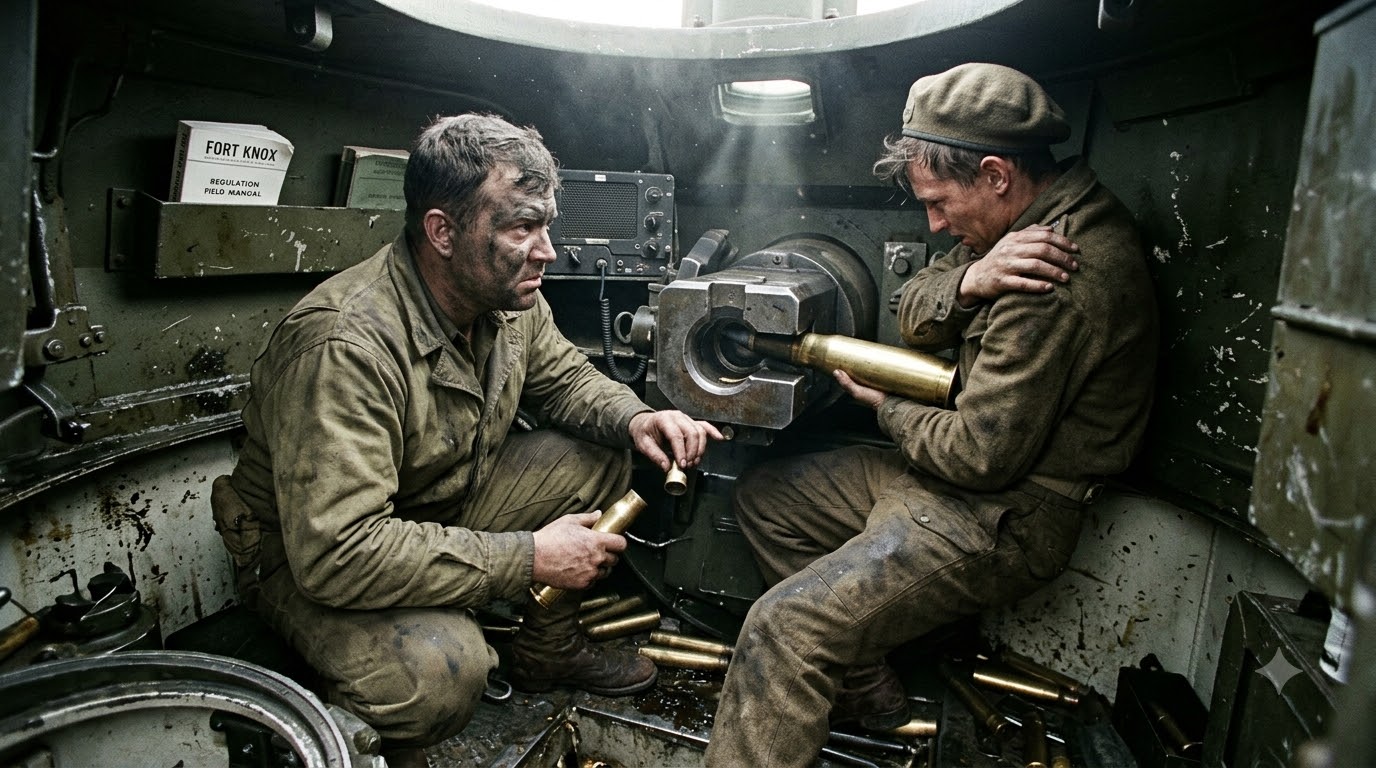
The M4 Sherman turret smelled of hot oil, cordite, and unwashed wool.
At 11:23 a.m., the world narrowed to the 7-foot iron cage of the fighting compartment.
Outside, three German Panzer IV tanks were closing the distance across the French hedgerows at 800 yards.
Inside, the gunner screamed raw coordinates while the driver threw the transmission into a desperate reverse.
Walter pressed his back against the cold steel of the turret wall to keep from vomiting.
His right shoulder was a screaming knot of agony where a deflected high-explosive round had popped the joint out of socket two days prior.
The battalion medic had forced it back in, but the muscle was torn, weak, and utterly useless for heavy lifting.
The standard training manual from Fort Knox was very clear.
Face the breech. Two hands on the shell. Push straight forward.
The manual assumed a healthy, right-handed loader standing in a spacious, perfectly stable room.
It assumed nothing about mud, terror, a cramped turret, or a torn rotator cuff.
The gunner slammed his boot against the traverse floor ring.
“Load! Move, you idiot!”
Walter reached blindly into the ready rack for the first 38-pound high-explosive round.
His fingers brushed the cold brass casing,slick with his own nervous sweat mixed with machine grease.
He tried to square his shoulders to the breech the way the instructors back in Kentucky had drilled into him.
He lifted the heavy shell with his right arm.
His shoulder shrieked, the joint popping with a dull internal click.
The 38-pound weight tilted dangerously toward the floorboards.
The turret bounced violently as the tank rolled over a ditch, throwing Walter off balance.
The window to fire was vanishing by the second, and the German Panzers were already sighting their barrels through the morning fog.
CHAPTER 2: THE BACKWARD PIVOT
Walter didn’t think about the training manual from Fort Knox.
There was no room for standard doctrine when a 38-pound piece of brass was slipping toward the rusty floorboards.
His right shoulder burned with a searing, white-hot agony that stole the breath straight from his lungs.
Sergeant Miller roared an order from the commander’s hatch, his voice muffled by the shrieking grind of the tank’s motor.
“Keep that gun loaded! They’re zeroing in on our flank!”
Walter stared at the breech mechanism just inches from his chest.
If he tried to face it head-on with one dead arm, the heavy shell would drop, and the Panzers across the field would finish their bracket.
Panic stripped away every rule he had memorized during basic training.
He whipped his body around, planting his back squarely against the hot metal of the breech housing.
His left hand reached backward into the dark void like a blind man searching for a door handle.
His fingers found the cold rim of the brass casing instantly.
He used his back and his left shoulder muscles—ignoring the tearing pain in his collarbone—to shove the heavy shell backward.
The mechanism caught it with a sharp, metallic bite.
The breech slammed shut.
The gunner didn’t hesitate, yanking the firing lanyard with a violent yank.
The recoil slammed through the small turret like a sledgehammer, filling the air with acrid cordite smoke and stinging heat.
Walter’s neck scorched against the hot air, but he didn’t blink.
He was already reaching back for the next round.
CHAPTER 3: THE QUIET RECKONING
Walter’s left hand gripped a hot brass shell casing with soot staining his knuckles, the residual heat pulsing against his palm long after the firing lanyard fell still.
Outside the steel hull, the silence of the French hedgerow settled in like heavy fog, broken only by the distant clank of tracks and the popping of cooling metal.
Sergeant Miller crouched down from the commander’s hatch, his boots thudding against the turret floor as he slid into the cramped space.
The sergeant’s face was caked in black grease and gray dust, his eyes fixed entirely on Walter’s awkward posture.
Miller reached out, his calloused fingers tapping sharply against the edge of the breech mechanism.
—That shouldn’t have worked, Miller muttered, his voice dropping into a gravelly whisper.
Walter said nothing, pressing his back against the bulkhead to ease the burning throb in his collarbone.
Miller picked up an empty brass casing from the floor rack, turning it over in his palms while his brow furrowed in deep calculation.
The regulation field manual rested in the rack behind the radio mount, its pristine pages demanding that every soldier face the breech head-on.
Miller stared at the manual, then back at Walter’s soot-blackened back, weighing the heavy penalty of court-martial against the hard math of survival.
—If command catches wind you’re throwing rounds backward like a madman, they’ll bust us both down to latrine duty, Miller whispered, his jaw tightening into a hard line.
Walter rolled a small, oil-stained iron washer between his fingers, keeping his eyes locked on the narrow slit of the periscope.
—They can bust us after we stop getting killed out here, Walter replied quietly.
Miller didn’t answer for a long, heavy moment, his thumb tracing the edge of the brass casing as he weighed the dangerous cost of breaking the rules.
CHAPTER 4: WHISPERS IN THE MUD
Sergeant Miller slid the brass casing back into the rack with a sharp, echoing metallic snap.
The sound cut through the damp air of the maintenance shed behind the frontline motor pool, where canvas tarps dripped with cold autumn rain.
Outside, two replacement loaders from the neighboring platoon were struggling to heave heavy ammunition crates off the back of a truck, their boots sliding in the thick French clay.
Walter sat on an overturned fuel tin, rubbing his aching shoulder while watching the men fumble with their awkward grips.
The standard military training manuals dictated a strict two-handed frontal approach, but the mud and the tight confines made every textbook movement a sluggish trap.
—They’re moving too slow, Miller muttered, wiping black grease from his forehead with the back of a stained glove.
—They’re doing it by the book, Walter replied, his voice flat and dry as he tossed a spare bolt onto the workbench.
By the book meant dying in three seconds flat when a Panzer rounded a hedgerow.
Across the muddy yard, a young loader named Jenkins dropped a heavy shell into the dirt, cursing under his breath as senior corporals shouted warnings.
Walter stood up slowly, ignoring the sharp twinge in his collarbone, and walked out into the cold drizzle without a word of introduction.
He didn’t hand out pamphlets or quote regulations; he simply demonstrated the motion once behind the shadow of an armored hull—turning his back to an imaginary breech, guiding the weight home with a swift, compact pivot of his left arm.
Jenkins watched the movement twice, his eyes widening as he realized how little space the unconventional stance required in the cramped hull.
Within the hour, three more crews behind the maintenance sheds were quietly turning their backs to their gun breeches, trading military protocol for raw survival.
CHAPTER 5: THE COLONELS CRUCIBLE
Jenkins gripped a spare casing behind the hull, his left shoulder squared against the metal in quiet defiance of the standard manual.
The heavy roar of an approaching command vehicle cut through the morning mist, its engine idling with an aggressive, authoritative hum.
Lieutenant Colonel Abrams stepped out from the lead jeep, his boots crunching sharply into the frozen mud of the training ground.
His eyes swept over the motor pool with cold, calculating precision before locking onto the irregular stance of the crew standing by the tank.
Abrams strode across the gravel, his leather gloves slapping rhythmically against his thigh as he stopped three feet from the chassis.
—What in tarnation are you men doing out of position? Abrams demanded, his voice slicing through the damp air like a razor.
Jenkins froze, his fingers tightening instinctively around the brass cylinder while the rest of the crew fell into a rigid, nervous silence.
Sergeant Miller stepped forward from the hatch, his face hardening as he braced to take the full weight of the impending reprimand.
—We’re loading by the numbers that actually keep us breathing, sir, Miller replied, his tone flat and unyielding.
Abrams glared at the sergeant, then jerked his chin toward the open turret hatch with a sharp, impatient motion.
—Get inside that hull and show me right now, Abrams snapped, crossing his arms over his chest.
Walter stepped out from the shadows of the maintenance shed, his injured shoulder aching with a familiar, dull throb as he met the colonel’s fierce gaze.
There was no retreat left, and no manual in the world could argue with the raw physics of survival.
CHAPTER 6: THE UNWRITTEN STANDARD
Walter’s boots sank into the wet gravel as he reached for a heavy shell casing under Abrams’ watchful eye.
The colonel didn’t blink, his arms remaining locked across his chest while he tracked every micro-movement of Walter’s injured frame.
Without a word of warning, Walter spun his back squarely against the breech, his left hand sweeping behind him to guide the brass home with ruthless, unbroken momentum.
The mechanism slammed shut in under three seconds flat, echoing sharply across the silent motor pool.
Abrams stared at the breech, then down at his stopwatch, his expression hardening into absolute realization.
—That violates every regulation in the field manual, Abrams muttered, his voice dropping into a dangerous, low register.
Sergeant Miller stepped forward, his jaw set like iron against the threat of a court-martial.
—It violates the book, Colonel, but it keeps the men alive out in the hedgerows, Miller countered without a flinch.
Abrams stood motionless for thirty long seconds, the cold wind whipping his wool coat against his ribs while he weighed theory against the brutal math of the front lines.
—Then tear up the damn manual, Abrams ordered, his voice carrying across the entire battalion yard.
Within days, General Patton’s command swept through the Third Army, turning an unwritten survival trick into the permanent standard across thousands of Sherman tanks.
The regulations at Fort Knox remained unchanged on paper, but out in the mud, common sense had finally broken through the red tape.
Years later, Walter stood in his quiet Detroit garage, working an oil-stained wrench between his calloused fingers with no medals on his chest and no official mention in the national archives.
The roaring engines and the burning fields were long gone, replaced by the steady hum of a lathe and the quiet peace of an ordinary life well earned.
He didn’t call himself a hero, because to him, it was never about glory or grand strategy.
It was just a hard-working man fixing a broken machine, turning his back to the danger, and doing what needed to be done.