The Weight of Worn Shoes: How a Forgotten Child Read the Past to Claim His Future
CHAPTER 1: THRESHOLD OF GLASS
Thomas Webb’s hand clamped on Elijah’s shoulder.
Rough.
Public.
Like grabbing a stray dog.
“What the hell? Get away from that display. You people always looking for something to steal?”
“I’m sorry, sir. I just wanted to read.”
“Read? Don’t play games with me, kid. Homeless thugs don’t read ancient languages. You probably can’t even spell your own name. Now, get out before I drag you out.”
Dr. Sinclair’s assistant walked past. She saw the whole thing. Kept walking.
Elijah held a crumpled flyer in his free hand.
The museum seeks volunteer translators. All languages welcome.
Nobody looked twice.
Inside the third-floor lab, twelve PhDs surrounded a document worth $200 million. Ancient script. Impossible to decode. The answer was waiting in the hands of the boy they had just humiliated.
The delivery truck had arrived at 7:15. Elijah had slipped through the loading dock while Webb argued with the driver about paperwork. He followed the urgent, frustrated voices coming straight from the conservation lab.
The heavy oak door stood half open.
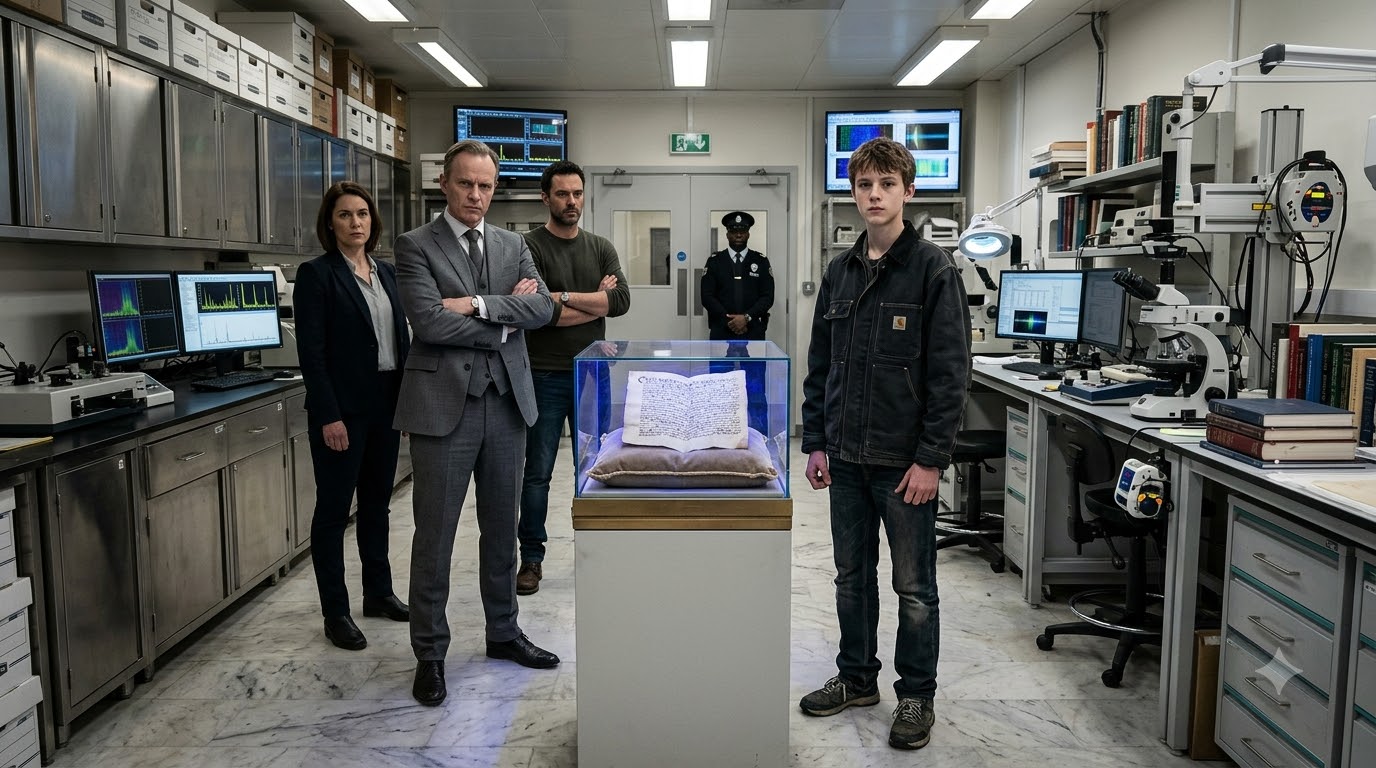
Elijah stopped on the threshold. Twelve people crowded around a glass case. Scholars in expensive clothes. Three faces glowing on video screens. Everyone staring at a single piece of parchment under ultraviolet light.
“We have forty-eight hours.”
Dr. Margaret Sinclair spoke with the weight of someone who had completely stopped sleeping. Her white lab coat bore faint coffee stains.
“Forty-eight hours before the Egyptian delegation arrives. This contract determines ownership of artifacts worth two hundred million dollars.”
A younger man with an expensive watch gleaming on his wrist leaned closer.
“Dr. Sinclair, the symbols don’t match any known Coptic dialect we’ve cataloged.”
“I can see that, Marcus.” Her jaw tightened.
On the largest screen, a man with thick glasses frowned. Dr. Ramon Ortiz.
“Margaret, I’ve run it through every database. The syntax is completely irregular. It’s like they invented their own commercial shorthand.”
Elijah’s eyes moved across the document. His lips parted silently.
Reading.
The symbols made sense. Perfect sense. It wasn’t pure Coptic. It was Sahidic mixed with Judeo-Aramaic commercial abbreviations. The kind merchants used along ancient Nile trade routes.
Jennifer, the assistant, glanced toward the door. Saw him standing there.
“Security!” Her voice cut through the room. “There’s someone—”
Elijah didn’t think. The words simply came out.
“It’s not Coptic. It’s Sahidic mixed with Judeo-Aramaic commercial shorthand.”
Every head turned. They saw a skinny kid in an oversized jacket standing in a room where he absolutely did not belong.
The room went dead silent.
CHAPTER 2: THE FIRST TRANSLATION
Elijah stood on the threshold of the conservation lab, his fingers tightening around the strap of his oversized jacket.
Twelve pairs of eyes drilled into him. Expensive wool suits, polished loafers, and expressions ranging from sheer annoyance to utter disbelief.
“I’m standing right here,” Elijah said, his voice dropping into the quiet space between the UV lamps. “I can hear you.”
Dr. Margaret Sinclair turned away from the glass case, her white lab coat sweeping against the metal frame. Her eyes locked onto his with an intensity that made him want to step backward into the hallway.
“How old are you?” she asked.
“Fifteen, ma’am.”
Murmurs rippled through the room like dry leaves scraping across concrete. Someone near the back let out a sharp, dismissive scoff.
“Fifteen,” Marcus repeated, crossing his arms over his chest as his expensive watch flashed under the overhead lights. “This is what we’re doing now? Listening to stray kids off the street?”
Dr. Sinclair ignored Marcus completely, stepping closer to the glass partition.
“Where did you learn about Sahidic-Aramaic hybrid scripts?”
Elijah shifted his weight again, feeling the grit of street dust grinding beneath his worn soles.
“I read about it. In a book.”
“Which book?”
“Kaufman’s comparative analysis of Semitic trade languages.” Elijah kept his voice flat, steady, forcing the words past a throat dry from the morning air. “The library had it in the reference section.”
Dr. Sinclair’s eyebrows rose fractionally. That specific text was a graduate-level monolith. Most doctoral candidates struggled past the first three chapters.
“You read Kaufman?”
“Yes, ma’am.”
“The whole thing?”
“Yes, ma’am.”
The silver-haired scholar near the corner shook her head, adjusting her glasses with a sharp click of metal. “Margaret, this is absurd. We are facing a multi-million-dollar deadline, and we are questioning a child.”
Dr. Sinclair didn’t blink. She kept her gaze fixed on Elijah’s face, searching for hesitation, for a lie, for anything that would give her an excuse to look away.
“Can you read any of this document?” she asked.
Marcus stepped directly into Elijah’s line of sight, his jaw tight. “Dr. Sinclair, we cannot seriously—”
“I asked him a question, Marcus.” The coldness in her tone could have frozen water in midair. She turned back to Elijah. “Can you read it?”
Elijah stepped forward. The scent of chemical preservatives and old, brittle leather washed over him, thick and ancient.
His sneakers squeaked once on the polished marble. The sound felt deafening in the silence.
He didn’t touch the glass. He kept his fingers curled tightly into his palms, hovering just inches above the surface where the light hit the cracked parchment.
“Line three,” Elijah whispered.
The words formed on his tongue like something he had spoken a thousand times before.
“It says, ‘Between the merchant Theophilus and the temple administrator…'”
Dr. Ramon Ortiz stared into his camera feed from across the country, his fingers freezing over his keyboard.
“Wait,” Ortiz breathed, his face draining of color on the monitor. “The fragment we already confirmed—the merchant’s name…”
Ortiz looked down at his own notes, then back at the screen.
“He’s right. How is he right?”
CHAPTER 3: BOARDROOM RESISTANCE
Marcus tapped the screen with a manic speed, his knuckles turning white under the fluorescent glare.
“This is completely irregular,” Marcus muttered, his eyes darting from his device back to the glass display case. “An untrained minor cannot simply walk off the street and upend six months of structural analysis.”
Dr. Sinclair didn’t look at him. She kept her focus locked on the subtle contours of the parchment where a tiny, misplaced ink smudge marred the margin.
“The translation holds, Marcus,” she said, her voice carrying a quiet, dangerous finality. “Unless you have a better reading for the merchant’s liability clause.”
Marcus opened his mouth to reply, but the heavy glass doors at the end of the corridor slid open with a soft hiss.
Richard Holloway strode into the third-floor space, his tailored three-piece suit rustling with expensive authority. His gaze swept over the room, pausing instantly on Elijah’s worn sneakers and oversized jacket.
“Margaret,” Holloway’s voice boomed, carrying the practiced resonance of a man used to commanding boards of directors. “What is the meaning of this report? The legal team downstairs is in a panic.”
“They should be,” Dr. Sinclair replied, stepping between the director and the display case. “They were missing a two-hundred-million-dollar clause.”
Holloway crossed his arms, his posture stiffening as he stared down at Elijah with undisguised irritation.
“We are hosting an international delegation tomorrow morning,” Holloway said, keeping his voice carefully modulated for the video feeds. “We cannot present a child with no credentials as our institutional anchor. The optics are disastrous.”
“The optics are accurate,” Dr. Sinclair shot back, her jaw tightening. “The document is translated correctly.”
“Correct according to whom? A boy who doesn’t even have a permanent address?” Holloway turned his gaze directly toward Elijah, his eyes narrowing into cold slits. “Listen to me, kid. The real world doesn’t run on library books. You don’t belong in this room.”
Elijah felt the blood rush to his ears, the old, familiar weight of dismissal settling onto his shoulders like wet cement.
He didn’t shrink back. Instead, his fingers brushed against the crumpled flyer in his pocket, feeling the rough paper fibers grounding him against the marble floor.
“I read the contract, sir,” Elijah said, his voice quiet, cutting effortlessly through the director’s bluster. “And the liability clause isn’t about trade taxes. It’s about hidden debt.”
Holloway’s expression froze, the polished veneer cracking for a fraction of a second before he hardened his stance.
CHAPTER 4: THE DELEGATIONS TEST
The gold ring struck the wood again.
Clack. Clack.
“You’re missing the point entirely, Margaret,” Holloway said, his voice dropping an octave as he leaned over the table. “This isn’t about scholarship. This is about presentation.”
“This is about a two-hundred-million-dollar contract,” Dr. Sinclair countered, her posture rigid as she stood her ground beside the display case. “The Egyptians arrive in black cars at eight o’clock tomorrow morning. They don’t care about designer suits. They care about accuracy.”
Marcus hovered near the edge of the room, his phone buzzing incessantly against his palm.
“If the delegation sees a kid from the loading dock handling their national patrimony,” Marcus muttered under his breath, “they’ll walk out before the ink dries.”
Elijah didn’t look at Marcus. He kept his eyes fixed on the small margin smudge near the bottom of the parchment.
“They won’t walk out,” Elijah said quietly, the sound cutting through the polished office with the weight of absolute certainty. “Because the terms match their trade manifests from the fourth century.”
Holloway spun around, his face flushing a mottled pink. “Nobody asked you, kid. This is a matter for adults who understand institutional risk.”
“He’s right,” Dr. Sinclair said, stepping closer to Elijah’s side. “And tomorrow morning, he translates the secondary fragment right in front of Dr. El Sayed.”
The heavy glass doors slid open once more, and the first black sedan pulled up to the curb below, casting long, fractured headlight beams across the ceiling.
CHAPTER 5: THE CALENDAR TRAP
The pen rolled across the patterned rug, silent and heavy, while Dr. El Sayed stepped into the center of the room with his delegation behind him.
“We have reviewed your primary translations,” Dr. El Sayed began, his voice level and entirely unreadable. “They are remarkably accurate. But a discrepancy has emerged in the calendar conversion on line forty-three.”
Director Holloway stiffened, his fingers locking onto the edge of the mahogany table.
“A discrepancy?” Holloway’s voice hitched slightly. “That’s impossible. Our team verified the dates twice.”
“The Coptic calendar year does not seamlessly align with the Roman year required for international legal standing,” Dr. El Sayed continued, stepping closer to the display cases. “If this conversion is off by even a single digit, the entire multimillion-dollar agreement fails validation.”
Marcus began typing frantically on his device, his breath coming in short, ragged gasps.
“We need the Coptic calendar codex from deep storage,” Marcus blurted out, his face draining of color. “It will take at least six hours to retrieve and authenticate it.”
Dr. El Sayed checked his gold watch with a sharp, deliberate snap of his wrist.
“Our flight leaves at eight o’clock tonight. Without verification, we cannot sign.”
The room plunged into an icy, suffocating silence. Holloway looked ready to collapse into his leather chair, his corporate bluster entirely evaporated.
Elijah stared down at the polished wood of the table, his chest tightening as the weight of the entire institution settled squarely onto his narrow shoulders.
“I remember the tables,” Elijah said, his voice barely audible over the hum of the overhead lights.
Every head in the room whipped around to stare at him.
“Elijah, no,” Dr. Sinclair murmured, her hand hovering protectively near his arm. “The codex has four hundred pages of dense calendrical calculations. You cannot be expected to—”
“I read it,” Elijah interrupted, his jaw set as he met Dr. El Sayed’s searching gaze. “Two years ago. I can verify the conversion right now.”
Holloway let out a harsh, desperate laugh. “This is absurd! We are staking an international treaty on a kid’s memory?”
“Young man,” Dr. El Sayed said, his eyes narrowing with intense scrutiny. “If you are wrong, years of diplomatic work are destroyed. Do you understand the weight of that?”
“I understand,” Elijah answered, his fingers curling tightly against the edge of the table. “Give me the numbers.”
CHAPTER 6: THE NEW FOUNDATION
The telephone on Dr. Sinclair’s desk shattered the silence with a shrill, piercing ring.
Dr. Sinclair snatched the receiver before the second echo could fade against the marble walls.
“Yes. Speak,” she commanded into the mouthpiece.
The archivist’s voice crackled through the speaker, thin and breathless. “Page two hundred and forty-seven, third column confirmed. Coptic calendar year one thousand fifty corresponds to Roman year three hundred thirty-four Common Era. The boy… he was entirely correct.”
Director Holloway slumped backward into his leather chair, the color draining completely from his face.
Dr. El Sayed stepped forward, his expression shifting from guarded skepticism to profound respect as he extended a steady hand toward Elijah.
“Young man,” Dr. El Sayed said, his voice carrying clearly across the stunned room. “You have achieved what institutional archives failed to manage in six months. Your name belongs on this contract.”
Holloway opened his mouth, attempting a final desperate protest about protocol and junior standing, but the international legal team cut him off with sharp, dismissive murmurs.
The contract was signed under the glare of camera flashes, with Elijah Carter’s name inked permanently into the primary translator line.
Three months later, the marble floors of the museum no longer felt like a place to be feared.
Elijah sat at his own desk in the conservation lab, the soft glow of a reading lamp illuminating the Byzantine manuscript spread out before him.
The heavy glass doors clicked open behind him.
Dr. Sinclair paused in the doorway, holding a fresh cup of coffee and a warm jacket.
“Don’t stay too late, Elijah,” she said softly. “You have school tomorrow morning.”
“I know,” Elijah replied, a quiet smile touching the corners of his mouth. “Thanks, Mom.”
The word hung in the air, warm and solid, replacing every cold stone and locked door from the past.
Through the tall glass windows, the city lights twinkled across the New York streets where he used to search for a place to sleep.
He didn’t need to search anymore.
He belonged right here.