The Quiet Inheritance: How Patient Silence Dismantled an Empire Built on Arrogance and Deception
CHAPTER 1: THE COURTYARD SNATCH
The morning sun over the Hargrove estate brought no warmth.
Eleanor held the small velvet box, its fabric worn thin by decades of use.
Her fingers brushed the cold metal of her grandmother’s brooch inside.
Three words sat folded in her coat pocket, inked in her father’s steady hand.
For my Eleanor.
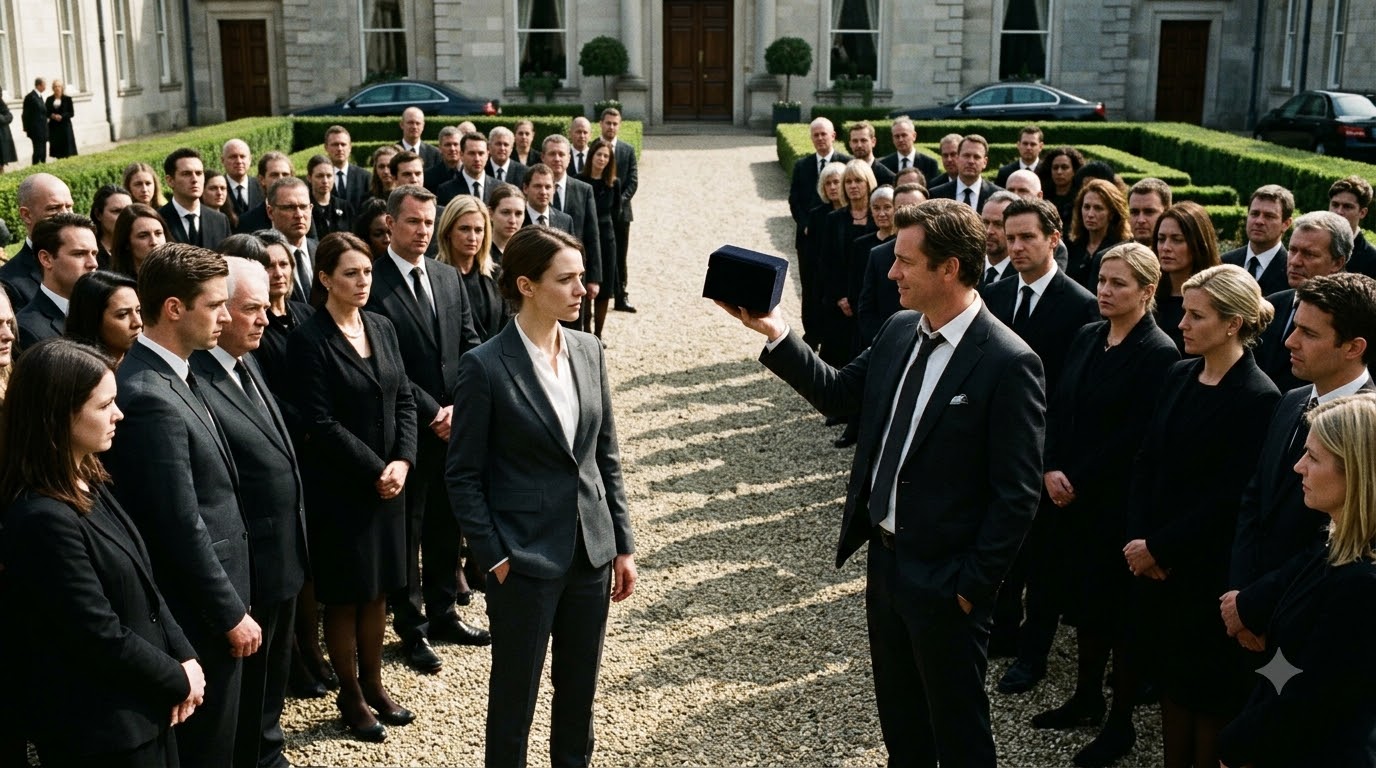
Around them, two hundred mourners murmured in muted tones, dressed in the heavy wool and dark silk of grief.
Thomas stood near the front, adjusting his lapel with the practiced solemnity of a man performing for an audience.
Richard Callaway walked across the manicured grass with Diana Wells on his arm.
His stride was unhurried, measured by the absolute confidence of a man who believed the hardest calculations were already finished.
He stopped directly in front of Eleanor.
His eyes dropped to the open box.
A tight, dismissive smile touched the corners of his mouth.
Richard reached out without asking, his fingers closing over the velvet edges.
He lifted the box from her hands and turned, offering it to Diana.
“That’ll look better on someone who actually meant something to him,” Richard said loud enough for the nearest mourners to hear.
The air vanished from the courtyard.
Eleanor did not pull her hands back.
She did not lurch forward, and she did not raise her voice.
She simply watched him with the heavy, unblinking stillness of stone.
She looked at Richard the way a mechanic looks at a rusted bolt that refuses to turn, measuring the resistance before the torque.
Slowly, she let her empty hands drop to her sides.
She reached into her coat pocket, felt the crisp edge of the folded note, and pressed her thumb against it.
“Keep it,” Eleanor said, her voice flat and devoid of tremor.
Richard gave a short, dry laugh, entirely misreading the quiet chill in her tone as defeat.
He turned away to guide Diana toward the seating area.
Eleanor walked to her designated row, her boots crunching softly on the gravel, keeping her eyes fixed straight ahead.
CHAPTER 2: THE STUDY FILES
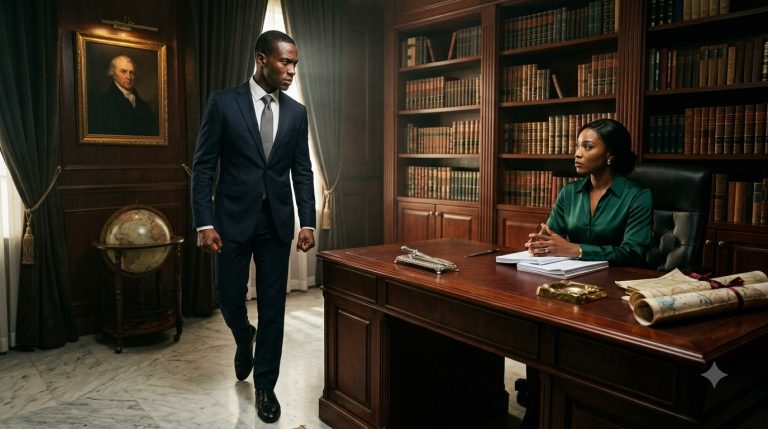
Eleanor pushed the heavy oak door open. The study was dim, the heavy curtains drawn tightly against the glaring afternoon sun.
Margaret Cole sat behind Franklin’s massive desk. She wore the same charcoal suit she had worn to the funeral, her posture rigid, her hands resting flat on either side of a single, red-banded folder.
Neither woman offered a greeting. The time for hollow condolences had expired the moment Richard Callaway opened his mouth in the courtyard.
Eleanor crossed the room. Her low heels sank into the thick Persian rug, deadening the sound of her approach. Her legs ached with a dull, throbbing exhaustion that had settled deep into her bones over the last three days.
She took the leather wingback chair opposite Margaret.
Eleanor reached into her coat pocket. She didn’t pull out the folded note. She just pressed her thumb against the crisp edge of the paper through the fabric, grounding herself.
Then, she reached across the desk and picked up her father’s scarred silver pen. It was heavy, dented near the cap from years of Franklin tapping it against the mahogany when a number didn’t align.
Margaret slid the red-banded folder across the polished wood. The friction of the cardboard made a dry, scraping sound.
“Richard built Calloway Group on the assumption of permanence,” Margaret said, her voice entirely devoid of inflection.
Eleanor opened the folder. The silver pen rested between her fingers. She didn’t write. She just used the blunt metal tip to trace the first line of the top document.
“He leveraged our name,” Eleanor replied, her eyes scanning the dense legal text. “He told his clients he had insider access.”
“He did more than that.” Margaret leaned forward slightly. “Your father allowed him to anchor Calloway Group’s primary credit facility directly to a Hargrove subsidiary trust. Richard used it to guarantee millions in commercial acquisitions.”
Eleanor stopped the pen. She pressed the metal tip into the paper just hard enough to leave an indentation.
“Richard doesn’t have the liquidity to cover those acquisitions if the guarantee is pulled,” Eleanor stated bluntly.
“Exactly.” Margaret pulled a secondary ledger from her briefcase and placed it squarely on the desk. “And your father structured that specific subsidiary trust to dissolve automatically upon the execution of his will.”
The silence in the study grew dense. The faint hum of the central air conditioning suddenly sounded like a roar in Eleanor’s ears.
She stared at the numbers. Richard had spent the last five years acting like a king, entirely oblivious that he was sitting on a throne held up by a single rotting wooden beam. And Franklin had rigged the beam to snap the moment his heart stopped beating.
Margaret frowned, her index finger pausing on the secondary ledger.
“There is one minor discrepancy,” Margaret murmured, tracing a line on the index. “The master transfer log lists a secondary protection clause for the subsidiary assets. But the physical transfer sheet—the one bearing the final signature—isn’t in this stack.”
Eleanor looked up. The silver pen rolled slowly between her thumb and forefinger.
“Does it stop the dissolution?” Eleanor asked.
“No,” Margaret said firmly. “But it dictates exactly how fast the banks will issue the margin calls to Richard’s firm. We need that document to seal the perimeter.”
Eleanor looked back down at the folder. In her mind’s eye, she saw Richard smiling in the courtyard, handing her family’s legacy to another woman. He thought he had already won. He thought she was just a quiet, helpless woman standing in his way.
She tapped the heavy silver pen against the desk. Once.
“Find the signature, Margaret,” Eleanor said, her voice dropping to a low, flat whisper. “I want the perimeter locked before he even realizes he’s trapped.”
CHAPTER 3: THE GREENWICH SILENCE
The front door of the Greenwich house stuck slightly on the frame. It always did when the humidity spiked.
Eleanor pushed her shoulder against the heavy wood, forcing it open with a dull thud. The entryway smelled strongly of expensive citrus cleaner, masking the stale air of a house that had been empty for too long.
She dropped her keys into the brass bowl on the console table. They hit the metal with a harsh clatter.
Richard was in the living room.
He sat on the white leather sofa, one leg crossed over the other, a highball glass resting loosely in his hand. He hadn’t bothered to change out of his funeral suit, though he had discarded the tie.
He didn’t look up when the keys dropped. He was scrolling through his phone, his thumb flicking across the screen with practiced, lazy rhythm.
“You’re back late,” Richard observed. He took a slow sip from the glass. The ice clinked gently against the crystal.
Eleanor stood in the archway. The exhaustion from the drive, from the funeral, from the suffocating three days in the hospital room, pulled at her shoulders like wet sand.
She looked at him. She looked at the man who had ripped her grandmother’s brooch from her hands in front of her entire family.
“Traffic on 95,” Eleanor said. Her voice was flat, a sheet of gray slate.
She walked past the sofa, not pausing, and headed toward the kitchen. The marble floor was cold through the thin soles of her shoes.
“I was talking to Thomas before we left,” Richard called out after her. The casualness in his tone was thick, aggressively normal. It was a performance designed to erase what he had done in the courtyard by simply refusing to acknowledge it.
Eleanor turned the tap in the kitchen sink. Cold water rushed over the stainless steel. She filled a glass, gripping the sides until her knuckles whitened.
“He thinks the transition is going to be messy,” Richard continued, his voice projecting easily through the open floor plan. “Without Franklin micro-managing every subsidiary, the board is going to want to restructure.”
Eleanor drank the water. It was so cold it hurt her teeth.
“Thomas doesn’t understand the subsidiaries,” Eleanor replied. She kept her back to him, staring out the window into the dark backyard.
“Well, he understands enough to know that Calloway Group is going to need a more formal advisory role moving forward.”
The audacity was so heavy it was almost a physical presence in the room. He wasn’t just ignoring the courtyard; he was actively planning how to spend the inheritance he assumed she would quietly hand him.
Eleanor set the glass down on the granite counter.
She reached into her coat pocket. Her thumb found the heavy silver pen she had taken from the study. She rolled it slowly against the fabric.
“A formal role,” Eleanor repeated.
Richard appeared in the kitchen doorway. He leaned against the frame, the highball glass swaying slightly in his hand. The warm, trustworthy smile he used on clients was pasted perfectly across his face.
“It just makes sense, El,” he said, using the nickname she hated. “Your father built a machine, but it’s old. It needs new leverage. My firm has the modern client base. We integrate the portfolios, we streamline the debt structure…”
He took another sip.
“It’s what’s best for the family.”
Eleanor turned around. She looked at the expensive suit, the confident posture, the absolute certainty in his eyes that she was a stepping stone.
She felt the cold silver pen in her pocket.
“I suppose we will see what the documents dictate,” Eleanor said softly.
Richard chuckled, a low, dismissive sound. “Documents are just paper, Eleanor. It’s about who controls the narrative now.”
He turned and walked back toward the living room, leaving the scent of scotch and citrus cleaner in his wake.
Eleanor stayed by the sink. She pulled the pen from her pocket and held it under the kitchen light.
The narrative, she thought.
She tapped the pen once against the granite.
It was time to let him start talking to the banks.
CHAPTER 4: THE ADVISORY PRESSURE
Richard stepped out of the elevator on the thirty-second floor, his tailored wool coat swinging with the practiced rhythm of a man accustomed to owning whatever room he entered.
He didn’t check his reflection in the polished brass doors. He didn’t need to.
His phone buzzed against his thigh, a short, urgent vibration from his lead acquisitions coordinator regarding a multi-million-dollar commercial portfolio tied directly to the Hargrove subsidiary line.
Richard flicked the screen open with his thumb, walking down the carpeted corridor without breaking his stride.
“Push the closing date to Friday,” Richard said into the phone, his voice dropping into its smooth, confident pitch. “The Hargrove subsidiary credit line is clearing the audit this week. There’s nothing to worry about.”
He ended the call just as he reached his corner office.
Inside, the panoramic view of the skyline stretched out behind his mahogany desk like a conquered territory.
Richard dropped his leather briefcase onto the surface. It landed with a heavy, satisfying thud that echoed off the glass walls.
He unbuttoned his suit jacket, feeling the slight pull of the fabric across his chest, a minor biological protest to the heavy breakfast he hadn’t fully digested.
He ignored it. He was moving too fast to feel tired.
“Mr. Callaway,” his assistant said, stepping through the doorway with a stack of quarterly reports cradled against her chest. “The representatives from the Mercantile Bank are on line two. They’re asking for written confirmation of the subsidiary asset guarantee before they release the next tranche of capital.”
Richard picked up his silver fountain pen—a gift he had bought himself three years ago to celebrate his first major corporate expansion—and spun it between his fingers.
“Tell them the paperwork is being finalized by Margaret Cole’s office,” Richard instructed, not looking up from the desk. “Tell them it’s standard estate processing. They’ll back off once they hear Margaret’s name.”
The assistant hesitated, shifting the heavy folders in her arms. A faint bead of sweat formed near her hairline under the harsh office lights.
“I tried calling Ms. Cole’s office this morning,” she said quietly. “Her assistant said the file hasn’t been logged under Calloway Group.”
Richard stopped spinning the pen.
The silence in the office suddenly felt thin, stretched tight over a vacuum.
“What do you mean, it hasn’t been logged?” Richard asked, his voice losing its easy cadence.
“They said the primary credit facility associated with that subsidiary trust was moved to a separate holding account late last night,” she replied, her eyes dropping to the carpet. “They wouldn’t give me the docket number.”
Richard stood up from the desk. The leather chair rolled backward, bumping softly against the glass partition.
His chest tightened, a sharp, uninvited jolt of adrenaline cutting through his carefully constructed confidence.
“Get me Eleanor,” Richard snapped, his hand gripping the edge of the mahogany desk until his knuckles turned bone-white. “She’s at the Greenwich house. Tell her to call Margaret right now.”
CHAPTER 5: THE UNRAVELING LEDGER
Margaret Cole did not raise her eyes from the document when the phone on her desk buzzed.
She let it ring three times before pressing the speaker button with the tip of a heavy brass letter opener.
“The line is secure, Eleanor,” Margaret said, her voice cutting cleanly through the hum of the office.
Eleanor stood by the tall arched window of the Charleston estate study. Outside, the moss-draped branches of the live oaks swayed slowly in the heavy afternoon humidity.
“Is the subsidiary transfer sheet secured?” Eleanor asked.
“That is precisely what we are examining now.” Margaret turned a heavy page of parchment, the sound dry and sharp in the quiet room. “The master index lists the primary asset transfer, but the secondary page bearing the final operational authorization signature is still missing from the active binder.”
Eleanor pressed her thumb against the wooden window frame. The paint was old, flaking slightly under the pressure of her grip.
“Richard thinks the banks are just processing standard estate delays,” Eleanor said, her voice entirely flat. “He hasn’t realized the credit line has already been severed.”
“He will realize it by four o’clock this afternoon,” Margaret replied, her fingers tracing a blank line at the bottom of the ledger. “Once Mercantile Bank issues the formal margin call on his commercial acquisitions, his liquidity will drop to zero.”
Margaret stopped moving her hand.
Her gaze locked onto a small, handwritten notation tucked into the bottom margin of the previous page—a marginal note written in Franklin Hargrove’s unmistakable, precise script.
“Eleanor,” Margaret murmured, leaning closer to the desk. “Look at the registry number on the subsidiary asset allocation.”
Eleanor turned away from the window, crossing the Persian rug in three measured strides. She leaned over the mahogany desk, her eyes scanning the marginalia.
“My father’s handwriting,” Eleanor whispered.
“Indeed.” Margaret tapped the paper with her brass letter opener. “He didn’t misplace the signature sheet. He withheld it intentionally. He left it locked in the private wall safe behind his portrait, accessible only to you.”
Eleanor stared at the inked numbers.
Franklin hadn’t just built a trap for Richard; he had left the final, crushing weight entirely in his daughter’s hands, waiting for her to pull the last bolt.
The heavy oak door of the study creaked open a fraction of an inch, revealing the dim hallway outside.
CHAPTER 6: THE FINAL COLLAPSE
Inside the shallow recess of the wall safe sat a single, cream-colored envelope bearing her father’s handwriting.
Margaret watched from across the desk, her expression tight and unyielding.
“Open it,” Margaret instructed.
Eleanor lifted the envelope out. She slid her thumb under the flap, tearing the paper with a dry, ripping sound that broke the stillness of the study.
Inside was the missing operational signature sheet, complete with Franklin’s final, binding authorization date.
The telephone on the mahogany desk rang.
It wasn’t a standard ring. It was the private line—the direct emergency feed reserved exclusively for executive crises.
Margaret picked up the handset on the first ring.
“Cole,” she said.
She listened for five seconds. She did not blink.
“Execute the transfer log immediately,” Margaret said, and hung up the phone.
She looked up at Eleanor. “Mercantile Bank just issued the full margin call to Calloway Group. Their revolving credit facility has been frozen.”
A heavy silence settled over the room.
The door to the study pushed wide open, slamming against the oak bookshelf with a loud, jarring crash.
Richard stood in the doorway.
His expensive suit was rumpled, the tie completely missing, his face flushed dark with raw, unmitigated fury. He had driven down from New York without stopping, his entitlement finally cracking under the weight of absolute financial ruin.
“What did you do?” Richard shouted, his voice echoing off the high ceiling. He took two fast steps into the room, pointing a shaking finger directly at Eleanor. “Your banks just locked my accounts! They’re saying the subsidiary guarantee is void! You had no right—”
Eleanor did not flinch.
She stood by the open safe, holding the cream-colored paper in her hand.
“You took something that didn’t belong to you in a courtyard full of people, Richard,” Eleanor said, her voice entirely level, carrying the cold weight of absolute certainty. “You assumed quiet meant weak.”
“I built that firm!” Richard yelled, his face twisting as he lunged forward toward the desk. “You’re a quiet nobody riding on your father’s coattails! You can’t do this!”
Margaret stepped smoothly into his path, her posture an immovable wall of legal authority.
“Mr. Callaway,” Margaret said, her voice cutting through his tirade like a scalpel. “The assets were never yours. The debt is entirely yours. Security is waiting downstairs to escort you off the property.”
Richard spun around, looking for an ally, looking for a loophole, looking for anyone to validate his outrage.
There was no one.
His chest heaved, his breathing shallow and erratic as the reality of his total collapse finally slammed into him. He opened his mouth to argue, to threaten, to demand, but no words came out.
He turned on his heel and stormed out of the study, his footsteps echoing furiously down the hallway and out the front door into the empty afternoon.
The house grew quiet again.
Eleanor walked back to the desk. She placed the final signature sheet squarely in the center of the mahogany wood.
She reached into her coat pocket, pulled out the folded note—For my Eleanor—and placed it flat beside the papers.
She sat down in her father’s wingback chair.
The sunlight drifted through the live oaks outside, casting long, peaceful shadows across the floor.
Eleanor picked up the heavy silver pen, unscrewed the cap, and laid it quietly on the desk.
The noise was gone.