An Eight-Year-Old Girl Stood at a Billionaire Gate With Heavy Yams, Awakening a Forgotten Father and Shattering a Dynasty’s Cold Legacy
CHAPTER 1: THE THRESHOLD OF GLASS
The air in Victoria Island smelled of clipped grass and polished asphalt. Zuri wiped a streak of sweat from her forehead, her fingers trembling against the coarse burlap of the yam sack. Her neck burned from the hours of balance and unyielding sun, but her gaze remained locked on the golden scrollwork of the mansion’s gate.
Behind her, the long road stretched back toward the crowded mainland and the narrow hospital bed where her mother fought for every breath. Ahead of her stood towering white pillars and immaculate flower beds that belonged to a completely different world. The two security guards stood shoulder to shoulder, their blue uniforms crisp and unwrinkled, looking down at her with sharp, impatient disdain.
“I told you to move along,” the taller guard barked, stepping forward to block the path completely. “We don’t take beggars here.”
Zuri swallowed the metallic taste of thirst, her small fingers tightening around the rough twine of the sack. “I am not a beggar, sir,” she said, her voice small but steady against the roar of distant traffic. “I am selling fresh yams. Please. Just let me speak to whoever lives inside.”
The guard laughed, a dry, dismissive sound that bounced off the marble driveway. He reached out a heavy hand to push her back, his expression entirely hardened against her exhaustion.
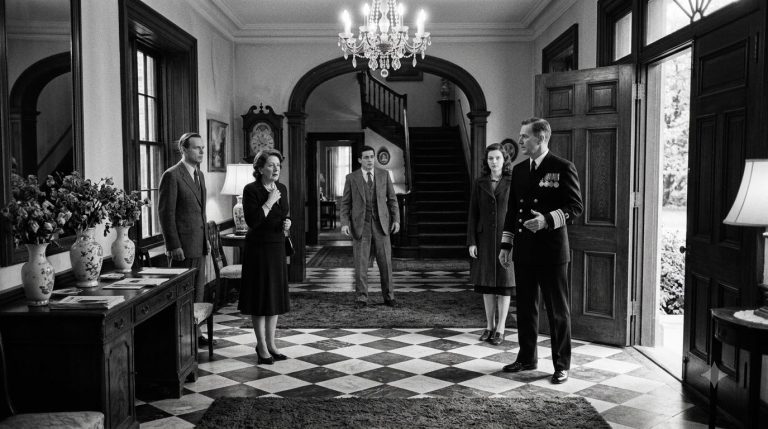
Before his fingers could touch her shoulder, the heavy front door of the mansion swung open with a deep, echoing thud. A tall man in a simple white shirt stepped onto the porch, his eyes immediately cutting through the distance to fix on the commotion at the gate.
“Let her in,” Tunde called out, his voice cutting cleanly across the quiet compound.
The guards froze instantly, their hands dropping to their sides as they stared back in shock. Zuri did not wait for them to change their minds; she shifted the heavy burden on her head, took a deep breath, and stepped across the threshold into a place that would alter the course of everything she knew.
CHAPTER 2: THE COLD WARD
Amara kept her gaze fixed on the IV drip suspended from the rusted metal pole above her head. The rhythmic, mechanical click of the pump served as the only reliable clock in a room where time felt completely stagnant.
Outside the thin glass of the window, the Lagos traffic hummed a relentless, grinding tune that offered no comfort.
“They won’t wait past eight in the morning,” Amara murmured, her voice thin and dry against the pillows. “We both know how these places work, Zuri.”
Zuri stood beside the narrow mattress, refusing to sit on the plastic chair that smelled of old sweat and disinfectant. She reached out and smoothed the edge of the faded white sheet over her mother’s thin shoulder.
“I paid eighteen thousand naira yesterday, Mommy,” Zuri said, her words sharp with a resilience no eight-year-old should ever have to master. “The nurse took the money. She said the rest has to wait until tomorrow.”
Amara closed her eyes, a sharp shudder passing through her frame as the memory of the golden gates on Victoria Island flickered behind her eyelids. “You shouldn’t have gone there,” she whispered, her fingers twitching against the rough cotton blanket. “That man… his world is not a place for people like us.”
The door creaked open before Zuri could answer, letting in the cool, drafty air of the public hallway.
Dr. Chinedu Okoye stood in the threshold, holding a brown paper folder that looked entirely too thin to contain anything good. He did not step fully into the room, choosing instead to keep one hand braced against the doorframe like a man ready to retreat at a moment’s notice.
“Afternoon, Amara,” the doctor said, his voice stripped of all professional warmth. “I see your daughter is back.”
Zuri stepped immediately between the doctor and the bed, her chin lifting with defensive instinct. “My mommy is getting better,” she said, her voice dropping an octave to mimic the serious tone of the adults around her. “We brought money.”
Dr. Okoye sighed, flipping the cover of the folder open just enough to check a printed slip of paper inside. “Eighteen thousand is a start, young lady, but the ledger doesn’t care about good intentions,” he said, avoiding Amara’s hollow gaze. “The hospital administration updated the account this morning. The total balance has gone up because of the extra monitoring.”
The silence in the room dropped like a heavy iron weight.
Amara tried to push herself up on her elbows, but her muscles betrayed her with a sudden, trembling collapse against the mattress. “How much more?” she asked, her voice cracking.
“Forty-five thousand total,” the doctor replied, shutting the folder with a sharp snap that echoed off the bare concrete walls. “Minus what the child brought in yesterday. You need twenty-seven thousand more by sunrise.”
He turned on his heel before either of them could speak, his rubber-soled shoes squeaking against the dirty floor as he retreated down the corridor.
Zuri watched him leave, her jaw clenched tight enough to hurt. She turned back to her mother, her small chest rising and falling with quiet fury.
“I’ll go back to the street,” Zuri said, her voice dropping to a dangerous whisper. “I’ll sell the rest of the yams.”
Amara reached out, catching her daughter’s wrist with a grip that felt surprisingly fierce. “No,” she said, her eyes wide with a sudden, overwhelming dread that had nothing to do with the hospital bills. “You heard what happened at that gate. They know who you are now.”

CHAPTER 3: THE FRACTURED ESTATE
Tunde slammed the heavy wooden study door shut, cutting off the polite hum of the mansion’s central air conditioning.
Modupe sat behind her polished mahogany desk, her posture rigidly upright, her fingers steepled over a pristine stack of quarterly tax reports.
“You think bringing that child to my front gate was a display of strength,” Modupe said, her voice dropping into a dry, chilling cadence. “It was an amateur mistake.”
“I didn’t bring her there,” Tunde said, his fists clenching at his sides as he stared down the length of the room. “She walked herself across half of Lagos because your grandson’s hospital bed was about to be locked out.”
Modupe did not blink. She reached out, her fingernail tapping once against the corner of a document.
“The girl carries bad blood, Tunde. She comes from a roadside huckster who knows nothing of our standing,” she said smoothly, her eyes sharpening like glass. “Cut the ties now, settle them with a quiet monthly stipend on the mainland, and let the board resume normal operations tomorrow.”
Tunde took two deliberate steps forward, the polished marble floor cold beneath his boots.
“The only thing being cut today is any remaining control you think you have over my life,” he said, his voice entirely flat and devoid of hesitation. “I am walking out of this house, and if you or your lawyers go near that hospital again, I will burn down every corporate bridge keeping this family name afloat.”
Modupe’s composure finally fractured, a single muscle twitching beneath her immaculate makeup as she rose from her chair.
“You would throw away thirty years of dynasty for a woman who sells yams in the dirt?” she hissed.
“It’s not a dynasty,” Tunde said, turning his back on her without another word. “It’s a cage.”
CHAPTER 4: THE QUIET ESTATE
The secure estate outside felt unnaturally still, wrapped in a blanket of clipped hedges and guarded silence that offered zero comfort.
Amara gripped the edge of the polished wood, her knuckles turning bone-white as the notification light blinked its rhythmic, warning pulse.
“She called again,” Amara said, her voice dropping into a flat, exhausted whisper as Tunde stepped through the front door.
Tunde tossed his car keys onto the tray by the entryway, the metal clatter breaking the heavy stillness of the room. He did not ask who.
“Let her dial until her fingers ache,” Tunde said, rolling up his sleeves and loosening his tie with sharp, mechanical jerks. “She has no leverage left inside these walls.”
“You don’t know her,” Amara replied, turning to face him with dark circles carved deep beneath her eyes. “She doesn’t use noise, Tunde. She uses patience.”
Down the hall, the soft clatter of colored pencils against a small table reminded them both of what was truly at stake.
Zuri sat cross-legged on her bedroom floor, humming a quiet tune as she finished another drawing of three stick figures standing under a wide tree.
“She sent an auditor to my former associates this morning,” Tunde said, lowering his voice as he closed the distance between them. “Quietly. Politely. Testing the foundations.”
Amara shook her head, a bitter smile touching the corners of her mouth. “And you think standing here in a bigger house stops an avalanche?”
“It stops her from dictating where we stand,” Tunde said, his jaw set with unyielding granite. “We stay right here.”
CHAPTER 5: THE PUBLIC STAND
Flashbulbs popped like white lightning against the dark wood of the podium, throwing harsh geometric shadows across Tunde’s face.
He did not reach for a prepared script, nor did he look toward the corner where his corporate public relations team stood frozen in helpless protest.
“Eight years ago, the woman I loved vanished from Lagos while carrying my child,” Tunde said, his voice steady and flat against the rising murmur of the press corps. “I was told she left by choice. I was fed lies to protect an estate built on intimidation.”
A journalist in the front row half-rose, holding up a digital recorder. “Mr. Adeyemi, are these allegations coming directly from your family’s board—”
“These are facts,” Tunde interrupted, his hand slamming flat against the wooden edge of the podium with a sharp, echoing crack. “My mother spent decades weaponizing silence and fear to control who lived and who starved under her roof.”
In the back of the room, a whispered wave rippled through the reporters as live streams broadcast the unvarnished truth across every screen in the city.
Tunde stared directly into the blinding glare of the main camera lens, his jaw set like iron.
“Yesterday, that same systemic intimidation reached into an elementary school classroom to frighten an eight-year-old girl,” he continued, his voice dropping an octave into absolute, unyielding coldness. “That ends today. If anyone believes wealth gives them the right to hunt my family, let them come through me.”
CHAPTER 6: THE UNBROKEN GROUND
Modupe Adeyemi sat alone in the sprawling stillness of her Victoria Island study, staring down at a phone screen that had stopped ringing hours ago.
The quarterly reports were scattered across the mahogany desk untouched, their figures rendered completely meaningless by a single public broadcast that had dismantled thirty years of curated silence.
The grand mansion felt heavy, cold, and hollow—a fortress built entirely on control that now echoed with nothing but her own unheeded voice.
Across town, the balcony doors of the Lekki apartment stood wide open, letting in the cheerful hum of children playing in the courtyard below.
Amara leaned against the doorframe, her fingers tracing the edge of a clean notebook as she listened to the sound of Zuri laughing over a schoolbook at the dining table.
“She has an art project tomorrow,” Tunde said softly, stepping out onto the terrace to stand beside her with two cups of warm tea. “A family drawing. She asked if I could help her pick the right colors.”
Amara looked up, the remaining shadows of old fear finally dissolving from her dark eyes as she accepted the cup.
“Tell her to use whatever colors she wants,” Amara replied, her voice steady and clear. “The page belongs to her now.”
Tunde reached out, his hand wrapping firmly around hers over the cool iron railing as they watched the Lagos sun dip below the horizon, leaving behind a sky of unbroken, peaceful gold.