How a Worn-Out Diner Owner’s Simple Act of Midnight Kindness Sparked a Multi-Million Dollar Legacy of Healing
CHAPTER 1: THE MIDNIGHT ARRIVAL
The kettle hissed on the two-burner stove, a thin stream of steam curling up toward the water-stained ceiling tiles.
Margaret wrapped her calloused fingers around the handle of her chipped ceramic mug, letting the warmth soak into skin that had weathered decades of dishwater and winter drafts.
Outside, the heavy crunch of gravel on the dirt road signaled an uninvited disruption to the morning quiet.
She didn’t move away from the window immediately.
Three black utility vehicles sat idling beyond her rusted screen door, their tinted windows reflecting the flat gray of the California sky.
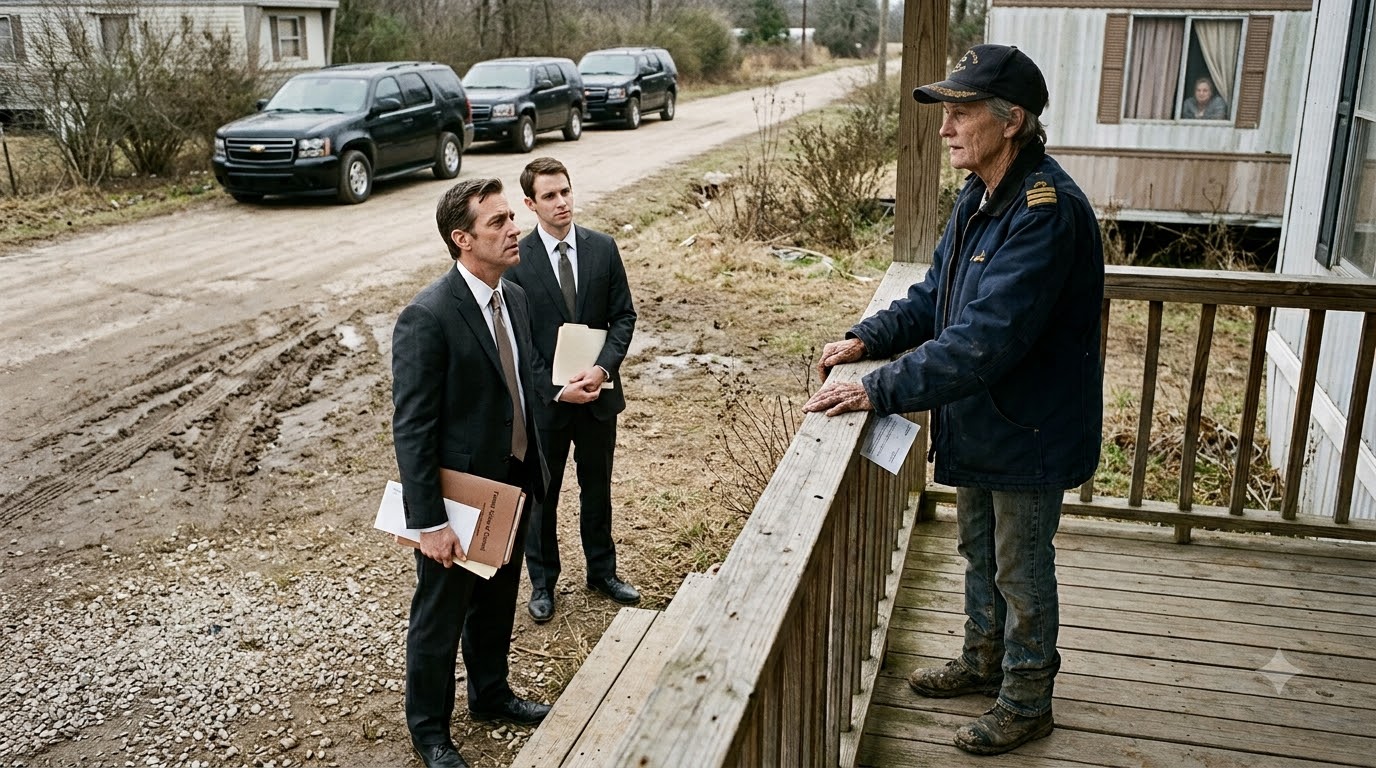
Car doors opened in unison, and two men in tailored dark suits stepped out, their polished shoes sinking slightly into the damp earth.
They didn’t look like neighbors, and they certainly didn’t look like bill collectors.
They moved with the deliberate, unhurried posture of people who believed every door in the world would eventually open for them.
Margaret set her mug down on the Formica counter with a soft, hollow click.
Her chest tightened with a familiar, defensive caution, the instinctive bracing of someone who had spent a lifetime learning that unexpected visitors rarely brought good news.
“Mrs. Hollis?” the taller man called out, his voice carrying clearly through the thin aluminum siding as he approached the porch.
She wiped her palms on her faded jeans, her gaze dropping briefly to the silver lock on the screen door before she reached out to push it open.
“Depends who’s asking,” Margaret said, her voice dry and unyielding as she stood framed in the doorway.
The man stopped two steps short of the porch, removing his sunglasses to reveal sharp, tired eyes that scanned the cramped porch before fixing on her face.
“We’ve been looking for you for a very long time, Margaret,” he said softly, holding up a thick leather briefcase like an offering. “It’s about a young man you sheltered a long time ago.”
CHAPTER 2: THE COLD VERIFICATION
The lead attorney didn’t flinch at Margaret’s defensive posture.
He shifted his weight onto his back foot, the polished leather of his shoe sinking an extra fraction of an inch into the muddy dirt of the yard.
“Mrs. Hollis, we are not here to cause trouble,” the man said, his tone measured and professional. “We are here because of a legal filing that has been tied up in probate for nearly eight months.”
Margaret kept her hand locked firmly around the brass latch of the screen door.
“Trouble usually finds me without an invitation,” she replied, her gaze flicking past him to the second attorney standing by the passenger door of the middle SUV.
That second man was holding a thin, cream-colored document folder against his thigh, the corner of an official paper sticking out like a white flag.
Margaret didn’t need to read the fine print to know what it meant.
The silence stretching between the porch and the vehicles was heavy, thick with the weight of decades she had spent trying to forget the roar of that semi-truck on the highway.
“Show me what you’re holding,” Margaret said, her voice dropping into the flat, unyielding register she used when closing time had passed and unwanted stragglers refused to leave.
The lead attorney nodded slowly, gesturing for his associate to step forward.
Instead of walking up the steps, the second man held up a single sheet of paper from the folder, letting the overcast morning light catch the stamped seal at the top.
“This is a formal notice of contest,” the lead attorney explained, stepping back to give his colleague room. “Filed by distant relatives of the artist who claim the original 1993 copyright registration was executed under undue influence.”
Margaret felt the cold metal of the latch bite into her palm.
“I haven’t seen that boy in thirty-two years,” she said sharply. “I fed him scrambled eggs and gave him a dry storage room when the temperature dropped below freezing. That isn’t influence. That’s basic human decency.”
“The law doesn’t always care about decency, Mrs. Hollis,” the attorney murmured, his eyes locking onto hers with a stark, uncomfortable honesty. “It cares about paper trails, and right now, those relatives have frozen the entire trust fund while they challenge your very existence.”
Margaret’s chest tightened as she looked at the white paper fluttering slightly in the morning wind.
The multi-million dollar account, the royalties from a song born out of a freezing winter night in Carver Springs, wasn’t going to buy her peace or fund a memorial.
It was locked behind a wall of hostile lawyers and fabricated claims designed to starve her out before she even knew she had a stake.
“They think an old woman living in a rusted trailer won’t fight back,” Margaret said, her voice hardening into a low, dangerous edge.
The attorney didn’t answer, but his silence confirmed every suspicion she harbored.
He reached into his breast pocket and withdrew a single, crisp envelope, sliding it across the wooden railing of the porch until it rested against her worn knuckles.
“An unsigned copy of their primary subpoena,” the attorney said quietly, turning on his heel. “They left it at our downtown office yesterday. I thought you deserved to see what kind of fight is coming to your front door.”
CHAPTER 3: THE BROKEN TRUST
The black vehicles rolled away down the dirt track, leaving behind a thick cloud of dust that settled slowly over the sparse weeds outside the trailer.
Margaret stood frozen on the small wooden porch, her thumb rubbing back and forth over the sharp edge of the legal paper.
The local bank in town had already called twice that week about overdue utility bills, treating her name like a liability rather than a legacy.
Now, with the estate vultures locking up every cent of the royalties behind a wall of fabricated probate claims, the local institutions were tightening their grip even faster.
The front door clicked open a fraction as a neighbor’s weathered face peeked out from across the road, watching her with a mixture of suspicion and pity.
People in towns like this didn’t understand millions, but they understood when someone rich was trying to crush an ordinary person into the dirt.
Margaret folded the subpoena sharply down the middle, the crease sharp enough to cut.
She didn’t have high-powered lawyers or retainer fees to fight back in a Los Angeles courtroom.
All she had was thirty-two years of keeping her head down, a stubborn unwillingness to be pushed off her own land, and a memory of a starving boy playing a duct-taped guitar in the back of a freezing diner.
The phone inside the trailer began to ring, a harsh, jangled sound that cut through the quiet afternoon.
She let it ring three times, listening to the hollow echo bounce off the aluminum walls before she stepped back inside and snatched the receiver off the cradle.
— Mrs. Hollis? This is the probate clerk down at the county annex, — a sharp, bureaucratic voice snapped through the static without a greeting. — We’ve received a fresh emergency petition from the estate executors claiming your residential parcel is tied up in the frozen asset dispute. You have forty-eight hours to vacate or contest in person.
Margaret gripped the plastic receiver until her knuckles turned white, her breath catching in her throat as the trap snapped shut around her.
CHAPTER 4: THE QUIET LEGACY
The estate lawyers expected an old woman in a rusted trailer to pack her bags the second a piece of paper arrived.
They didn’t account for thirty-two years of scrubbing grease off diner counters and surviving winters alone.
Margaret didn’t call a high-priced attorney or look for a loophole in the frozen millions.
Instead, she walked over to her small wooden table, picked up the original yellowed napkin covered in the boy’s frantic handwriting, and slid it into the pocket of her jeans.
She stepped out onto the porch, locked the screen door behind her with a definitive click, and walked down the dirt path toward her truck.
The engine sputtered twice before catching, coughing a cloud of gray smoke into the crisp air as she turned the steering wheel toward town.
When she arrived at the county annex building twenty minutes later, the estate’s lead representative was already waiting by the steps with a smug, anticipatory grin.
— Mrs. Hollis, saving everyone a trip won’t change the fact that the court owns this parcel until the probate closes, — the lawyer called out, stepping forward with his hands tucked neatly into his wool coat.
Margaret killed the truck engine, stepped out onto the cracked asphalt, and locked her gaze onto his.
— You can keep your frozen bank accounts and your fancy courthouse papers, — Margaret said, her voice cutting through the traffic noise with absolute, unshakeable calm. — That song wasn’t bought with your court orders, and it wasn’t built on your greed.
The lawyer scoffed, crossing his arms. — Without the trust fund releasing funds, your little foundation idea is dead in the water.
— A foundation doesn’t need a million-dollar endowment to open its doors on day one, — Margaret replied, reaching into her pocket to brush her fingers against the edge of the framed napkin she had brought with her. — It just needs someone willing to make space for kids who have nowhere else to go.
She walked past him without breaking stride, her boots clicking steadily against the concrete steps as she pushed open the heavy glass doors of the building.
The estate’s legal blockade remained legally intact, but their leverage had completely evaporated against her unyielding resolve.
Hours later, back in her small kitchen with the afternoon sun cutting through the windowpanes, Margaret hung the original napkin and the platinum record side by side on the living room wall.
The trailer was quiet again, stripped of the morning’s chaos and the weight of distant litigation.
She poured a fresh cup of coffee into her chipped ceramic mug, took a slow, grounding sip, and looked down at the empty notepad where she had begun drafting the first real-world steps for the local youth shelter.
Michael’s name was written at the top of the page in her steady, legible handwriting.
She didn’t need a single cent of the disputed millions to start keeping the door open for the next kid who walked out of the cold.
Some things couldn’t be bought, and some bonds couldn’t ever be broken by a court order.