The Iron Weight of the Horizon: A German Ace Confronts the American Machine That Broke the Reich
CHAPTER 1: THE COLD TARMAC
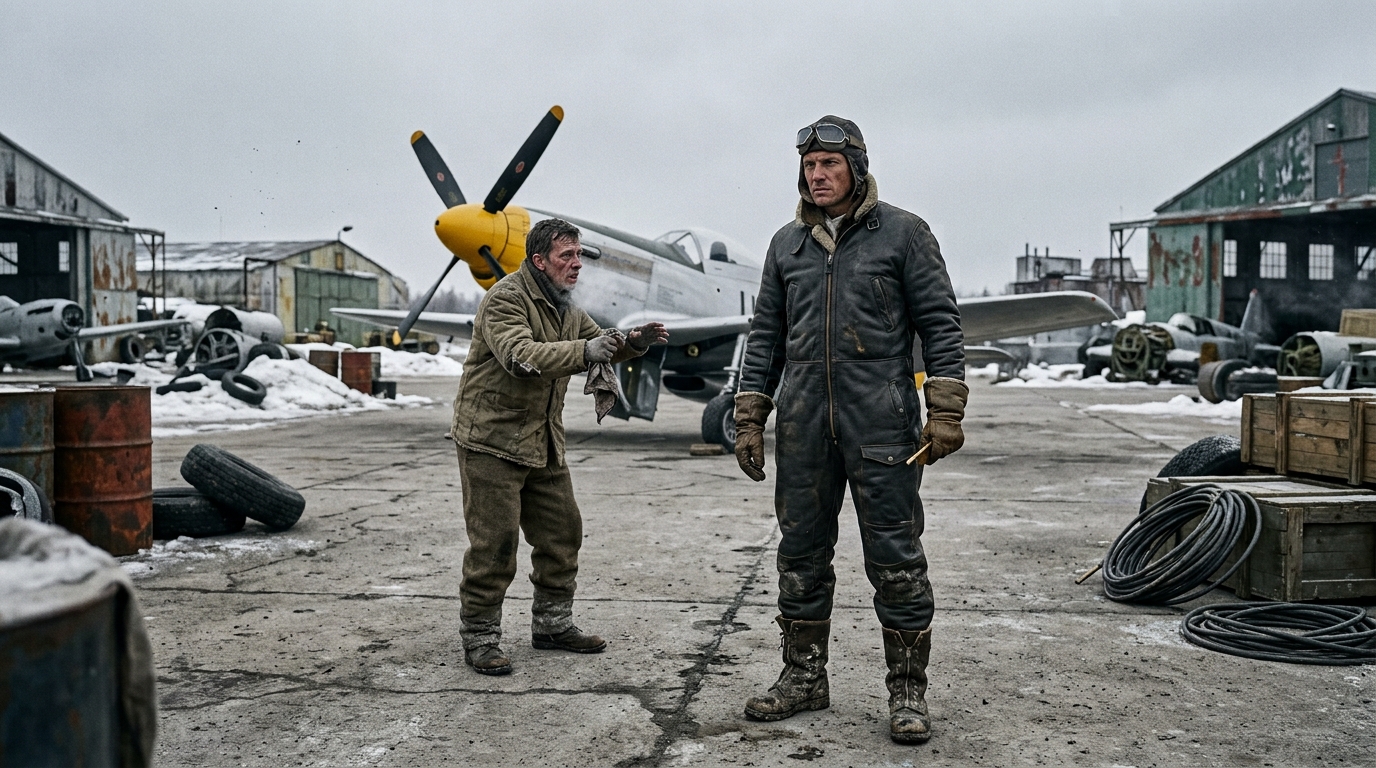
The winter frost bit through the heavy leather of Wolfrram’s gloves as he walked across the fractured concrete of the airfield.
His boots crunched against frozen mud, each step a dull, heavy reminder of the four combat wounds stitched into his flesh.
Ahead of him sat the silver-skinned intruder, painted with bold German markings and bright yellow cowlings to keep friendly gunners from tearing it apart.
It was a North American P-51 Mustang, the exact machine that had been systematically dismantling his wing over the Reich.
High command wanted answers, but Wolfrram wanted silence.
He gripped his scarred brass flight-log pencil inside his pocket, pressing it hard against his thumb until the metal felt like ice.
The brass cylinder of the fuselage gleamed under the gray German sky, untouched by soot or strain.
He didn’t need a manual or a briefing to know what this assignment meant.
The war had narrowed down to this single strip of concrete and the cold metal waiting at the end of it.
CHAPTER 2: THE SPACIOUS COCKPIT
Wolfrram hoisted himself up over the wing root, his boots finding purchase on the non-skid surface before he dipped his head beneath the thick, bubble-shaped canopy.
He slid into the pilot seat, expecting the familiar, claustrophobic squeeze of his Messerschmitt.
Instead, his shoulders found empty air on either side.
There was no cramped armor plate pressing directly against his spine, no iron instrument panel hovering inches from his teeth.
The space felt hollow, wide, and entirely unnatural for a fighter aircraft.
He reached out to touch the side console, but his gloved fingers missed the expected cluster of manual selectors, falling short against a smooth, uninterrupted wall of gray-green primer.
Everything was too far away, arranged with an unsettling economy of motion that left his muscle memory drifting in empty space.
On the instrument panel, the dials were neatly grouped behind flat glass, clean and unblemished by the soot of a hard engine life.
Wolfrram tapped the brass flight-log pencil against his knee, feeling the cold metal ground him against the disorientation.
A ground crewman peered up through the open glass, his face gray with fatigue and frost, waiting for an immediate verdict.
—Well? Is it an interceptor or a transport? — the mechanic shouted over the rising wind, his breath pluming white against the fuselage.
—Neither, — Wolfrram muttered, his eyes tracing the clean sweep of the interior framework. — It is a room.
CHAPTER 3: THE SILENT ENGINE
Wolfrram pushed the starter button with the tip of his gloved thumb, half-expecting the deep, agonizing groan of a flywheel wearing down frozen gears.
Instead, the Packard-built Merlin caught instantly, a liquid-cooled V12 roar cutting through the freezing air without a cough or a sputter.
He glanced down at the engine cowling through the canopy reflection, searching for the familiar greasy trail of fluid that coated every Messerschmitt he had ever flown.
There was nothing.
The metal remained bone-dry, free of the leaks that kept German mechanics chained to the snow-covered hangars through the darkest hours of the night.
A sharp rap echoed against the side of the fuselage as the ground mechanic gestured frantically toward the oil pressure gauges.
Wolfrram checked the dials, noting how steady the needles sat without trembling against the vibration.
—It does not bleed, — Wolfrram murmured to himself, his hand resting heavily on the throttle quadrant.
The absence of mechanical strain was more terrifying than any enemy weapon, because it proved an industrial capacity that no amount of individual grit could ever match.
—Well? Does it hold compression? — the mechanic shouted up, wiping grease onto a frozen rag.
—It holds everything, — Wolfrram replied, his eyes locked on the unmoving gauges. — And we are running out of time.
CHAPTER 4: THE FINAL VERDICT
Wolfrram dropped his heavy leather helmet onto the map table, scattering a line of wooden markers across the plywood surface.
Colonel von Berg looked up from the sector reports, his face tight with the strained expectation of a man who needed comforting lies.
The tent smelled of damp wool and stale chicory coffee, the air thick with the unspoken hope that the American machine was just a temporary anomaly.
Wolfrram didn’t offer a salute.
He pulled the brass flight-log pencil from his pocket and laid it flat across the map, right over the concentric circles marking the defense perimeter of Berlin.
—Well, Walter? — von Berg demanded, his voice dropping an octave as he braced his hands against the table. — What are their structural weaknesses? Where do we hit them?
—We do not hit them, — Wolfrram said, his voice flat and devoid of defiance.
—Explain yourself, Oberleutnant, — von Berg barked, a bead of sweat breaking through the powder on his brow. — We need tactical vulnerabilities.
—There are no leaks, — Wolfrram answered, staring straight into the colonel’s uncomprehending eyes. — There is no crank handle, no frantic scramble in the freezing dawn, and no shortage of machines waiting behind them.
The tent fell into a heavy, suffocating silence that felt colder than the wind outside.
Von Berg opened his mouth to issue another demand, then closed it slowly as the raw weight of the mathematical truth settled over the room.
The war was no longer being fought in the air by pilots; it was being calculated in factories thousands of miles away, and no amount of iron crosses could change the arithmetic.
Wolfrram turned his back on the map table, stepping out into the gray afternoon where the wind carried the distant, unyielding hum of a horizon they could no longer defend.