The Survey of Consequences: A Land Surveyor’s Fight for Sovereignty in a Compromised Neighborhood
CHAPTER 1: The Boundary of Silence
The heat on the Callaway Ranch didn’t just sit; it pressed. It had a weight to it, the kind that smelled of dried grass and oxidized iron, and today, it felt like the property was holding its breath.
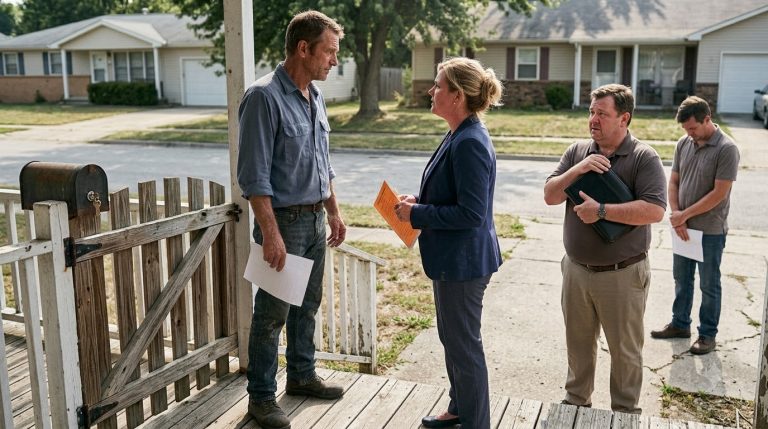
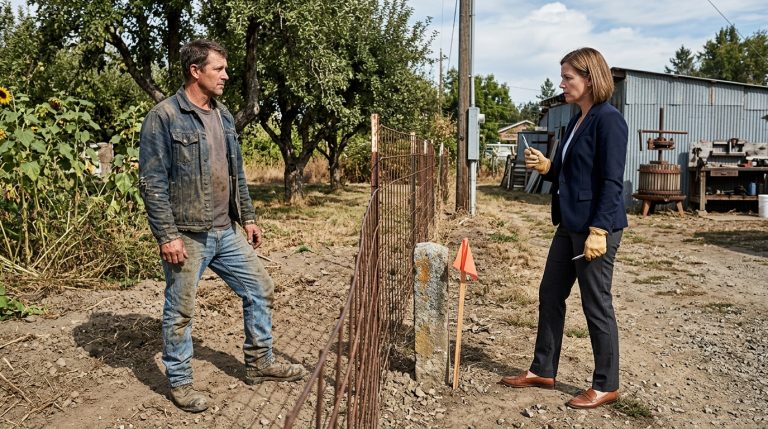
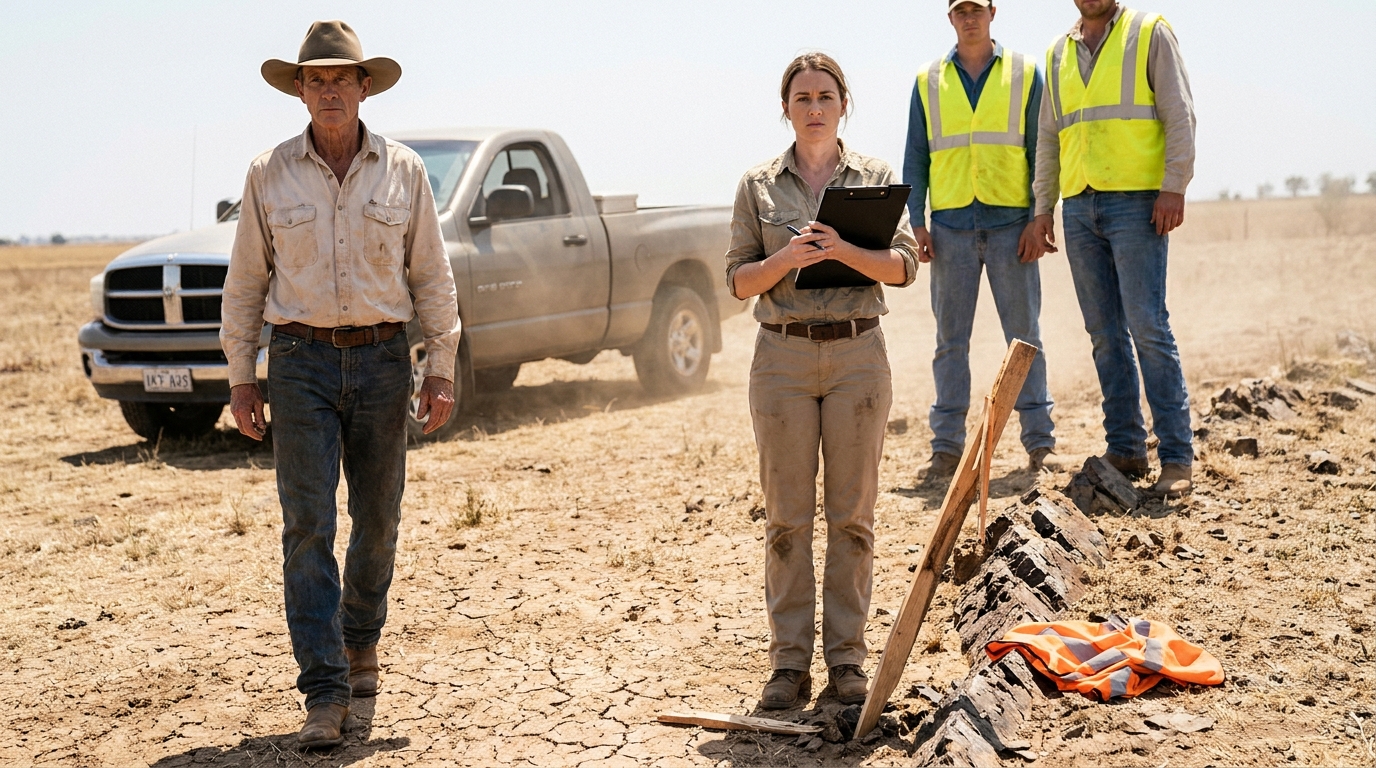
Sandra Briggs was busy asserting authority over dirt. She didn’t look up when she stepped off the gravel access road, her boots crunching into the dormant pasture like she owned the soil. Behind her, two men in high-visibility vests worked with a rhythmic, indifferent efficiency. They were driving a stake into the eastern corner of the pasture, right where the old fence line met the heavy brush.
I stood by my truck, the engine ticked as it cooled. I didn’t shout. I didn’t even step off the running board. I watched the worker raise the mallet, the metal head glinting in the harsh midday glare, and bring it down. The stake didn’t sink clean. It hit a vein of rock and shuddered, the vibration traveling up the wood and into the air between us.
“You’re on my land,” I said. My voice wasn’t loud, but in the stillness of the ranch, it carried with the clarity of a dropped coin.
Sandra finally turned. She didn’t look annoyed; she looked inconvenienced, the way a person might react to a telemarketer. She was holding a clipboard, her knuckles white against the black plastic. “We’re inspecting the utility corridor, Mr. Callaway. It’s routine.”
“It’s private,” I countered, closing the distance between us with slow, steady strides. I kept my eyes on her, noting the fraying edges of her collar and the way she gripped the pen like a weapon. “There’s no recorded easement for this section.”
She didn’t flinch. She just held out a document, a single page stapled to a map. “We have an easement recorded twelve years ago. It’s county-backed. This access is authorized.”
I didn’t take the paper. I knew what it was—a draft, a suggestion, a wish—but it wasn’t a recorded instrument. I leaned in, just close enough to see the smudge of ink on her thumb, a smear of blue that spoke of nervous, repetitive movement. “You’re pushing stakes into my property based on a document that holds no water, Sandra. Pull them out.”
She looked at me then, really looked at me, and for a split second, the polished mask slipped. There was a flicker of something raw in her eyes—not fear, but a frantic, desperate rigidity. She believed in the utility of her own narrative more than she believed in the registry of deeds.
She turned her back to me, signaling the workers to continue. It was a dismissal so complete it was almost rhythmic. That was the moment I knew. She didn’t just have a flawed document; she had a desperate need for it to be true. I watched the worker lift the mallet again, the hammer hanging in the air for a heartbeat, and I started calculating the cost of the coming fallout.
The ground beneath us felt like it was shifting, not because of the stakes, but because of the thin, hollow silence she had just draped over the property. She hadn’t heard the warning, and by the time she did, the survey would be finished, and she would be left standing in a reality that no longer recognized her claim.
CHAPTER 2: The Paper Trail
I didn’t argue further with the workers. Arguing with hired muscle is a waste of breath—they just do what they’re told, and Sandra was currently the one doing the telling. I climbed into the cab of my truck, the vinyl seat hot against my back, and watched through the rearview mirror as they continued to hammer the stakes into the hardpan of the eastern pasture. They were neat, systematic, and entirely wrong.
I turned the ignition, the engine’s idle a low rumble that vibrated through the floorboards. I didn’t head back to the house. I turned toward the county seat.
Driving into town, the transition from the ranch to the county infrastructure felt like moving through layers of sediment. The higher up you go, the more everything is built on assumptions. My grandfather, a man who could measure a property line by eye to within an inch, had lived his life by a code of mutual trust that I was only just beginning to realize was a structural liability. I remembered him sitting on the porch, watching the utility crews move across the eastern edge of the property, a cup of coffee in his hand, his expression entirely unbothered. Back then, I’d thought it was wisdom. Now, hitting the brakes at a red light in the center of town, I understood it was an invitation.
The county archives were housed in a basement beneath the clerk’s office. It smelled of wet concrete, ozone, and the slow, inexorable decay of paper. I signed the register, my pen scratching on the heavy logbook, and was directed to the microfilm and document stacks.
For the next three hours, the world outside the basement didn’t exist. There was only the flicker of the microfilm reader and the sharp, dry scent of dust-covered ledgers. I started with 1971, the year my grandfather had taken over the ranch. I traced the property transfers, the boundary adjustments, and the tax filings with the focus of a man performing surgery.
My mind kept darting back to the pasture, to the way the stake had buckled. It was a physical flaw in the logic of the HOA’s claim. If they truly had a recorded easement, they would have had to survey the corridor years ago. They would have known about the vein of rock running through the eastern edge. They wouldn’t have been guessing where to drive the stakes.
I found the file for the Crestline Ridge development. It was thick, dense with permits and environmental impact studies. I flipped through the pages, looking for the specific instrument that would grant them the right to occupy my grandfather’s land.
Nothing.
There was a draft. Unsigned. Undated. It was a photocopy of a photocopy, the ink faint and bleeding into the fibers of the paper. It was a suggestion of an agreement, a ghost of an intention that had never been realized in ink and seal. I sat back, the chair groaning under my weight. A memory surfaced, unbidden—the smell of my grandfather’s tobacco and the sound of a neighbor’s truck pulling into the driveway late one evening a decade ago. I had been younger, focused on my own life, dismissing the interaction as just another neighborly trade. I hadn’t realized he was trading away the very ground I was now standing on, not with a contract, but with a handshake.
The realization hit me with a dull, cold impact: he hadn’t protected the land because he didn’t care about the legal boundaries. He cared about the people, and that was the flaw the HOA had been exploiting for eleven years.
I moved to the next drawer, my hands steady even as my pulse quickened. I needed to see if there was a hidden filing, something misindexed in the chaos of county records, but the further I dug, the more the void stared back at me. There was no easement. There was no authority. There was only an eleven-year assumption of power, a long-running bluff that Sandra Briggs was currently acting out in the middle of my pasture.
I stood up, my knees popping in the quiet room. I had enough. I pulled my phone from my pocket and took a high-resolution photo of the empty index card where the easement should have been recorded. I needed to prove not just what existed, but what didn’t.
As I walked out of the basement and into the stark, bright daylight of the town square, the air felt different. It felt charged. I wasn’t just a surveyor anymore; I was a man looking at a map that had been systematically erased by someone who thought nobody would notice the blank spaces.
I drove back toward the ranch, the road winding through the valley. I didn’t see the landscape as scenery anymore. I saw it as a grid. And somewhere on the horizon, Sandra Briggs was still hammering at the dirt, unaware that I was coming back with the ledger that proved she was trespassing on a lie.
CHAPTER 3: The Violation Notice
The ranch house was silent when I pulled into the gravel drive, the only sound the rhythmic pinging of metal contracting in the cooling twilight. I didn’t head inside to find dinner or a drink. I stayed in the kitchen, the overhead light casting long, clinical shadows across the butcher-block island where I’d laid out the day’s findings.
There was the photo of the blank index card. There was my notebook, filled with dates and instrument numbers that didn’t lead to anything. And then, there was the envelope.
It had arrived while I was in town. Thick, heavy, and marked with the unmistakable weight of a Crestline Ridge HOA letterhead. I didn’t need to open it to know what was inside. Sandra Briggs didn’t know how to retreat; she only knew how to escalate. I sliced the top of the envelope with a pocketknife, the sound tearing through the kitchen’s stillness like a serrated edge.
The violation notice was a masterclass in bureaucratic hostility. It was printed on heavy bond paper, every line justified, every citation underscored. Section 4.2: Interference with authorized infrastructure maintenance. Section 7.1: Obstruction of recorded utility corridor.
I read it once, then a second time, standing perfectly still. The fine was marked in bold: $1,500. Due in thirty days.
What caught my attention wasn’t the dollar amount. It was the language. It was phrased not as a request, but as an indictment. It was designed to trigger a specific, reactive response—the kind of hot-headed, immediate defensive action that would force a person to break their own silence. I could almost see Sandra typing it, selecting each word like a surveyor placing a transit, aiming to catch me in an error of protocol.
I set the letter down and pulled a chair out, the legs scraping against the linoleum. My grandfather had always kept a glass bowl of loose hardware on this counter—rusted nails, washers, old keys. I ran my thumb over a bent carriage bolt, feeling the rough, pitted surface of it. It grounded me. The house was full of these physical remnants of his way of life, things that were simple, honest, and functional.
I looked back at the letter. It was an anomaly in this space. It didn’t belong here, just as the utility corridor didn’t belong on the property.
I pulled out my phone and began to document it. I took a photo of the front, the back, and the specific section citing the easement. I logged the delivery date and the timestamp. If this was a game of documentation, I would play it with the same surgical precision I applied to a boundary survey. Every act of theirs would become a piece of evidence in a file they hadn’t yet realized I was building.
The suspicion gnawed at me, a low-frequency hum in the back of my mind. Was the HOA acting out of genuine delusion, or was there something else hidden in the way they’d written this? The phrasing “authorized infrastructure” was repeated three times. It was a rhythmic repetition, an attempt to make the lie feel like a law through sheer volume. They weren’t just trying to get me to move; they were trying to normalize the encroachment, layering the documentation until the fake easement felt as solid as a real one.
I stood up and went to the window, looking out toward the eastern pasture. It was dark, a deep, bruised purple stretching toward the horizon. Somewhere out there, the wooden stakes stood like small, fragile warnings. I realized then that my grandfather’s silence hadn’t been a lack of knowledge—it had been a lack of fight. He had treated the land like a garden, something to be shared and nurtured. But a garden that isn’t fenced is eventually just a field that anyone can cross.
I wouldn’t make that mistake.
I walked to the pantry and opened the floorboard panel I’d known about since I was seven. Inside sat a heavy, fireproof lockbox. It contained the original deeds, the maps, and the historical records my grandfather had meticulously collected over forty years. I took out a fresh folder, labeled it “Crestline Ridge,” and began to organize the papers.
The house felt larger now, quieter. The letter sat on the counter, a stark, white geometric shape in a room defined by the organic, weathered textures of my family’s history. I wasn’t going to call Sandra. I wasn’t going to reply to the fine. I was going to wait.
Sandra was counting on the pressure of the deadline. She was counting on the fine to make me flinch. She didn’t realize that in land surveying, the most important work happens long before you ever pick up the equipment. It happens in the records, in the research, in the slow, painstaking process of proving exactly where you stand.
I turned off the kitchen light, leaving the room in shadows. The letter remained on the island, a piece of paper that had no legal power, yet demanded everything. I’d let it wait. The silence was becoming my most effective tool, and for the first time in my life, I found that I was perfectly comfortable in it.
CHAPTER 4: The Neighborhood Leak
The phone call from Tom Greer didn’t come until late, well after the sun had finished its slow retreat behind the western ridges. I was on the back porch, checking the tension on a section of the east fence line, my gloved hands moving over the familiar, rusted steel. The wire was loose, singing a low, discordant note in the breeze. It was a small, persistent problem, the kind of maintenance that usually felt soothing, but tonight, it felt like an oversight I couldn’t afford.
My phone vibrated against the wooden railing, the sound sharp and jarring. I didn’t need to look at the screen to know who it was. Tom was the only one who called this late.
“Ray,” he said, skipping any preamble. His voice was gravelly, filtered through the static of a poor connection. “You need to be prepared. Sandra’s calling a meeting. Thursday night. It’s not just a standard review; she’s framing you as the villain.”
I leaned against the fence, the wire digging into my palm. “What’s she telling them, Tom?”
“The usual,” he sighed, and I could hear the weariness in his breath. “She’s got a map printed out, red ink all over your eastern pasture. She’s telling everyone that if the power goes out, the whole Crestline Ridge subdivision stays dark for days because you’re blocking ’emergency access.’ She’s got them terrified. People are looking at their kids, thinking about their AC units, and she’s standing there holding the solution, blaming you for the risk.”
I looked out toward the pasture. The stakes the workers had driven in were invisible in the dark, but I knew exactly where they sat, a line of artificial intrusions in the middle of a landscape that had belonged to my family for decades.
“Does she mention the easement?” I asked.
“She mentions the need for it,” Tom corrected. “She doesn’t mention the paperwork. She’s playing on the assumption that if it’s a utility line, it must be legal. And right now, in that room, the people just want the light to stay on. They don’t care about the fine print of a land deed.”
“And you, Tom? What do you tell them?”
There was a long silence on the other end of the line. I heard the faint rustle of his jacket, the sound of him looking out at his own acres, which bordered mine to the north. “I tell them to look at the fence. I tell them I’ve known your grandfather since the seventies. But I’m one voice, Ray. Sandra’s been cultivating this for months. She’s built a consensus. If you aren’t there to challenge it, it becomes the truth by default.”
“I don’t have standing,” I said, repeating the legal reality. “I’m not a homeowner in Crestline Ridge. I can’t walk into their meeting and demand the floor.”
“No,” Tom agreed, his voice dropping lower. “But you don’t have to be the one to shout. You just need to make sure the right questions are being asked. Sandra’s playing a game of speed. She wants to close this before anyone thinks to check the county clerk’s office. You give them a reason to pause, and the whole structure she’s built starts to crack.”
We talked for another ten minutes, the wind picking up, carrying the scent of dry earth and impending rain. When we hung up, the porch felt colder. I stayed there for a long time, watching the distant, faint glow of the subdivision’s streetlights against the dark sky.
Sandra was betting that I would stay isolated, that I would retreat into my work and let the narrative harden around me. She wanted me to be the “stubborn newcomer.” It was a tidy, convenient story. It didn’t require any proof, only fear.
I walked back inside and opened the folder. I pulled out the blank index card photo. I thought about Carol Demps, the homeowner Tom had mentioned in passing—the one with the municipal planning background. I didn’t know her, but I knew her type. People who worked in planning had a natural allergy to unverified data.
I wouldn’t go to the meeting. I wouldn’t provide the spectacle Sandra craved. Instead, I sat down and started writing a letter—not to the HOA, but to the residents. It wouldn’t be a legal threat or an angry outburst. It would be a series of simple, factual questions about the history of the utility corridor, phrased in the dry, neutral tone of a professional surveyor. I wouldn’t call anyone a liar. I would just ask for the document that proved the truth.
I’d drop them in the mailboxes of the most vocal residents—the ones who stood to lose the most if the infrastructure truly was as precarious as Sandra claimed. If they wanted to know why their power was at risk, I’d give them the only documentation that mattered. I’d give them the map of what wasn’t there.
The fence line outside was still loose. I realized I’d have to fix it tomorrow. But for tonight, the foundation was set. I was no longer just protecting land; I was dismantling a consensus, one measured, factual step at a time.
CHAPTER 5: The Legal Retainer
Patricia Owens’ office was a testament to the fact that law was not practiced in marble halls, but in the trenches of cramped cubicles and buried paperwork. The air here was heavy with the smell of scorched coffee and old ink, a combination that felt more honest than anything the HOA had sent my way.
I sat in the chair opposite her, my boots planted firmly on the worn industrial carpet. Patricia didn’t look up immediately. She was moving through a stack of folders with the methodical, rhythmic speed of a card dealer, her glasses perched on the very tip of her nose.
“You’re not here because you want a win, Ray,” she said finally, her voice dry. She stopped moving and looked at me, her eyes sharp, measuring. “You’re here because you want it finished correctly. That changes the strategy.”
“I have the documentation,” I said, sliding the folder from the ranch across the desk. “The clerk’s search, the photos of the blank index, the copy of the violation notice.”
Patricia opened the folder. She didn’t skim. She worked through the papers, her finger tracing the lines of the HOA’s citation. When she reached the reference to the “recorded utility corridor,” she paused. A faint, knowing smile touched her lips, though it didn’t reach her eyes.
“They’re bluffing,” she stated, her tone flat. “This isn’t a legal document; it’s a psychological one. They’re using the language of authority to mask the absence of it. They want you to panic and sign something—anything—to make the fine go away. They want to turn a temporary encroachment into a permanent easement through your own signature.”
She leaned back, her chair creaking in the sterile silence of the office. “Do you know what happens if you pay that fine, even under protest?”
“It sets a precedent,” I said. “It admits their jurisdiction.”
“Exactly.” She picked up a pen and tapped the tip against the desk, a steady, hypnotic sound. “But there’s more. If we move now, we don’t just stop them. We expose them. The board members of Crestline Ridge aren’t developers. They’re homeowners who have been lied to by their president. Sandra has been operating with a level of unilateral control that suggests she hasn’t just misled you; she’s misled them.”
I watched her, observing the way she handled the papers—not as if they were just evidence, but as if they were the structural blueprints of a building that was about to collapse. She was looking for the load-bearing lie.
“I’ve been talking to Carol Demps,” I added, the name sounding foreign in the office’s clinical atmosphere. “She’s one of the residents. She’s starting to ask questions about the utility infrastructure permits.”
Patricia’s eyebrows rose. “If she’s doing that, she’s doing our work for us. Code enforcement has to respond to a formal inquiry from a resident. If there are no permits for those power lines—which, given the lack of an easement, is almost certain—the city will have to step in.”
She pulled a fresh document from a drawer, a retainer agreement, but before she pushed it toward me, she leaned forward, her demeanor shifting from professional to personal. “This is going to get messy, Ray. Sandra will try to make this about you. She’ll try to frame the surveyor as the obstructionist. Can you handle the noise?”
“I don’t care about the noise,” I said. “I care about the land.”
As I took the pen, I noticed a slight tremor in the paper she held—the edge of a document detailing the HOA’s bylaws. It was so subtle, a mere vibration in the light, but it caught my eye. It was a sign of the pressure already mounting behind the scenes. This wasn’t just a disagreement; it was a unraveling.
I signed the agreement, the ink flowing dark and permanent onto the page. The act felt small, but the finality of it was absolute. I had brought in the only person who could translate my research into a language the HOA couldn’t ignore.
Leaving the office, the fluorescent lights felt brighter, colder. I walked out into the parking lot, the heat of the day having finally broken, leaving behind a sharp, clean breeze. I looked at the folder in my hands. The game of patience was over. I had stopped waiting for the encroachment to end; I had started forcing it out. Every step from here on would be on the record, and for the first time, the foundation of Sandra’s authority wasn’t just shaky—it was being marked for removal.
CHAPTER 6: The Injunction Hearing
The rain began as a low rumble against the roof of my truck, then escalated into a torrential sheet that turned the county seat into a blur of gray stone and slick asphalt. I pulled into the lot of the County Civil Court, the wipers fighting a losing battle against the deluge. It was a day for endings, and the weather seemed intent on washing the slate clean.
Inside, the courtroom was small, suffocatingly warm, and smelled faintly of floor wax and damp wool. I took my seat next to Patricia, who was already meticulously arranging her files. She didn’t look at me; she was focused on the opposing table.
Sandra Briggs was there, flanked by two attorneys who looked as polished and sterile as a surgical ward. They were going over documents with an intensity that suggested they were bracing for an impact. Sandra looked up, her gaze locking onto mine for a fraction of a second—a cold, calculating appraisal—before she smoothed the lapels of her blazer and turned back to her team. She looked confident. She looked like a woman who believed the law was merely a set of suggestions.
“They’re pushing for the emergency injunction,” Patricia whispered, not moving her lips. “They’re going to frame the lack of access as an imminent threat to life and property. If the judge buys the ’emergency’ aspect, she’ll grant the access immediately. We have to kill the definition of the emergency before we even talk about the easement.”
“I’m ready,” I replied, my voice steady.
Judge Marian Hail entered, her robes swishing with a sharp, crisp sound. She was a woman who didn’t tolerate preamble. She took her seat, adjusted her glasses, and the room snapped to attention.
“Case number 24-CV-882,” she announced, her voice echoing off the high ceiling. “Motion for emergency injunctive relief regarding utility infrastructure access.”
Sandra’s lead attorney stood. He was a man who spoke with the practiced, melodic cadence of a television preacher. He spent the next fifteen minutes painting a picture of a neighborhood on the brink. He spoke of children without heat, of elderly residents whose medical equipment relied on that grid, and of a “stubborn, uncooperative” landowner who was playing games with people’s safety. He was good. If I hadn’t known the truth, I might have felt the fear he was trying to manufacture.
When Patricia stood, she didn’t bother with a stage presence. She held up the certified letter from the county clerk.
“Your Honor,” she began, “the defense is arguing that there is an emergency. But an emergency, by legal definition, requires a documented failure or an imminent threat. We have requested—and received—a statement from the actual utility provider, the ones who own and maintain the power lines in question. They have reported zero faults, zero failures, and zero maintenance requests on the Crestline Ridge corridor for the last ninety days.”
She walked to the judge’s bench and laid the paper down. “This isn’t a maintenance emergency. It’s a business dispute. They are attempting to use this court to grant them a prescriptive easement they could not negotiate and did not record.”
I watched Sandra. For the first time, her mask didn’t just slip; it fractured. She leaned over to her attorney, her whisper sharp and frantic. I saw the lead attorney’s face tighten, a flush of irritation climbing his neck. They hadn’t expected us to verify the utility company’s records. They were gambling on the judge taking their word for the “emergency.”
The room went silent. You could hear the rain drumming against the high, narrow windows, a rhythmic, percussive sound that seemed to mark the seconds of Sandra’s crumbling strategy. Judge Hail pulled the document toward her, peering at it through her glasses. She traced the lines of the utility provider’s letter with a steady, clinical finger.
Then, the lights in the courtroom flickered. The storm outside had reached a peak, and for a heartbeat, the room was bathed in the dim, gray light of the afternoon.
“Council,” the judge said, not looking up from the paper. “Your motion relies entirely on the existence of an emergency. This statement from the utility provider suggests there is none. How do you respond?”
Sandra’s attorney stumbled, his previous polish replaced by a stuttering, desperate scramble for a different angle. He started talking about “preventative measures” and “future liability,” but the judge cut him off with a single, sharp gesture.
“Potential risk is not a standard for emergency injunctive relief,” she said, her voice like ice. “The motion is denied.”
The gavel strike was a dull, heavy thud. It wasn’t a victory—it was a clearing of the air. Sandra sat back, her hands gripping the edge of the table so tightly her knuckles were white. She looked at me again, and this time, the cold calculation was gone, replaced by a raw, naked frustration. She knew the court record was now permanent, and she knew she had just lost the shield she’d been using to hide behind for eleven years.
We walked out into the hallway as the rain finally began to slacken. The air was cool and smelled of wet earth and impending change. Patricia stood beside me, her expression unreadable.
“She’ll try to pivot,” Patricia said. “She has to. But she’s running out of room. The court record is an anchor now. She can’t keep claiming an emergency when a judge has already dismissed it.”
I looked out at the parking lot, where the gray light of the storm was giving way to a pale, washed-out sun. The fence line on the ranch was waiting. The stakes were still there, but their authority was gone. The board of Crestline Ridge was going to find out exactly what their president had been doing in their name, and when they did, the reality of the missing easement would be the least of her problems.
CHAPTER 7: The CounterClaim
The drive back to the ranch was a long, slow exercise in tactical breathing. My hands gripped the wheel, knuckles pale, the highway blurring into a ribbon of gray beneath the headlights. I had expected a win to feel like a destination, but the reality was far more jagged. Winning in court was just the beginning of the friction.
When I finally pulled into the driveway, the house was dark, save for the porch light that flickered like a dying firefly. Tucked into the gap of my wiper blade was a thick, official-looking envelope. I didn’t need to read the return address to know it came from the state licensing board.
I sat in the truck for a long time, the engine ticking as it cooled. I knew what was inside before I broke the seal. It was the next stage of Sandra’s counter-offensive. She hadn’t been defeated; she had simply shifted the battlefield from the county court to my professional license.
I opened the envelope, the paper crisp and authoritative, and pulled out the notice of a formal complaint. She was accusing me of using my professional credentials—my training, my surveyor’s stamp—to manufacture a dispute and manipulate property records. It was a precise, targeted, and entirely manufactured attack on my livelihood. It wasn’t about the pasture anymore; it was about making me radioactive to any future client.
I walked into the house, the silence feeling heavier than usual. I didn’t reach for the phone. I didn’t call Patricia. I went straight to the folder on the kitchen island and pulled out the file on Sandra’s previous actions.
She was playing the long game, using every regulatory lever she could find to turn my own expertise against me. She knew that a licensing board investigation wasn’t a public trial—it was an administrative trap. Even if I was cleared, the investigation would remain on my record, a stain that would haunt my reputation for years. It was designed to keep me tied up in paperwork while she quietly consolidated her power at the HOA.
I spent the rest of the night reviewing the records. I needed to build a response that was as precise and unyielding as the land I surveyed. I pulled every correspondence, every document, every verified survey, and every communication from the county clerk. I was building a timeline that would show the board—and the state board—not just the facts, but the pattern of retaliation.
The realization hit me around 3:00 AM: Sandra was terrified. She was doing this because she had realized that she couldn’t win on the merit of her claim, so she was trying to destroy the messenger. The complaint wasn’t a sign of her strength; it was the final, desperate move of a person who knew they were out of time.
I laid the documents out on the kitchen island, a sprawling, complex puzzle of evidence. I had the county’s letter, the judge’s dismissal, the utility company’s admission, and now, this fraudulent licensing claim. If she wanted a fight, I would give her one—but not on her terms. I wouldn’t defend myself; I would go on the offensive.
I picked up the phone and typed a message to Patricia, laying out the core components of a counter-claim: abuse of process, tortious interference, and defamation. I didn’t just want to be cleared; I wanted to make sure that filing a malicious, retaliatory complaint against a licensed professional had a price that Sandra couldn’t afford to pay.
The morning light began to bleed through the kitchen window, pale and cold, as I finished drafting the framework for our response. I had been a surveyor for nineteen years, and I had learned that the most important thing you can do when you’re facing a boundary dispute is to prove your own lines beyond a shadow of a doubt. I had mine.
I poured a cup of coffee and walked out to the porch. The eastern pasture was quiet, the mist rolling off the grass in thin, ghostly ribbons. The survey stakes were still there, but they looked smaller now, less like markers of authority and more like debris. The storm had passed, leaving behind a clear, sharp morning, and I was ready for the final step. Sandra had tried to mark me, but she had only succeeded in highlighting exactly where she was failing.
CHAPTER 8: Final Boundary
The morning air felt thin, scrubbed clean by the remnants of the storm. I drove out to the eastern pasture, my truck tires crunching over the wet gravel. This was the final step: the placement of the permanent survey monuments, the brass caps that would physically define the boundary I had spent months reclaiming through paper, policy, and patience.
Sandra Briggs was not there to stop me. She was nowhere to be found, her life in Crestline Ridge dissolving into the silent, ignominious exit of someone who had gambled on a future that didn’t exist. The board had removed her, the legal claims were settled, and the utility company had finally acknowledged the legal reality: without a recorded easement, they were guests on this land, not masters.
I climbed out of the truck, the damp earth clinging to my boots. I looked toward the fence line. It stretched away into the distance, a straight, unyielding line that commanded the landscape. I took the heavy mallet and the bronze survey monuments from the truck bed. They were cold, dense with history.
For the first time in eleven years, the corridor wasn’t a shadow. It was a measured, documented fact. I drove the first monument into the ground, the impact percussive and final. I repeated the process at every designated corner, the rhythmic clang of metal on stone serving as the heartbeat of the land.
As I worked, I thought about the board members—men and women who had spent years in the dark, trusting Sandra’s “authority” because it was easier than checking the records themselves. They hadn’t been malicious; they had been negligent, and their negligence had been the very thing that allowed a temporary, neighborly favor to mutate into a predatory assumption. They were the true victims of the “institutional board negligence” that had sustained this conflict, and now, they were busy tearing down the structures that had enabled it.
The final monument went into the ground at the southern boundary. I stood back, wiping my hands on my jeans, and took a long, slow breath. The pasture looked the same as it had when Sandra first walked through my gate, but the weight of it had changed. The tension had vanished, replaced by the deep, resonant peace of a property line that finally possessed the integrity of law.
Later that afternoon, Tom Greer drove over. He didn’t say much, just walked the line with me, his eyes scanning the new monuments. He stood by the cedar post, the same spot where he had first warned me about the community meeting months ago.
“Your grandfather,” Tom said, his voice quiet against the vastness of the prairie, “he’d be proud of how you handled this. He let things slide because he loved the neighborly peace. But he didn’t know how to protect what he was giving away. You did.”
“I just read the documents, Tom,” I said, though I knew it was more than that. It was the patience of the surveyor—the understanding that the truth is always there, hidden beneath the surface, waiting for someone to do the work of finding it.
We walked back to the barn as the sun began to sink, the light turning the landscape into a golden, saturated dream. I had spent months fighting to define what was mine, only to realize that the act of surveying had defined me in turn. I wasn’t the newcomer who didn’t understand the history; I was the man who had authored the next chapter.
I returned to the house, the folder of evidence now neatly filed away in the fireproof box. It was over. No more letters, no more threats, no more courtroom maneuvering. The land was clean, the title was absolute, and the future—for the first time in over a decade—was finally open, unburdened by the ghosts of unauthorized agreements.
I walked to the kitchen and made a fresh pot of coffee, the aroma filling the room. I sat by the window, watching the stars begin to pin themselves against the dark, vast expanse of the sky. The property line held steady in the dark, a silent testament to the fact that when you know exactly where you stand, the entire world has to respect the boundary.