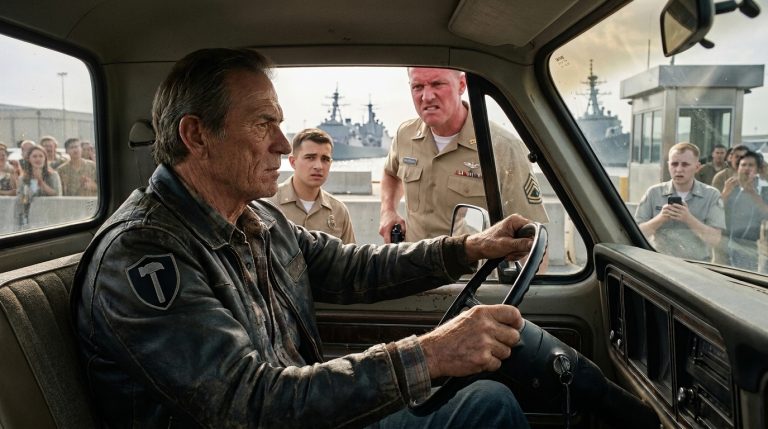
The Smoking Gun: A Tactical Siege on the Suburbs and the Architecture of Quiet Revenge
CHAPTER 1: THE FIRST SHOT
The air in Oakwood Preserve didn’t just feel still; it felt curated. Every blade of grass in our front yard was trimmed to a uniform height, a green, bristling carpet that seemed to protest the presence of anything unscripted. And today, the most unscripted thing in the entire state of Ohio was sitting right in my driveway.
It was my life’s work—a custom-built, mirror-polished mobile kitchen I’d christened the Smoking Gun. Every cent of my army severance had gone into the stainless-steel interior, the heavy-duty vents, the massive offset smoker that could handle a hundred pounds of brisket without breaking a sweat. It was my way out of the logistics grind, my bridge to a future that didn’t involve reporting to a commander.
Then the shadow fell over it.
“That monstrosity,” she spat.
Karen Peterson stood at the edge of my driveway, a woman whose entire presence was a lecture. She didn’t walk; she paced, her movements governed by the rigid, invisible grid of the neighborhood covenants. She gestured toward the truck with a hand heavily weighted by a ring that looked like it cost more than my first car.
“It’s a violation of Section 12, Paragraph C,” she continued, her voice clipping the air. “Twenty-four hours, Mr. Jensen. Towing at your expense. Five hundred dollars for the initial violation, one hundred for every day it remains.”
I didn’t blink. Years of managing supply chains in environments where rules were written in blood had taught me one fundamental truth: you don’t fight a bully by apologizing. You fight them by identifying the point of failure in their logic.
“The covenant specifies commercial vehicles with permanent signage or apparatus,” I said, my voice steady, stripped of the reflexive urge to explain or beg. “This is a registered personal vehicle. The branding is magnetic and currently removed. It isn’t a commercial business.”
Her eyes, small and hard like polished pebbles, narrowed into slits. She wasn’t listening to the argument; she was processing a target. “The board defines the utility of the vehicle, Mr. Jensen. Not the registration. Your intent to conduct business from a residential property is clear. We don’t want a roach coach here.”
She turned on her heel, her posture radiating a smug, self-satisfied authority. She expected me to crumble. She expected the heat in my face to be the heat of shame. She didn’t realize that in my world, heat was just the byproduct of a fire that was currently being stoked.
I watched her walk away, her step light, absolutely certain of her dominion. I turned back to the truck, the metallic surface reflecting the afternoon sun back at me in a glare so bright it was blinding. I didn’t reach for my phone to call a lawyer, and I didn’t reach for a wrench to move it.
I reached into the truck, pulling out a legal pad and a highlighter. I looked down the street, past the perfectly groomed hedges, to the house on the corner. A massive boat sat on a custom trailer, oversized, ugly, and undeniably commercial-grade. It hadn’t been towed. It hadn’t been fined.
A flicker of cold, sharp realization hit me, harder than any fine could: Karen wasn’t just enforcing rules. She was building a wall, and I was the first thing she was going to tear down to reinforce it.
I took a pen and made the first mark on my pad. The battle hadn’t started because I violated a covenant. It had started because I was an intruder in her kingdom. And the first rule of logistics was simple: know your enemy, study the terrain, and never, ever concede the high ground.
I stepped into the house and closed the door, leaving the silent, gleaming truck to guard the driveway like a sentinel. My wife, Sarah, looked up from her desk, her brow furrowed. “Did she see it?”
“She saw it,” I said, my voice quiet, sharpening with every syllable. “She saw it, and she made a mistake. She made it personal.”
I didn’t tell her the rest. Not yet. I walked to the kitchen, opened the drawer where we kept the HOA binder—the three hundred pages of fine print I’d memorized—and started looking for the cracks. The Zeigarnik effect was already buzzing in my brain, a relentless, rhythmic ticking. I needed to see the fine print, but more than that, I needed to see the gaps.
I looked at the counter. The refrigerator hummed, a low, consistent sound that suddenly seemed to mock the silence. I realized, with a sudden, sinking dread, that I’d been looking at the wrong document. It wasn’t the Covenants I needed to worry about. It was the meeting minutes. The ones she didn’t want me to see.
I had been played, and the game wasn’t about the truck at all. It was about what was currently hidden in the bottom drawer of the HOA clubhouse, and I knew exactly who had the key.
CHAPTER 2: THE ARCHIVE OF INTENT
The front door clicked shut behind me, the sound final and weighted, like the closing of a bunker hatch. I didn’t turn on the lights. The late-afternoon sun was bleeding through the blinds in thin, amber slats, carving the living room into a grid of sharp light and deep shadow.
Sarah was already moving, her focus sharp. She’d laid out the HOA covenant document—the three-hundred-page beast I’d pored over months ago—on the dining room table. It looked innocent enough, a stack of white paper bound by a black plastic spine, but to my eyes, it was beginning to look like a map of a battlefield.
“She’s rattled, Mark,” Sarah said, her voice low. She didn’t look up. Her hands were steady, flipping through the pages with the precise, rhythmic motions of a paralegal sorting evidence for discovery. “She didn’t expect a pushback. Most people just pay the fine or move the truck. She’s not used to someone actually reading the text.”
I walked over, my boots feeling heavy on the hardwood. My mind was still back in the driveway, replaying the exact pitch of Karen’s voice, the way she had dismissed the law as a matter of “board interpretation.” A sudden, intrusive memory of a supply depot in Kandahar surged into my awareness—a missing manifest, a cargo plane diverted because someone down the chain of command had ‘interpreted’ a priority code to favor their own local interests. The feeling of helplessness I’d fought so hard to suppress back then clawed its way to the surface now. It was the same mechanism: a small, localized power structure weaponizing bureaucratic ambiguity to create a sense of inevitable failure.
I shoved the memory aside, grounding myself in the present. I leaned over the table, my shadow eclipsing the text. “It’s not about the truck,” I said, the realization hardening in my chest. “If it were about the truck, she would have cited the specific clause, issued the notice, and moved on. The fact that she’s making up ‘roach coach’ definitions on the fly means she’s not looking for compliance. She’s looking for a justification to start a cycle.”
“A cycle?” Sarah looked up, her expression unreadable.
“A paper trail,” I answered. “She needs enough documented violations to make the ‘nuisance’ case stick when she finally moves to file a lien or force a sale. She’s not clearing the neighborhood of commercial vehicles; she’s clearing it of people who don’t fit the aesthetic. She’s managing the asset value.”
I reached out and flipped to Article 12. The text was dry, sterile, and deliberately broad. Any vehicle capable of commercial use. It was a blank check. I traced the words with my finger, feeling the texture of the paper, the dry, artificial grit of the HOA’s manufactured authority.
“We need the meeting minutes,” I said.
“I’ve requested them,” Sarah replied, tapping her laptop. “But I have a feeling they’re going to be ‘lost,’ ‘redacted,’ or ‘unavailable for public inspection.’ That’s the classic play.”
I walked to the window, pulling the blind just enough to see the street. The Smoking Gun sat in the driveway, its metallic surfaces dark and muted in the fading light. It looked like a silent, defiant object in a neighborhood built for conformity. I wondered how many other people in this enclave were currently staring out their windows, wondering if the next envelope in their mailbox would be the one that ended their dream.
“She has an ally on the board,” I said, a thought crystallizing in the quiet. “She didn’t speak in the singular until the very end. She kept saying ‘the board defines.’ She’s not acting alone; she’s acting as the filter. If we can find out who she’s shielding—who’s being allowed to break the rules without consequence—we find the weakness in her authority.”
“The boat,” Sarah said suddenly, her eyes widening. “The one down on Oakwood Drive. It’s been there for three weeks, and it’s clearly a commercial-grade trailer. If there’s no violation on file for that, it proves selective enforcement.”
“And selective enforcement is the death of a covenant’s legal standing,” I finished.
The weight of the situation felt less like a burden and more like a tactical challenge. I wasn’t just defending a truck; I was analyzing an ecosystem. I moved to the kitchen island, pulling out my own legal pad. I began to map the street, noting the houses I knew to be Karen-aligned and the ones I suspected were just like us—biding their time, waiting for a sign.
My reflection caught in the dark window—a man standing in his own home, planning a maneuver against an enemy who lived three blocks away. I felt the familiar, cold focus of a deployment. No more waiting for the next fine. No more polite emails. I needed to see the books, I needed the minutes, and I needed to find someone else who was tired of the game.
“She thinks this is a siege,” I said, watching the streetlamps flicker to life, one by one. “She thinks we’re the ones who are going to break. But she hasn’t realized that the person you’re trying to crush is the same person who spent twenty years learning how to build a supply chain from nothing.”
I turned back to the table, my gaze locking onto the covenant binder. The game had started, and for the first time since moving here, I didn’t feel like a resident. I felt like a ghost in the machine, and I was just starting to find the master controls.
CHAPTER 3: THE TRIBUNAL OF BEIGE
The clubhouse was a space designed to neutralize dissent. It was filled with beige furniture, muted lighting, and the persistent, chemically sharp scent of chlorine bleeding in from the adjacent pool area. It felt less like a community facility and more like a waiting room for something that had already been decided.
I checked my watch. 6:58 PM. I stood in the doorway, the binder under my arm acting as a physical anchor. Beside me, Sarah was composed, her posture as rigid as the steel of the mobile kitchen parked back at the house. She had checked the property codes twice more before we left, her confidence a quiet, steady rhythm against the noise of my own internal planning.
“Remember,” she whispered, her voice barely audible over the hum of the overhead ventilation, “they want you to get angry. If you get angry, you look unstable. If you look unstable, you’re a liability. Keep the focus on the text, not the tone.”
I nodded once. I wasn’t there for a conversation. I was there to enter an exhibit.
We walked into the main room. The Architectural Control Committee occupied a long folding table that cut the space in half, effectively creating a border between the ‘authority’ and the ‘subject.’ Karen was in the center, her presence amplified by a small, portable microphone that sat before her like a judge’s gavel. To her left sat Gary, whose scowl seemed etched into his features, and to her right, Albert, the bird-like man who spent his time adjusting his glasses, eyes darting to Karen for confirmation of his own reality.
“Mr. Jensen,” Karen said, her voice amplified by the speakers, the sound echoing slightly off the sterile walls. “You have requested a hearing regarding the notice of violation. You have five minutes.”
She didn’t offer a seat. She didn’t offer a pleasantry. She offered a countdown.
I stepped to the front of the table. I didn’t rush. I placed the binder down on the laminate surface and opened it to the first tab. I looked at Karen, then let my gaze sweep across the other two members of the committee—the two men who looked like they were suffering from a collective desire to be anywhere else.
“Article 12, Paragraph C,” I began, my voice even, measured to carry without strain. “The covenant defines a commercial vehicle as one bearing exterior commercial signage or equipped with external apparatus. My vehicle, as documented in the photographs submitted on page three, bears no permanent signage. It is registered as a personal vehicle, consistent with a transport for private, non-commercial use.”
Karen didn’t look at the binder. She didn’t look at the photos. She looked through me. “We’ve already reviewed your position, Mr. Jensen. The board’s authority to interpret the covenants for the general welfare of the community is absolute. It is the board’s determination that the mere presence of such a vehicle lowers property values and constitutes an aesthetic nuisance.”
“An aesthetic nuisance,” I repeated, the phrase hanging in the air like dust. “Is that the official designation in the meeting minutes? And if so, how was that standard applied to the boat on Oakwood Drive? Or the heavy-duty service trailer on Maple?”
Gary shifted, his chair scraping against the floor—a harsh, dissonant sound. “That’s different,” he growled. “Those aren’t ‘roach coaches.’ We know what you’re planning to do with that thing.”
“I’m planning to store my property,” I said, leaning in slightly, keeping my body language defensive but open. “The covenant protects my right to park personal property. If you’re applying a standard to me that you aren’t applying to other residents, you aren’t interpreting the covenant. You’re performing selective enforcement. That’s a violation of the fiduciary duty you owe every homeowner here.”
Karen’s smile didn’t reach her eyes. It was a practiced, cold curvature of the lips. “Mr. Jensen, your attempt to lecture the board on fiduciary duty is noted. However, the board is not a court of law. We are a body of residents tasked with maintaining standards.” She tapped a button on her microphone. “The fines stand. You have forty-eight hours to remove the vehicle, or the lien process will be initiated.”
She moved to close the binder I had laid out. I reached out and covered it with my hand. The contact was brief, but it felt like striking iron.
“The board’s decision is final,” she said, her voice dropping an octave, losing the syrupy veneer. “Remove it, or face the consequences.”
I stood there for a beat, letting the silence lengthen. I saw the way Albert’s hand trembled as he reached for a pen. I saw the way the two silent committee members in the back of the room looked at the floor. They were terrified. Not of me, but of the machine Karen had built.
“I understand,” I said softly, picking up my binder.
We turned and walked out. The clubhouse air followed us, cold and artificial, until we stepped out into the night. The crickets were singing, a natural, chaotic sound that felt like a relief after the sterile silence of the meeting room.
“She’s scared,” Sarah said as we reached the car. “She didn’t even try to debate the merits. She jumped straight to the ‘absolute authority’ claim. She’s overcompensating.”
“She’s not just scared, Sarah,” I said, looking back at the beige clubhouse. “She’s cornered. She’s playing a hand she knows is bluffing, and she’s trying to intimidate us into folding before we call it.”
I climbed into the driver’s seat. I didn’t start the engine. I sat in the darkness, the adrenaline of the confrontation slowly fading into a sharp, clear sense of purpose. I had the minutes. I had the facts. Now, I needed the ghost. I needed David Petri. If she had run him out, she had left a trail, and I was going to follow it until I found where the power actually lived.
CHAPTER 4: THE GHOST IN THE ARCHIVES
The drive to the address David Petri had left behind three years ago wasn’t far, but it felt like traversing into a different climate. The manicured perfection of Oakwood Preserve faded, replaced by the frayed, practical reality of a town that didn’t hide its wear and tear behind a committee.
I parked the sedan at the curb and looked at the house. It was a modest ranch, the kind that didn’t demand attention, with a lawn that hadn’t seen a professional landscaper in years. I checked the notes on my phone. This was the place where David had tried to build his cabinetry business before the letters began.
“You ready?” Sarah asked from the passenger seat. She had her tablet braced against her knees, the screen flickering with the property records she’d been tracking.
“I’m ready for the truth,” I said, opening the door. The air here smelled of damp earth and automotive oil, a stark contrast to the sterile, chlorine-tinged breeze of the clubhouse.
David answered the door before I could knock. He was a man who seemed to have spent the last few years trying to shrink, his shoulders hunched, his eyes possessing the defensive alertness of a soldier who had spent too long looking over his shoulder. When he saw me, his gaze didn’t soften; it sharpened.
“You’re the one with the truck,” he said, not as a greeting, but as an identification.
“I’m the one who’s sick of being told where to park it,” I countered, keeping my voice low.
He looked me over for a long moment, then stepped back, gesturing toward a living room that smelled faintly of sawdust. “Come in. But keep it quiet. The neighbors aren’t like the ones in the Preserve. They don’t report you, but they don’t like visitors who look like they’re carrying trouble.”
We moved into the space. There were stacks of wood in the corner, cabinets partially constructed, the labor of a man who had gone back to his trade. I didn’t beat around the bush. I laid out the situation: the fines, the committee, the “aesthetic nuisance” argument, and the selective enforcement I’d uncovered at the clubhouse.
David sat on a stool, his hands working a piece of sandpaper over a cabinet door. “She told you the board’s decision was final, right? She used that exact phrase.”
“Every time,” I said.
David let out a sharp, jagged laugh. “She uses that to make you feel like the board is a wall. It isn’t. It’s a stage. She’s the only one standing on it. Gary and Albert are just the lights and the sound guy. She tells them where to stand, and they do it.”
“I found your file,” I said, watching him closely. “I saw the lien notice. What happened after you sold?”
His hand stopped on the sandpaper. He didn’t look up. “She sent a final letter. A ‘courtesy’ notice. Told me that if I didn’t leave by the end of the month, she’d drag my name through the local papers for ‘creating an unsafe environment.’ She knew I couldn’t afford a lawyer to fight it. She knew I had a kid. She played the long game.”
“Why didn’t you push back?”
“With what, Mark? My pride? My bank account was already drained by the fines.” He looked up, and for the first time, I saw the true weight of the trauma. It wasn’t the loss of the house; it was the realization that he’d been beaten by a process that was supposed to protect him.
“I need to know if anyone else was targeted,” I pressed, my voice steady, feeling the cold weight of the evidence I’d seen earlier. “I saw a lot of names in those boxes. I saw empty lots, Dave. Why were there so many vacant lots marked as ‘restricted access’ in the middle of a prime neighborhood?”
David stood up, walking to a drawer and pulling out a yellowed folder. He tossed it onto the workbench. “You want to see the real game? Look at the dates.”
I opened the folder. It was a logbook, hand-written, detailing every fine he’d received. But the last few pages were something else entirely. It was a list of property assessments. Houses that had been flagged for ‘Covenant Violations’ and then, within six months, sold to a holding company called Blue Horizon.
“I started tracking them after I left,” David said. “I couldn’t let it go. Every time she forced someone out, the house got picked up for pennies by Blue Horizon. Six months later, it was renovated, the violation notices disappeared, and it was back on the market at triple the price.”
The cold realization hit me with the force of a physical blow. The landscaping kickbacks with Gary’s company were a distraction—a decoy secret to keep people focused on petty corruption. The real machine wasn’t just skimming dues; it was a property liquidation engine. They were weaponizing the HOA to force foreclosures on homeowners, seizing the equity, and cycling the houses back into the market.
“She’s not just a tyrant,” I whispered, looking at the spreadsheet. “She’s a real estate scavenger.”
“She’s a predator,” David corrected, picking up the sandpaper again. “And she thinks because she’s done it before, she’s untouchable.”
I looked at Sarah. Her face was pale, the data she’d been tracking finally clicking into a cohesive, horrifying picture. We had arrived here looking for a way to save a truck. We were leaving with the evidence of a system that didn’t just want my property—it wanted my home, my equity, and my silence.
I didn’t say goodbye. I didn’t need to. We walked out to the car, the cool evening air clinging to my skin. I looked back at the house, then at the empty road ahead.
“We need to get to the county records office tomorrow,” I said, my voice cutting through the silence of the car. “We need to see who owns Blue Horizon.”
Sarah didn’t look at me, but her fingers were already flying across the screen of her tablet. “I’m already on it, Mark. If she’s the one running this, she’s made a trail. She’s just too arrogant to realize that someone is finally following it.”
I started the engine. The engine’s rumble was the only sound in the night. The war hadn’t just escalated; it had moved from a dispute over a truck to a fight for the structural integrity of the entire neighborhood. And for the first time, I wasn’t just an officer navigating a supply chain—I was a man about to tear down the bridge the enemy was standing on.
CHAPTER 5: THE TACTICAL RETREAT
The storage facility gate groaned as it retracted, a heavy, rhythmic shriek of rusted metal that set my teeth on edge. It was 3:00 AM, the hour when the world outside the fence became a blurred, indistinct gray. I pulled the sedan through, the headlights sweeping across rows of gray corrugated steel units, each one a tomb for someone’s abandoned dreams or temporary inconveniences.
Beside me, Sarah remained silent, her eyes tracing the perimeter. We weren’t here to move the truck yet; we were here to ensure the perimeter was clear and to verify the storage facility’s security posture. I wasn’t leaving anything to chance. Karen’s influence was insidious, and the last thing I needed was for my primary asset—my truck—to be compromised by a security guard she might have on payroll or a ‘maintenance’ issue that locked the gates from the inside.
“Tom should be here,” I said, checking my watch.
As if on cue, a side door to the office unit creaked open. Tom, a man whose skin seemed to have been toughened by years of working in shipping yards, walked toward us. He didn’t offer a smile; he offered a nod.
“She’s exactly where you left her, Mark,” Tom said, his voice a gravelly monotone. “I’ve kept the power on, kept the battery trickle-charged. She’s ready to roll.”
I stepped out of the car, the night air sharp and biting. I walked toward the unit, the smell of dust and stagnant air hitting me as the heavy padlock clicked open. Inside, the Smoking Gun sat like a hibernating beast. Its polished stainless steel exterior caught the thin light of my flashlight, reflecting a distorted, warped image of my own face back at me. It was clean, ready, and utterly silent.
“I need to keep her here for another forty-eight hours,” I said, walking around the vehicle, checking the tire pressure and the secure seals on the smoker’s doors. “Once I have the link to the property records confirmed, we’re going to move.”
“You’re planning to bring her back to the driveway,” Tom said, leaning against the doorframe. It wasn’t a question. “You know that’s going to trigger an immediate reaction.”
“That’s the point,” I replied, running my hand along the cool metal. “I don’t need her to be reasonable. I need her to be predictable. If she thinks I’m pushing back, she’ll double down. She’ll jump at the chance to send another violation, another fine, another notice. Every paper she signs in anger is one more thread in the web she’s spinning around herself.”
Tom grunted, a sound of grim appreciation. “You’re baiting her.”
“I’m measuring her,” I corrected. “I’m seeing exactly how far she’s willing to go before she starts making mistakes that can’t be explained away as ‘neighborhood standards.'”
Sarah joined me inside the unit, her tablet illuminating the space in a cold, blue glow. “Mark, I pulled the incorporation papers for Blue Horizon,” she said, her voice dropping as she moved closer. “It’s a shell, but the registered agent address traces back to a law firm in the city. The same law firm that’s listed as the ‘official consultant’ on the HOA’s financial disclosures.”
The connection was there—a thin, black line connecting the HOA’s legal budget to the firm handling the property acquisitions. It was a loop of corruption that was almost elegant in its simplicity.
“They’re using the HOA’s own funds to pay the lawyers who help them seize the houses they target,” I said, the weight of the evidence finally settling into place. “It’s not just a hobby for Karen. It’s a business model.”
“And we’re the inventory,” Sarah added, her gaze fixed on the screen.
I looked at the truck, then back at my wife. We were no longer in the Preserve. We were in the engine room of the enemy’s ship, looking at the piping that kept it all running. I felt a surge of cold, calculated purpose. The frustration that had fueled me during the tribunal had dissipated, replaced by the calm, surgical focus of a commander who has finally identified the center of gravity.
“We need to move the truck tomorrow evening,” I said, my voice echoing slightly against the corrugated walls. “I want it back in the driveway right at sunset. I want her to see it when she takes her evening ‘patrol.'”
“She’ll come with the police this time,” Sarah cautioned. “She tried and failed once; she’ll be looking for a different angle.”
“Then we’ll give her one,” I said, pulling my phone out and checking the schedule for the local city council meeting. “If she calls the police, we show them the records. If she tries to leverage the HOA, we show them the audit trail we’re building. We’re not fighting a skirmish anymore, Sarah. We’re fighting a war of transparency. She hides in the dark; we’re going to force her into the light.”
I grabbed the heavy padlock, snapped it shut, and pulled it tight. The Smoking Gun was secure for now. I walked back to the sedan, the cold night air feeling like a challenge rather than a barrier. I had the plan, I had the evidence, and tomorrow, I was going to push the enemy into their own trap.
“Let’s go home,” I said, getting into the car. “I have a lot of paperwork to draft, and I think it’s time we drafted an email to the entire board.”
CHAPTER 6: THE PAPER STILETTO
The county archives office was a labyrinth of dim, fluorescent-lit rows, smelling of ozone and slowly decaying pulp. Sarah and I had been here for three hours, our hands stained with the gray, powdery residue of fifty-year-old ledger paper. Every box we opened was a testament to the slow, bureaucratic gears of county governance, but we weren’t looking for the gears—we were looking for the grit that had jammed them.
“Found it,” Sarah whispered. Her voice sounded fragile in the cavernous silence of the aisles.
I walked over, the light from my phone catching the metallic sheen of her tablet as she held it over a series of carbon-copy invoices. I looked at the documentation she’d uncovered. These were the original service contracts filed with the county for Oakwood Preserve’s infrastructure maintenance. Tucked into the back of a binder—a section clearly meant to be ignored by anyone doing a casual audit—was the supplemental contract for ‘Specialized Grounds Maintenance.’
The date matched the period when Karen had begun her ascent to the presidency. The signatory for the HOA wasn’t Karen, but the previous president, an elderly man who had passed away shortly after the transition. The service provider, however, was clearly listed: Evergreen Solutions.
I looked closer, my thumb tracing the embossed seal at the bottom of the page. “Look at the ownership registry,” I said, pointing to a line near the bottom of the attachment. The registered owner of Evergreen Solutions wasn’t just a residential address. It was a holding company. And the managing partner for that holding company was listed as Gary Thompson.
“She didn’t just give him the contract,” Sarah said, her voice tight with a mixture of professional disgust and adrenaline. “She created a shell structure to hide the fact that the contract was awarded without a competitive bidding process, violating the very bylaws they force us to follow.”
The memory of the logistics depots in the desert flared again—the feeling of realizing that the shortfall in supplies wasn’t an error, but an intentional diversion. It was a psychological phantom, the same pattern of calculated, corrupt efficiency. Karen wasn’t just a petty tyrant; she was a professional. She knew exactly which rules to break and which ones to point to when she needed to keep others in line.
“Take the photo,” I said. “Every page. Don’t leave a single one out.”
While Sarah worked the camera, I moved down the row, looking for the records of the other vendors—the ones that had been cycled through in the three years since David Petri was pushed out. I found them. A string of companies, each with a different name but the same registered agent address. Every single one of them was a vessel for Gary, Albert, or a rotation of Karen’s inner circle. They were treating the HOA as a private bank, using the covenant enforcement fines as a tool to destabilize the homeowners and keep them too preoccupied with their own survival to notice the money being bled from the community coffers.
A sudden, sharp metallic click echoed from the far end of the aisle. I froze, my body instantly shifting into a tactical stance. The archives were supposed to be closed to the public at this hour, and the heavy doors at the entrance were locked from the inside.
“Mark?” Sarah said, her voice barely a breath.
I put a hand on her shoulder, signaling for silence. I moved to the end of the aisle, my heart beating a steady, controlled rhythm. I peered through the gap in the shelves. A silhouette moved against the flickering light of the far hallway—a person, moving with the slow, methodical gait of someone looking for something specific. They weren’t a staff member; their movements were jagged, searching.
I recognized the coat—the same beige trench that Karen wore when she did her ‘patrols.’
She was here. She wasn’t just patrolling the neighborhood; she was tracking us.
I ducked back, the cold, sharp reality of the situation pressing against me like a physical weight. We had found the proof, but we had triggered a response. She wasn’t just reactive—she was preemptive. She knew we were digging, and she was here to clean up the evidence.
“She’s in the aisle, Sarah,” I whispered, pulling my phone from my pocket and turning it to silent. “We need to get to the side exit, now.”
“We don’t have the last three invoices,” Sarah said, her eyes panicked.
“We have enough,” I said, grabbing her hand. “If we get caught here, the evidence doesn’t matter. She’ll have us charged with trespassing and confiscate the phone.”
We turned, moving as quietly as possible through the maze of ledgers and dust. The sound of footsteps grew louder, more rhythmic—the confident stride of a predator who owned the ground she walked on. Every shadow felt like a trap, every stack of paper a potential obstacle. My pulse surged, not with fear, but with a cold, sharpening clarity. We had been playing in the weeds, but now we were deep in the machinery.
We reached the service door, a small, steel-paneled exit that led to the loading bay. I pushed the bar, the sound of the metal groan muted by the heavy padding of the door seal. We slipped out into the humid night air, the transition from the sterile, ozone-scented archives to the real world feeling like a sudden, jarring change in gravity.
I pulled the door shut behind us, the lock clicking into place with a definitive, satisfying snap. We didn’t run. Running would look like guilt. We walked, calmly and steadily, toward the exit of the parking lot, even as the lights in the archive office flickered and dimmed, signaling that our pursuer had reached the spot where we had been standing only seconds before.
I glanced back once. A single, sharp-edged shadow moved against the glass of the archive windows. The game had turned, and the hunter had just realized that we weren’t running away—we were heading back to the Preserve, and we were armed with the one thing she feared more than anything else: the truth about where the money had gone.
CHAPTER 7: THE GHOST ENTITY
The sedan shimmied, the steering wheel vibrating with a violence that made my grip tighten until my knuckles turned white. I pulled onto the shoulder, the gravel crunching under the tires as the car groaned to a halt. The night was suffocatingly humid, the silence of the suburban outskirts broken only by the hiss of escaping air.
“Dammit,” I muttered, killing the lights. “Check the rear.”
Sarah was already moving, her eyes scanning the dark road behind us. “Nothing, Mark. But we can’t stay here. If she saw us leave the archives, she’ll be retracing our route.”
I stepped out, the air feeling heavy with the threat of what was to come. I wasn’t surprised. A flat tire at 3:00 AM on a road that led from a county archive building was statistically improbable—unless someone had been waiting in the shadows. I popped the trunk, my hands working with the cold, practiced efficiency of a man who had changed tires in the middle of a sandstorm while under fire. The jack groaned, the car rising slowly, agonizingly, as I worked to secure the spare.
“She’s escalating,” Sarah said, her voice strained. She was pacing the small patch of road illuminated by our hazard lights, watching the periphery. “If she’s willing to sabotage a vehicle, she’s not just trying to protect a secret anymore. She’s trying to stop us from reaching the board.”
“She’s trying to delay us,” I corrected, tightening the lug nuts until they screamed. “She knows we found something. The question is, how much does she think we know?”
I dropped the jack, the car thudding against the pavement. I tossed the ruined tire into the trunk and slammed it shut. We weren’t going to the Preserve tonight. We were going to a secure location—a neutral ground where we could process what we’d found without the immediate threat of a ‘patrol’ stumbling upon us.
As I pulled back onto the road, the car handled sluggishly, the spare tire a reminder of the fragility of our position. We drove in silence for miles, taking a circuitous route that dodged the main arteries, winding through industrial zones where the shadows were deep and the eyes were few.
“We need a name,” I said, breaking the silence. “The ghost company. We need to create our own.”
“Patriot Provisions,” Sarah suggested, her voice picking up a thread of the same resolve I felt. “If we’re going to get inside the block party, we can’t be Mark and Sarah Jensen. We need a front. Something that looks like a small business, something that Karen will look at, see ‘wholesome’ and ‘local,’ and then ignore because it doesn’t fit the ‘nuisance’ narrative.”
“Patriot Provisions,” I tested the name. It felt right—sharp, clean, and utterly innocuous. “We register it as a catering entity. It’s the one thing Karen won’t be able to turn down without making herself look like an enemy of the community’s biggest event.”
“We’ll need a P.O. Box in the next town over, and a burner phone,” she said, her fingers already working on the tablet. “I can have the LLC filed by sunrise. It’s going to be tight, but if we can get the proposal in before the board meeting, we can force her into a position where she either accepts us or has to explain to the residents why she rejected a local vendor.”
I watched the road, the lights of the occasional late-night truck cutting through the darkness. The plan was taking shape. It was a high-stakes gamble—a shell game played against a professional player—but it was the only way to get close enough to see the heart of the machine.
“She thinks she can manage us,” I said, my voice quiet, directed more at the dashboard than to Sarah. “She thinks we’re just another couple who will fold under the weight of her paper threats. But she doesn’t understand the logistical reach of someone who’s spent their life learning how to move resources through the most difficult terrain on earth.”
We pulled into the drive of the safe house, the engine clicking as it cooled. I sat there for a moment, the silence of the house pressing against the windows. The evidence from the archives was in my pocket, the plan was set, and for the first time, I felt the shift. We weren’t the ones being managed anymore. We were the ones dictating the tempo of the engagement.
“Tomorrow,” I said, reaching out and brushing the edge of the tablet, “we start the ghost. And by the time the block party arrives, she’s going to realize that the phantom she’s been chasing has already arrived at her front door.”
CHAPTER 8: THE BAIT
I sat in the glow of the laptop, the screen reflecting in my eyes, a cold, blue reminder of the digital terrain we were now traversing. Beside me, Sarah was working on the final formatting of the proposal. It was a masterpiece of corporate banality: crisp, professional, and dripping with the kind of bland, patriotic enthusiasm that would make it impossible for an HOA board to reject without looking like they were actively working against the neighborhood’s “spirit.”
“It’s sent,” Sarah whispered, her finger hovering over the mouse. She looked over at me, her face pale in the light. “Once she opens this, there’s no going back. She’s going to know we’ve moved past defense. This is an intrusion.”
“She’s been intruding on our lives for months,” I said, my voice steady, though I could feel the familiar tightening in my chest. “Let’s see how she likes it when the intruder is officially invited to the party.”
She clicked ‘Send.’ The progress bar crawled across the screen—a digitized, agonizingly slow march toward an inevitable confrontation.
As soon as the ‘Message Sent’ notification popped up, I felt a sudden, sharp spike of paranoia. I looked at the router, then at the window. Was she watching the traffic? Did she have someone monitoring the local network? The thought was irrational, a symptom of the exhaustion that had been building in my bones, but it felt grounded in the reality of what we’d uncovered. We were no longer fighting a homeowner; we were fighting a machine that had integrated itself into every facet of our digital existence.
I stood up, walking to the window to peer out at the quiet street. The neighborhood here was dark, the houses mere silhouettes against a sky bruised by the light pollution of the city. I realized, with a sudden, sinking feeling, that I was no longer checking for Karen’s white SUV. I was checking for everything. Every flickering streetlight, every passing car, every shadow that seemed to move a second too slow.
“We need to disconnect,” I said, turning back to Sarah. “If she’s as deep as the records suggest, she might have the capability to track the IP of the sender.”
Sarah nodded, her hands moving quickly to shut down the connection. She looked up at me, her eyes reflecting the same frayed, sharp-edged tension I felt. “We’ve pushed the button, Mark. If she accepts, we have to perform. We have to be the caterers she thinks she’s hired. If we fail, or if she sees through the Patriot Provisions front, she’ll have the legal ammunition to destroy us before we even reach the block party.”
“She won’t see through it,” I said, more to convince myself than her. “She’s so arrogant, so convinced of her own superiority, that the idea of a veteran and a paralegal outmaneuvering her will never cross her mind. She sees the name, she sees the low bid, and she sees a way to look like a hero to the board.”
I walked to the kitchen, the floorboards groaning under my weight, and poured a glass of water. The cold liquid felt sharp against my throat. I stood there, listening to the silence of the house, waiting for the sound of a phone notification—the chime that would signal the start of the endgame.
Minutes bled into hours. The tension was a physical presence in the room, thick and suffocating. My phone, sitting on the counter, seemed to grow heavier with every passing second of silence.
Then, it hummed.
A single, crisp vibration. I reached for it, my movements fluid, calculated. It was a short, curt email from the HOA board’s official account, signed by Karen.
The proposal has been reviewed. The board accepts your bid for the block party. Contract follows in the attachment. Please sign and return by tomorrow.
I handed the phone to Sarah. She read it, then looked at me, a slow, grim smile spreading across her face. “She took it. She didn’t even verify the address. She didn’t check the state registry.”
“She didn’t need to,” I said, feeling a cold rush of triumph. “She was too busy calculating the cost savings.”
I looked at the screen of the laptop, the contract sitting in the inbox like a dormant bomb. We had the entry point. We had the invitation. And now, we had forty-eight hours to prepare for a public confrontation that would dismantle everything she had built. The bait was set, and the trap was about to close—not with a bang, but with the cold, methodical precision of a soldier who had finally secured his objective.
“Check the cancellation clause again,” I said, my voice barely above a whisper. “We need to make sure that if she finds out who we are at the last minute, the financial penalty for pulling the event is steep enough to keep her locked into the contract.”
Sarah checked the document, her fingers dancing across the keys. “It’s ironclad, Mark. She’s locked in. She has no way out.”
I leaned back, the exhaustion finally pulling at my limbs. The war wasn’t over, but for the first time, I could see the end of the supply line. We were in the heart of the enemy’s territory, and tomorrow, we were going to start loading the guns.
CHAPTER 9: THE PREDEPLOYMENT
The morning of the final preparation didn’t start with the sun; it started with the hum of the smoker, a low, rhythmic vibration that resonated through the floorboards of the storage facility. I was there before dawn, my hands moving with the mechanical certainty of someone reassembling a weapon. The Smoking Gun wasn’t just a food truck anymore—it was a delivery system for the truth.
I spent the morning pressure-washing the exterior, the high-powered stream of water stripping away the dust of its exile. Each pass of the nozzle was a meditative act. I needed the truck to look not just clean, but immaculate. It had to be a beacon of professional competence that would make any attempt to label it a “nuisance” look like pure, unadulterated madness.
“The brisket is holding at 195 degrees,” I muttered to myself, checking the internal thermal probe. It was a perfect, slow-rendered core of flavor.
Sarah arrived shortly after, her face drawn but her eyes bright with the same frantic energy that had kept us moving for weeks. She carried a stack of magnetic signs, the Patriot Provisions logo printed in crisp, high-contrast ink. She walked around the truck, applying the decals with the steady hand of a woman who had finally found her target.
“The registration is live,” she said, her voice tight. “The city health department has cleared us for the block party event. It’s all in the binder, Mark. If she challenges the truck, she’s not just challenging an HOA rule—she’s challenging a municipal health permit. That’s a layer of insulation she can’t easily burn through.”
I looked at the truck. It looked transformed. With the new branding, it didn’t look like a rogue operator; it looked like a small business, local and hardworking. It was the ultimate camouflage.
“What about the packets?” I asked, pointing to the boxes stacked in the corner.
“Ready,” she said, tapping a box. “Detailed, documented, and ready for distribution. David and the Millers are prepared to start the door-to-door as soon as you pull onto the main street. They’ll wait for the moment you enter the cul-de-sac.”
I stood back, taking a final look at the truck. The memory of a supply failure in the field hit me—a moment when a bridge had collapsed, and I’d had to re-route two hundred trucks across a river in the middle of a monsoon. It was the same feeling: the precarious balance between a successful delivery and a total systemic collapse. Everything had to be perfectly timed. If the ground troops moved too early, they’d be noticed. If they moved too late, the crowd would already be under Karen’s control.
“We have one shot,” I said, my voice echoing in the vast, empty unit. “Once I move into the cul-de-sac, there is no ‘oops.’ There is no ‘I’ll explain later.’ You go to the distribution points. David takes the west side, the Millers take the east. Mrs. Gable is going to handle the committee members who have been wavering.”
“What about you?” she asked, a flicker of fear crossing her face.
“I’m the focal point,” I said. “I’m the magnet. I’ll keep her occupied, and I’ll force her to play the game on the field we’ve built. She’ll come for me the moment I turn the corner. That’s when the packets hit the doors.”
We stood in the dim light of the storage unit, the scent of hickory smoke and cold metal heavy in the air. I reached out and took Sarah’s hand. Her skin was cold, but her grip was firm—a partner in a mission that had started as a petty grudge and had evolved into a defense of our entire world.
“We aren’t fighting to save the truck,” I said, a final, crystallizing realization taking hold. “We’re fighting to show them that the machine she built has a power button.”
I turned back to the truck, the polished steel surface gleaming in the dim light. I opened the door, the mechanical latch clicking with the definitive, sharp sound of a bolt being chambered. Tomorrow, we would roll into Oakwood Preserve not as residents, but as an insurgency. And for the first time in my life, I wasn’t just following the orders of a higher command—I was the one writing the mission briefing.
I climbed into the driver’s seat, the leather worn and familiar, the ignition key feeling heavy in my palm. The truck was ready. The ground troops were positioned. And somewhere, three streets away, an enemy was waiting for a caterer who was currently fueling up for a war.
CHAPTER 10: OPERATION BLOCKBUSTER
The morning air in Oakwood Preserve was deceptively peaceful. The sprinklers were dancing across the lawns, their rhythmic hiss-thwack the only sound in a neighborhood that usually felt like it was holding its breath. I eased the Smoking Gun onto the street, the truck’s weight feeling solid and reliable beneath me.
“Everything is set,” Sarah said, checking her phone. She was tracking the locations of our ground team: David, the Millers, and Mrs. Gable. They were moving through the back lanes, the alleys, and the hidden paths that Karen never bothered to patrol. They weren’t just delivering packets; they were activating a network.
I stopped at the corner of Maple and Oak, the truck’s massive shadow falling over a mailbox. I saw it immediately. Mrs. Gable’s mailbox, which should have been empty, was stuffed with an official-looking orange envelope—the same distinct, aggressive paper that Karen used for her “nuisance” notices.
My grip tightened on the wheel. She was still at it. Even with the block party hours away, she was trying to clear the board, to silence the dissenters before they could even reach the clubhouse. The rage that surged through me wasn’t hot or chaotic—it was cold, channeled, and precise. It was the anger of an officer who had just realized the enemy was breaking the ceasefire.
“She’s still working them,” I said, my voice low.
“She’s desperate,” Sarah replied, her gaze fixed on the tablet. “She knows the packets are coming. She’s trying to intimidate the key players before they can coordinate.”
“Then we accelerate,” I said. “Drop the signal.”
Sarah didn’t hesitate. She sent the blast: a short, coded text to the entire ground team. Targeted disruption. Execute now.
I watched as the neighborhood reacted. Doors began to open. Not in a frantic, panicked way, but in a measured, deliberate succession. Mrs. Gable stepped onto her porch, her gaze fixed on the orange envelope, then she looked toward the street. When she saw my truck, she didn’t look afraid; she straightened her posture, pulled a packet from behind her back, and walked to her neighbor’s door.
The kinetic energy in the neighborhood shifted. The usual silence was punctured by the sound of voices—low, urgent conversations on front porches, the rustle of paper, the closing of doors. The packets were changing hands. The intelligence we had painstakingly gathered—the contracts, the invoices, the records of Blue Horizon—was finally circulating among the people who had been paying the price for Karen’s greed.
I continued to drive, keeping my speed steady, a silent anchor for the chaos that was unfolding. The truck, with its gleaming Patriot Provisions logo, was a beacon. It was a promise that things were changing. People who had been hiding behind their blinds for months were now standing on their lawns, reading, nodding, and pointing toward the clubhouse.
“It’s working,” Sarah said, a note of awe in her voice. “They’re not just reading it. They’re forming groups.”
“That’s how you break a siege,” I said, my focus fixed on the road ahead. “You don’t fight them on their terms. You create an environment where their rules no longer carry any weight.”
As I turned the corner toward the cul-de-sac, I saw Karen’s white SUV pulled up at the edge of the clubhouse parking lot. She was standing by the trunk, her back to me, clearly in the middle of directing her ‘gargoyles,’ Gary and Albert. She was holding a stack of envelopes, her movements sharp and agitated. She didn’t see me yet. She was too focused on the fact that her neighborhood wasn’t behaving the way it was supposed to.
I pulled the Smoking Gun to a slow, deliberate halt about fifty yards away. I wasn’t hiding anymore. I wanted her to see me. I wanted her to know that the move she had made this morning—the final attempt at suppression—had been the last move she would ever get to make.
“Ready?” I asked, putting the truck in park.
“Ready,” Sarah said, checking the final document one more time.
I opened the door, the sound of the engine idling a low, powerful growl that seemed to draw the attention of everyone in the cul-de-sac. Karen spun around. Her face, when she saw the truck, lost all its carefully constructed composure. Her eyes widened, not with fear, but with a realization that the ground had already been mined.
The block party wasn’t just a party anymore. It was the tribunal, and the people had already gathered their evidence.
CHAPTER 11: THE CULINARY SIEGE
Karen stood frozen, the stack of orange violation notices trembling in her hand as the Smoking Gun rumbled in the heart of her sanctuary. She looked at the truck, then at the growing circle of residents who were no longer looking at her with fear, but with a cold, sharpening focus.
The police cruiser eased into the circle, the blue-and-red light bar pulsing against the suburban beige. Officer Miller, a man who had known this neighborhood for twenty years, stepped out. He didn’t rush. He walked with a heavy, deliberate pace, his gaze scanning the crowd—the Millers holding their children, Mrs. Gable standing proud by her mailbox, David Petri watching from the shadows of the trees.
“Everything alright here?” the officer asked, his voice calm, cutting through the tension.
Karen lunged forward, her voice a jagged, high-pitched fracture. “Officer, thank God. This—this man is trespassing. He brought an unauthorized commercial vehicle into a restricted zone after repeated warnings. Remove him. Arrest him.”
I stepped down from the truck, my feet hitting the pavement with a solid, resonant thud. I didn’t raise my voice. “Officer, my name is Mark Jensen. I’m the proprietor of Patriot Provisions. We were hired by the Oakwood Preserve HOA board to cater this event.”
I reached into my pocket and produced the contract—the ironclad document Sarah had prepared, complete with the HOA seal and Karen’s own signature. I handed it to the officer.
“She signed it herself,” I said, my voice carrying to the edge of the silent crowd. “She invited us here, and now she’s attempting to breach the contract and use local law enforcement to shield herself from the financial consequences.”
The officer scanned the document, his brow furrowing as he read the clauses. He looked at Karen, his expression shifting from neutral to something altogether sharper. “Ma’am, this contract seems legitimate. Is there a dispute?”
“It’s a trick!” Karen screamed, her voice cracking. “They’re frauds! They’ve been stalking me, harassing me with these… these lies!”
She gestured wildly at the packets circulating through the crowd. I watched as Susan, one of the board members who had long been marginalized by Karen’s regime, stepped forward. She held a packet in one hand and her own copy of the HOA financial ledger in the other.
“They aren’t lies, Karen,” Susan said, her voice clear and cutting. “We’ve seen the records. We’ve seen the Blue Horizon contracts. We know about Gary’s landscaping kickbacks and the houses that were seized and sold under your ‘aesthetic’ violations.”
The air in the cul-de-sac seemed to crystallize. The ‘gargoyles’—Gary and Albert—began to back away, their eyes darting for an exit, but the crowd had closed the circle. Karen stood in the center, a woman stripped of her instruments of power. She looked to the officer, hoping for a return to the old order, but the officer had folded the contract and tucked it into his notebook.
“It’s a civil dispute, ma’am,” the officer said, his tone clinical. “However, given the evidence presented by the board members regarding potential embezzlement and fraud, I think it would be best if you stepped aside from the event operations.”
The finality of the statement hit her harder than any physical blow. The officer’s hand rested on his belt, not in an act of aggression, but in a signal that the authority of the uniform had officially shifted.
“You can’t do this,” Karen whispered, her face pale, the mask of the ‘Guardian of Order’ disintegrating. “I built this neighborhood.”
“No,” Mrs. Gable said, stepping forward, her voice steady and resonant. “You didn’t build it. You dismantled it, piece by piece, to line your own pockets.”
The crowd erupted—not in violence, but in a roar of long-delayed validation. It was a sound of profound relief, the collective exhale of a neighborhood that had finally found its voice. Karen turned, looking for an ally, but there were none left. She was alone in the center of the beige cul-de-sac, surrounded by the very people she had spent years devaluing.
I climbed back into the truck, the service window sliding open. The scent of hickory smoke drifted across the crowd, thick, warm, and inviting. The confrontation was over. The structure of her empire hadn’t just been challenged; it had been dismantled by the very rules she had used to build it.
As the crowd surged forward, eager to see the man who had stood up to the bully, I looked over at Sarah. She was leaning against the counter of the truck, her eyes wet, watching as Susan began to address the residents, her voice beginning the long, necessary process of restoring the neighborhood’s integrity.
The war of paper and postage was finished. The truth had arrived, and it tasted like justice.
CHAPTER 12: THE ARCHITECTURE OF PEACE
The cool night air settled over the cul-de-sac, dampening the echoes of the confrontation. The police cruiser’s lights had dimmed, and the officers were now simply standing by, observing the scene with the detached, weary posture of men who were happy to see a dispute end without a fight. Around them, the neighborhood of Oakwood Preserve was transforming. The silent, observing circle of residents hadn’t dispersed. They remained, their posture no longer characterized by the fearful paralysis of the past, but by the quiet, heavy resolve of a collective.
Karen had disappeared into her house minutes ago, the door clicking shut with a finality that sounded less like a retreat and more like the sealing of a tomb. Gary and Albert were gone, vanished into the shadows of the neighboring streets, their influence evaporated the moment their leader was stripped of her pulpit.
I walked to the Smoking Gun, the stainless steel cooling rapidly in the evening breeze. The interior, usually a frantic, high-stakes workspace, was eerily quiet. I reached in and turned off the ventilation, the mechanical whir dying away to leave only the sound of distant crickets and the low murmurs of neighbors beginning to reorganize their own lives.
Susan, the interim board president, walked over. She looked tired, the kind of exhaustion that isn’t just physical, but soul-deep. She carried a stack of the original association bylaws—the ones that had been modified, obscured, and weaponized by Karen over the years.
“It’s not just the fraud,” Susan said, her voice soft, devoid of the earlier sharp edge. “We’re finding that the entire structure of the HOA was designed to ensure that the board retained absolute control over the property deeds. If they couldn’t find a violation, they’d invent one, and if they couldn’t force a sale, they’d drive the homeowner to it. It was a planned, systemic devaluation of our homes to feed that Blue Horizon entity.”
“It was never about the neighborhood,” I said, leaning against the side of the truck. “It was about the asset. The neighborhood was just the cover.”
“We’ve initiated the audit,” Susan continued. “Every transaction for the last five years is being logged. The district attorney’s office is waiting for our handover. It’s over, Mark. They’ll never be able to hold a position on this board again.”
I watched her walk away to join the others, a sense of deep, anchoring peace washing over me. The battle was won, but the true payoff wasn’t the victory itself—it was the quiet, invisible return of the neighborhood’s character.
The next hour was a blur of dismantling. There was no need for grand speeches. We simply began to pack, the camaraderie of the neighbors providing a steady, gentle rhythm to the work. When we finished, the cul-de-sac was empty, the barricades removed, the streets returning to their original, tranquil state.
I returned to my own driveway. I looked at the Smoking Gun, the mirror-polished finish reflecting the pale, early-morning light. I went to the garage and retrieved my set of tools. There was a dent in the rear bumper, a reminder of a minor collision from a logistics run months ago. I’d spent so long fighting the “nuisance” label that I’d ignored the physical care of the vehicle itself. I spent the next hour working the metal, tapping out the imperfection, smoothing the surface until it was perfectly flush. It was a small, quiet act of repair—a symbolic closure to the months of chaos.
Inside the house, Sarah was sitting at the kitchen table, the laptop open. She wasn’t scanning documents; she was looking at the photos we’d taken of our daughter, Lily, playing in the yard earlier that afternoon. She looked up as I entered, a soft, weary smile touching her lips.
“We did it,” she said.
“We did,” I agreed.
We sat together in the silence, the house feeling more like a home than it had since the day we arrived. The fear, the constant threat of a lien, the surveillance—it was all gone. There was no grand celebration, no parade. Just the sound of the house settling into the morning, a steady, rhythmic breathing that was ours alone.
I looked at the window. The street was empty. The sprinklers were silent. Everything had returned to the expected, predictable order, but the underlying reality was fundamentally different. The power that had governed this place was gone, stripped away by the very people who had once been its subjects.
I reached out and took Sarah’s hand, holding it tight. We were tired, bruised by the fight, but for the first time, we were truly here. We were part of the neighborhood, not as victims of an HOA, but as members of a community. The truth had set us free, and in the quiet morning light, that was the only victory that mattered.