The Hydraulic Architect’s Vengeance: A Cold Calculation of Limestone, Bureaucracy, and Inescapable Ruin
CHAPTER 1: The Six OClock Ruin
The air at 6:00 a.m. on a Tuesday usually tasted like pine needles and the faint, earthy musk of the pond. Now, it tasted like bitter, acrid chemistry.
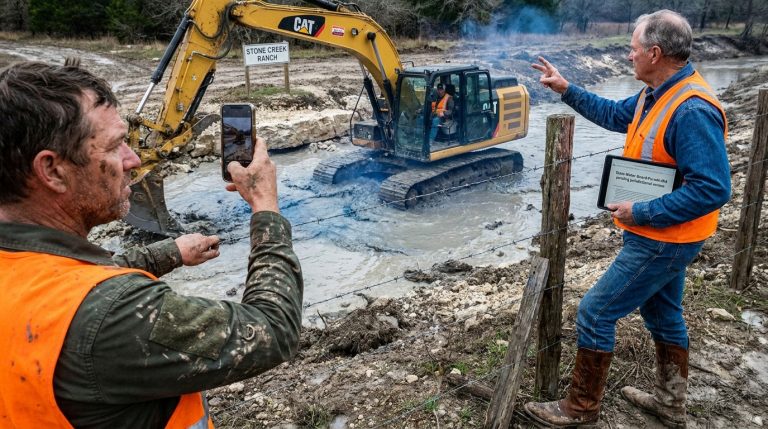
I sat in the idling truck, the heat from the engine ticking as it cooled, staring at the gap where a hundred years of precision-laid limestone had held back the valley’s chaos. It wasn’t just gone; it had been erased. The silence that followed the initial thunder was worse than the explosion itself. It was a pressurized, hollow vacuum, the kind that precedes a storm.
Dexter Hawthorne stood near the wreckage, his BMW X7 idling like a prowling beast in the background. He looked polished, out of place, a glossy consumer-grade artifact against the jagged, gray ruin of my life. He was tapping at his phone—likely queuing up a selfie to immortalize his triumph for the neighborhood group chat.
My grandfather, Samuel, had spent years shaping those stones, hand-fitting them so that not even a blade of grass could find purchase between the mortar. They were built to survive the Roman Empire’s timeline, yet Dexter had decided they were an aesthetic offense to his vision of beige-colored prosperity.
I put the truck in park, the sound of the transmission shifting feeling unnecessarily loud. My hands weren’t shaking. They were cold, static. I watched Dexter turn, his grin widening when he saw me. He brushed a dusting of grit from his khakis, the motion practiced and smug.
“Free demolition, Ezra,” he called out, his voice pitched to carry across the water. “Your little swamp was killing the property values. You should thank me for the upgrade.”
He didn’t look at the foundation. He didn’t look at the way the water was already beginning to surge, uncontrolled and hungry, through the breach. He only looked at me, waiting for the crack to show, waiting for the outburst that would justify his next legal maneuver.
I stepped out of the truck. My boots crunched on the gravel, a rhythmic, grinding sound. I didn’t yell. I didn’t run at him. Instead, I focused on the ground near his feet. There, wedged between two jagged chunks of limestone, was a fragment of the detonator housing—a specific, commercial-grade orange plastic that didn’t belong in a residential construction site.
“You didn’t just clear a pond, Dexter,” I said, my voice quiet, cutting through the morning stillness.
He laughed, a sharp, guttural noise. “I cleared an obstacle. There’s a difference.”
I knelt, pretending to inspect a piece of rubble, my fingers ghosting over the cold, sharp edges of the stone. I wasn’t looking at the stone. I was looking at the way the water had already begun to claw at the mud banks downstream. It was accelerating.
“You realize what the snowpack is this year?” I asked, looking up at him. I kept my face blank, a mask of civil disinterest. “We’re at one-forty percent of normal.”
“Irrelevant,” he dismissed, turning back to his phone. “The HOA has already authorized the regrading.”
He had no idea. He thought the law was a static thing he could buy and sell, just like the houses in Milbrook Estates. He didn’t understand the physics of a vacuum. By destroying the dam, he had removed the only thing keeping the valley from its own natural cycle. He had unstoppered the drain, and in six weeks, the mountain was going to come down in a torrent that would wash his polo shirts and his real estate dreams straight into the county drainage ditch.
I stood up, the orange plastic fragment tucked safely into my palm. Dexter was looking at his screen, his thumbs flying. He was uploading the victory.
He had just handed me the evidence I needed to dismantle his entire life, piece by piece, and he was too busy enjoying the view of the ruin to realize he was standing in the path of a federal tsunami.
CHAPTER 2: The Paperwork Offensive
I didn’t head straight home. Instead, I drove the long way into town, the backroads of the valley still slick with the morning’s dew. My mind was a closed circuit, running the variables of Dexter’s operation. He wasn’t just a man with a vendetta; he was a developer with a deadline, and those kinds of men were predictable. They relied on speed, on the assumption that the people they harassed would be too paralyzed by the sudden collapse of their world to look at the fine print.
I reached my house—a sturdy, quiet place built of wood and history—and sat in the dark of my kitchen. The silence of the house was a sharp contrast to the roar of the morning’s destruction. I turned on my laptop, the screen’s harsh blue glow reflecting in the darkened windows. My fingers felt steady as I pulled up the county’s public access portal.
Dexter had been the HOA president for eight years. In that time, he hadn’t just managed property values; he had created an infrastructure of authority that functioned like a private government. I started with the obvious: the filing records for Milbrook Estates. They were a mess of obfuscated links and corporate entities that seemed to evaporate upon closer inspection. But every entity left a digital footprint if you knew how to look for the decay.
I pulled up the bank routing numbers for the HOA’s “emergency maintenance” fund. They were redirected through a clearinghouse in Denver, then split into smaller increments and dispersed into accounts under the names of local landscape firms, legal advisory groups, and architectural consultants. I cross-referenced the business addresses.
The clacking of my keys was the only sound in the room, a rhythmic, mechanical percussion that felt like the building of a cage.
I found it forty minutes in: a firm called Mountain West Advisory. It claimed to provide “consulting services” for residential infrastructure. The address was a P.O. Box in a suburban strip mall three towns over. I checked the state’s business registry. The registered agent for Mountain West was listed as Dexter Hawthorne.
He hadn’t even bothered to hide it well. He had relied on the fact that no one would ever look. Why would they? People buy into an HOA for the manicured lawns and the promise of order; they don’t buy into them to audit the president’s personal side-hustles.
My pulse spiked, a sudden, cold thrill of realization. He was funneling community money into his own pockets to pay for the preliminary surveys and legal maneuvering required to turn my land into his resort. He was using the neighbors’ dues to pay for the tools that would destroy their own homes.
I leaned back, the chair groaning under my weight. My perception shifted. I had been looking at this as a personal struggle, a man defending his legacy. But it was larger than that. It was a heist, and I was the unexpected glitch in his software.
A notification pinged on my screen—an alert from the county zoning board. They had pushed through an amendment to the HOA bylaws late last night, expanding the board’s power to authorize “emergency structural demolitions” without a quorum. They hadn’t just blown up the dam; they had retroactively legalized the act.
I stared at the screen, the blue light making the lines of code and legalese blur. Was he really this bold? Or was he baiting me? He knew I was an engineer. He knew I’d investigate. Maybe he wanted me to run to the papers, to start a fight he could crush in a courtroom he’d already rigged.
The thought unsettled me. I picked up the fragment of orange plastic I’d kept on my desk, rolling it between my thumb and forefinger. It was high-grade polymer. It was the kind of industrial explosive material that required a specialized permit to even transport. Dexter was a real estate developer, not a demolition expert. He had hired someone—a contractor who knew how to leave a footprint.
I closed the laptop and walked to the window. The mist was beginning to lift off the pond, exposing the jagged, bleeding wound of the dam. The water level was already dropping. If I didn’t get ahead of his legal revisions, he would clear the site before I could even file a request for an injunction.
I grabbed my coat and a thick, empty binder. I needed to move, but I needed to be surgical. If I fought him on his terms, I would lose. I had to fight him on the reality of the landscape, and the one thing Dexter Hawthorne couldn’t change was the gravity of the valley.
I looked at the notes I’d scribbled on the pad—a list of names, addresses, and the dates of the shell company registrations. I was going to need a lot more coffee. And, as I looked out at the broken stones, I realized I was going to need an ally who knew how to turn these numbers into a prison sentence.
I didn’t leave through the front door. I slipped out the back, moving through the shadows of the treeline. If he had people watching, I didn’t want them to see me headed for the archives. I felt the sharp bite of the morning air against my face, a reminder that the physical world was still here, still cold, and still very much under my control.
The game had changed. He thought he was playing for property value; I was playing for the integrity of the earth. And as I reached my truck and slid into the driver’s seat, I knew that the more he built his castle of paper, the more weight he was adding to the foundation that was already destined to fail.
I turned the key, the engine coughing into life. I had a long drive ahead, and by the time I was finished, I wasn’t just going to have the evidence. I was going to have the trap.
CHAPTER 3: The Inspection Trap
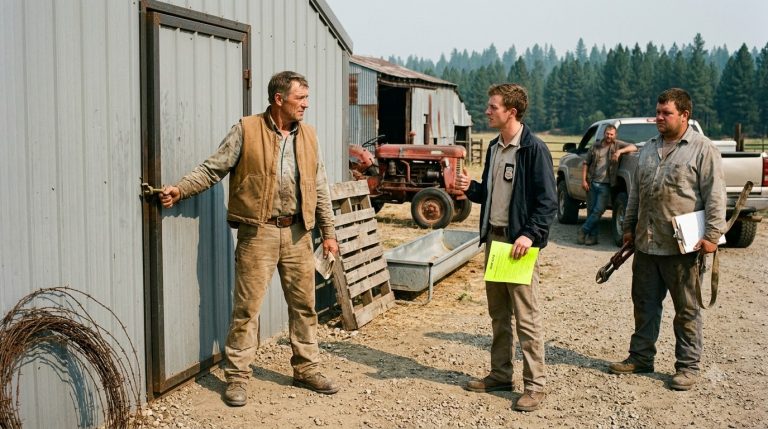
I didn’t have time to hide the binder. I didn’t even have time to close the laptop. The heavy, rhythmic crunch of boots on the gravel driveway was distinct—purposeful and heavy, lacking the casual scuff of a neighbor’s walk. It was Rick Morrison, the county building inspector, the man whose signature had authorized the “emergency assessment” of my dam with a screwdriver and a grunt.
I stepped away from the kitchen table, moving into the hallway just as a firm, aggressive knock rattled the front door. The wood shuddered under the impact. I didn’t rush to answer it. I took a slow, deliberate breath, letting the adrenaline subside into a cold, focused clarity. If he was here, he was acting on Dexter’s orders to confirm the dam was “structurally unsound” before the snowmelt. He was the frontline of the demolition.
I opened the door. Rick stood there, his clipboard tucked under his arm like a shield. He didn’t offer a greeting. His eyes immediately darted past me, scanning the hallway, looking for signs of life, signs of work, or signs of the very records I had just been analyzing. He was a man of modest build and outsized authority, his uniform clean, his expression a practiced mask of weary bureaucracy.
“Mr. Blackwood,” he said, the name sounding like a grievance. “I’m here for a follow-up assessment. Seems there’s been some… instability reported.”
“Reported by whom, Rick?” I asked, keeping my tone flat. I didn’t step aside to let him in. “The last time you were here, you didn’t even bring a flashlight. You poked the mortar with a screwdriver.”
He puffed his chest, the motion as performant as a bird’s display. “I’m an official of the county. I don’t need a flashlight to see structural erosion when it’s staring me in the face. We’ve had anonymous complaints about the integrity of the foundation. I’m here to verify them. Either let me perform the inspection, or I’ll have the sheriff here to ensure the county’s right of access.”
He was bluffing about the sheriff, but he was serious about the intimidation. I looked at the clipboard he held. The notice he had shoved toward me was on thick, cream-colored cardstock—not the standard, cheap thermal paper the county used for their usual citations. It was heavy, textured, almost like professional letterhead. It was the kind of stationery a private development firm would use for legal correspondence.
“You’re a long way from the county building, Rick,” I said, my gaze dropping to his hand. “And that’s a nice printer you’re using. Doesn’t look like the ones down at the office.”
His fingers tightened on the clipboard, just for a fraction of a second. A tremor, barely perceptible, betrayed him. He wasn’t a professional investigator; he was a guy who got paid to look the other way, and now he was realizing he was being watched.
“I don’t know what you’re talking about,” he muttered, trying to regain his composure. “Are you going to let me through, or are you obstructing a legal inspection?”
I stepped back, opening the door wide. “Go ahead. Look at the dam. But do me a favor, Rick—if you’re going to file another report, try to actually measure the mortar depth this time. I’ve got a structural firm coming out with sensors that cost more than your car. It’d be a shame for you to put your name on a document that’s going to be used as evidence in a fraud investigation.”
He didn’t blink, but his face hardened. He brushed past me, his shoulders brushing the doorframe. I followed him, keeping my distance. We walked out across the lawn toward the water. The morning air was biting, but the dampness was already beginning to cling to the broken stones of the dam.
He didn’t head for the dam immediately. Instead, he stopped by the spillway, looking at the water. He pulled out his phone and took a photo, his fingers moving quickly. He wasn’t looking at the foundation; he was looking for a pre-determined angle, a photo that would look good in a report intended to justify a demolition order.
“See here,” he gestured, pointing to a natural discoloration in the stone. “That’s wet-rot in the mortar. Total failure risk.”
“That’s moss, Rick,” I corrected him, my voice cutting through his rehearsed monologue. “It’s been there for eighty years. It’s a plant. Unless the county is now classifying local flora as structural liabilities, you’re just proving you don’t know the difference between a ecosystem and a failure.”
He stopped, his jaw setting tight. He turned to face me, his eyes narrowing. “You’re making a mistake, Ezra. You think you’re fighting for your land. You’re just fighting for a pile of rocks that’s going to bring the whole hill down on you. Dexter is trying to help you. If you’d just sign the release, this would be over. You’d be out, you’d have a payout, and we wouldn’t be having this conversation.”
“A payout,” I repeated. The word tasted like copper. “From who? Mountain West Advisory?”
His eyes flashed—a momentary shock that he tried to bury under a sneer. He knew the name. That was all the confirmation I needed.
“I don’t know what that is,” he said, turning back to the pond. He scribbled something on his clipboard, his handwriting frantic and jagged. “I’m marking this as a high-risk zone. You’ll receive an order for closure by the end of the day.”
“File it, Rick,” I said, my voice quiet. “Every page, every photo, every lie you write down today. Make it a masterpiece. Because I’m going to make sure every single one of those pages becomes a reason for you to lose your pension.”
He didn’t respond. He turned and marched back toward his truck, his gait stiff, his confidence rattled. I stood by the water’s edge, watching him go. I noticed he didn’t even bother to take a second look at the foundation. He didn’t care about the truth; he only cared about the paperwork.
As his truck roared to life and he sped away, throwing gravel into the air, I knelt down by the water. I traced the line of the limestone, feeling the solid, unshakable weight of it beneath my palm. It wasn’t rot. It was endurance. And as long as it held, the water would be forced to flow exactly where my great-grandfather had decided it should go. I just had to make sure the evidence I was collecting would be ready for the inevitable day the inspector finally realized he was the one who was sinking.
CHAPTER 4: The Public Comment
The municipal building smelled of dry-erase markers and decades of institutional indifference. I walked down the carpeted hallway, my boots making no sound, my mind already rehearsing the opening lines of my statement. The council chamber was smaller than I remembered, a claustrophobic space designed to discourage public dissent through sheer lack of comfort. The wood paneling was faux, the lighting was a flickering, jaundice-yellow that made everyone look slightly ill, and the air was recycled to the point of exhaustion.
Dexter Hawthorne was already there, sitting in the front row, his posture relaxed, his hands folded over a leather-bound folio. He looked like he was attending a board meeting, not a public hearing on the destruction of an entire family legacy. He didn’t turn when I walked in, but I saw the way his shoulder tensed, a microscopic shift that told me he knew I was entering his theater.
The room was filling up with the usual suspects: the HOA board members, the local retirees looking for something to do, and a handful of worried homeowners who had likely been told by Dexter that I was the one threatening their neighborhood’s “safety.” I took a seat in the back, far enough away to keep the room in my peripheral vision, but close enough to watch Dexter’s every move.
The council members filed in at precisely 2:00 p.m. Councilman Bradley Walsh, the man Dexter had effectively bought and paid for with the promise of future resort kickbacks, took the center chair. He didn’t look at the crowd; he looked at his notes, his face already set into a mask of weary, pre-determined agreement.
“We have one item on the agenda regarding the safety assessments at the Blackwood property,” Walsh said, his voice echoing slightly off the acoustic tiles. “The board has received a report from the county building inspector regarding structural deficiencies in the pre-1950 water retention structure. We are here to discuss a proposed ordinance for immediate remediation.”
I didn’t wait to be called. I stood up, moving into the aisle. The room went quiet, a sudden, expectant stillness.
“Mr. Blackwood,” Walsh said, his gaze finally shifting toward me. “Please keep your comments to three minutes. We have a full agenda.”
I reached the podium. The microphone was too low, a high-pitched whine echoing for a second before I adjusted it. I didn’t look at the council; I looked directly at the back of Dexter’s head.
“You’re talking about ‘structural deficiencies’,” I began, my voice steady. “But let’s be clear about what’s actually happening here. Rick Morrison, the county inspector, filed a report based on a screwdriver and an opinion. He didn’t use a single engineering tool. I have here a report from Matthews and Associates—a firm that certifies the state’s bridges—that indicates the dam is structurally superior to modern code requirements.”
I held up the thick, spiral-bound report. The room erupted in a low murmur. Dexter didn’t move, but he gripped the edges of his folio until his knuckles turned white.
“This isn’t about safety,” I continued, pacing the small space behind the podium. “This is about the fact that Dexter Hawthorne, the president of your HOA, has been funnelling your monthly dues through a shell company called Mountain West Advisory. He’s been using your money to pay for the preliminary development plans of a resort community that he stands to profit from personally. He needs that dam gone to make room for his golf course, not to protect your basements.”
The silence that followed was absolute. It was the sound of a hundred people suddenly realizing they had been played. I pulled out the printout of the shell company registration, the one I had pulled from the county records that morning.
“I’ve filed these records with the state attorney general’s office this morning,” I said, my voice dropping, gaining weight. “This isn’t an engineering debate. This is a fraud case. If the council proceeds with this ‘remediation’ based on fraudulent documents provided by an inspector under investigation, every one of you sitting at this table will be personally named in the resulting litigation.”
Walsh’s face turned a shade of gray that matched the concrete foundation of the building. He looked toward Dexter, who finally turned around. His face wasn’t smug anymore; it was a cold, hard mask of calculation.
“This is irrelevant information,” Dexter interrupted, standing up. His voice wasn’t loud, but it was dripping with a dangerous, controlled authority. “Mr. Blackwood is a disgruntled property owner trying to obstruct community improvement. The council should focus on the immediate safety threat, not these desperate, baseless accusations of financial mismanagement.”
He was good. He was calm, articulate, and he knew exactly how to dismiss a threat by framing it as a personal grievance. But the room had shifted. I saw Janet Morrison—one of the neighbors I had spoken to the day before—looking at the folder of documents in her lap. The doubt was there, spreading through the room like a contagion.
“Is the accusation baseless, Councilman?” I asked, looking at Walsh. “Because I have the tax filings. And I have the invoices.”
Walsh cleared his throat, shuffling his papers. The air in the room felt thick, almost heavy, as if the oxygen was being sucked out by the tension.
“We… we will need to take these documents under advisement,” Walsh said, his voice lacking the conviction of his earlier statement. “The vote on the ordinance is hereby postponed, pending an audit of the HOA’s financial records.”
Dexter stood there for a heartbeat, his eyes locking with mine. There was no fear, only a raw, predatory promise of a fight that hadn’t even begun. He didn’t shout. He didn’t threaten. He simply nodded, once, a short, sharp movement that was more terrifying than any speech could have been.
“Fine,” Dexter said, his voice soft. “We’ll wait for the audit.”
He walked out of the room, his footsteps echoing in the silence. I stood at the podium, my hands gripping the mahogany edge. I had won the hour, but I had just declared a war. I looked down at the documents I had left on the table—the paper trail was solid, but I knew Dexter wasn’t the kind of man to let a bit of bad accounting stop him. He would find another way, a darker way, to get what he wanted.
As I walked out of the council chamber, the cool, stale air of the hallway felt like a reprieve. I had set the trap, and I had seen the look in his eyes when he realized the cage was closing. Now, I just had to make sure I wasn’t inside it with him when the walls finally collapsed.
CHAPTER 5: The Geologic Reality
The drive up to the ridge was a white-knuckle affair. The squall hit while I was still three miles from the dam, a wall of rain so thick it turned the gravel road into a slick, unpredictable river of mud. My tires hummed, fighting for purchase against the slope. I had Dr. Martinez’s field equipment in the passenger seat—an array of pressure sensors and water-level gauges that cost more than my truck.
I didn’t turn back. I couldn’t. If the storm hit the basin with the force the barometer suggested, the pressure on the dam’s weakened foundation would spike. I had to get the sensors in place before the surge, or the data I needed to build the federal negligence case against Dexter would be lost to the mud.
I skidded to a halt near the crest. The wind was whipping the pine trees into a frenzy, their needles sounding like static against the glass. I grabbed the gear, zipping my jacket to my chin. The cold was instantaneous, a sharp, physical slap that cleared the lingering exhaustion of the council meeting. I sprinted toward the spillway, my boots sliding in the saturated earth.
I reached the water’s edge just as a flash of lightning illuminated the entire valley in a strobe-like flicker of white. The dam looked smaller, more vulnerable than it ever had in the daylight. The sabotage by Dexter’s men—the deliberate fracturing of the mortar joints—was visible now. Small, jagged fissures had opened up under the pressure of the rising rain, and I could hear the faint, high-pitched whistle of water forcing its way through the stone.
I knelt in the muck, my hands moving with practiced speed to calibrate the first sensor. This wasn’t just a survey anymore; it was a battle. Every stone of this structure was an extension of my family’s history, and right now, it was fighting a losing war against both the weather and the rot Dexter had introduced.
“Hold together,” I whispered, the words lost to the howling wind.
I hammered the sensor stake into the silt near the base, the metallic ping of the tool ringing out against the storm. I connected the transmission cable, my fingers numb but precise. The first data stream hit the handheld unit—the water pressure was already climbing, far faster than the historical models predicted. The fracture wasn’t just aesthetic; it was causing a rapid, subsurface erosion of the foundation.
A massive crack of thunder rattled my ribcage. I turned, scanning the perimeter, and saw a dark silhouette standing near the treeline, watching me.
It wasn’t a county official. The figure was holding a heavy, black bag—tooling, maybe, or something else. I shielded my eyes from the driving rain. It was Dexter’s brother-in-law. I recognized the slouch, the way he stood with his weight shifted to one side. He wasn’t supposed to be here. The area was under legal observation.
I stood up, the mud sucking at my boots. He saw me, and for a second, he didn’t run. He just stood there, the rain soaking through his jacket, and then he raised something—a heavy, handheld radio. He wasn’t here to sabotage the dam further; he was here to witness it break. He was waiting for the structural collapse to happen on his watch, the perfect cover for Dexter’s ‘natural failure’ narrative.
My blood went cold. If he triggered another charge—another small, calculated explosive to push the weakened mortar over the edge—the sudden flood would be categorized as a catastrophic accident. No negligence, no federal liability for Dexter. Just a tragic, natural event.
I started running toward him, my lungs burning, the rain lashing against my face. “Get out of here!” I yelled, though I knew he couldn’t hear me over the squall.
He didn’t wait. He turned and vanished into the thicket of pines, disappearing into the dark, swirling chaos of the storm. He wasn’t fighting me anymore; he was retreating, confident that he had already done enough damage to let the mountain do the rest.
I stopped at the edge of the trees, panting, my legs shaking from the strain. I looked back at the dam. A new stream of water had appeared—a dark, surging jet erupting from the center of the masonry. It was failing. The pressure was building beyond the threshold. I pulled out my phone, the screen slick with rain, and hit the emergency alert button I’d programmed for the coalition.
“Evacuate,” I shouted into the phone, the automated message sending the warning to every downstream house. “The dam is failing. Repeat, move to high ground.”
I stood there for a long moment, watching the stone yield. The logic of the disaster was unfolding exactly as the models had predicted, but witnessing it in the raw, wet dark was a different kind of horror. The water was no longer a resource; it was a weapon, and Dexter had set the firing pin. As the ground beneath me shivered with the weight of the coming surge, I knew the battle wasn’t just about the dam anymore. It was about how many families I could pull out of the path of the disaster Dexter was currently watching from the safety of his office window.
CHAPTER 6: The Shredder Incident
I didn’t head for the shelter. I headed for the HOA office.
My mind was white-hot, a singular, focused point of rage. The dam was gone, or close enough that the difference didn’t matter. The water was tearing through the valley, and somewhere, Dexter was likely sitting in a climate-controlled office, watching the sensors and waiting for the “accident” report to land on his desk. He thought the destruction of the dam wiped the slate clean, that the physical evidence of his corruption would be buried under ten feet of mountain runoff.
He was wrong.
I drove through the downpour, the wipers on the highest setting unable to keep up with the deluge. My truck hydroplaned once, the rear end swinging wide before I caught the drift, my knuckles white on the steering wheel. I didn’t care about the risk. The road was a blur of gray and green, but I knew every inch of this valley. I reached the community center at 2:00 a.m.
The building was dark, but a sliver of light leaked out from the side office—the HOA president’s private room.
I killed the headlights a hundred yards out and rolled the truck into the shadows of the maintenance shed. I didn’t have a weapon, but I had the heavy steel flashlight I’d been using for the survey, and I had the absolute, unyielding clarity of a man who had already lost his home. I moved through the rain, staying low, the wet grass soaking through my jeans in seconds.
I reached the side window and peered through the blinds.
Dexter was there. He wasn’t alone. His brother-in-law was standing over an industrial shredder, shoveling stacks of thick, cream-colored cardstock into the hungry metal teeth. They were destroying the original, high-quality stationery—the documents that linked Mountain West Advisory to the county demolition orders.
They were fast, desperate, their movements jerky and frantic. Dexter was checking his watch every few seconds, his face tight, his eyes darting toward the door. They were closing the books, erasing the paper trail before the flood waters could reach the main road and force an evacuation.
I didn’t knock. I took the heavy flashlight, stepped back, and swung it with everything I had into the glass of the side window.
The sound was explosive, a crystalline shatter that echoed through the empty office. Dexter screamed, a high, thin sound of pure panic, and spun around. I vaulted through the frame, glass crunching under my boots, and landed in the center of the room.
“Stop!” I roared, the flashlight leveled like a club.
The brother-in-law froze, his hand still hovering over the shredder. Dexter stood near the desk, his hands empty, his composure finally, completely shattered. For a moment, no one moved. The only sound was the whirring of the shredder and the heavy, ragged breathing of the men in front of me.
“You’re a bit late, Ezra,” Dexter said, though his voice lacked any of the authority he’d carried in the council chamber. He looked older, his hair disheveled, the expensive polo shirt stained with mud and sweat. “The documents are in the machine. By morning, they’ll be confetti. You have nothing.”
“I have the forensic accounting,” I said, stepping toward him, the broken glass singing under my weight. “I have the emails. I have the sensor data from the dam that proves the structural failure was caused by explosives, not age. You didn’t just break the law, Dexter. You committed federal crimes. You’re going to prison for the rest of your life.”
Dexter stepped back, hitting the desk. “You can’t prove I ordered the demolition. It was a failure. A natural failure. The county inspector signed off on it.”
“The county inspector is in the back of a squad car,” I said. “And the records you’re shredding right now? They were already backed up on the cloud an hour ago. You weren’t just being watched by the law. You were being watched by the physics of the valley.”
The brother-in-law made a move, reaching for a heavy metal pipe on the floor, but I didn’t hesitate. I swung the flashlight, catching him across the shoulder with a sickening, wet thud. He collapsed, clutching his arm, the pipe clattering across the floor.
I stood over them, the rain pouring through the broken window, chilling the air. Dexter looked at the shredder, then at me, then at the door. He realized he was trapped. The exit was blocked, and the man he’d relied on to do his dirty work was currently groaning on the floor, useless.
“You think you’ve won,” Dexter whispered, his face twisting into a sneer of pure, undiluted malice. “The flood is already happening, Ezra. You lost the dam. You lost the pond. You lost everything.”
“I lost the stone,” I said, looking him dead in the eye. “But you’re losing your freedom. And that’s a trade I’ll make every day of the week.”
I pulled out my phone and dialed the sheriff’s direct line. I didn’t take my eyes off him. I kept the flashlight trained on his chest, ready for the moment he decided to try something stupid. I stayed there, in the cold, wet dark of the office, holding the space, holding the evidence, and holding the man who had thought he could overwrite reality with nothing more than a pen and a corrupt inspector’s signature. The flood roared in the distance, a low, tectonic rumble that served as the final judgment on everything he had tried to build.
CHAPTER 7: The Federal Stay
The rain had reached a fever pitch, hammering against the community center’s metal roof with the frantic, discordant beat of a panic-stricken crowd. Outside, the world was dissolving. I held the phone to my ear, the signal dropping in and out, listening to Harold Brighton’s voice—thin, fragile, but sharp with the authority of someone who had spent six decades sharpening his mind against the whetstone of the law.
“Ezra,” Harold shouted over the roar of the wind, “the judge has signed the stay! The demolition is formally declared illegal under federal jurisdiction. Do you have the physical documents? Are they secure?”
I looked at the shredder, then at the scattered, cream-colored remnants of the files I’d managed to save before the machine could finish them. They were confetti, but the remaining pile—the ones I’d physically pulled from the hopper—were enough. I had the signatures, the routing numbers, the clear, undeniable link between Dexter’s personal accounts and the demolition order.
“I have them,” I said, my voice barely audible over the drumming rain.
“Then you stay put,” Harold commanded. “The sheriff is two minutes out. The federal injunction is being transmitted to the precinct now. If anyone—I mean anyone—tries to interfere, you cite the 1953 compact. You are the legal steward of that site until the federal authorities arrive.”
I dropped the phone into my pocket and turned back to Dexter. He was leaning against the desk, his face pale, his eyes fixed on the door. He wasn’t the master of the valley anymore; he was a cornered man, watching his carefully constructed reality evaporate in the downpour.
“You think the injunction matters?” he spat, though his voice lacked the bite of his earlier bravado. “The dam is already gone. The water is already moving. You can show the judge all the paper you want, Ezra, but you can’t put that much water back in the pond.”
“I don’t need to put the water back,” I said, stepping toward him. I gripped the file-laden binder, my knuckles white. “I just need the judge to see that you destroyed the flood control system while knowing—having been explicitly warned by hydrological models—that it would cause a disaster. That makes this criminal negligence. It makes you liable for every cent of the cleanup, every dollar of property damage, and every life you put at risk tonight.”
I heard the heavy, rhythmic thud of a vehicle pulling into the parking lot. A spotlight swung through the dark, illuminating the rain-lashed office for a split second before dying out. The sheriff was here.
I walked to the door and pulled it open. Deputy Maria Santos stepped in, her jacket glistening with rainwater, her duty belt heavy with the weight of her authority. She didn’t look at me; she looked at Dexter.
“Dexter Hawthorne,” she said, her voice devoid of emotion, “you’re under arrest for federal environmental violations, conspiracy to commit fraud, and criminal negligence. Turn around and place your hands behind your back.”
Dexter hesitated, looking at the door, at the shredder, at the evidence pile. Then, slowly, he turned. The click of the handcuffs was the most satisfying sound I had ever heard. It was the finality of a mechanical lock, a firm, non-negotiable end to the corruption that had poisoned the valley for months.
As she led him out into the storm, his shoes splashing through the deepening puddles, I walked to the edge of the office’s porch. The scene before me was a nightmare of natural force. The valley floor was changing. The water had bypassed the channel and was scouring the soil, turning the manicured lawn of the neighborhood into a scarred, muddy wasteland.
It was a tragedy, yes—a failure of governance, a failure of ethics—but it was also a return to the natural state. The valley was doing exactly what it was meant to do before we tried to tame it with concrete and plastic.
I looked at the binder in my hand. The evidence was safe. The law had caught up, and the physics were finally, painfully clear. I took a deep breath of the cold, ozone-scented air. The disaster was far from over—the cleanup would take years—but the corruption was severed. Dexter was in the back of the cruiser, and the valley was finally, in its own brutal way, being heard. I stepped out into the rain, feeling the weight of the binder against my chest, and began the walk toward the sheriff’s car. It was time to hand over the truth.
CHAPTER 8: The Inescapable Tide
The cleanup effort was a symphony of heavy machinery and exhausted men. It had been weeks since the flood, but the marks of the water remained—scoured channels where the road used to be, silt-choked basements, and the hollowed-out shells of the McMansions that Dexter had deemed “property value cancer.” Standing on the ridge, watching the Army Corps of Engineers put the final, armored finish on the new spillway, I felt a strange, hollow sense of peace.
The new dam was a beast—massive, reinforced limestone blocks pinned to the bedrock with steel that would outlast the very mountain itself. It was the structure my great-grandfather had envisioned, updated with the brutal, uncompromising precision of modern flood-control science. It wasn’t just a barrier; it was a promise.
I walked down the slope toward the pond’s edge, the mud giving way to the solid, graveled path that now circled the basin. The water was clear, deep, and unnervingly still. Dexter’s trial had been a formality. The evidence I’d dragged from the shredder, combined with the federal investigation into his shell companies, had made a defense impossible. He hadn’t even tried to testify. He sat in his cell in Kansas now, a man who had traded a century of community history for a golf course that would never be built.
I stopped where the old foundation used to be. The ghosts were gone. The metallic tang of the blast and the frantic, chemical smell of the night at the HOA office had been replaced by the scent of damp earth and the subtle, sweet rot of pine needles.
Janet Morrison met me near the overflow channel. She was wearing a high-visibility vest, her clipboard tucked under her arm. The HOA had changed. The transparency rules were ironclad, the corruption purged with a fervor that bordered on the religious.
“The final restitution checks went out this morning,” she said, her voice soft. “It’s not enough to fix the memories, but it’s enough to rebuild the houses. Everyone’s taking the federal offer to integrate the flood-resistant architecture.”
“It’s the right move,” I replied, watching a trout break the surface of the pond. It was a native, a flicker of silver in the dark water.
We walked in silence for a while. The work was exhausting, the emotional cost of the last six months etched into the lines around her eyes, but there was a resilience here now that hadn’t existed before. We had been tested by the water and the corruption, and we had come out the other side harder, sharper, and better connected.
I reached into my pocket and pulled out a small, smoothed piece of limestone—the last remaining fragment of my great-grandfather’s work that I’d kept on my desk. I knelt at the base of the new spillway and pressed the stone into the mortar joint of the new structure. It was a small act of continuity, a bridge between the 1924 design and the modern reality.
“What happens now?” she asked.
“Now?” I stood up, wiping the grit from my hands. “Now, we maintain. The dam isn’t a trophy. It’s a job. And I’m going to make sure the next president knows exactly what happens when they decide to ignore the physics of the valley.”
The sun began to dip below the ridge, casting long, golden shadows across the spillway. The valley looked different—less curated, less manicured, more honest. The fake perfection of Milbrook Estates had been washed away, revealing the rugged, resilient landscape beneath.
I thought of Ezra, the version of me from six months ago—the man who moved here to hide from a failed marriage and a broken life, who thought he could find peace by simply ignoring the world. That man was gone, replaced by someone who knew the value of the ground he stood on.
I walked back to my truck, the engine starting with a low, steady growl. The road ahead was long, and there were twelve other towns on my calendar for the next month, twelve other water systems that needed an audit from someone who knew how to speak the language of limestone and gravity.
I looked back one last time. The dam held. The water was governed. The valley was silent, and for the first time in a long time, the silence didn’t feel like a threat. It felt like an answer. I put the truck in gear and drove away from the ridge, leaving the past to the stone, and turning my attention to the road that lay ahead, clear and unburdened in the fading light.