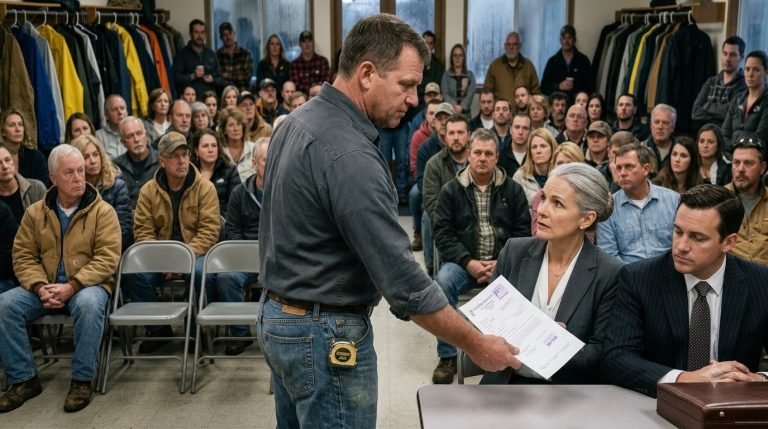
Iron in the Soil: A Veteran’s Calculated War Against a Corrupted Neighborhood Empire
CHAPTER 1: THE IRON GATE
The teeth of the cutters closed with finality.
Captain Jake Thornton stood motionless twenty yards away, his boots planted on the limestone path leading from his grandfather’s office window. Through the smudged double-paned glass, the reflection of his own steady, unblinking eyes stared back. He didn’t rush. In twelve years with the Army Corps of Engineers, he had learned that a premature reaction only gifted the enemy tactical initiative.
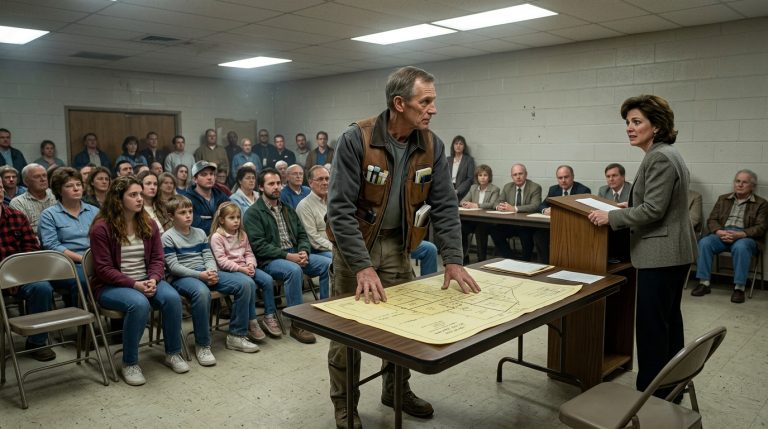
Karen Westfield stepped through the newly opened gap in the main gate like an inspecting officer claiming a conquered trench. Her white pantsuit was spotless, sharply cut against the dust of the 340-acre Thornton Ranch. Flanking her were two neighborhood board members and a contracted locksmith whose nervous fingers kept twitching toward his tool pouch.
“Make sure the chain is secured with our lock,” Karen said, her voice carrying easily across the dry grass. She didn’t look down at the gravel; she looked straight ahead toward the historic 1955 barn, her gaze calculating square footage and potential subdivision lines.
Jake watched the rise and fall of her shoulders. She wore the smug, weightless expression of someone who believed she was executing a routine administrative eviction. She had calculated the math of the county recorder’s office incorrectly by exactly fifty feet and sixty-six years, but she was entirely unaware of the trap waiting at the bottom of the legal ledger.
The locksmith looped a heavy brass padlock through the gate’s wrought iron, clicking it shut with a dull snap that echoed off the dry oak trees.
Jake let out a slow, controlled breath, feeling the cold weight of the keys in his right pocket—the duplicate keys to the exact padlock she had just rendered obsolete. He did not step out onto the porch. Instead, his eyes drifted past Karen’s tailored shoulder, latching onto a subtle discrepancy in the locksmith’s posture: the man kept glancing back toward the white Lexus idling on the asphalt shoulder, his hand hovering over his belt in a silent tell of unease. He knew this ground didn’t belong to them.
The silence between the ranch house and the gate stretched taut, brittle as dry pine under the late-summer heat, waiting for the precise second to break.
CHAPTER 2: THE THREERING BINDER AND THE FIRST DEFENCE LINE
The white Lexus did not rush away. It idled by the shoulder for four full heartbeats, its exhaust curling thin and grey against the amber September stubble, before the transmission whined and gravel spat from beneath its tires.
Jake did not watch them leave. He turned his back on the new padlock, his hand sliding off the cool brass of the office doorknob only after confirming the latch was set. The interior of his grandfather’s study smelled of old paper, pipe tobacco that had not been burned in three years, and the sharp, mineral tang of dry leather. The dust motes suspended in the slanting afternoon light caught the edge of a mahogany desk that had stood unmoved since the Eisenhower administration.
His boots clicked rhythmically against the wide-plank oak flooring as he crossed the room, stopping before a stack of legal correspondence neatly squared beside an unpolished brass lamp.
The three-ring binder sat at the bottom of the stack like an unexploded ordnance casing. Four inches thick, bound in heavy black vinyl, its spine reinforced with strips of yellowing adhesive tape. It was an archive of friction. Every certified letter, every notice of code violation scrawled on county letterhead, every threat of municipal penalty—each sheet had been hole-punched, fitted over steel prongs, and stamped with the exact hour of its arrival.
Jake dropped into the leather desk chair. The springs groaned under his weight, a familiar, low-pitched complaint that had comforted him through twelve years of deployment architecture reports and overseas land-rights mediation.
He didn’t open the binder immediately. Instead, his gaze snagged on a stray wooden shaving resting beside the blotter—a remnant from the morning he had spent reinforcing the tack room latch. The sight triggered an abrupt, visceral flash of memory: his grandfather, Samuel, standing in that exact spot in the summer of 1994, scraping red oak with a drawknife while cursing the county commissioner over a disputed drainage ditch. The law is just a tool, Jake, the old man had muttered, blowing a curl of wood off his sleeve. If you don’t know how to read the blueprint, someone else is always drawing the walls around you.
The memory hardened the set of his jaw. He flipped the binder open.
The heavy plastic rings clicked with a hollow, mechanical sound. Page one: the initial NextDoor printout captured by a neighbor’s phone camera, the pixels grainy around the edges of the rusted tractor bucket. Page twelve: the health inspector’s preliminary notes, scribbled in blue ink with a signature that had since retired to Florida. Page eighty-four: the formal cease-and-desist letter bearing the letterhead of Ridgeline Estates Legal Committee, signed by Richard Westfield—a patent attorney whose professional registration number revealed he hadn’t argued a real property case in twenty years.
A patent attorney representing a residential covenant in an agricultural zone.
Jake’s thumb stopped turning the pages. He stared at Richard Westfield’s signature, his mind breaking down the mechanics of the threat. A patent lawyer doesn’t issue local zoning demands unless he’s operating as a proxy for something structural—something deeper than mere noise complaints about veteran retreats or tractor dust. Patent law is about exclusivity, claims of novel invention, and exclusionary rights over design.
He reached for a red grease pencil, pulling it from the carved wooden holder his sister had given him before her deployment to Grafenwöhr. With deliberate, measured strokes, he drew a small, clean circle around Richard Westfield’s name, then drew a sharp line connecting it back to the county surveyor’s office seal stamped on the front-page notice of lien.
The connection was too clean, too aggressively administrative. Karen Westfield wasn’t just acting out of neighborly spite; she was enforcing an exclusionary boundary designed to isolate the 340 acres from every vector of supply and credit.
The desk lamp buzzed softly, casting a jaundiced, low-voltage glow across the paperwork as the sun dipped behind the western ridge, plunging the pasture into sudden shadow. A floorboard creaked in the hallway—not the house settling, but the distinct, heavy-heeled tread of Miguel coming in from the north paddock.
The office door swung inward without a knock, the brass knob clicking against the plaster wall.
Miguel stood in the frame, his Stetson held low against his thigh, his dark eyes shadowed by the overhead light. His breathing was slightly shallow, the respiration of a man who had jogged up from the equipment shed rather than walked.
“Boss,” Miguel said, his voice dropping an octave to match the acoustics of the paneled room. “The feed store just called back. Not about the credit line. They said the delivery truck we scheduled for Thursday isn’t coming. They’re cancelling the grain drop.”
Jake didn’t look up from the red-circled signature on the page. The pencil remained steady in his fingers.
“Did they give a reason?” Jake asked, his tone flat, stripped of surprise.
“Owner sounded like he was reading off a script,” Miguel said, shifting his weight from one boot to the other, the leather squeaking against the dry floorboards. “Said their commercial insurer flagged our delivery route as a disputed liability zone because of the new gate padlock. They said until the HOA clears the access easement with the county clerk, their trucks won’t cross the cattle guard.”
The room grew very still. The low hum of the desk lamp seemed to fill the vacuum left by the silence, vibrating against the glass of the grandfather’s framed discharge papers on the opposite wall.
Jake closed the binder. The black vinyl cover met the base with a dull, heavy thud that rattled the brass pen holder.
“They aren’t just locking the gate,” Jake whispered, his eyes fixed on the reflection of the window pane where the darkness outside was beginning to mirror the interior. “They’re trying to starve the livestock out before the first frost.”
Miguel didn’t flinch. He simply tightened his grip on the brim of his hat, his knuckles pale under the dim light. “What do we do, Captain? We’ve got forty head in the lower pasture that need feed by Friday.”
Jake stood up, the chair legs scraping backward against the oak planks with a sharp, metallic screech. He reached into his coat pocket, pulling out the heavy brass keys to the secondary ranch access road—the old logging trail cutting through the creek bed that Karen Westfield’s surveyors hadn’t even bothered to map.
“We don’t wait for their permission to cross our own land,” Jake said, walking past Miguel toward the heavy canvas coat hanging by the back door. “Get the flatbed ready. We’re running the back road tonight.”
CHAPTER 3: THE GHOSTBILLING DISCOVERY AT THE COUNTY ARCHIVES
The county records office smelled of damp cotton and industrial bleach, a sharp chemical sting that masked decades of decomposing parchment.
Jake kept his coat buttoned against the drafty basement corridor, his boots striking the linoleum floor with a heavy, deliberate cadence. It was 8:15 on a Thursday morning, twenty minutes before public hours, but county clerk records access for certified engineers carrying an active civil motion was a matter of statutory right. He didn’t wait for the front desk receptionist to finish her coffee. He laid his bar-coded badge and civil certification card flat on the counter.
“I need the original 1987 parcel folio and the subsequent incorporation charters for Ridgeline Estates, phase one through four,” Jake said, his voice flat, engineered to bypass small talk.
The clerk, a gaunt woman with wire-rimmed glasses perched low on her nose, looked from the badge up to Jake’s face. She didn’t blink. Without a word, she swiped a plastic keycard against the electronic wicket behind her, unlocking the heavy steel-reinforced door leading to the deep archives.
“Table four,” she muttered. “Don’t unbind anything. If I see a binder clip come off, I pull your credentials.”
Jake pushed through the door into the vault. The temperature dropped ten degrees, the air growing stale and thin. Row upon row of grey metal shelving stretched into the amber glow of overhead fluorescent tubes that hummed with a high-frequency whine.
He didn’t head for the modern digital terminals. Digital databases were clean, scrubbed, and easily manipulated by administrative overrides. He wanted the paper—the heavy, off-white ledger sheets stamped with physical ink and countersigned by officials long since retired or buried.
Table four was a scarred oak surface illuminated by a single, adjustable gooseneck lamp. Resting upon it was a flat cardboard storage box labeled Ridgeline-Original-1987-Inc.
Jake pulled out his notepad, a mechanical pencil, and sat down. He lifted the lid.
The documents inside were layered like geological strata. On top sat the polished 2018 developer filings, clean and crisp, boasting modern architectural layouts and utility easements. But as Jake slid his gloved fingers beneath the upper divider, lifting the plastic sheath, he hit the older layer.
The 1987 municipal incorporation documents.
His eyes scanned the margin notes, looking for the surveyor’s seal. According to Karen Westfield’s legal filings, the boundary line of the residential tract extended thirty feet past the oak line, absorbing the western edge of his grandfather’s grazing path. But as he pulled the original hand-drawn topographical map signed by the county surveyor thirty-nine years ago, a physical discrepancy leaped off the page.
The ink used for the boundary extension wasn’t blue, nor was it the standard black archival carbon. It was a modern synthetic violet ink—the kind used by inkjet printers manufactured after 2005. Someone had retroactively altered the archival map, tracing over an old boundary line to make it look like an official clerical correction.
Jake didn’t touch the map with his bare hands. He leaned in closer, his breath fogging the clear protective cover slightly. Beneath the transparent film, the paper fibers were disturbed—scraped clean with a razor blade before the new line had been inked over.
A quiet, metallic click echoed down the aisle behind him.
Jake didn’t turn his head immediately. He listened to the soft scuffle of rubber-soled shoes pausing between stacks three and four.
“Can I help you find a specific folio, Mr. Thornton?”
The voice belonged to a man in a rumpled grey suit who had materialized from the deep archive rows. He wore an identification badge tucked inside his jacket lapel, but the lanyard was blank—no county seal, no department code. He stood five paces away, hands tucked neatly into his pockets, his posture too rigid, too alert for a municipal archivist.
“I’m reviewing public incorporation records,” Jake said evenly, keeping his pencil resting steadily against the edge of the oak table. “Standard civil discovery.”
“Right. Civil discovery,” the man repeated, stepping an inch closer into the pool of yellow light cast by the gooseneck lamp. “Just keep in mind that older folios are fragile. Excessive handling can damage the structural integrity of the paper.”
It wasn’t a warning about conservation; it was a boundary marker. The man was monitoring how deep Jake was digging into the paper trail.
Jake looked up, locking his eyes onto the stranger’s gaze with the flat, unblinking stillness of a man who had spent years evaluating hostile reconnaissance teams. The stranger’s eyes flicked downward toward the altered 1987 map, lingering on the violet ink line for a fraction of a second too long.
“Paper is tougher than it looks,” Jake said softly, rising slowly from the metal chair, his height and broad shoulders filling the narrow aisle. “Especially when it’s backed by county certification. But fraudulent ink tends to bleed under the right humidity.”
The stranger’s jaw tightened. The silence between them stretched, thick with unspoken friction, before the man gave a tight, economical nod, turned on his heel, and retreated down the dark aisle toward the exit doors without another word.
Jake watched him vanish into the shadows, his mind clicking through the tactical implications. They weren’t just fighting an HOA president anymore; they were guarding a paper trail that someone was actively trying to sanitize.
He looked back down at the altered map, picked up his phone, and snapped three high-resolution macro-photographs of the shaved paper fibers beneath the violet ink. Then, he closed the box, packed his notes, and walked out into the harsh basement light, ready to pull the next layer of the ledger.
CHAPTER 4: THE CORPORATE FOOTPRINT AND THE DEVELOPERS LEDGER
The engine of the pickup truck turned over with a deep, concussive rumble that rattled the loose change in the center console. Jake didn’t shift into drive immediately. His fingers rested on the steering wheel, the macro-photographs of the altered 1987 map glowing softly against the screen of his burner phone where he had transferred them minutes prior.
The violet inkjet fibers weren’t just a local clerical blunder. They were a fingerprint.
He pulled out of the county municipal lot, his tires crunching over loose gravel, and drove the three miles toward the county business registry annex on Maple Street. If Ridgeline Estates was executing a coordinated boundary expansion, they had to register corporate partnership agreements with the state commerce division whenever a development tract exceeded fifty acres.
The annex was a low-slung brick building sandwiched between a bail bondsman and an empty agricultural supply store. Inside, the air tasted of floor wax and stale vending machine coffee.
Jake walked straight to the electronic public terminal in the center of the room, swiped his civil litigation credential, and entered the corporate registration number he had memorized from the margin notes of the 1987 folio: Prestige Summit LLC.
The screen blinked twice, loading a dense, multi-page corporate filing dossier.
He scrolled past the standard articles of incorporation, bypassing the placeholder directors and front-facing LLC trustees, until he hit the financial disclosures and asset assignment schedules. His eyes narrowed as the corporate structure unspooled across the monitor.
Prestige Summit LLC wasn’t an independent out-of-state developer. It was a shell subsidiary owned entirely by an umbrella holding group based out of the state capital. And buried deep within the third-tier partnership appendix was a specific land-acquisition rider dated six months prior—precisely coinciding with the week his grandfather had passed away.
The rider outlined a contingency bonus structure: a two-million-dollar community improvement grant awarded to Ridgeline Estates conditional upon the successful clearance and absorption of adjacent unencumbered agricultural parcels totaling no less than three hundred acres.
There it was. The exact financial incentive driving Karen Westfield’s campaign. The $47,000 lien wasn’t a random administrative penalty; it was a targeted, hostile foreclosure engineered to trigger a default clause within the developer’s acquisition window.
Jake printed the portfolio, the laser printer behind the clerk’s counter churning out twenty pages of dense financial data with a sharp, rhythmic clatter.
As the final page slid into the output tray, the heavy glass front door of the annex swung open, letting in a sudden gust of dry autumn wind.
A man in a sharp charcoal suit stepped inside—not the same operative from the basement archives, but cut from the same tactical cloth. He paused by the entry mat, his eyes sweeping the room with professional, calculated efficiency before locking directly onto Jake’s broad shoulders standing by the public terminal.
The man didn’t approach. He simply slid his hands into his coat pockets, leaned his shoulder against the doorframe, and planted himself squarely between Jake and the exit.
Jake didn’t blink. He gathered the printed pages from the output tray, squared the edges against the formica counter with a deliberate, audible thud, and slid them into his leather portfolio.
The message was clear: they knew he had found the corporate ledger, and the battle was moving out of the archives and onto open ground.
Jake zipped the portfolio shut, his jaw tightening into a hard, unyielding line as he walked straight toward the exit, passing within three feet of the suit in the doorway without breaking his stride.
CHAPTER 5: THE FEDERAL COURTHOUSE CORRIDOR AND THE PRESENTATION OF EVIDENCE
The double doors of the federal courthouse swung shut with a muffled, pneumatic thud, cutting off the rumble of downtown traffic.
Jake stood in the center of the marble-columned vestibule, his boots clicking sharply against the polished grey stone as he adjusted the strap of his portfolio. The air inside smelled of floor wax and old judgment books. Security screening was a routine gauntlet—belt off, keys in the plastic bin, the cold pass of a metal detector wand down his shoulders—executed with the detached efficiency of men who had seen every flavor of desperation walk through these doors.
He didn’t head for the public galleries. He took the secure side corridor toward the civil litigation filing desks, where civil disputes involving federal jurisdiction over protected wetlands and veteran property encumbrances were processed.
Rebecca Brennan was already waiting by the column outside Courtroom 3B. Her black tailored suit was immaculate, her gray hair pulled back into a severe knot that emphasized the sharp angles of her jaw. In her hands, she held a thick stack of blue-backed motion papers bound with heavy rubber bands.
“You look like you didn’t sleep, Jake,” Rebecca said, her voice dropping to a low, gravelly hum as he approached.
“I slept enough,” Jake replied, stopping three paces away. He unzipped his portfolio and slid the corporate dossier and the macro-photographs across the flat surface of a nearby walnut writing desk. “The developer’s partnership filing. Prestige Summit LLC. They tied a two-million-dollar community grant directly to the clearance of this acreage. Karen Westfield isn’t acting as an independent HOA president. She’s a paid acquisition agent operating under corporate indemnity.”
Rebecca leaned over the papers, her sharp eyes scanning the margin notes and the financial rider. A slow, predatory smile touched the corners of her mouth—the look of a litigator who had just been handed a loaded weapon in a knife fight.
“Ghost billing disguised as legal fees, backed by a shell corporation and an altered 1987 survey,” Rebecca whispered, her fingers tracing the text of the developer’s rider. “This isn’t just an abuse of process anymore. This is civil conspiracy and wire fraud. If Judge Harding sees this during the summary judgment motion, Westfield won’t just lose her lien—she’ll face personal liability that will strip her down to the drywall of her suburban home.”
The mahogany doors of Courtroom 3B clicked open, and a bailiff in a pressed blue uniform stepped out, scanning the hallway with tired eyes.
“Case number 24-CV-881, Thornton versus Ridgeline Estates HOA,” the bailiff called out, his voice echoing off the vaulted ceiling. “Counsels and parties report for the record.”
Jake felt the familiar, cold drop of adrenaline in his stomach—the exact physiological spike he used to get before an engineering reconnaissance briefing in hostile territory. He didn’t hesitate. He checked the button on his suit jacket, squared his shoulders, and followed Rebecca through the threshold into the wood-paneled room where the final legal machinery was about to engage.
CHAPTER 6: THE JUDGES GAVEL AND THE COLLAPSE OF THE DEFENSE
The gallery of Courtroom 3B was packed to the wooden wainscoting.
Jake kept his stride measured, his boots striking the linoleum floor behind Rebecca as they walked toward the plaintiff’s table. To his right, across the central aisle, Karen Westfield sat stiffly upright in her cream-colored pantsuit, her chin tilted at an angle of defensive defiance. Beside her, defense attorney Roger Simmons was furiously shuffling through a stack of tabbed legal briefs, his forehead dotted with small beads of sweat under the glare of the recessed ceiling lights.
Judge Margaret Harding did not wait for the bailiff to finish the formal call to order. She sat behind the elevated mahogany bench, her reading glasses lowered onto the bridge of her nose, her fingers resting flat against a certified copy of the 1987 folio Jake had retrieved from the county vault.
“Counsel,” Judge Harding’s voice cut through the ambient murmur of the room like a cold blade. “I have reviewed the supplemental filings submitted this morning by the plaintiff, including the corporate partnership disclosures from Prestige Summit LLC and the physical photographic evidence of the altered topographical registry.”
Roger Simmons stood up quickly, his coat button catching slightly on the edge of the table. “Your honor, those documents represent late-stage discovery additions that bypass standard administrative protocols—”
“Sit down, counselor,” Judge Harding said without raising her voice. The quiet finality of the command forced Simmons back into his leather chair mid-sentence. “When an officer of the court submits documentation revealing ghost-billing schemes and fabricated property boundaries executed to trigger a commercial developer’s acquisition bonus, administrative protocols take a secondary position to fraud prevention.”
Jake watched Karen’s shoulders stiffen. She leaned toward her attorney, whispering something sharp and urgent, but Simmons kept his eyes fixed forward, refusing to meet her gaze.
Rebecca Brennan stepped smoothly to the podium, her hands resting lightly on the wooden frame. “Your honor, as demonstrated by the financial rider and the internal email threads between the defendant and the developer’s representatives, the $47,000 lien placed upon my client’s agricultural parcel was never a good-faith covenant enforcement. It was an instrument of economic sabotage designed to force a default and clear the way for commercial subdivision.”
Judge Harding turned her gaze from Rebecca down toward the defense table, her expression hardening into absolute frost.
“Miss Westfield,” the judge said, her tone level and penetrating. “The court has inspected the original 1987 survey maps alongside your submitted exhibits. The violet inkjet alterations are visible to the naked eye. Do you care to explain how a residential covenant claims jurisdiction over a property that predates your incorporation by sixty-six years?”
Karen stood up, her composure cracking at the edges, her fingers gripping the edge of the defense table until her knuckles turned white. “Your honor, the community’s property values are at stake—”
“This is not a discussion about property values,” Judge Harding interrupted, her gavel coming down once with a sharp, echoing crack that rattled the water pitcher on the clerk’s desk. “This is an abuse of judicial process, a fraudulent encumbrance of title, and a coordinated conspiracy using non-profit association funds for private commercial enrichment.”
The silence that followed the gavel stroke was absolute. In the gallery behind them, an elderly resident shifted uncomfortably in the wooden pew, the creak sounding loud in the dead air.
“The motion for summary judgment in favor of the plaintiff is granted in full,” Judge Harding declared, picking up her pen to sign the final decree. “The fraudulent lien is hereby nullified and stricken from the county records. The defendants are held jointly and severally liable for compensatory damages totaling four hundred twenty-seven thousand dollars, alongside all verified legal fees. Furthermore, pursuant to state and federal statutes, I am issuing a formal referral to the United States Attorney’s Office for criminal investigation into wire fraud, conspiracy, and falsification of public records.”
Karen stood frozen for three heartbeats, her mouth slightly open as the weight of the ruling settled over the courtroom like lead. Then, her eyes darted across the aisle, locking onto Jake with a flash of unfiltered, venomous panic.
“This isn’t over,” Karen hissed, her voice vibrating across the quiet room before her attorney could yank her back down by the sleeve. “You won’t get away with this. You’re just squatting on land that belongs to the future!”
“Bailiff,” Judge Harding said coldly, not even looking up from her paperwork. ” escort Miss Westfield outside. Court is adjourned.”
CHAPTER 7: THE REVOCATION OF THE ACCESS ROAD
The gravel crunch beneath the truck tires sounded sharp and dry against the freezing morning air.
Jake kept his hands steady on the steering wheel, his eyes tracking the gray metal boundary posts of the Ridgeline Estates access corridor. Beside him on the passenger seat rested two heavy legal documents: the signed federal summary judgment and the formal notice of easement revocation.
He didn’t drive straight home. Instead, he pulled the pickup to a dead stop directly across the asphalt road that served as the primary entrance to the residential development—the exact road built over his grandfather’s 1987 agricultural easement.
The engine idled with a low, rhythmic vibration. He reached into the glove box, pulled out a heavy steel chain and a fresh brass padlock, and stepped out into the biting wind.
Within ninety seconds, the consequences of the court’s decree manifested. A large commercial concrete mixer, bearing the bright insignia of Prestige Summit’s contracted fleet, rumbled around the bend, its diesel engine revving as it approached the entrance. The driver hit the air brakes, the heavy vehicle sliding slightly on the frosted asphalt before coming to a grinding halt ten feet behind Jake’s pickup.
The driver leaned out of his window, his face flushed with irritation. “Hey! Move the truck! You’re blocking the lane!”
Jake didn’t rush. He walked slowly toward the front bumper of the concrete mixer, his boots crunching on the frozen rime. He pulled a laminated copy of the federal court injunction and the executed easement revocation from his coat pocket and held it up against the driver’s side glass.
“Federal easement revocation,” Jake said, his voice carrying clearly over the diesel roar. “Commercial traffic on this corridor is permanently terminated under court order. Turn the mixer around.”
The driver stared at the document, his mouth opening to argue, then caught sight of the federal seal stamped across the header. Without another word, he threw the transmission into reverse, the gears grinding in protest as the heavy truck began backing away down the narrow residential lane.
Behind the mixer, a line of three resident sedans stacked up, horns blaring in sudden, confused frustration. A man in a blue fleece jacket leaped out of the lead sedan, marching angrily toward Jake across the cold pavement.
“What is the meaning of this?” the resident demanded, his breath pluming white in the freezing air. “This is the only way out to the main highway! You can’t just block the road!”
Jake turned to face him, his posture completely unyielding, channeling the absolute weight of the legal clearance now backing every inch of the land.
“Tell that to the former HOA president,” Jake said quietly, his voice hard as iron. “The road runs through my grandfather’s acreage. And under federal seal, the grace period is over.”
The resident froze, recognition dawning in his eyes as he looked from Jake’s steady gaze down to the legal notice clutched in his hand. He didn’t say another word. He turned on his heel, walked back to his sedan, and sat in silence as the barrier held firm against the morning tide.
CHAPTER 8: THE QUIET POND AT DUSK AND THE FINAL LEDGER
The gravel driveway of the Thornton Ranch felt different underfoot that evening—not softer, exactly, but relieved of an invisible, grinding tension that had compressed the soil for months.
Jake walked the perimeter fence line alone, his heavy canvas coat zipped to the throat against the falling temperature. The concrete mixer had turned around hours ago, and the emergency HOA board delegates had already called Tom Chen’s office three times to negotiate terms for the permanent easement. They had agreed to the monthly maintenance fees, the permanent boundary covenants, and the complete financial restitution mandated by the federal court.
Karen Westfield’s name was already fading from the local circuit, replaced by the relentless, quiet machinery of federal indictments and civil asset seizure. Her Lexus had been impounded by federal marshals three days prior, and her husband had filed for divorce before the ink on Judge Harding’s decree had fully dried. The developer’s partnership agreement with Prestige Summit LLC had dissolved overnight under the weight of the wire fraud investigation, leaving the targeted 340 acres untouched, sovereign, and secure.
Jake reached the crest of the grassy hill overlooking the spring-fed pond.
At the summit, beside the dark slate headstone of his grandparents, he stopped. The sun was sinking below the western ridge, bleeding long, amber streaks across the water’s surface and painting the weathered timber of the 1955 barn in shades of deep rust and gold.
He knelt down, brushing a stray oak leaf off Samuel Thornton’s engraved name.
“The road is secure,” Jake said softly, his voice carrying out over the empty pasture where the cattle grazed in quiet clusters. “The survey fraud is exposed, the developer’s ledger is locked in federal archives, and nobody is ever going to put a lien on this dirt again.”
He pulled his grandfather’s 1987 leather-bound journal from his coat pocket, flipping open the back cover to where the final, shaky entries rested. The old man’s words had been a compass through the legal storm: The land remembers who cares for it.
Jake reached into his pocket and pulled out the brass padlock he had cut off the front gate weeks ago—the physical relic of Karen’s failed siege. With a small, precise movement of his pocketknife, he scraped a clean, bright line across the rusted steel shackle, then placed the lock down in the grass at the base of the headstone as a marker of closure.
From down the slope, the heavy wooden back door of the ranch house swung open. Miguel and the crew were unloading fresh feed bales by the lower shed, their voices carrying clear and steady across the evening breeze. Near the porch, Elena’s truck was parked right where it belonged, its tires resting safely on unencumbered ground.
Jake stood up, brushing the dry grass from his knees, and looked out across the acreage that stretched toward the horizon. The fences were mended, the legal title was pristine, and the legacy his grandfather had forged out of scrub brush remained unbroken. He turned his back on the hill and walked down toward the house, stepping firmly into the quiet, enduring peace of the evening.