The Dust and the Deed: How a Southern Farmer Reclaimed His Land from the Cult of Comfort
CHAPTER 1: THE INFLUX OF LINEN AND LAVENDER
The morning air tasted like dust and exhaust fumes from a diesel engine that had seen twenty summers too many. I stood on the back porch with my coffee mug half-full, watching a woman in bone-colored yoga leggings attempt to loop a silk scarf around the neck of a very confused Hereford steer. The animal blinked its heavy black eyes, chewing cud with a slow, deliberate contempt that matched my own mood down to the bone.
Behind her, three pastel-colored canvas tents glowed against the dark green of the treeline like giant, misplaced marshmallows. A folding stage sat squarely over where my third-cutting alfalfa should have been coming up, its wooden planks smelling of fresh pine and urban entitlement.
“Hey,” I called out, my voice rasped from a night of heavy sleep and dry air. “That steer’s got a mean streak if you pull his head the wrong way. And that’s my hay field.”
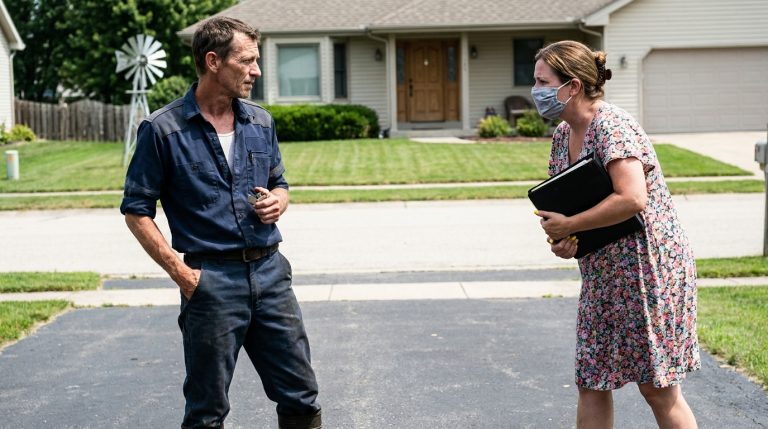
The woman stopped, letting go of the silk as if my voice had burned her fingers. She turned, shielding her eyes against the low July glare, and looked me up and down with the kind of practiced disdain usually reserved for bad wine or a dirty bumper. She had a silver clipboard tucked under her arm like a shield, her hair pulled back into a knot so tight it looked like it hurt to blink.
“Are you the groundskeeper?” she asked, her voice carrying the flat, nasal clip of someone who had never worked a day beneath an open sky. “Because we need these animals cleared out of the meditation perimeter. The sound of their breathing is disrupting the mindfulness circle.”
My fingers tightened around the ceramic handle of my mug. Down in southern Georgia, folks don’t usually walk onto a man’s private acreage without a wave at the mailbox or a holler from the cattle guard. They certainly don’t ask you to move your livestock out of the way of a gluten-free doughnut stand.
I walked down the steps, my boots crunching on the dry gravel of the drive. The screen door banged shut behind me with a hollow, familiar rattle.
“Ma’am,” I said, keeping my tone level, though my jaw felt like it had been chiseled out of granite. “This ain’t a public park. This is my property. You’ve climbed a barbed-wire fence to get in here, and you’ve set up camp right over my winter feed.”
She gave a small, airy laugh—the kind that sounds like dry leaves scraping across concrete—and tapped her clipboard. “The land was vacant. There are no active structures here. Under the regional right-to-reconnect statutes, spaces that remain uncultivated for public wellness are subject to community-access buffering. We’ve filed the intent with the county board.”
My brain stalled out for three full seconds. Not because what she said made sense, but because the sheer, unadulterated weight of her nonsense was heavy enough to bend iron.
“County board,” I muttered, looking past her toward a man in a pristine golf visor who was currently hanging lavender sachets from my antique wagon wheels. “Lady, the only board that matters out here is the one my granddad nailed to this porch, and it don’t say a word about yoga.”
She stepped closer, pointing the tip of her silver pen right at my chest. “You can adopt a hostile tone all you like, but the festival is locked in for seventy-two hours. Try to interfere, and you’ll find out very quickly how the modern legal system treats rural obstructionists.”
She turned on her heel, her linen trousers swishing against the dry grass, and walked back toward the stage without waiting for an answer. I stood there in the dust, watching the early morning sun catch the silver clasp of her clipboard. It wasn’t just the trespass that set my teeth on edge; it was the way she looked at the dirt beneath her feet—not as something lived in, worked, and bled over, but as a blank canvas waiting for her signature.
As I turned back toward the house to find my phone, my boot caught on something half-buried in the red clay near the bottom step—a bright orange surveyor’s stake, freshly driven, stamped with a permit number I didn’t recognize.
CHAPTER 2: THE FIRST LINE AND THE WARNING SHOT
The orange plastic of the stake stood out against the gray-brown dirt like a fresh bruise. I nudged it with the toe of my work boot, feeling the slight give where someone had pounded it deep into the drought-baked earth under the cover of night or midday distraction. It hadn’t been there when I cleared the irrigation valve on Tuesday. That meant someone—probably the man in the golf visor with the lavender sachets—had been trespassing with a mallet while I was busy turning cows out to the north pasture.
I bent down, my knees popping with the dry, complaining creak of a man who spent forty years bending over tractor engines and calving stalls, and pulled the stake straight up out of the clay. It came with a wet sucking sound, damp underneath despite the week-long dry spell. Somebody had watered it to make the ground hold.
” Hank!”
The voice came floating down from the ridge where my old equipment shed sat rusting beside the cedar break. I looked up. Earl was leaning against the fender of his dented blue Ford pickup, holding a pair of heavy-duty wire cutters in one hand and a thermos of black coffee in the other. He didn’t look like a man who was worried about yoga instructors; he looked like a man who had seen every brand of foolishness southern Georgia could breed and was waiting to see which one would break first.
I walked up the incline, holding the orange plastic stake like a javelin.
“Found another one,” I said, tossing it into the truck bed where it clattered against a pile of rusted fencing wire and a half-empty bucket of galvanized bolts.
Earl unscrewed the cap of his thermos, took a cautious sip, and squinted down at the pastel tents sparkling in the morning heat. The yoga class had moved on to some kind of breathing exercise where they all made the sound of a deflating tire in unison.
“They’re setting up a second stage down by the creek bed,” Earl said, his voice flat as a washboard. “Heard that woman—Trish—talking to a fellow with a video camera about a ‘sacred water feature initiative.’ Said your creek is part of a regional watershed restoration project.”
“That creek,” I said, wiping my palms on my jeans, “was dug by hand with a mule and a slip-scraper by my great-uncle back in nineteen-forty-two so the livestock wouldn’t die of thirst in August. It ain’t a watershed restoration project. It’s a drainage ditch with ambition.”
“Well, ambition’s loud today,” Earl noted, spitting a stray piece of tobacco into the dust. “You talk to the sheriff yet?”
“Sheriff’s got his hands full with the county commissioners trying to figure out why the tax assessors’ office has three different digital maps of this township and none of them match the paper deeds from the courthouse basement.” I leaned against the warm metal of Earl’s truck door, letting the smell of old oil and sun-baked rubber settle my nerves. “Claude’s digging through the old books. Says there’s something funny about how the property lines were redrawn back when the state put in that power easement twenty years back.”
Earl nodded slowly, his eyes narrowing as he watched a woman in an oversized straw hat carry an armload of bamboo mats across my pasture. “Funny how things get redrawn when city folks decide they want a view without paying the mortgage on it. You remember your granddad always said a fence ain’t just wood and wire, Hank. It’s a conversation between neighbors. Problem is, these folks don’t speak the language. They think silence means you agree.”
“They’re going to find out what silence means around here pretty soon,” I muttered.
The morning sun climbed higher, baking the red clay until the surface turned white and cracked like old porcelain. I didn’t go back to the house right away. Instead, I walked the perimeter line, checking every post, every strand of barbed wire, and every inch of cedar post my daddy had set in place with creosote and stubborn pride. Every fifty yards, I found another one of those bright orange plastic markers driven flush with the ground, each one biting twelve inches deeper into my property than any legal map had ever allowed since the county was surveyed.
It wasn’t just a prank. It was a systematic nibbling, an inch here, ten feet there, done by someone with a tape measure and a clipboard who figured a working farmer wouldn’t notice the difference between an acre of alfalfa and an acre of nothing.
By noon, the heat was shimmering off the metal roofs of the barn. I went back inside, washed the red dust from my face with cold well water, and sat at the kitchen table with a legal pad Claude had given me three weeks ago when the first rumblings of the county land-use committee started making noise. I started listing every gate, every fence post, and every formal notice I’d filed since Trish and her crew dropped out of the sky like a plague of expensive locusts.
My phone buzzed against the formica table. It was an unknown number, local area code.
I let it ring three times before I swiped the screen.
“Hank?” a sharp, corporate-sounding voice asked without a hello. It wasn’t Trish; it was a man, smooth-talking and thin, like oil on water. “Mr. Henry Miller? My name is Marcus Vance. I’m representing the Harmony Homestead Collective. We’d like to discuss a voluntary buyout of your southern buffer zone to streamline our festival footprint.”
The kitchen was dead silent except for the low hum of the refrigerator motor. Through the window, I could see old Bessie sitting quietly behind the equipment shed, her heavy steel tank catching the glare of the noon sun like a dark, patient eye.
“Mr. Vance,” I said, keeping my voice low and steady. “You got thirty seconds to tell me who signed your paycheck before I hang this phone up and let the cows back into the main lane.”
There was a brief pause on the line—just long enough for a man to realize he wasn’t talking to a caretaker who could be bullied with a clipboard.
“We’re only looking at legal options, Mr. Miller,” Vance said, his smooth tone slipping just a fraction into iron. “And the county has a great deal of interest in uncultivated acreage.”
“Then tell the county,” I said, “to bring a shovel.”
I cut the connection, dropped the phone onto the table, and walked out the back door. The sun was burning down through the pecan trees, hot and unyielding, and somewhere down in the lower pasture, a goat was bleating at the sky.
CHAPTER 3: OLDE BESSIE WAKES IN THE DARK
The sun dropped fast behind the western tree line, bleeding a dull, bruised purple across the Georgia sky. Down in the lower pasture, the tiki torches of the Harmony Homestead Collective flickered to life like cheap fireflies trying to mimic a proper hearth. Through the heavy, humid air came the rhythmic, hollow thud of hand drums and the faint, airy warbling of someone trying to find their inner chakra while standing on three thousand dollars’ worth of stolen dirt.
I stood in the shadow of the equipment shed, running a rough, calloused palm over Bessie’s rusted side panels. She wasn’t a pretty machine. Her paint had flaked off in jagged scabs back during the Clinton administration, and her discharge valve leaked a slow, stubborn drip of black grease that had stained the concrete floor a permanent midnight. But she was heavy, she was loud, and she held sixteen hundred gallons of the richest, ripest, most unholy blend of fermented cow slurry and organic runoff this side of the Savannah River.
“Looking good, old girl,” a voice muttered from the gloom.
Earl stepped out from behind the hay rake, holding a pair of heavy-duty safety goggles in one hand and a flashlight gripped between his teeth like a pirate’s knife. He pulled the flashlight out with a wet click. “Just checked the lower fence line. They pulled up another two orange stakes near the creek. They’re moving inward, Hank. If we don’t give ’em a proper welcoming ceremony tonight, they’ll have an amphitheater poured by Friday.”
I unscrewed the inspection hatch on top of Bessie’s tank. The smell hit us instantly—thick, hot, and biting enough to peel the paint off a tractor. It smelled like pure, concentrated consequence.
“Vance called me around noon,” I said, my voice barely carrying over the distant murmur of the drum circle. “Talked about county zoning, municipal interest, and a voluntary buyout of the buffer zone.”
Earl stopped, his hand hovering over the valve lever. He spat a stream of dark tobacco juice into the dirt, missing my boot by an inch. “Corporate sharks. They figure if they squeeze the edges long enough, a working farmer gets tired of paying lawyers and just signs the deed over for pennies on the dollar. Same playbook they ran down in Coffee County three years back.”
“Except they picked the wrong pasture,” I said.
I climbed up onto the steel chassis, my boots finding purchase on the diamond-plate cat-walk that ran alongside the tank. The metal groaned under my weight, a deep, familiar sound of strained iron. Earl scrambled up behind me, tossing the goggles onto the platform.
“According to that laminated schedule Trish dropped by the wellhead,” Earl grinned, his teeth flashing white in the gathering dark, “their Silent Drum Circle meditation is scheduled for eleven-forty-five p.m. Right in the middle of your alfalfa patch.”
“Then let’s not keep them waiting,” I said.
I fired up the old diesel engine in the bay. The starter ground its teeth twice before the engine caught with a concussive cough that shook the corrugated tin roof of the shed. Blue smoke billowed out of the exhaust pipe, smelling of unburnt fuel and thirty years of hard labor. I threw her into low gear, pulled the hand brake with a sharp snap, and eased the clutch out. Bessie rolled forward out of the shadows, her heavy tires crunching over the gravel driveway like an iron landslide.
We kept the lights off, hugging the dark line of the pecan orchard where the overhanging branches scraped against the cab roof with a dry, scratching rhythm. The pasture ahead glowed under the amber haze of tiki torches and battery-powered lanterns. Through the windshield, I could see the pastel tents swaying slightly in the night breeze, surrounded by dozens of yoga mats arranged in a neat, geometric circle.
Trish stood near the center on a raised wooden crate, her arms outstretched toward the dark sky, her voice carrying over a portable Bluetooth speaker. “…and as we absorb the primordial frequency of the earth, we release the heavy, unevolved energies of those who seek to hoard creation…”
Earl leaned out the passenger window, his grin stretching from ear to ear. “Sounds like she’s talking about us, Hank.”
“She’s about to get a firsthand lesson in earth energy,” I said.
I swung Bessie wide, bringing her out of the tree line and directly up the gentle slope behind the meditation circle. The engine hummed low and heavy, a steady vibration that shook the steering wheel in my hands. The crowd didn’t notice us at first; they were too busy humming in unison, their eyes closed, breathing in the scent of burning sage and imported incense.
We rolled to a halt fifty yards out, right at the edge of the flattened alfalfa.
“Valve’s ready,” Earl whispered, checking the heavy brass lever at the rear.
“Open her up slow,” I said, keeping my foot light on the brake. “Let ’em feel the atmosphere first.”
Earl threw the lever. With a wet, concussive hiss that tore through the night air like a ruptured steam line, the first heavy arc of dark, fermented slurry launched from the rear pipe. It climbed high into the humid Georgia night, caught the amber glow of the tiki torches, and descended across those pastel canvas tents with the merciless, unyielding weight of divine geometry.
CHAPTER 4: THE LEGAL INJUNCTION AND THE HIDDEN SURVEY
The waiting room of the county courthouse smelled of stale floor wax, damp newsprint, and the particular brand of defeat that only poor plumbing and small-town bureaucracy could manufacture. Claude’s office was down the hall, but we were sitting on the wooden bench right outside Judge Holloway’s chambers, waiting for the clerk to stamp a stack of papers that looked thick enough to stop a .45 slug.
Claude sat beside me, wearing a seersucker suit that had survived thirty summers of humid Georgia courtrooms and a pair of spectacles held together at the bridge with black electrical tape. He didn’t look up from the certified mail envelope sitting open in his lap.
“She didn’t just file a complaint, Hank,” Claude muttered, tapping a corner of the official letterhead with a tobacco-stained thumbnail. “She went broad. Injunction for chemical contamination, emergency stop-work order on your own pasture, and a formal petition for municipal annexation of the buffer strip under an emergency ecological restoration clause.”
I rubbed the back of my neck, feeling the grit of red clay still embedded in my skin from the night before. “Ecological restoration? We spread cow manure on a cow pasture. That’s not an emergency; that’s Tuesday.”
“Try telling that to a municipal judge who spent his morning listening to an attorney from Atlanta talk about soil acidity and holistic watershed preservation,” Claude said dryly. He pulled out a folded, yellowing document from his inner pocket—a fragile, onion-skin map with cracked edges and faded blue ink lines. “Which is why we aren’t arguing about the manure. We’re arguing about where the patio sits.”
He unfolded the map across his knees. It was an original survey from November 1981, signed by a surveyor named Henderson who had passed away twenty years back. I leaned in, smelling the dry, paper-moth odor of old archives.
“Look right here,” Claude said, pressing his index finger against a faint boundary grid near the western corner of my property line. “When they paved the secondary county road back in the eighties, they shifted the right-of-way ten feet east. Everyone assumed the property lines shifted with it. But your granddad never signed the easement release. He kept the paper copy in the tobacco tin.”
I traced the faded ink line with my thumb. The coordinates didn’t match the digital maps Trish’s consultants had pulled off the county website. In fact, they showed that the concrete patio, the wine fridge enclosure, and half of the decorative stone walkway belonging to Trish’s vacation cottage sat a full thirty feet onto my side of the real fence line.
“Thirty feet,” I murmured.
“Thirty feet of prime agricultural frontage,” Claude corrected, a slow, grim smile cracking the corners of his mouth. “And because it was never legally deeded over to the county or the previous residential lot owners, it’s still part of the original Miller patent.”
Before I could answer, the heavy oak door to the clerk’s office swung open. A young clerk with tired eyes and a stack of manila folders stepped out, calling my name.
We didn’t wait for Trish or her smooth-talking lawyer, Marcus Vance. We walked straight into the back office, filed the counter-claim, and attached the 1981 survey with a heavy steel staple that felt satisfyingly permanent. As we walked back out past the courthouse steps, I saw Trish standing near her imported hybrid SUV, talking animatedly into a phone while clutching a fresh copy of her injunction like it was a sword.
She caught sight of me through the humid glare of the parking lot. Her eyes narrowed into hard little slits, and she dropped her phone to her side, stepping forward with that familiar, tight-lipped fury.
“You think a few down-home legal tricks are going to stop a regional wellness initiative, Mr. Miller?” she called out across the gravel, her voice sharp enough to cut glass. “We have the county environmental commission reviewing your drainage logs as we speak. That tank of yours is going to cost you every acre you own.”
I didn’t yell back. I didn’t even slow down. I just reached into my pocket, pulled out a small, bright orange survey stake I’d pulled out of my creek bed that morning, and tossed it into the back of Claude’s truck before climbing into the cab.
“See you in court, Ms. Trish,” I muttered through the open window as Claude put the truck in reverse. “Bring your walking shoes.”
CHAPTER 5: GOAT HOOVES ON THE PATIO STONES
The dust hadn’t even settled on the driveway by the time I pulled up to the north gate. Earl was already waiting by the cattle guard, leaning against his weathered fence post with a clipboard of his own—though his wasn’t filled with legal jargon, just a handwritten list of feed schedules and local contacts.
“Got a call from the goat rental folks down in Vidalia,” Earl said as I stepped out of the truck, the heat of the afternoon radiating off the hood. “They were looking for an outdoor space with good perimeter fencing and some natural stone character for a weekend yoga session. I told ’em we had a nice patch of disputed territory right over the property line where a certain stone patio was currently sitting uncomfortably on Miller dirt.”
I felt the tight corners of my mouth pull upward into a dry, humorless grin. “The patio?”
“The very same,” Earl said, spitting a piece of straw into the dirt. “They brought twenty head of dairy goats and four instructors in matching lavender tank tops about an hour ago. Right now, they’re doing downward dog directly over Trish’s wine fridge.”
We walked down past the equipment shed, heading toward the western boundary where the old 1981 survey stakes had rewritten the rules of the neighborhood. The scene that met us was nothing short of a masterpiece in pragmatic retaliation. Trish’s pristine, imported stone patio—complete with its built-in gas grill, decorative windchimes, and wrought-iron furniture—was currently serving as an open-air pen for a herd of energetic, horned Nigerian Dwarf goats.
The animals were having the time of their lives. Two of them were clambering over the hood of a sleek electric golf cart parked near the patio edge, while a handful of cheerful women in stretch leggings held yoga poses on colorful mats, completely unbothered by the sharp click of hooves on flagstone and the rich, earthy scent of livestock. One sweet-faced instructor was calmly guiding a participant through a spinal twist while a small white goat nibbled inquisitively at the fringe of Trish’s decorative outdoor rug.
From the other side of the newly erected temporary wire fence, Trish was losing her mind.
She stood on her actual lawn, wrapped in a linen shawl that looked like it had cost more than my first tractor, her face flushed red beneath an oversized sun hat. She was screaming into a portable megaphone, her words lost partly to the wind and partly to the general bleating of the herd.
“This is an outrage!” her amplified voice squawked across the pasture, bouncing off the barn wall. “You cannot bring livestock onto a designated wellness easement! I am calling code enforcement! I am calling the state attorney general!”
The goat yoga instructor—a young woman named Cassie with a braided ponytail and a smile like a sunrise—stood up calmly from her mat, brushed a speck of dirt off her knee, and walked over to the wire fence.
“Good afternoon, ma’am,” Cassie said, her voice dripping with the kind of polite, relentless southern sweetness that cuts deeper than a razor. “Are you looking to join the session? We do have an opening for core strengthening, though we do ask that participants leave megaphones outside the pen. They tend to startle the kids.”
Trish lowered the megaphone, her chest heaving as she glared across the wire. “That patio is private property! Those stones belong to the association!”
“Well,” I chimed in, walking up slowly beside Earl and resting my forearms on top of the fence post, “according to the county surveyor and a certified map from nineteen-eighty-one, those stones are currently sitting thirty feet deep inside my tractor lane. So unless your patio has wheels, I’d say it’s doing a fine job of helping me graze my livestock.”
Trish whipped her head around, her eyes locking onto mine with a look of pure, unadulterated venom. “You planned this. You and your backwoods lawyers conspired to alter county records!”
“Records were there all along, Ms. Trish,” I said quietly, keeping my voice level as the wind rustled through the pecan trees. “You just didn’t bother checking them before you built your wine fridge on a man’s livelihood. You figured a farmer wouldn’t look twice at a clipboard. You figured wrong.”
Before she could scream another syllable, a low rumble of an engine caught our attention down the road. A county sheriff’s cruiser rolled slowly past the gate, slowing down just enough for the deputy inside to look over the scene—the goats, the yoga mats, the furious woman with the megaphone, and the bright orange boundary stakes marking the true line. The deputy gave a slow, approving nod, tipped the brim of his hat toward me, and kept driving.
Trish stood there for a long moment, her mouth opening and closing like a fish out of water, before she turned sharply on her heel and stormed back toward her cottage, the screen door slamming behind her with a satisfying, hollow echo.
Earl watched her go, shaking his head. “Well, Hank. I’d say the atmosphere out here is finally starting to clear.”
“It’s clear enough,” I said, looking out over the quiet pastures as the sun began its slow descent toward the horizon, casting long, clean shadows across the red clay. “Now let’s go make sure those goats don’t chew the wiring on my tractor.”
CHAPTER 6: THE DUSTY VERDICT AND THE QUIET HORIZON
The courtroom air on the final day of hearings smelled faintly of floor polish and the dry, paper-moth weight of closed files. Judge Holloway didn’t waste time with opening statements. He sat behind his heavy oak bench, spectacles perched low on his nose, looking down over a thick stack of certified documents that included the 1981 Henderson survey, county tax maps, and a freshly unsealed financial disclosure Claude had subpoenaed seventy-two hours prior.
Trish sat at the defense table, flanked by Marcus Vance. Her posture was rigid, her linen blazer immaculate, but the small twitch in her jaw betrayed the frantic collapse of her position. Vance was whispering urgently into her ear, flipping through pages of shell-company corporate registries that tied the “Harmony Homestead Collective” directly to a commercial real estate development group out of Savannah.
“Mr. Miller,” Judge Holloway said, his voice dry and steady as a well-bucket chain. “Your counsel has submitted records indicating that the operational entity behind this wellness festival is not a registered cultural cooperative at all, but a corporate shell aimed at acquiring agricultural buffer zones through municipal zoning manipulation and tax-default loopholes.”
“Yes, Your Honor,” Claude said, standing up and buttoning his seersucker jacket. “We have established that the defendants deliberately drove survey markers twelve inches inside my client’s property line, manufactured false environmental citations, and attempted to seize thirty feet of working farmland to inflate the commercial valuation of adjacent residential lots.”
Trish stood up abruptly, her chair scraping sharply against the linoleum floor. “That is a distortion! We were revitalizing uncultivated land for community benefit! The property owner was hoarding resources!”
“Sit down, Ms. Vance—or whatever corporate entity you happen to be representing this afternoon,” Judge Holloway said, his tone dropping an octave until the courtroom fell entirely silent. He tapped a heavy wooden gavel once, the sound flat and final. “You trespassed on private agricultural land, harassed a working farmer, and attempted to weaponize local ordinances using fraudulent boundary claims. The injunction for chemical nuisance is dismissed with prejudice. Furthermore, the property counter-claim filed by Mr. Miller regarding the western boundary and patio encroachment is granted in full. You have fourteen days to remove your structures from his land, or they become the legal property of the estate.”
The silence that followed was heavy, broken only by the hum of the overhead fluorescent lights. Trish didn’t shout. She didn’t drop her clipboard. She simply stood there for a long, shaky second, blinked against the reality of the room, and sat back down slowly, the wind entirely gone out of her sails.
Two hours later, the sun was casting long shadows across the Georgia pines as I drove my truck back down the gravel lane toward the farm.
The pasture was quiet. The goats were back in their proper enclosure, munching on coastal Bermuda grass with steady, mindless contentment. Old Bessie sat parked near the equipment shed, her rusted steel tank catching the last glint of golden evening light like a retired war horse resting after a long campaign.
I parked near the porch, turned off the engine, and stepped out into the dry evening air. My boots crunched on the gravel—the same gravel my granddad had laid down by hand fifty years ago.
Earl was waiting by the front steps, holding a hammer and a wooden post. He tossed me a fresh roll of galvanized wire.
“Heard the news,” Earl said, a slow, easy grin spreading across his face. “They’re already packing up the canvas tents. Saw a moving van parked out by Trish’s cottage about twenty minutes ago. No speech, no committees, just a couple of guys loading up folding tables and scented candles.”
“Good,” I said, catching the wire and feeling its cold, solid weight in my hands.
I walked over to the spot near the south corner where the fence had been knocked down weeks ago. Kneeling in the red clay, I took my hammer and began driving a new cedar post deep into the earth, striking it rhythmically until it stood firm, plumb, and unyielding against the horizon.
There was no grand triumph, no movie-style fanfare. Just the steady rhythm of iron hitting wood, the smell of dry earth, and the quiet knowledge that some lines shouldn’t be crossed. When I finished, I ran a fresh strand of barbed wire across the posts, pulling it tight until it sang in the evening wind. The farm was back to what it had always been—quiet, stubborn, and entirely our own.