The Weight of a Sinking Shoreline: A Patient Reckoning Beneath the Cold Glass of Binoculars
CHAPTER 1: THE IRON VALVE
The morning air smelled of wet shale and rusted iron. It was six o’clock, the hour when the frost still clung to the cedar shingles of the porch like ground glass. I didn’t rush. Haste belonged to people who built things on land they didn’t own; patience belonged to the man who held the key to the drain.
My fingers found the cold grooves of the brass valve without looking. Two years of planning, of quiet letters filed away in a banker’s box, of listening to the Ridge Rest HOA talk about community enrichment over local radio frequencies—all of it came down to the torque of my wrist.
At precisely six-and-seven minutes, I turned it.
It didn’t groan. The inner seals had been greased with heavy marine tallow every Sunday for nineteen years. The water behind the concrete dam didn’t rush out in a cinematic roar; it whispered. A sleek, dark line began to form against the damp aggregate of the spillway—a millimeter at first, then a centimeter. The level at Harrow Lake was dropping. Not enough for anyone in town to notice yet, not while the dew was still heavy on the lawns three miles down the valley, but enough to set the gears in motion.
I lifted the heavy Japanese binoculars, resting the textured rubber eyepieces against my brow. The magnification brought Vivian Marsh’s staging ground into sharp, blinding focus. Even from this distance, through the gray haze of the pine ridge, I could see the skeletal framework of the grand opening pavilion. White nylon tent canvas whipped against aluminum poles. Red, white, and blue ribbons fluttered in the early draft coming off the water.
They had spent three hundred and forty thousand dollars on that park. They had poured concrete boat ramps over private silt. They had taken out county grants with my shoreline registered as public collateral, all because a photocopied paragraph from a nineteen-ninety-one easement gave them the right to walk the bank with a fishing rod.
They thought a walking stick was a deed. They thought a public relations campaign was a title scroll.
Down at the water’s edge through the glass, a solitary mallard paddled across the glassy reflection of the banner that read Harrow Lake Community Park: Open For All. It looked permanent. It looked official. It looked like something built by people who believed the world existed entirely to applaud their generosity.
My thumb rubbed the knurled edge of the focusing ring. The magnification clicked, sharpening the image until I could see the individual staples holding the canvas to the wooden uprights. Four hours until Vivian cut the ribbon. Four hours until the cameras arrived from the regional affiliate.
I lowered the binoculars and let them hang against my chest by the woven strap. The metal was freezing against my shirt.
Inside the kitchen, the wall clock ticked with a flat, dry rhythm. Leonard K’s voice from two winters ago drifted back into the room, calm and clipped over a scratchy landline connection: Let her build, Arthur. Let her pour the concrete. Let her invite the commissioners. A tree doesn’t fall until the termites finish the core, and right now, she’s chewing right through the middle of your property line.
I turned away from the window, but the image stayed behind my eyelids—sharp, clean, and entirely inevitable.
The front door was bolted, but through the mail slot, a pale sliver of morning light cut across the floorboards. I walked over to the hallway table and picked up the heavy manila envelope resting beside the brass key dish. Inside was the final draft of the forty-seven-page injunction, stamped, signed, and waiting for a man named Miller who liked to arrive precisely at ten-thirty-one.
As I set the envelope back down, the floorboards gave a faint, familiar creak under my boots. Something outside caught the corner of my eye through the side window—a sudden, unnatural flicker of movement down by the distant boat launch.
CHAPTER 2: THE RIBBON IN THE MIST
The shadow down by the boat launch wasn’t a deer, and it wasn’t a stray dog.
Through the coated rubber cups of the binoculars, the movement resolved into a flash of high-visibility yellow—a county work vest moving with the hurried, nervous energy of men who knew the governor’s office was scheduled for an eleven-o’clock flyby. They were frantically adjusting the tension on a velvet rope stretched across the newly paved asphalt apron.
I lowered the glass an inch, letting the cold morning damp hit my eyes. The silence in the kitchen was broken only by the refrigerator’s compressor clicking on with a heavy, rhythmic shudder.
Nineteen years of records sat in three green metal filing cabinets against the back wall. Every inch of that shoreline was mapped out in India ink on yellowed linen paper. Leonard K had told me over black coffee in a booth at the diner that summer, “Arthur, they aren’t stealing your land with guns. They’re doing it with clipboards. That makes it clean for the papers. You keep it just as clean with the math.”
I didn’t need to shout from the porch. I didn’t need to walk down there with a shotgun or a sign. The mathematics of the valley were absolute.
I stepped away from the window, my boots striking the fir flooring with a dry, deliberate cadence. The manila envelope containing the forty-seven-page complaint rested on the oak table like a loaded scale. Miller would be pulling his blue sedan onto the gravel county road in twenty minutes. He was a retired bailiff who didn’t talk much, except to ask if the papers needed to be served in person or left with a signature.
Outside, the first faint notes of a brass band drifted across the open water, muffled by the wall of pine trees. They were tuning their instruments. Vivian Marsh would already be standing beneath the nylon pavilion, smoothing the lapels of her cream-colored blazer, checking her watch, and smiling for the local photographer who had set up his tripod on the freshly laid sod.
She had spent six months talking about “reclaiming the public trust.” Every press release was a monument to her own reflection.
I walked to the sideboard, pulled open the small drawer where I kept the spare keys to the old tractor shed, and my fingers brushed against something cold and metallic—a small, notched brass peg. The auxiliary lock for the lower spillway gate. A redundant safeguard I’d installed back when the county first tried to survey the ridge line in ninety-eight.
A memory flickered—the smell of hot engine oil and my father’s voice telling me that a man who doesn’t secure his own boundaries is just renting space from his neighbors. The thought vanished as quickly as it came, leaving behind the sharp, astringent taste of black coffee from three hours ago.
The band music swelled, a jagged, discordant march floating over the glassy surface of the cove.
I checked my pocket watch. 9:14 a.m.
The water level at the intake pipe had dropped another four inches since I turned the primary valve at dawn. By now, the subterranean clay shelf beneath the new concrete boat launch was beginning to lose its hydrostatic pressure. Concrete poured over dry mud looks solid enough when the basin is full, but physics doesn’t care about ribbon-cutting ceremonies or county grants. When the water pulls back, the weight of the slab remains, but the earth beneath it turns to lard.
I picked up my coat from the peg by the door—heavy wool, stiff with salt and weather-proofing—and slid my arms into the sleeves. The fabric was cold against my wrists.
The front gate clicked.
It wasn’t Miller yet. The sound was too light, too hesitant. Through the narrow sidelight of the front door, a flash of red nylon caught my eye. A local kid on a bicycle, tossing a rolled-up bundle of the morning gazettes onto the gravel driveway. The headlines on the front page would be full of Vivian’s smiling face, her hands outstretched toward the water, promising a new era of lakeside leisure for a town that hadn’t owned a foot of that bank since the territory was surveyed.
Let them print it. Every extra copy added weight to the bundle they’d have to carry back down the hill when the mud started to slide.
I reached out, my fingers curling around the brass knob of the front door, and waited for the steady crunch of tires that meant the process server was finally turning onto the lane.
CHAPTER 3: THE SINKING OF THE RAMP
The gravel driveway remained stubbornly quiet for three minutes after the bicycle tire tracks vanished down the shoulder of the lane.
I let go of the brass knob, my hand retaining the chill of the metal for a long beat before I turned back toward the window. Down in the valley basin, the wind picked up a fraction, carrying the faint, tinny echo of a public address system testing its frequencies. Vivian Marsh’s voice, flattened by distance and electronic feedback, bounced off the opposing ridge: …welcome to the new jewel of our community…
Through the glass, the festive colors of the grand opening looked garish against the desaturated gray of the November timberline. Rows of folding chairs were filling up rapidly now. I could see the distinct shapes of county commissioners in dark windbreakers, their hands tucked into their pockets against the damp air coming off the water, nodding as Vivian gestured toward the newly poured concrete boat launch.
The launch was the centerpiece of her $340,000 budget allocation. It stretched twenty feet out into what used to be a stable six-foot shelf of submerged clay.
What Vivian didn’t understand, and what the county planning board had neglected to check when they signed off on the municipal grant application, was that concrete poured over silt without pilings is only as honest as the water holding it up.
At 10:14 a.m., the physics of the valley began to answer her speech.
A woman standing near the front row of the assembly—someone in a bright red coat—suddenly stopped clapping. She took half a step backward, her heels sinking an inch into what should have been saturated shoreline turf, but instead kicked up a cloud of dry, pale dust. She looked down at her shoes, then out across the surface of the lake.
Even from three miles away, through the sharp lenses of the binoculars, the line of retreat was unmistakable.
The water didn’t crash or drain with a whirlpool’s roar; it simply peeled back from the banks like skin pulling away from a healed wound. An eighteen-inch band of exposed, glistening lakebed emerged in a matter of seconds, slick with dark silt and tangled roots that had spent two decades underwater. The picnic tables near the water line didn’t slide—they settled with a dull, sickening thud as the mud beneath their legs lost its hydrostatic support.
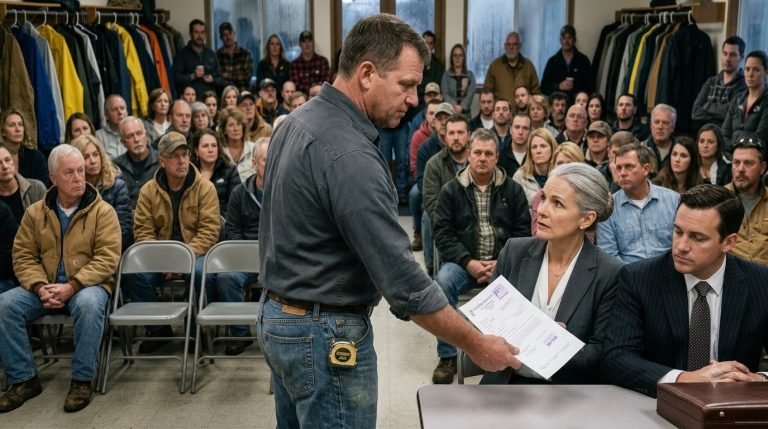
The applause died out in ragged, staggered increments. First one family stopped, then a cluster of children near the refreshments table, until the entire crowd of three hundred and fourteen people stood in an uneasy, bewildered silence.
I didn’t smile. Satisfaction of that sort belonged to amateurs who needed an audience to validate their work. I simply adjusted the focus ring, watching the color drain from Vivian’s face as she turned away from the microphone to stare at the receding shoreline.
She walked toward the edge of the new concrete ramp, her heels clicking sharply against the aggregate. Then she stopped dead.
The outer edge of the launch—the very section engineered to sit flush with the summer water level—was now hanging suspended over a foot of empty, dry air as the basin floor retreated beneath it. The slab was cracking down the center, a hairline fracture branching like a lightning bolt from the water’s edge back toward the turf.
My phone remained silent on the oak sideboard. It wouldn’t ring until Miller reached the perimeter gate with the forty-seven-page complaint.
I turned away from the window, walked back to the kitchen counter, and picked up a clean linen cloth to wipe down the surface where the manila envelope rested. Every gear was meshing precisely where Leonard K had said it would. The public relations machine had built the stage, the county had written the checks, and the water was doing the unyielding work of telling the truth.
A sharp rapping sound echoed from the front porch. Two short strikes, followed by the heavy, deliberate weight of boots shifting on the cedar planks.
Miller had arrived right on schedule.
CHAPTER 4: THE FORTYSEVEN PAGES
The two sharp raps on the cedar boards didn’t demand an answer; they simply announced an inevitability.
I left the kitchen counter, my boots making a dry, rhythmic sound against the fir flooring as I crossed the narrow hallway. The air inside the house smelled faintly of old paper and the iron tang of the woodstove. When my fingers wrapped around the brass latch and pulled the door inward, the morning light cut a sharp, pale wedge across the threshold.
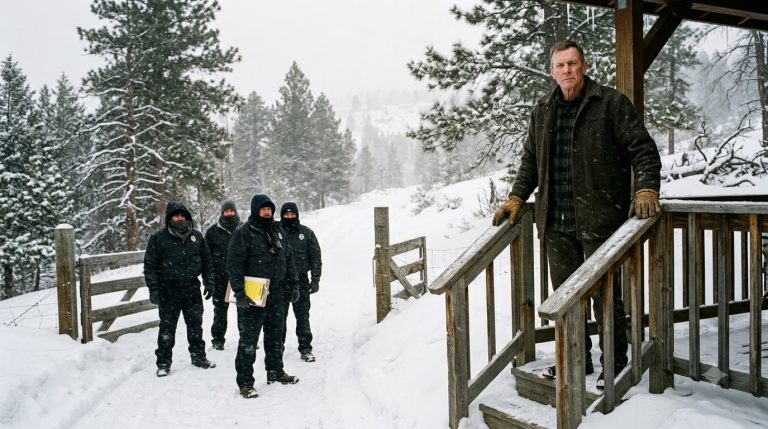
Miller stood on the porch. He didn’t smile, and he didn’t offer a morning greeting. Retired bailiffs didn’t waste breath on pleasantries when a delivery was timed to the minute. He wore a canvas jacket faded by salt air, and under his arm, tucked securely against his ribs like a ledger, was the heavy manila envelope containing the forty-seven-page complaint.
“Ten-thirty-one,” Miller said, his voice flat and gravelly. He tilted his chin toward the valley below, where the faint, confused murmur of three hundred people could still be heard drifting up through the pine tops. “Timing’s tight down there. The news crews are setting up their tripods by the parking lot.”
“They’re early,” I said, stepping back to let the threshold clear.
Miller didn’t cross into the house. He simply reached into his canvas jacket, pulled out a smaller, duplicate sheaf of yellowed manifold paper, and held it out for my signature. His fingers were thick, scarred at the knuckles from decades of serving papers to men who thought their property lines extended further than the law allowed.
” Leonard called from town ten minutes ago,” Miller muttered, pressing a wooden ballpoint pen into my palm. The plastic was cold. “He said the county commissioner tried to reach the road department, but the mobile relay towers down by the basin are jammed with people trying to upload video of the receding waterline. The whole project is sitting on dry dirt right now.”
I signed my initials beside the red verification stamp, the ballpoint scratching sharply against the paper. “They thought a walking path gave them dominion over the basin,” I said, handing the clipboard back. “They forgot that a lakebed belongs to the man who owns the deed to the high-water mark.”
Miller tucked the manifold paper away, his eyes fixed on mine with a cold, professional understanding. “You want me to deliver the primary copy directly to her hands while she’s standing by that broken concrete ramp?”
“No,” I replied, my voice dropping an octave as I looked past him toward the distant ridge. “Not yet. Let her finish her interview with the regional affiliate. Let her explain to the cameras why the public park she spent three hundred and forty thousand dollars on is currently sinking into two feet of dead silt.”
Miller gave a slow, measured nod, turning his collar up against the mountain draft. He stepped off the porch, his boots crunching heavily into the gravel drive, and headed back down toward his idling sedan.
I closed the front door, the latch clicking home with a solid, definitive snap.
The house felt smaller now, the silence heavier. On the oak table, the remaining copies of the survey maps lay unrolled, held flat at the corners by heavy brass weights. I walked over and traced the boundary lines with the tip of my thumb, feeling the sharp crease where Leonard K had folded the master deed two years ago. Down in the valley, the cameras were rolling, and Vivian Marsh was about to find out that the ground she stood on wasn’t nearly as solid as she had told the county board.
CHAPTER 5: THE CAMERAS LENS
The sound of Miller’s sedan engine faded down the winding gravel grade, leaving behind only the low, ambient hum of the wind through the eaves.
I walked back to the oak table where the survey maps lay weighted down by brass blocks. The red ink of Leonard K’s annotations stared up from the parchment, mapping out every legal vulnerability the Ridge Rest HOA had blundered into over the past two years. They had assumed that a public ribbon-cutting ceremony and a three-hundred-and-forty-thousand-dollar budget allocation could override the physical realities of property law.
They were learning otherwise in real-time.
Outside, the afternoon shadows were beginning to stretch long and sharp across the valley floor. Through the multi-paned glass of the side window, the distant basin looked like an emptied bowl. The regional news affiliate’s satellite truck, which had arrived around noon with its telescoping mast raised high into the gray overcast sky, was now surrounded by an agitated cluster of county officials and board members.
Vivian Marsh was still down there. Through the high-powered lenses of the binoculars, I watched her standing near the fractured concrete apron of the boat launch. Her cream-colored blazer, immaculate just hours before when she cut the ceremonial ribbon, was now dusted with dry silt kicked up by the retreating waterline. She was holding a mobile phone to her ear with one hand while gesturing wildly at a local television reporter who had his microphone extended toward her face.
The regional broadcast feed, picked up on the local radio frequency in the kitchen, crackled with jagged audio fragments: …unprecedented environmental drop… questions regarding structural permits… county commissioners unavailable for comment…
By mid-afternoon, the footage had already been uploaded to regional news servers, streaming out across digital networks to thousands of viewers who saw only the embarrassing spectacle of a newly minted public park sinking into an abyss of dried mud. The public relations narrative Vivian had spent a year meticulously constructing was unraveling faster than the water was draining from the basin.
I picked up the copper poker from the hearth and gave the iron logs in the woodstove a sharp, measured jab. Sparks flew upward, dying quickly against the dark interior of the flue.
The strategy was working precisely because it required no malice on my part—only patience and an absolute adherence to the paperwork. I didn’t need to shout from the ridge or interrupt her speeches. The land and the water spoke with an authority no PR firm could spin or rewrite.
My phone buzzed against the wooden tabletop—a short, sharp vibration.
I walked over and picked it up. A text message from Leonard K: The state attorney general’s office just pulled the county grant files. They want to talk about how public funds were applied to private property without a clear title clearance. The HOA board is in full panic.
I set the phone back down face-down on the wood.
The second phase of the descent had begun. The public humiliation was complete; now came the institutional reckoning. Down in the valley, the television crew was packing their equipment into the rear of the satellite van, their lenses turning away from the ruined pavilion as the cold mountain twilight began to settle over the barren shore.
CHAPTER 6: THE RETURNING SHORE
By Sunday morning, the valley had grown preternaturally still.
The satellite truck from the regional affiliate was gone, its tire tracks frozen into the rutted mud of the empty parking lot. The festive banners bearing the words Harrow Lake Community Park had been cut down from their aluminum poles late Saturday night, leaving only ragged strips of red and blue nylon fluttering like warning flags in the cold mountain draft.
I stood on the front porch with my coffee mug cradled in both hands, feeling the dense, unyielding porcelain chill against my palms.
Down by the basin, the water level had stabilized. The lower gates of the concrete dam were locked back into their primary housings, secured by the heavy brass padlocks I hadn’t opened in years. The lake had settled into its natural boundaries—narrower than the public park designers had anticipated, contained entirely within the legal deeded lines registered under my family’s name since the territory was mapped.
A low rumble signaled the approach of a vehicle on the gravel road.
It wasn’t Miller, and it wasn’t Leonard K. A black sedan with state plates slowed to a crawl as it passed the property line, the driver’s side window rolled down an inch against the frost. Inside, a man in a charcoal overcoat glanced up toward the porch. He didn’t wave, and neither did I. He simply looked at the heavy cedar siding, the iron-bracketed chimney, and the unbroken wire of the fence line before pressing his foot down on the accelerator and continuing toward the county seat.
Vivian Marsh had resigned late Saturday afternoon without a public statement. Her criminal defense attorney had already filed paperwork requesting an extension with the state attorney general’s office, attempting to untangle how municipal grant funds had been poured into private silt without a formal title search. The Ridge Rest HOA board was currently holed up in a church basement ten miles down the valley, trying to figure out how to explain a three-hundred-and-forty-thousand-dollar deficit to homeowners who now had a mud pit instead of a boat launch.
They had built their entire ambition on the fragile assumption that public enthusiasm could override private property. They had assumed that a twenty-year-old walking easement gave them the right to rewrite the geography of the valley.
I walked back inside, closing the heavy wooden door behind me, and set the ceramic mug down on the oak table.
The unrolled survey maps still lay beneath the brass weights, their red ink lines crisp and permanent. I reached out, my fingers tracing the margin where my grandfather’s signature was stamped in faded purple ink. The ink hadn’t faded nearly enough to suit them.
From the corner of the room, on the small wooden workbench where I kept my maintenance tools, I picked up the heavy brass padlock I had removed from the secondary drain valve earlier that morning. The housing was smeared with dark marine grease and tiny grains of wet shale.
I pulled a clean flannel rag from my back pocket and began to wipe away the grime, moving my thumb in slow, methodical circles until the polished metal caught the pale sunlight cutting through the window. The scratches were deep—earned through decades of seasonal adjustments, winter freezes, and quiet vigilance.
The house was entirely silent, save for the steady, measured ticking of the wall clock in the hall. There was no need to watch the ridge anymore, no need to lift the binoculars to scan the basin. The water had done its work, exposing the weak foundations of a lie down to the bare, dry earth.
I set the gleaming lock down on the workbench, the metallic clink sharp and final in the quiet room, and walked over to the armchair by the woodstove to sit down. The fire was settling into a bed of glowing red embers, radiating a steady, dry warmth that reached all the way to the floorboards.